A critical perspective on Social Enterprise New Dawn or False Promise? Being a Devils Advocate - Critical reflection is called for in order to assess different perspectives and provide some challenge to the dominant view: Definitions
"A critical perspective on Social Enterprise New" is the property of its rightful owner. Permission is granted to
download and print the materials on this website for personal, non-commercial use only, and to display it
on your personal computer provided you do not modify the materials and that you retain all copyright
notices contained in the materials. By downloading content from our website, you accept the terms of this
agreement.
Presentation Transcript
01
A critical perspective on Social Enterprise New Dawn or False Promise?<br>
02
Being a Devils Advocate - Critical reflection is called for in order to assess different perspectives and provide some challenge to the dominant view: Definitions
History, Legal and Culture
Governance and Finance
Observations and Conclusion<br>
03
The Dominant View “ Many of the challenges social enterprise aims to resolve are the greatest challenge faced by humanity – Poverty, Climate Change, Conflict”
The saviour of public and private business
The answer to “worklessness” social isolation and inequality
Social Enterprise, and in particular its “undisputed star” microfinance has demonstrated its capacity to deliver
Social enterprises are at once looking at ways to make micro-impacts on local populations, while also working to shift entire systems of production, consumption and even government<br>
04
Definition- what is a Social Enterprise? Social Enterprise remains a very broad and often quite vague concept – referring primarily to market orientated economic activity serving a social goal
Social enterprise is an innovate response to the funding problems of non-profit organisations
The concept of Social Enterprise includes a wide spectrum of organisations from businesses engaged in social benefit activities to non-profit organisations engaged in mission trading activity.<br>
05
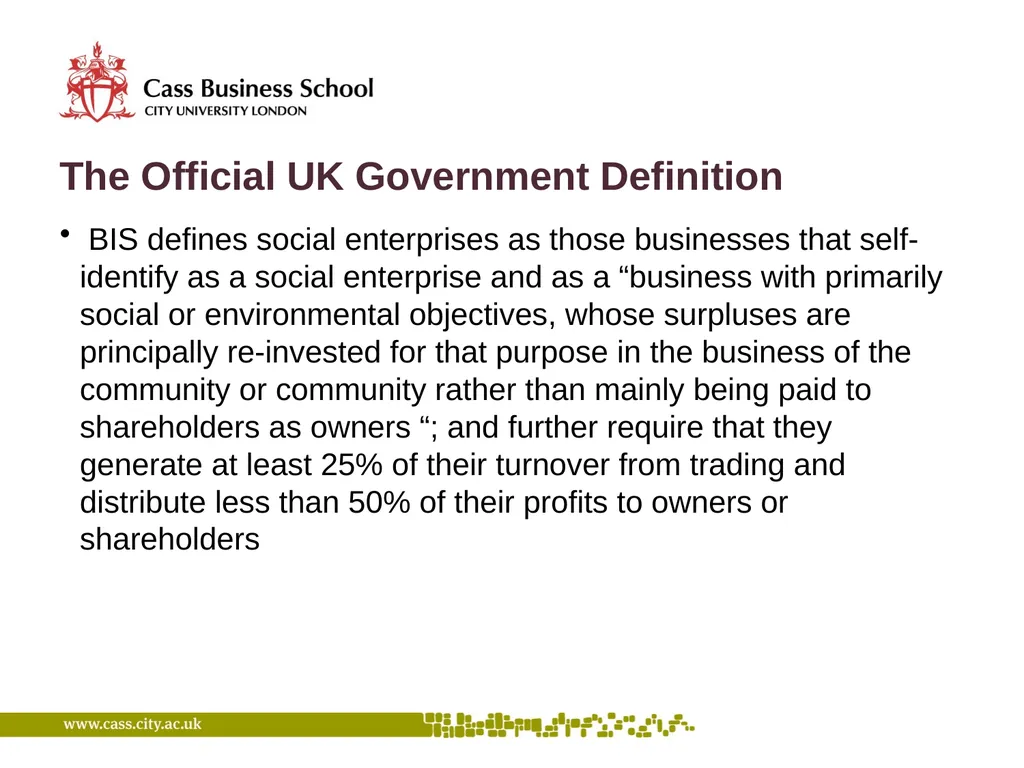
The Official UK Government Definition BIS defines social enterprises as those businesses that self- identify as a social enterprise and as a “business with primarily social or environmental objectives, whose surpluses are principally re-invested for that purpose in the business of the community or community rather than mainly being paid to shareholders as owners “; and further require that they generate at least 25% of their turnover from trading and distribute less than 50% of their profits to owners or shareholders<br>
06
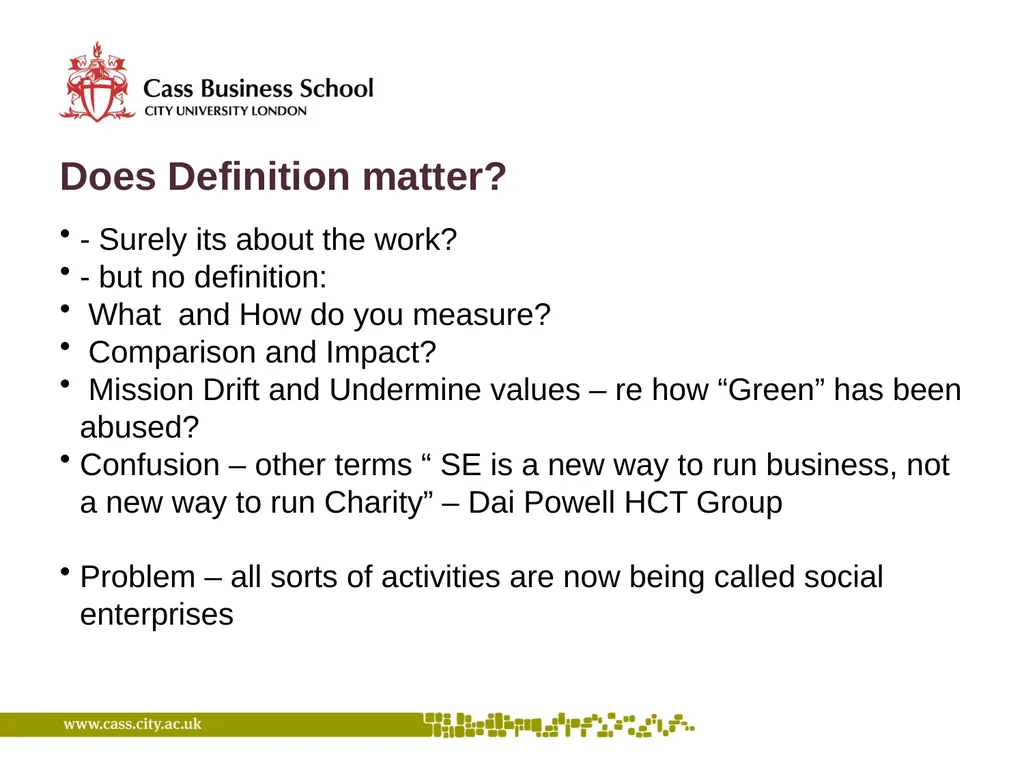
Does Definition matter? - Surely its about the work?
- but no definition:
What and How do you measure?
Comparison and Impact?
Mission Drift and Undermine values – re how “Green” has been abused?
Confusion – other terms “ SE is a new way to run business, not a new way to run Charity” – Dai Powell HCT Group
Problem – all sorts of activities are now being called social enterprises<br>
07
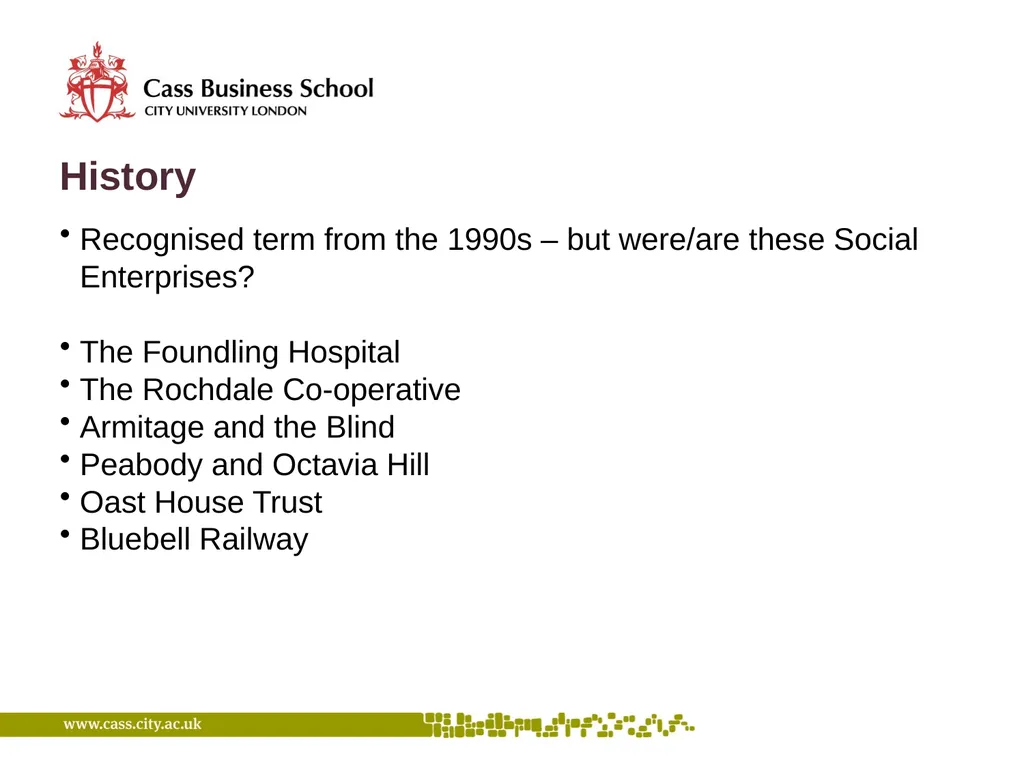
History Recognised term from the 1990s – but were/are these Social Enterprises?
The Foundling Hospital
The Rochdale Co-operative
Armitage and the Blind
Peabody and Octavia Hill
Oast House Trust
Bluebell Railway<br>
08
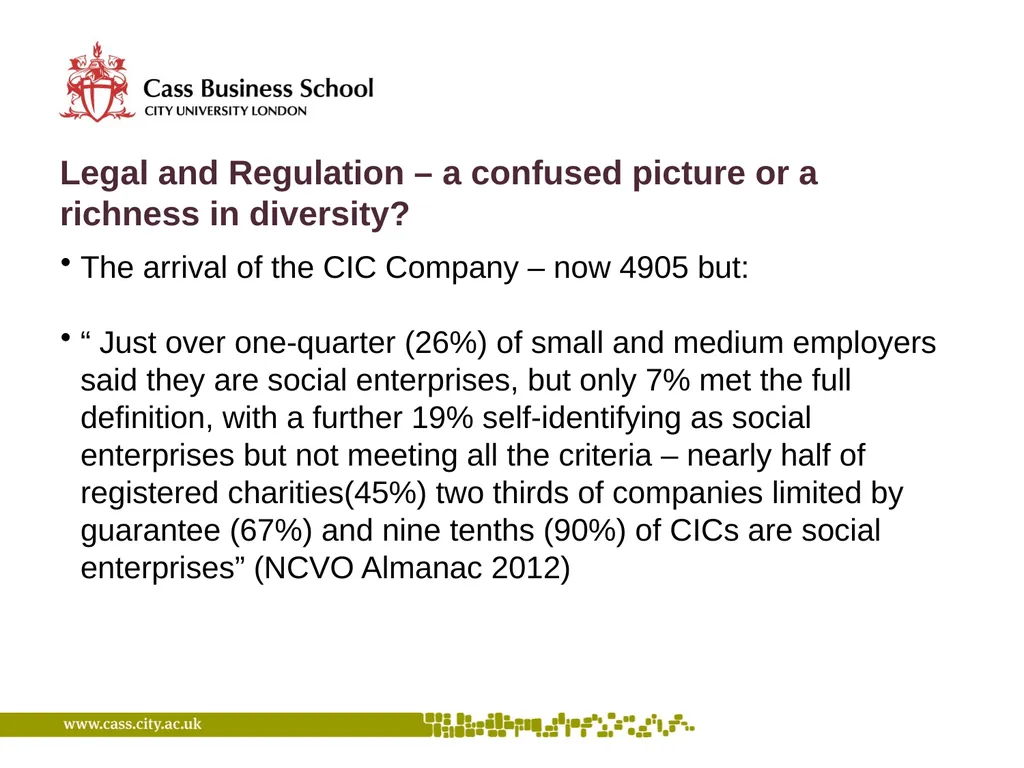
Legal and Regulation – a confused picture or a richness in diversity? The arrival of the CIC Company – now 4905 but:
“ Just over one-quarter (26%) of small and medium employers said they are social enterprises, but only 7% met the full definition, with a further 19% self-identifying as social enterprises but not meeting all the criteria – nearly half of registered charities(45%) two thirds of companies limited by guarantee (67%) and nine tenths (90%) of CICs are social enterprises” (NCVO Almanac 2012)<br>
09
International - UK a compromise of ideas! To further complicate matters there are differences in interpretations of social enterprise across the globe:
USA – social enterprise embraces the entrepreneurial culture, where the individual, the entrepreneur, is focused upon far more than the collective or the community
Europe – stakeholder democracy – benefit the community and are autonomous organisations, with group objectives, shared aims and decision making power that is not based on capital ownership<br>
10
Cultural and Political Issues How different from modern charities and public benefit?
Are they really enterprises? – “They restrict me from creating real value which doesn’t make any sense” – quote from a previous winner of the Apprentice
“Ten or so years ago it would have seamed like an oxymoron to amalgamate the terms social and enterprise” (Arthur 2006) – a leap of faith – assumption that if business a success, social aims will follow?
Relationship with the Public Sector?
Criticism from Unite – are social enterprises a “spin” away from the real issues of full employment and the welfare state?<br>
11
Financial Issues The issues of scalability? – are SEs really social SME’s? – can they be templated?
Access finance and capital – social bonds still an emerging area
External business support services to SMEs?
Marketing and Pricing products<br>
12
Governance Theory and models – Stakeholder or Stewardship?
Regulation confused – no one regulator – how effective is the CIC regulator? – “The Government expects the Regulator to be a “light touch regulator” who will encourage the development of the CIC brand and provide guidance and assistance on matters relating to CICs.”
The Trade Mark – how many have joined? – is it a money making exercise?<br>
13
Governance Issues To Get the CEO on the Board?
Short term fix to underlying governance problems?
Q – is it really true that traditional governance structures of charities do not fit the Social Entrepreneurial nature of Social Enterprises?<br>
14
Conclusion Could get lost in terminology – responsible capitalism – collaborative entrepreneurship – and lose identity
Resilience to criticism? – impact and other studies may suggest no longer flavour of the month or not delivering– i.e. micro finance impact studies questioning how effective
Social value and impact – lack of a research evidence base – “the social entrepreneur as a heroic figure is a myth!<br>
15
Lose the hype – a real research agenda Social Value creation
Risk taking
Managing a social venture
Effects of change process
Social Venture formation
Motivation of social entrepreneurs
Social and economic values<br>