04
A Deep Dive into Dyslexia<br>
05
The Delphi Definition of Dyslexia (March 2025) “ Dyslexia is a set of processing difficulties that affect the acquisition of reading and spelling. The most commonly observed cognitive impairment in dyslexia is a difficulty in phonological processing (i.e. in phonological awareness, phonological processing speed or phonological memory). However, phonological difficulties do not fully explain the variability that is observed. Working memory, processing speed and orthographic skills can contribute to the impact of dyslexia.” A New UK Definition of Dyslexia…<br>
06
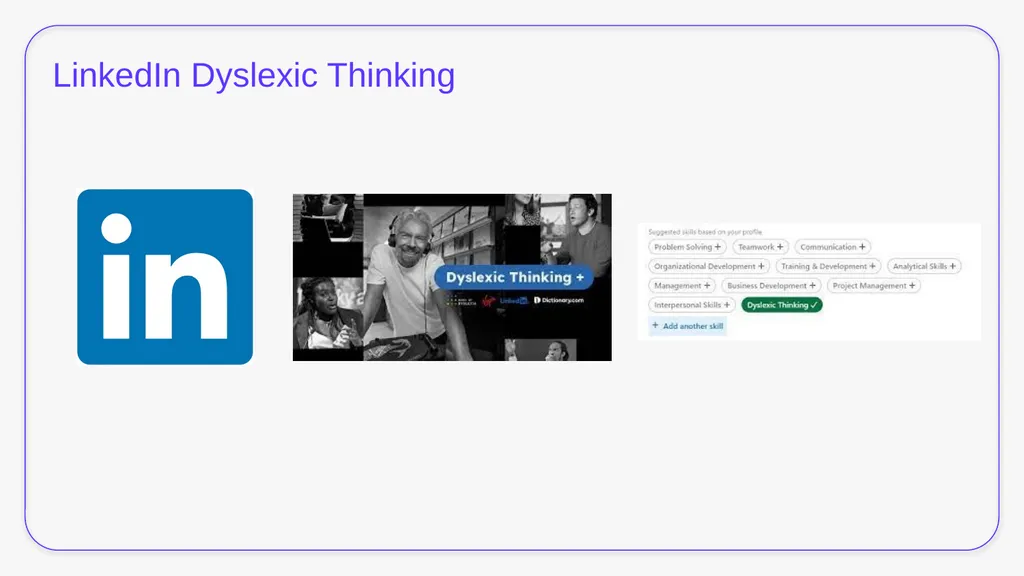
LinkedIn Dyslexic Thinking<br>
08
How might recent press coverage that dyslexia doesn’t exist make colleagues feel who live with this neurodifference? Ask the Audience Time<br>
09
Dyslexia – Fact Checking<br>
10
Dyslexic individuals have super-powers!
Dyslexic individuals just need to work a bit harder to overcome their challenges
The lived experience of Dyslexia is always the same
Dyslexia does not co-occur with other neurodivergent differences
Everyone with Dyslexia has literacy issues…
There are only a small group of females who live with Dyslexia
We’re all a ‘little bit’ Dyslexic!
If your literacy issues connected to Dyslexia have ‘gone away’ then you don’t have Dyslexia anymore
Coloured overlays can ‘cure’ Dyslexia… Myth Busting (One of these doesn’t fit!)<br>
11
6.3 million people with dyslexia in the UK
40 % of those unemployed are thought to have dyslexia
40% Millionaires have dyslexia
The Highest Incidence Disability – 10-15% of the population. Dyslexia – The statistics?<br>
12
Determination
Problem solving
3-D thinker, thinking outside the box!
Creative
Great verbal communicator
Confident, good social skills
Empathic – good with people Potential Dyslexia Strengths…<br>
13
‘I am such a great people person, always have been even as a child. It’s only into adulthood that I started to equate the fact I have dyslexia with the fact that I am good with people… I am often the one that our clients ask to speak with, I’m a great listener and have good empathy skills, so I feel I really connect with folks’
Nikesh The Lived Experience…<br>
14
Literacy Issues
Numeracy Issues
Organisation
Memory: working memory, short term memory
Processing skills
Concentration
Task Completion
Automaticity Potential Dyslexia Challenges…<br>
15
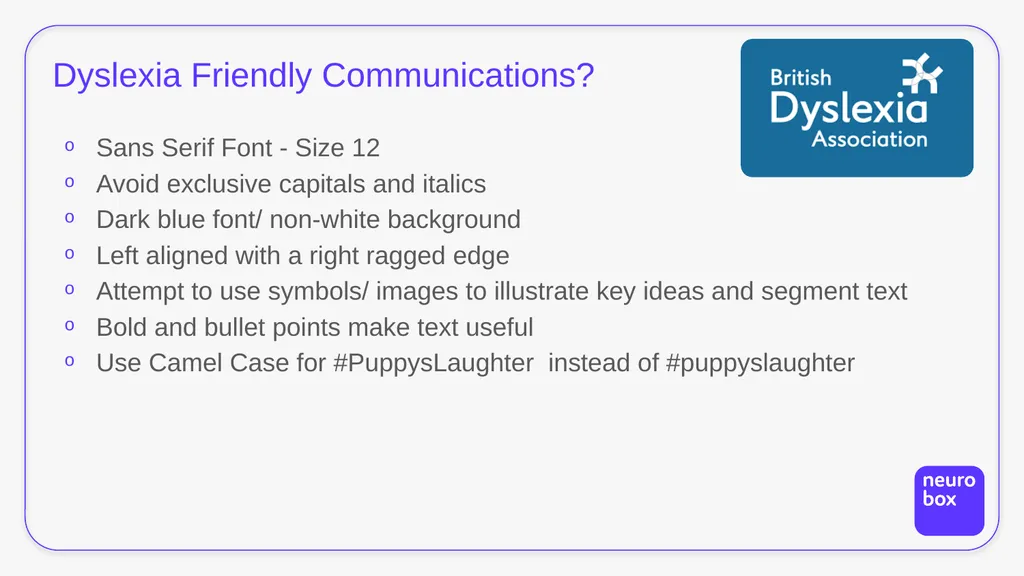
Sans Serif Font - Size 12
Avoid exclusive capitals and italics
Dark blue font/ non-white background
Left aligned with a right ragged edge
Attempt to use symbols/ images to illustrate key ideas and segment text
Bold and bullet points make text useful
Use Camel Case for #PuppysLaughter instead of #puppyslaughter Dyslexia Friendly Communications?<br>
16
‘If someone were to ask me the key to getting the best out of me, I would say LISTEN to me, I have lost track of the times over the years I have had managers tell me about who I am rather than ask me, it’s so arrogant and patronising. Sure there is a dialogue that needs to happen and I’m happy to listen, but please don’t pigeon-hole me before you have gotten to know me just because I am neurodivergent…’
Robert The Lived Experience<br>
17
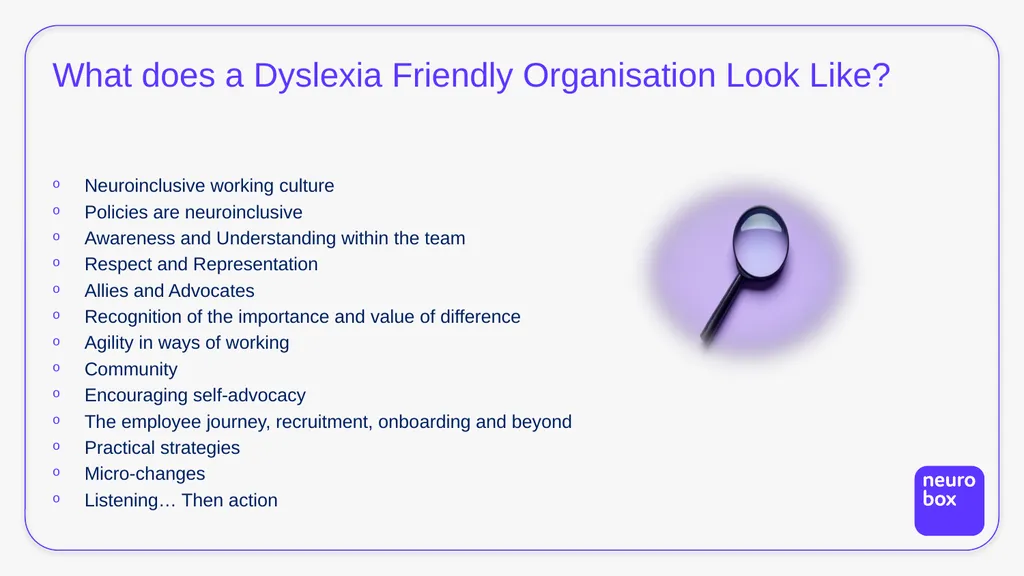
What does a Dyslexia Friendly Organisation Look Like?<br>
18
Neuroinclusive working culture
Policies are neuroinclusive
Awareness and Understanding within the team
Respect and Representation
Allies and Advocates
Recognition of the importance and value of difference
Agility in ways of working
Community
Encouraging self-advocacy
The employee journey, recruitment, onboarding and beyond
Practical strategies
Micro-changes
Listening… Then action What does a Dyslexia Friendly Organisation Look Like?<br>
19
Getting it Right for Our Dyslexic Colleagues…<br>
20
“After many years in the world of work, the firms I have felt most at home with and really flourished are those who have really tried to value those of us with dyslexia, good for me of course but also a better way to work for everyone!”
Josie The Lived Experience<br>
21
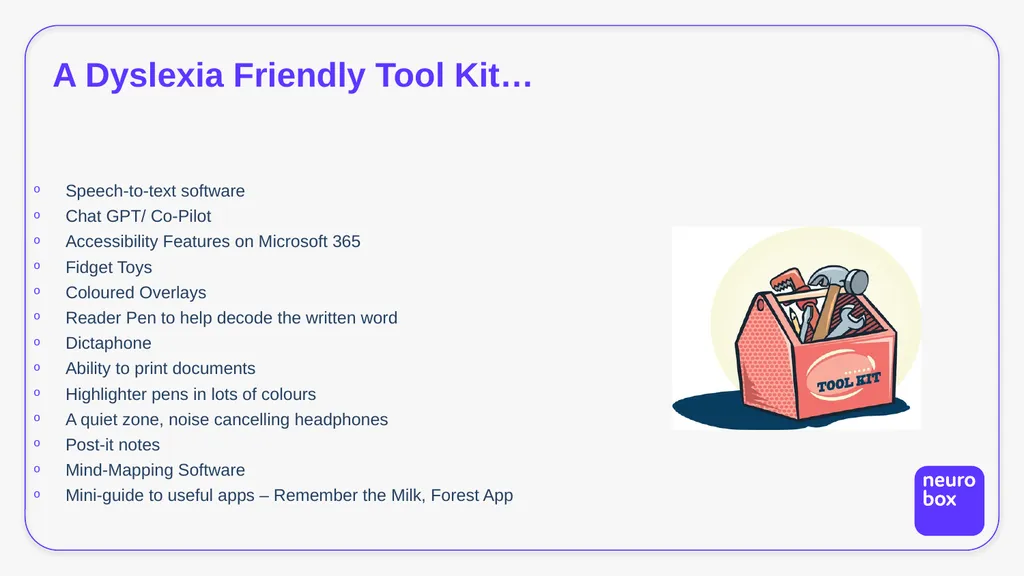
Speech-to-text software
Chat GPT/ Co-Pilot
Accessibility Features on Microsoft 365
Fidget Toys
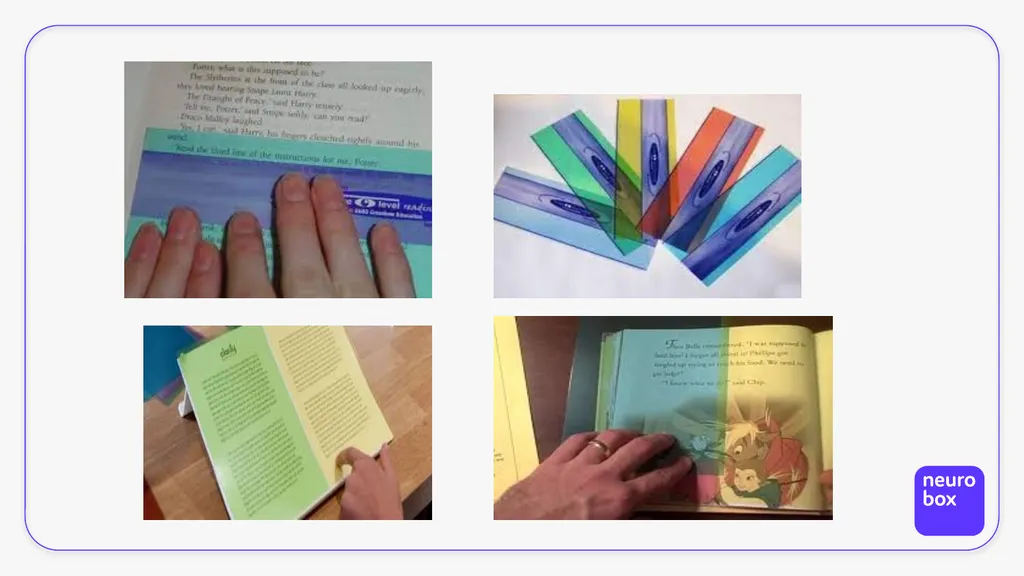
Coloured Overlays
Reader Pen to help decode the written word
Dictaphone
Ability to print documents
Highlighter pens in lots of colours
A quiet zone, noise cancelling headphones
Post-it notes
Mind-Mapping Software
Mini-guide to useful apps – Remember the Milk, Forest App A Dyslexia Friendly Tool Kit…<br>
22
A conversation between you and an Assessor. The Workplace Needs Assessments helps the assessor understand what your working day looks like; your role, responsibilities, tasks, strengths, and any challenges you are experiencing, all so that they can make useful recommendations to support you.
Your assessor will produce a report recommending possible adjustments, the reasons for them, and explaining how they might help. With your consent, this report will be submitted to your employer so that they can consider the recommendations suggested. When we’re not Sure? The Workplace Needs Assessment<br>
23
1. Self-Validation – the feeling that your feelings, experiences and thoughts are valid and should be accepted, you are worthy of respect.
2. Community! You are not alone, reach out to colleagues, create networks, get into the habit of sharing.
3. Do your research… Finding out about dyslexia has never been so easy, there is so much information out there, knowledge is power!
4. Know yourself – knowing what we are great at and our areas of challenge can really help us and our organisation figure out how to get the best out of ourselves.
5. Find your safe space, if being your authentic self is new to you, find a safe space with trusted people where you can truly be the real you.
6. One step at a time… don’t pressurise yourself to share until you are ready
7. You can’t be what you can’t see, don’t forget role models, are so important, so
whether it’s colleagues or a favourite celebrity, having a role model can really inspire us! 10 Top Dyslexia Friendly Tips<br>
24
8. Play it forward – supporting other colleagues on their journey too can help us to find our own path.
9. Celebrating Dyslexia awareness time and inviting speakers into your team can really help to raise awareness and understanding across our organisation.
10. If you don’t ask you don’t get! Don’t forget good employers work alongside their team to support them and bring out their talents, don’t be too shy to have the conversations about what can help you really flourish at work and be your authentic self. 10 Top Dyslexia Friendly Tips<br>
25
‘Now I’m in my 50s I finally feel confident to stand up for those of us who have dyslexia, since I have spoken out and become an ally, there have been so many colleagues who have approached me to thank me or who want to stand with me! We now have a bit of an army going on and it’s fantastic! Me speaking up has caused ripples of hope’
Mohammed The Lived Experience<br>
26
neurobox: https://neurobox.co.uk/
British Dyslexia Association Helpline: helpline@bdadyslexia.org.uk, 0333 405 4567
Helen Arkell Dyslexia Charity: https://helenarkell.org.uk/
Adult Dyslexia Centre: https://www.adc.org.uk/
Succeed with Dyslexia Youtube Channel: https://www.youtube.com/@SucceedWithDyslexia
Looking for your Local Dyslexia Association? https://www.bdadyslexia.org.uk/contact/find-a-local-dyslexia-association
Made by Dyslexia: https://www.madebydyslexia.org/
Call Scotland App Wheel: https://www.callscotland.org.uk/blog/updated-aac-ipad-app-wheel-available-now/
Microsoft Accessibility: https://support.microsoft.com/en-gb/topic/accessibility-tools-for-learning-a610cc7f-6cd1-49ff-a543-214cdf9a0710 Useful Links and Resources in the Dyslexia Community<br>
27
Thank you and Keep in Touch Any questions?<br>