
A Faster and Efficient Timing Constraint
Description: A Faster and Efficient Timing Constraint Verification Methodology for GFX SOCs Vineeth B, SOC Design Engineer Deepmala Sachan, SOC Design Manager Intel Technology India Pvt. Ltd. Accellera Systems Initiative 1 Introduction Complex
Related Topics
Download Presentation
"A Faster and Efficient Timing Constraint" is the property of its rightful owner. Permission is granted to download and print the materials on this website for personal, non-commercial use only, and to display it on your personal computer provided you do not modify the materials and that you retain all copyright notices contained in the materials. By downloading content from our website, you accept the terms of this agreement.
Presentation Transcript
slide1. A Faster and Efficient Timing Constraint Verification Methodology for GFX SOCs Vineeth B, SOC Design Engineer
Deepmala Sachan, SOC Design Manager
Intel Technology India Pvt. Ltd. © Accellera Systems Initiative 1<br>
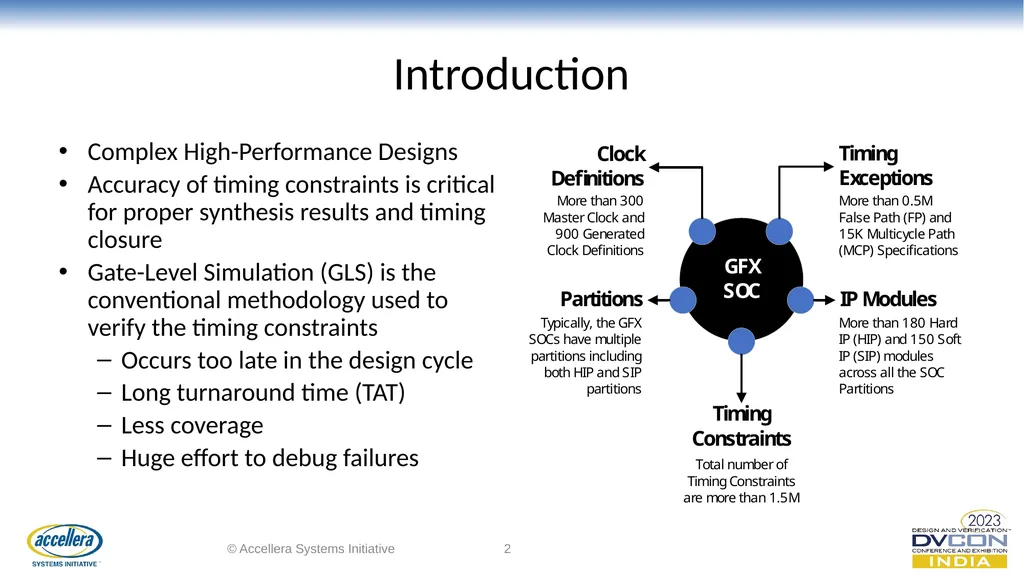
slide2. Introduction Complex High-Performance Designs
Accuracy of timing constraints is critical for proper synthesis results and timing closure
Gate-Level Simulation (GLS) is the conventional methodology used to verify the timing constraints
Occurs too late in the design cycle
Long turnaround time (TAT)
Less coverage
Huge effort to debug failures © Accellera Systems Initiative 2<br>
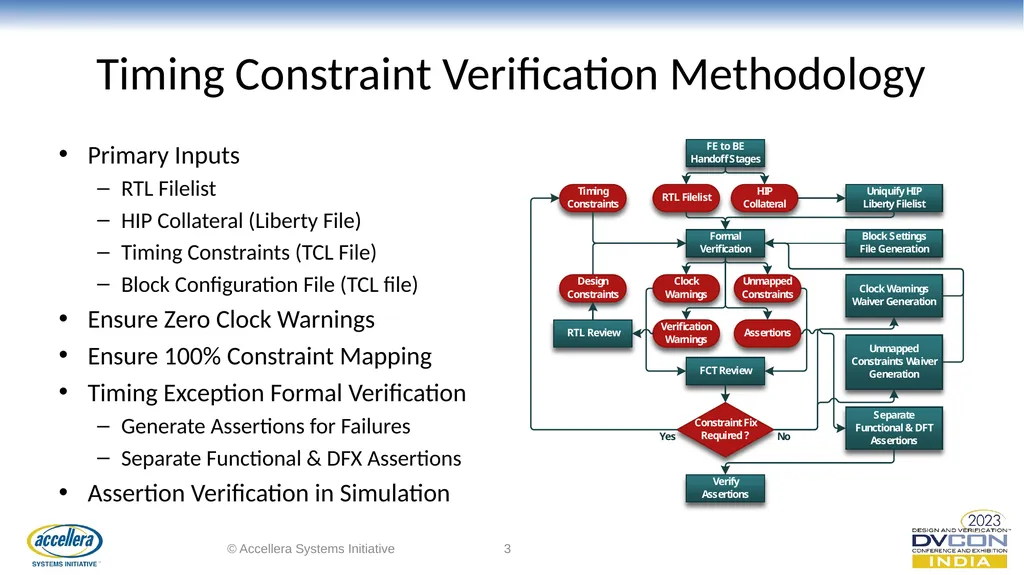
slide3. Timing Constraint Verification Methodology Primary Inputs
RTL Filelist
HIP Collateral (Liberty File)
Timing Constraints (TCL File)
Block Configuration File (TCL file)
Ensure Zero Clock Warnings
Ensure 100% Constraint Mapping
Timing Exception Formal Verification
Generate Assertions for Failures
Separate Functional & DFX Assertions
Assertion Verification in Simulation © Accellera Systems Initiative 3<br>
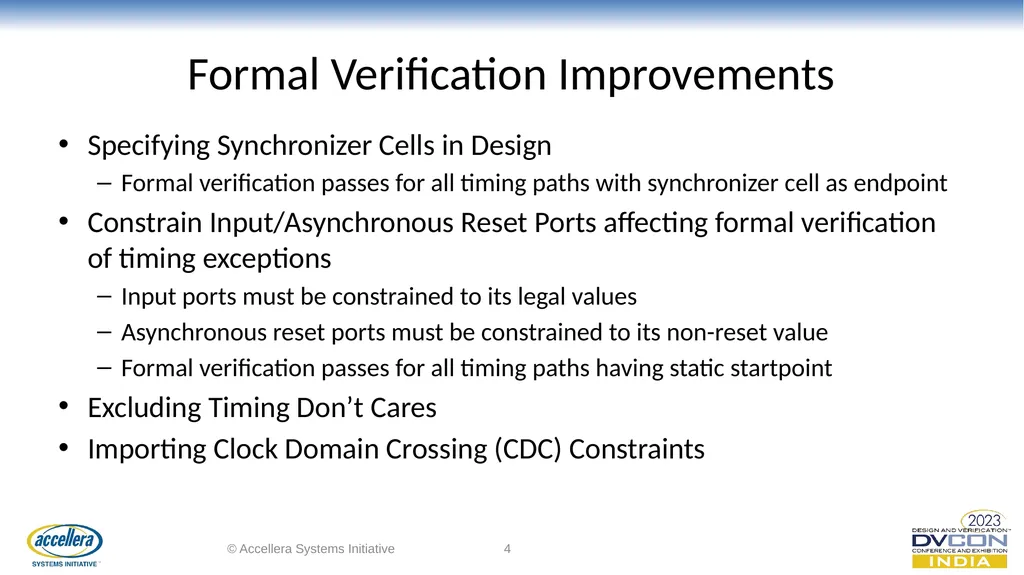
slide4. Formal Verification Improvements Specifying Synchronizer Cells in Design
Formal verification passes for all timing paths with synchronizer cell as endpoint
Constrain Input/Asynchronous Reset Ports affecting formal verification of timing exceptions
Input ports must be constrained to its legal values
Asynchronous reset ports must be constrained to its non-reset value
Formal verification passes for all timing paths having static startpoint
Excluding Timing Don’t Cares
Importing Clock Domain Crossing (CDC) Constraints © Accellera Systems Initiative 4<br>
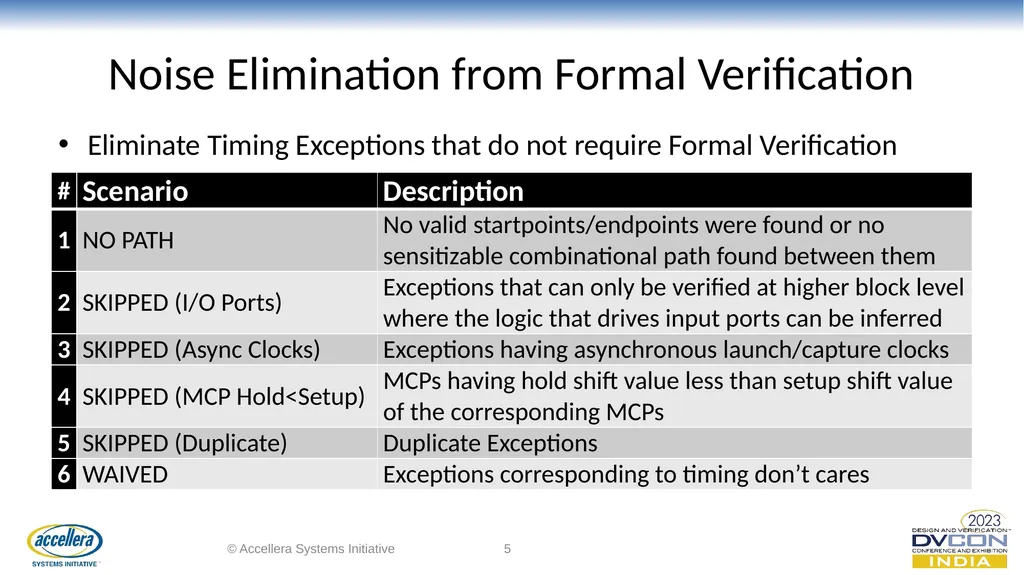
slide5. Noise Elimination from Formal Verification Eliminate Timing Exceptions that do not require Formal Verification © Accellera Systems Initiative 5<br>
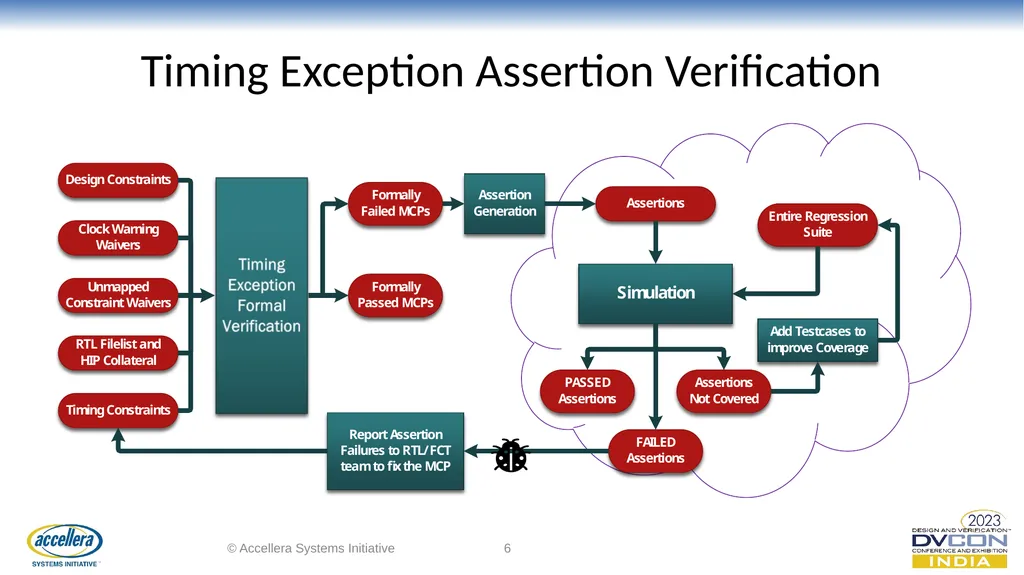
slide6. Timing Exception Assertion Verification © Accellera Systems Initiative 6<br>
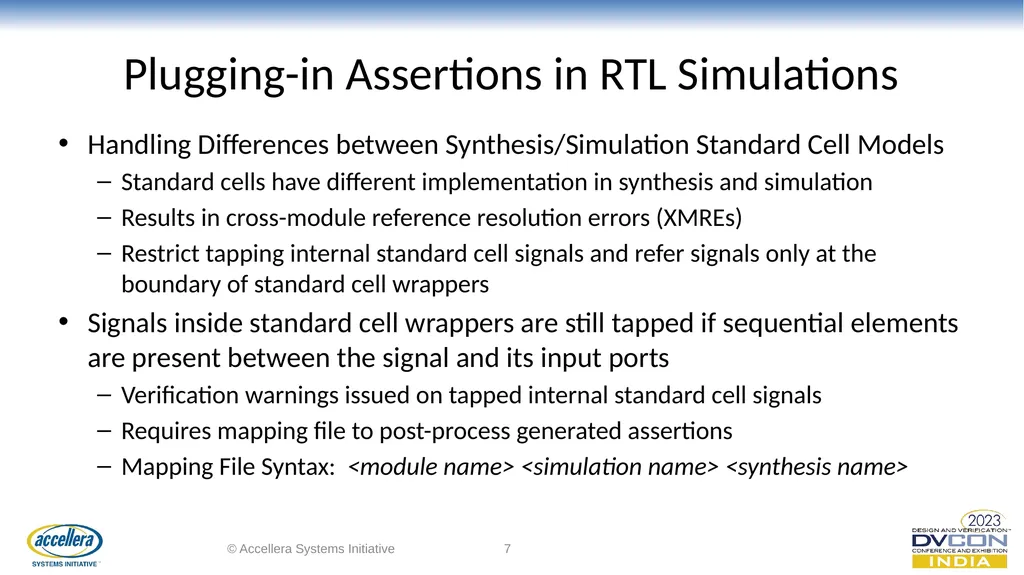
slide7. Plugging-in Assertions in RTL Simulations Handling Differences between Synthesis/Simulation Standard Cell Models
Standard cells have different implementation in synthesis and simulation
Results in cross-module reference resolution errors (XMREs)
Restrict tapping internal standard cell signals and refer signals only at the boundary of standard cell wrappers
Signals inside standard cell wrappers are still tapped if sequential elements are present between the signal and its input ports
Verification warnings issued on tapped internal standard cell signals
Requires mapping file to post-process generated assertions
Mapping File Syntax: <module name> <simulation name> <synthesis name> © Accellera Systems Initiative 7<br>
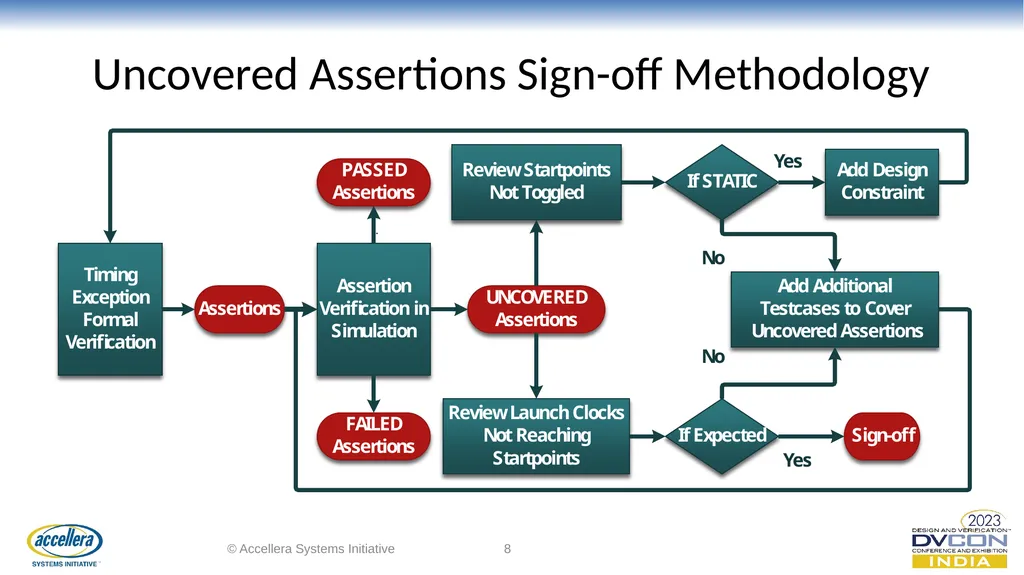
slide8. Uncovered Assertions Sign-off Methodology © Accellera Systems Initiative 8<br>
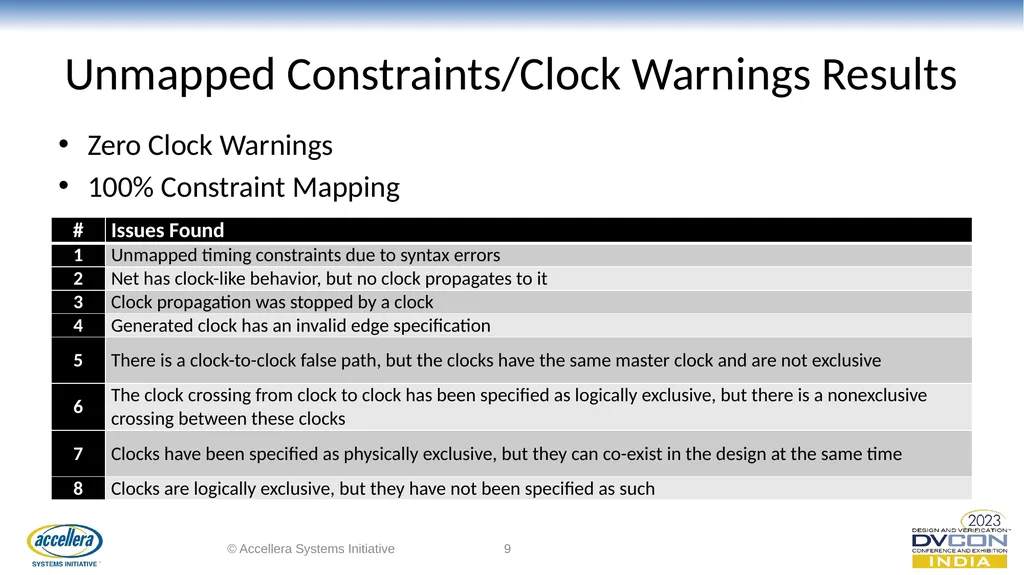
slide9. Unmapped Constraints/Clock Warnings Results Zero Clock Warnings
100% Constraint Mapping © Accellera Systems Initiative 9<br>
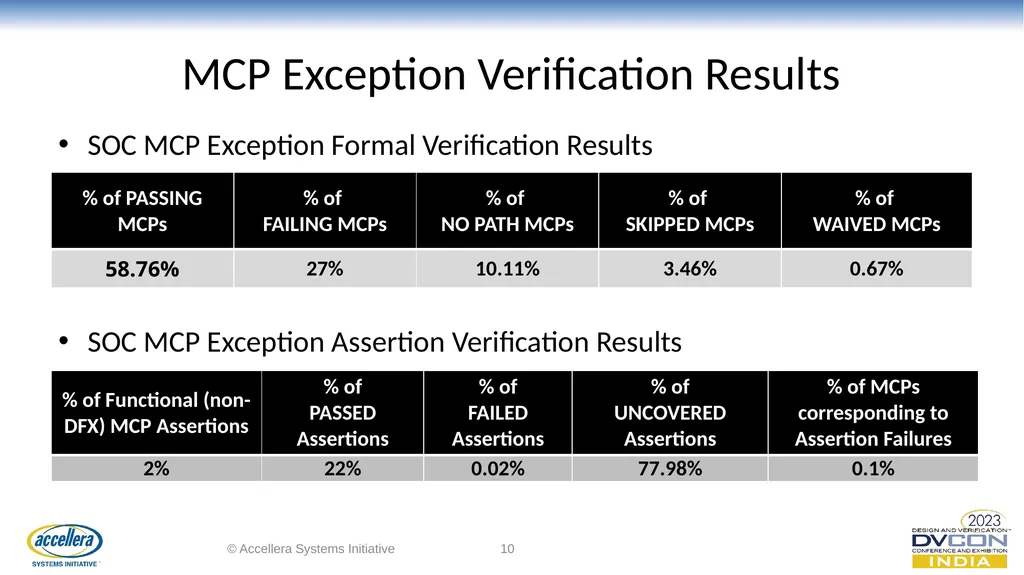
slide10. MCP Exception Verification Results SOC MCP Exception Formal Verification Results
SOC MCP Exception Assertion Verification Results © Accellera Systems Initiative 10<br>
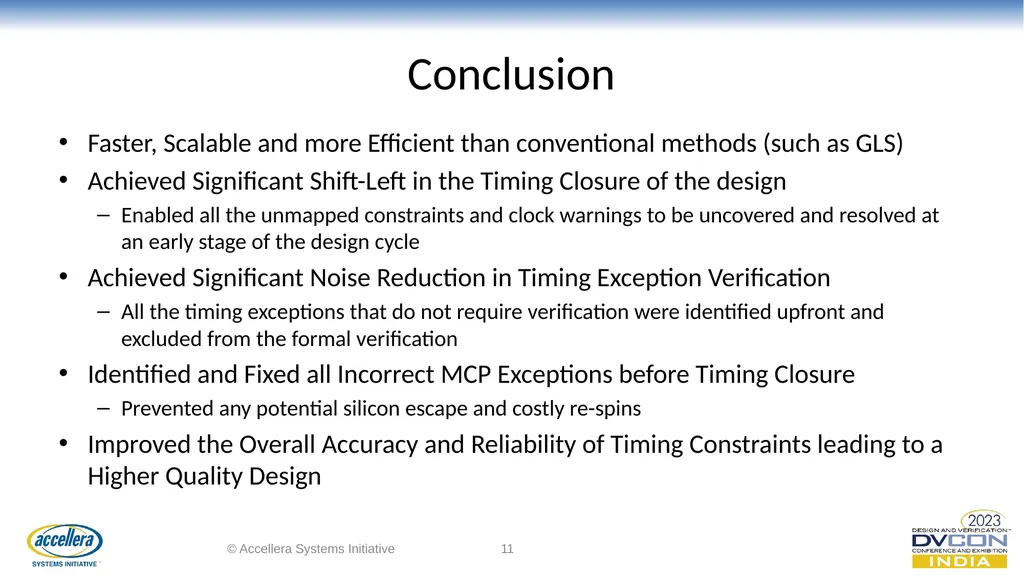
slide11. Conclusion Faster, Scalable and more Efficient than conventional methods (such as GLS)
Achieved Significant Shift-Left in the Timing Closure of the design
Enabled all the unmapped constraints and clock warnings to be uncovered and resolved at an early stage of the design cycle
Achieved Significant Noise Reduction in Timing Exception Verification
All the timing exceptions that do not require verification were identified upfront and excluded from the formal verification
Identified and Fixed all Incorrect MCP Exceptions before Timing Closure
Prevented any potential silicon escape and costly re-spins
Improved the Overall Accuracy and Reliability of Timing Constraints leading to a Higher Quality Design © Accellera Systems Initiative 11<br>
slide12. Questions © Accellera Systems Initiative 12<br>
Deepmala Sachan, SOC Design Manager
Intel Technology India Pvt. Ltd. © Accellera Systems Initiative 1<br>
slide2. Introduction Complex High-Performance Designs
Accuracy of timing constraints is critical for proper synthesis results and timing closure
Gate-Level Simulation (GLS) is the conventional methodology used to verify the timing constraints
Occurs too late in the design cycle
Long turnaround time (TAT)
Less coverage
Huge effort to debug failures © Accellera Systems Initiative 2<br>
slide3. Timing Constraint Verification Methodology Primary Inputs
RTL Filelist
HIP Collateral (Liberty File)
Timing Constraints (TCL File)
Block Configuration File (TCL file)
Ensure Zero Clock Warnings
Ensure 100% Constraint Mapping
Timing Exception Formal Verification
Generate Assertions for Failures
Separate Functional & DFX Assertions
Assertion Verification in Simulation © Accellera Systems Initiative 3<br>
slide4. Formal Verification Improvements Specifying Synchronizer Cells in Design
Formal verification passes for all timing paths with synchronizer cell as endpoint
Constrain Input/Asynchronous Reset Ports affecting formal verification of timing exceptions
Input ports must be constrained to its legal values
Asynchronous reset ports must be constrained to its non-reset value
Formal verification passes for all timing paths having static startpoint
Excluding Timing Don’t Cares
Importing Clock Domain Crossing (CDC) Constraints © Accellera Systems Initiative 4<br>
slide5. Noise Elimination from Formal Verification Eliminate Timing Exceptions that do not require Formal Verification © Accellera Systems Initiative 5<br>
slide6. Timing Exception Assertion Verification © Accellera Systems Initiative 6<br>
slide7. Plugging-in Assertions in RTL Simulations Handling Differences between Synthesis/Simulation Standard Cell Models
Standard cells have different implementation in synthesis and simulation
Results in cross-module reference resolution errors (XMREs)
Restrict tapping internal standard cell signals and refer signals only at the boundary of standard cell wrappers
Signals inside standard cell wrappers are still tapped if sequential elements are present between the signal and its input ports
Verification warnings issued on tapped internal standard cell signals
Requires mapping file to post-process generated assertions
Mapping File Syntax: <module name> <simulation name> <synthesis name> © Accellera Systems Initiative 7<br>
slide8. Uncovered Assertions Sign-off Methodology © Accellera Systems Initiative 8<br>
slide9. Unmapped Constraints/Clock Warnings Results Zero Clock Warnings
100% Constraint Mapping © Accellera Systems Initiative 9<br>
slide10. MCP Exception Verification Results SOC MCP Exception Formal Verification Results
SOC MCP Exception Assertion Verification Results © Accellera Systems Initiative 10<br>
slide11. Conclusion Faster, Scalable and more Efficient than conventional methods (such as GLS)
Achieved Significant Shift-Left in the Timing Closure of the design
Enabled all the unmapped constraints and clock warnings to be uncovered and resolved at an early stage of the design cycle
Achieved Significant Noise Reduction in Timing Exception Verification
All the timing exceptions that do not require verification were identified upfront and excluded from the formal verification
Identified and Fixed all Incorrect MCP Exceptions before Timing Closure
Prevented any potential silicon escape and costly re-spins
Improved the Overall Accuracy and Reliability of Timing Constraints leading to a Higher Quality Design © Accellera Systems Initiative 11<br>
slide12. Questions © Accellera Systems Initiative 12<br>