A Flexible Framework to Achieve Strategic Objectives in US-China Policy Maorong Jiang, PhD Creighton University maorongjiangcreighton.edu October 30. 2019 1 Strategic Policy Objectives: To avert two equally dangerous possible scenarios:
"A Flexible Framework to Achieve Strategic" is the property of its rightful owner. Permission is granted to
download and print the materials on this website for personal, non-commercial use only, and to display it
on your personal computer provided you do not modify the materials and that you retain all copyright
notices contained in the materials. By downloading content from our website, you accept the terms of this
agreement.
Presentation Transcript
01
A Flexible Framework to Achieve Strategic Objectives in US-China Policy
Maorong Jiang, PhD
Creighton University
maorongjiang@creighton.edu
October 30. 2019 1<br>
02
Strategic Policy Objectives:
To avert two equally dangerous possible scenarios: (1) China’s rising, with the US as its rival and Russia as its ally; (2) China’s economic collapse, with renewed resentment against the US, and accompanying global economic crisis. 2<br>
03
Reality Recognized:
Neither the traditional approach of engagement intended to promote democratic ideals, nor more recent confrontational practices, have worked.
To some, these current ups and downs are undermining longstanding agreement about how to constructively engage China.
To others who view China policy prior to the current administration as having failed to serve the interests of the United States. 3<br>
04
Time for transformation in thinking about China Today:
There is an urgent need for a new strategic framework that embraces Chinese political and economic realities and uses those realities to US advantage to advance US national and international agendas. 4<br>
05
The US must intentionally and purposefully nurture a developing China with its socialist system under authoritarian rule, as a global partner serving US strategic objectives. 5<br>
06
To attain the strategic objectives, the US must embrace China as a prospective responsible stakeholder and ally, or it risks pushing China more firmly towards Russia, with the potential to form a truly destructive, anti-American alliance. 6<br>
07
7 Holding Beijing accountable to its own, self-proclaimed principles would be a skilful tactic by which to oblige China to adhere to international norms, in a manner that achieves the US’s long-term strategic objectives.<br>
08
8 Following the recent rise of US populism, and paired with the US’s withdrawal from global affairs, China has seized an opportunity to become a policy-defining voice of wisdom on the world stage. This is a positive development on China’s part to engage itself in regional and global affairs.<br>
09
9 The absence of the United States from the global forums will not necessarily lead to a power transition, however. Rather, China is stepping in to shoulder its responsibility as a world leader.<br>
10
10 US acknowledges China’s rightful place on the global stage as a result of its economic success, it must also be acutely conscious of the fact that China is a pro at exaggerating its own power. It is too early to tell how Xi’s China Dream will turn out, if China will realize its “Project of the Century” through its Belt and Road Initiative, and where the latest “New Long March” will take China on the global map. It is in the US’s and everyone else’s interest for the “largest developing country,” as China calls itself, to become a developed economy, and to engage in pursuit of the public good.<br>
11
What is proposed here is an innovative strategic framework utilizing a soft-power deterrence approach to simultaneously engage, challenge, and integrate China. Successfully implementing this strategy demands a flexible rather than reactive US-China policy encompassing short-term (re-engagement), medium-term (challenging), and long-term (integrating) approaches that will advance US interests across the spectrum of cooperation, competition, and conflict throughout the coming decade. 11<br>
12
These strategies should be implemented with the flexibility necessary to ensure adaptability in the face of change, while always maintaining a coherent and rational approach. 12<br>
13
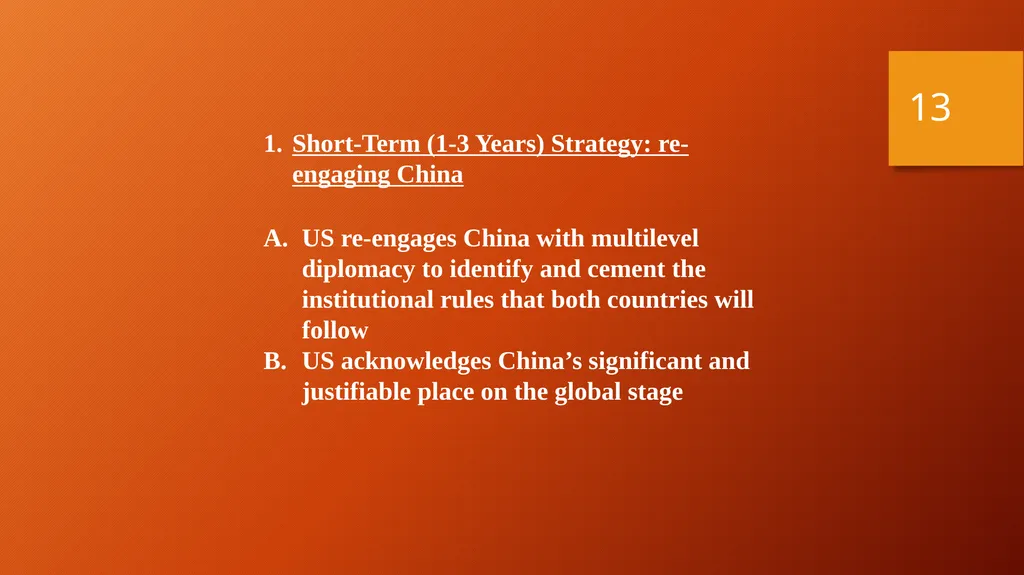
Short-Term (1-3 Years) Strategy: re-engaging China
US re-engages China with multilevel diplomacy to identify and cement the institutional rules that both countries will follow
US acknowledges China’s significant and justifiable place on the global stage 13<br>
14
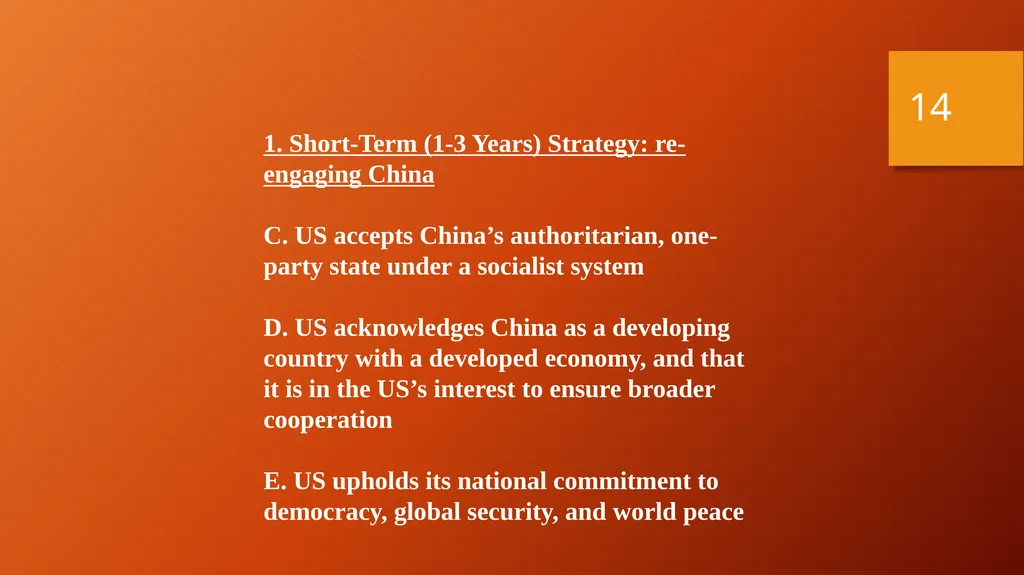
1. Short-Term (1-3 Years) Strategy: re-engaging China
C. US accepts China’s authoritarian, one-party state under a socialist system
D. US acknowledges China as a developing country with a developed economy, and that it is in the US’s interest to ensure broader cooperation
E. US upholds its national commitment to democracy, global security, and world peace 14<br>
15
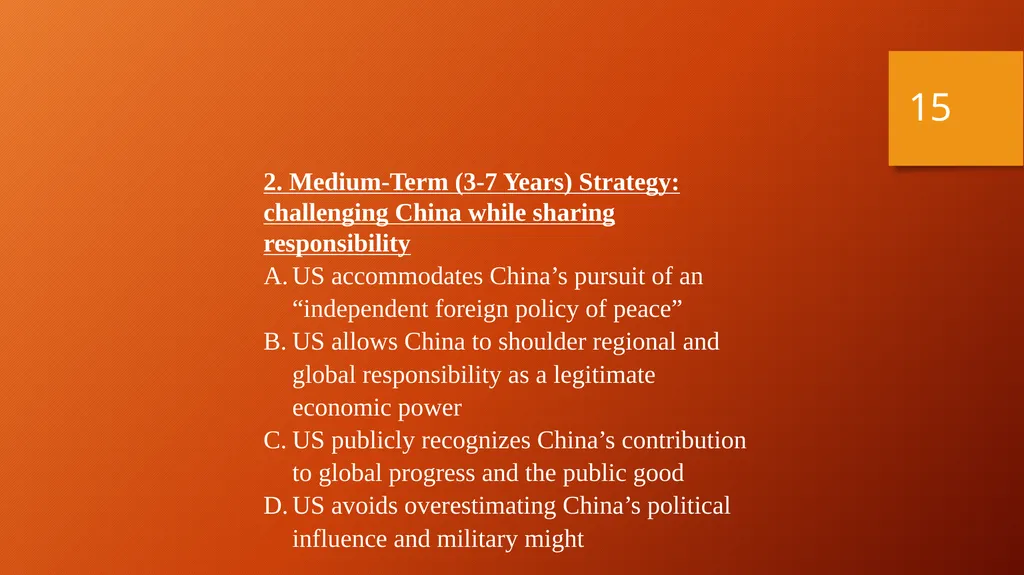
2. Medium-Term (3-7 Years) Strategy: challenging China while sharing responsibility
US accommodates China’s pursuit of an “independent foreign policy of peace”
US allows China to shoulder regional and global responsibility as a legitimate economic power
US publicly recognizes China’s contribution to global progress and the public good
US avoids overestimating China’s political influence and military might 15<br>
16
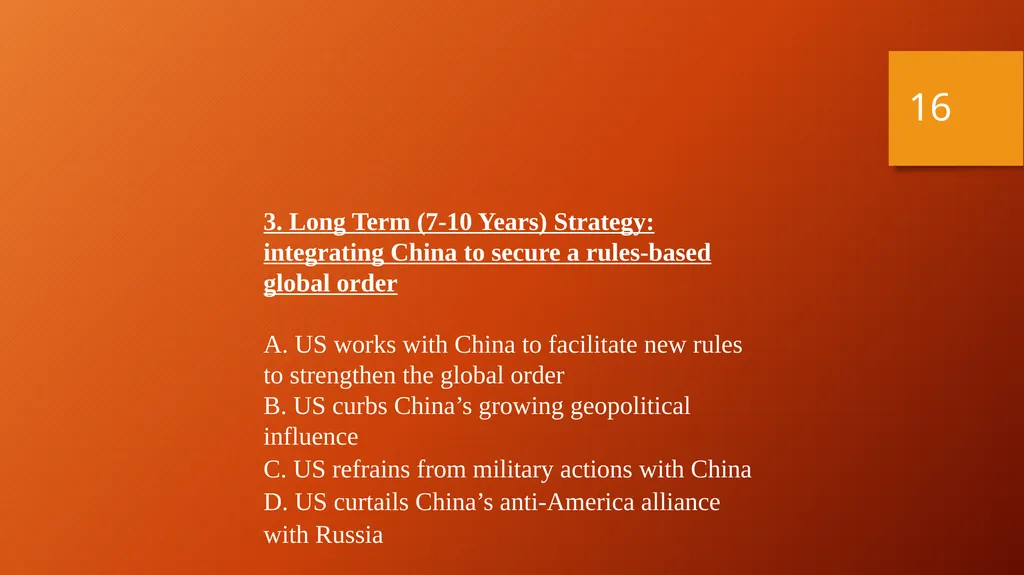
3. Long Term (7-10 Years) Strategy: integrating China to secure a rules-based global order
A. US works with China to facilitate new rules to strengthen the global order
B. US curbs China’s growing geopolitical influence
C. US refrains from military actions with China
D. US curtails China’s anti-America alliance with Russia 16<br>
17
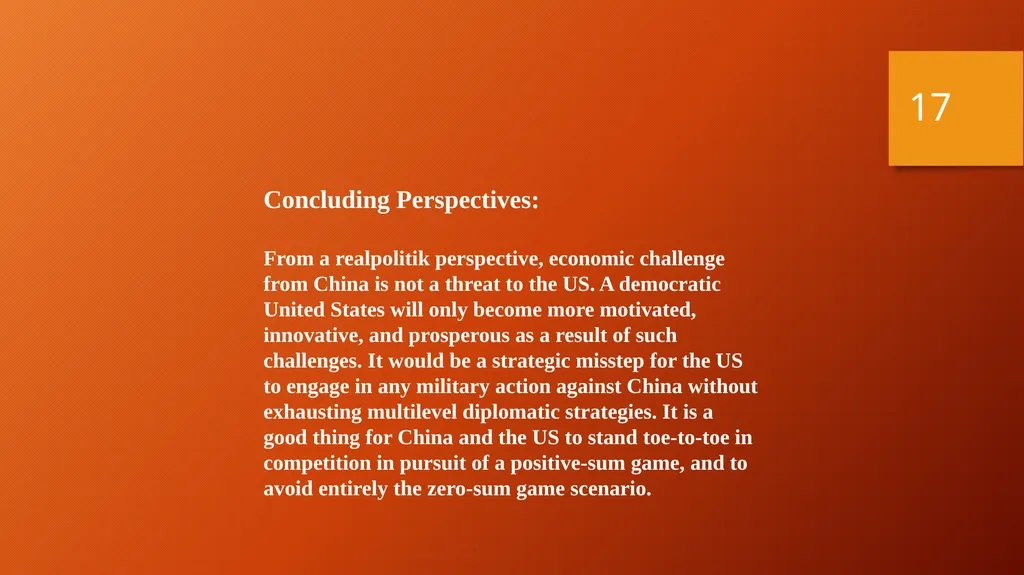
17 Concluding Perspectives:
From a realpolitik perspective, economic challenge from China is not a threat to the US. A democratic United States will only become more motivated, innovative, and prosperous as a result of such challenges. It would be a strategic misstep for the US to engage in any military action against China without exhausting multilevel diplomatic strategies. It is a good thing for China and the US to stand toe-to-toe in competition in pursuit of a positive-sum game, and to avoid entirely the zero-sum game scenario.<br>