A Framework of Applying Process Mining for Fraud Scheme Detection Tiffany Chiu, Yunsen Wang and Miklos Vasarhelyi Rutgers 18th Fraud Seminar, December 7th This paper aims at providing a framework on how process mining can be applied to
"A Framework of Applying Process Mining for Fraud" is the property of its rightful owner. Permission is granted to
download and print the materials on this website for personal, non-commercial use only, and to display it
on your personal computer provided you do not modify the materials and that you retain all copyright
notices contained in the materials. By downloading content from our website, you accept the terms of this
agreement.
Presentation Transcript
01
A Framework of Applying Process Mining for Fraud Scheme Detection Tiffany Chiu, Yunsen Wang and Miklos Vasarhelyi
Rutgers 18th Fraud Seminar, December 7th<br>
02
This paper aims at providing a framework on how process mining can be applied to identify fraud schemes and assessing the riskiness of business processes.
Specifically, the proposed framework captures how the patterns in process mining can be used to detect potentially fraudulent transactions.
This paper contributes to the existing literature by associating notable variants/activities with potential fraud schemes and then assigning risk levels, which could be used as an automatic tool to test the fraud risk of every transaction. Introduction<br>
03
The idea of mining business processes was first proposed by Agrawal et al. (1998) where they developed an approach to identify business processes occurred in the system by evaluating existing logs.
Cook and Wolf (1998) proposed the term - process discovery, and introduced a technique that develops process models by capturing current business processes.
A large body of academic research analyzed business processes using event logs and proposed either new types of process mining techniques or a case study to evaluate or improve these techniques.
Bozkaya et al. (2009) proposed a process diagnostics method using process mining to help organizations understand three perspectives, namely: “how the process model actually looks like,” “how well does the system perform,” and “who is involved in the process and how.”
Rozinat and van der Aalst (2008) proposed a novel conformance checking approach to examine the differences between the observed business process and the designed process model. 3 Literature Review<br>
04
Financial Statements Fraud and Fraud Type
Accounting research on financial statement fraud and Accounting and Auditing Enforcement Releases (AAERs) includes testing hypotheses grounded in the literature of earnings management (Summers and Sweeney, 1998; Beneish, 1999; Sharma, 2004) and corporate governance (e.g., Beasley, 1996).
Numerous measures for earnings management are created to indicate the risk of financial misstatement and fraud, such as earnings persistence (e.g., Richardson et al., 2005), abnormal accruals and accruals models (e.g., Jones, 1991; Dechow et al., 1995; Dechow and Dichev, 2002; Kothari et al., 2005), and earnings smoothness (e.g., McInnis, 2010).
To evaluate the predictive power of the extent accrual-based earnings management measures to detect financial statement fraud, Jones et al. (2008) conducted an empirical analysis comparing ten measures (e.g., discretionary accruals, accrual quality) derived from popular accrual models and found that only the accrual estimation errors (Dechow and Dichev, 2002) and their modifications have the ability to predict fraud and non-fraudulent restatements of earnings. 4 Literature Review<br>
05
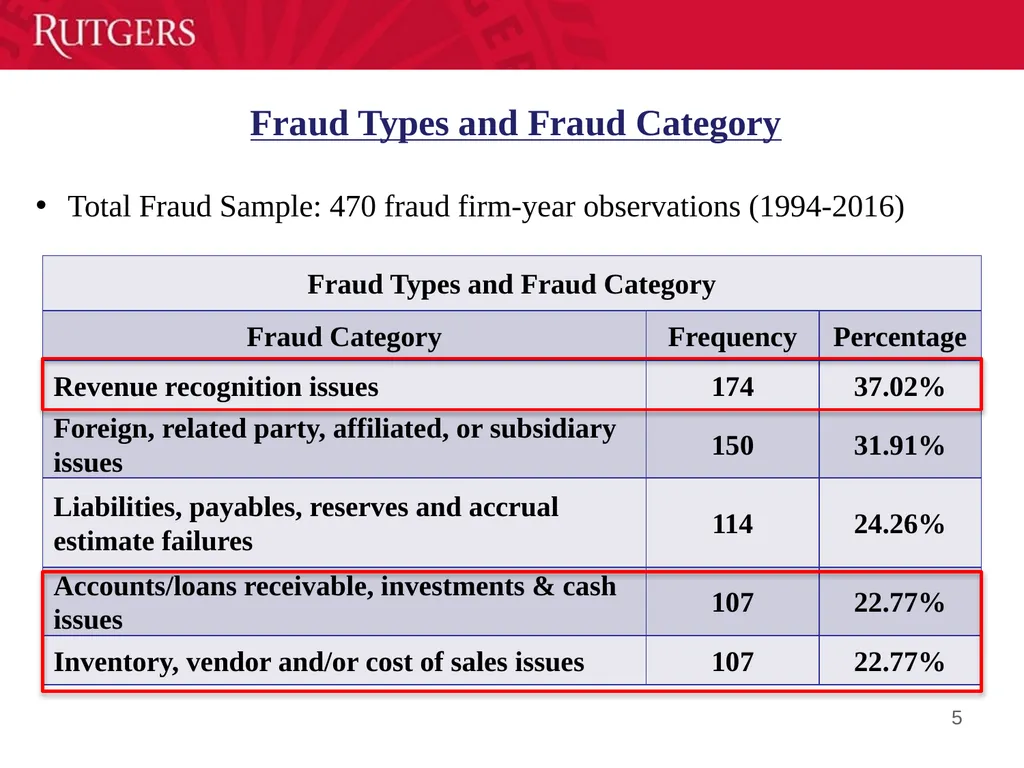
5 Fraud Types and Fraud Category Total Fraud Sample: 470 fraud firm-year observations (1994-2016)<br>
06
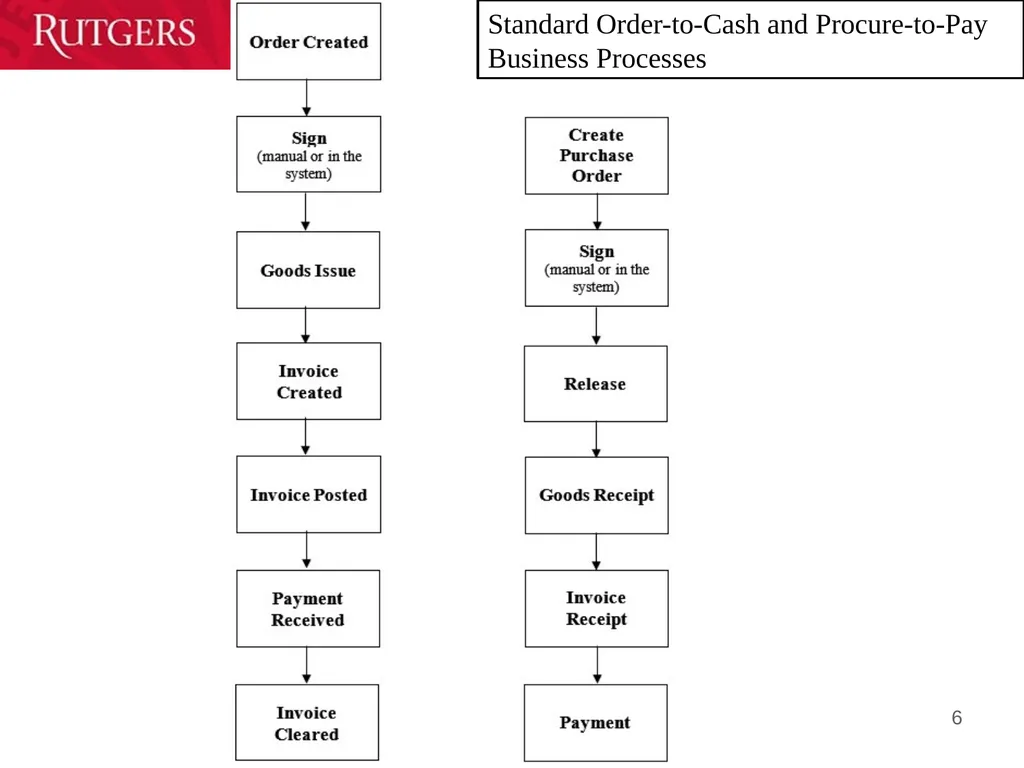
6 Standard Order-to-Cash and Procure-to-Pay Business Processes<br>
07
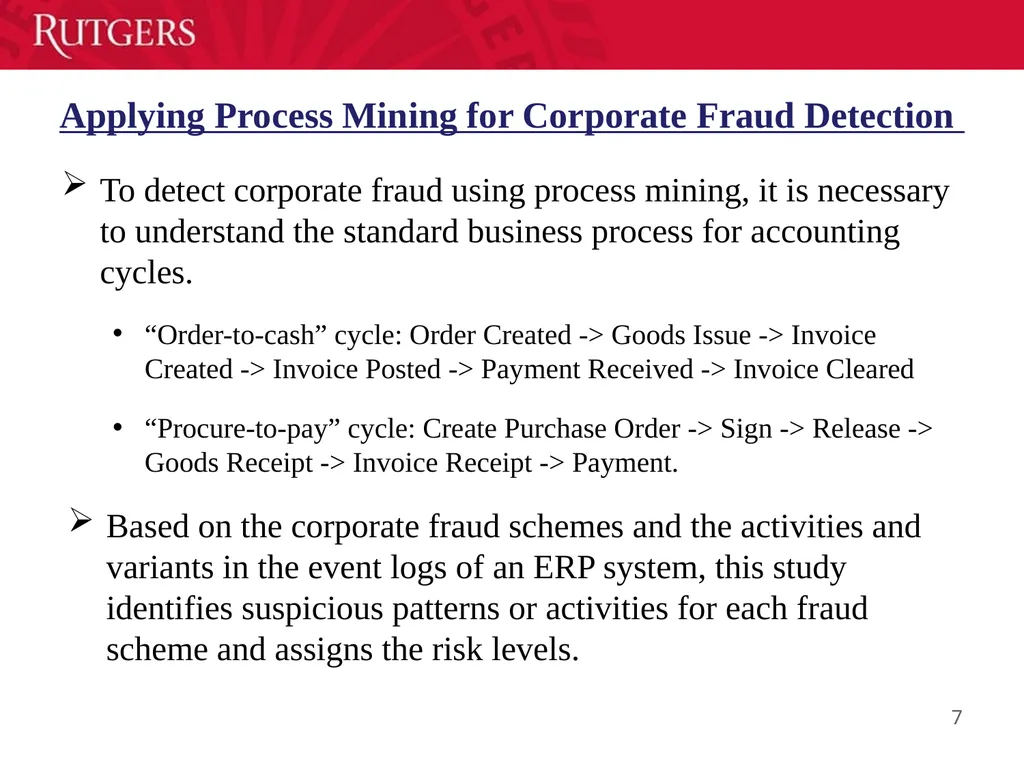
Applying Process Mining for Corporate Fraud Detection To detect corporate fraud using process mining, it is necessary to understand the standard business process for accounting cycles.
“Order-to-cash” cycle: Order Created -> Goods Issue -> Invoice Created -> Invoice Posted -> Payment Received -> Invoice Cleared
“Procure-to-pay” cycle: Create Purchase Order -> Sign -> Release -> Goods Receipt -> Invoice Receipt -> Payment.
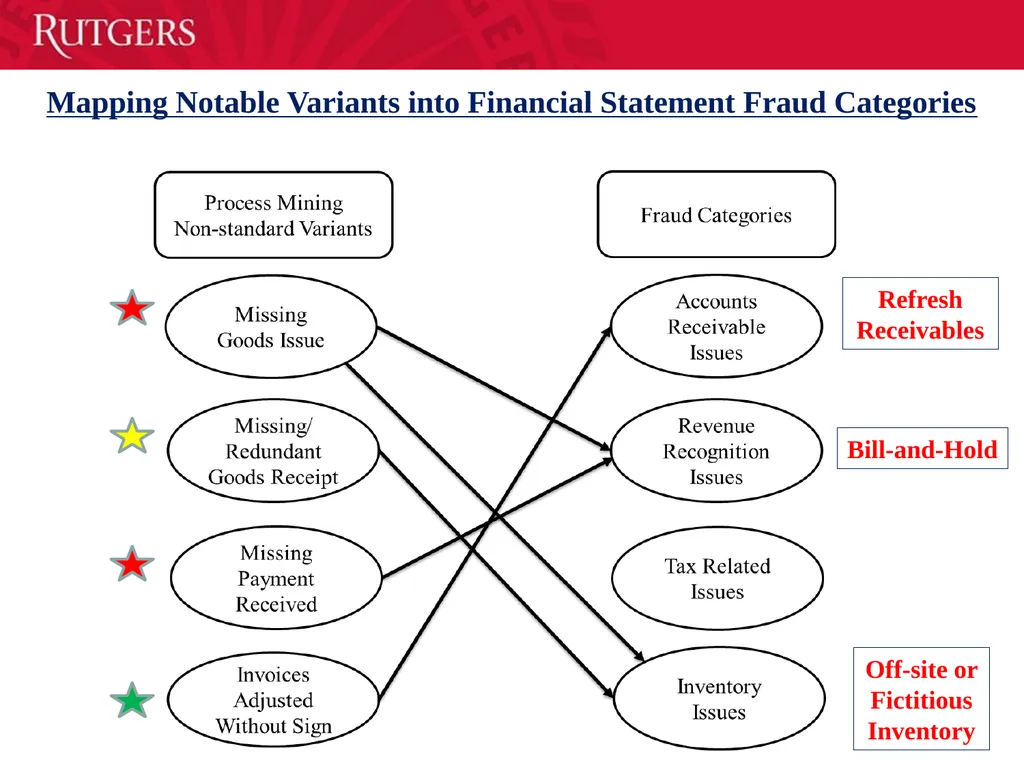
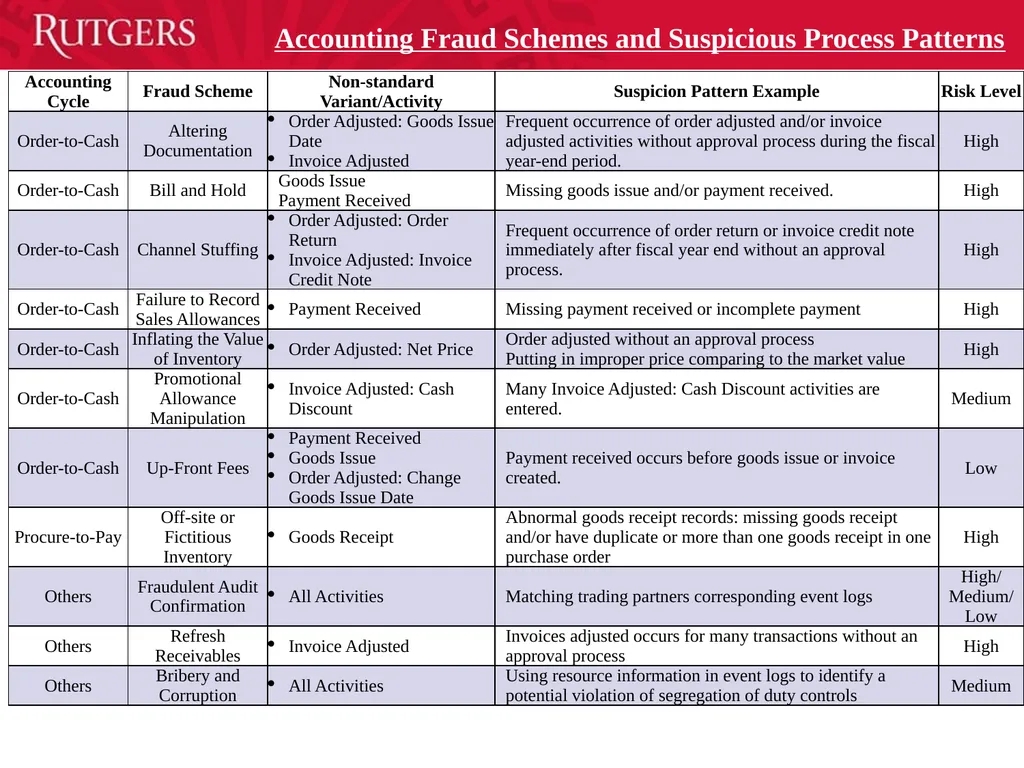
Based on the corporate fraud schemes and the activities and variants in the event logs of an ERP system, this study identifies suspicious patterns or activities for each fraud scheme and assigns the risk levels. 7<br>
08
8 Mapping Notable Variants into Financial Statement Fraud Categories Bill-and-Hold Off-site or Fictitious Inventory Refresh Receivables<br>
09
Accounting Fraud Schemes and Suspicious Process Patterns<br>
10
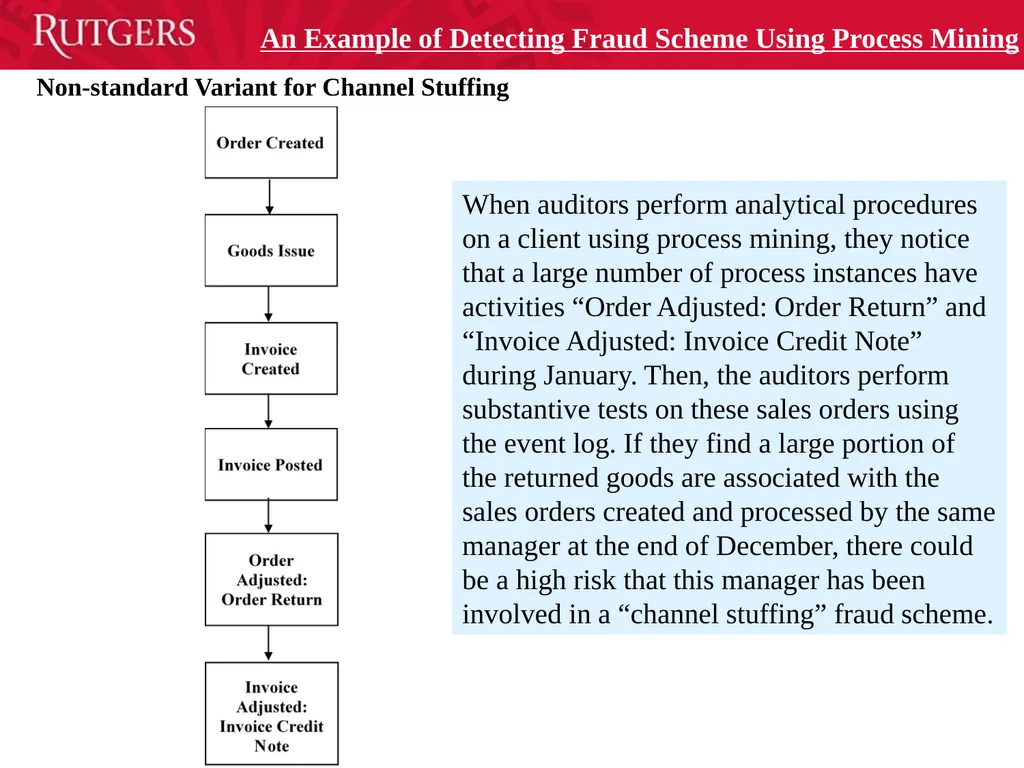
An Example of Detecting Fraud Scheme Using Process Mining When auditors perform analytical procedures on a client using process mining, they notice that a large number of process instances have activities “Order Adjusted: Order Return” and “Invoice Adjusted: Invoice Credit Note” during January. Then, the auditors perform substantive tests on these sales orders using the event log. If they find a large portion of the returned goods are associated with the sales orders created and processed by the same manager at the end of December, there could be a high risk that this manager has been involved in a “channel stuffing” fraud scheme. Non-standard Variant for Channel Stuffing<br>
11
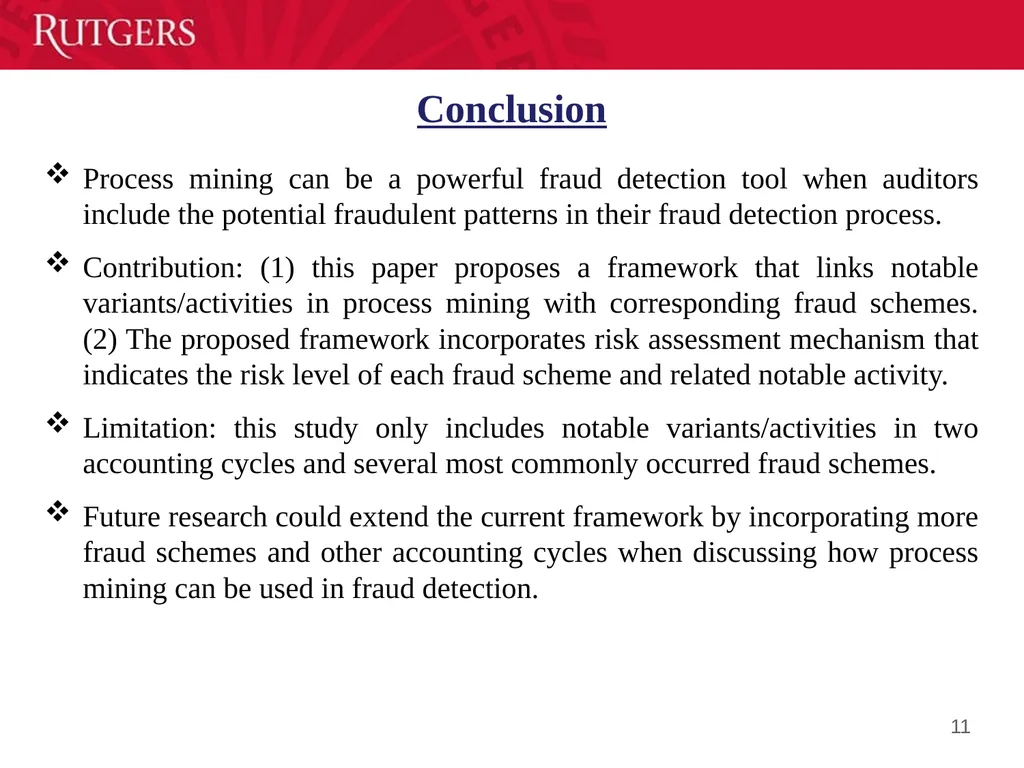
Conclusion Process mining can be a powerful fraud detection tool when auditors include the potential fraudulent patterns in their fraud detection process.
Contribution: (1) this paper proposes a framework that links notable variants/activities in process mining with corresponding fraud schemes. (2) The proposed framework incorporates risk assessment mechanism that indicates the risk level of each fraud scheme and related notable activity.
Limitation: this study only includes notable variants/activities in two accounting cycles and several most commonly occurred fraud schemes.
Future research could extend the current framework by incorporating more fraud schemes and other accounting cycles when discussing how process mining can be used in fraud detection. 11<br>