A level Art Transition How to be prepared for A level Art. Drawing and painting skills You should be practicing your drawing painting photography making skills. This can be in any form or subject matter that interests you. The most
"A level Art Transition How to be prepared for A" is the property of its rightful owner. Permission is granted to
download and print the materials on this website for personal, non-commercial use only, and to display it
on your personal computer provided you do not modify the materials and that you retain all copyright
notices contained in the materials. By downloading content from our website, you accept the terms of this
agreement.
Presentation Transcript
01
A level Art Transition How to be prepared for A level Art.<br>
02
Drawing and painting skills You should be practicing your drawing/ painting/ photography/ making skills. This can be in any form or subject matter that interests you. The most important thing is that you keep improving your skill level, as A level has a much higher expectation in this regard. You should be aiming to do one observational drawing a day.
Here area few online tutorials for improving your drawing skills:
Below are a few videos with tips on drawing details of the face or hands.
https://www.youtube.com/watch?v=zqNZ9df0tho
https://www.youtube.com/watch?v=-WR-FyUQc6I
https://www.youtube.com/watch?v=j739xyYn0fE
https://www.youtube.com/watch?v=vrN4TOY8rSw<br>
03
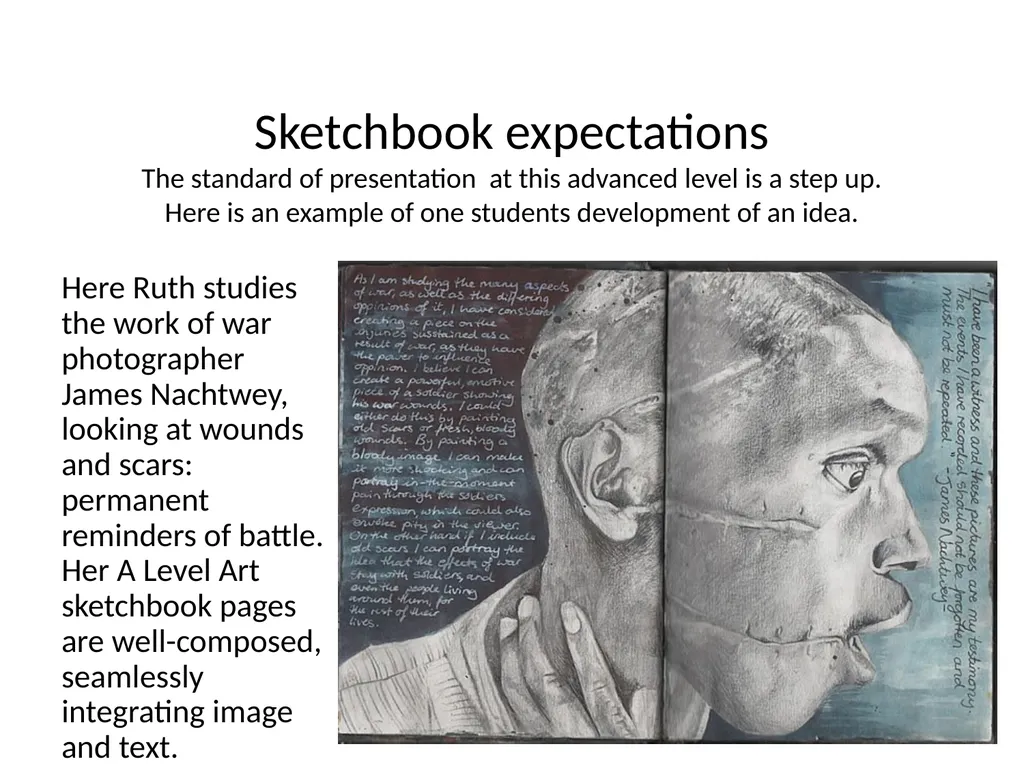
Sketchbook expectations The standard of presentation at this advanced level is a step up. Here is an example of one students development of an idea. Here Ruth studies the work of war photographer James Nachtwey, looking at wounds and scars: permanent reminders of battle. Her A Level Art sketchbook pages are well-composed, seamlessly integrating image and text.<br>
04
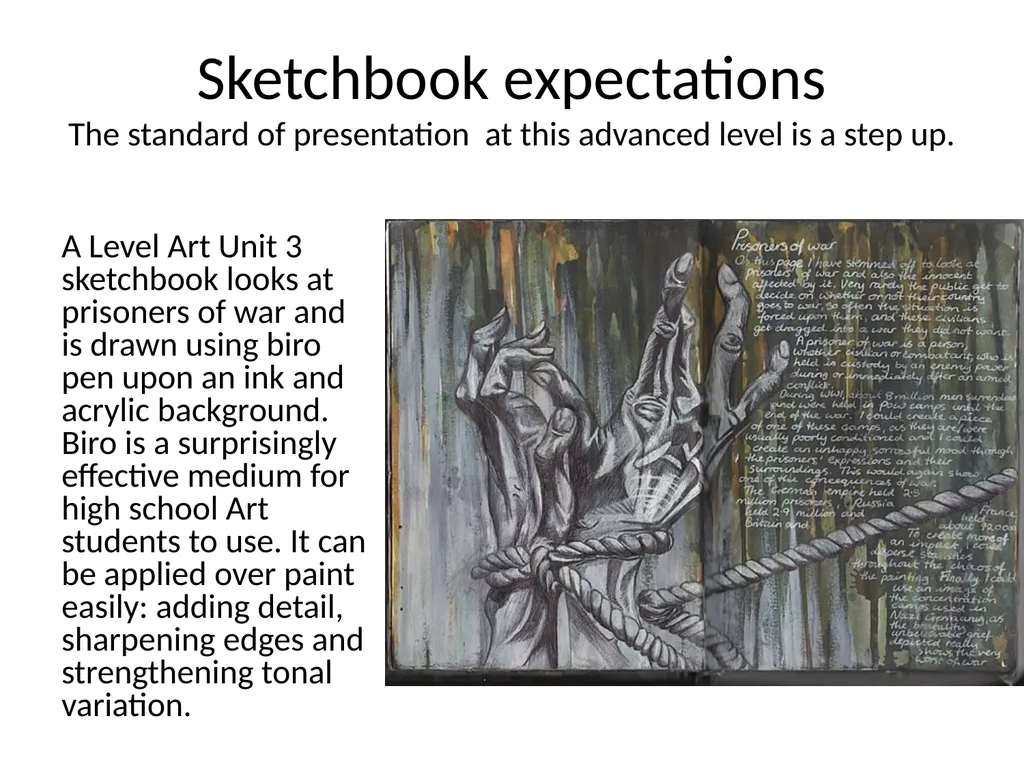
Sketchbook expectations The standard of presentation at this advanced level is a step up. A Level Art Unit 3 sketchbook looks at prisoners of war and is drawn using biro pen upon an ink and acrylic background. Biro is a surprisingly effective medium for high school Art students to use. It can be applied over paint easily: adding detail, sharpening edges and strengthening tonal variation.<br>
05
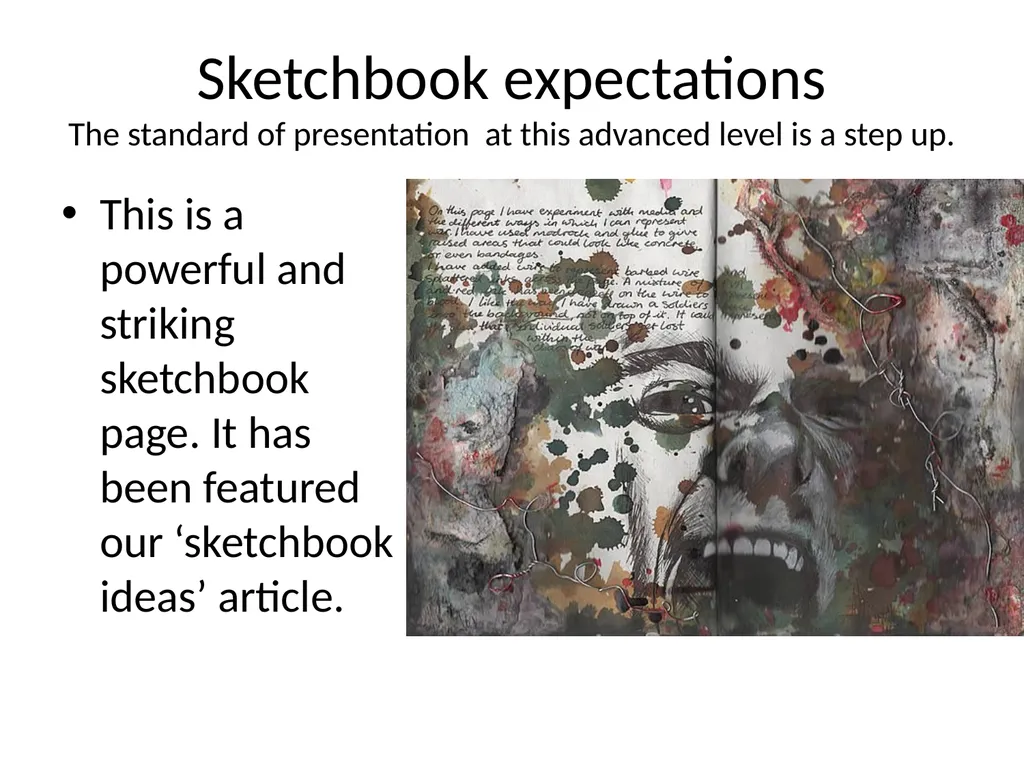
Sketchbook expectations The standard of presentation at this advanced level is a step up. This is a powerful and striking sketchbook page. It has been featured our ‘sketchbook ideas’ article.<br>
06
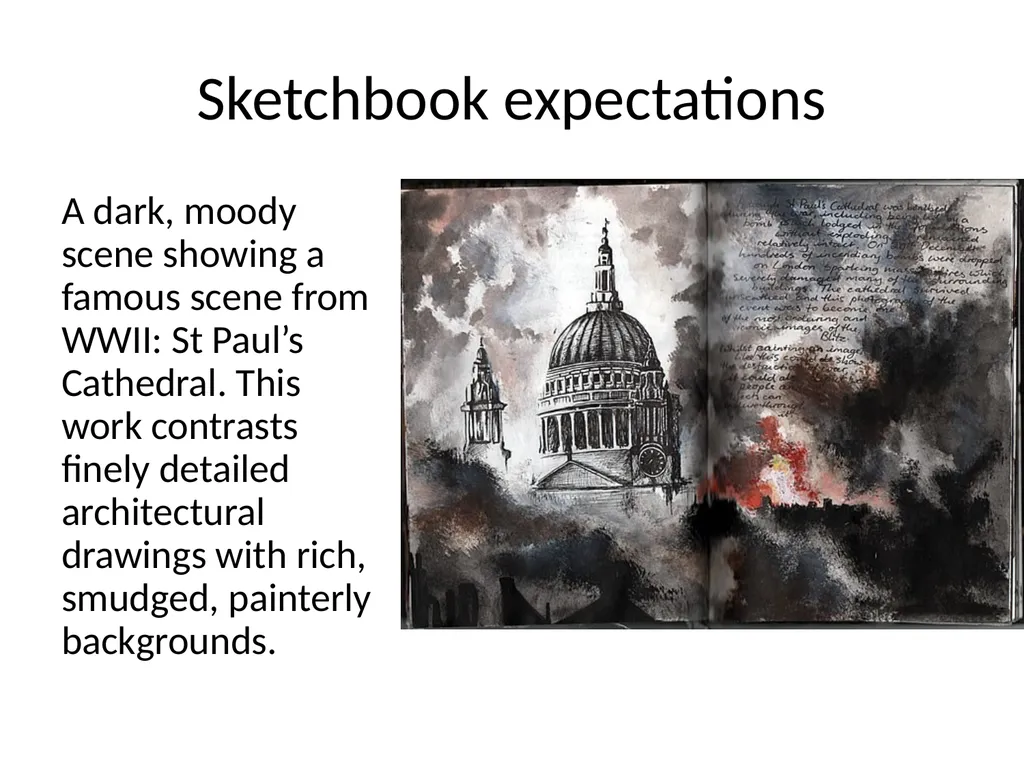
Sketchbook expectations A dark, moody scene showing a famous scene from WWII: St Paul’s Cathedral. This work contrasts finely detailed architectural drawings with rich, smudged, painterly backgrounds.<br>
07
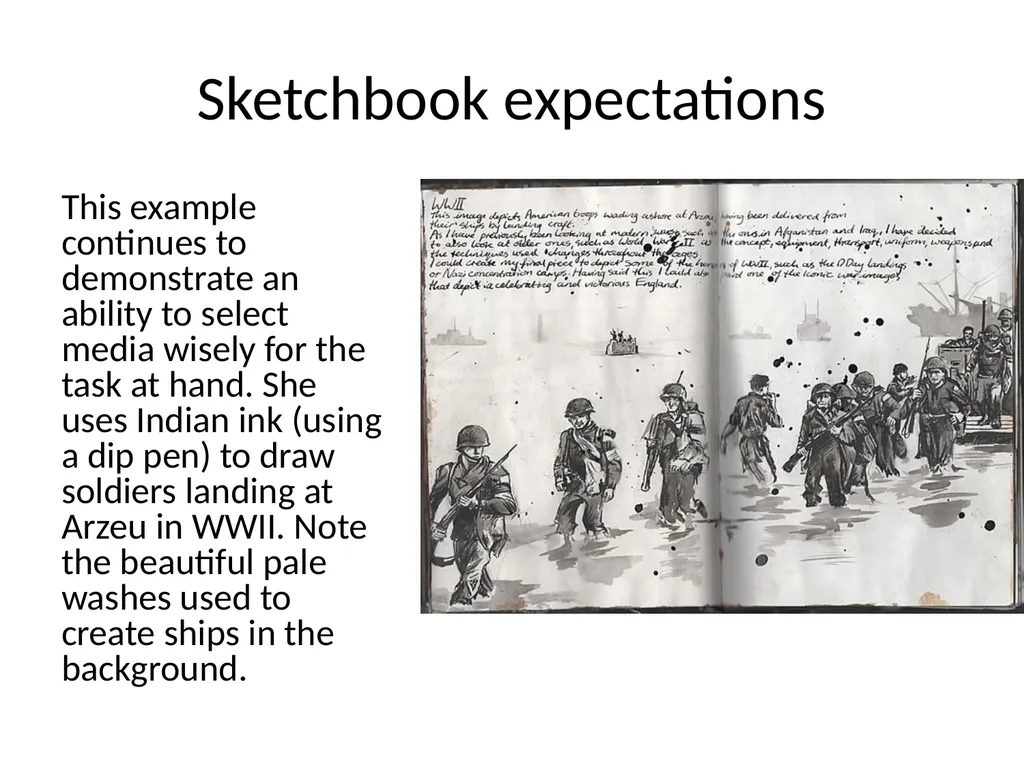
Sketchbook expectations This example continues to demonstrate an ability to select media wisely for the task at hand. She uses Indian ink (using a dip pen) to draw soldiers landing at Arzeu in WWII. Note the beautiful pale washes used to create ships in the background.<br>
08
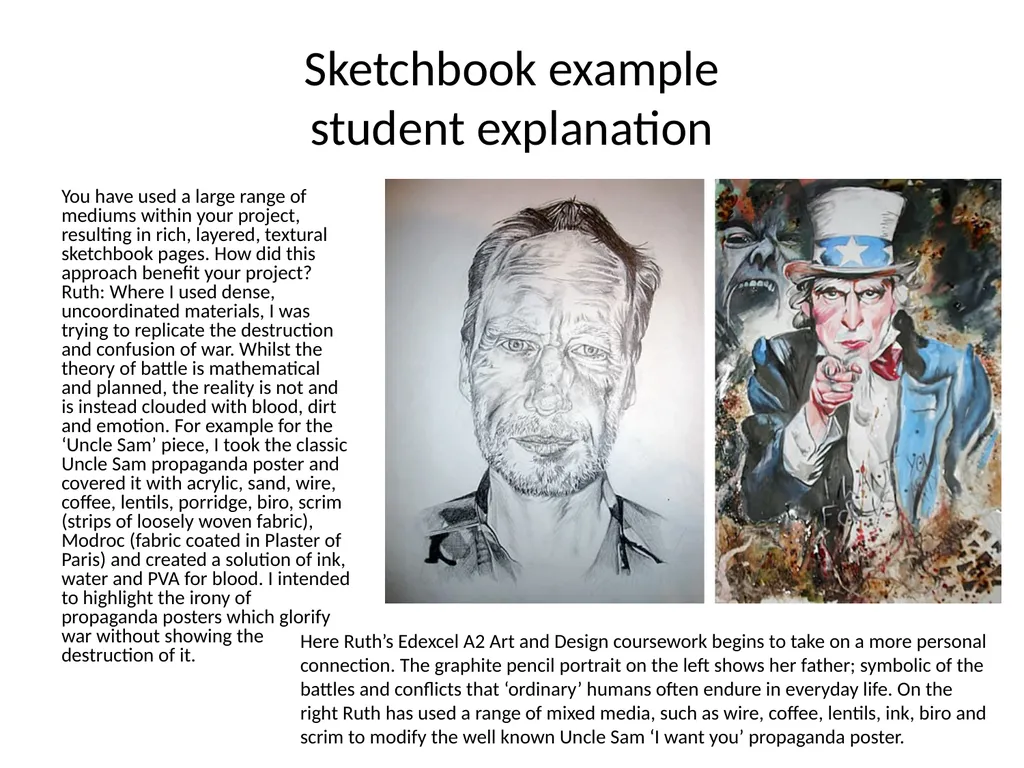
Sketchbook example student explanation You have used a large range of mediums within your project, resulting in rich, layered, textural sketchbook pages. How did this approach benefit your project? Ruth: Where I used dense, uncoordinated materials, I was trying to replicate the destruction and confusion of war. Whilst the theory of battle is mathematical and planned, the reality is not and is instead clouded with blood, dirt and emotion. For example for the ‘Uncle Sam’ piece, I took the classic Uncle Sam propaganda poster and covered it with acrylic, sand, wire, coffee, lentils, porridge, biro, scrim (strips of loosely woven fabric), Modroc (fabric coated in Plaster of Paris) and created a solution of ink, water and PVA for blood. I intended to highlight the irony of propaganda posters which glorify war without showing the destruction of it. Here Ruth’s Edexcel A2 Art and Design coursework begins to take on a more personal connection. The graphite pencil portrait on the left shows her father; symbolic of the battles and conflicts that ‘ordinary’ humans often endure in everyday life. On the right Ruth has used a range of mixed media, such as wire, coffee, lentils, ink, biro and scrim to modify the well known Uncle Sam ‘I want you’ propaganda poster.<br>
09
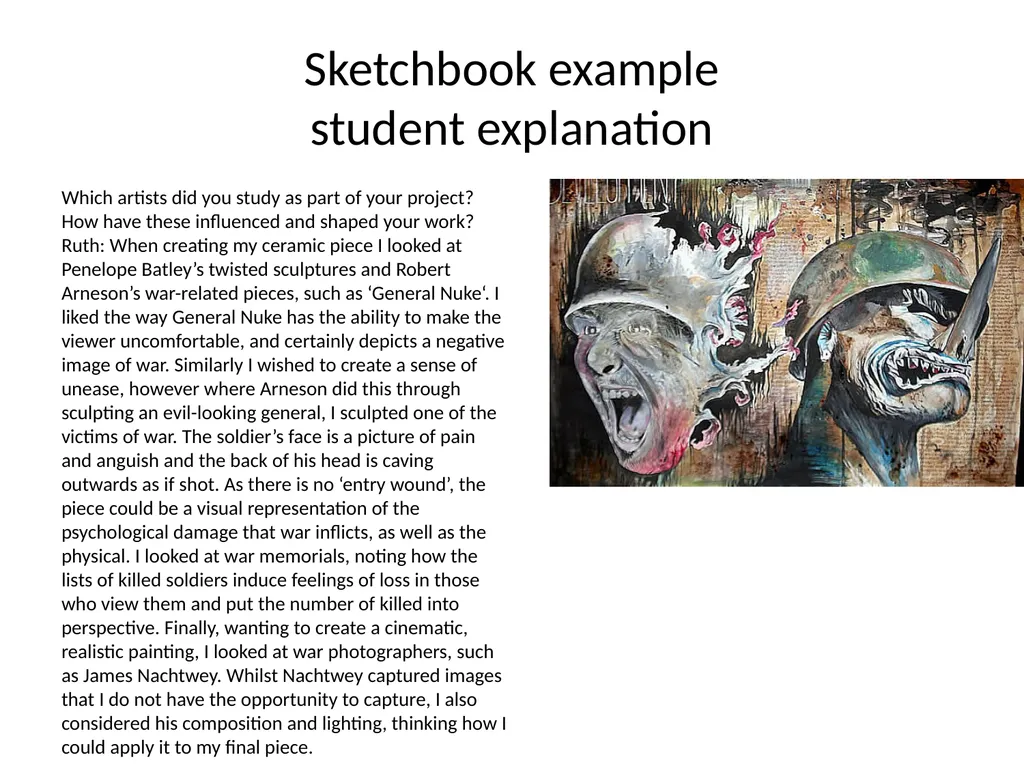
Sketchbook example student explanation Which artists did you study as part of your project? How have these influenced and shaped your work? Ruth: When creating my ceramic piece I looked at Penelope Batley’s twisted sculptures and Robert Arneson’s war-related pieces, such as ‘General Nuke‘. I liked the way General Nuke has the ability to make the viewer uncomfortable, and certainly depicts a negative image of war. Similarly I wished to create a sense of unease, however where Arneson did this through sculpting an evil-looking general, I sculpted one of the victims of war. The soldier’s face is a picture of pain and anguish and the back of his head is caving outwards as if shot. As there is no ‘entry wound’, the piece could be a visual representation of the psychological damage that war inflicts, as well as the physical. I looked at war memorials, noting how the lists of killed soldiers induce feelings of loss in those who view them and put the number of killed into perspective. Finally, wanting to create a cinematic, realistic painting, I looked at war photographers, such as James Nachtwey. Whilst Nachtwey captured images that I do not have the opportunity to capture, I also considered his composition and lighting, thinking how I could apply it to my final piece.<br>
10
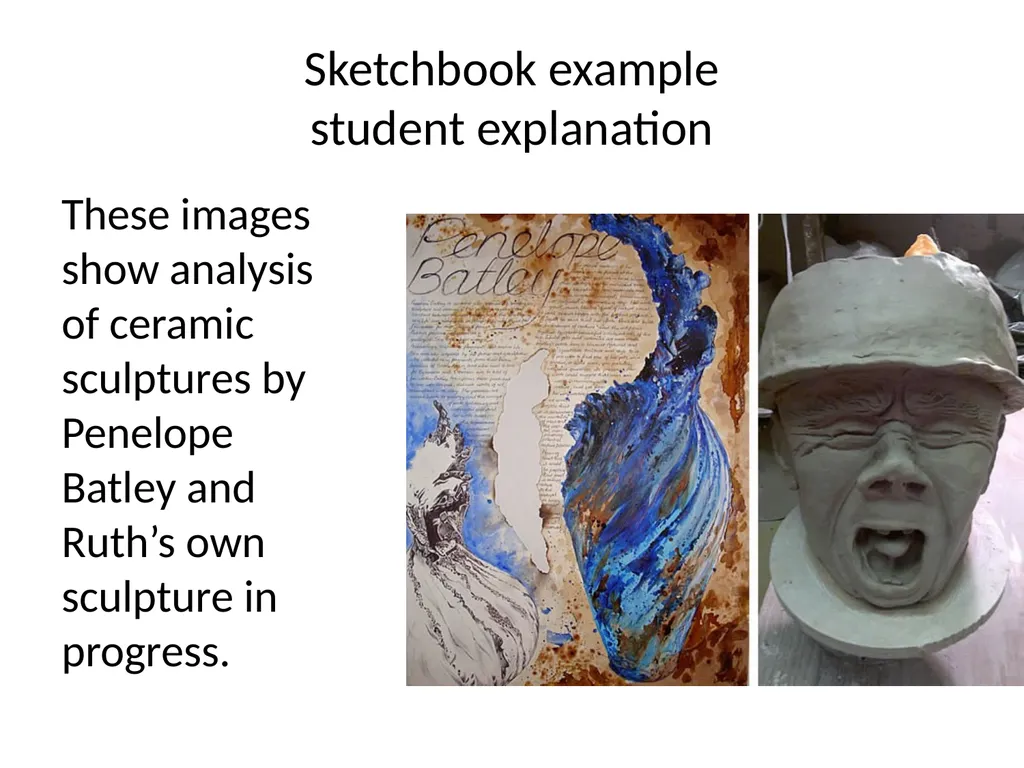
Sketchbook example student explanation These images show analysis of ceramic sculptures by Penelope Batley and Ruth’s own sculpture in progress.<br>
11
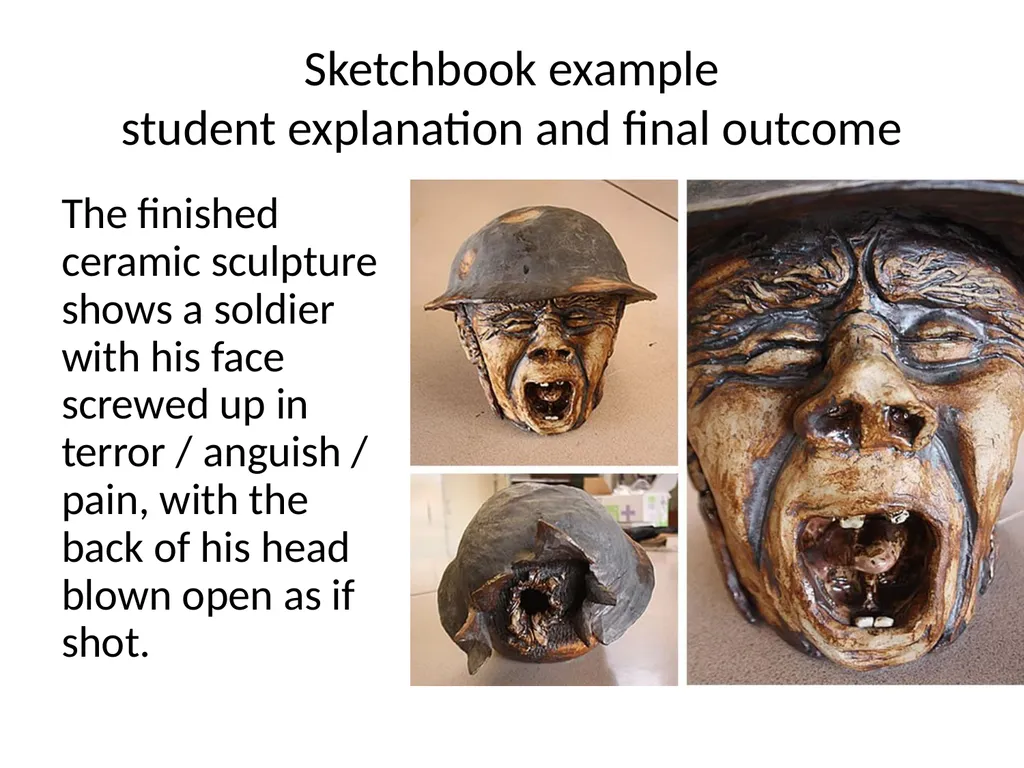
Sketchbook example student explanation and final outcome The finished ceramic sculpture shows a soldier with his face screwed up in terror / anguish / pain, with the back of his head blown open as if shot.<br>
http://www.artnet.com/artists/ You should also be broadening your knowledge of artists and designers, creative practitioners of any sort.
Your understanding of their creative processes and motivations becomes more in-depth at A level. There will be written assignments asking you to research and analyse artists of your choice that form a separate assessment as part of your grading. It is a good chance to start reading up on areas of interest to give you a greater understanding of the creative industries and the wide range of practitioners. Reading about artists on gallery websites is a good start as visiting is not possible at present. Keep a notebook of details of artist that you like. This means later when you are asked to produce research to inform your work you will have a bank of artists you already know are working in a way you would like to follow and experiment in a similar way.
Have artists working in a range of media. ( Painting, sculpture, photography, film, textiles, installation, ceramics, fashion, etc)
The following websites are a good place to start.<br>