
A-level Sociology Unit 3 CPD Presentation Option 1


Description: A-level Sociology Unit 3 CPD Presentation Option 1 Crime and Deviance continues to be by far the most popular and there still no centres opting for politics. The standard was generally very high candidates cope well with the demands of
Related Topics
Download Presentation
"A-level Sociology Unit 3 CPD Presentation Option 1" is the property of its rightful owner. Permission is granted to download and print the materials on this website for personal, non-commercial use only, and to display it on your personal computer provided you do not modify the materials and that you retain all copyright notices contained in the materials. By downloading content from our website, you accept the terms of this agreement.
Presentation Transcript
slide1. A-level Sociology Unit 3 CPD Presentation<br>
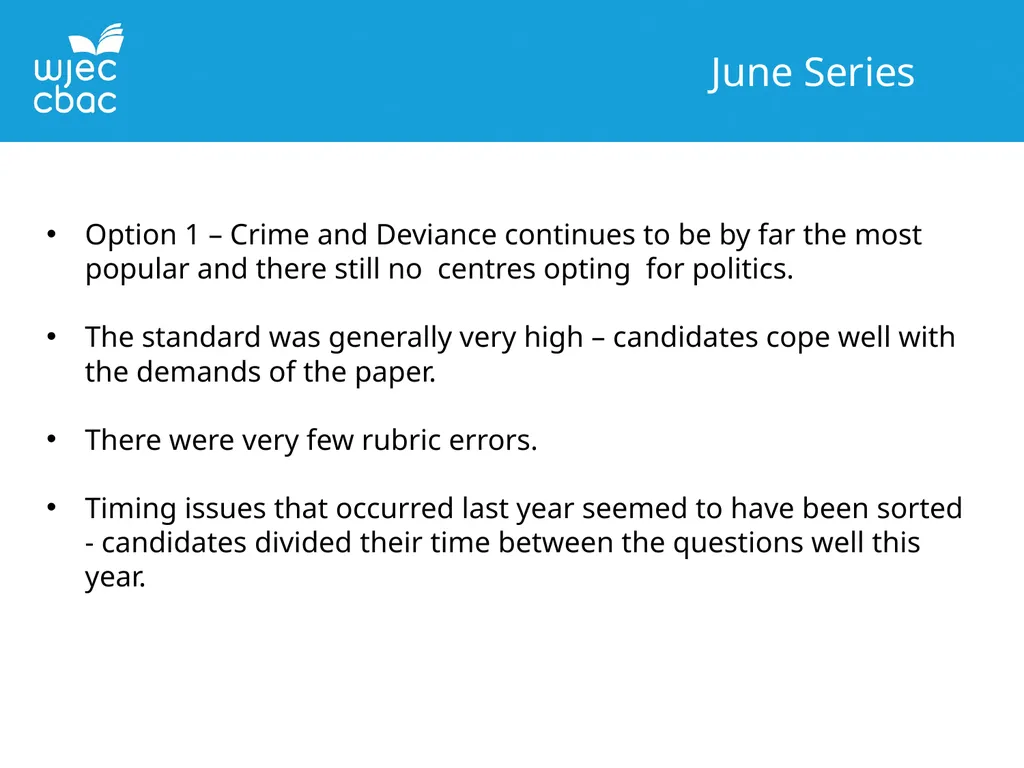
slide2. Option 1 – Crime and Deviance continues to be by far the most popular and there still no centres opting for politics.
The standard was generally very high – candidates cope well with the demands of the paper.
There were very few rubric errors.
Timing issues that occurred last year seemed to have been sorted - candidates divided their time between the questions well this year. June Series<br>
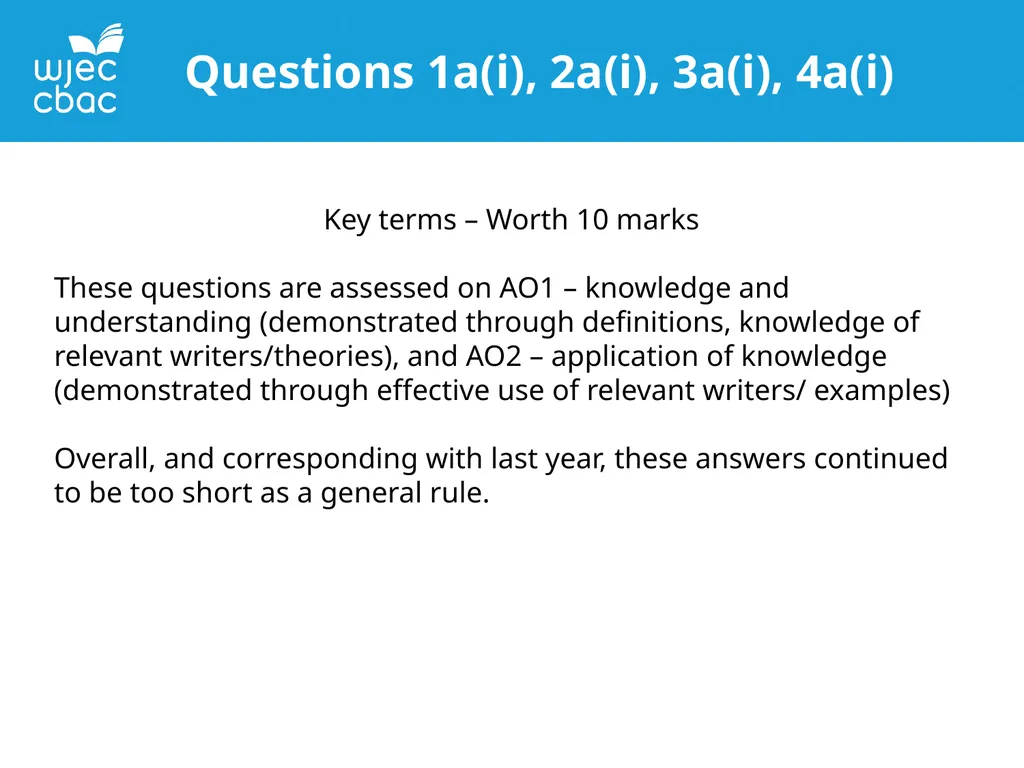
slide3. Key terms – Worth 10 marks
These questions are assessed on AO1 – knowledge and understanding (demonstrated through definitions, knowledge of relevant writers/theories), and AO2 – application of knowledge (demonstrated through effective use of relevant writers/ examples)
Overall, and corresponding with last year, these answers continued to be too short as a general rule. Questions 1a(i), 2a(i), 3a(i), 4a(i)<br>
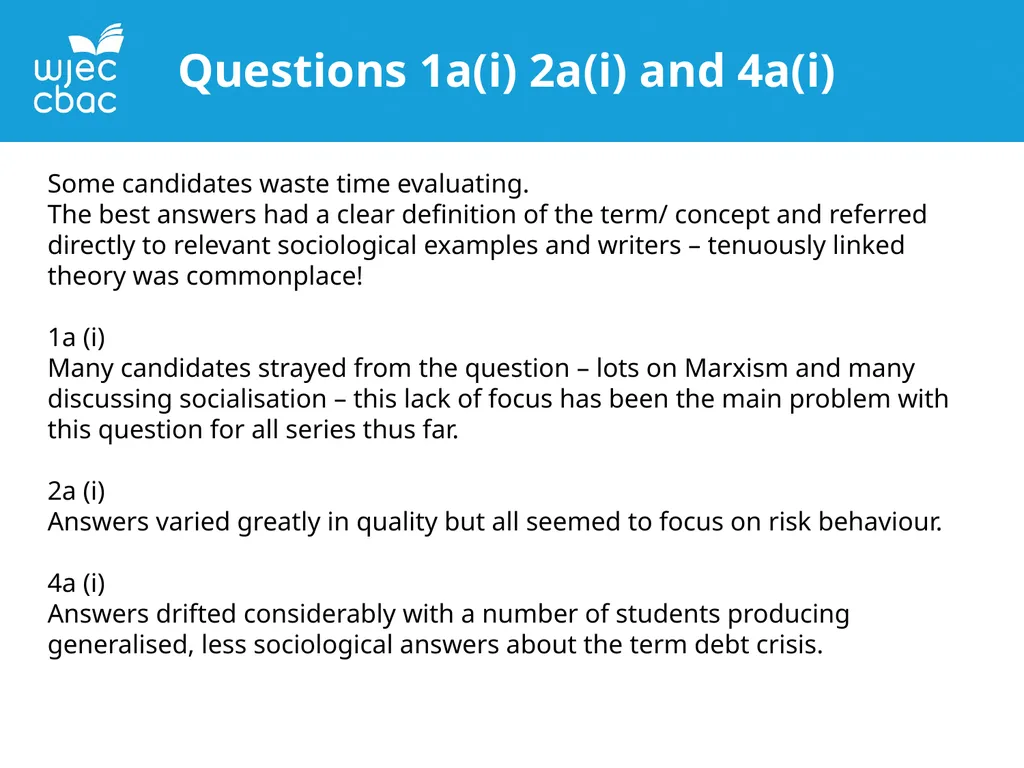
slide4. Some candidates waste time evaluating.
The best answers had a clear definition of the term/ concept and referred directly to relevant sociological examples and writers – tenuously linked theory was commonplace!
1a (i)
Many candidates strayed from the question – lots on Marxism and many discussing socialisation – this lack of focus has been the main problem with this question for all series thus far.
2a (i)
Answers varied greatly in quality but all seemed to focus on risk behaviour.
4a (i)
Answers drifted considerably with a number of students producing generalised, less sociological answers about the term debt crisis. Questions 1a(i) 2a(i) and 4a(i)<br>
slide5. Worth - 20 marks
1a (ii)
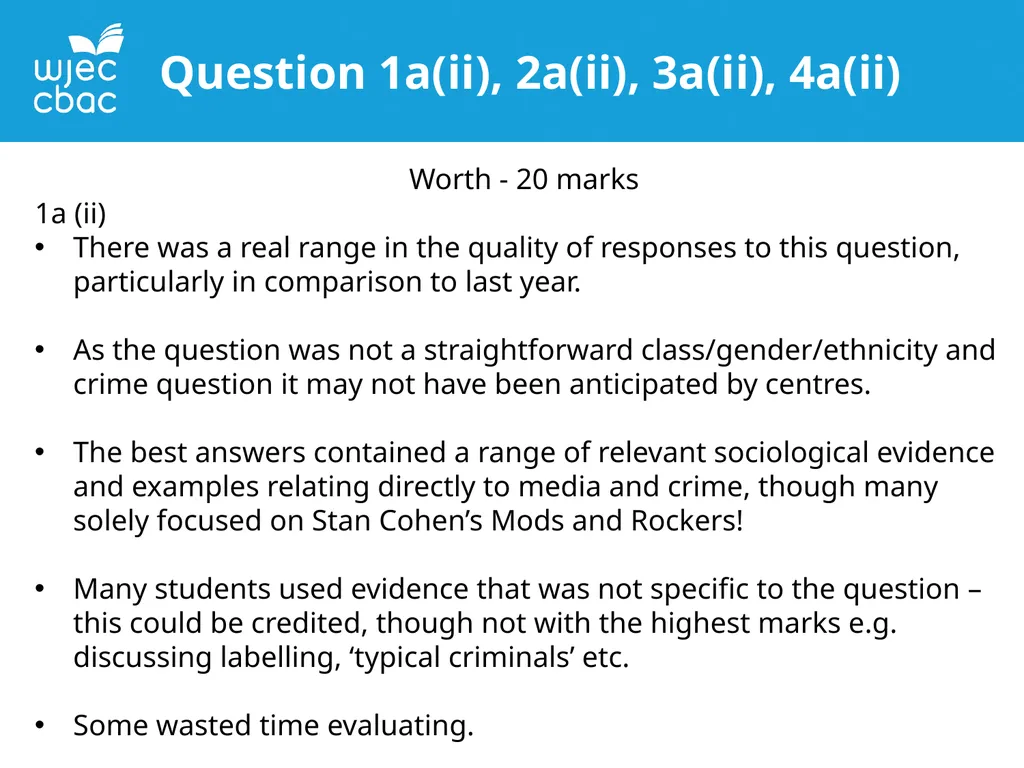
There was a real range in the quality of responses to this question, particularly in comparison to last year.
As the question was not a straightforward class/gender/ethnicity and crime question it may not have been anticipated by centres.
The best answers contained a range of relevant sociological evidence and examples relating directly to media and crime, though many solely focused on Stan Cohen’s Mods and Rockers!
Many students used evidence that was not specific to the question – this could be credited, though not with the highest marks e.g. discussing labelling, ‘typical criminals’ etc.
Some wasted time evaluating. Question 1a(ii), 2a(ii), 3a(ii), 4a(ii)<br>
slide6. 1a(ii)
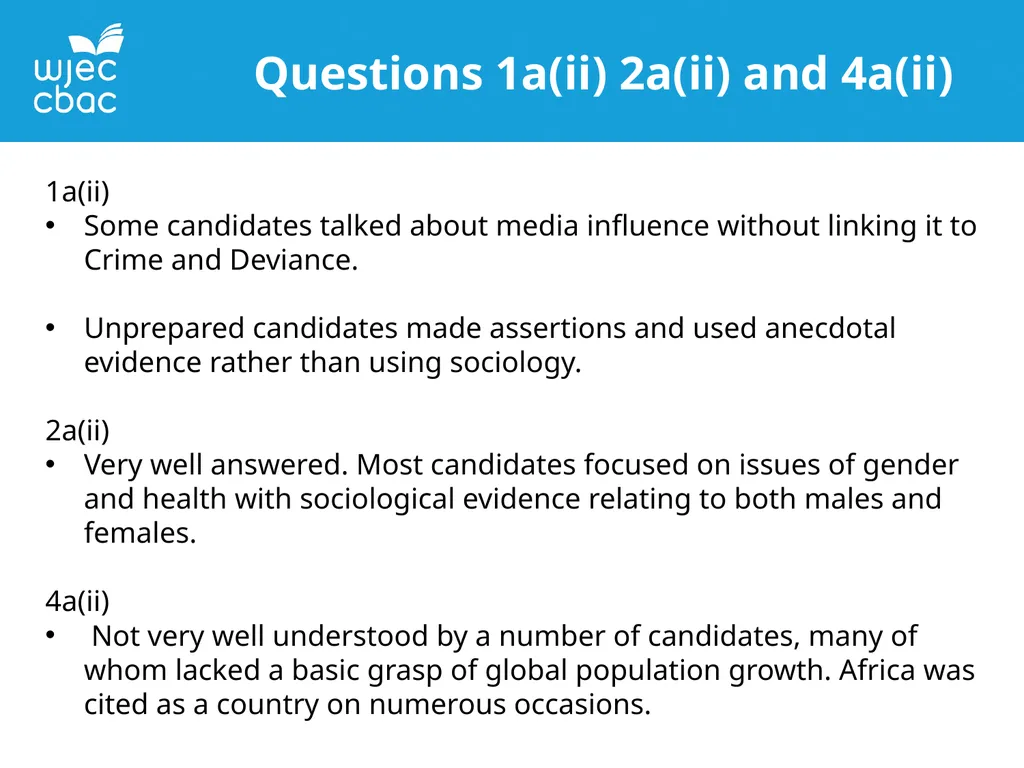
Some candidates talked about media influence without linking it to Crime and Deviance.
Unprepared candidates made assertions and used anecdotal evidence rather than using sociology.
2a(ii)
Very well answered. Most candidates focused on issues of gender and health with sociological evidence relating to both males and females.
4a(ii)
Not very well understood by a number of candidates, many of whom lacked a basic grasp of global population growth. Africa was cited as a country on numerous occasions. Questions 1a(ii) 2a(ii) and 4a(ii)<br>
slide7. Essay Questions – Worth 40 marks
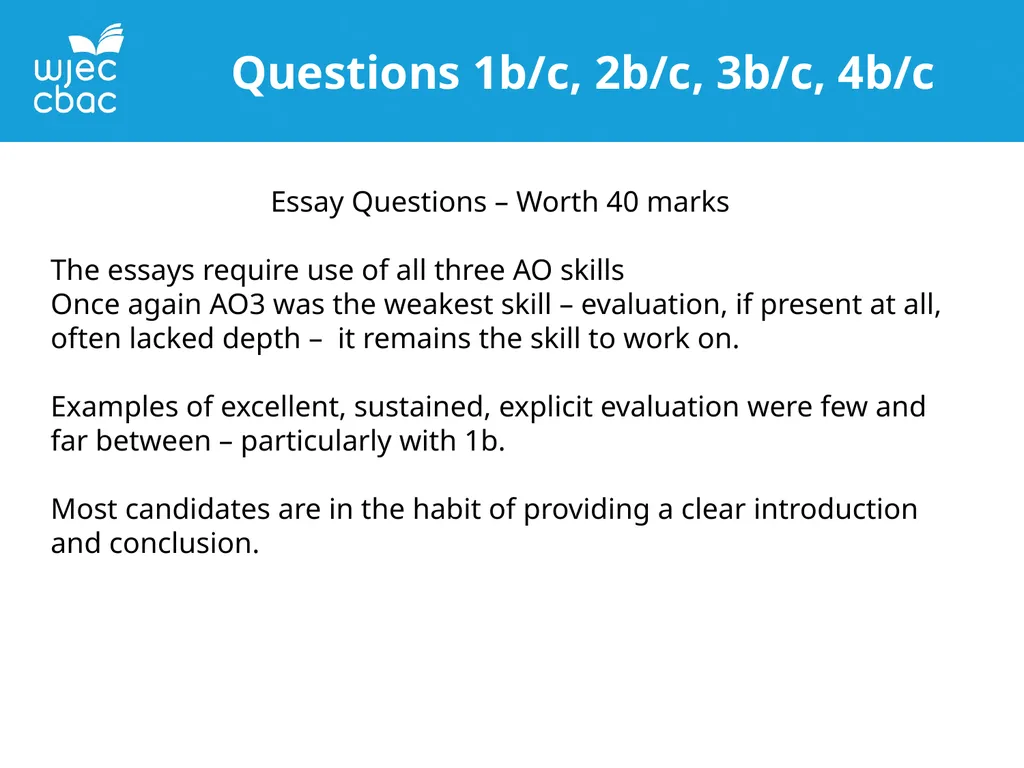
The essays require use of all three AO skills
Once again AO3 was the weakest skill – evaluation, if present at all, often lacked depth – it remains the skill to work on.
Examples of excellent, sustained, explicit evaluation were few and far between – particularly with 1b.
Most candidates are in the habit of providing a clear introduction and conclusion. Questions 1b/c, 2b/c, 3b/c, 4b/c<br>
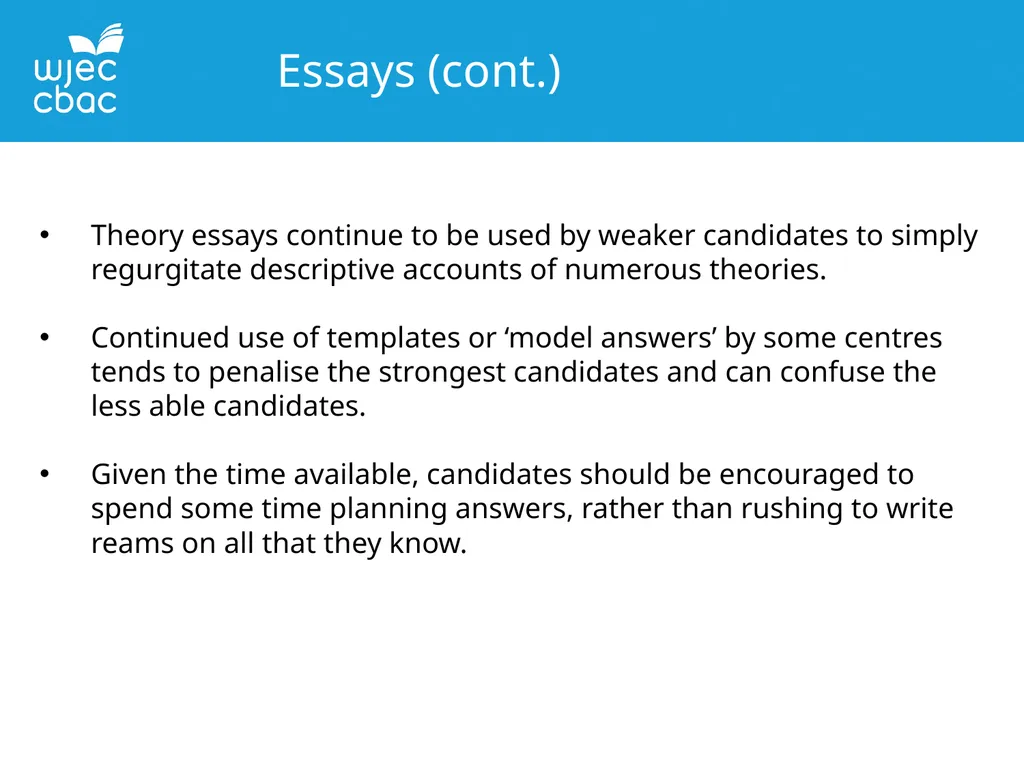
slide8. Theory essays continue to be used by weaker candidates to simply regurgitate descriptive accounts of numerous theories.
Continued use of templates or ‘model answers’ by some centres tends to penalise the strongest candidates and can confuse the less able candidates.
Given the time available, candidates should be encouraged to spend some time planning answers, rather than rushing to write reams on all that they know. Essays (cont.)<br>
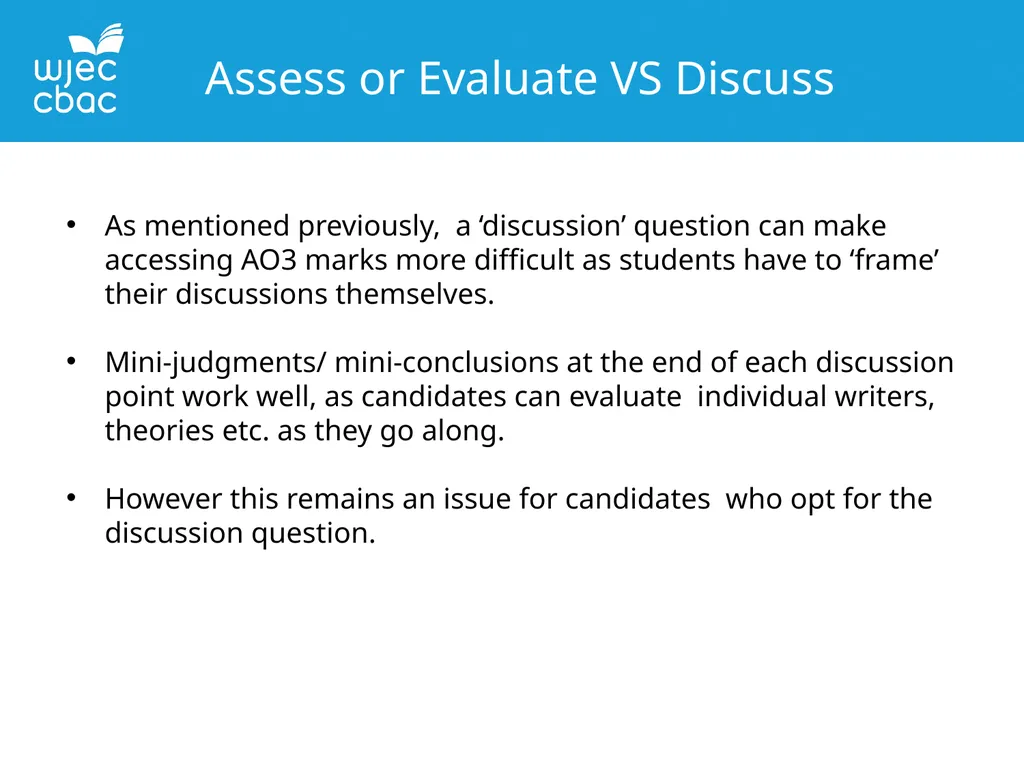
slide9. As mentioned previously, a ‘discussion’ question can make accessing AO3 marks more difficult as students have to ‘frame’ their discussions themselves.
Mini-judgments/ mini-conclusions at the end of each discussion point work well, as candidates can evaluate individual writers, theories etc. as they go along.
However this remains an issue for candidates who opt for the discussion question. Assess or Evaluate VS Discuss<br>
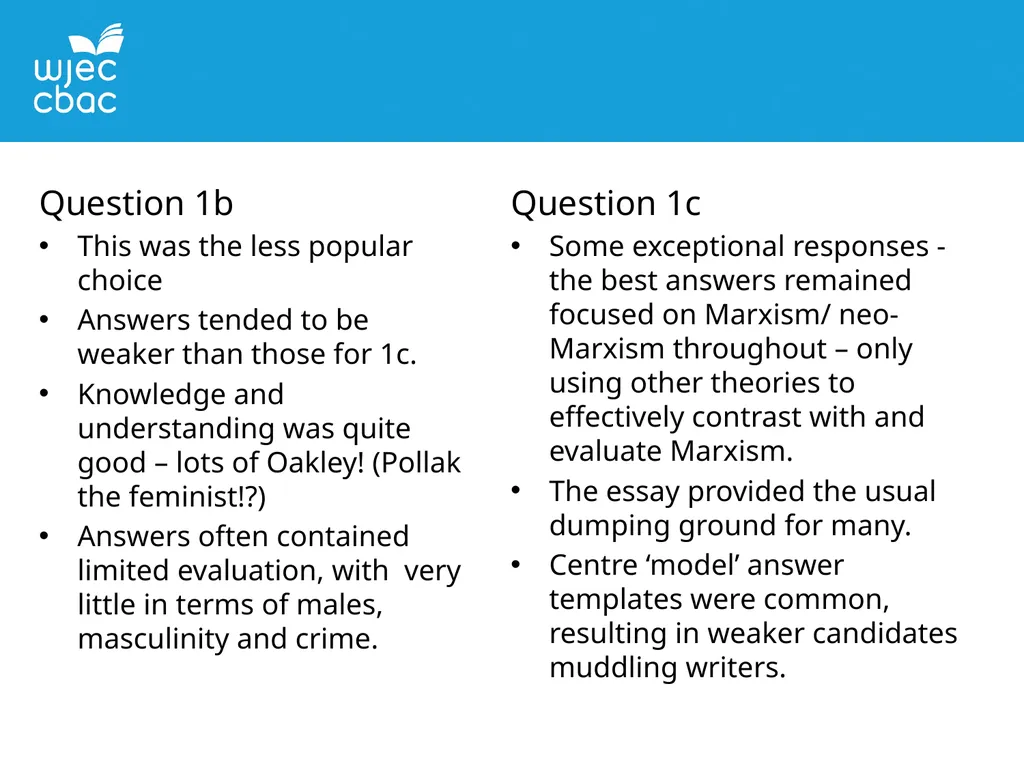
slide10. Question 1b
This was the less popular choice
Answers tended to be weaker than those for 1c.
Knowledge and understanding was quite good – lots of Oakley! (Pollak the feminist!?)
Answers often contained limited evaluation, with very little in terms of males, masculinity and crime. Question 1c
Some exceptional responses - the best answers remained focused on Marxism/ neo-Marxism throughout – only using other theories to effectively contrast with and evaluate Marxism.
The essay provided the usual dumping ground for many.
Centre ‘model’ answer templates were common, resulting in weaker candidates muddling writers.<br>
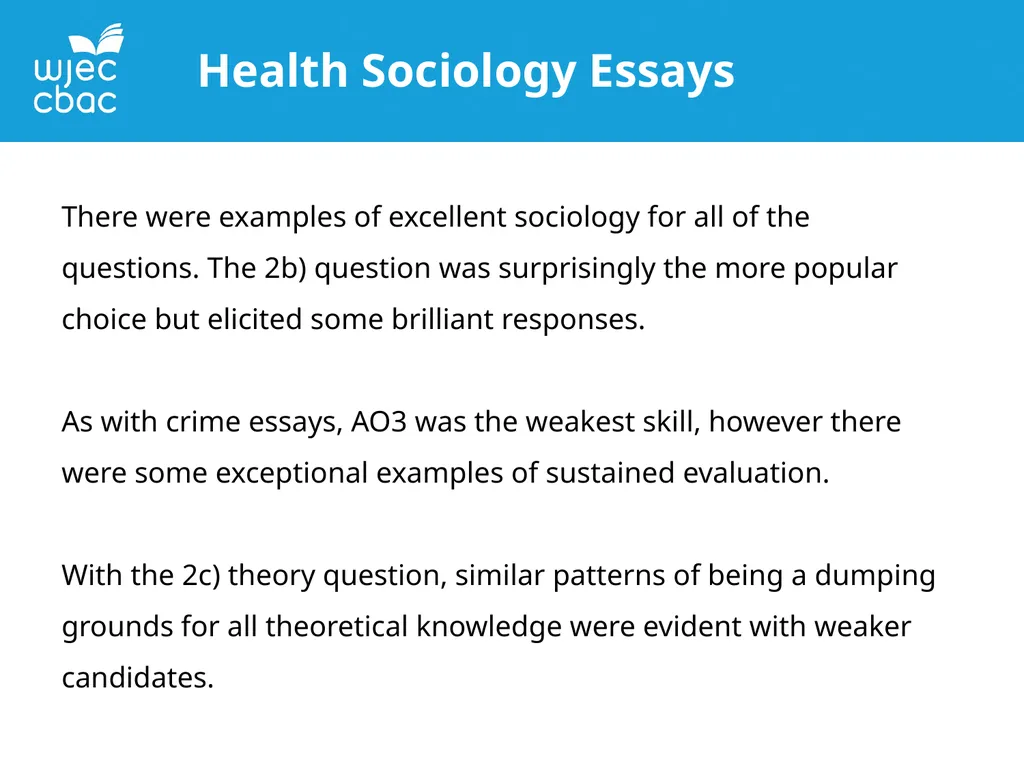
slide11. There were examples of excellent sociology for all of the questions. The 2b) question was surprisingly the more popular choice but elicited some brilliant responses.
As with crime essays, AO3 was the weakest skill, however there were some exceptional examples of sustained evaluation.
With the 2c) theory question, similar patterns of being a dumping grounds for all theoretical knowledge were evident with weaker candidates. Health Sociology Essays<br>
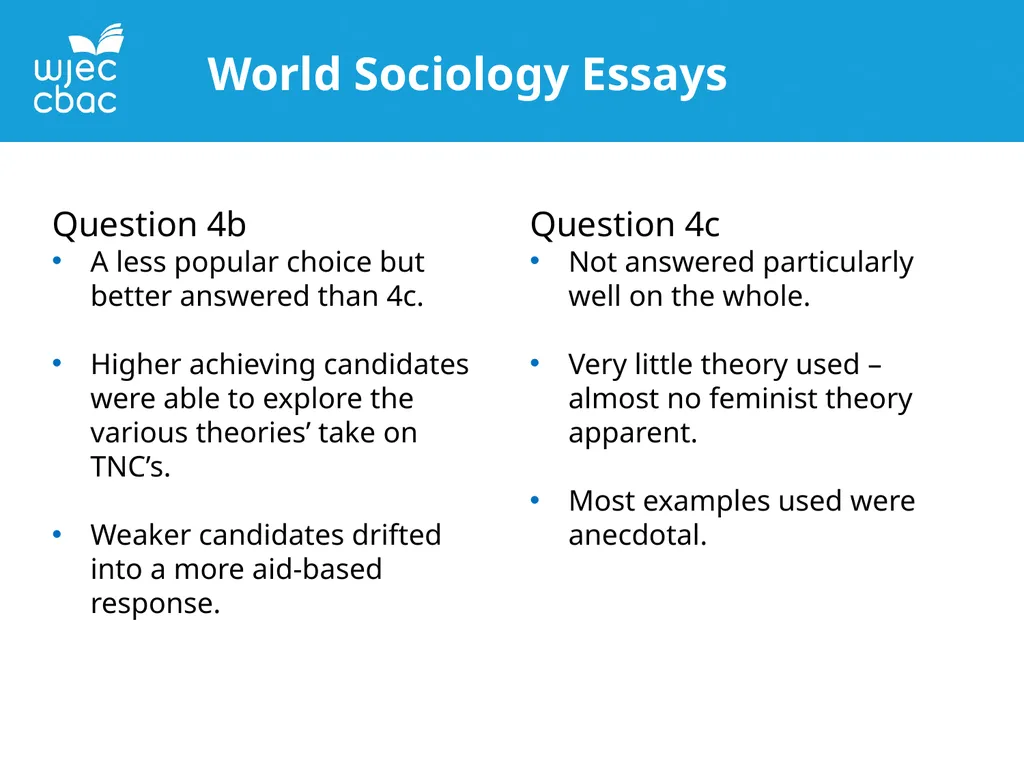
slide12. World Sociology Essays Question 4b
A less popular choice but better answered than 4c.
Higher achieving candidates were able to explore the various theories’ take on TNC’s.
Weaker candidates drifted into a more aid-based response. Question 4c
Not answered particularly well on the whole.
Very little theory used – almost no feminist theory apparent.
Most examples used were anecdotal.<br>
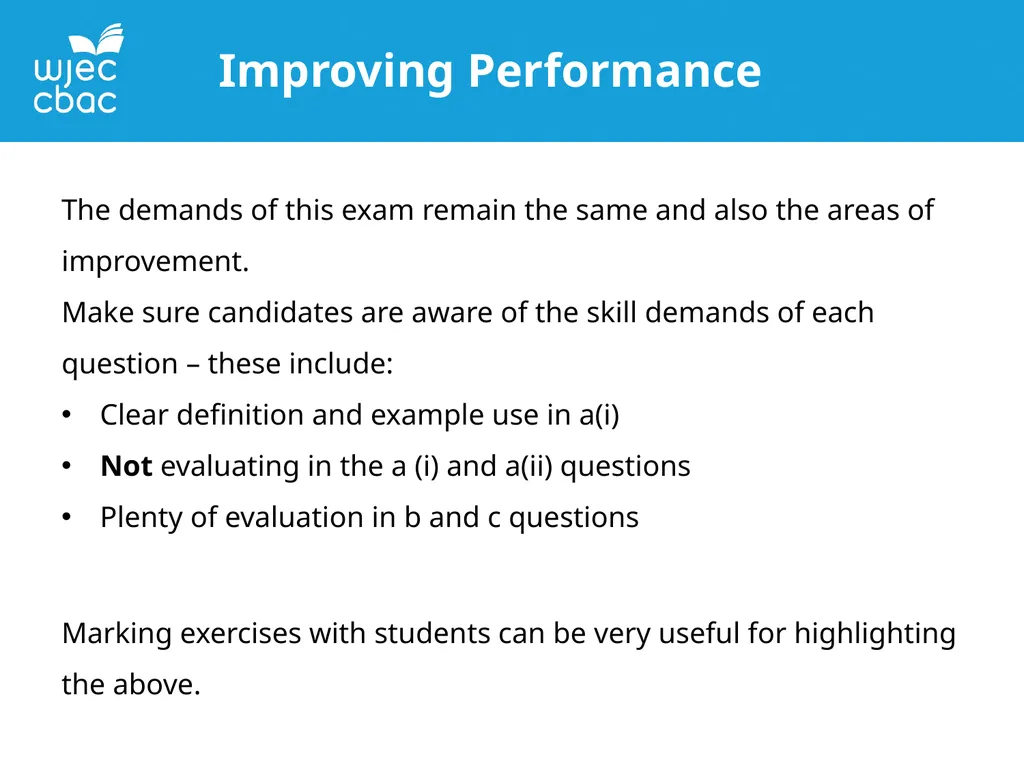
slide13. Improving Performance The demands of this exam remain the same and also the areas of improvement.
Make sure candidates are aware of the skill demands of each question – these include:
Clear definition and example use in a(i)
Not evaluating in the a (i) and a(ii) questions
Plenty of evaluation in b and c questions
Marking exercises with students can be very useful for highlighting the above.<br>
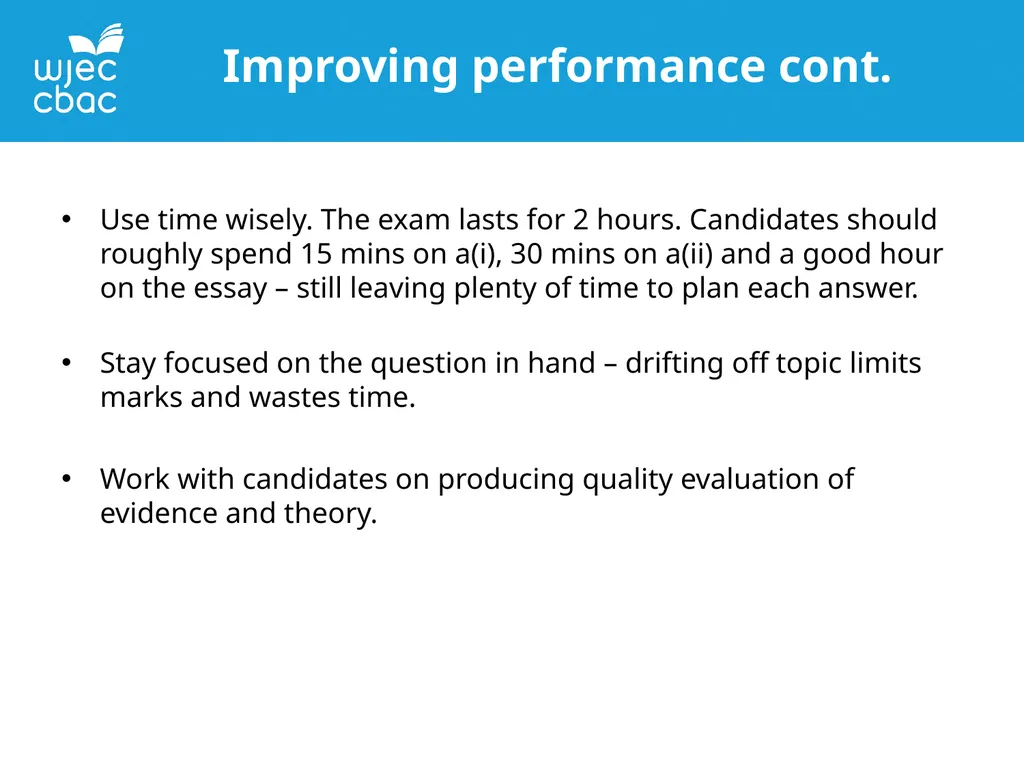
slide14. Improving performance cont. Use time wisely. The exam lasts for 2 hours. Candidates should roughly spend 15 mins on a(i), 30 mins on a(ii) and a good hour on the essay – still leaving plenty of time to plan each answer.
Stay focused on the question in hand – drifting off topic limits marks and wastes time.
Work with candidates on producing quality evaluation of evidence and theory.<br>
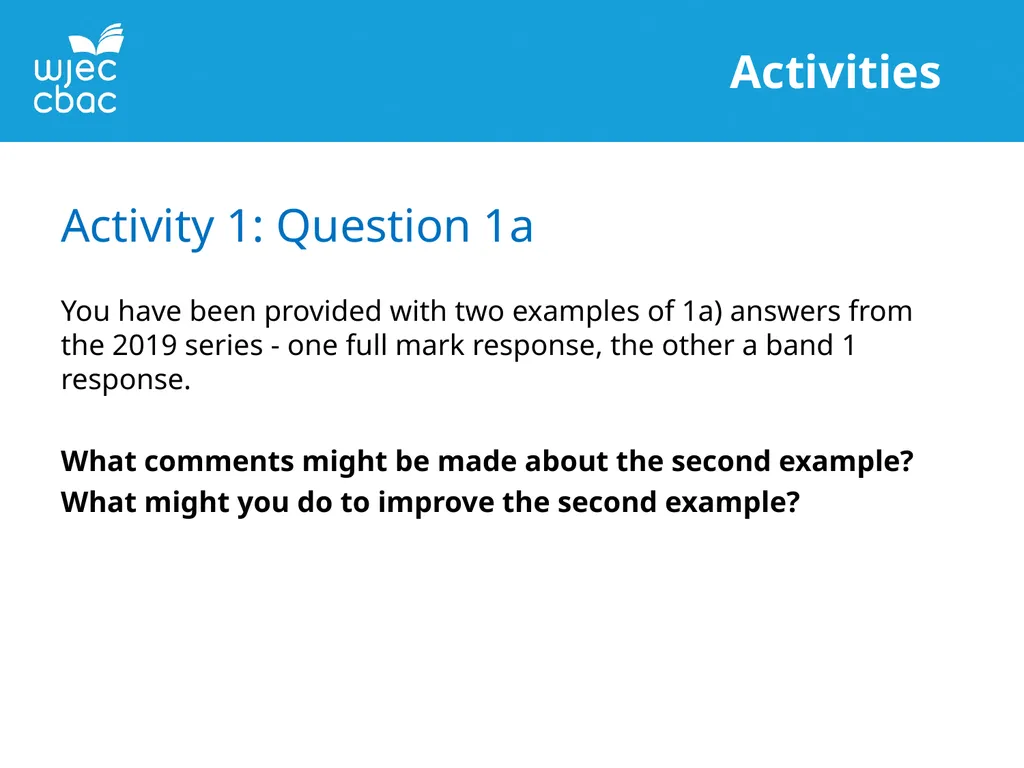
slide15. Activity 1: Question 1a You have been provided with two examples of 1a) answers from the 2019 series - one full mark response, the other a band 1 response.
What comments might be made about the second example?
What might you do to improve the second example? Activities<br>
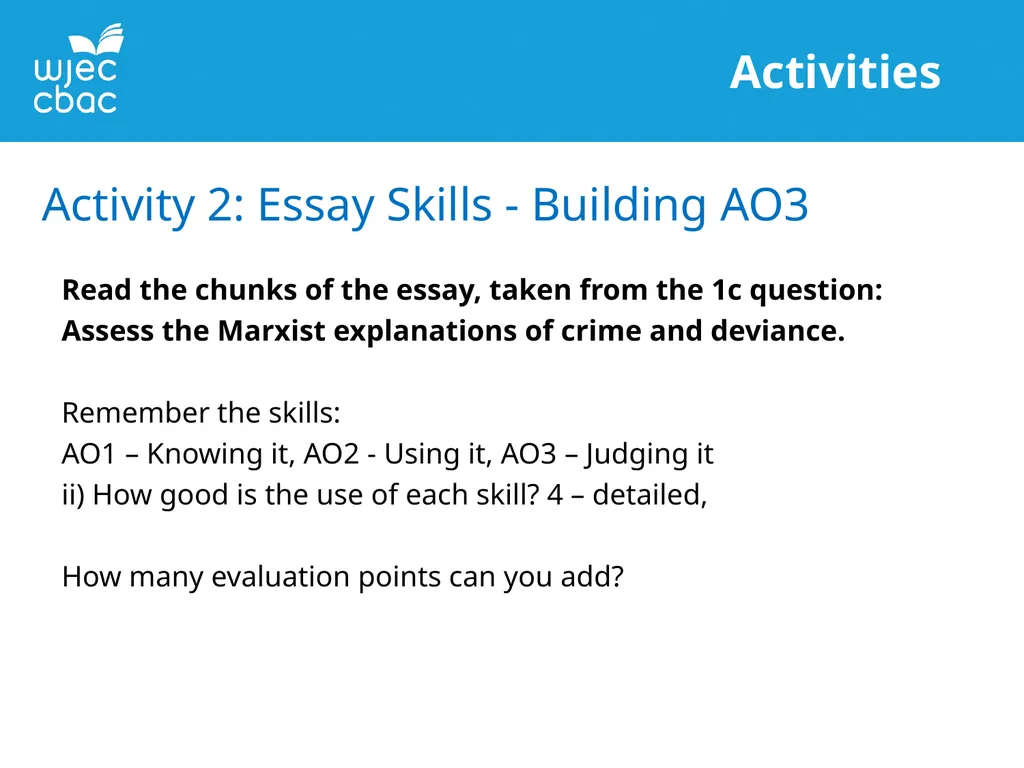
slide16. Activity 2: Essay Skills - Building AO3 Read the chunks of the essay, taken from the 1c question:
Assess the Marxist explanations of crime and deviance.
Remember the skills:
AO1 – Knowing it, AO2 - Using it, AO3 – Judging it
ii) How good is the use of each skill? 4 – detailed,
How many evaluation points can you add? Activities<br>
slide17. Cwestiynau? | Any Questions? Cysylltwch â’n Swyddogion Pwnc arbenigol a thîm cefnogaeth weinyddol eich pwnc os oes gennych unrhyw gwestiynau.
Joanna Lewis
Subject Officer
02922 404 279
GCESociology@wjec.co.uk
Eira Morgan
Subject Support Officer
02922 404 279
GCESociology@wjec.co.uk Contact our specialist Subject Officers and administrative support team for your subject with any queries.<br>
slide2. Option 1 – Crime and Deviance continues to be by far the most popular and there still no centres opting for politics.
The standard was generally very high – candidates cope well with the demands of the paper.
There were very few rubric errors.
Timing issues that occurred last year seemed to have been sorted - candidates divided their time between the questions well this year. June Series<br>
slide3. Key terms – Worth 10 marks
These questions are assessed on AO1 – knowledge and understanding (demonstrated through definitions, knowledge of relevant writers/theories), and AO2 – application of knowledge (demonstrated through effective use of relevant writers/ examples)
Overall, and corresponding with last year, these answers continued to be too short as a general rule. Questions 1a(i), 2a(i), 3a(i), 4a(i)<br>
slide4. Some candidates waste time evaluating.
The best answers had a clear definition of the term/ concept and referred directly to relevant sociological examples and writers – tenuously linked theory was commonplace!
1a (i)
Many candidates strayed from the question – lots on Marxism and many discussing socialisation – this lack of focus has been the main problem with this question for all series thus far.
2a (i)
Answers varied greatly in quality but all seemed to focus on risk behaviour.
4a (i)
Answers drifted considerably with a number of students producing generalised, less sociological answers about the term debt crisis. Questions 1a(i) 2a(i) and 4a(i)<br>
slide5. Worth - 20 marks
1a (ii)
There was a real range in the quality of responses to this question, particularly in comparison to last year.
As the question was not a straightforward class/gender/ethnicity and crime question it may not have been anticipated by centres.
The best answers contained a range of relevant sociological evidence and examples relating directly to media and crime, though many solely focused on Stan Cohen’s Mods and Rockers!
Many students used evidence that was not specific to the question – this could be credited, though not with the highest marks e.g. discussing labelling, ‘typical criminals’ etc.
Some wasted time evaluating. Question 1a(ii), 2a(ii), 3a(ii), 4a(ii)<br>
slide6. 1a(ii)
Some candidates talked about media influence without linking it to Crime and Deviance.
Unprepared candidates made assertions and used anecdotal evidence rather than using sociology.
2a(ii)
Very well answered. Most candidates focused on issues of gender and health with sociological evidence relating to both males and females.
4a(ii)
Not very well understood by a number of candidates, many of whom lacked a basic grasp of global population growth. Africa was cited as a country on numerous occasions. Questions 1a(ii) 2a(ii) and 4a(ii)<br>
slide7. Essay Questions – Worth 40 marks
The essays require use of all three AO skills
Once again AO3 was the weakest skill – evaluation, if present at all, often lacked depth – it remains the skill to work on.
Examples of excellent, sustained, explicit evaluation were few and far between – particularly with 1b.
Most candidates are in the habit of providing a clear introduction and conclusion. Questions 1b/c, 2b/c, 3b/c, 4b/c<br>
slide8. Theory essays continue to be used by weaker candidates to simply regurgitate descriptive accounts of numerous theories.
Continued use of templates or ‘model answers’ by some centres tends to penalise the strongest candidates and can confuse the less able candidates.
Given the time available, candidates should be encouraged to spend some time planning answers, rather than rushing to write reams on all that they know. Essays (cont.)<br>
slide9. As mentioned previously, a ‘discussion’ question can make accessing AO3 marks more difficult as students have to ‘frame’ their discussions themselves.
Mini-judgments/ mini-conclusions at the end of each discussion point work well, as candidates can evaluate individual writers, theories etc. as they go along.
However this remains an issue for candidates who opt for the discussion question. Assess or Evaluate VS Discuss<br>
slide10. Question 1b
This was the less popular choice
Answers tended to be weaker than those for 1c.
Knowledge and understanding was quite good – lots of Oakley! (Pollak the feminist!?)
Answers often contained limited evaluation, with very little in terms of males, masculinity and crime. Question 1c
Some exceptional responses - the best answers remained focused on Marxism/ neo-Marxism throughout – only using other theories to effectively contrast with and evaluate Marxism.
The essay provided the usual dumping ground for many.
Centre ‘model’ answer templates were common, resulting in weaker candidates muddling writers.<br>
slide11. There were examples of excellent sociology for all of the questions. The 2b) question was surprisingly the more popular choice but elicited some brilliant responses.
As with crime essays, AO3 was the weakest skill, however there were some exceptional examples of sustained evaluation.
With the 2c) theory question, similar patterns of being a dumping grounds for all theoretical knowledge were evident with weaker candidates. Health Sociology Essays<br>
slide12. World Sociology Essays Question 4b
A less popular choice but better answered than 4c.
Higher achieving candidates were able to explore the various theories’ take on TNC’s.
Weaker candidates drifted into a more aid-based response. Question 4c
Not answered particularly well on the whole.
Very little theory used – almost no feminist theory apparent.
Most examples used were anecdotal.<br>
slide13. Improving Performance The demands of this exam remain the same and also the areas of improvement.
Make sure candidates are aware of the skill demands of each question – these include:
Clear definition and example use in a(i)
Not evaluating in the a (i) and a(ii) questions
Plenty of evaluation in b and c questions
Marking exercises with students can be very useful for highlighting the above.<br>
slide14. Improving performance cont. Use time wisely. The exam lasts for 2 hours. Candidates should roughly spend 15 mins on a(i), 30 mins on a(ii) and a good hour on the essay – still leaving plenty of time to plan each answer.
Stay focused on the question in hand – drifting off topic limits marks and wastes time.
Work with candidates on producing quality evaluation of evidence and theory.<br>
slide15. Activity 1: Question 1a You have been provided with two examples of 1a) answers from the 2019 series - one full mark response, the other a band 1 response.
What comments might be made about the second example?
What might you do to improve the second example? Activities<br>
slide16. Activity 2: Essay Skills - Building AO3 Read the chunks of the essay, taken from the 1c question:
Assess the Marxist explanations of crime and deviance.
Remember the skills:
AO1 – Knowing it, AO2 - Using it, AO3 – Judging it
ii) How good is the use of each skill? 4 – detailed,
How many evaluation points can you add? Activities<br>
slide17. Cwestiynau? | Any Questions? Cysylltwch â’n Swyddogion Pwnc arbenigol a thîm cefnogaeth weinyddol eich pwnc os oes gennych unrhyw gwestiynau.
Joanna Lewis
Subject Officer
02922 404 279
GCESociology@wjec.co.uk
Eira Morgan
Subject Support Officer
02922 404 279
GCESociology@wjec.co.uk Contact our specialist Subject Officers and administrative support team for your subject with any queries.<br>