03
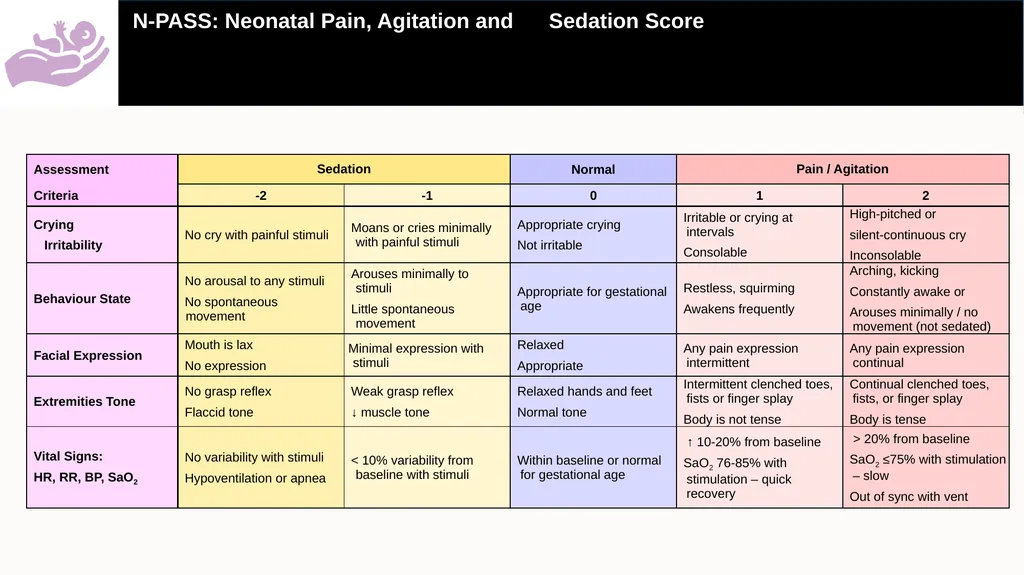
N-PASS: Neonatal Pain, Agitation and Sedation Score 3 Measures pain, agitation and sedation levels
Can be used for pain assessment in mechanically ventilated preterm babies
Shows good validity and reliability for assessment of acute and chronic pain
Validation studies included 23 to 40 weeks’ gestation babies
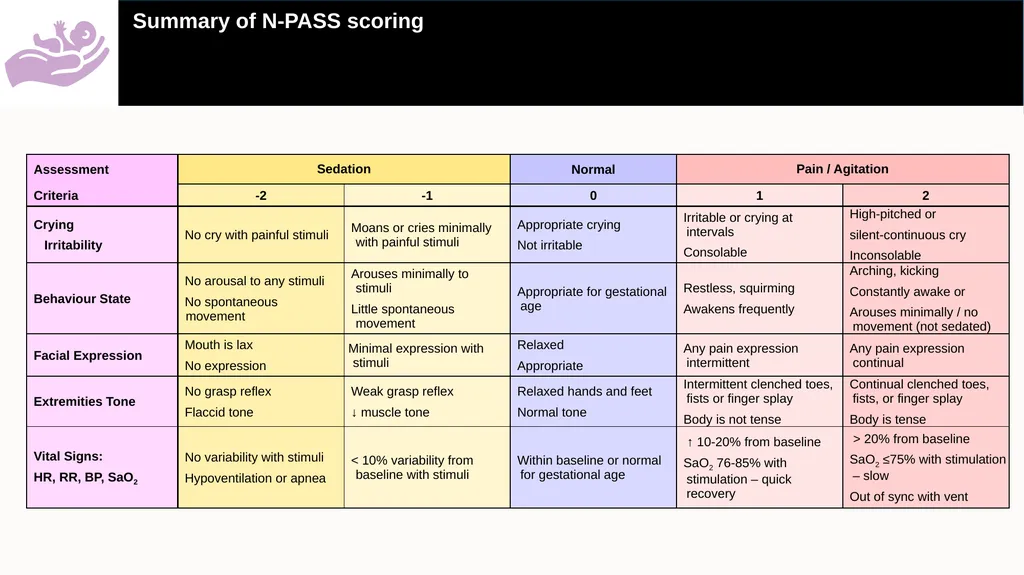
Includes multidimensional indicators of pain (5 criteria) – each graded from -2 to 2 and a total score obtained by adding the scores for each criteria Ref: Morgan et al., 2020; https://doi.org/10.1038/s41372-020-00840-7
Giordano et al., 2019; https://doi.org/10.1001/jamapediatrics.2019.3351<br>
04
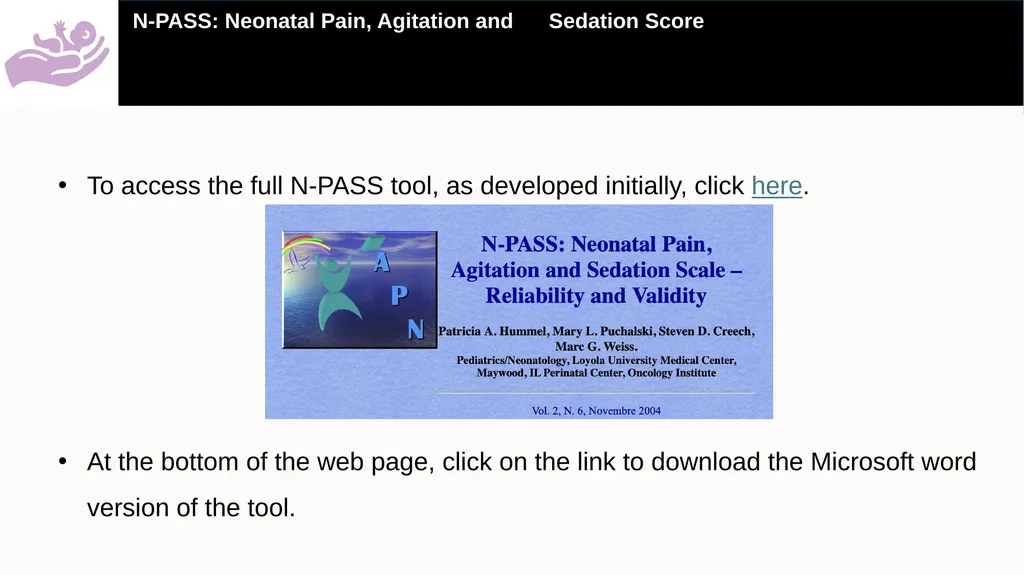
N-PASS: Neonatal Pain, Agitation and Sedation Score 4 To access the full N-PASS tool, as developed initially, click here.
At the bottom of the web page, click on the link to download the Microsoft word version of the tool.<br>
05
N-PASS: Neonatal Pain, Agitation and Sedation Score 5<br>
06
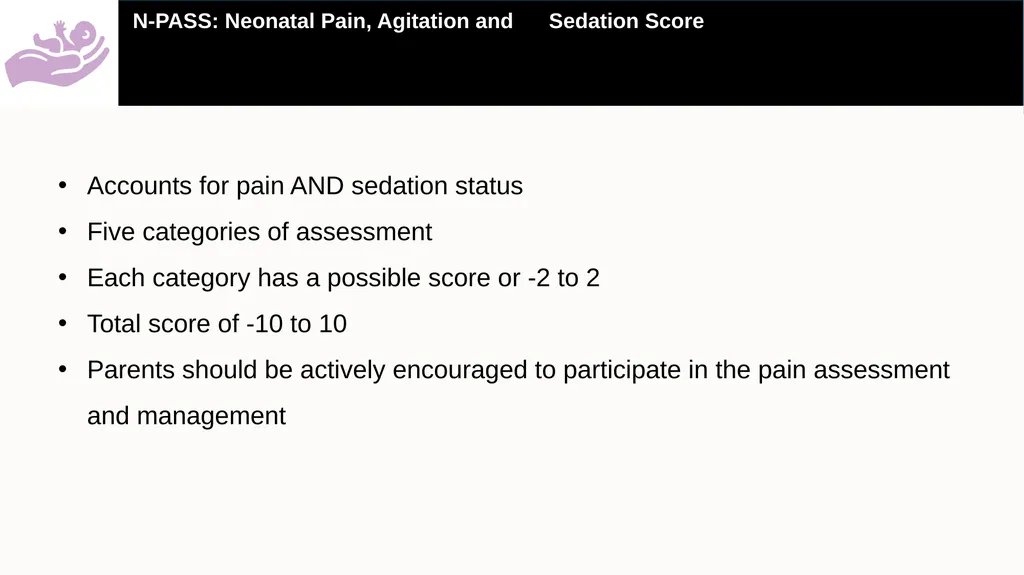
N-PASS: Neonatal Pain, Agitation and Sedation Score 6 Accounts for pain AND sedation status
Five categories of assessment
Each category has a possible score or -2 to 2
Total score of -10 to 10
Parents should be actively encouraged to participate in the pain assessment and management<br>
07
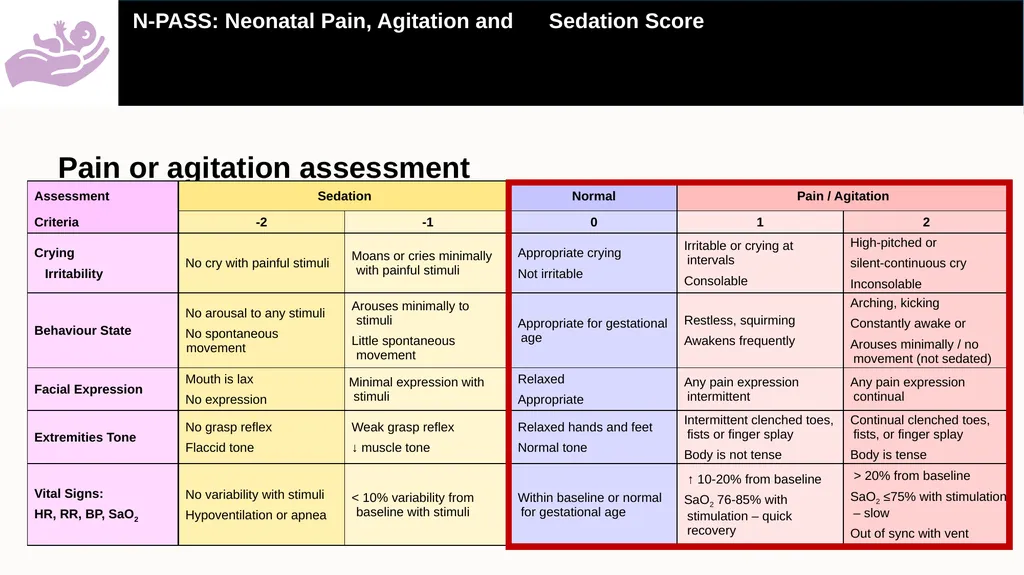
N-PASS: Neonatal Pain, Agitation and Sedation Score 7 Pain or agitation assessment<br>
08
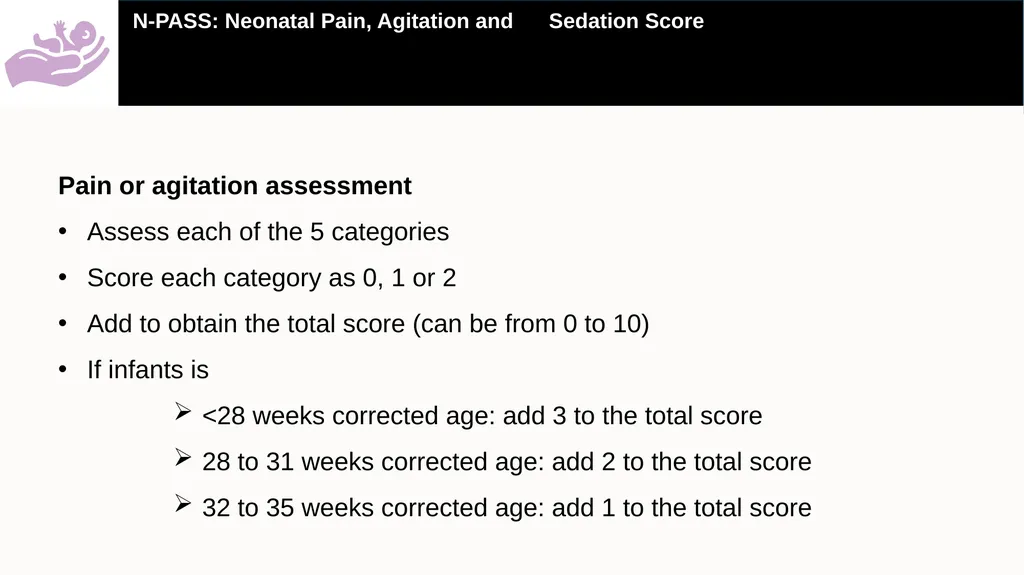
N-PASS: Neonatal Pain, Agitation and Sedation Score 8 Pain or agitation assessment
Assess each of the 5 categories
Score each category as 0, 1 or 2
Add to obtain the total score (can be from 0 to 10)
If infants is
<28 weeks corrected age: add 3 to the total score
28 to 31 weeks corrected age: add 2 to the total score
32 to 35 weeks corrected age: add 1 to the total score<br>
09
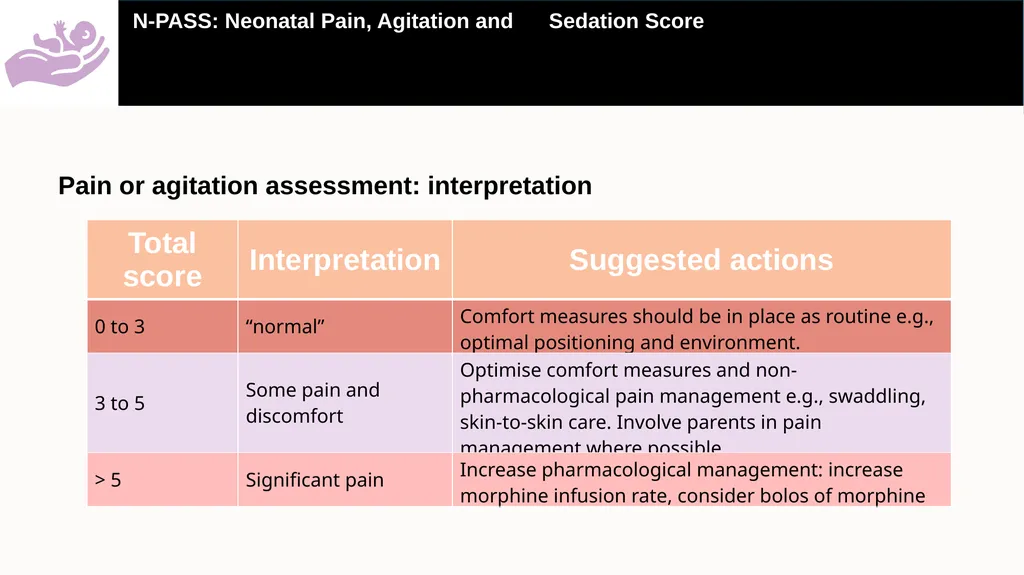
N-PASS: Neonatal Pain, Agitation and Sedation Score 9 Pain or agitation assessment: interpretation<br>
10
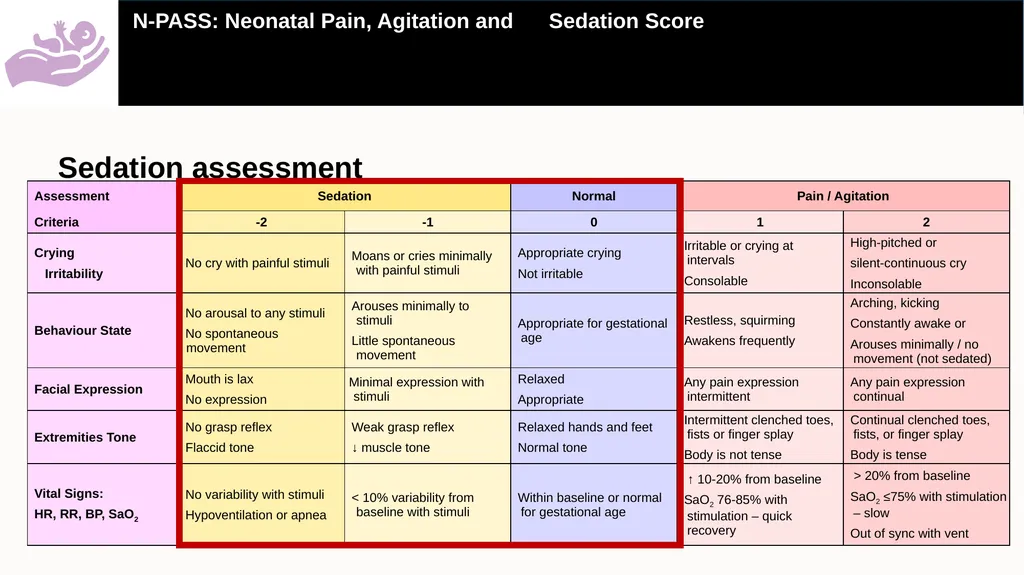
N-PASS: Neonatal Pain, Agitation and Sedation Score 10 Sedation assessment<br>
11
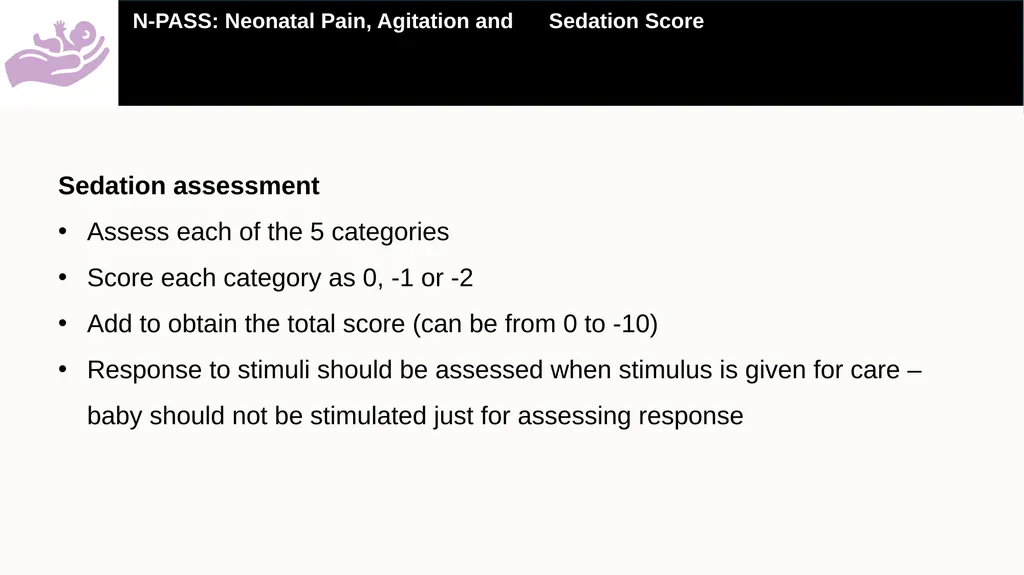
N-PASS: Neonatal Pain, Agitation and Sedation Score 11 Sedation assessment
Assess each of the 5 categories
Score each category as 0, -1 or -2
Add to obtain the total score (can be from 0 to -10)
Response to stimuli should be assessed when stimulus is given for care – baby should not be stimulated just for assessing response<br>
12
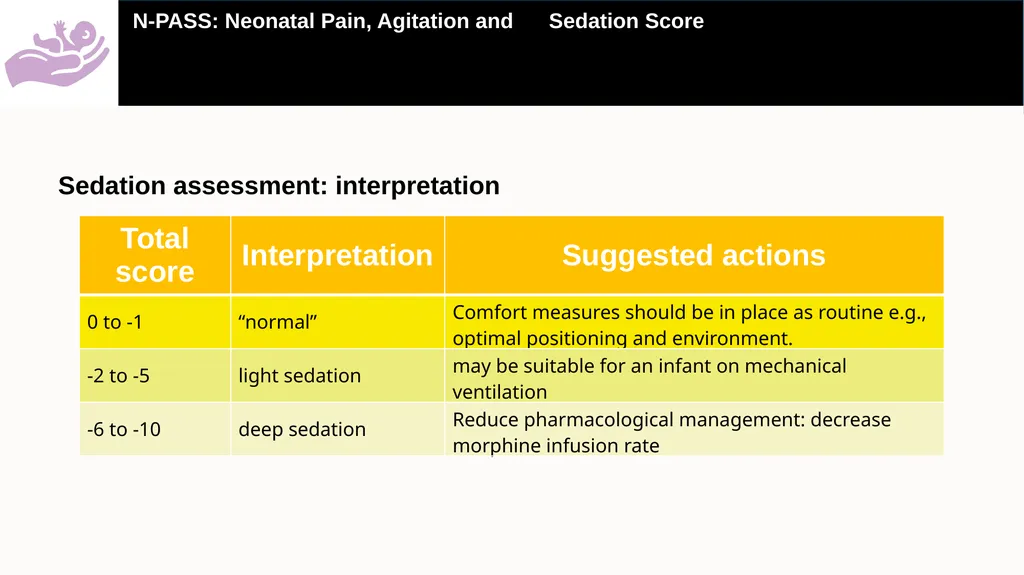
N-PASS: Neonatal Pain, Agitation and Sedation Score 12 Sedation assessment: interpretation<br>
13
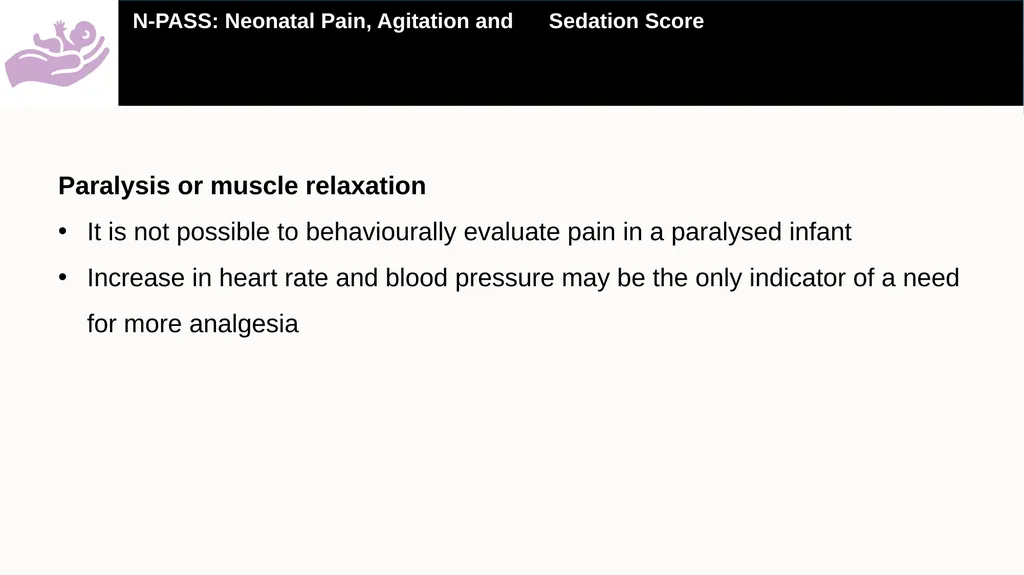
N-PASS: Neonatal Pain, Agitation and Sedation Score 13 Paralysis or muscle relaxation
It is not possible to behaviourally evaluate pain in a paralysed infant
Increase in heart rate and blood pressure may be the only indicator of a need for more analgesia<br>
14
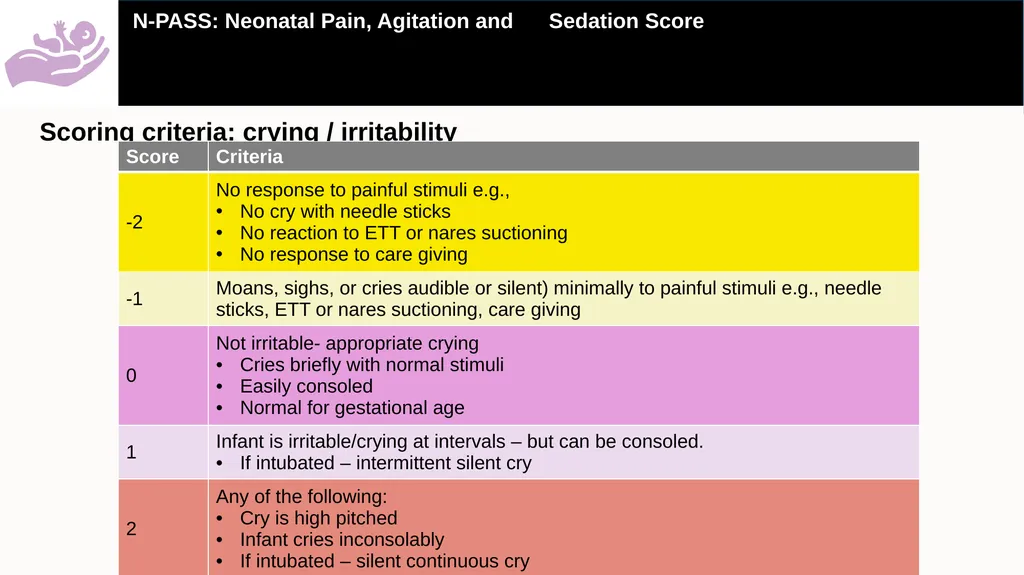
N-PASS: Neonatal Pain, Agitation and Sedation Score 14 Scoring criteria: crying / irritability<br>
15
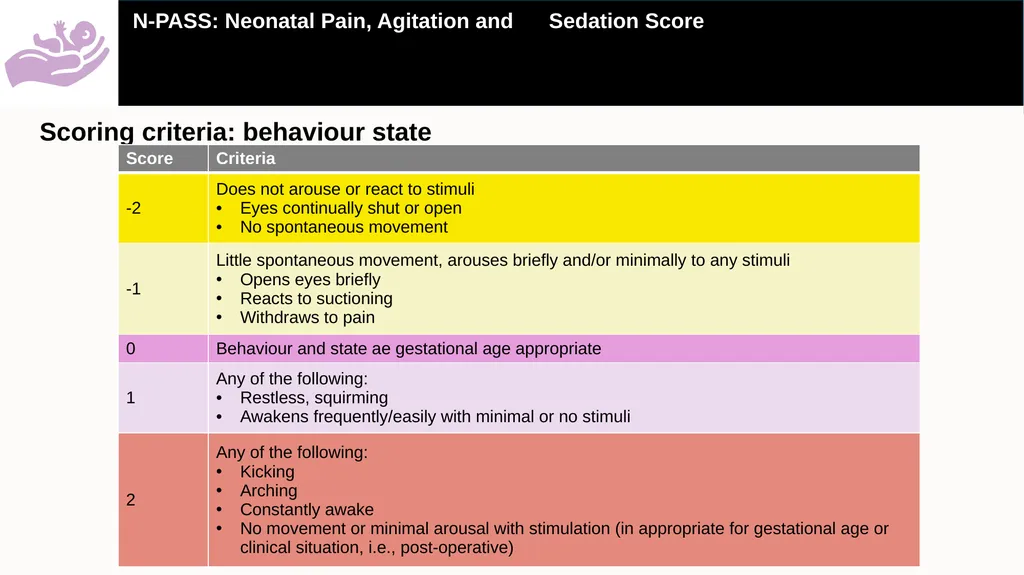
N-PASS: Neonatal Pain, Agitation and Sedation Score 15 Scoring criteria: behaviour state<br>
16
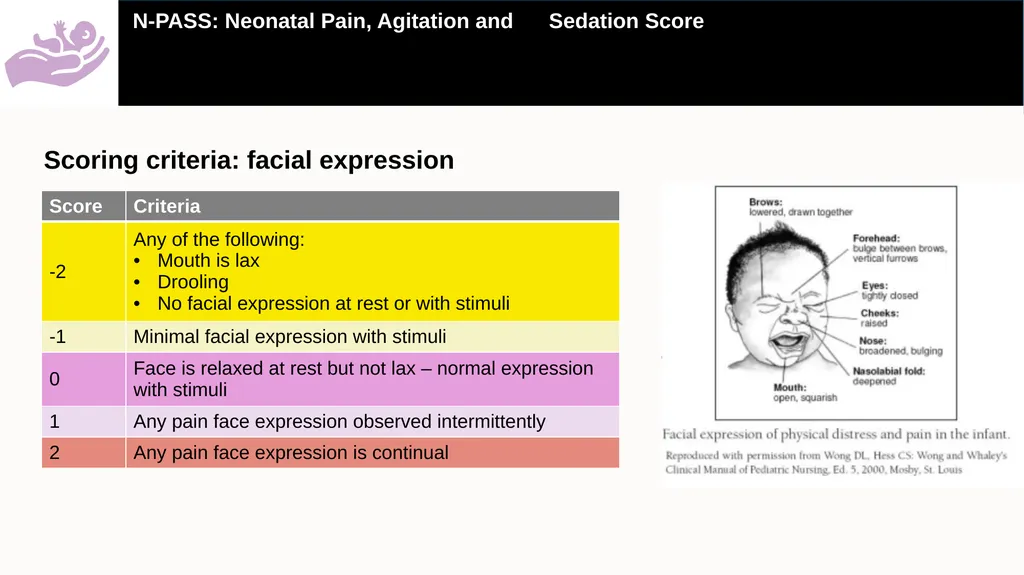
N-PASS: Neonatal Pain, Agitation and Sedation Score 16 Scoring criteria: facial expression<br>
17
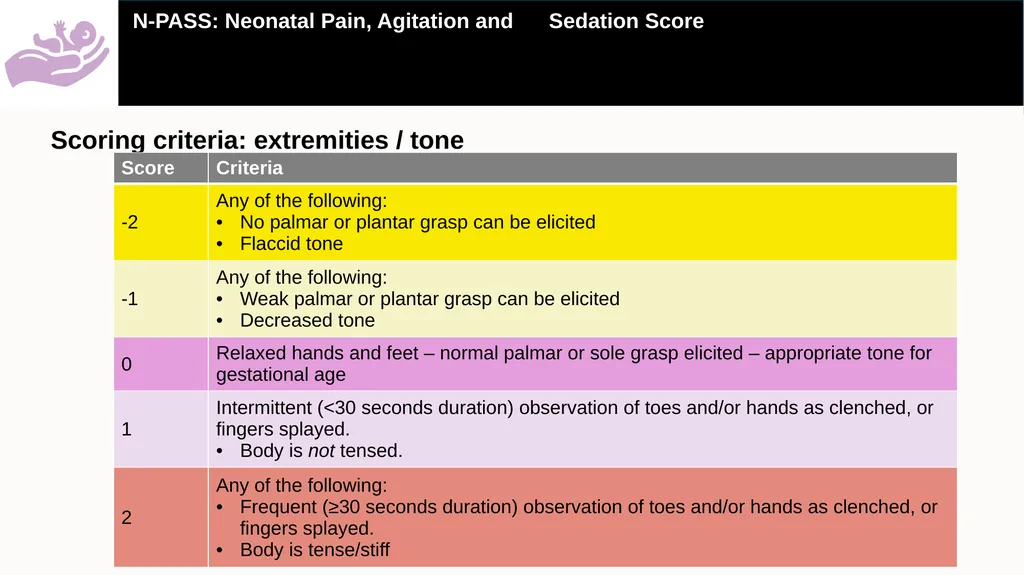
N-PASS: Neonatal Pain, Agitation and Sedation Score 17 Scoring criteria: extremities / tone<br>
18
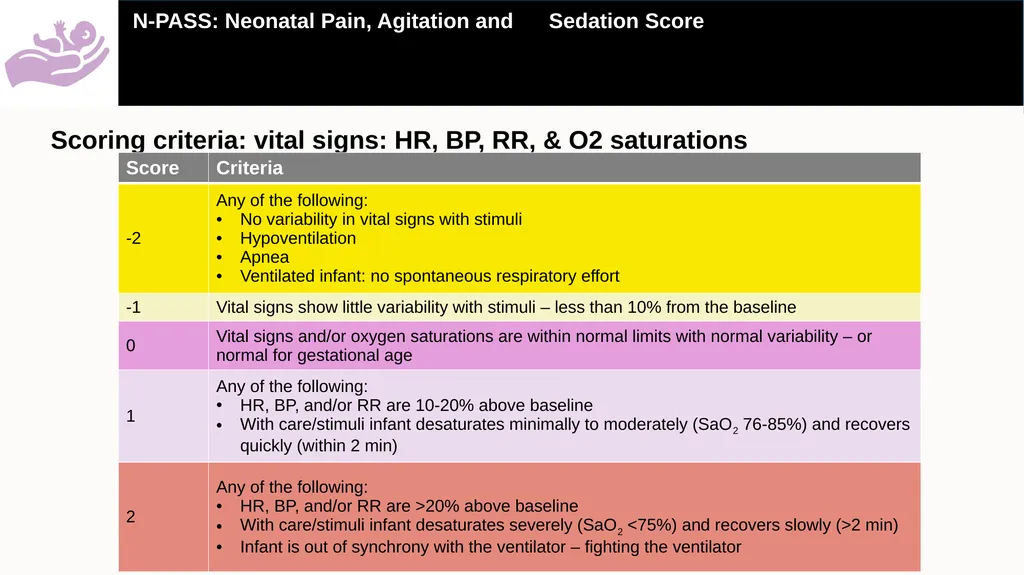
N-PASS: Neonatal Pain, Agitation and Sedation Score 18 Scoring criteria: vital signs: HR, BP, RR, & O2 saturations<br>
19
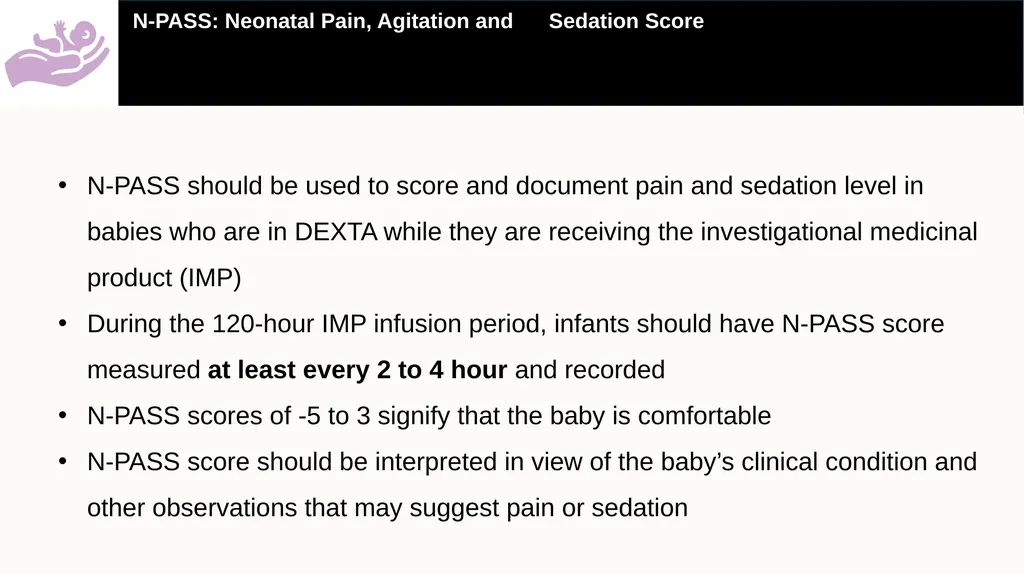
N-PASS: Neonatal Pain, Agitation and Sedation Score 19 N-PASS should be used to score and document pain and sedation level in babies who are in DEXTA while they are receiving the investigational medicinal product (IMP)
During the 120-hour IMP infusion period, infants should have N-PASS score measured at least every 2 to 4 hour and recorded
N-PASS scores of -5 to 3 signify that the baby is comfortable
N-PASS score should be interpreted in view of the baby’s clinical condition and other observations that may suggest pain or sedation<br>
20
Summary of N-PASS scoring 20<br>
21
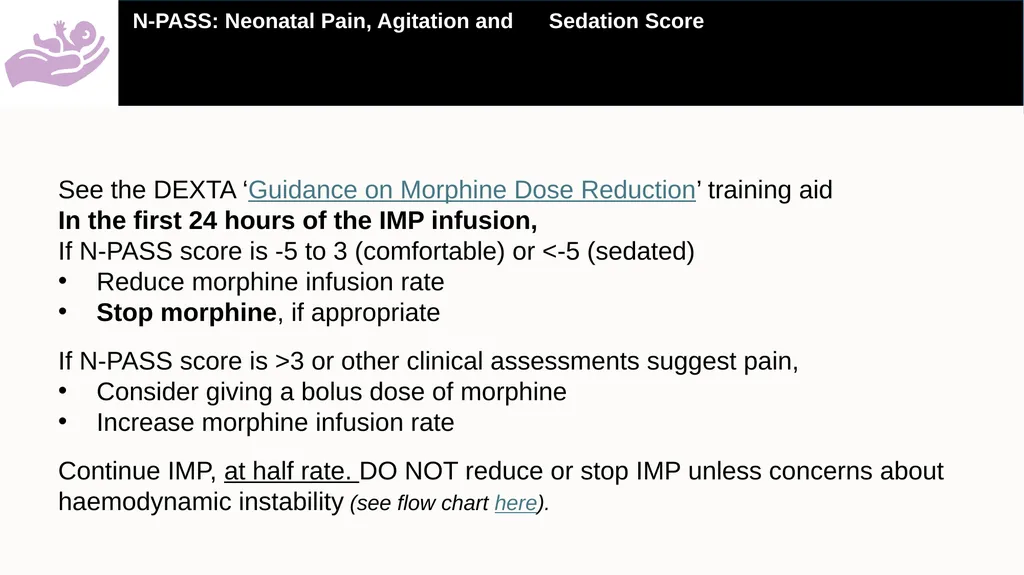
N-PASS: Neonatal Pain, Agitation and Sedation Score 21 See the DEXTA ‘Guidance on Morphine Dose Reduction’ training aid
In the first 24 hours of the IMP infusion,
If N-PASS score is -5 to 3 (comfortable) or <-5 (sedated)
Reduce morphine infusion rate
Stop morphine, if appropriate
If N-PASS score is >3 or other clinical assessments suggest pain,
Consider giving a bolus dose of morphine
Increase morphine infusion rate
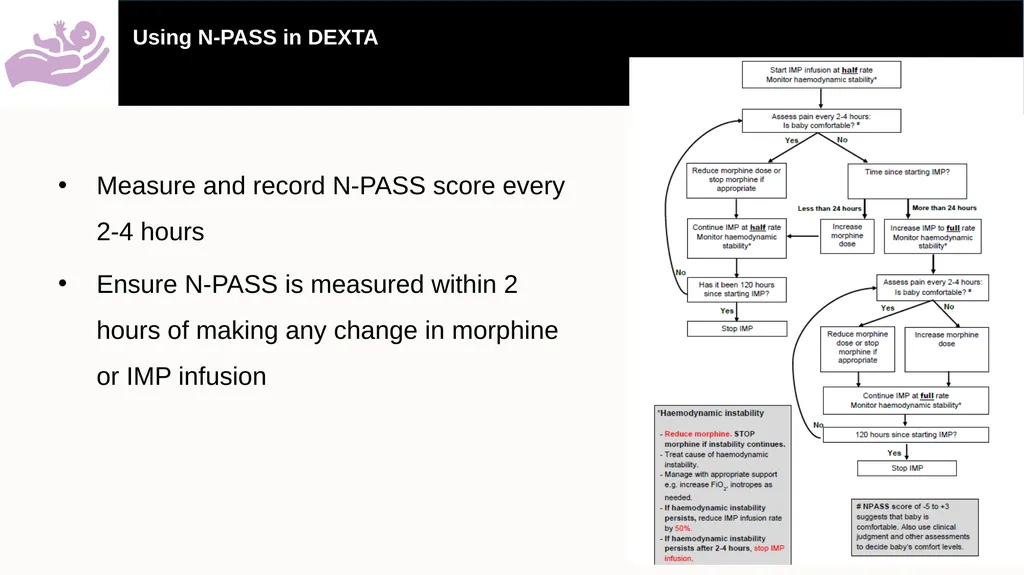
Continue IMP, at half rate. DO NOT reduce or stop IMP unless concerns about haemodynamic instability (see flow chart here).<br>
22
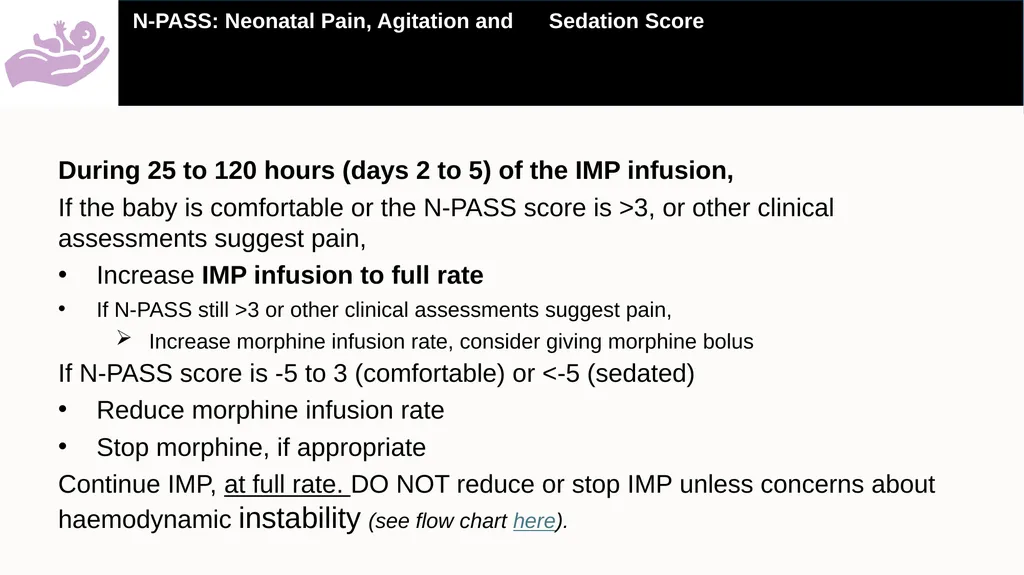
N-PASS: Neonatal Pain, Agitation and Sedation Score 22 During 25 to 120 hours (days 2 to 5) of the IMP infusion,
If the baby is comfortable or the N-PASS score is >3, or other clinical assessments suggest pain,
Increase IMP infusion to full rate
If N-PASS still >3 or other clinical assessments suggest pain,
Increase morphine infusion rate, consider giving morphine bolus
If N-PASS score is -5 to 3 (comfortable) or <-5 (sedated)
Reduce morphine infusion rate
Stop morphine, if appropriate
Continue IMP, at full rate. DO NOT reduce or stop IMP unless concerns about haemodynamic instability (see flow chart here).<br>
23
Using N-PASS in DEXTA 23 Measure and record N-PASS score every 2-4 hours
Ensure N-PASS is measured within 2 hours of making any change in morphine or IMP infusion<br>
24
Summary 24 N-PASS is a routinely used pain score, validated for use in ventilated preterm infants
It uses 5 criteria to score pain and sedation
N-PASS should be scored and recorded every 2-4 hours while the baby is on the IMP in DEXTA
Morphine should be reduced and stopped if the baby remains comfortable
IMP should be continued for 120 hours unless clinical concerns about hemodynamic instability<br>
25
Feel free to email us: dexta@nottingham.ac.uk
Or visit the website www.dexta.ac.uk<br>