
A presentation entitled: “Towards a regional
SN
Published · 28 slides · 0 views
1 / 1



Description
A presentation entitled: Towards a regional consideration of utilities regulation and competition enforcement in the CSME Delivered at the ORGANIZATION OF CARIBBEAN UTILITY REGULATORS (OOCUR) 20TH ANNUAL CONFERENCE under the theme:
Related Topics
Share
Embed code
Download this presentation From Below
"A presentation entitled: “Towards a regional" is the property of its rightful owner. Permission is granted to download and print the materials on this website for personal, non-commercial use only, and to display it on your personal computer provided you do not modify the materials and that you retain all copyright notices contained in the materials. By downloading content from our website, you accept the terms of this agreement.
Presentation Transcript
01
A presentation entitled:
“Towards a regional consideration of utilities regulation and competition enforcement in the CSME”
Delivered at the
ORGANIZATION OF CARIBBEAN UTILITY REGULATORS (OOCUR)
20TH ANNUAL CONFERENCE
under the theme:
“Navigating Caribbean Regulatory Challenges: Opportunities, Innovations
and Collaborations”
27 April – 01 May 2026, Trelawny Jamaica Presenter:
MARC S. JONES
Senior Legal Counsel
CARICOM Competition Commission
Jamaica | 30 April 2026 1<br>
“Towards a regional consideration of utilities regulation and competition enforcement in the CSME”
Delivered at the
ORGANIZATION OF CARIBBEAN UTILITY REGULATORS (OOCUR)
20TH ANNUAL CONFERENCE
under the theme:
“Navigating Caribbean Regulatory Challenges: Opportunities, Innovations
and Collaborations”
27 April – 01 May 2026, Trelawny Jamaica Presenter:
MARC S. JONES
Senior Legal Counsel
CARICOM Competition Commission
Jamaica | 30 April 2026 1<br>
02
2 Disclaimer THE VIEWS EXPRESSED DO NOT REPRESENT THOSE OF THE BOARD OF COMMISSIONERS OF THE CARICOM COMPETITION COMMISSION.<br>
03
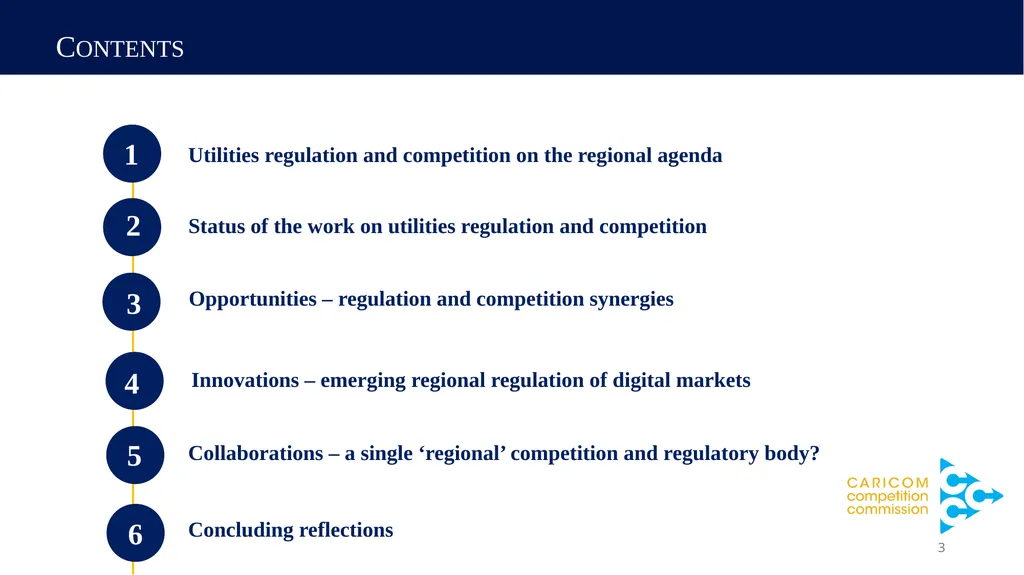
Status of the work on utilities regulation and competition 1 2 3 Opportunities – regulation and competition synergies Innovations – emerging regional regulation of digital markets Utilities regulation and competition on the regional agenda 4 Collaborations – a single ‘regional’ competition and regulatory body? 5 Contents 3 6 Concluding reflections<br>
04
4 1. Utilities regulation and competition on the regional agenda<br>
05
5 Relevance of utilities regulation in building the CSME There are clear synergies between utitlies regulation and competition law. Generally, both domains pursue economic goals (although utilities regulation may also pursue other non-economic goals), usually related to economic efficiency and welfare considerations.
As small developing countries, Member States have committed to constructing a Caribbean Single Market and Economy (CSME) to, inter alia, achieve economic development through efficient markets which promote the welfare of their citizens (Preamble, Revised Treaty of Chaguaramas).
While the RTC does not dedicate specific disciplines to utilities regulation; from a regional perspective CSME Member States have accepted that public utilities provide key inputs to enable both the government and private sector to achieve the goals of regional integration.
Chapter IV RTC – Community Industrial Policy: “cross-border employment of natural resources… for the production of goods and services” (Article 51).
Chapter IV RTC – Community Industrial Policy: “the efficient provision of infrastructural services including telecommunications…” (Article 54).
CSME Member States have, therefore, long established utilities regulatory frameworks and utilities regulators, which pre-date the RTC but continue to be critical for achieving economic development as an expected benefit of the CSME. Marc Jones<br>
As small developing countries, Member States have committed to constructing a Caribbean Single Market and Economy (CSME) to, inter alia, achieve economic development through efficient markets which promote the welfare of their citizens (Preamble, Revised Treaty of Chaguaramas).
While the RTC does not dedicate specific disciplines to utilities regulation; from a regional perspective CSME Member States have accepted that public utilities provide key inputs to enable both the government and private sector to achieve the goals of regional integration.
Chapter IV RTC – Community Industrial Policy: “cross-border employment of natural resources… for the production of goods and services” (Article 51).
Chapter IV RTC – Community Industrial Policy: “the efficient provision of infrastructural services including telecommunications…” (Article 54).
CSME Member States have, therefore, long established utilities regulatory frameworks and utilities regulators, which pre-date the RTC but continue to be critical for achieving economic development as an expected benefit of the CSME. Marc Jones<br>
06
6 The Community Competition Policy and the implementation deficit Similarly, competition policy is also critical for achieving economic development as an expected benefit of the CSME. Chapter VIII RTC is devoted to an explicit Community Competition Policy that pursues goals of enhancing economic efficiency and promoting consumer welfare.
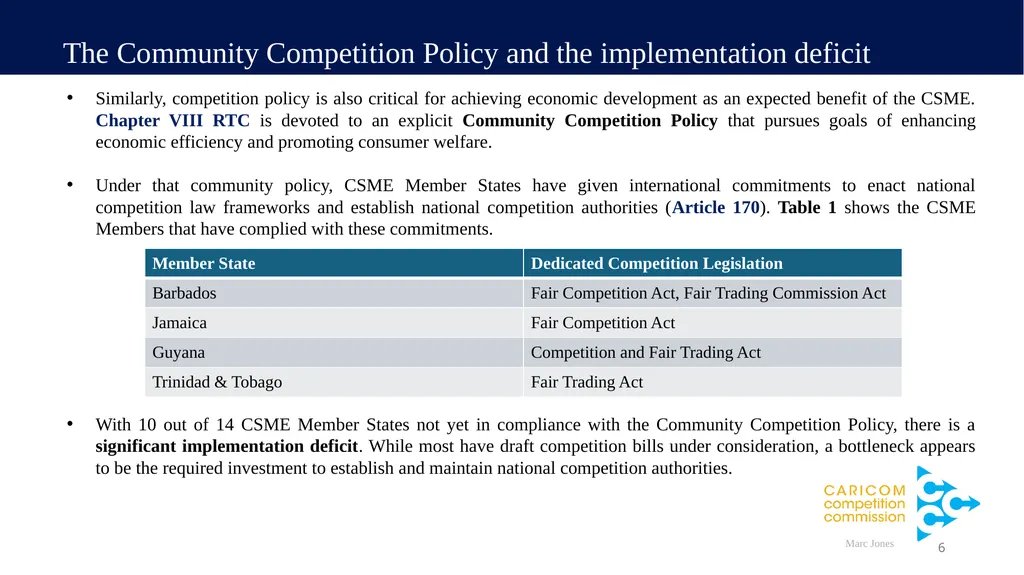
Under that community policy, CSME Member States have given international commitments to enact national competition law frameworks and establish national competition authorities (Article 170). Table 1 shows the CSME Members that have complied with these commitments.
With 10 out of 14 CSME Member States not yet in compliance with the Community Competition Policy, there is a significant implementation deficit. While most have draft competition bills under consideration, a bottleneck appears to be the required investment to establish and maintain national competition authorities. Marc Jones<br>
Under that community policy, CSME Member States have given international commitments to enact national competition law frameworks and establish national competition authorities (Article 170). Table 1 shows the CSME Members that have complied with these commitments.
With 10 out of 14 CSME Member States not yet in compliance with the Community Competition Policy, there is a significant implementation deficit. While most have draft competition bills under consideration, a bottleneck appears to be the required investment to establish and maintain national competition authorities. Marc Jones<br>
07
7 The resultant “gap” as concerns exist without frameworks to address The CCC is established under Article 171 RTC to, inter alia, enforce regional competition rules. The rub is that because most CSME Member States have not enacted national competition law frameworks; regional enforcement to address cross-border competition concerns is stymied by lack of capacity at the national level – hence the “gap.”
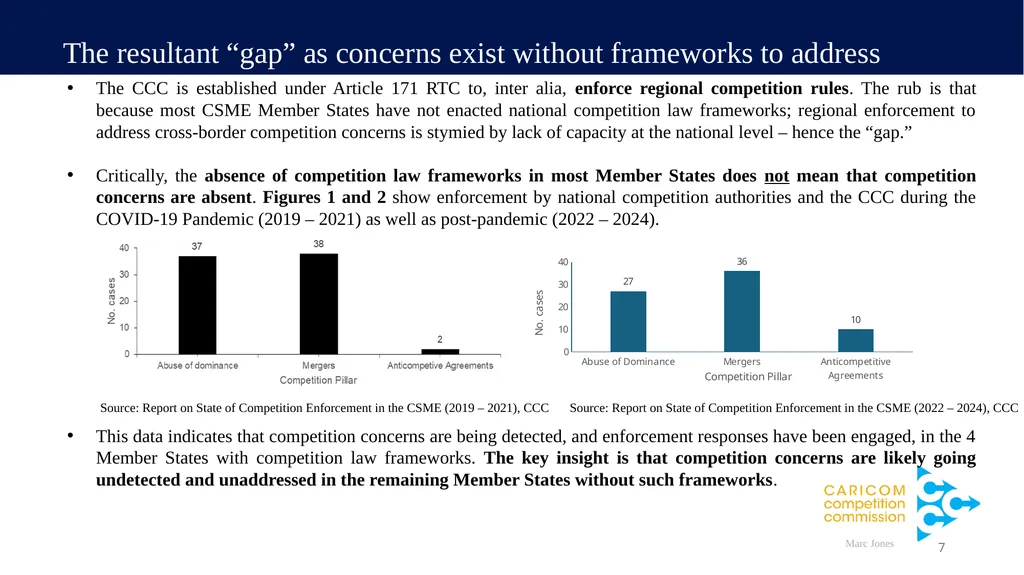
Critically, the absence of competition law frameworks in most Member States does not mean that competition concerns are absent. Figures 1 and 2 show enforcement by national competition authorities and the CCC during the COVID-19 Pandemic (2019 – 2021) as well as post-pandemic (2022 – 2024).
This data indicates that competition concerns are being detected, and enforcement responses have been engaged, in the 4 Member States with competition law frameworks. The key insight is that competition concerns are likely going undetected and unaddressed in the remaining Member States without such frameworks. Source: Report on State of Competition Enforcement in the CSME (2019 – 2021), CCC Source: Report on State of Competition Enforcement in the CSME (2022 – 2024), CCC Marc Jones<br>
Critically, the absence of competition law frameworks in most Member States does not mean that competition concerns are absent. Figures 1 and 2 show enforcement by national competition authorities and the CCC during the COVID-19 Pandemic (2019 – 2021) as well as post-pandemic (2022 – 2024).
This data indicates that competition concerns are being detected, and enforcement responses have been engaged, in the 4 Member States with competition law frameworks. The key insight is that competition concerns are likely going undetected and unaddressed in the remaining Member States without such frameworks. Source: Report on State of Competition Enforcement in the CSME (2019 – 2021), CCC Source: Report on State of Competition Enforcement in the CSME (2022 – 2024), CCC Marc Jones<br>
08
8 Attempts to mend the gap through a Dual Role modality for the CCC In seeking to cure the implementation deficit, and in recognizing that the RTC does not mandate any particular form or structure for national competition authorities, the Eighteenth Special Meeting of the Conference of Heads of Government agreed in 2018 to: “amend constitutional documents to enable certain institutions such as the… the CCC to act as both a national and regional body.”
Subsequently, in 2019 the Reconvened Task Force on Competition Law and Policy in the CSME was tasked to examine the necessary requirements, from both legal and financial perspectives, that would allow the CCC to execute both its existing regional role and a proposed national role for those Member States who opt for such.
This “Dual Role” proposal is essentially one to repurpose the CCC as a regional institution into a partly national institution as a means of enabling most CSME Member States to comply with their RTC obligation to establish competition frameworks. An example of this approach is the ‘ECTEL Model’ in the OECS region.
The outputs of the Reconvened Task Force indicated that while this is legally possible (with appropriate RTC amendments and legislative enactments); institutionally the dual role would require significant resource commitments from the Member States to ensure that:
the CCC is properly funded in its existing regional mandate; and
additional funding is allocated to the CCC for the proposed national mandate. Marc Jones<br>
Subsequently, in 2019 the Reconvened Task Force on Competition Law and Policy in the CSME was tasked to examine the necessary requirements, from both legal and financial perspectives, that would allow the CCC to execute both its existing regional role and a proposed national role for those Member States who opt for such.
This “Dual Role” proposal is essentially one to repurpose the CCC as a regional institution into a partly national institution as a means of enabling most CSME Member States to comply with their RTC obligation to establish competition frameworks. An example of this approach is the ‘ECTEL Model’ in the OECS region.
The outputs of the Reconvened Task Force indicated that while this is legally possible (with appropriate RTC amendments and legislative enactments); institutionally the dual role would require significant resource commitments from the Member States to ensure that:
the CCC is properly funded in its existing regional mandate; and
additional funding is allocated to the CCC for the proposed national mandate. Marc Jones<br>
09
9 A possible ‘Triple Role’ to include utilities regulation? Based on a series of stakeholder consultations from 2021 to 2023, Member States have taken several positions on the Dual Role proposal. Most Member States with competition law frameworks, have indicated that they may not implement the proposal.
Member States without competition law frameworks have expressed a plurality of views ranging from support for the Dual Role to promises of establishing their own national competition authorities. In 2024, the Council for Trade and Economic Development (COTED), directed the continuation of technical work to develop the Dual Role proposals.
Concurrent with consultations on the Dual Role proposal, the Fourteenth Meeting of the Prime Ministerial Subcommittee on the CSME (PMSC-CSME) in early 2024:
Based on this high-level recommendation, the Fifty-Eight COTED in mid-2024: “recommended that consideration be given to including the regulation of utilities in the work of a Regional Competition Commission.” “agreed to the constitution of a Technical Working Group, comprised of experts of Member States, the CCC and the CARICOM Secretariat, to consider the dual role of the CCC and the possible inclusion of the regulation of utilities in the work of the Regional Competition Commission” Marc Jones<br>
Member States without competition law frameworks have expressed a plurality of views ranging from support for the Dual Role to promises of establishing their own national competition authorities. In 2024, the Council for Trade and Economic Development (COTED), directed the continuation of technical work to develop the Dual Role proposals.
Concurrent with consultations on the Dual Role proposal, the Fourteenth Meeting of the Prime Ministerial Subcommittee on the CSME (PMSC-CSME) in early 2024:
Based on this high-level recommendation, the Fifty-Eight COTED in mid-2024: “recommended that consideration be given to including the regulation of utilities in the work of a Regional Competition Commission.” “agreed to the constitution of a Technical Working Group, comprised of experts of Member States, the CCC and the CARICOM Secretariat, to consider the dual role of the CCC and the possible inclusion of the regulation of utilities in the work of the Regional Competition Commission” Marc Jones<br>
10
10 2. Status of the work on utilities regulation and competition<br>
11
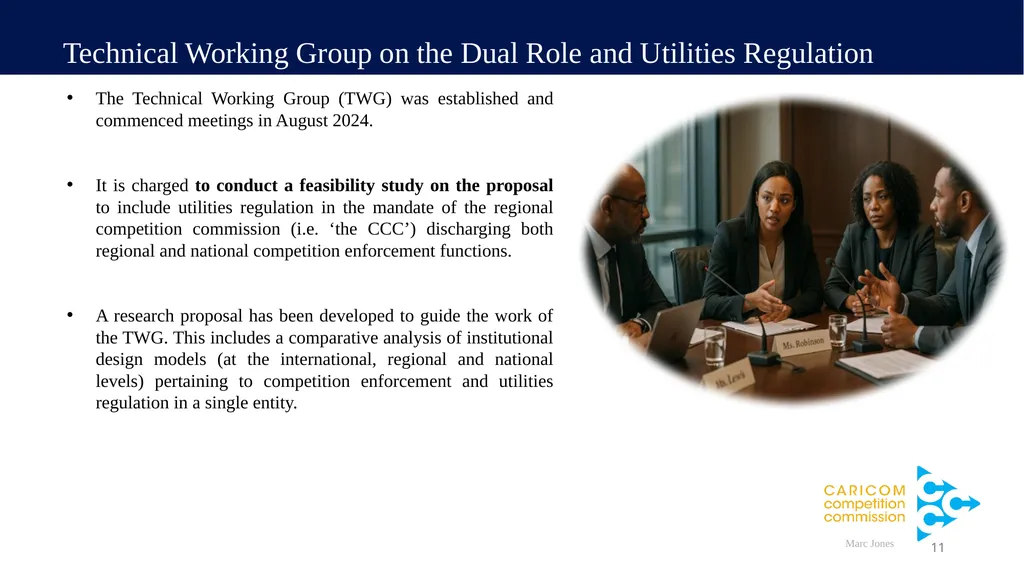
11 Technical Working Group on the Dual Role and Utilities Regulation The Technical Working Group (TWG) was established and commenced meetings in August 2024.
It is charged to conduct a feasibility study on the proposal to include utilities regulation in the mandate of the regional competition commission (i.e. ‘the CCC’) discharging both regional and national competition enforcement functions.
A research proposal has been developed to guide the work of the TWG. This includes a comparative analysis of institutional design models (at the international, regional and national levels) pertaining to competition enforcement and utilities regulation in a single entity. Marc Jones<br>
It is charged to conduct a feasibility study on the proposal to include utilities regulation in the mandate of the regional competition commission (i.e. ‘the CCC’) discharging both regional and national competition enforcement functions.
A research proposal has been developed to guide the work of the TWG. This includes a comparative analysis of institutional design models (at the international, regional and national levels) pertaining to competition enforcement and utilities regulation in a single entity. Marc Jones<br>
12
12 Technical Working Group on the Dual Role and Utilities Regulation A preliminary observation has been that while there is some experience at the national level of combining utilities regulation and competition enforcement in a single institution; at the level of regional integration communities there is no experience with combining both disciplines in a single institution with cross-border remit across several territories.1
The TWG reports through the CARICOM Secretariat to the COTED, and its work continues to examine the feasibility of the dual role in competition enforcement together with utilities regulation at the regional level.
It is anticipated that the TWG should complete its research and consideration of the matter within this year; with rounds of stakeholder consultations to ensue in early 2027. Marc Jones<br>
The TWG reports through the CARICOM Secretariat to the COTED, and its work continues to examine the feasibility of the dual role in competition enforcement together with utilities regulation at the regional level.
It is anticipated that the TWG should complete its research and consideration of the matter within this year; with rounds of stakeholder consultations to ensue in early 2027. Marc Jones<br>
13
13 3. Opportunities – regulation and competition synergies<br>
14
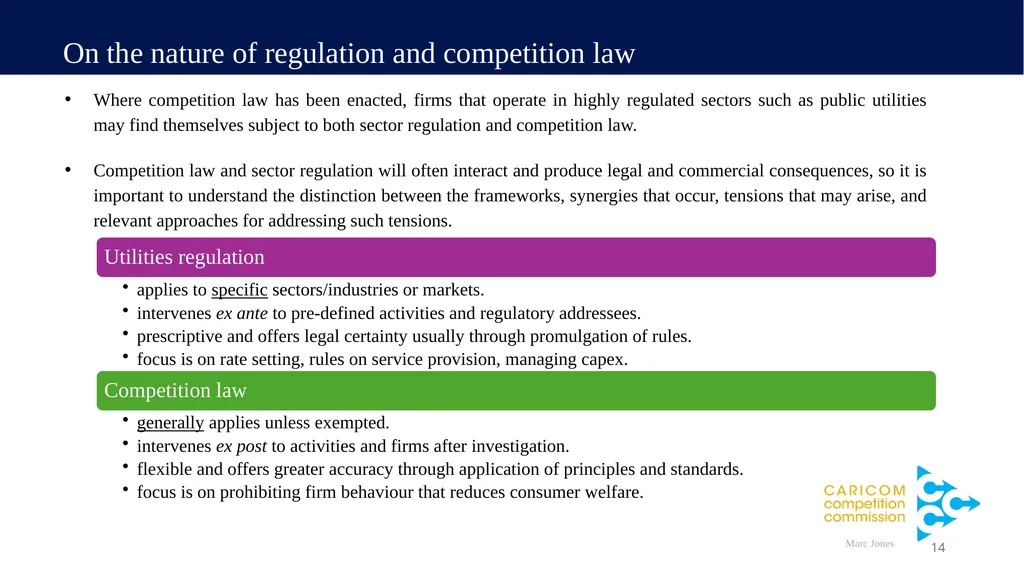
14 On the nature of regulation and competition law Where competition law has been enacted, firms that operate in highly regulated sectors such as public utilities may find themselves subject to both sector regulation and competition law.
Competition law and sector regulation will often interact and produce legal and commercial consequences, so it is important to understand the distinction between the frameworks, synergies that occur, tensions that may arise, and relevant approaches for addressing such tensions. Marc Jones<br>
Competition law and sector regulation will often interact and produce legal and commercial consequences, so it is important to understand the distinction between the frameworks, synergies that occur, tensions that may arise, and relevant approaches for addressing such tensions. Marc Jones<br>
15
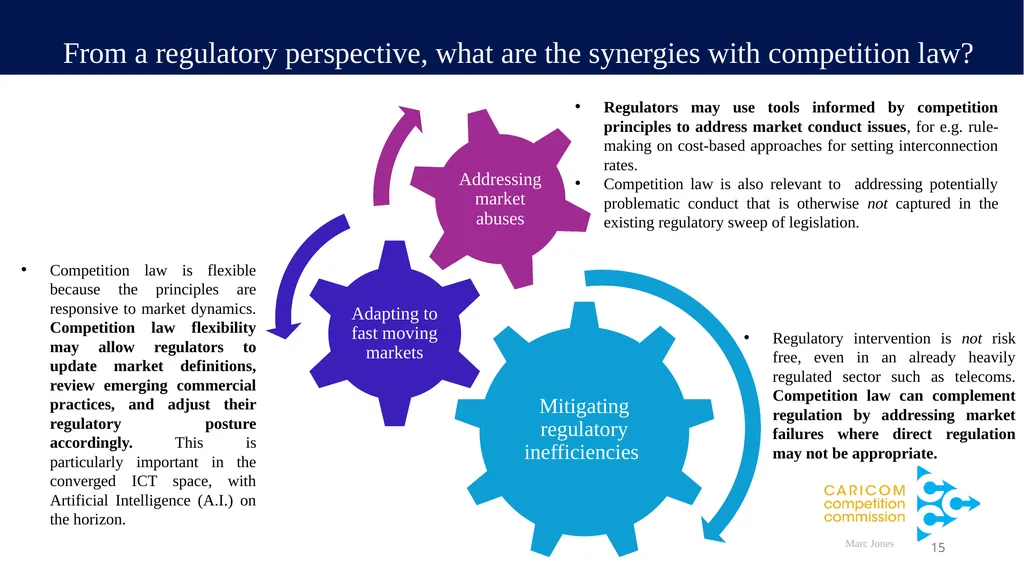
15 From a regulatory perspective, what are the synergies with competition law? Regulators may use tools informed by competition principles to address market conduct issues, for e.g. rule-making on cost-based approaches for setting interconnection rates.
Competition law is also relevant to addressing potentially problematic conduct that is otherwise not captured in the existing regulatory sweep of legislation. Regulatory intervention is not risk free, even in an already heavily regulated sector such as telecoms. Competition law can complement regulation by addressing market failures where direct regulation may not be appropriate. Competition law is flexible because the principles are responsive to market dynamics. Competition law flexibility may allow regulators to update market definitions, review emerging commercial practices, and adjust their regulatory posture accordingly. This is particularly important in the converged ICT space, with Artificial Intelligence (A.I.) on the horizon. Marc Jones<br>
Competition law is also relevant to addressing potentially problematic conduct that is otherwise not captured in the existing regulatory sweep of legislation. Regulatory intervention is not risk free, even in an already heavily regulated sector such as telecoms. Competition law can complement regulation by addressing market failures where direct regulation may not be appropriate. Competition law is flexible because the principles are responsive to market dynamics. Competition law flexibility may allow regulators to update market definitions, review emerging commercial practices, and adjust their regulatory posture accordingly. This is particularly important in the converged ICT space, with Artificial Intelligence (A.I.) on the horizon. Marc Jones<br>
16
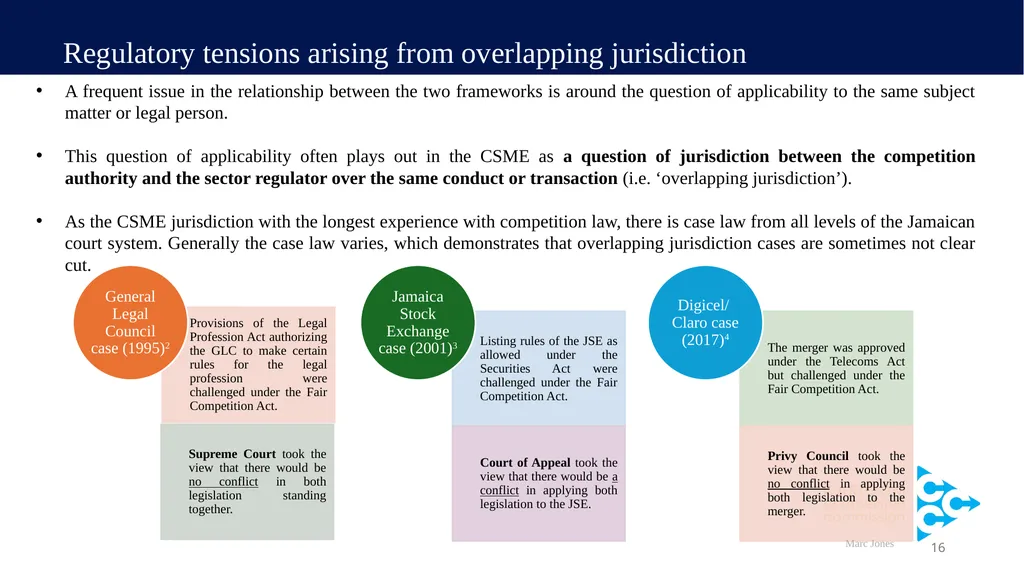
16 Regulatory tensions arising from overlapping jurisdiction A frequent issue in the relationship between the two frameworks is around the question of applicability to the same subject matter or legal person.
This question of applicability often plays out in the CSME as a question of jurisdiction between the competition authority and the sector regulator over the same conduct or transaction (i.e. ‘overlapping jurisdiction’).
As the CSME jurisdiction with the longest experience with competition law, there is case law from all levels of the Jamaican court system. Generally the case law varies, which demonstrates that overlapping jurisdiction cases are sometimes not clear cut. Marc Jones<br>
This question of applicability often plays out in the CSME as a question of jurisdiction between the competition authority and the sector regulator over the same conduct or transaction (i.e. ‘overlapping jurisdiction’).
As the CSME jurisdiction with the longest experience with competition law, there is case law from all levels of the Jamaican court system. Generally the case law varies, which demonstrates that overlapping jurisdiction cases are sometimes not clear cut. Marc Jones<br>
17
17 4. Innovations – emerging regional regulation of digital markets<br>
18
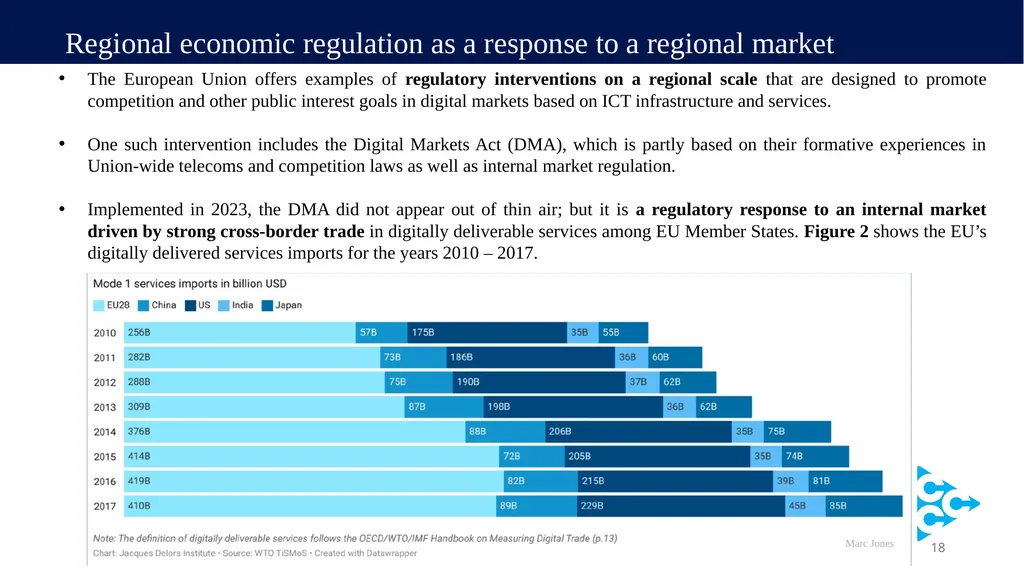
18 Regional economic regulation as a response to a regional market The European Union offers examples of regulatory interventions on a regional scale that are designed to promote competition and other public interest goals in digital markets based on ICT infrastructure and services.
One such intervention includes the Digital Markets Act (DMA), which is partly based on their formative experiences in Union-wide telecoms and competition laws as well as internal market regulation.
Implemented in 2023, the DMA did not appear out of thin air; but it is a regulatory response to an internal market driven by strong cross-border trade in digitally deliverable services among EU Member States. Figure 2 shows the EU’s digitally delivered services imports for the years 2010 – 2017. Marc Jones<br>
One such intervention includes the Digital Markets Act (DMA), which is partly based on their formative experiences in Union-wide telecoms and competition laws as well as internal market regulation.
Implemented in 2023, the DMA did not appear out of thin air; but it is a regulatory response to an internal market driven by strong cross-border trade in digitally deliverable services among EU Member States. Figure 2 shows the EU’s digitally delivered services imports for the years 2010 – 2017. Marc Jones<br>
19
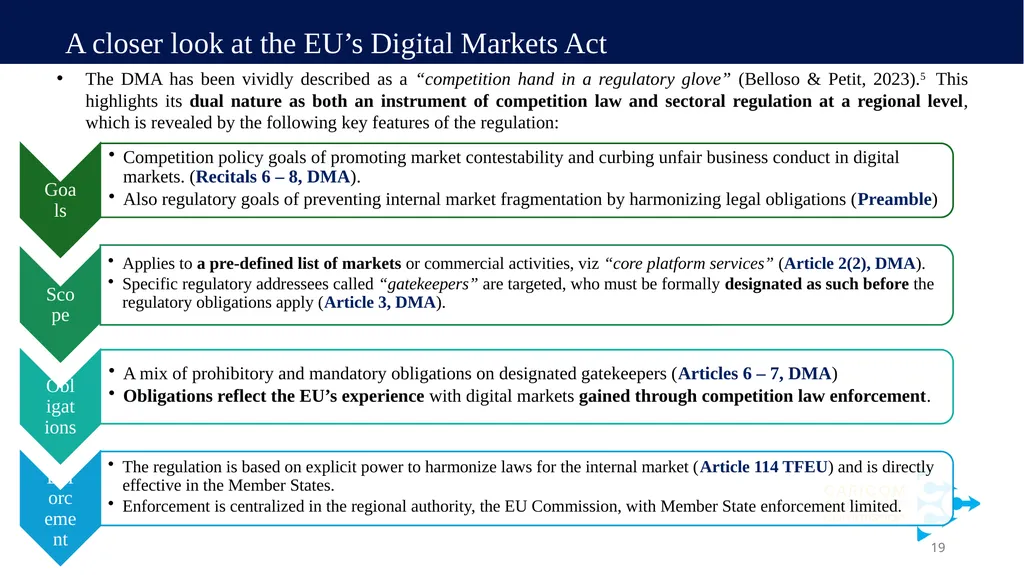
19 A closer look at the EU’s Digital Markets Act The DMA has been vividly described as a “competition hand in a regulatory glove” (Belloso & Petit, 2023).5 This highlights its dual nature as both an instrument of competition law and sectoral regulation at a regional level, which is revealed by the following key features of the regulation:<br>
20
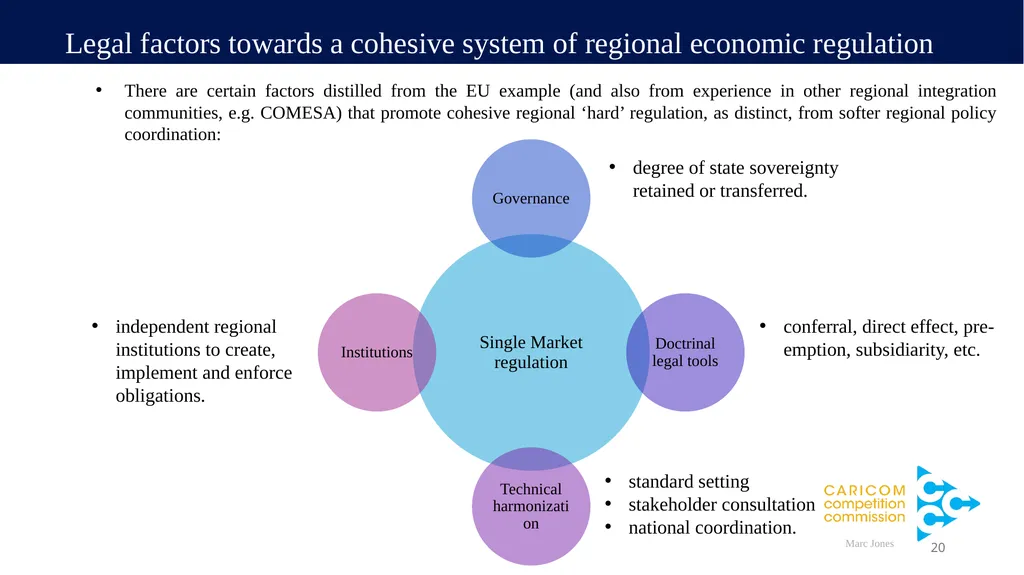
20 Legal factors towards a cohesive system of regional economic regulation There are certain factors distilled from the EU example (and also from experience in other regional integration communities, e.g. COMESA) that promote cohesive regional ‘hard’ regulation, as distinct, from softer regional policy coordination: degree of state sovereignty retained or transferred. conferral, direct effect, pre-emption, subsidiarity, etc. standard setting
stakeholder consultation
national coordination. independent regional institutions to create, implement and enforce obligations. Marc Jones<br>
stakeholder consultation
national coordination. independent regional institutions to create, implement and enforce obligations. Marc Jones<br>
21
21 Insights for a cohesive regional economic regulatory approach in the CSME Truism that regulation shapes markets, but it is equally true that markets should shape regulation; especially where the market is nascent or dynamic. This is borne out by the example of the EU’s DMA.
Where there is not a regional market for a product, or where there is limited cross-border trade in the resource or service, the incentives for a regional ‘hard’ regulatory approach will be limited. In such circumstances, softer forms of policy coordination may be suitable.
Another insight is that even where there are incentives for regional regulation, certain factors in the context of an integration community of sovereign states are relevant for promoting a cohesive approach (i.e. whether through unification or harmonization of competition laws and utilities regulation.)
Some of those features are present in the OECS (for e.g. ECTEL’s coordination of electronic communications regulation pursuant to Articles 4 – 5 ECTEL Treaty); but even then, the inter-governmentalist arrangements among the OECS Member States means that implementation of regional regulatory approaches is still largely subject to national priorities.
The potential for cohesive regional economic regulation in the CSME may be even more limited, with Member States at different stages of development (as recognized in Chapter VII RTC), relatively limited intra-CSME trade, strong inter-governmentalism, and absence in the RTC of doctrinal legal tools to promote a unified or even harmonized regulatory approach. Marc Jones<br>
Where there is not a regional market for a product, or where there is limited cross-border trade in the resource or service, the incentives for a regional ‘hard’ regulatory approach will be limited. In such circumstances, softer forms of policy coordination may be suitable.
Another insight is that even where there are incentives for regional regulation, certain factors in the context of an integration community of sovereign states are relevant for promoting a cohesive approach (i.e. whether through unification or harmonization of competition laws and utilities regulation.)
Some of those features are present in the OECS (for e.g. ECTEL’s coordination of electronic communications regulation pursuant to Articles 4 – 5 ECTEL Treaty); but even then, the inter-governmentalist arrangements among the OECS Member States means that implementation of regional regulatory approaches is still largely subject to national priorities.
The potential for cohesive regional economic regulation in the CSME may be even more limited, with Member States at different stages of development (as recognized in Chapter VII RTC), relatively limited intra-CSME trade, strong inter-governmentalism, and absence in the RTC of doctrinal legal tools to promote a unified or even harmonized regulatory approach. Marc Jones<br>
22
22 5. Collaborations – a single ‘regional’ competition and regulatory body?<br>
23
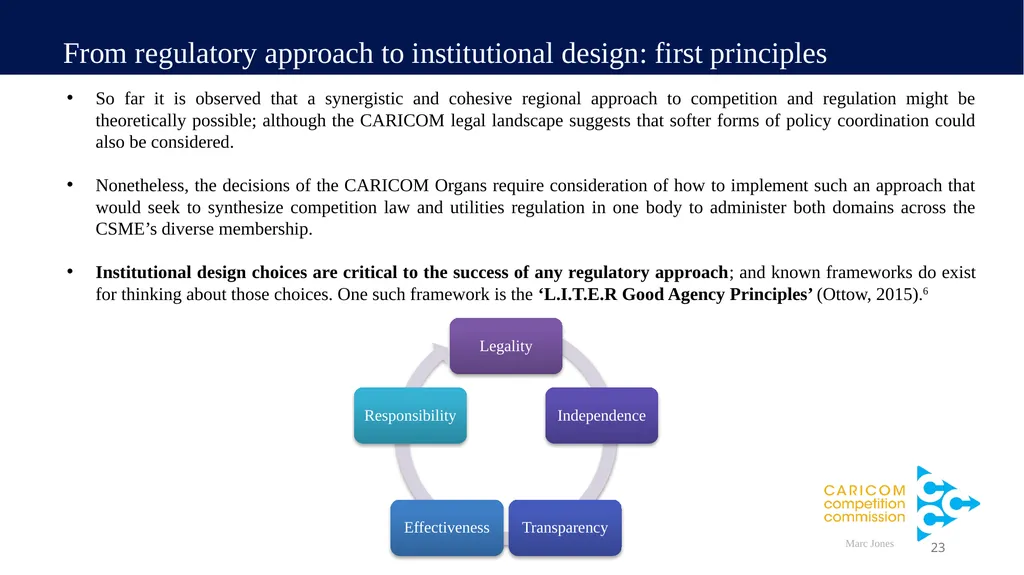
23 From regulatory approach to institutional design: first principles So far it is observed that a synergistic and cohesive regional approach to competition and regulation might be theoretically possible; although the CARICOM legal landscape suggests that softer forms of policy coordination could also be considered.
Nonetheless, the decisions of the CARICOM Organs require consideration of how to implement such an approach that would seek to synthesize competition law and utilities regulation in one body to administer both domains across the CSME’s diverse membership.
Institutional design choices are critical to the success of any regulatory approach; and known frameworks do exist for thinking about those choices. One such framework is the ‘L.I.T.E.R Good Agency Principles’ (Ottow, 2015).6 Marc Jones<br>
Nonetheless, the decisions of the CARICOM Organs require consideration of how to implement such an approach that would seek to synthesize competition law and utilities regulation in one body to administer both domains across the CSME’s diverse membership.
Institutional design choices are critical to the success of any regulatory approach; and known frameworks do exist for thinking about those choices. One such framework is the ‘L.I.T.E.R Good Agency Principles’ (Ottow, 2015).6 Marc Jones<br>
24
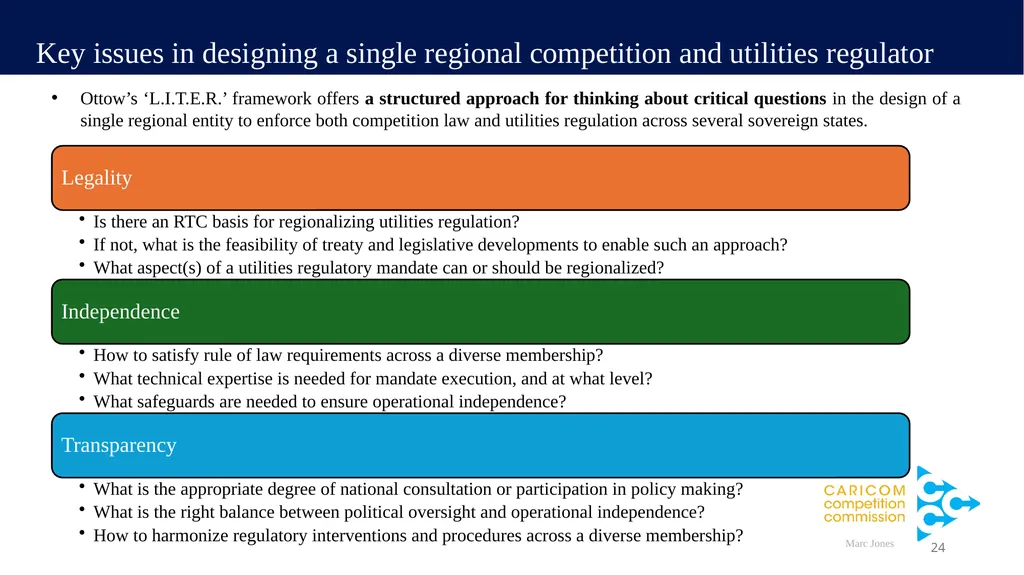
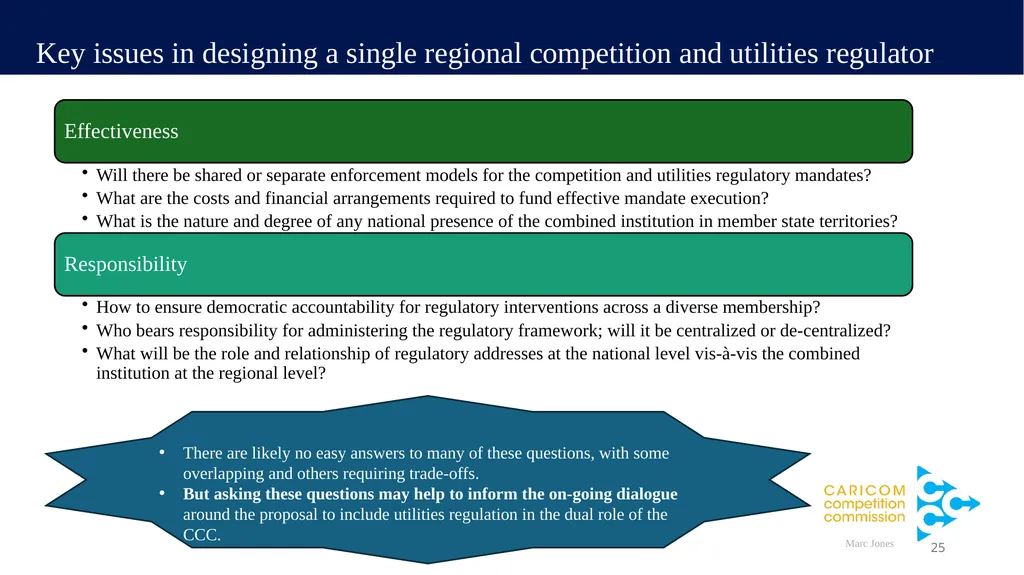
24 Key issues in designing a single regional competition and utilities regulator Ottow’s ‘L.I.T.E.R.’ framework offers a structured approach for thinking about critical questions in the design of a single regional entity to enforce both competition law and utilities regulation across several sovereign states. Marc Jones<br>
25
25 Key issues in designing a single regional competition and utilities regulator There are likely no easy answers to many of these questions, with some overlapping and others requiring trade-offs.
But asking these questions may help to inform the on-going dialogue around the proposal to include utilities regulation in the dual role of the CCC. Marc Jones<br>
But asking these questions may help to inform the on-going dialogue around the proposal to include utilities regulation in the dual role of the CCC. Marc Jones<br>
26
26 6. Concluding reflections<br>
27
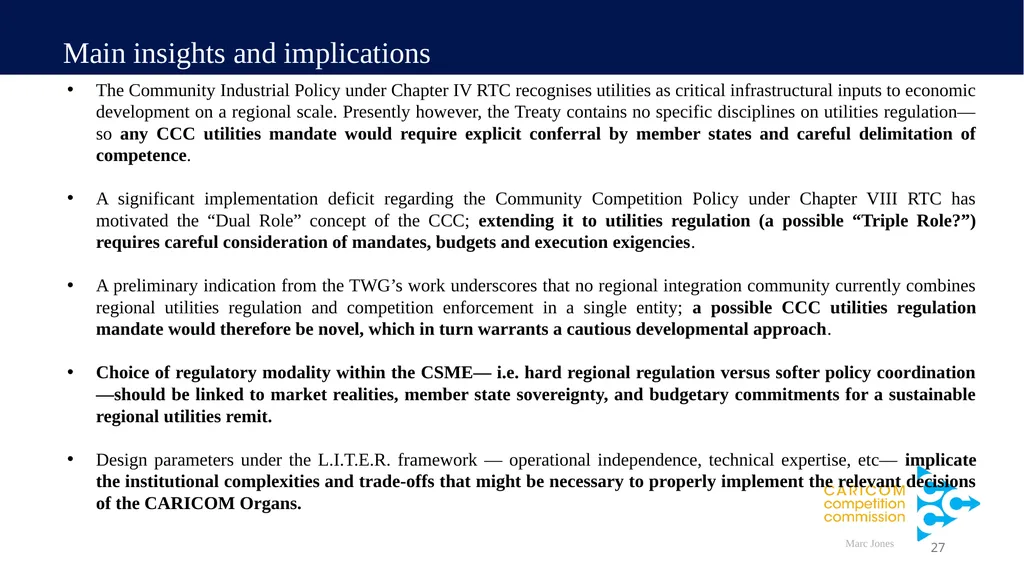
27 Main insights and implications The Community Industrial Policy under Chapter IV RTC recognises utilities as critical infrastructural inputs to economic development on a regional scale. Presently however, the Treaty contains no specific disciplines on utilities regulation—so any CCC utilities mandate would require explicit conferral by member states and careful delimitation of competence.
A significant implementation deficit regarding the Community Competition Policy under Chapter VIII RTC has motivated the “Dual Role” concept of the CCC; extending it to utilities regulation (a possible “Triple Role?”) requires careful consideration of mandates, budgets and execution exigencies.
A preliminary indication from the TWG’s work underscores that no regional integration community currently combines regional utilities regulation and competition enforcement in a single entity; a possible CCC utilities regulation mandate would therefore be novel, which in turn warrants a cautious developmental approach.
Choice of regulatory modality within the CSME— i.e. hard regional regulation versus softer policy coordination—should be linked to market realities, member state sovereignty, and budgetary commitments for a sustainable regional utilities remit.
Design parameters under the L.I.T.E.R. framework — operational independence, technical expertise, etc— implicate the institutional complexities and trade-offs that might be necessary to properly implement the relevant decisions of the CARICOM Organs. Marc Jones<br>
A significant implementation deficit regarding the Community Competition Policy under Chapter VIII RTC has motivated the “Dual Role” concept of the CCC; extending it to utilities regulation (a possible “Triple Role?”) requires careful consideration of mandates, budgets and execution exigencies.
A preliminary indication from the TWG’s work underscores that no regional integration community currently combines regional utilities regulation and competition enforcement in a single entity; a possible CCC utilities regulation mandate would therefore be novel, which in turn warrants a cautious developmental approach.
Choice of regulatory modality within the CSME— i.e. hard regional regulation versus softer policy coordination—should be linked to market realities, member state sovereignty, and budgetary commitments for a sustainable regional utilities remit.
Design parameters under the L.I.T.E.R. framework — operational independence, technical expertise, etc— implicate the institutional complexities and trade-offs that might be necessary to properly implement the relevant decisions of the CARICOM Organs. Marc Jones<br>
28
28<br>