
“A program that produces results, is fun and
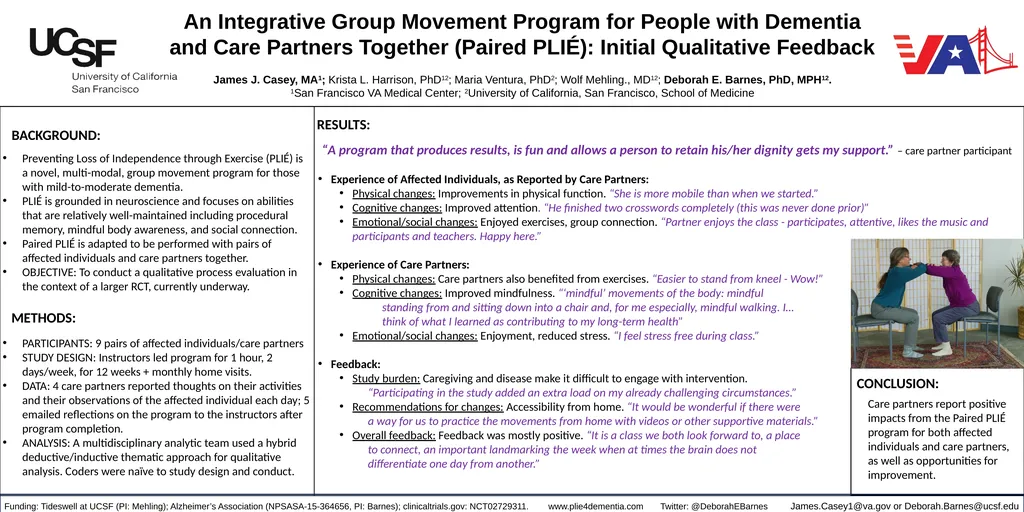
Description: A program that produces results, is fun and allows a person to retain hisher dignity gets my support. care partner participant Experience of Affected Individuals, as Reported by Care Partners: Physical changes: Improvements in physical
Related Topics
Download Presentation
"“A program that produces results, is fun and" is the property of its rightful owner. Permission is granted to download and print the materials on this website for personal, non-commercial use only, and to display it on your personal computer provided you do not modify the materials and that you retain all copyright notices contained in the materials. By downloading content from our website, you accept the terms of this agreement.
Presentation Transcript
slide1. “A program that produces results, is fun and allows a person to retain his/her dignity gets my support.” – care partner participant
Experience of Affected Individuals, as Reported by Care Partners:
Physical changes: Improvements in physical function. “She is more mobile than when we started.”
Cognitive changes: Improved attention. “He finished two crosswords completely (this was never done prior)”
Emotional/social changes: Enjoyed exercises, group connection. “Partner enjoys the class - participates, attentive, likes the music and participants and teachers. Happy here.”
Experience of Care Partners:
Physical changes: Care partners also benefited from exercises. “Easier to stand from kneel - Wow!”
Cognitive changes: Improved mindfulness. “‘mindful’ movements of the body: mindful
standing from and sitting down into a chair and, for me especially, mindful walking. I…
think of what I learned as contributing to my long-term health”
Emotional/social changes: Enjoyment, reduced stress. “I feel stress free during class.”
Feedback:
Study burden: Caregiving and disease make it difficult to engage with intervention.
“Participating in the study added an extra load on my already challenging circumstances.”
Recommendations for changes: Accessibility from home. “It would be wonderful if there were
a way for us to practice the movements from home with videos or other supportive materials.”
Overall feedback: Feedback was mostly positive. “It is a class we both look forward to, a place
to connect, an important landmarking the week when at times the brain does not
differentiate one day from another.” CONCLUSION:
Care partners report positive impacts from the Paired PLIÉ program for both affected individuals and care partners, as well as opportunities for improvement. Preventing Loss of Independence through Exercise (PLIÉ) is a novel, multi-modal, group movement program for those with mild-to-moderate dementia.
PLIÉ is grounded in neuroscience and focuses on abilities that are relatively well-maintained including procedural memory, mindful body awareness, and social connection.
Paired PLIÉ is adapted to be performed with pairs of affected individuals and care partners together.
OBJECTIVE: To conduct a qualitative process evaluation in the context of a larger RCT, currently underway.
PARTICIPANTS: 9 pairs of affected individuals/care partners
STUDY DESIGN: Instructors led program for 1 hour, 2 days/week, for 12 weeks + monthly home visits.
DATA: 4 care partners reported thoughts on their activities and their observations of the affected individual each day; 5 emailed reflections on the program to the instructors after program completion.
ANALYSIS: A multidisciplinary analytic team used a hybrid deductive/inductive thematic approach for qualitative analysis. Coders were naïve to study design and conduct. An Integrative Group Movement Program for People with Dementia and Care Partners Together (Paired PLIÉ): Initial Qualitative Feedback
James J. Casey, MA1; Krista L. Harrison, PhD12; Maria Ventura, PhD2; Wolf Mehling., MD12; Deborah E. Barnes, PhD, MPH12.
1San Francisco VA Medical Center; 2University of California, San Francisco, School of Medicine BACKGROUND: METHODS: Funding: Tideswell at UCSF (PI: Mehling); Alzheimer’s Association (NPSASA-15-364656, PI: Barnes); clinicaltrials.gov: NCT02729311. www.plie4dementia.com Twitter: @DeborahEBarnes James.Casey1@va.gov or Deborah.Barnes@ucsf.edu RESULTS:<br>
Experience of Affected Individuals, as Reported by Care Partners:
Physical changes: Improvements in physical function. “She is more mobile than when we started.”
Cognitive changes: Improved attention. “He finished two crosswords completely (this was never done prior)”
Emotional/social changes: Enjoyed exercises, group connection. “Partner enjoys the class - participates, attentive, likes the music and participants and teachers. Happy here.”
Experience of Care Partners:
Physical changes: Care partners also benefited from exercises. “Easier to stand from kneel - Wow!”
Cognitive changes: Improved mindfulness. “‘mindful’ movements of the body: mindful
standing from and sitting down into a chair and, for me especially, mindful walking. I…
think of what I learned as contributing to my long-term health”
Emotional/social changes: Enjoyment, reduced stress. “I feel stress free during class.”
Feedback:
Study burden: Caregiving and disease make it difficult to engage with intervention.
“Participating in the study added an extra load on my already challenging circumstances.”
Recommendations for changes: Accessibility from home. “It would be wonderful if there were
a way for us to practice the movements from home with videos or other supportive materials.”
Overall feedback: Feedback was mostly positive. “It is a class we both look forward to, a place
to connect, an important landmarking the week when at times the brain does not
differentiate one day from another.” CONCLUSION:
Care partners report positive impacts from the Paired PLIÉ program for both affected individuals and care partners, as well as opportunities for improvement. Preventing Loss of Independence through Exercise (PLIÉ) is a novel, multi-modal, group movement program for those with mild-to-moderate dementia.
PLIÉ is grounded in neuroscience and focuses on abilities that are relatively well-maintained including procedural memory, mindful body awareness, and social connection.
Paired PLIÉ is adapted to be performed with pairs of affected individuals and care partners together.
OBJECTIVE: To conduct a qualitative process evaluation in the context of a larger RCT, currently underway.
PARTICIPANTS: 9 pairs of affected individuals/care partners
STUDY DESIGN: Instructors led program for 1 hour, 2 days/week, for 12 weeks + monthly home visits.
DATA: 4 care partners reported thoughts on their activities and their observations of the affected individual each day; 5 emailed reflections on the program to the instructors after program completion.
ANALYSIS: A multidisciplinary analytic team used a hybrid deductive/inductive thematic approach for qualitative analysis. Coders were naïve to study design and conduct. An Integrative Group Movement Program for People with Dementia and Care Partners Together (Paired PLIÉ): Initial Qualitative Feedback
James J. Casey, MA1; Krista L. Harrison, PhD12; Maria Ventura, PhD2; Wolf Mehling., MD12; Deborah E. Barnes, PhD, MPH12.
1San Francisco VA Medical Center; 2University of California, San Francisco, School of Medicine BACKGROUND: METHODS: Funding: Tideswell at UCSF (PI: Mehling); Alzheimer’s Association (NPSASA-15-364656, PI: Barnes); clinicaltrials.gov: NCT02729311. www.plie4dementia.com Twitter: @DeborahEBarnes James.Casey1@va.gov or Deborah.Barnes@ucsf.edu RESULTS:<br>