
A quick guide to Immunology testing in Pernicious



Description: A quick guide to Immunology testing in Pernicious Anaemia Dr Charu Consultant Immunologist NHS Lothian The best test to diagnose Pernicious Anaemia (PA) is probably largely related to your clinical judgement (!) Excluding causes other
Related Topics
Download Presentation
"A quick guide to Immunology testing in Pernicious" is the property of its rightful owner. Permission is granted to download and print the materials on this website for personal, non-commercial use only, and to display it on your personal computer provided you do not modify the materials and that you retain all copyright notices contained in the materials. By downloading content from our website, you accept the terms of this agreement.
Presentation Transcript
slide1. A quick guide to Immunology testing in Pernicious Anaemia Dr Charu
Consultant Immunologist
NHS Lothian<br>
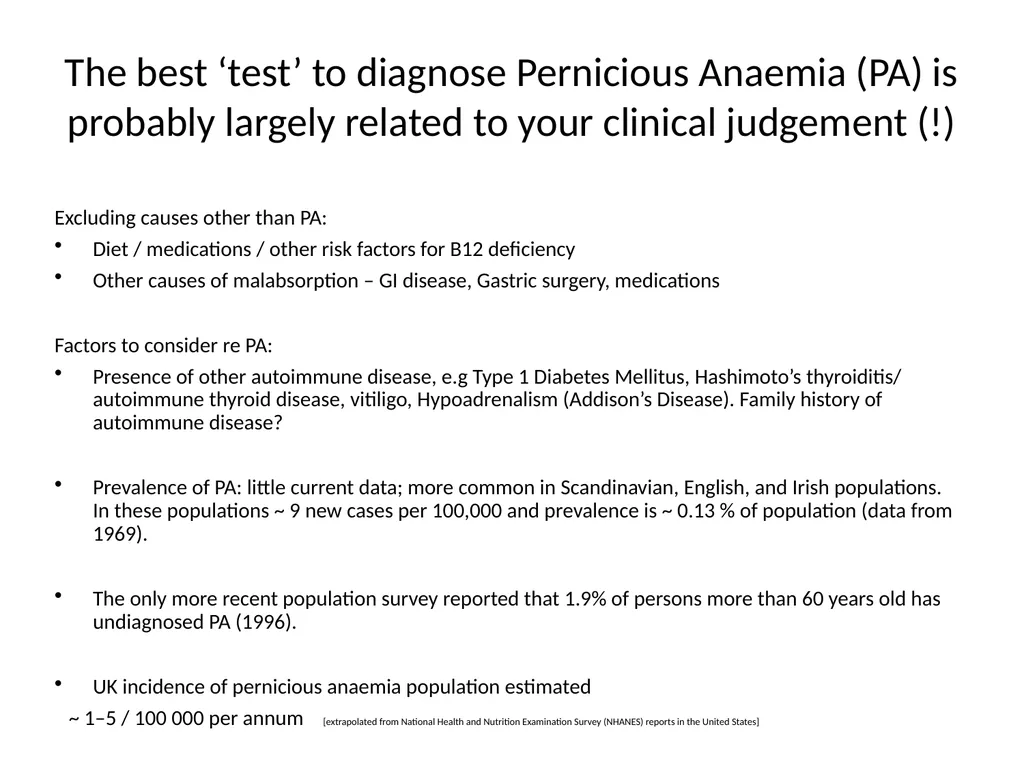
slide2. The best ‘test’ to diagnose Pernicious Anaemia (PA) is probably largely related to your clinical judgement (!) Excluding causes other than PA:
Diet / medications / other risk factors for B12 deficiency
Other causes of malabsorption – GI disease, Gastric surgery, medications
Factors to consider re PA:
Presence of other autoimmune disease, e.g Type 1 Diabetes Mellitus, Hashimoto’s thyroiditis/ autoimmune thyroid disease, vitiligo, Hypoadrenalism (Addison’s Disease). Family history of autoimmune disease?
Prevalence of PA: little current data; more common in Scandinavian, English, and Irish populations. In these populations ~ 9 new cases per 100,000 and prevalence is ~ 0.13 % of population (data from 1969).
The only more recent population survey reported that 1.9% of persons more than 60 years old has undiagnosed PA (1996).
UK incidence of pernicious anaemia population estimated
~ 1–5 / 100 000 per annum [extrapolated from National Health and Nutrition Examination Survey (NHANES) reports in the United States]<br>
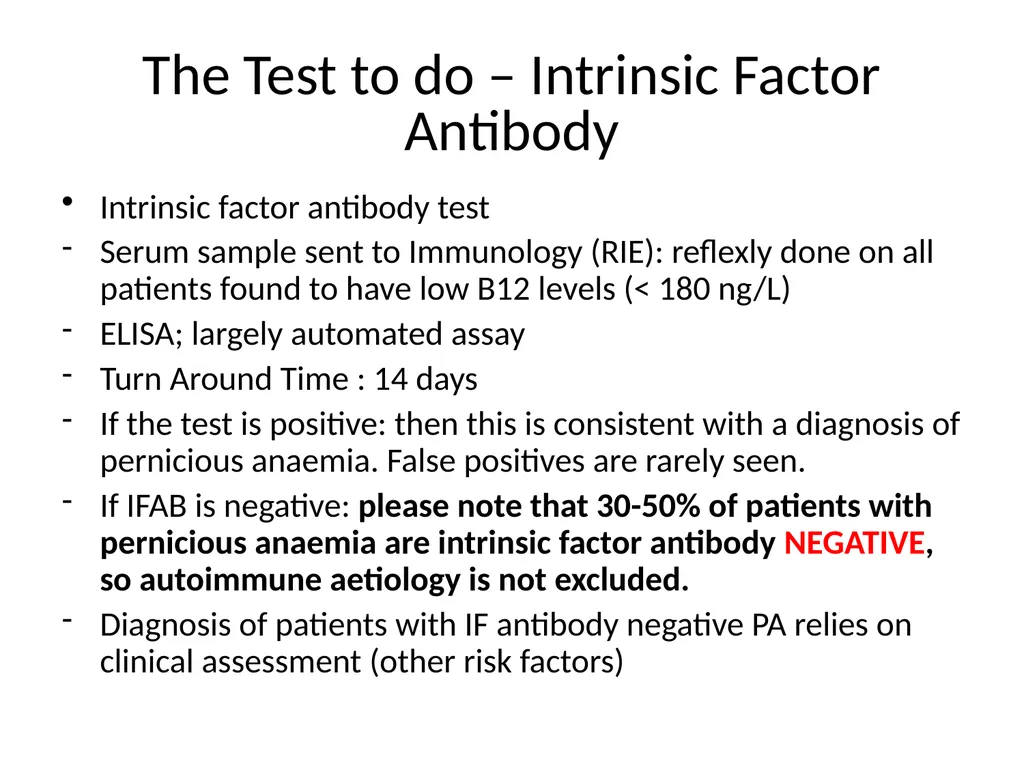
slide3. The Test to do – Intrinsic Factor Antibody Intrinsic factor antibody test
Serum sample sent to Immunology (RIE): reflexly done on all patients found to have low B12 levels (< 180 ng/L)
ELISA; largely automated assay
Turn Around Time : 14 days
If the test is positive: then this is consistent with a diagnosis of pernicious anaemia. False positives are rarely seen.
If IFAB is negative: please note that 30-50% of patients with pernicious anaemia are intrinsic factor antibody NEGATIVE, so autoimmune aetiology is not excluded.
Diagnosis of patients with IF antibody negative PA relies on clinical assessment (other risk factors)<br>
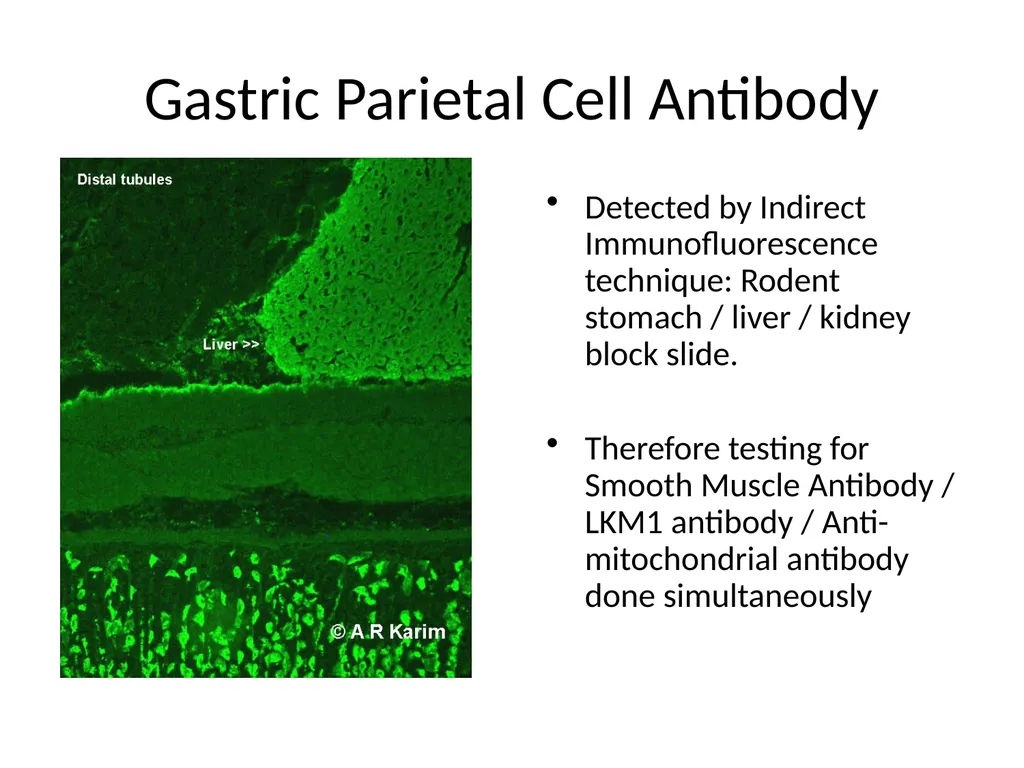
slide4. Gastric Parietal Cell Antibody Detected by Indirect Immunofluorescence technique: Rodent stomach / liver / kidney block slide.
Therefore testing for Smooth Muscle Antibody / LKM1 antibody / Anti-mitochondrial antibody done simultaneously<br>
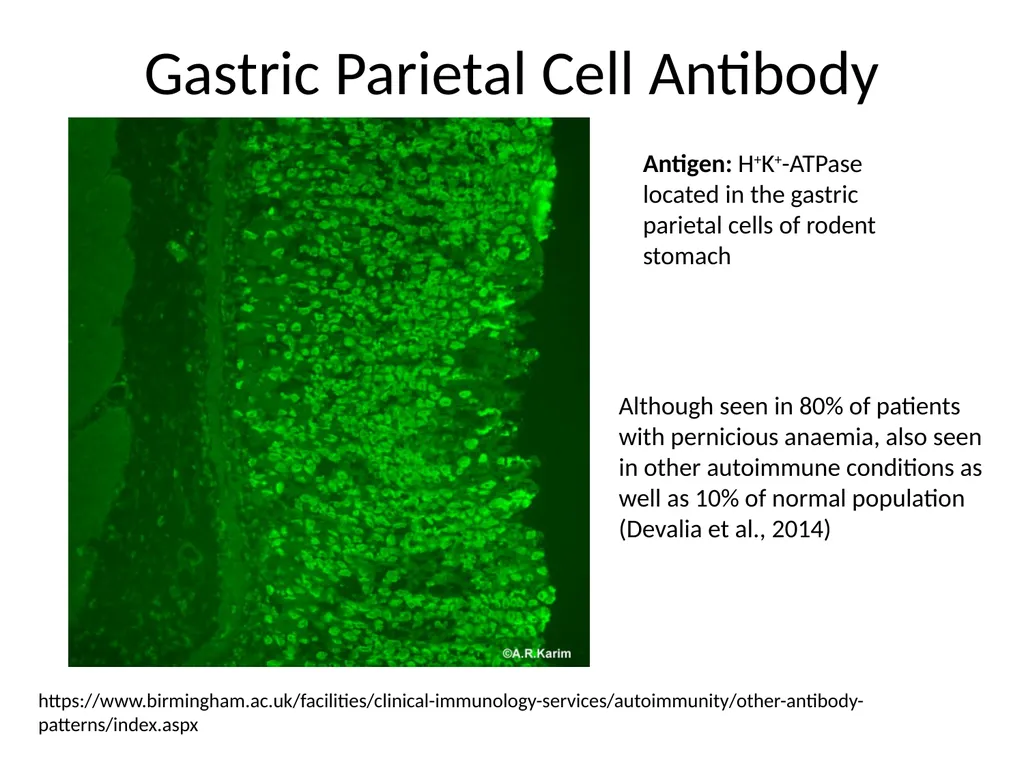
slide5. Antigen: H+K+-ATPase located in the gastric parietal cells of rodent stomach https://www.birmingham.ac.uk/facilities/clinical-immunology-services/autoimmunity/other-antibody-patterns/index.aspx Gastric Parietal Cell Antibody Although seen in 80% of patients with pernicious anaemia, also seen in other autoimmune conditions as well as 10% of normal population (Devalia et al., 2014)<br>
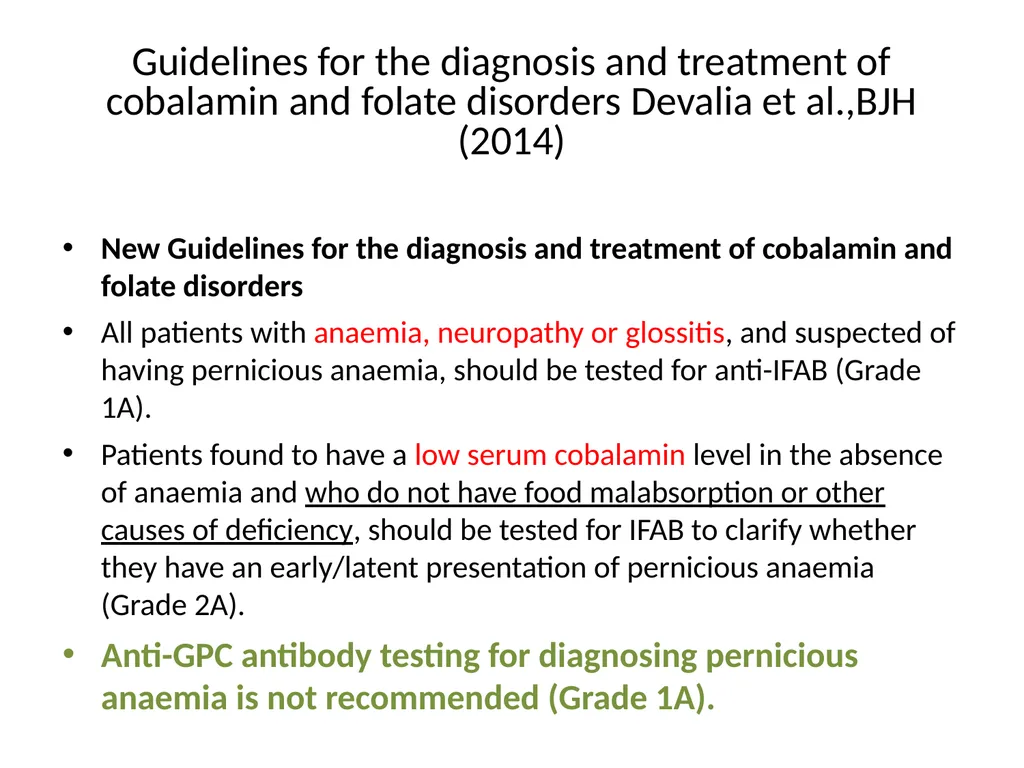
slide6. Guidelines for the diagnosis and treatment of cobalamin and folate disorders Devalia et al.,BJH (2014) New Guidelines for the diagnosis and treatment of cobalamin and folate disorders
All patients with anaemia, neuropathy or glossitis, and suspected of having pernicious anaemia, should be tested for anti-IFAB (Grade 1A).
Patients found to have a low serum cobalamin level in the absence of anaemia and who do not have food malabsorption or other causes of deficiency, should be tested for IFAB to clarify whether they have an early/latent presentation of pernicious anaemia (Grade 2A).
Anti-GPC antibody testing for diagnosing pernicious anaemia is not recommended (Grade 1A).<br>
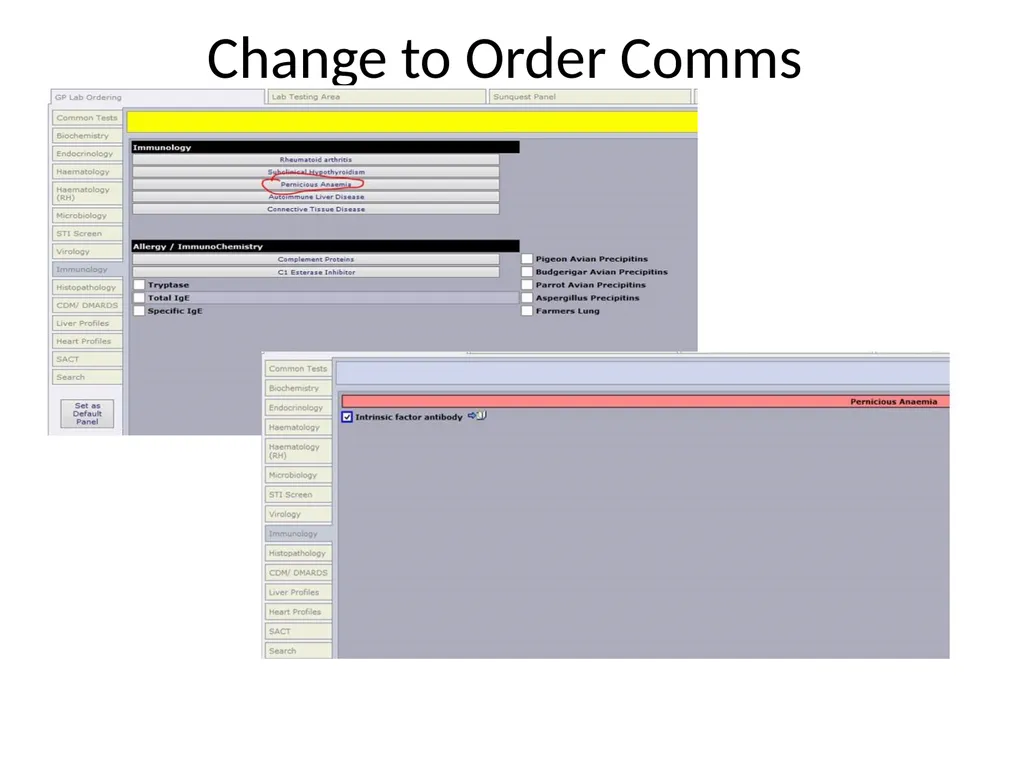
slide7. Change to Order Comms<br>
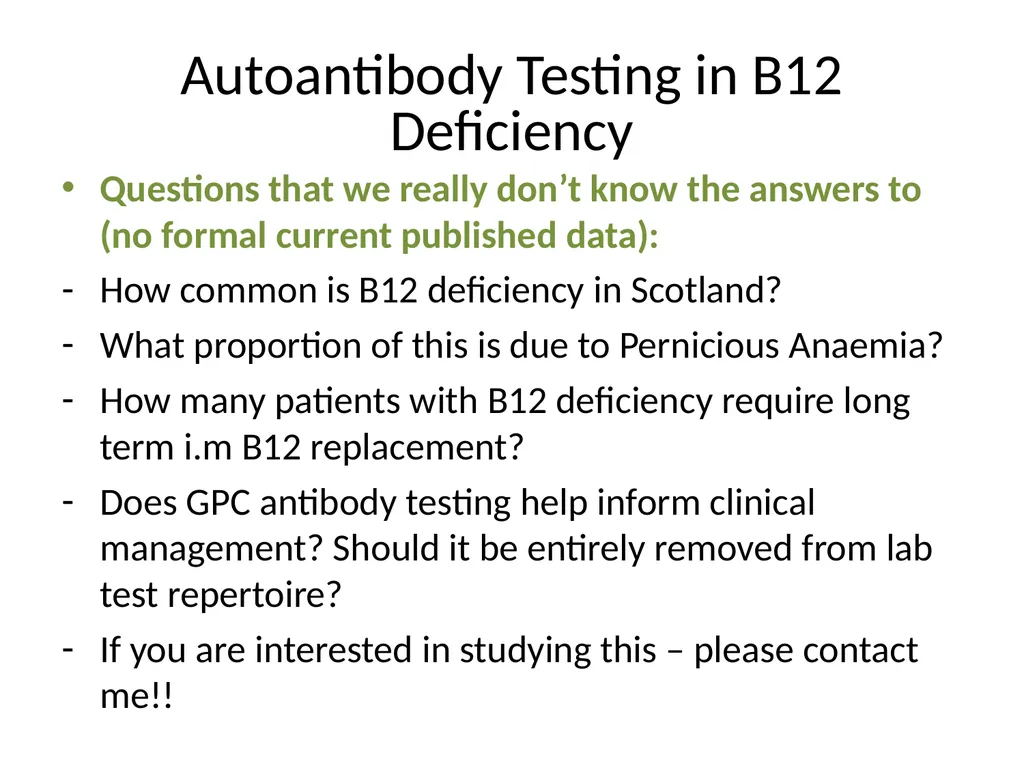
slide8. Autoantibody Testing in B12 Deficiency Questions that we really don’t know the answers to (no formal current published data):
How common is B12 deficiency in Scotland?
What proportion of this is due to Pernicious Anaemia?
How many patients with B12 deficiency require long term i.m B12 replacement?
Does GPC antibody testing help inform clinical management? Should it be entirely removed from lab test repertoire?
If you are interested in studying this – please contact me!!<br>
slide9. Thank you charuchopra@nhs.net<br>
Consultant Immunologist
NHS Lothian<br>
slide2. The best ‘test’ to diagnose Pernicious Anaemia (PA) is probably largely related to your clinical judgement (!) Excluding causes other than PA:
Diet / medications / other risk factors for B12 deficiency
Other causes of malabsorption – GI disease, Gastric surgery, medications
Factors to consider re PA:
Presence of other autoimmune disease, e.g Type 1 Diabetes Mellitus, Hashimoto’s thyroiditis/ autoimmune thyroid disease, vitiligo, Hypoadrenalism (Addison’s Disease). Family history of autoimmune disease?
Prevalence of PA: little current data; more common in Scandinavian, English, and Irish populations. In these populations ~ 9 new cases per 100,000 and prevalence is ~ 0.13 % of population (data from 1969).
The only more recent population survey reported that 1.9% of persons more than 60 years old has undiagnosed PA (1996).
UK incidence of pernicious anaemia population estimated
~ 1–5 / 100 000 per annum [extrapolated from National Health and Nutrition Examination Survey (NHANES) reports in the United States]<br>
slide3. The Test to do – Intrinsic Factor Antibody Intrinsic factor antibody test
Serum sample sent to Immunology (RIE): reflexly done on all patients found to have low B12 levels (< 180 ng/L)
ELISA; largely automated assay
Turn Around Time : 14 days
If the test is positive: then this is consistent with a diagnosis of pernicious anaemia. False positives are rarely seen.
If IFAB is negative: please note that 30-50% of patients with pernicious anaemia are intrinsic factor antibody NEGATIVE, so autoimmune aetiology is not excluded.
Diagnosis of patients with IF antibody negative PA relies on clinical assessment (other risk factors)<br>
slide4. Gastric Parietal Cell Antibody Detected by Indirect Immunofluorescence technique: Rodent stomach / liver / kidney block slide.
Therefore testing for Smooth Muscle Antibody / LKM1 antibody / Anti-mitochondrial antibody done simultaneously<br>
slide5. Antigen: H+K+-ATPase located in the gastric parietal cells of rodent stomach https://www.birmingham.ac.uk/facilities/clinical-immunology-services/autoimmunity/other-antibody-patterns/index.aspx Gastric Parietal Cell Antibody Although seen in 80% of patients with pernicious anaemia, also seen in other autoimmune conditions as well as 10% of normal population (Devalia et al., 2014)<br>
slide6. Guidelines for the diagnosis and treatment of cobalamin and folate disorders Devalia et al.,BJH (2014) New Guidelines for the diagnosis and treatment of cobalamin and folate disorders
All patients with anaemia, neuropathy or glossitis, and suspected of having pernicious anaemia, should be tested for anti-IFAB (Grade 1A).
Patients found to have a low serum cobalamin level in the absence of anaemia and who do not have food malabsorption or other causes of deficiency, should be tested for IFAB to clarify whether they have an early/latent presentation of pernicious anaemia (Grade 2A).
Anti-GPC antibody testing for diagnosing pernicious anaemia is not recommended (Grade 1A).<br>
slide7. Change to Order Comms<br>
slide8. Autoantibody Testing in B12 Deficiency Questions that we really don’t know the answers to (no formal current published data):
How common is B12 deficiency in Scotland?
What proportion of this is due to Pernicious Anaemia?
How many patients with B12 deficiency require long term i.m B12 replacement?
Does GPC antibody testing help inform clinical management? Should it be entirely removed from lab test repertoire?
If you are interested in studying this – please contact me!!<br>
slide9. Thank you charuchopra@nhs.net<br>