
A Robust Web Service Composition Model with
PM
Published · 34 slides · 0 views
1 / 1
Description
A Robust Web Service Composition Model with Decentralized Data Dependency Analysis and Rule-Based Failure Recovery Capability Le Gao July 2011 This research is supported by the National Science Foundation under Grant No. CCF-0820152. Any
Related Topics
Share
Embed code
Download this presentation From Below
"A Robust Web Service Composition Model with" is the property of its rightful owner. Permission is granted to download and print the materials on this website for personal, non-commercial use only, and to display it on your personal computer provided you do not modify the materials and that you retain all copyright notices contained in the materials. By downloading content from our website, you accept the terms of this agreement.
Presentation Transcript
01
A Robust Web Service Composition Model with Decentralized Data Dependency
Analysis and Rule-Based Failure Recovery Capability* Le Gao
July 2011
*This research is supported by the National Science Foundation under Grant No.
CCF-0820152. Any opinions, findings, and conclusions or recommendations
expressed in this material are those of the author(s) and do not necessarily reflect
the views of the National Science Foundation.<br>
July 2011
*This research is supported by the National Science Foundation under Grant No.
CCF-0820152. Any opinions, findings, and conclusions or recommendations
expressed in this material are those of the author(s) and do not necessarily reflect
the views of the National Science Foundation.<br>
02
Overview of Presentation Research Motivation
Related Work
Background
Decentralized Data Dependency Analysis
Assurance Points
Application Exception Rules
Research Challenges of Existing Work
Statement of Objectives
Methodologies
Summary<br>
Related Work
Background
Decentralized Data Dependency Analysis
Assurance Points
Application Exception Rules
Research Challenges of Existing Work
Statement of Objectives
Methodologies
Summary<br>
03
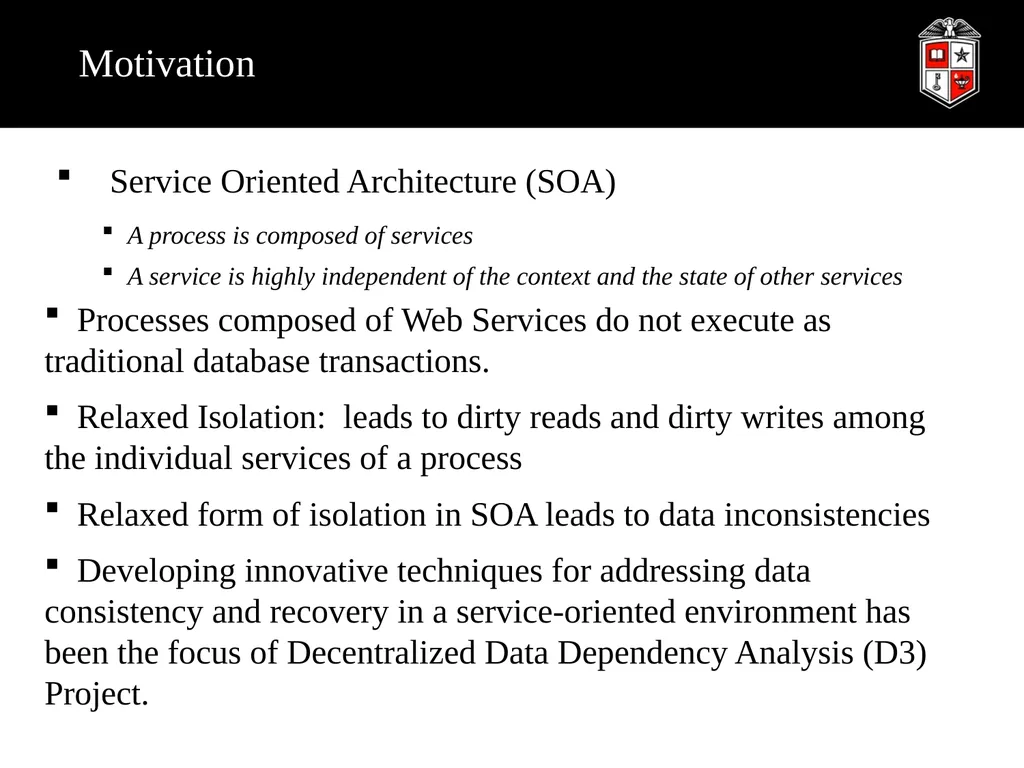
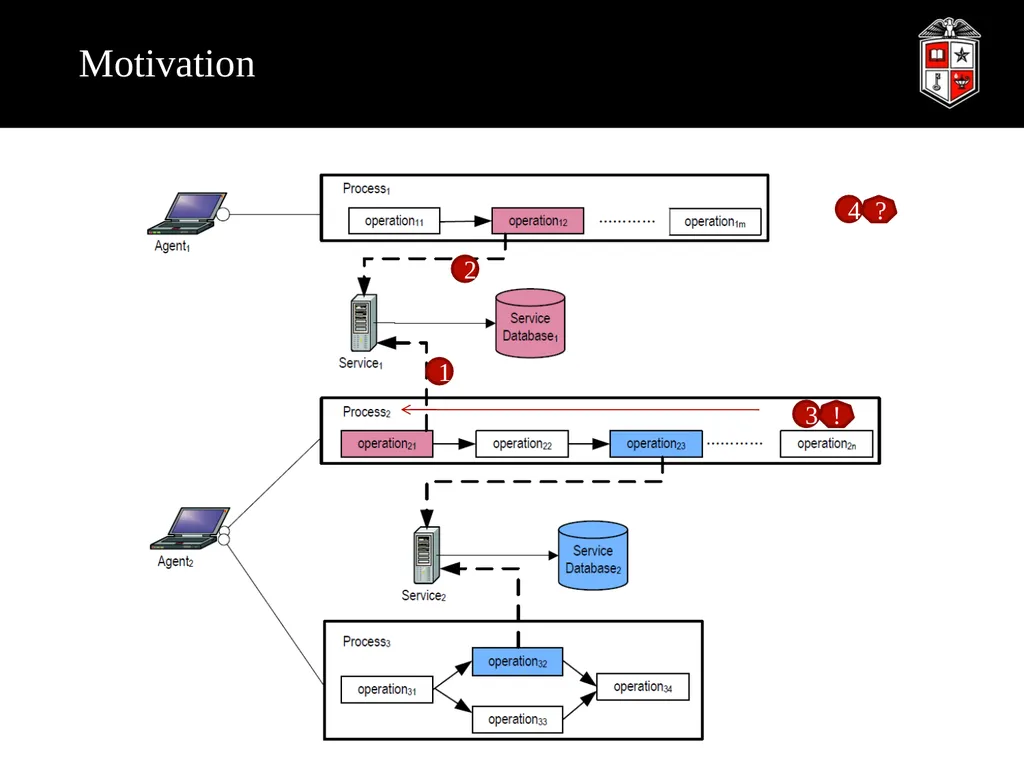
Motivation Service Oriented Architecture (SOA)
A process is composed of services
A service is highly independent of the context and the state of other services
Processes composed of Web Services do not execute as traditional database transactions.
Relaxed Isolation: leads to dirty reads and dirty writes among the individual services of a process
Relaxed form of isolation in SOA leads to data inconsistencies
Developing innovative techniques for addressing data consistency and recovery in a service-oriented environment has been the focus of Decentralized Data Dependency Analysis (D3) Project.<br>
A process is composed of services
A service is highly independent of the context and the state of other services
Processes composed of Web Services do not execute as traditional database transactions.
Relaxed Isolation: leads to dirty reads and dirty writes among the individual services of a process
Relaxed form of isolation in SOA leads to data inconsistencies
Developing innovative techniques for addressing data consistency and recovery in a service-oriented environment has been the focus of Decentralized Data Dependency Analysis (D3) Project.<br>
04
Motivation 1 2 3 ! 4 ?<br>
05
Motivation Current components in D3 project
The Decentralized Process Execution Agents (PEXAs) model in (Liu 2009) proposed mechanisms to identify data dependencies among concurrently executing processes.
Support for user defined constraint checking and flexible failure recovery was proposed in the Assurance Points Model (Shrestha 2010).
Application exception rules that handle interruptions due to external events among concurrent execution processes is developing in (Ramachandran 2011)
The proposed research represents an integration of the current components of the decentralized data dependency analysis project to create a more robust web service composition model with decentralized data dependency analysis and rule-based failure recovery capability.<br>
The Decentralized Process Execution Agents (PEXAs) model in (Liu 2009) proposed mechanisms to identify data dependencies among concurrently executing processes.
Support for user defined constraint checking and flexible failure recovery was proposed in the Assurance Points Model (Shrestha 2010).
Application exception rules that handle interruptions due to external events among concurrent execution processes is developing in (Ramachandran 2011)
The proposed research represents an integration of the current components of the decentralized data dependency analysis project to create a more robust web service composition model with decentralized data dependency analysis and rule-based failure recovery capability.<br>
06
Related Work Exception handling in a service composition environment
Promise Approach (Jang, Fekete, & Greenfield, 2007)
an agreement between a client application and a ‘promise maker’
Reservation-Based Approach (Zhao, Moser, & Melliar-Smith, 2005)
a contract between the client and the resource provider
Transactional Attitudes (Mikalsen, Tai, and Rouvellou 2002)
Maintain reliability by using PTAs and CTAs to define attitudes
Checkpointing Systems (Dialani et al., 2002; Luo, 2000)
During failures and exceptions, the activity can be rolled back to the closest consistent checkpoint, resuming the execution from that point
Aspect-Oriented Workflows (Charfi and Mezini 2007) , (Kiczales et al., 2001)
modularizes the process specification, such as adding joint-point
This Research
Supports relaxed isolation and user-defined semantic correctness
Rule-based and event-driven approach to resolving failure and recovery impact on concurrent processes.
Decentralized data dependencies analysis from streaming database log files.<br>
Promise Approach (Jang, Fekete, & Greenfield, 2007)
an agreement between a client application and a ‘promise maker’
Reservation-Based Approach (Zhao, Moser, & Melliar-Smith, 2005)
a contract between the client and the resource provider
Transactional Attitudes (Mikalsen, Tai, and Rouvellou 2002)
Maintain reliability by using PTAs and CTAs to define attitudes
Checkpointing Systems (Dialani et al., 2002; Luo, 2000)
During failures and exceptions, the activity can be rolled back to the closest consistent checkpoint, resuming the execution from that point
Aspect-Oriented Workflows (Charfi and Mezini 2007) , (Kiczales et al., 2001)
modularizes the process specification, such as adding joint-point
This Research
Supports relaxed isolation and user-defined semantic correctness
Rule-based and event-driven approach to resolving failure and recovery impact on concurrent processes.
Decentralized data dependencies analysis from streaming database log files.<br>
07
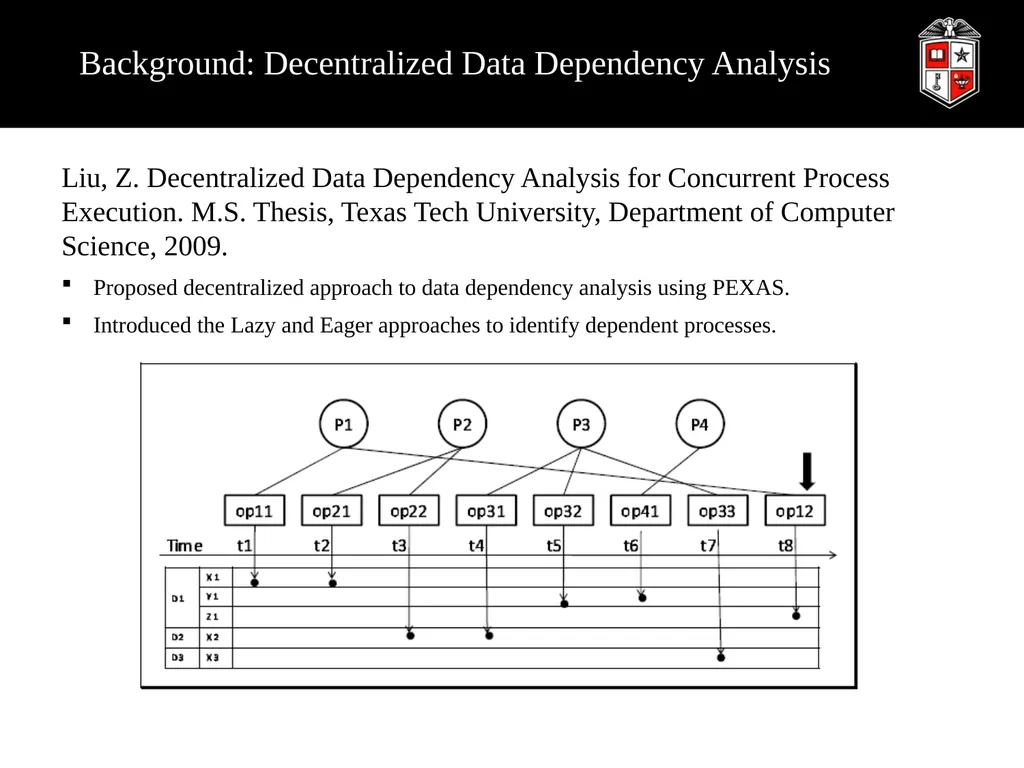
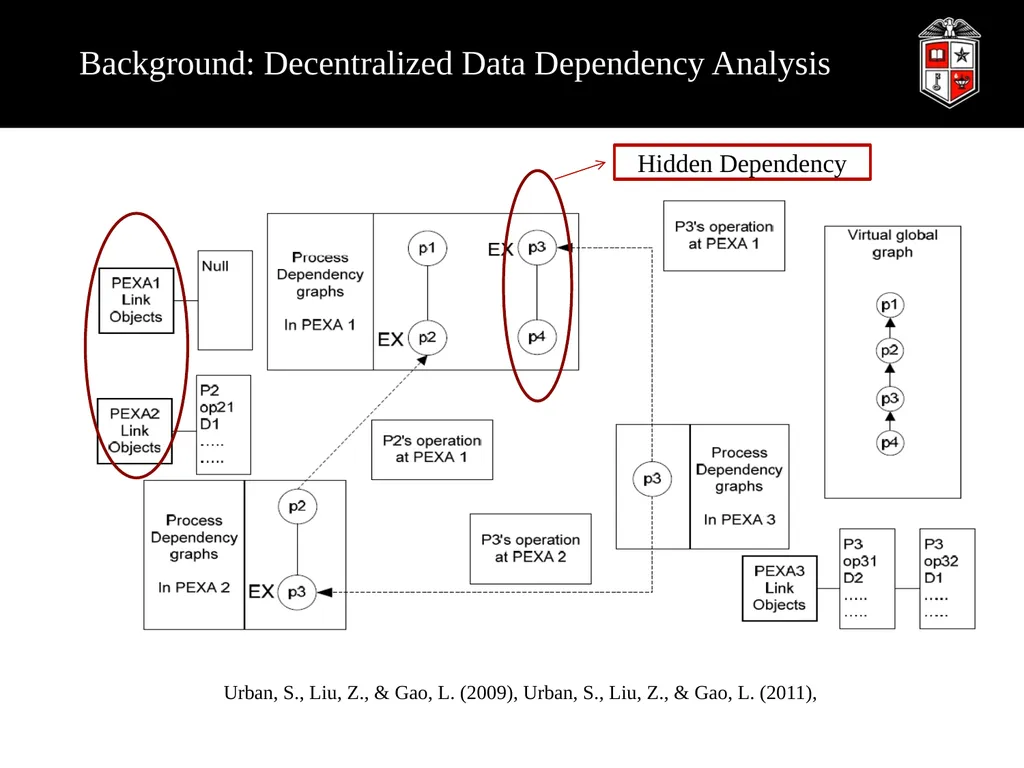
Background: Decentralized Data Dependency Analysis Liu, Z. Decentralized Data Dependency Analysis for Concurrent Process Execution. M.S. Thesis, Texas Tech University, Department of Computer Science, 2009.
Proposed decentralized approach to data dependency analysis using PEXAS.
Introduced the Lazy and Eager approaches to identify dependent processes.<br>
Proposed decentralized approach to data dependency analysis using PEXAS.
Introduced the Lazy and Eager approaches to identify dependent processes.<br>
08
Background: Decentralized Data Dependency Analysis Urban, S., Liu, Z., & Gao, L. (2009), Urban, S., Liu, Z., & Gao, L. (2011), Hidden Dependency<br>
09
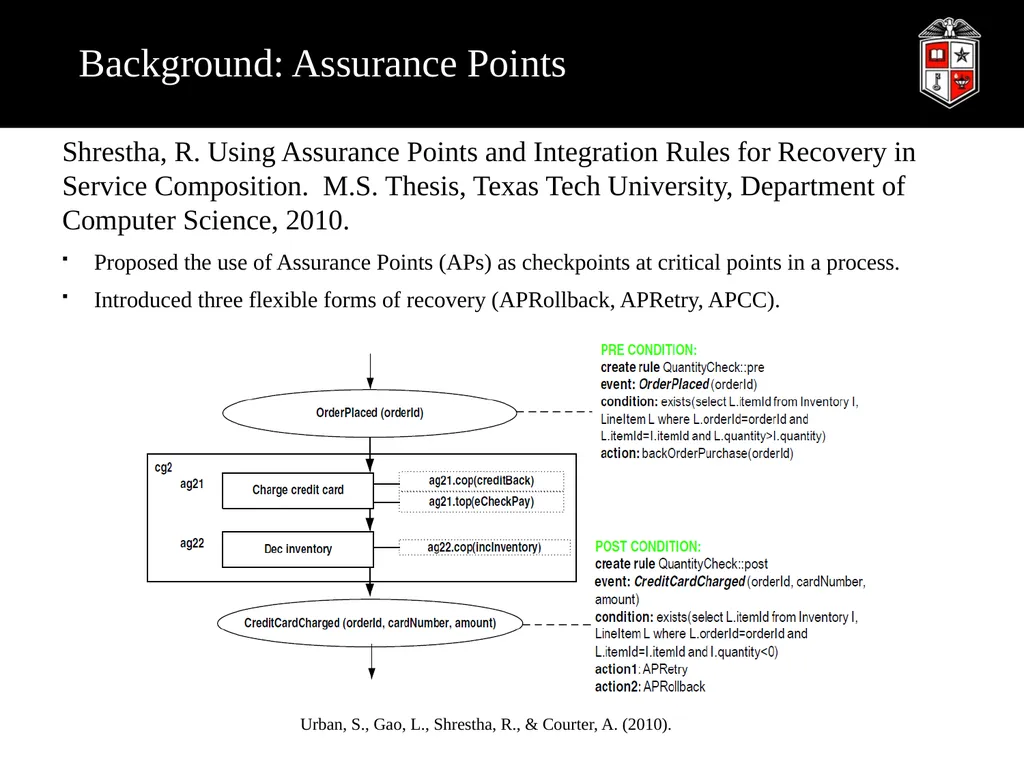
Background: Assurance Points Shrestha, R. Using Assurance Points and Integration Rules for Recovery in Service Composition. M.S. Thesis, Texas Tech University, Department of Computer Science, 2010.
Proposed the use of Assurance Points (APs) as checkpoints at critical points in a process.
Introduced three flexible forms of recovery (APRollback, APRetry, APCC). Urban, S., Gao, L., Shrestha, R., & Courter, A. (2010).<br>
Proposed the use of Assurance Points (APs) as checkpoints at critical points in a process.
Introduced three flexible forms of recovery (APRollback, APRetry, APCC). Urban, S., Gao, L., Shrestha, R., & Courter, A. (2010).<br>
10
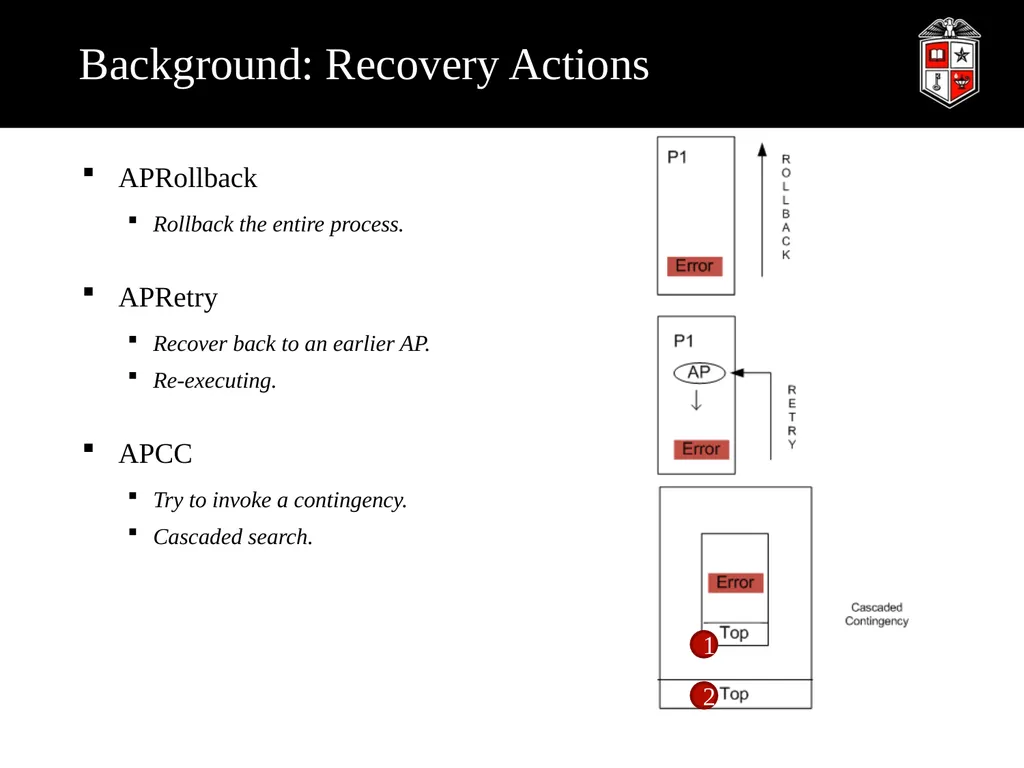
Background: Recovery Actions APRollback
Rollback the entire process.
APRetry
Recover back to an earlier AP.
Re-executing.
APCC
Try to invoke a contingency.
Cascaded search. 1 2<br>
Rollback the entire process.
APRetry
Recover back to an earlier AP.
Re-executing.
APCC
Try to invoke a contingency.
Cascaded search. 1 2<br>
11
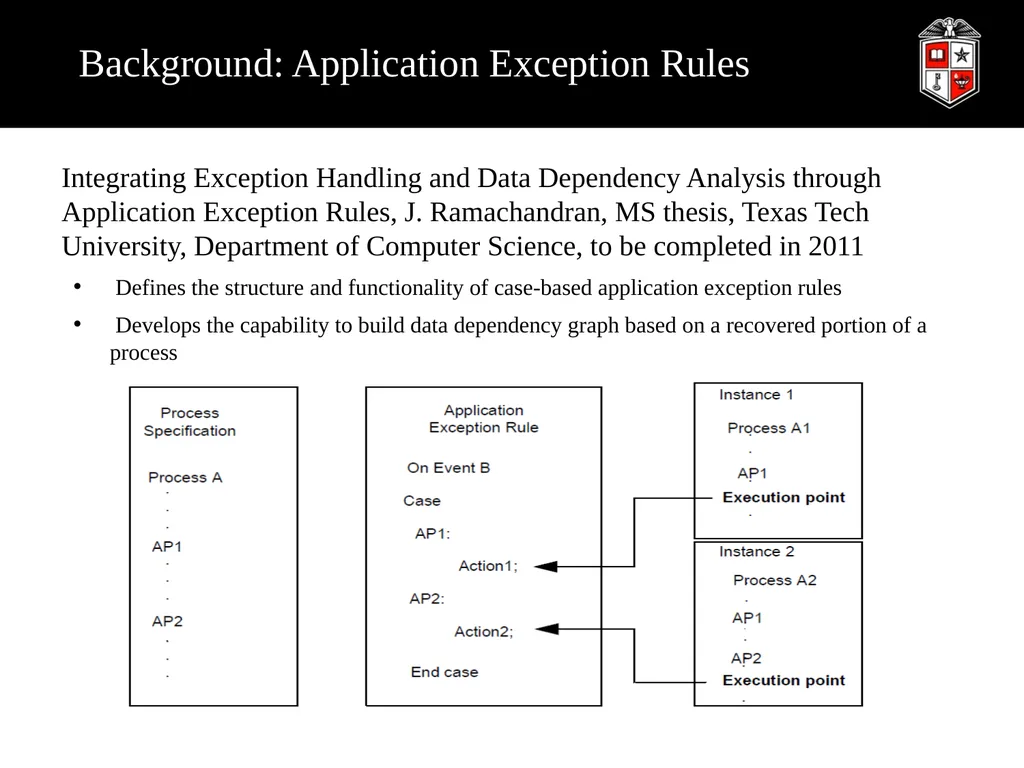
Background: Application Exception Rules Integrating Exception Handling and Data Dependency Analysis through Application Exception Rules, J. Ramachandran, MS thesis, Texas Tech University, Department of Computer Science, to be completed in 2011
Defines the structure and functionality of case-based application exception rules
Develops the capability to build data dependency graph based on a recovered portion of a process<br>
Defines the structure and functionality of case-based application exception rules
Develops the capability to build data dependency graph based on a recovered portion of a process<br>
12
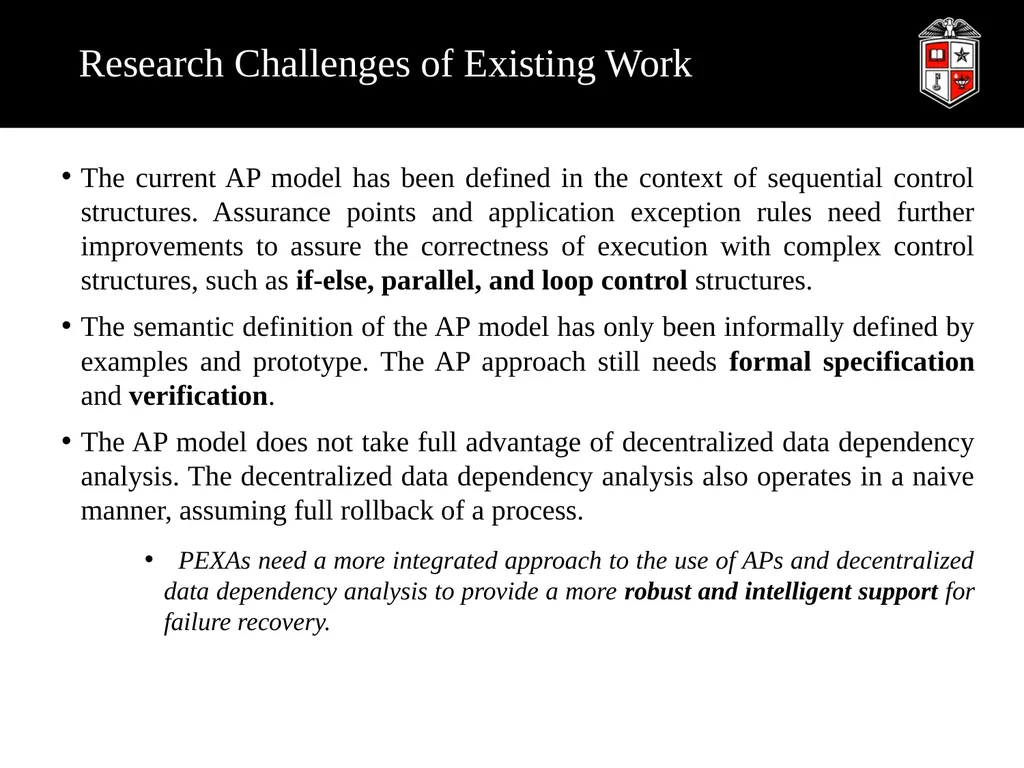
Research Challenges of Existing Work The current AP model has been defined in the context of sequential control structures. Assurance points and application exception rules need further improvements to assure the correctness of execution with complex control structures, such as if-else, parallel, and loop control structures.
The semantic definition of the AP model has only been informally defined by examples and prototype. The AP approach still needs formal specification and verification.
The AP model does not take full advantage of decentralized data dependency analysis. The decentralized data dependency analysis also operates in a naive manner, assuming full rollback of a process.
PEXAs need a more integrated approach to the use of APs and decentralized data dependency analysis to provide a more robust and intelligent support for failure recovery.<br>
The semantic definition of the AP model has only been informally defined by examples and prototype. The AP approach still needs formal specification and verification.
The AP model does not take full advantage of decentralized data dependency analysis. The decentralized data dependency analysis also operates in a naive manner, assuming full rollback of a process.
PEXAs need a more integrated approach to the use of APs and decentralized data dependency analysis to provide a more robust and intelligent support for failure recovery.<br>
13
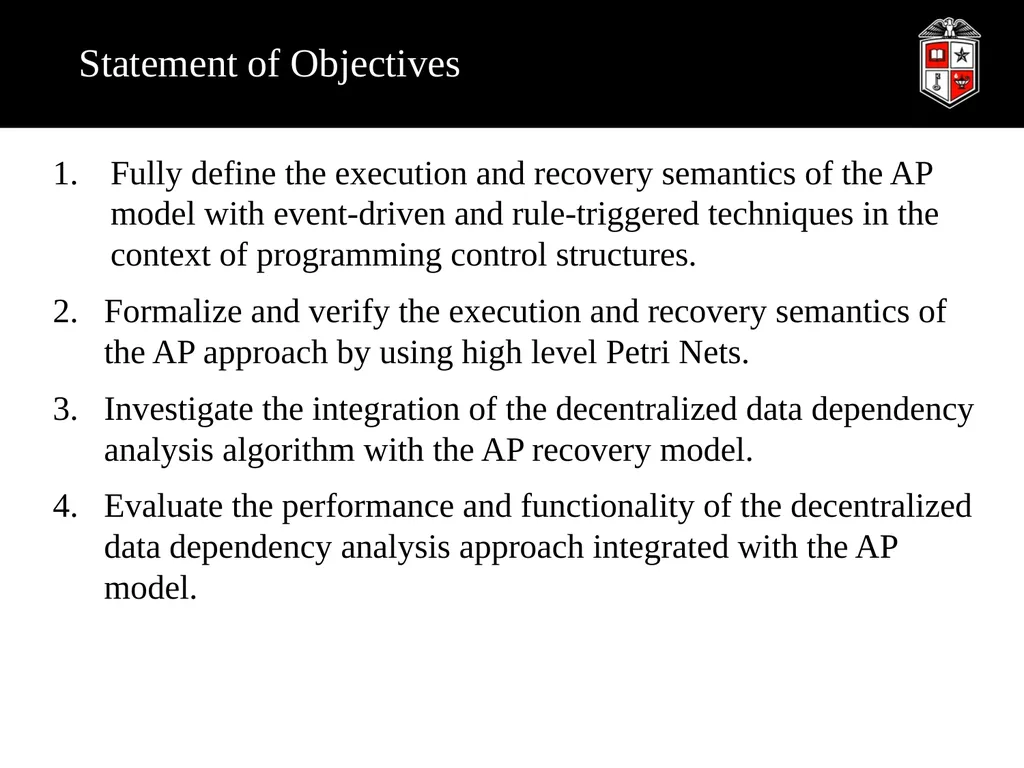
Statement of Objectives Fully define the execution and recovery semantics of the AP model with event-driven and rule-triggered techniques in the context of programming control structures.
Formalize and verify the execution and recovery semantics of the AP approach by using high level Petri Nets.
Investigate the integration of the decentralized data dependency analysis algorithm with the AP recovery model.
Evaluate the performance and functionality of the decentralized data dependency analysis approach integrated with the AP model.<br>
Formalize and verify the execution and recovery semantics of the AP approach by using high level Petri Nets.
Investigate the integration of the decentralized data dependency analysis algorithm with the AP recovery model.
Evaluate the performance and functionality of the decentralized data dependency analysis approach integrated with the AP model.<br>
14
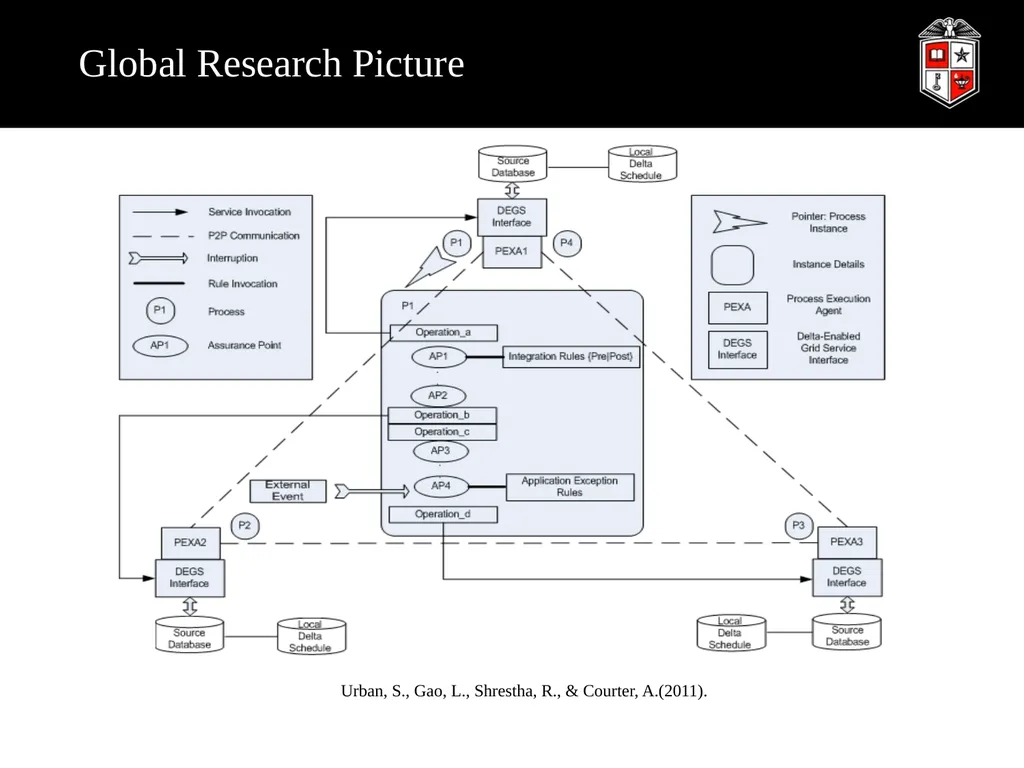
Global Research Picture Urban, S., Gao, L., Shrestha, R., & Courter, A.(2011).<br>
15
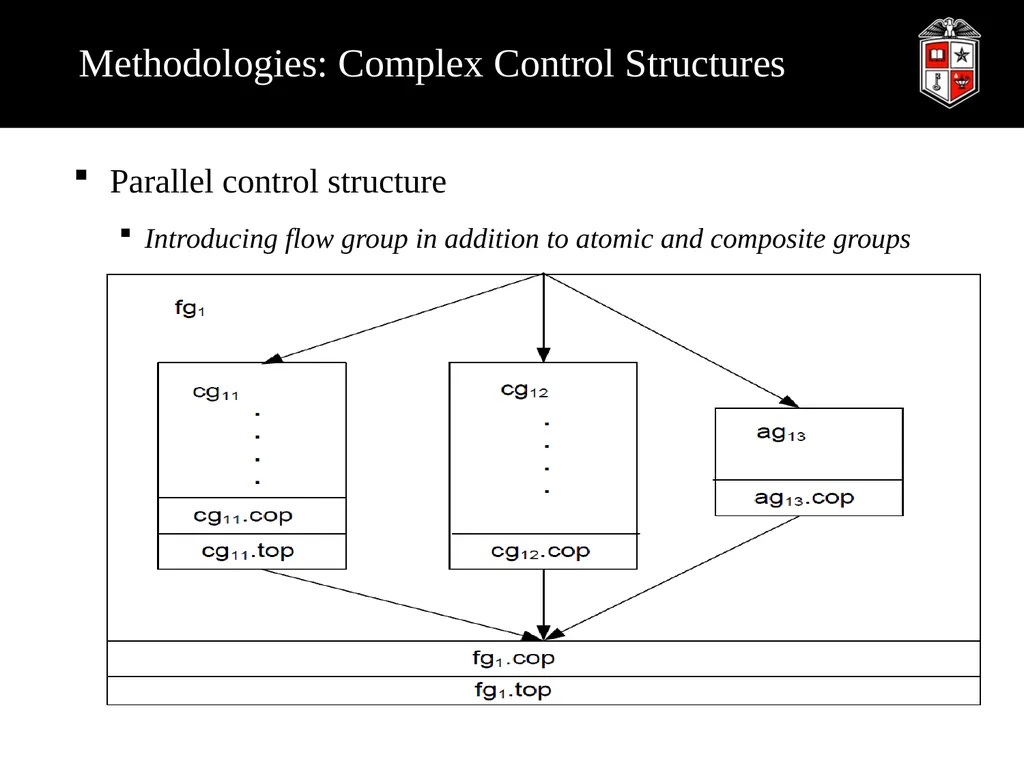
Methodologies: Complex Control Structures Parallel control structure
Introducing flow group in addition to atomic and composite groups<br>
Introducing flow group in addition to atomic and composite groups<br>
16
Methodologies: Complex Control Structures Parallel control structure
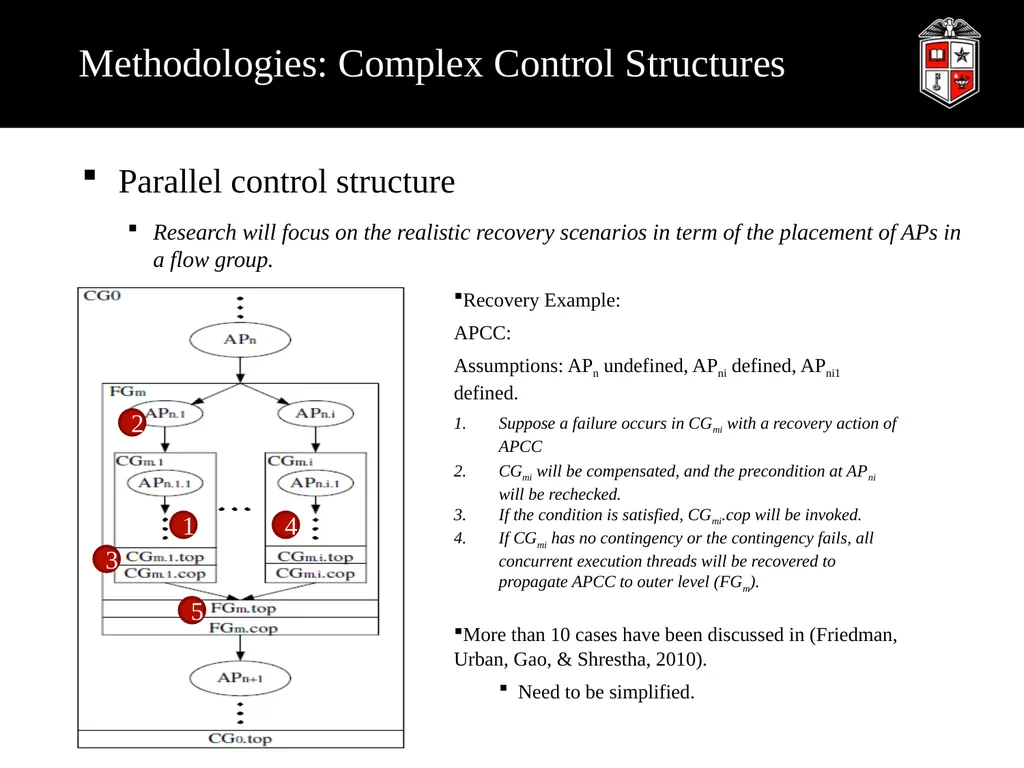
Research will focus on the realistic recovery scenarios in term of the placement of APs in a flow group. Recovery Example:
APCC:
Assumptions: APn undefined, APni defined, APni1 defined.
Suppose a failure occurs in CGmi with a recovery action of APCC
CGmi will be compensated, and the precondition at APni will be rechecked.
If the condition is satisfied, CGmi.cop will be invoked.
If CGmi has no contingency or the contingency fails, all concurrent execution threads will be recovered to propagate APCC to outer level (FGm).
More than 10 cases have been discussed in (Friedman, Urban, Gao, & Shrestha, 2010).
Need to be simplified. 3 2 1 4 5<br>
Research will focus on the realistic recovery scenarios in term of the placement of APs in a flow group. Recovery Example:
APCC:
Assumptions: APn undefined, APni defined, APni1 defined.
Suppose a failure occurs in CGmi with a recovery action of APCC
CGmi will be compensated, and the precondition at APni will be rechecked.
If the condition is satisfied, CGmi.cop will be invoked.
If CGmi has no contingency or the contingency fails, all concurrent execution threads will be recovered to propagate APCC to outer level (FGm).
More than 10 cases have been discussed in (Friedman, Urban, Gao, & Shrestha, 2010).
Need to be simplified. 3 2 1 4 5<br>
17
Methodologies: Complex Control Structures If-else control structure
The process should only need to recover the path which has been executed.
Loop control structure
Because the recovery procedure in the AP model is based on the presence of APs in a process, APs inside of a loop control structure can potentially complicate the recovery process.
In this research, the necessity and complexity of inserting APs in the loop control structure will be investigated.<br>
The process should only need to recover the path which has been executed.
Loop control structure
Because the recovery procedure in the AP model is based on the presence of APs in a process, APs inside of a loop control structure can potentially complicate the recovery process.
In this research, the necessity and complexity of inserting APs in the loop control structure will be investigated.<br>
18
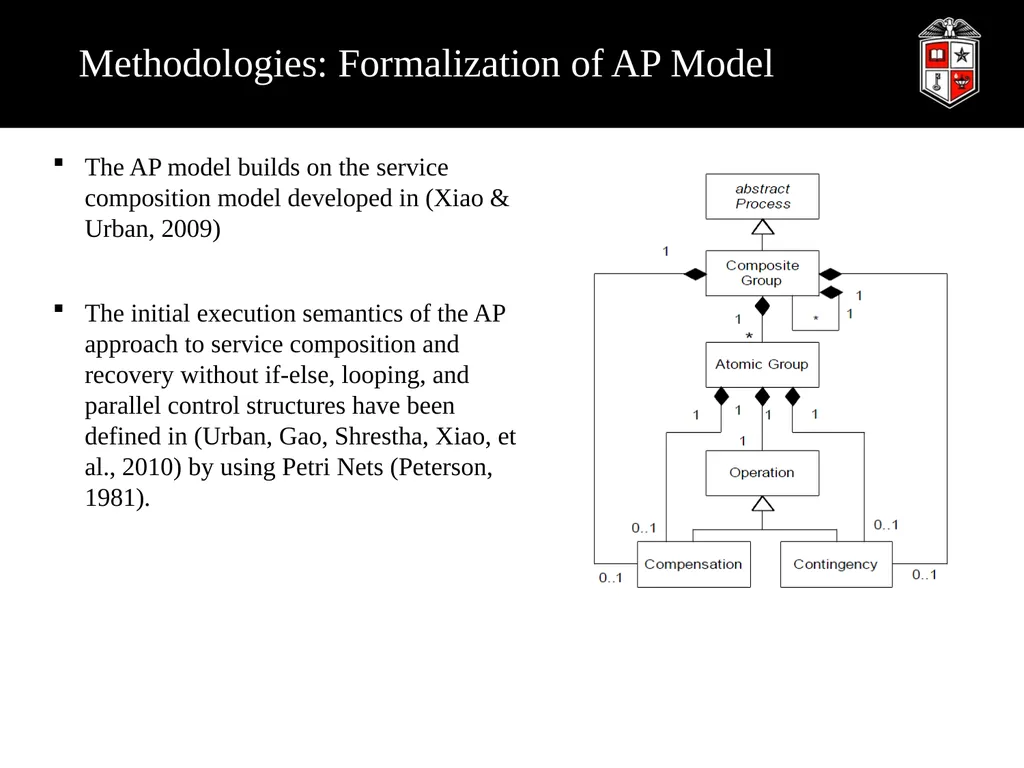
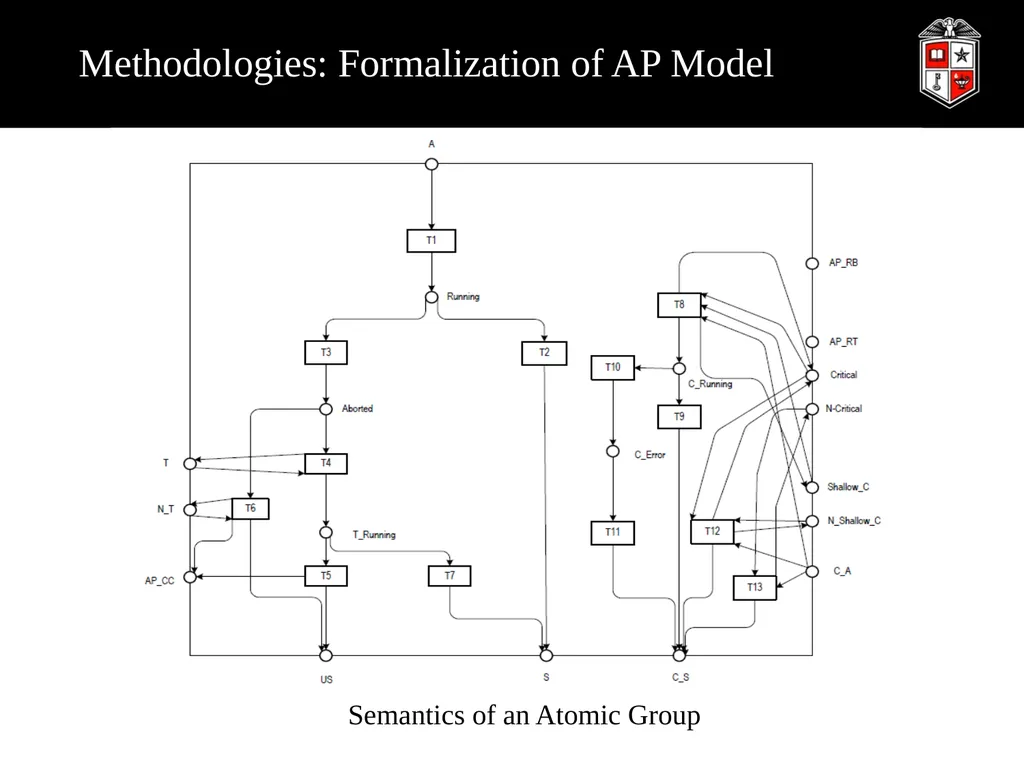
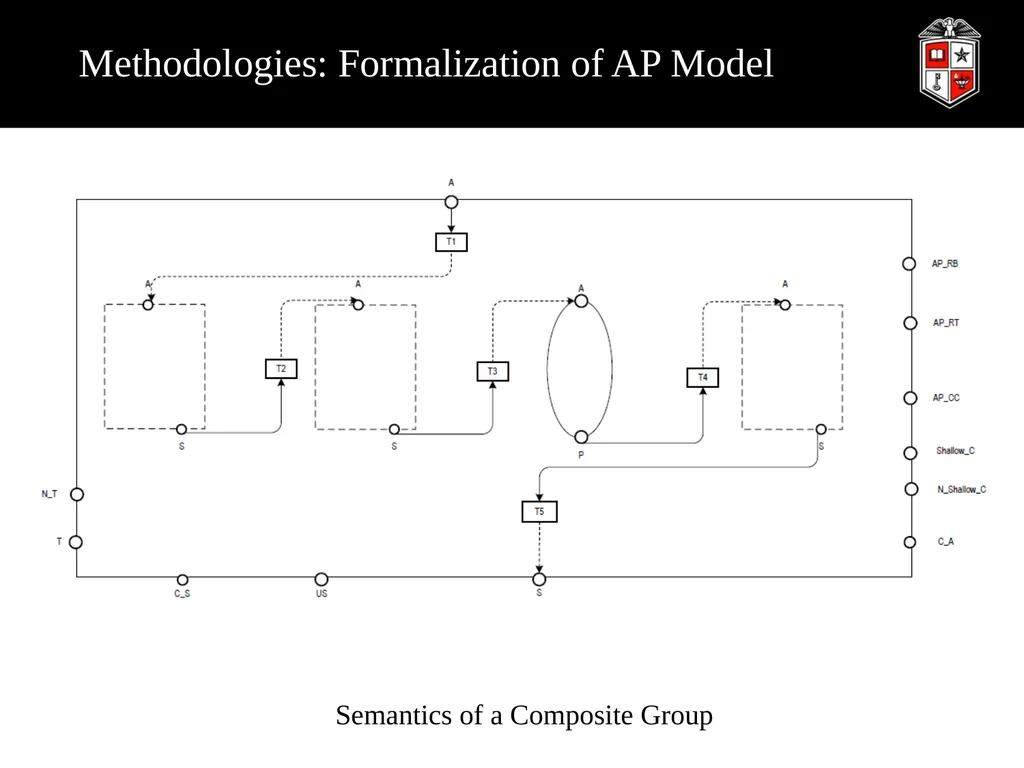
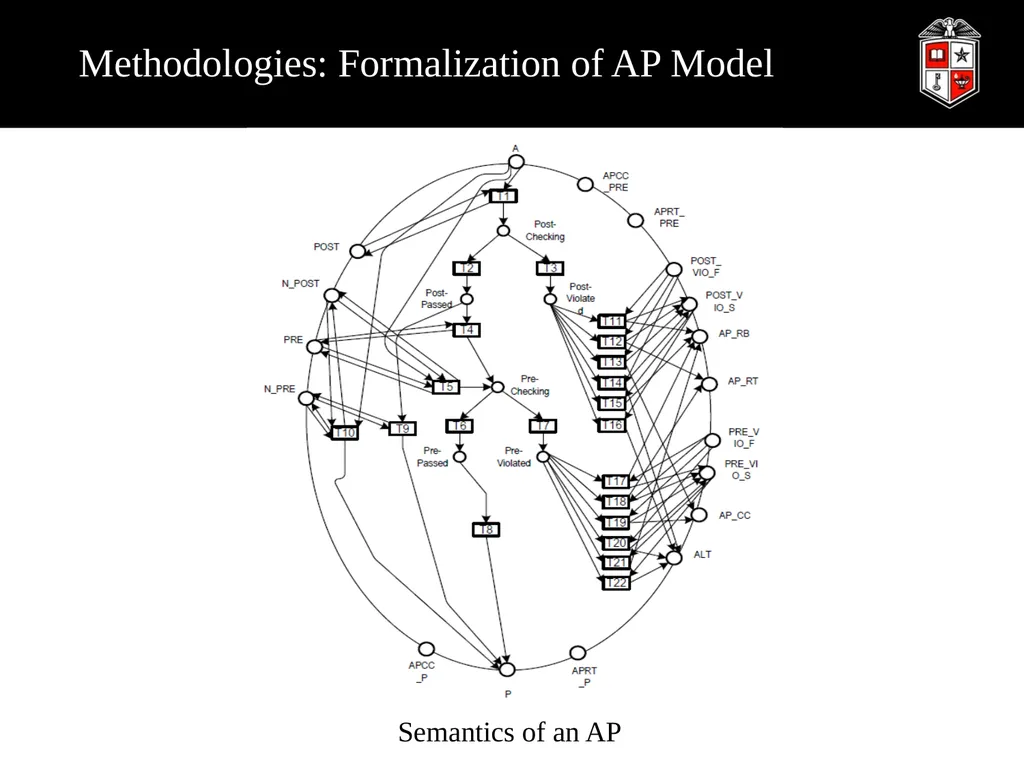
Methodologies: Formalization of AP Model The AP model builds on the service composition model developed in (Xiao & Urban, 2009)
The initial execution semantics of the AP approach to service composition and recovery without if-else, looping, and parallel control structures have been defined in (Urban, Gao, Shrestha, Xiao, et al., 2010) by using Petri Nets (Peterson, 1981).<br>
The initial execution semantics of the AP approach to service composition and recovery without if-else, looping, and parallel control structures have been defined in (Urban, Gao, Shrestha, Xiao, et al., 2010) by using Petri Nets (Peterson, 1981).<br>
19
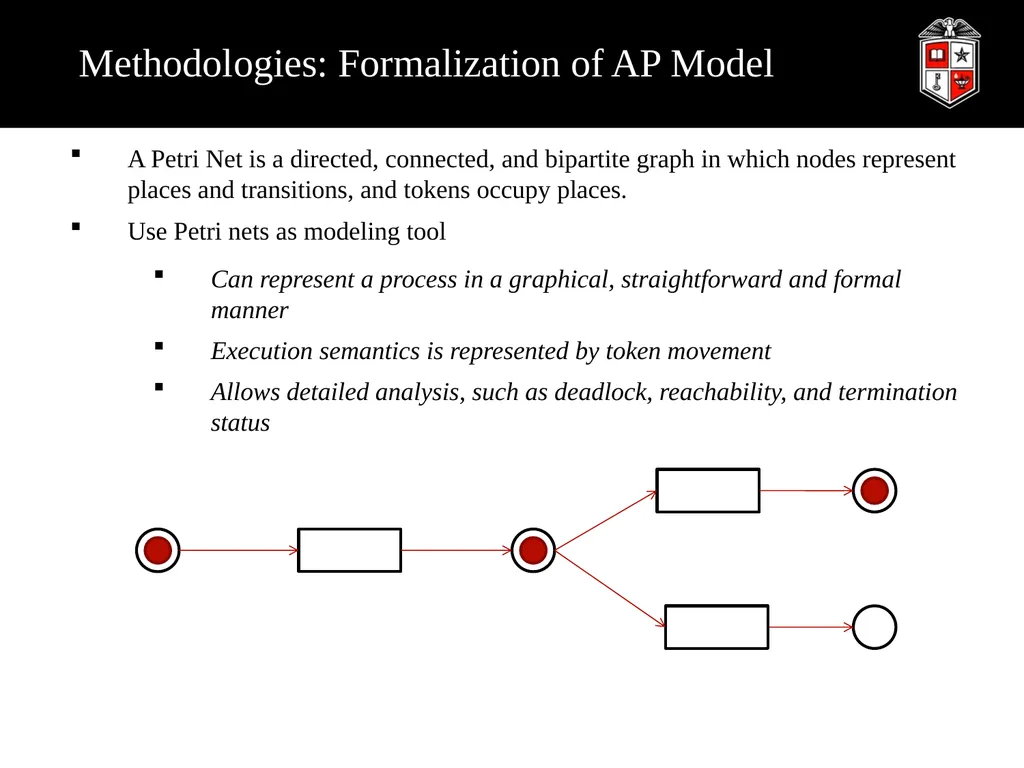
Methodologies: Formalization of AP Model A Petri Net is a directed, connected, and bipartite graph in which nodes represent places and transitions, and tokens occupy places.
Use Petri nets as modeling tool
Can represent a process in a graphical, straightforward and formal manner
Execution semantics is represented by token movement
Allows detailed analysis, such as deadlock, reachability, and termination status<br>
Use Petri nets as modeling tool
Can represent a process in a graphical, straightforward and formal manner
Execution semantics is represented by token movement
Allows detailed analysis, such as deadlock, reachability, and termination status<br>
20
Methodologies: Formalization of AP Model Semantics of an Atomic Group<br>
21
Methodologies: Formalization of AP Model Methodologies: Formalization of AP Model Semantics of a Composite Group<br>
22
Methodologies: Formalization of AP Model Semantics of an AP<br>
23
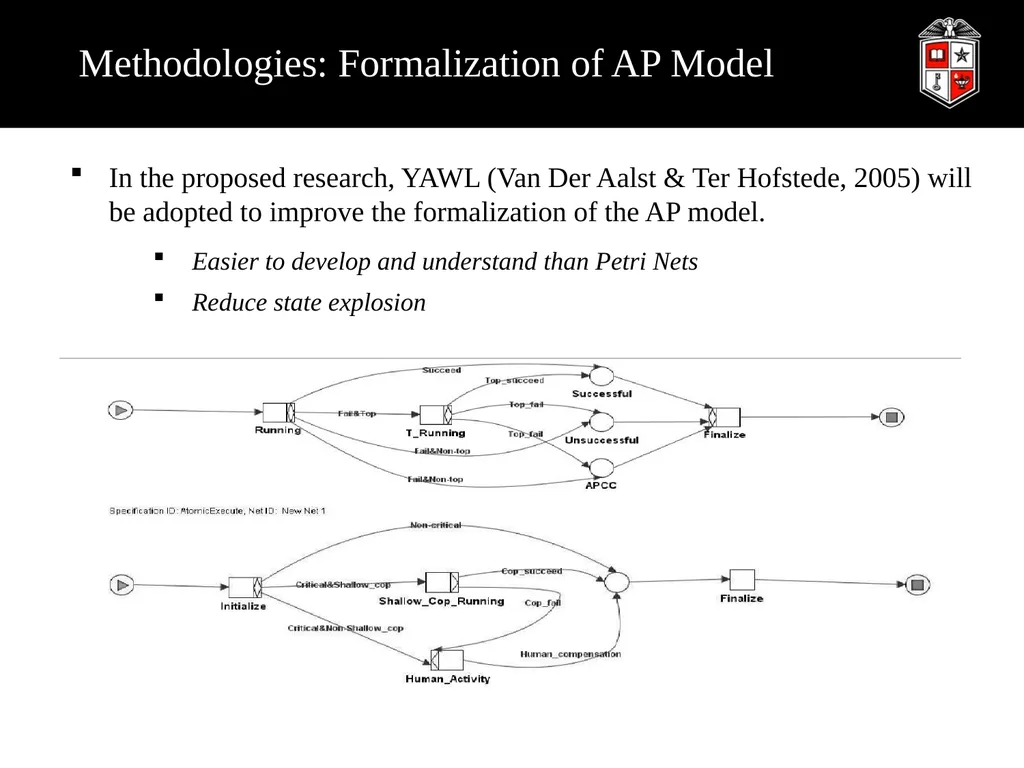
Methodologies: Formalization of AP Model In the proposed research, YAWL (Van Der Aalst & Ter Hofstede, 2005) will be adopted to improve the formalization of the AP model.
Easier to develop and understand than Petri Nets
Reduce state explosion<br>
Easier to develop and understand than Petri Nets
Reduce state explosion<br>
24
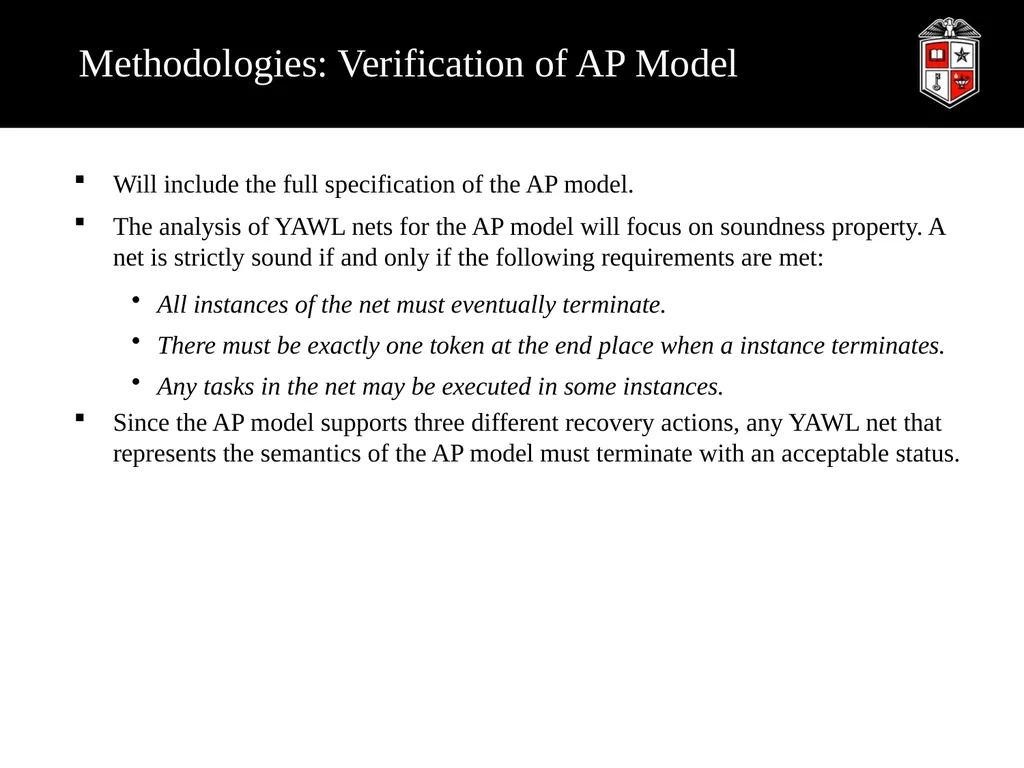
Methodologies: Verification of AP Model Will include the full specification of the AP model.
The analysis of YAWL nets for the AP model will focus on soundness property. A net is strictly sound if and only if the following requirements are met:
All instances of the net must eventually terminate.
There must be exactly one token at the end place when a instance terminates.
Any tasks in the net may be executed in some instances.
Since the AP model supports three different recovery actions, any YAWL net that represents the semantics of the AP model must terminate with an acceptable status.<br>
The analysis of YAWL nets for the AP model will focus on soundness property. A net is strictly sound if and only if the following requirements are met:
All instances of the net must eventually terminate.
There must be exactly one token at the end place when a instance terminates.
Any tasks in the net may be executed in some instances.
Since the AP model supports three different recovery actions, any YAWL net that represents the semantics of the AP model must terminate with an acceptable status.<br>
25
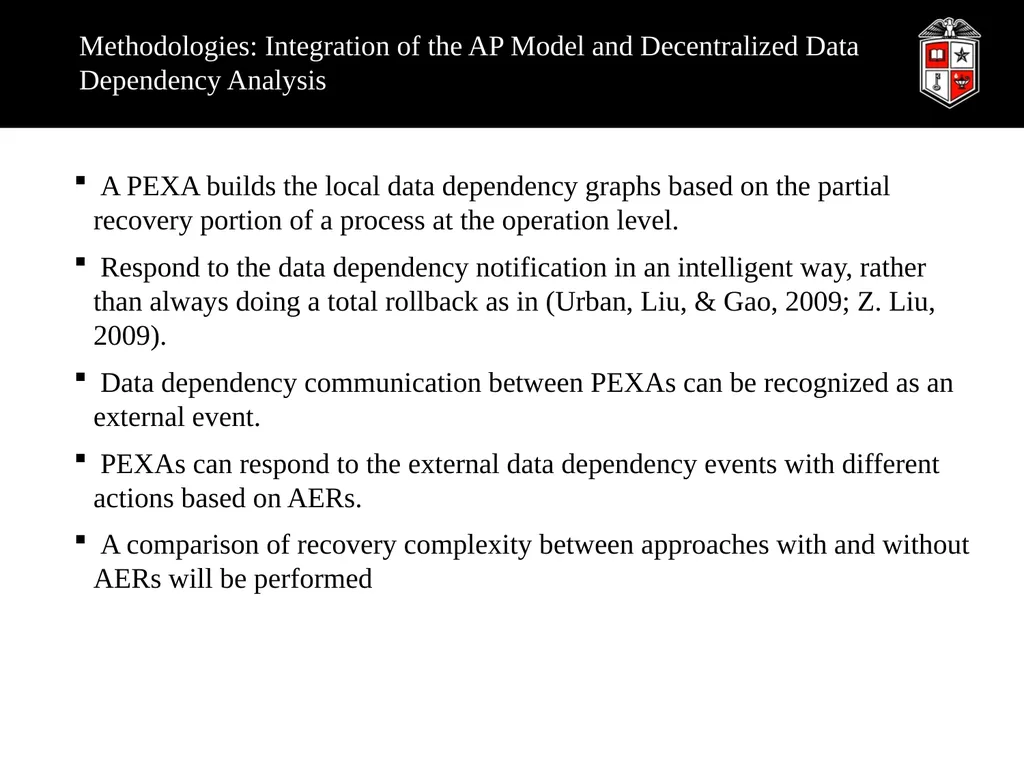
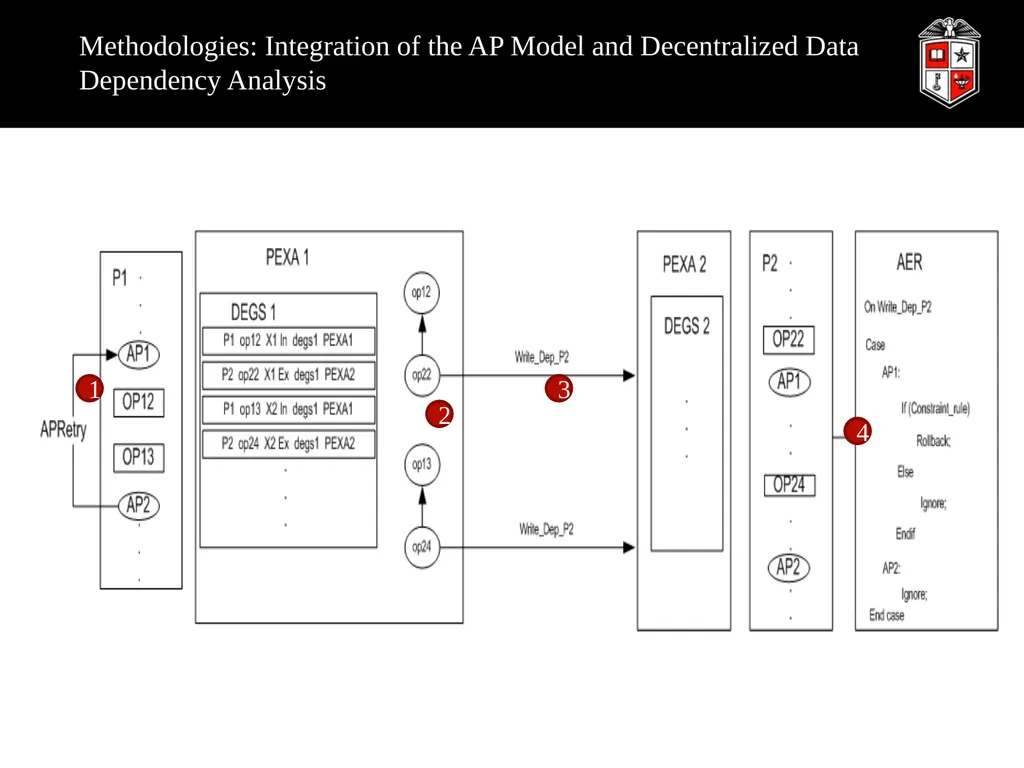
Methodologies: Integration of the AP Model and Decentralized Data Dependency Analysis A PEXA builds the local data dependency graphs based on the partial recovery portion of a process at the operation level.
Respond to the data dependency notification in an intelligent way, rather than always doing a total rollback as in (Urban, Liu, & Gao, 2009; Z. Liu, 2009).
Data dependency communication between PEXAs can be recognized as an external event.
PEXAs can respond to the external data dependency events with different actions based on AERs.
A comparison of recovery complexity between approaches with and without AERs will be performed<br>
Respond to the data dependency notification in an intelligent way, rather than always doing a total rollback as in (Urban, Liu, & Gao, 2009; Z. Liu, 2009).
Data dependency communication between PEXAs can be recognized as an external event.
PEXAs can respond to the external data dependency events with different actions based on AERs.
A comparison of recovery complexity between approaches with and without AERs will be performed<br>
26
Methodologies: Integration of the AP Model and Decentralized Data Dependency Analysis 1 2 3 4<br>
27
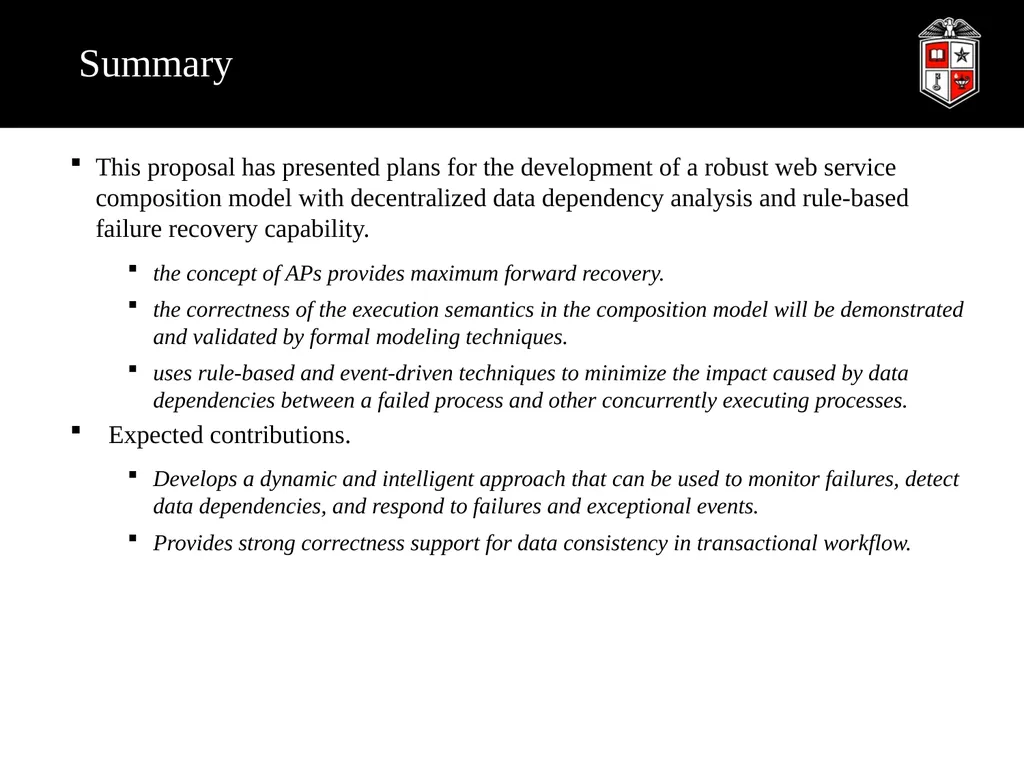
Summary This proposal has presented plans for the development of a robust web service composition model with decentralized data dependency analysis and rule-based failure recovery capability.
the concept of APs provides maximum forward recovery.
the correctness of the execution semantics in the composition model will be demonstrated and validated by formal modeling techniques.
uses rule-based and event-driven techniques to minimize the impact caused by data dependencies between a failed process and other concurrently executing processes.
Expected contributions.
Develops a dynamic and intelligent approach that can be used to monitor failures, detect data dependencies, and respond to failures and exceptional events.
Provides strong correctness support for data consistency in transactional workflow.<br>
the concept of APs provides maximum forward recovery.
the correctness of the execution semantics in the composition model will be demonstrated and validated by formal modeling techniques.
uses rule-based and event-driven techniques to minimize the impact caused by data dependencies between a failed process and other concurrently executing processes.
Expected contributions.
Develops a dynamic and intelligent approach that can be used to monitor failures, detect data dependencies, and respond to failures and exceptional events.
Provides strong correctness support for data consistency in transactional workflow.<br>
28
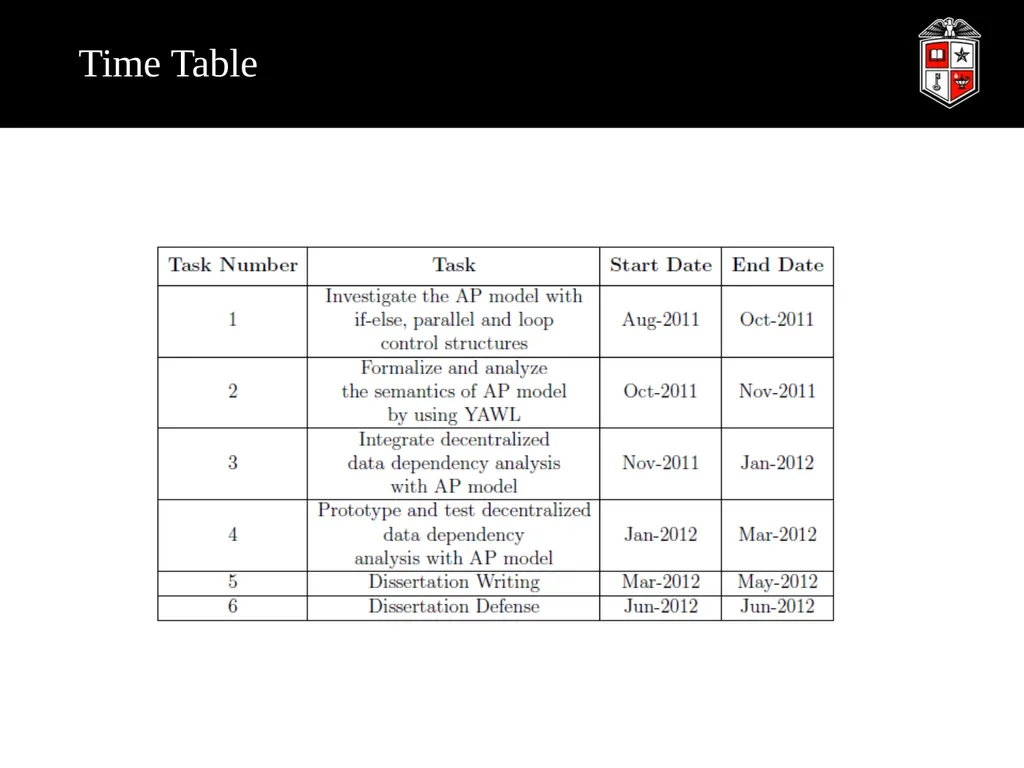
Time Table<br>
29
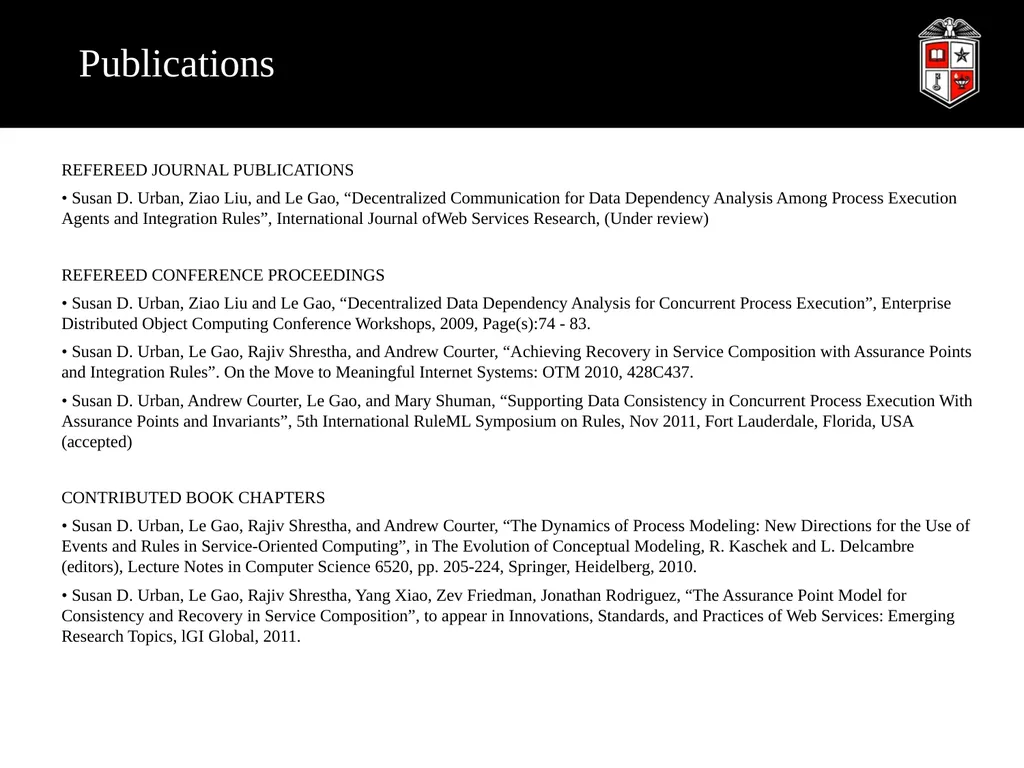
Publications REFEREED JOURNAL PUBLICATIONS
• Susan D. Urban, Ziao Liu, and Le Gao, “Decentralized Communication for Data Dependency Analysis Among Process Execution Agents and Integration Rules”, International Journal ofWeb Services Research, (Under review)
REFEREED CONFERENCE PROCEEDINGS
• Susan D. Urban, Ziao Liu and Le Gao, “Decentralized Data Dependency Analysis for Concurrent Process Execution”, Enterprise Distributed Object Computing Conference Workshops, 2009, Page(s):74 - 83.
• Susan D. Urban, Le Gao, Rajiv Shrestha, and Andrew Courter, “Achieving Recovery in Service Composition with Assurance Points and Integration Rules”. On the Move to Meaningful Internet Systems: OTM 2010, 428C437.
• Susan D. Urban, Andrew Courter, Le Gao, and Mary Shuman, “Supporting Data Consistency in Concurrent Process Execution With Assurance Points and Invariants”, 5th International RuleML Symposium on Rules, Nov 2011, Fort Lauderdale, Florida, USA (accepted)
CONTRIBUTED BOOK CHAPTERS
• Susan D. Urban, Le Gao, Rajiv Shrestha, and Andrew Courter, “The Dynamics of Process Modeling: New Directions for the Use of Events and Rules in Service-Oriented Computing”, in The Evolution of Conceptual Modeling, R. Kaschek and L. Delcambre (editors), Lecture Notes in Computer Science 6520, pp. 205-224, Springer, Heidelberg, 2010.
• Susan D. Urban, Le Gao, Rajiv Shrestha, Yang Xiao, Zev Friedman, Jonathan Rodriguez, “The Assurance Point Model for Consistency and Recovery in Service Composition”, to appear in Innovations, Standards, and Practices of Web Services: Emerging Research Topics, lGI Global, 2011.<br>
• Susan D. Urban, Ziao Liu, and Le Gao, “Decentralized Communication for Data Dependency Analysis Among Process Execution Agents and Integration Rules”, International Journal ofWeb Services Research, (Under review)
REFEREED CONFERENCE PROCEEDINGS
• Susan D. Urban, Ziao Liu and Le Gao, “Decentralized Data Dependency Analysis for Concurrent Process Execution”, Enterprise Distributed Object Computing Conference Workshops, 2009, Page(s):74 - 83.
• Susan D. Urban, Le Gao, Rajiv Shrestha, and Andrew Courter, “Achieving Recovery in Service Composition with Assurance Points and Integration Rules”. On the Move to Meaningful Internet Systems: OTM 2010, 428C437.
• Susan D. Urban, Andrew Courter, Le Gao, and Mary Shuman, “Supporting Data Consistency in Concurrent Process Execution With Assurance Points and Invariants”, 5th International RuleML Symposium on Rules, Nov 2011, Fort Lauderdale, Florida, USA (accepted)
CONTRIBUTED BOOK CHAPTERS
• Susan D. Urban, Le Gao, Rajiv Shrestha, and Andrew Courter, “The Dynamics of Process Modeling: New Directions for the Use of Events and Rules in Service-Oriented Computing”, in The Evolution of Conceptual Modeling, R. Kaschek and L. Delcambre (editors), Lecture Notes in Computer Science 6520, pp. 205-224, Springer, Heidelberg, 2010.
• Susan D. Urban, Le Gao, Rajiv Shrestha, Yang Xiao, Zev Friedman, Jonathan Rodriguez, “The Assurance Point Model for Consistency and Recovery in Service Composition”, to appear in Innovations, Standards, and Practices of Web Services: Emerging Research Topics, lGI Global, 2011.<br>
30
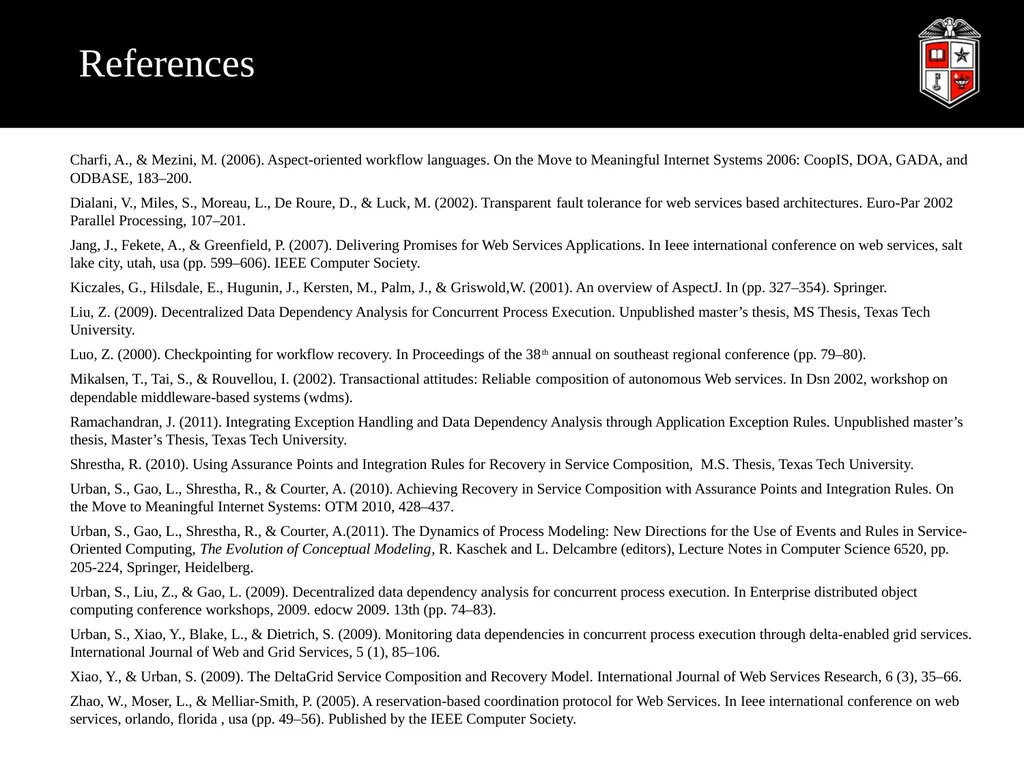
References Charfi, A., & Mezini, M. (2006). Aspect-oriented workflow languages. On the Move to Meaningful Internet Systems 2006: CoopIS, DOA, GADA, and ODBASE, 183–200.
Dialani, V., Miles, S., Moreau, L., De Roure, D., & Luck, M. (2002). Transparent fault tolerance for web services based architectures. Euro-Par 2002 Parallel Processing, 107–201.
Jang, J., Fekete, A., & Greenfield, P. (2007). Delivering Promises for Web Services Applications. In Ieee international conference on web services, salt lake city, utah, usa (pp. 599–606). IEEE Computer Society.
Kiczales, G., Hilsdale, E., Hugunin, J., Kersten, M., Palm, J., & Griswold,W. (2001). An overview of AspectJ. In (pp. 327–354). Springer.
Liu, Z. (2009). Decentralized Data Dependency Analysis for Concurrent Process Execution. Unpublished master’s thesis, MS Thesis, Texas Tech University.
Luo, Z. (2000). Checkpointing for workflow recovery. In Proceedings of the 38th annual on southeast regional conference (pp. 79–80).
Mikalsen, T., Tai, S., & Rouvellou, I. (2002). Transactional attitudes: Reliable composition of autonomous Web services. In Dsn 2002, workshop on dependable middleware-based systems (wdms).
Ramachandran, J. (2011). Integrating Exception Handling and Data Dependency Analysis through Application Exception Rules. Unpublished master’s thesis, Master’s Thesis, Texas Tech University.
Shrestha, R. (2010). Using Assurance Points and Integration Rules for Recovery in Service Composition, M.S. Thesis, Texas Tech University.
Urban, S., Gao, L., Shrestha, R., & Courter, A. (2010). Achieving Recovery in Service Composition with Assurance Points and Integration Rules. On the Move to Meaningful Internet Systems: OTM 2010, 428–437.
Urban, S., Gao, L., Shrestha, R., & Courter, A.(2011). The Dynamics of Process Modeling: New Directions for the Use of Events and Rules in Service-Oriented Computing, The Evolution of Conceptual Modeling, R. Kaschek and L. Delcambre (editors), Lecture Notes in Computer Science 6520, pp. 205-224, Springer, Heidelberg.
Urban, S., Liu, Z., & Gao, L. (2009). Decentralized data dependency analysis for concurrent process execution. In Enterprise distributed object computing conference workshops, 2009. edocw 2009. 13th (pp. 74–83).
Urban, S., Xiao, Y., Blake, L., & Dietrich, S. (2009). Monitoring data dependencies in concurrent process execution through delta-enabled grid services. International Journal of Web and Grid Services, 5 (1), 85–106.
Xiao, Y., & Urban, S. (2009). The DeltaGrid Service Composition and Recovery Model. International Journal of Web Services Research, 6 (3), 35–66.
Zhao, W., Moser, L., & Melliar-Smith, P. (2005). A reservation-based coordination protocol for Web Services. In Ieee international conference on web services, orlando, florida , usa (pp. 49–56). Published by the IEEE Computer Society.<br>
Dialani, V., Miles, S., Moreau, L., De Roure, D., & Luck, M. (2002). Transparent fault tolerance for web services based architectures. Euro-Par 2002 Parallel Processing, 107–201.
Jang, J., Fekete, A., & Greenfield, P. (2007). Delivering Promises for Web Services Applications. In Ieee international conference on web services, salt lake city, utah, usa (pp. 599–606). IEEE Computer Society.
Kiczales, G., Hilsdale, E., Hugunin, J., Kersten, M., Palm, J., & Griswold,W. (2001). An overview of AspectJ. In (pp. 327–354). Springer.
Liu, Z. (2009). Decentralized Data Dependency Analysis for Concurrent Process Execution. Unpublished master’s thesis, MS Thesis, Texas Tech University.
Luo, Z. (2000). Checkpointing for workflow recovery. In Proceedings of the 38th annual on southeast regional conference (pp. 79–80).
Mikalsen, T., Tai, S., & Rouvellou, I. (2002). Transactional attitudes: Reliable composition of autonomous Web services. In Dsn 2002, workshop on dependable middleware-based systems (wdms).
Ramachandran, J. (2011). Integrating Exception Handling and Data Dependency Analysis through Application Exception Rules. Unpublished master’s thesis, Master’s Thesis, Texas Tech University.
Shrestha, R. (2010). Using Assurance Points and Integration Rules for Recovery in Service Composition, M.S. Thesis, Texas Tech University.
Urban, S., Gao, L., Shrestha, R., & Courter, A. (2010). Achieving Recovery in Service Composition with Assurance Points and Integration Rules. On the Move to Meaningful Internet Systems: OTM 2010, 428–437.
Urban, S., Gao, L., Shrestha, R., & Courter, A.(2011). The Dynamics of Process Modeling: New Directions for the Use of Events and Rules in Service-Oriented Computing, The Evolution of Conceptual Modeling, R. Kaschek and L. Delcambre (editors), Lecture Notes in Computer Science 6520, pp. 205-224, Springer, Heidelberg.
Urban, S., Liu, Z., & Gao, L. (2009). Decentralized data dependency analysis for concurrent process execution. In Enterprise distributed object computing conference workshops, 2009. edocw 2009. 13th (pp. 74–83).
Urban, S., Xiao, Y., Blake, L., & Dietrich, S. (2009). Monitoring data dependencies in concurrent process execution through delta-enabled grid services. International Journal of Web and Grid Services, 5 (1), 85–106.
Xiao, Y., & Urban, S. (2009). The DeltaGrid Service Composition and Recovery Model. International Journal of Web Services Research, 6 (3), 35–66.
Zhao, W., Moser, L., & Melliar-Smith, P. (2005). A reservation-based coordination protocol for Web Services. In Ieee international conference on web services, orlando, florida , usa (pp. 49–56). Published by the IEEE Computer Society.<br>
31
Questions? Thank you.
Questions?<br>
Questions?<br>
32
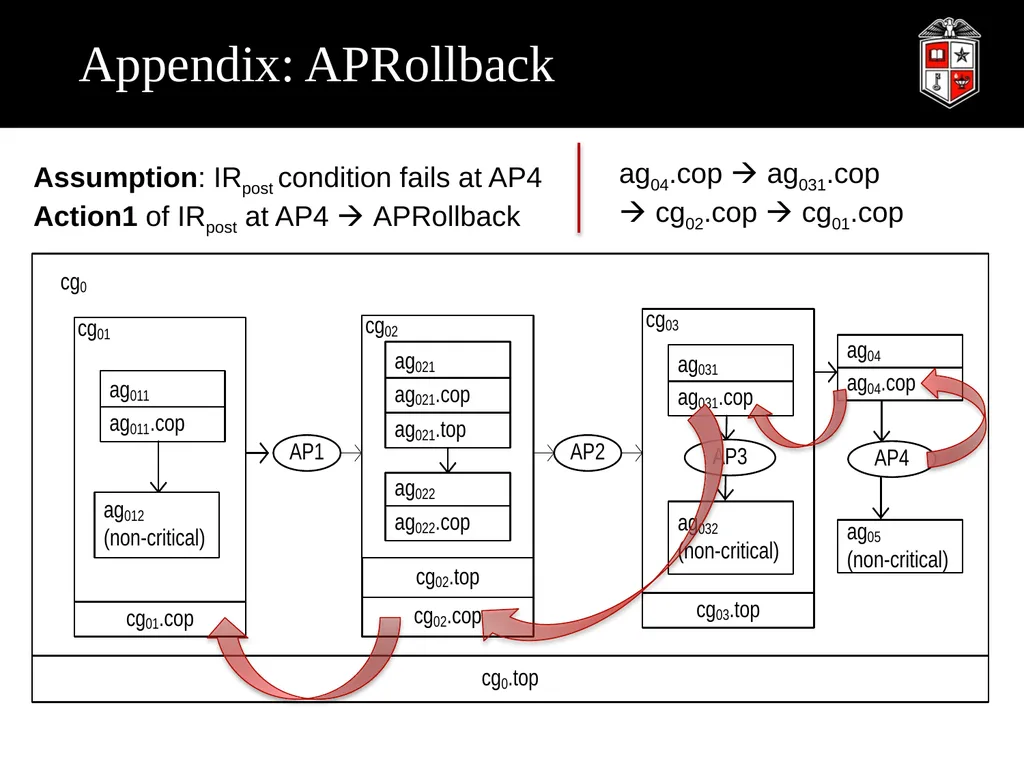
Appendix: APRollback Table 2. Activities Assumption: IRpost condition fails at AP4
Action1 of IRpost at AP4 APRollback ag04.cop ag031.cop
cg02.cop cg01.cop<br>
Action1 of IRpost at AP4 APRollback ag04.cop ag031.cop
cg02.cop cg01.cop<br>
33
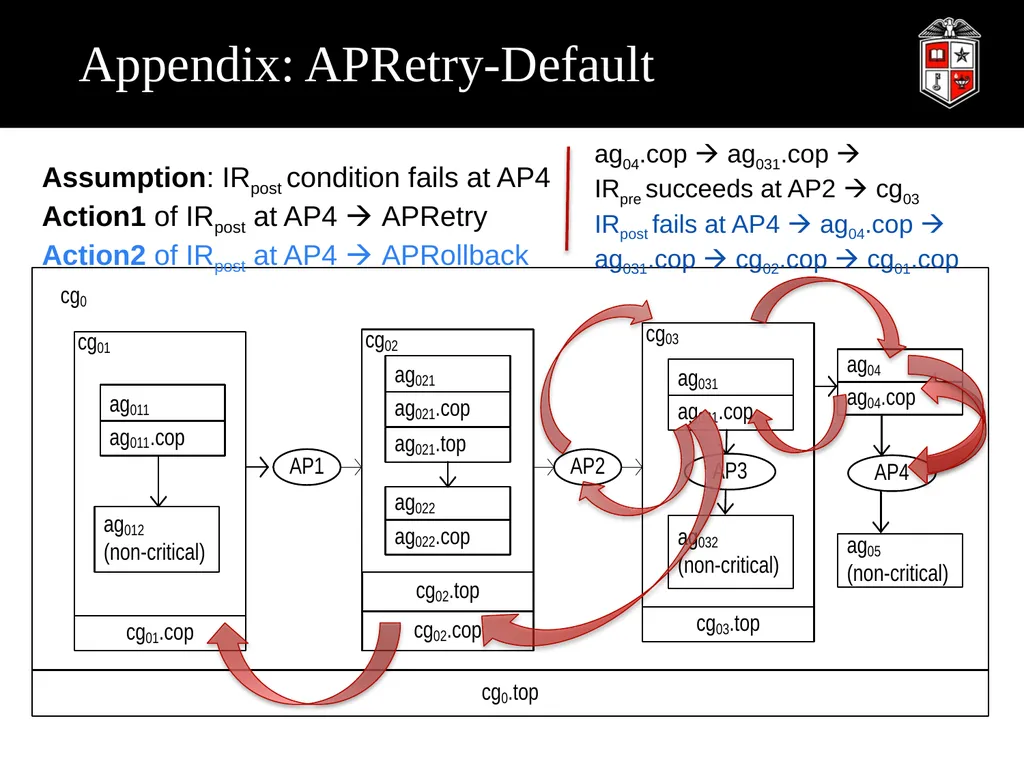
Appendix: APRetry-Default Table 2. Activities Assumption: IRpost condition fails at AP4
Action1 of IRpost at AP4 APRetry
Action2 of IRpost at AP4 APRollback ag04.cop ag031.cop
IRpre succeeds at AP2 cg03
IRpost fails at AP4 ag04.cop ag031.cop cg02.cop cg01.cop<br>
Action1 of IRpost at AP4 APRetry
Action2 of IRpost at AP4 APRollback ag04.cop ag031.cop
IRpre succeeds at AP2 cg03
IRpost fails at AP4 ag04.cop ag031.cop cg02.cop cg01.cop<br>
34
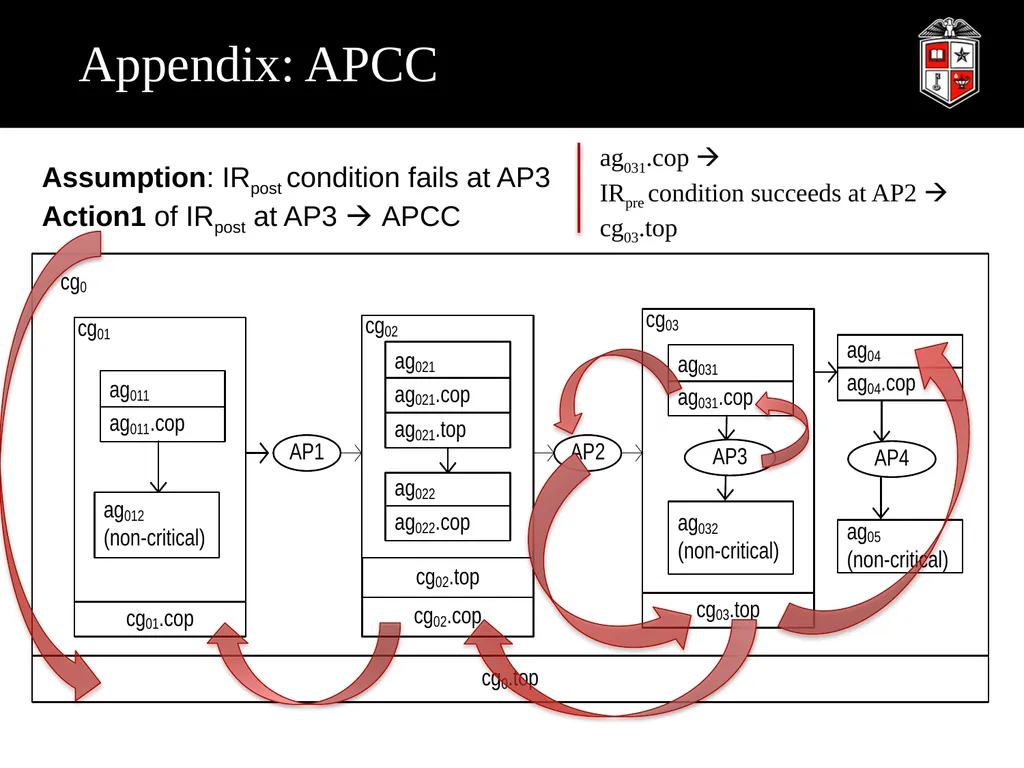
Appendix: APCC Table 2. Activities Assumption: IRpost condition fails at AP3
Action1 of IRpost at AP3 APCC ag031.cop
IRpre condition succeeds at AP2 cg03.top<br>
Action1 of IRpost at AP3 APCC ag031.cop
IRpre condition succeeds at AP2 cg03.top<br>