
A Session called “Festival Preparation” Because

Description: A Session called Festival Preparation Because thats what Bob asked for What is Festival for? Its authentic assessment for music groups. Its Rigorous, Relevant, Relationships. Its also an incredible mix of performance assessment,
Related Topics
Download Presentation
"A Session called “Festival Preparation” Because" is the property of its rightful owner. Permission is granted to download and print the materials on this website for personal, non-commercial use only, and to display it on your personal computer provided you do not modify the materials and that you retain all copyright notices contained in the materials. By downloading content from our website, you accept the terms of this agreement.
Presentation Transcript
slide1. A Session called “Festival Preparation” Because that’s what Bob asked for<br>
slide2. What is Festival for? It’s authentic assessment for music groups. It’s Rigorous, Relevant, Relationships. It’s also an incredible mix of performance assessment, formative assessment and summative assessment.
It puts Music on the same playground as all the other content areas.
It gives teachers and students long term and short term goals to work for.
It’s an extremely educational experience for students when it is approached properly, How many times have you really enjoyed taking a test? Festival should be one of those times. It should NOT be high stakes for kids–your job as a teacher is to make it so.
If you teach every day like you are going to Festival that evening you are teaching correctly.<br>
slide3. Practical Tips for Successful Festivals What can I help with?
4 years in HS really observing things. Very unique perspective for a HS kid.
UM Band Festival–volunteered and really listened to groups over the years.
Student taught with Dennis Granlie. That man is a legend when it comes to Festival preparation.
18 years in the Classroom. I’ve made all the mistakes, trust me!
12 years as a Music Administrator, where I run District Festival every year.
After 30+ years in the profession, these are some practical tips to help you out.<br>
slide4. Know your Students Know your Ensemble!
What are your strengths?
What are your weaknesses?
What do you need to grow in as a group?
What do you want your kids to be able to play in 2-3 years from now?<br>
slide5. Know Thyself Know your likes and dislikes. You can think of these as biases too.
Who is your favorite composer for your bands to play? Maybe you don’t do a work by that composer at Festival. Or you don’t play their stuff anywhere else that year except Festival.
An entire year of Randall Standridge and Brian Balmages is not a healthy diet.
Don’t play what your college band played. Don’t play what you think the judges will be impressed by. Because most of the time you will fall far short of a musical experience.<br>
slide6. Backwards Design-It’s not just for Curriculum Planning Class C/B with lots of Pep Band:
April Festival performance=Late March for nuance=early March for correct notes and rhythms=February and January for all the hard work=December for handing out the music (after Holiday programs are done).<br>
slide7. Backwards Design-It’s not just for Curriculum Planning Class A/AA with lots of Pep Band and other invitational Festivals:
April Festival performance=Late March for nuance=early March for correct notes and rhythms=February and January for all the hard work=December for handing out the music (after Holiday programs are done).
Work with Festival conductors on finding music that can be used at District Festival as a stand alone band.<br>
slide8. Sightreading Training Starts on Day One of Class This is so important. You should be sightreading almost daily with your kids.
Establish a system, and that system needs to work with Festival sight reading parameters. Teach it from day one, and ramp it up about a month before Festival. Show them the sight reading form, talk about how little things make a huge difference in a sight reading score.
STARS
Conducting/setting tempos
Teach students to analyze the music on their own–give them 1 minute or so to find answers instead of spoon feeding everything to them.
Actually practice it–hand out music, time yourselves, hand the music back in.<br>
slide9. Selecting Literature MHSA does not maintain a state list for ensemble performances. Too many variables with instrumentation to make this practical.
But other states have great resources, use them if you need some ideas:
Wisconsin. Class M is Class C, Class C is Class B/bigger C. Class B is A and training groups for AA. Class A is upper AA groups.
https://www.jwpepper.com/sheet-music/services-state-festival.jsp?state=WI&stategroup=&stategroupname=#state-info<br>
slide10. Literature continued Virginia Graded lists–look at Basic Library and Editor Choice options
https://www.jwpepper.com/sheet-music/services-state-festival.jsp?state=VA&stategroup=&stategroupname=#state-info
Maryland https://www.jwpepper.com/sheet-music/services-state-festival.jsp?state=MD&stategroup=&stategroupname=#state-info<br>
slide11. Other Resources Mentors
Colleagues in your District, Festival Chair
MBA Rendezvous Literature list
Wind Repertory List
Teaching Music Through Performance books
Band Music PDF (beware of copyright)
Session Input?<br>
slide12. Considerations 2 pieces is plenty. Leave time for adjudicator to really work with your group. Plan for no more than half of the time allotted for music making.
Genre/Style contrast.
Don’t use the same composer/arranger for both pieces.
Composer Diversity–don’t just program it because it ticks a box. Make sure it is educationally sound for your students.<br>
slide13. Copyright Know the law, know the rule.
Take the NFHS Copyright course! MHSA regulation for HS directors to do so now.
If it is something from Public domain, be able to prove it.
Super Hint! Solo and Ensemble Scores–start buying extra books for the solos that you use a lot. 2-3 a year and you will be set. Share books/sets at Festival time for extra score.<br>
slide14. Considerations Stay away from Pop/Broadway/Movie stuff.
Make sure you can play the tempos as printed. You can’t slow down on the hard stuff and then speed up again when it gets easy.
Make sure that percussion instrumentation is doable for you AND the Festival location.
Avoid pieces with complicated extras (wine glasses, antiphonal parts, props)
Avoid big soloist features. What if your rock star gets sick?<br>
slide15. Preparation You have to know the score, you just do.
If you expect the kids to perform well, you have to teach well. And that means preparation!
Your job is to learn the piece and be able to teach it to your students. You should not be learning it at the same time they are.
If you can’t conduct from memory with general tempos and dynamic, etc. about halfway through the rehearsal cycle you are not prepared enough. You need to get your head out of the score so you can really listen with your ears, not with your eyes to make effective change in the band sound for the last half of the rehearsal cycle.<br>
slide16. Preparation Listen to a few different recordings. YouTube, JW Pepper, Spotify, Apple Music, Wind Repertory Project, Publisher sites. This will give you a broad spectrum to help you find your own path.
Find Errata–WRP is a good source, Teaching Music through Performance another one. The old Instrumentalist books are great for the “yellow music” stuff.<br>
slide17. Preparation Pull out score. Read all the way through–follow the part with your instrument.
Then read through the other instruments in your family (brass, ww, perc).
What is in common? Do horns cover the same melodic line as alto sax? Is trombone different than euphonium? Is bass clarinet the same as tuba?
Make brackets for like lines if that helps you study/rehearse. This really saves time with your kids later, and helps you help THEM listen.<br>
slide18. Preparation Special considerations:
Trill fingerings. Write them in, practice them on your own.
Chromatic fingerings–this is easy to forget, especially if you are a brass player. Passages with lots of scales/arpeggios for ww are so much easier with the correct fingerings. Sometimes they are impossible without them.
Mutes for brass. What kind? Adjust for pitch too when muted.
Stopped horn–know the difference between muted and stopped. If it is stopped, play the note down a half step from where it is written.<br>
slide19. Preparation Special considerations:
Aleatoric music. This gets played a lot at Festival, but it usually is underplayed and not effective, Commit to the new techniques, vocals, sounds, etc. Spend ALOT of time working out these details, and make sure the kids understand exactly what they are trying to portray in these sections.<br>
slide20. Percussion I’ve seen Percussion make or break bands all the time at Festival.
A new space to perform in without any real time to practice in it is especially tough for percussionists. Treat them well, treat them with respect, and also make sure they understand how important they are for the success of the band at these events. They HAVE to be able to read music to be successful. Sight reading with percussionists that play by ear is a recipe for disaster,
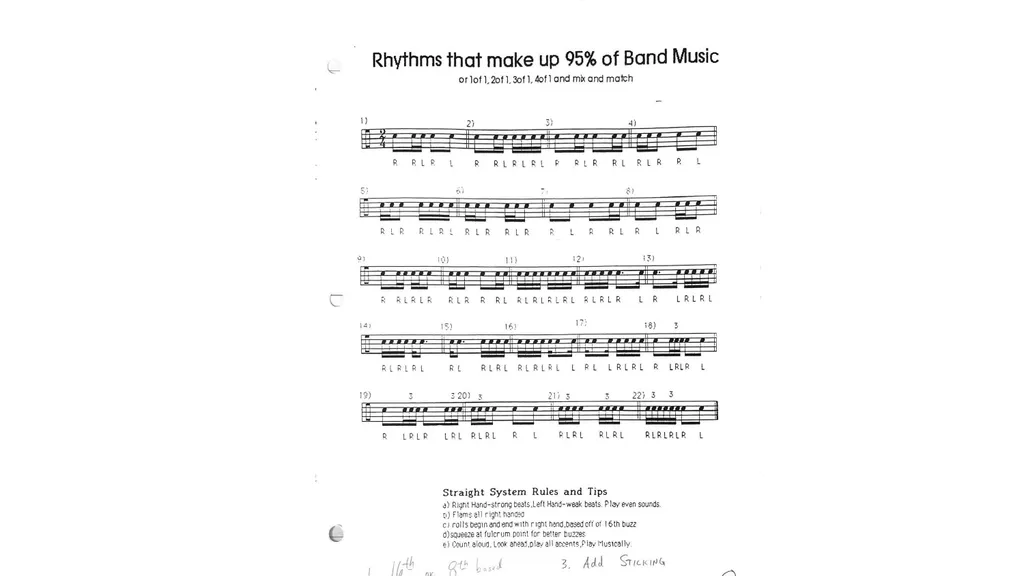
Common rhythm patterns are really helpful–practice them with everyone, but know that snares really need these under their hands.<br>
slide21. Percussion How many parts are there?
How many instruments are used?
What can be doubled?
What can be eliminated?
Draw a map for complicated stuff–think like Dan Bukvich. Have your kids help!<br>
slide22. Score Study Tips Things to mark:
Time signature changes
Crescendo/< Decrescendo/<
Sudden tempo changes
Big cues
Special consideration for percussion–mark crashes, new entrances. Especially for kids that are moving around a lot covering multiple instruments.<br>
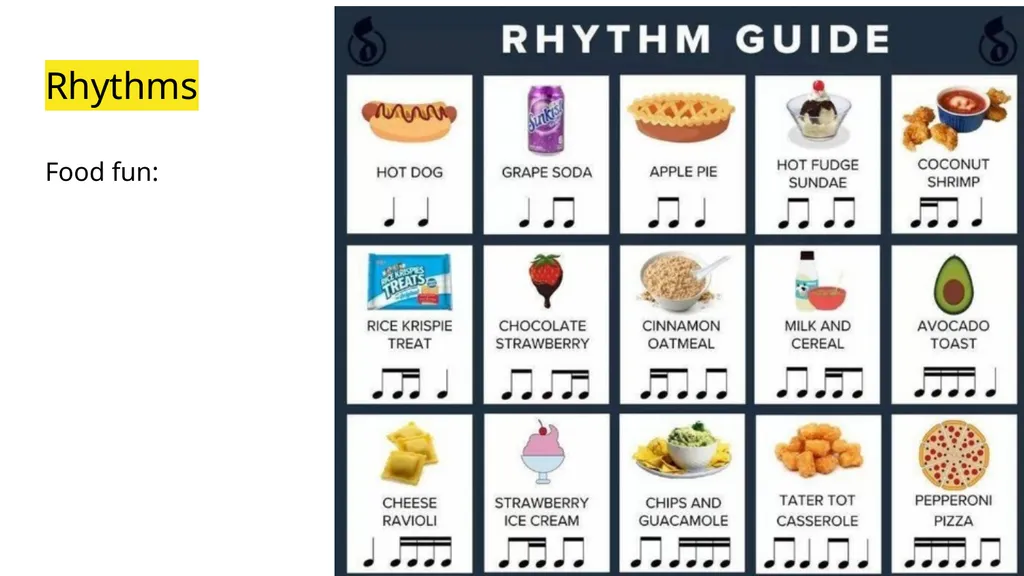
slide23. Rhythms Food fun:<br>
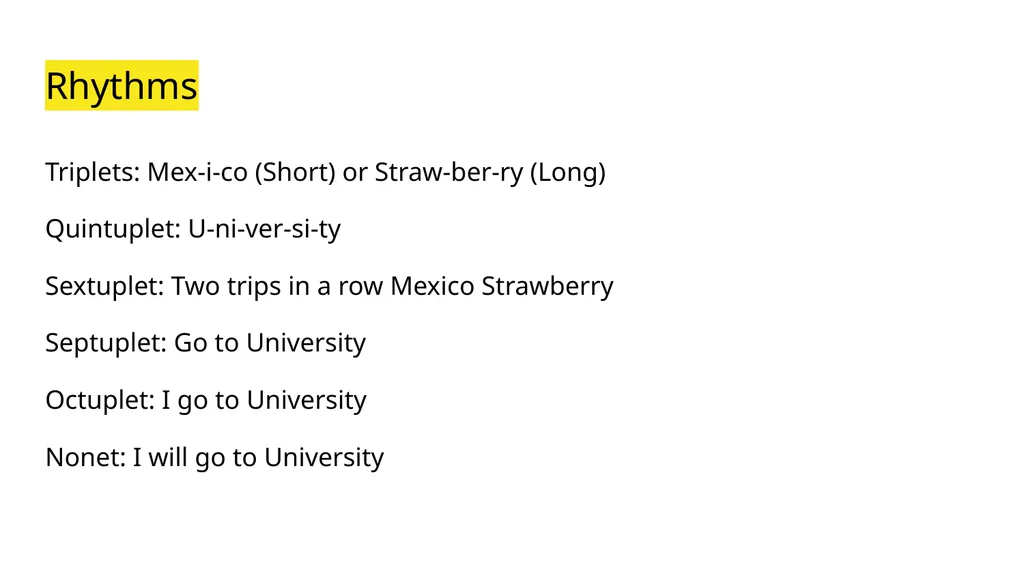
slide24. Rhythms Triplets: Mex-i-co (Short) or Straw-ber-ry (Long)
Quintuplet: U-ni-ver-si-ty
Sextuplet: Two trips in a row Mexico Strawberry
Septuplet: Go to University
Octuplet: I go to University
Nonet: I will go to University<br>
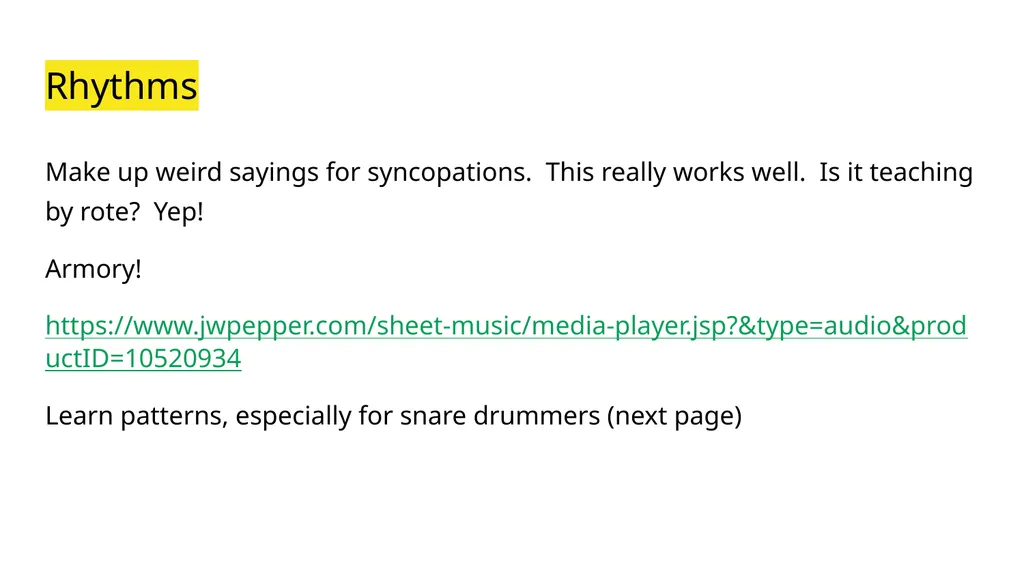
slide25. Rhythms Make up weird sayings for syncopations. This really works well. Is it teaching by rote? Yep!
Armory!
https://www.jwpepper.com/sheet-music/media-player.jsp?&type=audio&productID=10520934
Learn patterns, especially for snare drummers (next page)<br>
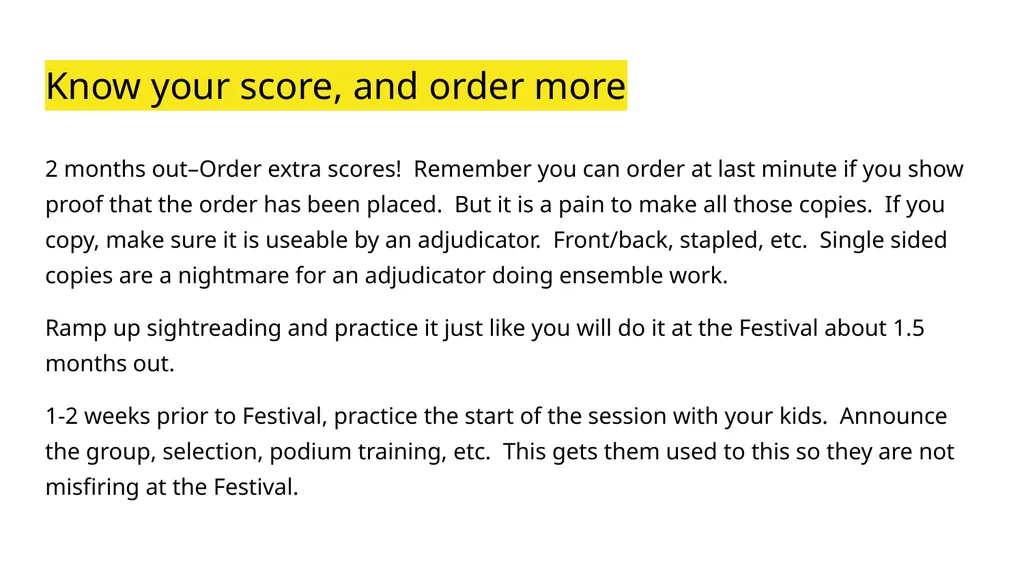
slide27. Know your score, and order more 2 months out–Order extra scores! Remember you can order at last minute if you show proof that the order has been placed. But it is a pain to make all those copies. If you copy, make sure it is useable by an adjudicator. Front/back, stapled, etc. Single sided copies are a nightmare for an adjudicator doing ensemble work.
Ramp up sightreading and practice it just like you will do it at the Festival about 1.5 months out.
1-2 weeks prior to Festival, practice the start of the session with your kids. Announce the group, selection, podium training, etc. This gets them used to this so they are not misfiring at the Festival.<br>
slide28. Travel Lists are your friend!
Percussion instrument list. Include mallets, beaters, etc! Check it with kids, and put a section leader in charge with a backup.
Music/folders: Snare drum boxes make good folder haulers. Or plastic crates. Put a couple of kids in charge (WW/Brass, etc.)
Spare parts for uniforms–ties, cummerbunds, etc. Put a kid in charge
You bring the extra scores<br>
slide29. When you are there Be smart about the performance–it starts the minute you step foot off the bus.
Set high expectations for kids for their decorum at the event. They are representing the school, their community, and the program. Make them stay in uniform so they are identifiable until you are going home.
Talk to adjudicator about any changes in the score that you have modified, etc.
Sound check for the room if you can–especially for percussion. Bass drum can kill you! Have a little chorale, and then tune.
Adjust the setup to you, not the other way around.<br>
slide30. More tips Electric Bass–place the amp on it’s “back” and have the speaker go up and not out. This helps blend the sound in the performance space. Avoid using picks for electric bass in concert band situations for better articulation.
Prep kids that they need to be responsive to the adjudicator once the performance is over. Their attitude is huge at this point! Coach them on being willing to try new things and be flexible with different approaches. This goes for you as the director as well.
Take the NFHS Adjudicator Course! It’s free.<br>
slide31. What not to play at Festival Air for Band
Bach transcriptions (Alfred Reed)
Things with lots of technology
Concertos
Two pieces by the same composer or arranger<br>
slide32. Bottom Lin e Good Festival Preparation is just good teaching with a trip added for most of us.
If you approach every day in the classroom like you are getting ready for Festival, your teaching will improve, and the level of expectation from the students will rise with that.
Good habits start early, and you bear the fruits of those in April.<br>
slide2. What is Festival for? It’s authentic assessment for music groups. It’s Rigorous, Relevant, Relationships. It’s also an incredible mix of performance assessment, formative assessment and summative assessment.
It puts Music on the same playground as all the other content areas.
It gives teachers and students long term and short term goals to work for.
It’s an extremely educational experience for students when it is approached properly, How many times have you really enjoyed taking a test? Festival should be one of those times. It should NOT be high stakes for kids–your job as a teacher is to make it so.
If you teach every day like you are going to Festival that evening you are teaching correctly.<br>
slide3. Practical Tips for Successful Festivals What can I help with?
4 years in HS really observing things. Very unique perspective for a HS kid.
UM Band Festival–volunteered and really listened to groups over the years.
Student taught with Dennis Granlie. That man is a legend when it comes to Festival preparation.
18 years in the Classroom. I’ve made all the mistakes, trust me!
12 years as a Music Administrator, where I run District Festival every year.
After 30+ years in the profession, these are some practical tips to help you out.<br>
slide4. Know your Students Know your Ensemble!
What are your strengths?
What are your weaknesses?
What do you need to grow in as a group?
What do you want your kids to be able to play in 2-3 years from now?<br>
slide5. Know Thyself Know your likes and dislikes. You can think of these as biases too.
Who is your favorite composer for your bands to play? Maybe you don’t do a work by that composer at Festival. Or you don’t play their stuff anywhere else that year except Festival.
An entire year of Randall Standridge and Brian Balmages is not a healthy diet.
Don’t play what your college band played. Don’t play what you think the judges will be impressed by. Because most of the time you will fall far short of a musical experience.<br>
slide6. Backwards Design-It’s not just for Curriculum Planning Class C/B with lots of Pep Band:
April Festival performance=Late March for nuance=early March for correct notes and rhythms=February and January for all the hard work=December for handing out the music (after Holiday programs are done).<br>
slide7. Backwards Design-It’s not just for Curriculum Planning Class A/AA with lots of Pep Band and other invitational Festivals:
April Festival performance=Late March for nuance=early March for correct notes and rhythms=February and January for all the hard work=December for handing out the music (after Holiday programs are done).
Work with Festival conductors on finding music that can be used at District Festival as a stand alone band.<br>
slide8. Sightreading Training Starts on Day One of Class This is so important. You should be sightreading almost daily with your kids.
Establish a system, and that system needs to work with Festival sight reading parameters. Teach it from day one, and ramp it up about a month before Festival. Show them the sight reading form, talk about how little things make a huge difference in a sight reading score.
STARS
Conducting/setting tempos
Teach students to analyze the music on their own–give them 1 minute or so to find answers instead of spoon feeding everything to them.
Actually practice it–hand out music, time yourselves, hand the music back in.<br>
slide9. Selecting Literature MHSA does not maintain a state list for ensemble performances. Too many variables with instrumentation to make this practical.
But other states have great resources, use them if you need some ideas:
Wisconsin. Class M is Class C, Class C is Class B/bigger C. Class B is A and training groups for AA. Class A is upper AA groups.
https://www.jwpepper.com/sheet-music/services-state-festival.jsp?state=WI&stategroup=&stategroupname=#state-info<br>
slide10. Literature continued Virginia Graded lists–look at Basic Library and Editor Choice options
https://www.jwpepper.com/sheet-music/services-state-festival.jsp?state=VA&stategroup=&stategroupname=#state-info
Maryland https://www.jwpepper.com/sheet-music/services-state-festival.jsp?state=MD&stategroup=&stategroupname=#state-info<br>
slide11. Other Resources Mentors
Colleagues in your District, Festival Chair
MBA Rendezvous Literature list
Wind Repertory List
Teaching Music Through Performance books
Band Music PDF (beware of copyright)
Session Input?<br>
slide12. Considerations 2 pieces is plenty. Leave time for adjudicator to really work with your group. Plan for no more than half of the time allotted for music making.
Genre/Style contrast.
Don’t use the same composer/arranger for both pieces.
Composer Diversity–don’t just program it because it ticks a box. Make sure it is educationally sound for your students.<br>
slide13. Copyright Know the law, know the rule.
Take the NFHS Copyright course! MHSA regulation for HS directors to do so now.
If it is something from Public domain, be able to prove it.
Super Hint! Solo and Ensemble Scores–start buying extra books for the solos that you use a lot. 2-3 a year and you will be set. Share books/sets at Festival time for extra score.<br>
slide14. Considerations Stay away from Pop/Broadway/Movie stuff.
Make sure you can play the tempos as printed. You can’t slow down on the hard stuff and then speed up again when it gets easy.
Make sure that percussion instrumentation is doable for you AND the Festival location.
Avoid pieces with complicated extras (wine glasses, antiphonal parts, props)
Avoid big soloist features. What if your rock star gets sick?<br>
slide15. Preparation You have to know the score, you just do.
If you expect the kids to perform well, you have to teach well. And that means preparation!
Your job is to learn the piece and be able to teach it to your students. You should not be learning it at the same time they are.
If you can’t conduct from memory with general tempos and dynamic, etc. about halfway through the rehearsal cycle you are not prepared enough. You need to get your head out of the score so you can really listen with your ears, not with your eyes to make effective change in the band sound for the last half of the rehearsal cycle.<br>
slide16. Preparation Listen to a few different recordings. YouTube, JW Pepper, Spotify, Apple Music, Wind Repertory Project, Publisher sites. This will give you a broad spectrum to help you find your own path.
Find Errata–WRP is a good source, Teaching Music through Performance another one. The old Instrumentalist books are great for the “yellow music” stuff.<br>
slide17. Preparation Pull out score. Read all the way through–follow the part with your instrument.
Then read through the other instruments in your family (brass, ww, perc).
What is in common? Do horns cover the same melodic line as alto sax? Is trombone different than euphonium? Is bass clarinet the same as tuba?
Make brackets for like lines if that helps you study/rehearse. This really saves time with your kids later, and helps you help THEM listen.<br>
slide18. Preparation Special considerations:
Trill fingerings. Write them in, practice them on your own.
Chromatic fingerings–this is easy to forget, especially if you are a brass player. Passages with lots of scales/arpeggios for ww are so much easier with the correct fingerings. Sometimes they are impossible without them.
Mutes for brass. What kind? Adjust for pitch too when muted.
Stopped horn–know the difference between muted and stopped. If it is stopped, play the note down a half step from where it is written.<br>
slide19. Preparation Special considerations:
Aleatoric music. This gets played a lot at Festival, but it usually is underplayed and not effective, Commit to the new techniques, vocals, sounds, etc. Spend ALOT of time working out these details, and make sure the kids understand exactly what they are trying to portray in these sections.<br>
slide20. Percussion I’ve seen Percussion make or break bands all the time at Festival.
A new space to perform in without any real time to practice in it is especially tough for percussionists. Treat them well, treat them with respect, and also make sure they understand how important they are for the success of the band at these events. They HAVE to be able to read music to be successful. Sight reading with percussionists that play by ear is a recipe for disaster,
Common rhythm patterns are really helpful–practice them with everyone, but know that snares really need these under their hands.<br>
slide21. Percussion How many parts are there?
How many instruments are used?
What can be doubled?
What can be eliminated?
Draw a map for complicated stuff–think like Dan Bukvich. Have your kids help!<br>
slide22. Score Study Tips Things to mark:
Time signature changes
Crescendo/< Decrescendo/<
Sudden tempo changes
Big cues
Special consideration for percussion–mark crashes, new entrances. Especially for kids that are moving around a lot covering multiple instruments.<br>
slide23. Rhythms Food fun:<br>
slide24. Rhythms Triplets: Mex-i-co (Short) or Straw-ber-ry (Long)
Quintuplet: U-ni-ver-si-ty
Sextuplet: Two trips in a row Mexico Strawberry
Septuplet: Go to University
Octuplet: I go to University
Nonet: I will go to University<br>
slide25. Rhythms Make up weird sayings for syncopations. This really works well. Is it teaching by rote? Yep!
Armory!
https://www.jwpepper.com/sheet-music/media-player.jsp?&type=audio&productID=10520934
Learn patterns, especially for snare drummers (next page)<br>
slide27. Know your score, and order more 2 months out–Order extra scores! Remember you can order at last minute if you show proof that the order has been placed. But it is a pain to make all those copies. If you copy, make sure it is useable by an adjudicator. Front/back, stapled, etc. Single sided copies are a nightmare for an adjudicator doing ensemble work.
Ramp up sightreading and practice it just like you will do it at the Festival about 1.5 months out.
1-2 weeks prior to Festival, practice the start of the session with your kids. Announce the group, selection, podium training, etc. This gets them used to this so they are not misfiring at the Festival.<br>
slide28. Travel Lists are your friend!
Percussion instrument list. Include mallets, beaters, etc! Check it with kids, and put a section leader in charge with a backup.
Music/folders: Snare drum boxes make good folder haulers. Or plastic crates. Put a couple of kids in charge (WW/Brass, etc.)
Spare parts for uniforms–ties, cummerbunds, etc. Put a kid in charge
You bring the extra scores<br>
slide29. When you are there Be smart about the performance–it starts the minute you step foot off the bus.
Set high expectations for kids for their decorum at the event. They are representing the school, their community, and the program. Make them stay in uniform so they are identifiable until you are going home.
Talk to adjudicator about any changes in the score that you have modified, etc.
Sound check for the room if you can–especially for percussion. Bass drum can kill you! Have a little chorale, and then tune.
Adjust the setup to you, not the other way around.<br>
slide30. More tips Electric Bass–place the amp on it’s “back” and have the speaker go up and not out. This helps blend the sound in the performance space. Avoid using picks for electric bass in concert band situations for better articulation.
Prep kids that they need to be responsive to the adjudicator once the performance is over. Their attitude is huge at this point! Coach them on being willing to try new things and be flexible with different approaches. This goes for you as the director as well.
Take the NFHS Adjudicator Course! It’s free.<br>
slide31. What not to play at Festival Air for Band
Bach transcriptions (Alfred Reed)
Things with lots of technology
Concertos
Two pieces by the same composer or arranger<br>
slide32. Bottom Lin e Good Festival Preparation is just good teaching with a trip added for most of us.
If you approach every day in the classroom like you are getting ready for Festival, your teaching will improve, and the level of expectation from the students will rise with that.
Good habits start early, and you bear the fruits of those in April.<br>