A typical stroke in a young female? Dr. Maha Al-istarabadi MD Neurology Department Skanes University Hospital Malmo, Sweden What role do modifiable and non-modifiable risk factors have in younger female stroke patients? What could be the
"A typical stroke in a young female? Dr. Maha" is the property of its rightful owner. Permission is granted to
download and print the materials on this website for personal, non-commercial use only, and to display it
on your personal computer provided you do not modify the materials and that you retain all copyright
notices contained in the materials. By downloading content from our website, you accept the terms of this
agreement.
Presentation Transcript
01
A typical stroke in a young female? Dr. Maha Al-istarabadi MD
Neurology Department
Skanes University Hospital
Malmo, Sweden<br>
02
What role do modifiable and non-modifiable risk factors have in younger female stroke patients?
What could be the stroke etiology and how do we plan the diagnostic work-up?
How do we monitor and follow-up these patients?<br>
03
Case
49 year old female
Arrives at the ER october 2020. Sudden onset of binocular diplopia and dizziness at work. Even dysphasia lasting several minutes.
Past medical history
Previous smoker
Migraine with aura
Suspected sleep apnea: Observed episodes of stopped breathing during sleep and loud snoring
Obese BMI 38
2015 one episode of weakness/parasthesia in right leg. No radiological signs of ischemia. Secondary prevention was not prescribed.
No family history of stroke
No prior medication<br>
04
Clinical and neurological findings at admission:
Isolated diplopia without any other neurological deficits –dissolving after 5 hours
Normal physical examination
BP 220/110 mm Hg
Normal ECG, sinusrythm
Body temperature < 37,5 O
Glucose 6,1 mm/L<br>
05
CT brain normal CT angiography: extra and intracranial vessels including aortic arch normal Radiological examinations Ct-brain and Ct-Angiography extra-intracranial vessels normal
esp. posterior circulation
No signs of dissection including aortic arch<br>
06
MRI brain at admission: 15 mm hyperintense lesion on Flair Sequences Left medial thalamus<br>
07
Q1: Which of the following risk factors in the patients history has a stronger association with stroke in younger woman? A.Smoking
B.Migraine with aura
C.Sleep apnea
D.Stress Answer B –Migraine with aura is associated with ischemic stroke in younger women.
Sugested reading: Stroke 2007;38:2438-2445<br>
08
Diagnostic work-up 24 hours heart monitoring – no signs of atrial fibrillation
Echocardiography – normal, no PFO.
Carotid ultrasound – no stenosis, no atherosclerosis
Laboratory examns - Blood tests: normal, including coagulation (antithrombin, protein c & s, lupus anticoagulant, cardiolipin antibody, DNA factor V mutation)
Embolic Stroke of Unknown origin?<br>
09
Q2: Which risk factor shows a stronger association with stroke in older women? A.Cardiovascular disease
B.Atrial fibrillation
C.Smoking
D.Hypertension
Stroke 2014 May;45(5):1545-88. doi: 10.1161/01.str.0000442009.06663.48. Epub 2014 Feb 6
- J Cereb Blood Flow Metab. 2018 Dec; 38(12): 2179–2191. Answer: B
Although the prevalence of AF is higher in men, women have a higher risk for stroke and death due to AF as well as worse outcomes after stroke secondary to AF.<br>
10
Treatment and follow-up ASA 75 mg , Simvastatin 40 mg, Enalapril 5 mg
Regular follow-ups with control of BP
Control Diabetes
Physical activity
Contact with dietician for weight loss
Referral for diagnosis and treatment of sleep apnea
Extended cardiac work-up
Implantable cardiac monitor 1 year detection atrial fibrillation dietician<br>
11
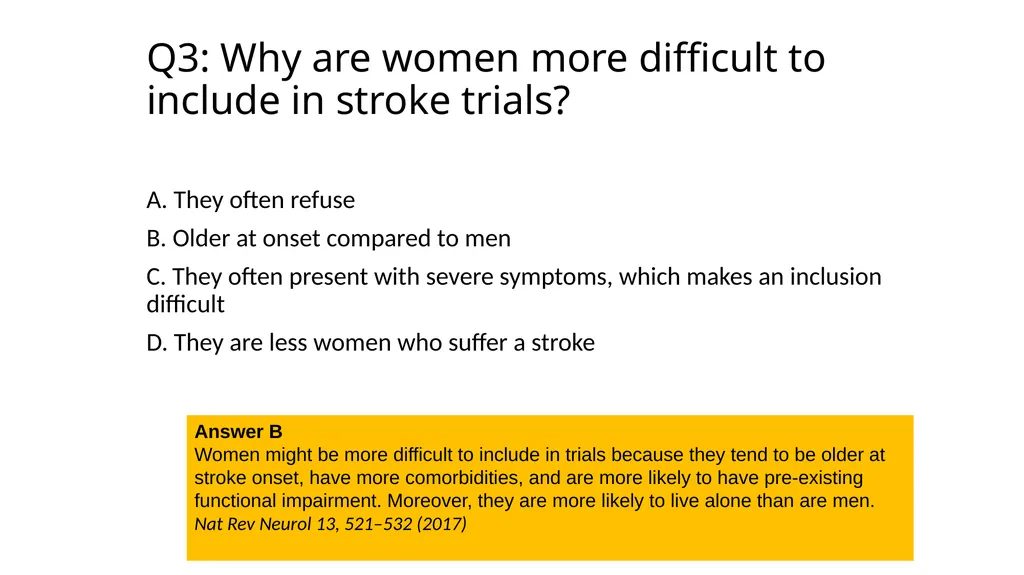
Q3: Why are women more difficult to include in stroke trials? A. They often refuse
B. Older at onset compared to men
C. They often present with severe symptoms, which makes an inclusion difficult
D. They are less women who suffer a stroke Answer B
Women might be more difficult to include in trials because they tend to be older at stroke onset, have more comorbidities, and are more likely to have pre-existing functional impairment. Moreover, they are more likely to live alone than are men.
Nat Rev Neurol 13, 521–532 (2017)<br>
12
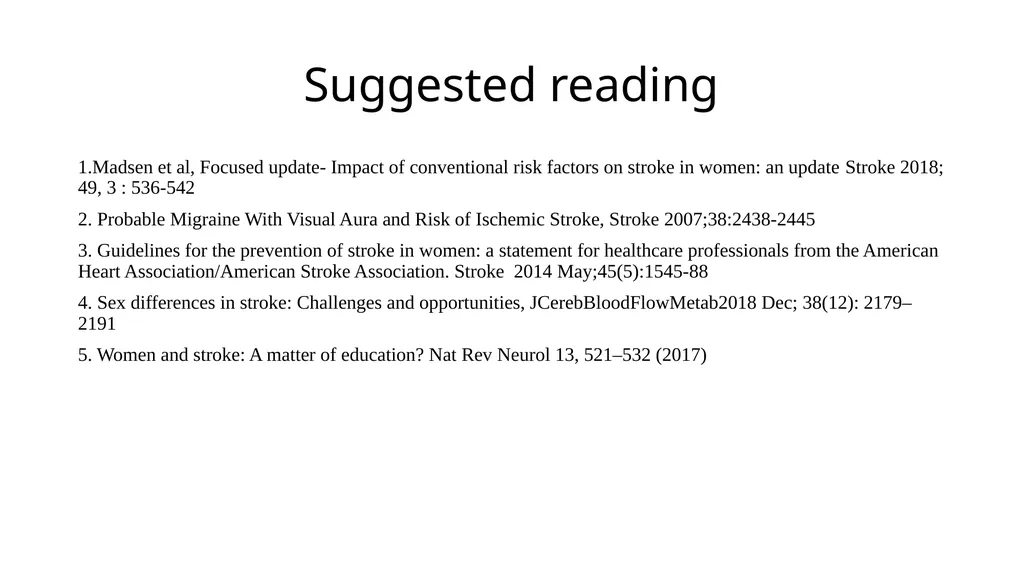
Suggested reading 1.Madsen et al, Focused update- Impact of conventional risk factors on stroke in women: an update Stroke 2018; 49, 3 : 536-542
2. Probable Migraine With Visual Aura and Risk of Ischemic Stroke, Stroke 2007;38:2438-2445
3. Guidelines for the prevention of stroke in women: a statement for healthcare professionals from the American Heart Association/American Stroke Association. Stroke 2014 May;45(5):1545-88
4. Sex differences in stroke: Challenges and opportunities, JCerebBloodFlowMetab2018 Dec; 38(12): 2179–2191
5. Women and stroke: A matter of education? Nat Rev Neurol 13, 521–532 (2017)<br>