04
How many STIs or BBVs have you heard of? rshp.scot<br>
05
How many STIs or BBVs have you heard of? Chlamydia
Genital Herpes
Genital Warts (HPV)
Gonorrhoea
Hepatitis
HIV
Pelvic Inflammatory Disease
Pubic Lice (Crabs)
Syphilis
Trichomoniasis (Trich)
Mpox rshp.scot<br>
06
STIs and BBVs
Some are viruses.
A virus is a small infectious agent that grows inside the living cells of other organisms.
Viruses can infect humans, other animals and plants. For example, the common cold and the flu are caused by a virus.
Genital Herpes, Genital Warts, Hepatitis A, B and C, HIV and Mpox are sexually transmitted viruses.
Treatment can include lotion, anti-viral drugs and medicine. rshp.scot<br>
07
STIs and BBVs
Some are bacteria.
Bacteria are very small organisms. Some bacteria can cause disease.
Treatment is often with antibiotics.
STIs that are a bacteria include Chlamydia, Gonorrhoea and Syphilis.
Treatment is often with antibiotics. rshp.scot<br>
08
STIs and BBVs
Some are parasites.
A parasite lives or feeds on the body.
STIs that are a parasite include Pubic Lice (also called crabs), Trichomoniasis (Trich for short).
The parasite lives in body hair or the genital area. They are very small. Treatment for lice is a cream or lotion. Treatment for Trich is antibiotics. rshp.scot<br>
09
How are STIs or BBVs transmitted? (How do you get them?) rshp.scot<br>
10
How are STIs or BBVs transmitted? (How do you get them?) STI’s like chlamydia and gonorrhoea are transmitted through unprotected oral, anal or vaginal sex (sex without a condom). These can also be caught by sharing sex toys.
Some STI’s can be caught by close bodily contact (such as being naked and intimate together). This includes pubic lice, syphilis, genital warts and mpox.
BBV’s such as HIV can be caught through other means, such as sharing needles and other drug injecting equipment. However, most people in the UK diagnosed with HIV acquired the virus through unprotected vaginal or anal sex.
You can catch HIV through oral sex, but the risk is extremely low.<br>
11
STIs: symptoms and treatment
A symptom is a change that you notice.
For example if you have chicken pox you would get a fever and feel sick, then you would get spots.
Some STIs/BBVs do not have symptoms.
A symptom of an STI could be sores, blisters, redness, bumps or lumps on or around the genitals (private parts). Or it could be an unusual, coloured or smelly discharge (liquid) from the vagina or penis. Or maybe itching around the genitals or pain when peeing or having sex. But some STIs have no symptoms. rshp.scot<br>
12
Testing: ��To find out if you have an STI the doctor or nurse needs to do some tests. This could be a swab from your genitals, a test of your urine or a blood test. rshp.scot<br>
13
Treatment
Treatment can be a medicine or other advice, like to eat a certain way or rest. Treatment by a doctor or nurse is confidential.
The condition will often get worse without treatment and you will be more likely to pass on the infection to others, which is why testing is important. rshp.scot<br>
14
What are the best ways to make sure you don’t get an STI/BBV? rshp.scot<br>
15
What are the best ways to make sure you don’t get an STI/BBV? To not have sex
To always use a condom for oral, anal or vaginal sex
To not have sex or close genital contact unless you and your partner have both been tested for STI’s/BBV’s rshp.scot<br>
16
What are the best ways to make sure you don’t get an STI/BBV? To have a vaccine that is available to prevent certain STIs. For example, you can get a vaccine to prevent types of Hepatitis and mpox. When you got to a sexual health clinic your nurse or doctor can talk to you about this.
If you are at risk of HIV, you can take a preventative treatment called PrEP. The tablets can be taken every day or can be taken in the days before and after sex, depending on what type of sex you have and how often. (More about this in our next lesson). rshp.scot<br>
17
STIs: True or False? rshp.scot<br>
18
True or False?
Only people who sleep around get an STI/BBV. rshp.scot<br>
20
True or False?
If someone has an STI/BBV you will see it. rshp.scot<br>
22
True or False?
The best protection against most STI’s/BBV’s is using condoms when having sex. rshp.scot<br>
24
True or False?
You can avoid STI’s/BBV’s by having oral sex. rshp.scot<br>
26
True or False?
You can protect yourself by limiting the number of sexual partners you have. rshp.scot<br>
27
True or False?
You can protect yourself by choosing not to have some kinds of sex. rshp.scot<br>
29
True or False?
Once you’ve had an STI/BBV, you can’t get it again. rshp.scot<br>
31
True or False?
If you get checked and you don’t have an STI/BBV, then your partner doesn’t need checked. rshp.scot<br>
33
True or False?
If you are in a relationship and only have sex with each other, you will be protected from STI’s/ BBV’s. rshp.scot<br>
35
True or False?
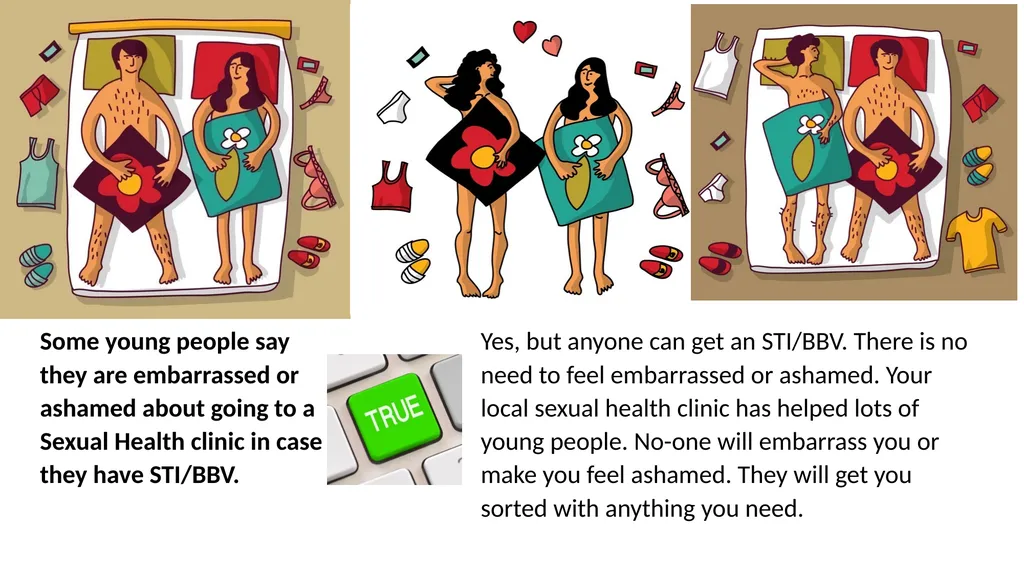
Some young people say they are embarrassed or ashamed about going to a Sexual Health clinic in case they have STI/BBV. rshp.scot<br>
36
Things to remember about STIs
Sex without a condom increases risk of STIs.
Anything that is different or unusual about your genitals (private parts) or body like rashes, blisters, itchiness or spots needs to be checked out at a clinic. rshp.scot<br>
37
Things to remember about STIs
Remember that not all STIs have symptoms, so when you are sexually active it’s a good idea to have a regular check-up.
More information about STIs and BBVs here: Sexual and reproductive | NHS inform rshp.scot<br>
38
Where can I go for information, help and advice?
INSERT LOCAL INFORMATION HERE
ChildLine provides confidential information on any subject Information and chat online https://www.childline.org.uk/
Phone 0800 1111
You can speak to an adult you trust and who will help you with any worry. rshp.scot<br>