
ABS 200 Business Case Analysis (BCA) Terence


Description: ABS 200 Business Case Analysis (BCA) Terence Kahapola Arachchi Brief self introduction Name - Terence Kahapola Arachchi Currently serving as a Senior Lecturer and the Dean of the Faculty of Management at Horizon Campus. Have been teaching
Related Topics
Download Presentation
"ABS 200 Business Case Analysis (BCA) Terence" is the property of its rightful owner. Permission is granted to download and print the materials on this website for personal, non-commercial use only, and to display it on your personal computer provided you do not modify the materials and that you retain all copyright notices contained in the materials. By downloading content from our website, you accept the terms of this agreement.
Presentation Transcript
slide1. ABS 200 Business Case Analysis (BCA) Terence Kahapola Arachchi<br>
slide2. Brief self introduction Name - Terence Kahapola Arachchi
Currently serving as a Senior Lecturer and the Dean of the Faculty of Management at Horizon Campus.
Have been teaching undergraduate and master’s level courses for the last seven years
Before becoming a university teacher, was an Advanced Level Business Studies teacher at two leading international schools
Industry experience in Pharmaceutical and IT industries - In Marketing and Business development.<br>
slide3. Introduction to the Business Case Analysis (BCA) module Module Aims:
This module aims to familiarise standard practices of business case analysis and presentations and develop competencies and skills thereof with some activities.
Module content:
1. Nature of a business case and the process of analysing it – 10%
2. Reading and mapping some cases for a case analysis – 40%
3. Linking the map to subject matters, writing the analysis and discussing with others 40%
4. Making comments on others’ analysis and debating the issues – 10%<br>
slide4. Intended Learning Outcomes (ILOs) of the Module: Knowledge
1. Understand content of a business case including its central problem and analytical questions
2. Understand the connection between a case and subject matters in accounting, business and strategy.
Competencies
3. Read and understand cases in relation to their central issues and underlying subject matters
4. Map an analysis combining the related subject matters<br>
slide5. Intended Learning Outcomes (ILOs) of the Module: Skills
5. Analyse, discuss and present some cases
6. Comment on other’s analysis with a clear position<br>
slide6. Introduction to today’s topic Nature of a business case and the process of analysing it – 10%
This is the first topic of this module.
The follow on topics are;
Reading and mapping some cases for a case analysis – 40%
Linking the map to subject matters, writing the analysis and discussing with others 40%
Making comments on others’ analysis and debating the issues – 10%<br>
slide7. Part 1: Nature of a business case Business case studies are usually summaries of a business situation, problem faced or a strategic choice to be made.
A business case may be based on a real-life company OR a fictitious company created by a business case writer.
Business case studies can illustrate business theory and show the application of such theory.<br>
slide8. Why use case studies? Case studies enable students to analyse business issues from a variety of perspectives.
Apply critical thinking and problem solving skills that you have been developing in your classes.
Apply business theories they have learnt in various subjects.
Business cases are summative - allows you to use different types of knowledge you have gained such as finance, marketing, operations and HR.<br>
slide9. What kind of analytical skills can you develop by analysing business case studies? Sorting and organising key information
Separate facts from opinions
Identifying important issues facing a company
Flag opportunities that are available to a company
Listing threats and problems
Understand critical limitations facing a company - e.g. lack of adequate finance, human resources or technical expertise.
Making decisions and providing practical solutions<br>
slide10. Part 2: The process of analysing a business case study The basic approach to business case study analysis is a FOUR step process.
Analyse the current situation
Understand key issues and their core elements
Formulate and evaluate alternative courses of action
Choose the best alternative and implement it<br>
slide11. Part 2: The process of analysing a business case study Analyse the current situation
Understand key issues and their core elements
Formulate and evaluate alternative courses of action
Choose the best alternative and implement it
Each step is a process by itself with a number of steps you will go through.
I will provide you with a check-list for each stage so that you are sure that you have done the best analysis based on given information.<br>
slide12. Learning the process of analysing a business case study The best way is to take a case study and practice by doing it.
We will start with a made-up business case study to keep things simple. Real world business cases can be too complex
Using this case study we will go through each of the four steps of analysing a business case study.
We will do individual work as well as work as groups for certain activities
Comparing analysis done by each-other
Commenting on positives and negatives
Support or oppose analytical findings of others<br>
slide13. Things to remember when analysing business cases and developing solutions. You will never get all the information you need - Good decisions need quality information. However, like in any real-life business situation, some information will not be available in your case study. You will have to make reasonable assumptions.
You will not have all the money you need - Finance (or lack of it) is the main limiting factor in real world businesses. Your solutions/decisions will only be practical if the firm can fund them. Therefore, propose solutions that the company can afford.<br>
slide14. Things to remember when analysing business cases and developing solutions. There may be shortage of other critical resources as well - The firm may be short-staffed and not in a position to hire more at present.
There may be operational limitations due to limited technical resources. E.g.
The factory may be running at full capacity and cannot expand production any more.
The firm may not have the technology or the technical expertise needed to implement the solutions you propose.
Shortages of other physical resources such as storage, retail outlets, transportation, office space, outdated computer systems<br>
slide15. Things to avoid Lack of clear understanding - Propose solutions without understanding the real issues.
Treating symptoms - Confuse symptoms with causes
Premature conclusions - Wait till the full analysis is done before you decide what is really wrong with the firm.
Look for the right answer (or right solution) - there is no right answer. Different people may come-up with different solutions for the same problem. Each can be equally effective.
Generalized solutions/recommendations - Business problems need very specific solutions. E.g. Rather than suggesting that the firm should increase cash-flow, propose how they can do it based on their situation and industry.<br>
slide16. Things to avoid Don't forget the big picture - A case study may focus on a certain area more (e.g. the financial issues facing the firm) however, make sure to consider other business functions such as operations, marketing, HR and Administration.
Understand the interconnectedness (synoptic nature) of all business decisions.
What might look like a good decision based on finance point of view could be a marketing disaster or lead to a serious HR issue.<br>
slide17. NEXT STEP First reading of the case study “What’s Driving Porsche?”
This is a 11 page case based on the history of Porsche and the challenges that had to be overcome when Porsche took a controlling stake in the VW company.
This case is unique as a smaller sports car company - Porsche - essentially took-over one of the world’s largest car-makers, the VW.<br>
slide18. What is our approach to this case? You must read this case a few times on your own.
Make sure you read thoroughly – Don’t not skim through or try to speed read.
I will take you through a condensed summery of the case so that you are aware of the major issues and factors – This will help your reading and analysis.
You will be given a short assignment based on this case which you must submit on or before next Saturday (27th February 2021)<br>
slide19. When reading this case……. You may get the feeling that it is disjointed and there is no logical flow.
The case seem to jump back and forth from past to present and back to past.
This is typical of Business School case-studies that deal with complex real-world businesses.
Part of the reading and notetaking should be to create your own summery in a logical way that is suitable to you.<br>
slide20. The case is written in 2009 with 2007 data – We will only consider facts as presented in the case – Current situation of VW/Porsche may be different but we will NOT consider current facts.<br>
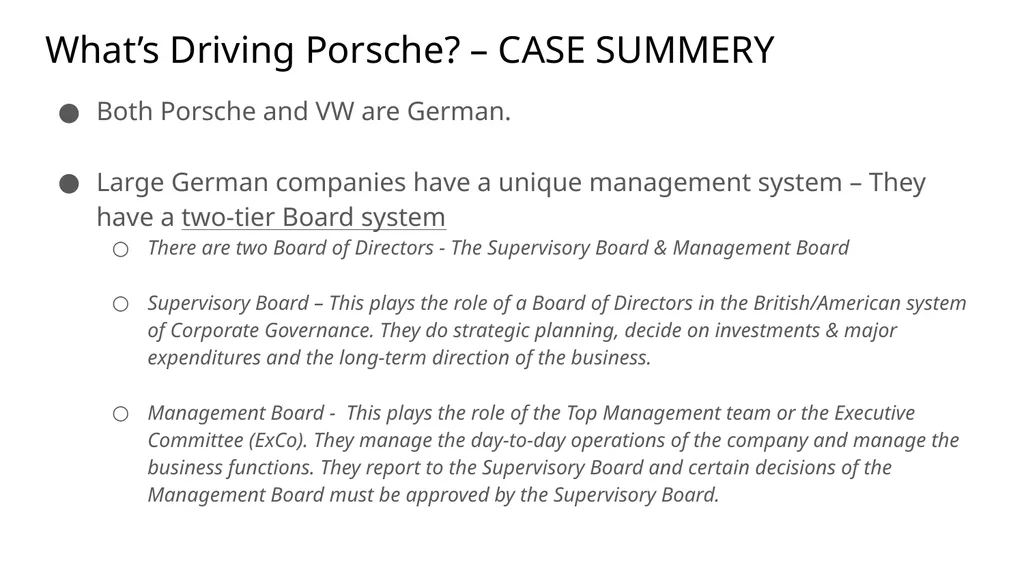
slide21. What’s Driving Porsche? – CASE SUMMERY Both Porsche and VW are German.
Large German companies have a unique management system – They have a two-tier Board system
There are two Board of Directors - The Supervisory Board & Management Board
Supervisory Board – This plays the role of a Board of Directors in the British/American system of Corporate Governance. They do strategic planning, decide on investments & major expenditures and the long-term direction of the business.
Management Board - This plays the role of the Top Management team or the Executive Committee (ExCo). They manage the day-to-day operations of the company and manage the business functions. They report to the Supervisory Board and certain decisions of the Management Board must be approved by the Supervisory Board.<br>
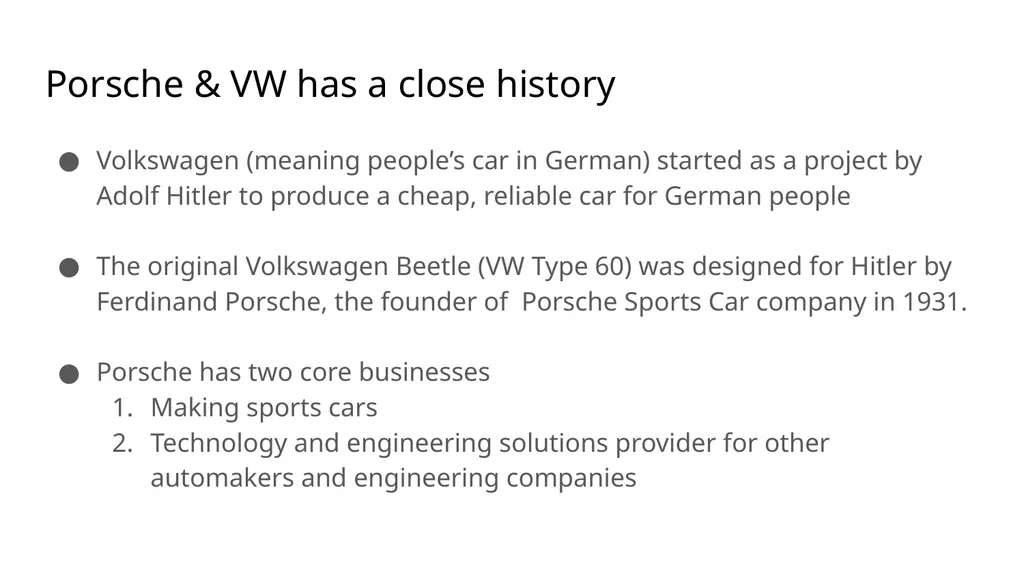
slide22. Porsche & VW has a close history Volkswagen (meaning people’s car in German) started as a project by Adolf Hitler to produce a cheap, reliable car for German people
The original Volkswagen Beetle (VW Type 60) was designed for Hitler by Ferdinand Porsche, the founder of Porsche Sports Car company in 1931.
Porsche has two core businesses
Making sports cars
Technology and engineering solutions provider for other automakers and engineering companies<br>
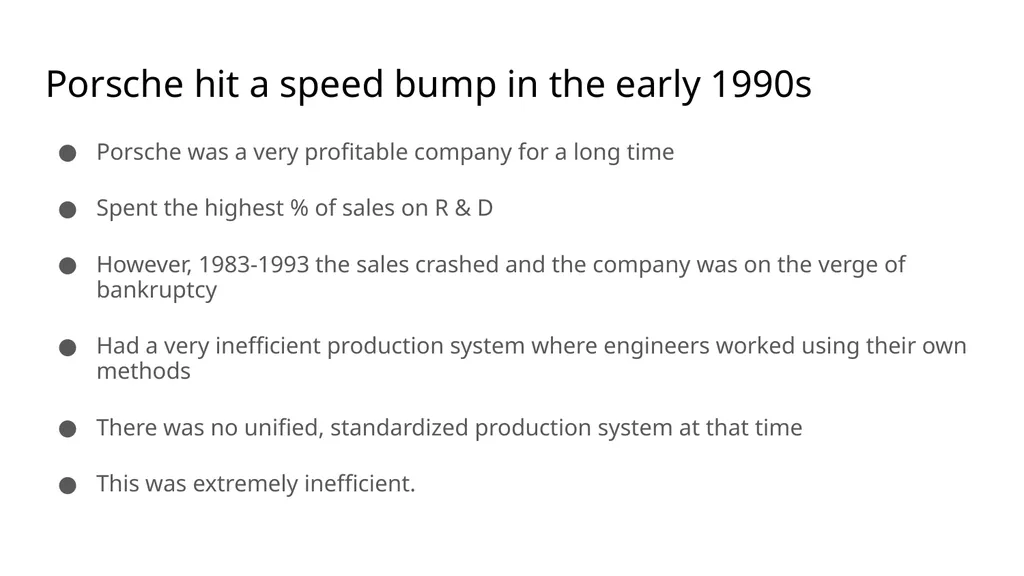
slide23. Porsche hit a speed bump in the early 1990s Porsche was a very profitable company for a long time
Spent the highest % of sales on R & D
However, 1983-1993 the sales crashed and the company was on the verge of bankruptcy
Had a very inefficient production system where engineers worked using their own methods
There was no unified, standardized production system at that time
This was extremely inefficient.<br>
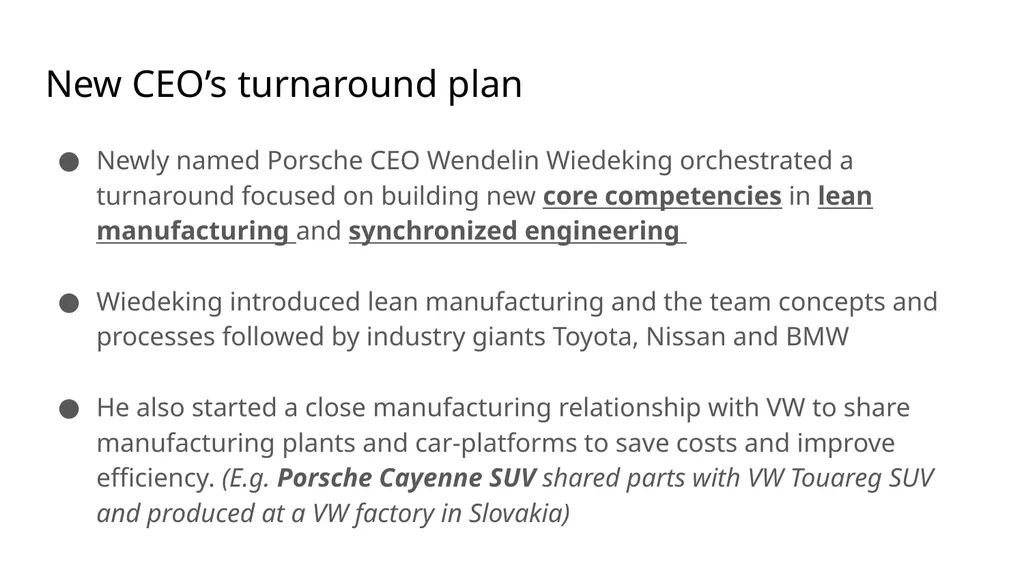
slide24. New CEO’s turnaround plan Newly named Porsche CEO Wendelin Wiedeking orchestrated a turnaround focused on building new core competencies in lean manufacturing and synchronized engineering
Wiedeking introduced lean manufacturing and the team concepts and processes followed by industry giants Toyota, Nissan and BMW
He also started a close manufacturing relationship with VW to share manufacturing plants and car-platforms to save costs and improve efficiency. (E.g. Porsche Cayenne SUV shared parts with VW Touareg SUV and produced at a VW factory in Slovakia)<br>
slide25. A major issue before takeover Porsche is the smaller company, but took a controlling interest (50%+) in VW
Porsche’s technology and engineering business was a major revenue and profit center
The supervisory board was concerned that if Porsche took over VW and became a part of it, other car companies would not want to work with Porsche for their technology and engineering needs as they would worry that VW, one of their biggest competitors will find out about their plans.<br>
slide26. Outside Engineering at Porsche Providing outside engineering services for carmakers had always been an important part of Porsche’s business model.
Porsche conducted research on behalf of their customers and shared the innovations and new technology.
For several decades VW had been Porsche’s main engineering services and technology development customer.
Porsche Engineering Services worked with virtually every auto maker in the world, with the exception of those that produced luxury sports cars, and was also involved in projects involving elevators, forklifts, earthmovers, and artificial knees.<br>
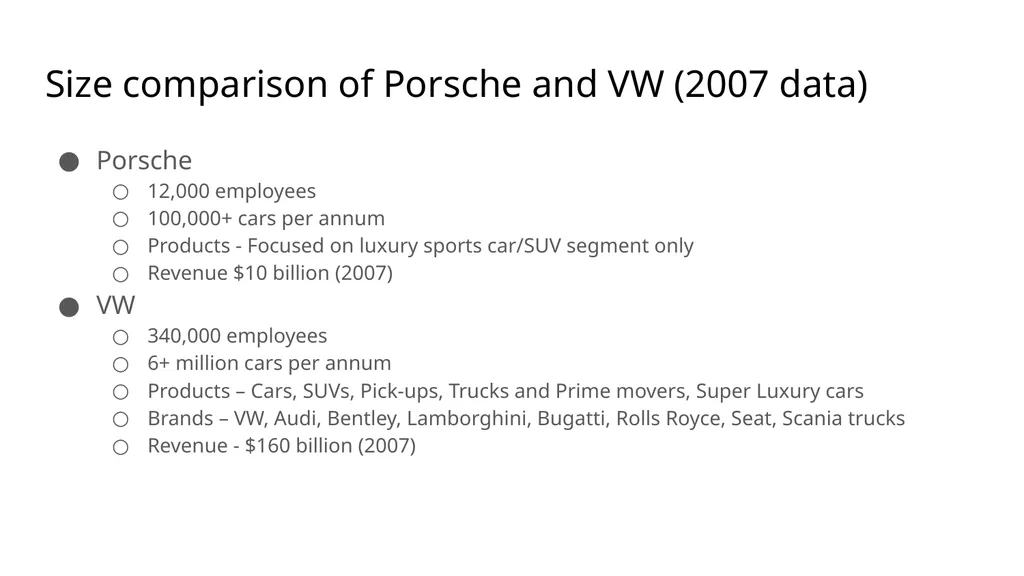
slide27. Size comparison of Porsche and VW (2007 data) Porsche
12,000 employees
100,000+ cars per annum
Products - Focused on luxury sports car/SUV segment only
Revenue $10 billion (2007)
VW
340,000 employees
6+ million cars per annum
Products – Cars, SUVs, Pick-ups, Trucks and Prime movers, Super Luxury cars
Brands – VW, Audi, Bentley, Lamborghini, Bugatti, Rolls Royce, Seat, Scania trucks
Revenue - $160 billion (2007)<br>
slide28. Takeover of VW The ability to scale and create synergies across a number of areas were two driving forces that led Porsche to secure its partnership with VW
Further - Seniors of Porsche and Piëch families founded Porsche. Porsche designed the original VW beetle and members of Piëch family has been members of VW supervisory board since its founding.
Porsche made its first move towards VW in 2005 when it acquired a 20% stake
In March 2007, Porsche upped its stake to 31% by paying €5 billion ($6.6 billion)<br>
slide29. The logic of the takeover Apart from the close relationship AND cross shareholdings of the founding families, there are other logical reasons for the takeover.
As Wiedeking explained, electronics and software were one area of particular interest: “In modern cars, electronics and software account for 30% to 35% of Research and development (R & D) costs. Spreading this investment over 6 million cars instead of Porsche’s 100,000 will make a big difference and per vehicle development costs will be cheaper.”
Shared factories, body platforms, body parts, engines and transmissions are a huge cost saver too<br>
slide30. Macroeconomic factors Luxury segment of the automobile market is very sensitive to the economic environment.
People are not going to buy luxury cars when there is economic uncertainty.
Therefore, luxury brands like Porsche are highly sensitive to macroeconomic environment.
By acquiring VW, Porsche was helping protect itself from the ups and downs of the auto sector. A huge mainstream global car company like VW is in a better position to weather any marketplace vagaries than a luxury brand like Porsche.<br>
slide31. Concerns Possible culture clashes between very proud, highly focused engineering teams of Porsche, Audi and VW.
Internal competition if companies like Porsche and Audi made similar models targeting the same segments. How to differentiate and protect the heritage of each company? How to prevent customer confusion?
How to practically realize the cost sharing, platform sharing, factory sharing and engineering cost sharing while preventing culture clash and damaging the brands?<br>
slide32. A Recap<br>
slide33. Checklist for Analyzing the Current Situation Analyzing the Current Situation is done is 4 phases
Phase 1: The environment
Phase 2: The industry
Phase 3: The firm
Phase 4: The management
You many NOT HAVE all the information you need to do an in-depth analysis of each of the above.
Use what is given. Remember that the case has 2007 data.
If you are going to look for economic and business data to fill the gaps, they must be 2007 data. Current (2019-2021) data will be meaningless to this case-study.<br>
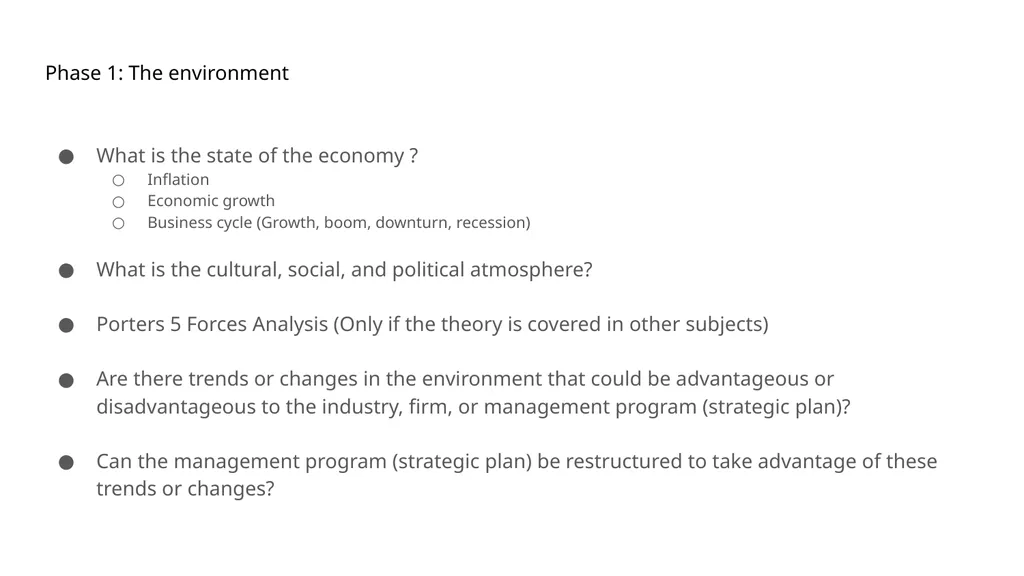
slide34. Phase 1: The environment What is the state of the economy ?
Inflation
Economic growth
Business cycle (Growth, boom, downturn, recession)
What is the cultural, social, and political atmosphere?
Porters 5 Forces Analysis (Only if the theory is covered in other subjects)
Are there trends or changes in the environment that could be advantageous or disadvantageous to the industry, firm, or management program (strategic plan)?
Can the management program (strategic plan) be restructured to take advantage of these trends or changes?<br>
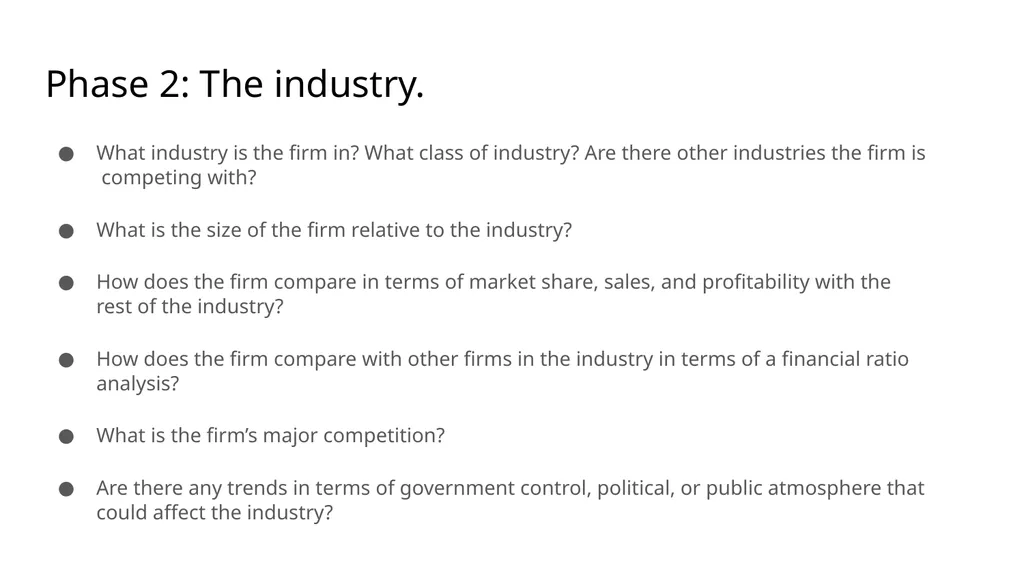
slide35. Phase 2: The industry. What industry is the firm in? What class of industry? Are there other industries the firm is competing with?
What is the size of the firm relative to the industry?
How does the firm compare in terms of market share, sales, and profitability with the rest of the industry?
How does the firm compare with other firms in the industry in terms of a financial ratio analysis?
What is the firm’s major competition?
Are there any trends in terms of government control, political, or public atmosphere that could affect the industry?<br>
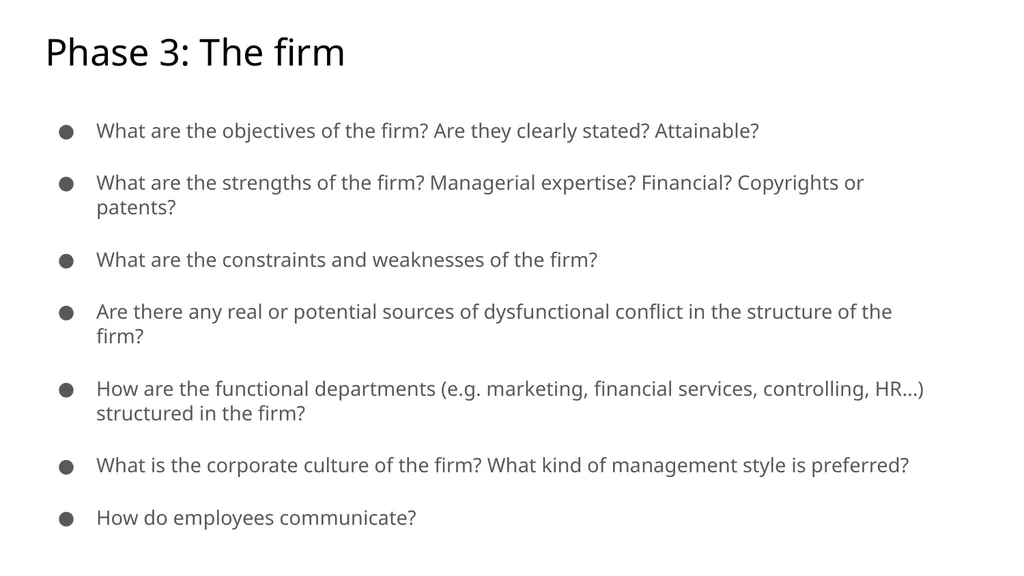
slide36. Phase 3: The firm What are the objectives of the firm? Are they clearly stated? Attainable?
What are the strengths of the firm? Managerial expertise? Financial? Copyrights or patents?
What are the constraints and weaknesses of the firm?
Are there any real or potential sources of dysfunctional conflict in the structure of the firm?
How are the functional departments (e.g. marketing, financial services, controlling, HR…) structured in the firm?
What is the corporate culture of the firm? What kind of management style is preferred?
How do employees communicate?<br>
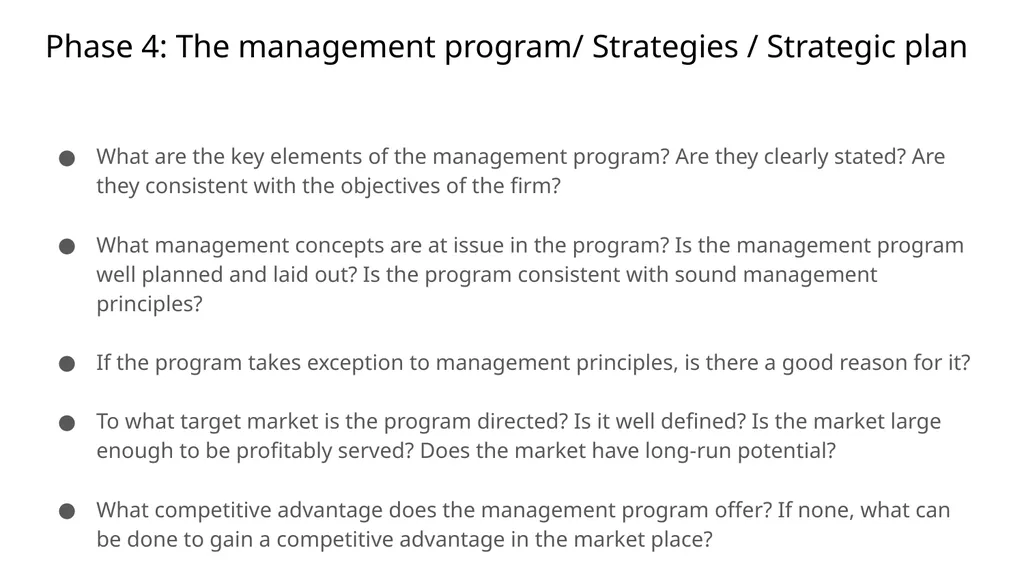
slide37. Phase 4: The management program/ Strategies / Strategic plan What are the key elements of the management program? Are they clearly stated? Are they consistent with the objectives of the firm?
What management concepts are at issue in the program? Is the management program well planned and laid out? Is the program consistent with sound management principles?
If the program takes exception to management principles, is there a good reason for it?
To what target market is the program directed? Is it well defined? Is the market large enough to be profitably served? Does the market have long-run potential?
What competitive advantage does the management program offer? If none, what can be done to gain a competitive advantage in the market place?<br>
slide38. What products are being sold? What is the width, depth, and consistency of the firm’s product lines? Does the firm need new products to fill out its product line? Should any product be deleted? What is the profitability of the various products?
What promotion mix is being used? Is promotion consistent with the products and product images? What could be done to improve the promotion mix?
What channels of distribution are being used? Do they deliver the product at the right time and right place to meet consumer needs? Are the channels typical of those used in the industry? Could channels be made more efficient?
What pricing strategies are being used? How do prices compare with similar products of other firms? How are prices determined?
Are business research and information systematically integrated into the management program? Is the overall management program internally consistent?
Are (senior/middle) managers capable to translate strategy into action? Are managers excellent in action or just in talking?<br>
slide39. Now, Let Us Move to the Full Analysis<br>
slide2. Brief self introduction Name - Terence Kahapola Arachchi
Currently serving as a Senior Lecturer and the Dean of the Faculty of Management at Horizon Campus.
Have been teaching undergraduate and master’s level courses for the last seven years
Before becoming a university teacher, was an Advanced Level Business Studies teacher at two leading international schools
Industry experience in Pharmaceutical and IT industries - In Marketing and Business development.<br>
slide3. Introduction to the Business Case Analysis (BCA) module Module Aims:
This module aims to familiarise standard practices of business case analysis and presentations and develop competencies and skills thereof with some activities.
Module content:
1. Nature of a business case and the process of analysing it – 10%
2. Reading and mapping some cases for a case analysis – 40%
3. Linking the map to subject matters, writing the analysis and discussing with others 40%
4. Making comments on others’ analysis and debating the issues – 10%<br>
slide4. Intended Learning Outcomes (ILOs) of the Module: Knowledge
1. Understand content of a business case including its central problem and analytical questions
2. Understand the connection between a case and subject matters in accounting, business and strategy.
Competencies
3. Read and understand cases in relation to their central issues and underlying subject matters
4. Map an analysis combining the related subject matters<br>
slide5. Intended Learning Outcomes (ILOs) of the Module: Skills
5. Analyse, discuss and present some cases
6. Comment on other’s analysis with a clear position<br>
slide6. Introduction to today’s topic Nature of a business case and the process of analysing it – 10%
This is the first topic of this module.
The follow on topics are;
Reading and mapping some cases for a case analysis – 40%
Linking the map to subject matters, writing the analysis and discussing with others 40%
Making comments on others’ analysis and debating the issues – 10%<br>
slide7. Part 1: Nature of a business case Business case studies are usually summaries of a business situation, problem faced or a strategic choice to be made.
A business case may be based on a real-life company OR a fictitious company created by a business case writer.
Business case studies can illustrate business theory and show the application of such theory.<br>
slide8. Why use case studies? Case studies enable students to analyse business issues from a variety of perspectives.
Apply critical thinking and problem solving skills that you have been developing in your classes.
Apply business theories they have learnt in various subjects.
Business cases are summative - allows you to use different types of knowledge you have gained such as finance, marketing, operations and HR.<br>
slide9. What kind of analytical skills can you develop by analysing business case studies? Sorting and organising key information
Separate facts from opinions
Identifying important issues facing a company
Flag opportunities that are available to a company
Listing threats and problems
Understand critical limitations facing a company - e.g. lack of adequate finance, human resources or technical expertise.
Making decisions and providing practical solutions<br>
slide10. Part 2: The process of analysing a business case study The basic approach to business case study analysis is a FOUR step process.
Analyse the current situation
Understand key issues and their core elements
Formulate and evaluate alternative courses of action
Choose the best alternative and implement it<br>
slide11. Part 2: The process of analysing a business case study Analyse the current situation
Understand key issues and their core elements
Formulate and evaluate alternative courses of action
Choose the best alternative and implement it
Each step is a process by itself with a number of steps you will go through.
I will provide you with a check-list for each stage so that you are sure that you have done the best analysis based on given information.<br>
slide12. Learning the process of analysing a business case study The best way is to take a case study and practice by doing it.
We will start with a made-up business case study to keep things simple. Real world business cases can be too complex
Using this case study we will go through each of the four steps of analysing a business case study.
We will do individual work as well as work as groups for certain activities
Comparing analysis done by each-other
Commenting on positives and negatives
Support or oppose analytical findings of others<br>
slide13. Things to remember when analysing business cases and developing solutions. You will never get all the information you need - Good decisions need quality information. However, like in any real-life business situation, some information will not be available in your case study. You will have to make reasonable assumptions.
You will not have all the money you need - Finance (or lack of it) is the main limiting factor in real world businesses. Your solutions/decisions will only be practical if the firm can fund them. Therefore, propose solutions that the company can afford.<br>
slide14. Things to remember when analysing business cases and developing solutions. There may be shortage of other critical resources as well - The firm may be short-staffed and not in a position to hire more at present.
There may be operational limitations due to limited technical resources. E.g.
The factory may be running at full capacity and cannot expand production any more.
The firm may not have the technology or the technical expertise needed to implement the solutions you propose.
Shortages of other physical resources such as storage, retail outlets, transportation, office space, outdated computer systems<br>
slide15. Things to avoid Lack of clear understanding - Propose solutions without understanding the real issues.
Treating symptoms - Confuse symptoms with causes
Premature conclusions - Wait till the full analysis is done before you decide what is really wrong with the firm.
Look for the right answer (or right solution) - there is no right answer. Different people may come-up with different solutions for the same problem. Each can be equally effective.
Generalized solutions/recommendations - Business problems need very specific solutions. E.g. Rather than suggesting that the firm should increase cash-flow, propose how they can do it based on their situation and industry.<br>
slide16. Things to avoid Don't forget the big picture - A case study may focus on a certain area more (e.g. the financial issues facing the firm) however, make sure to consider other business functions such as operations, marketing, HR and Administration.
Understand the interconnectedness (synoptic nature) of all business decisions.
What might look like a good decision based on finance point of view could be a marketing disaster or lead to a serious HR issue.<br>
slide17. NEXT STEP First reading of the case study “What’s Driving Porsche?”
This is a 11 page case based on the history of Porsche and the challenges that had to be overcome when Porsche took a controlling stake in the VW company.
This case is unique as a smaller sports car company - Porsche - essentially took-over one of the world’s largest car-makers, the VW.<br>
slide18. What is our approach to this case? You must read this case a few times on your own.
Make sure you read thoroughly – Don’t not skim through or try to speed read.
I will take you through a condensed summery of the case so that you are aware of the major issues and factors – This will help your reading and analysis.
You will be given a short assignment based on this case which you must submit on or before next Saturday (27th February 2021)<br>
slide19. When reading this case……. You may get the feeling that it is disjointed and there is no logical flow.
The case seem to jump back and forth from past to present and back to past.
This is typical of Business School case-studies that deal with complex real-world businesses.
Part of the reading and notetaking should be to create your own summery in a logical way that is suitable to you.<br>
slide20. The case is written in 2009 with 2007 data – We will only consider facts as presented in the case – Current situation of VW/Porsche may be different but we will NOT consider current facts.<br>
slide21. What’s Driving Porsche? – CASE SUMMERY Both Porsche and VW are German.
Large German companies have a unique management system – They have a two-tier Board system
There are two Board of Directors - The Supervisory Board & Management Board
Supervisory Board – This plays the role of a Board of Directors in the British/American system of Corporate Governance. They do strategic planning, decide on investments & major expenditures and the long-term direction of the business.
Management Board - This plays the role of the Top Management team or the Executive Committee (ExCo). They manage the day-to-day operations of the company and manage the business functions. They report to the Supervisory Board and certain decisions of the Management Board must be approved by the Supervisory Board.<br>
slide22. Porsche & VW has a close history Volkswagen (meaning people’s car in German) started as a project by Adolf Hitler to produce a cheap, reliable car for German people
The original Volkswagen Beetle (VW Type 60) was designed for Hitler by Ferdinand Porsche, the founder of Porsche Sports Car company in 1931.
Porsche has two core businesses
Making sports cars
Technology and engineering solutions provider for other automakers and engineering companies<br>
slide23. Porsche hit a speed bump in the early 1990s Porsche was a very profitable company for a long time
Spent the highest % of sales on R & D
However, 1983-1993 the sales crashed and the company was on the verge of bankruptcy
Had a very inefficient production system where engineers worked using their own methods
There was no unified, standardized production system at that time
This was extremely inefficient.<br>
slide24. New CEO’s turnaround plan Newly named Porsche CEO Wendelin Wiedeking orchestrated a turnaround focused on building new core competencies in lean manufacturing and synchronized engineering
Wiedeking introduced lean manufacturing and the team concepts and processes followed by industry giants Toyota, Nissan and BMW
He also started a close manufacturing relationship with VW to share manufacturing plants and car-platforms to save costs and improve efficiency. (E.g. Porsche Cayenne SUV shared parts with VW Touareg SUV and produced at a VW factory in Slovakia)<br>
slide25. A major issue before takeover Porsche is the smaller company, but took a controlling interest (50%+) in VW
Porsche’s technology and engineering business was a major revenue and profit center
The supervisory board was concerned that if Porsche took over VW and became a part of it, other car companies would not want to work with Porsche for their technology and engineering needs as they would worry that VW, one of their biggest competitors will find out about their plans.<br>
slide26. Outside Engineering at Porsche Providing outside engineering services for carmakers had always been an important part of Porsche’s business model.
Porsche conducted research on behalf of their customers and shared the innovations and new technology.
For several decades VW had been Porsche’s main engineering services and technology development customer.
Porsche Engineering Services worked with virtually every auto maker in the world, with the exception of those that produced luxury sports cars, and was also involved in projects involving elevators, forklifts, earthmovers, and artificial knees.<br>
slide27. Size comparison of Porsche and VW (2007 data) Porsche
12,000 employees
100,000+ cars per annum
Products - Focused on luxury sports car/SUV segment only
Revenue $10 billion (2007)
VW
340,000 employees
6+ million cars per annum
Products – Cars, SUVs, Pick-ups, Trucks and Prime movers, Super Luxury cars
Brands – VW, Audi, Bentley, Lamborghini, Bugatti, Rolls Royce, Seat, Scania trucks
Revenue - $160 billion (2007)<br>
slide28. Takeover of VW The ability to scale and create synergies across a number of areas were two driving forces that led Porsche to secure its partnership with VW
Further - Seniors of Porsche and Piëch families founded Porsche. Porsche designed the original VW beetle and members of Piëch family has been members of VW supervisory board since its founding.
Porsche made its first move towards VW in 2005 when it acquired a 20% stake
In March 2007, Porsche upped its stake to 31% by paying €5 billion ($6.6 billion)<br>
slide29. The logic of the takeover Apart from the close relationship AND cross shareholdings of the founding families, there are other logical reasons for the takeover.
As Wiedeking explained, electronics and software were one area of particular interest: “In modern cars, electronics and software account for 30% to 35% of Research and development (R & D) costs. Spreading this investment over 6 million cars instead of Porsche’s 100,000 will make a big difference and per vehicle development costs will be cheaper.”
Shared factories, body platforms, body parts, engines and transmissions are a huge cost saver too<br>
slide30. Macroeconomic factors Luxury segment of the automobile market is very sensitive to the economic environment.
People are not going to buy luxury cars when there is economic uncertainty.
Therefore, luxury brands like Porsche are highly sensitive to macroeconomic environment.
By acquiring VW, Porsche was helping protect itself from the ups and downs of the auto sector. A huge mainstream global car company like VW is in a better position to weather any marketplace vagaries than a luxury brand like Porsche.<br>
slide31. Concerns Possible culture clashes between very proud, highly focused engineering teams of Porsche, Audi and VW.
Internal competition if companies like Porsche and Audi made similar models targeting the same segments. How to differentiate and protect the heritage of each company? How to prevent customer confusion?
How to practically realize the cost sharing, platform sharing, factory sharing and engineering cost sharing while preventing culture clash and damaging the brands?<br>
slide32. A Recap<br>
slide33. Checklist for Analyzing the Current Situation Analyzing the Current Situation is done is 4 phases
Phase 1: The environment
Phase 2: The industry
Phase 3: The firm
Phase 4: The management
You many NOT HAVE all the information you need to do an in-depth analysis of each of the above.
Use what is given. Remember that the case has 2007 data.
If you are going to look for economic and business data to fill the gaps, they must be 2007 data. Current (2019-2021) data will be meaningless to this case-study.<br>
slide34. Phase 1: The environment What is the state of the economy ?
Inflation
Economic growth
Business cycle (Growth, boom, downturn, recession)
What is the cultural, social, and political atmosphere?
Porters 5 Forces Analysis (Only if the theory is covered in other subjects)
Are there trends or changes in the environment that could be advantageous or disadvantageous to the industry, firm, or management program (strategic plan)?
Can the management program (strategic plan) be restructured to take advantage of these trends or changes?<br>
slide35. Phase 2: The industry. What industry is the firm in? What class of industry? Are there other industries the firm is competing with?
What is the size of the firm relative to the industry?
How does the firm compare in terms of market share, sales, and profitability with the rest of the industry?
How does the firm compare with other firms in the industry in terms of a financial ratio analysis?
What is the firm’s major competition?
Are there any trends in terms of government control, political, or public atmosphere that could affect the industry?<br>
slide36. Phase 3: The firm What are the objectives of the firm? Are they clearly stated? Attainable?
What are the strengths of the firm? Managerial expertise? Financial? Copyrights or patents?
What are the constraints and weaknesses of the firm?
Are there any real or potential sources of dysfunctional conflict in the structure of the firm?
How are the functional departments (e.g. marketing, financial services, controlling, HR…) structured in the firm?
What is the corporate culture of the firm? What kind of management style is preferred?
How do employees communicate?<br>
slide37. Phase 4: The management program/ Strategies / Strategic plan What are the key elements of the management program? Are they clearly stated? Are they consistent with the objectives of the firm?
What management concepts are at issue in the program? Is the management program well planned and laid out? Is the program consistent with sound management principles?
If the program takes exception to management principles, is there a good reason for it?
To what target market is the program directed? Is it well defined? Is the market large enough to be profitably served? Does the market have long-run potential?
What competitive advantage does the management program offer? If none, what can be done to gain a competitive advantage in the market place?<br>
slide38. What products are being sold? What is the width, depth, and consistency of the firm’s product lines? Does the firm need new products to fill out its product line? Should any product be deleted? What is the profitability of the various products?
What promotion mix is being used? Is promotion consistent with the products and product images? What could be done to improve the promotion mix?
What channels of distribution are being used? Do they deliver the product at the right time and right place to meet consumer needs? Are the channels typical of those used in the industry? Could channels be made more efficient?
What pricing strategies are being used? How do prices compare with similar products of other firms? How are prices determined?
Are business research and information systematically integrated into the management program? Is the overall management program internally consistent?
Are (senior/middle) managers capable to translate strategy into action? Are managers excellent in action or just in talking?<br>
slide39. Now, Let Us Move to the Full Analysis<br>