Absorptive Capacity: A New Perspective on Learning and Innovation Cohen and Levinthal (1990) Administrative Science Quarterly 1 Modified by Jingya You and Youngsir Rha Originally created by Hyeonsuh Lee Background The ability to exploit
"Absorptive Capacity: A New Perspective on Learning" is the property of its rightful owner. Permission is granted to
download and print the materials on this website for personal, non-commercial use only, and to display it
on your personal computer provided you do not modify the materials and that you retain all copyright
notices contained in the materials. By downloading content from our website, you accept the terms of this
agreement.
Presentation Transcript
01
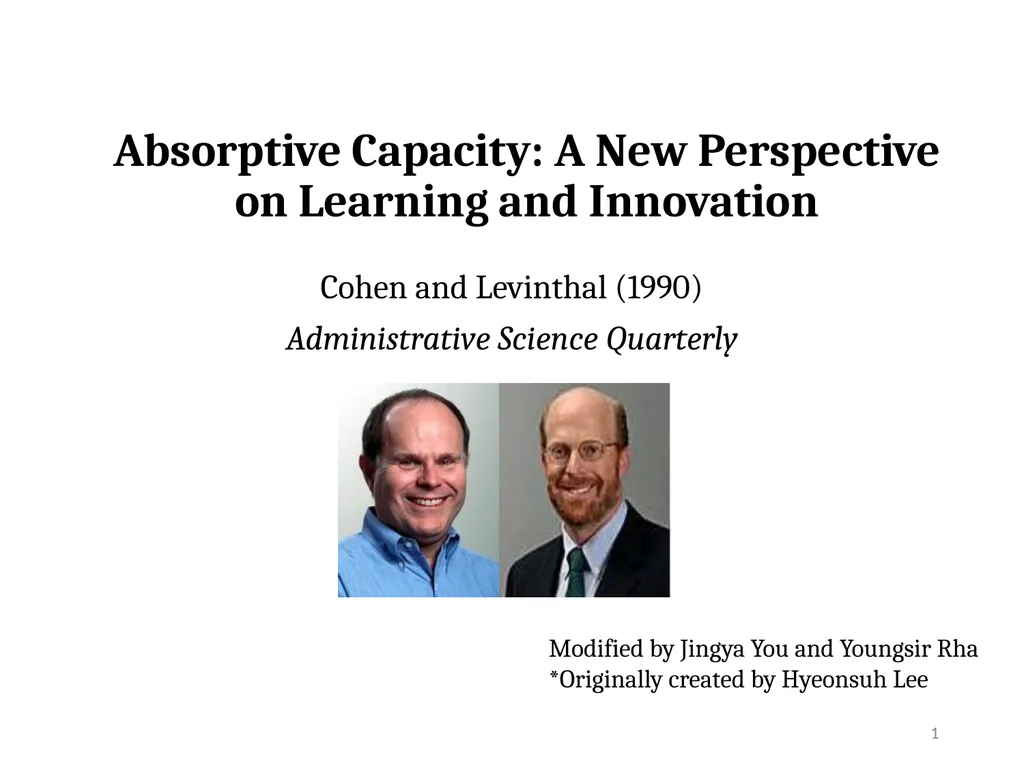
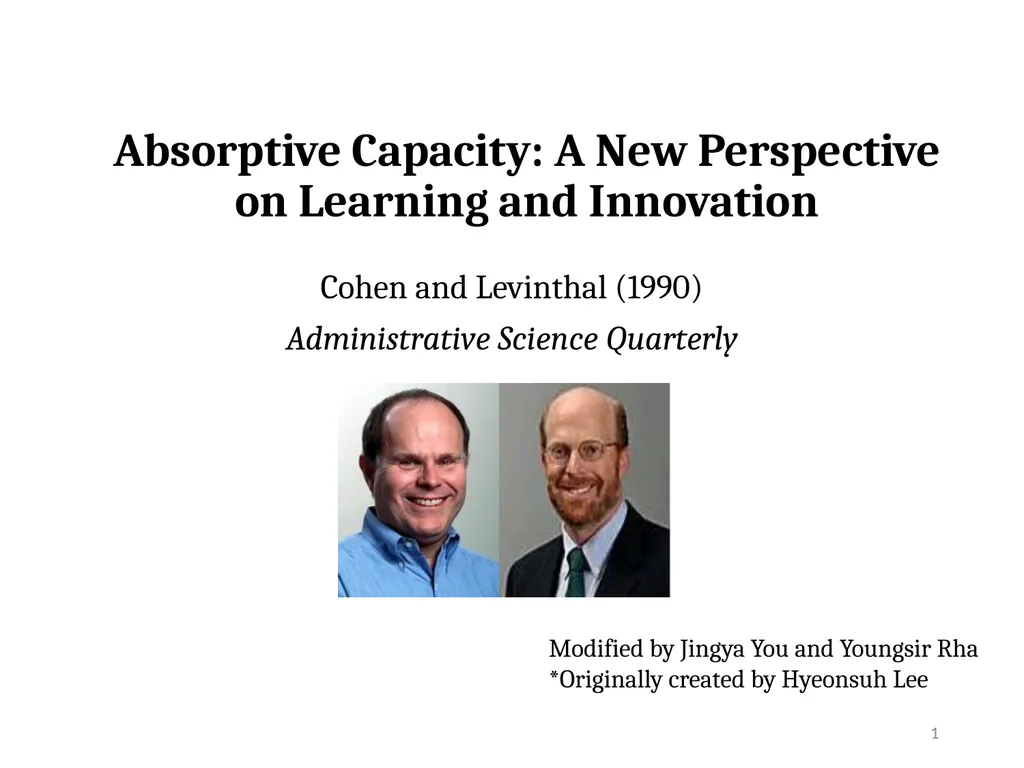
Absorptive Capacity: A New Perspective on Learning and Innovation Cohen and Levinthal (1990)
Administrative Science Quarterly 1 Modified by Jingya You and Youngsir Rha
*Originally created by Hyeonsuh Lee<br>
02
Background The ability to exploit external knowledge is a critical component of innovative capabilities.
Absorptive capacity
The ability to recognize the value of new information, assimilate it, and apply it to commercial ends. 2 The ability to assimilate information is a function of the richness of the pre-existing knowledge structure.
e.g. basic skills or shared language; knowledge of the most recent scientific or technological developments in the field.
Learning is cumulative, and learning performance is greatest when the object of learning is related to what is already known.
Diversity of knowledge plays an important role. A diverse background provides a more robust basis for learning and enables the individual to make novel associations and linkages.
Absorptive capacity is generated through R&D investment, manufacturing operations, or direct investment in absorptive capacity (advanced training)<br>
03
Organizational absorptive capacity Individual level: memory development; prior knowledge facilitates learning of new related knowledge, problem-solving and learning capabilities
An organization’s absorptive capacity depends on those of individual members, but is not simply the sum of them.
Sources of a firm’s absorptive capacity
The structure of communication between the external environment and the organization, as well as among the subunits of the organization
Character and distribution of expertise within the organization
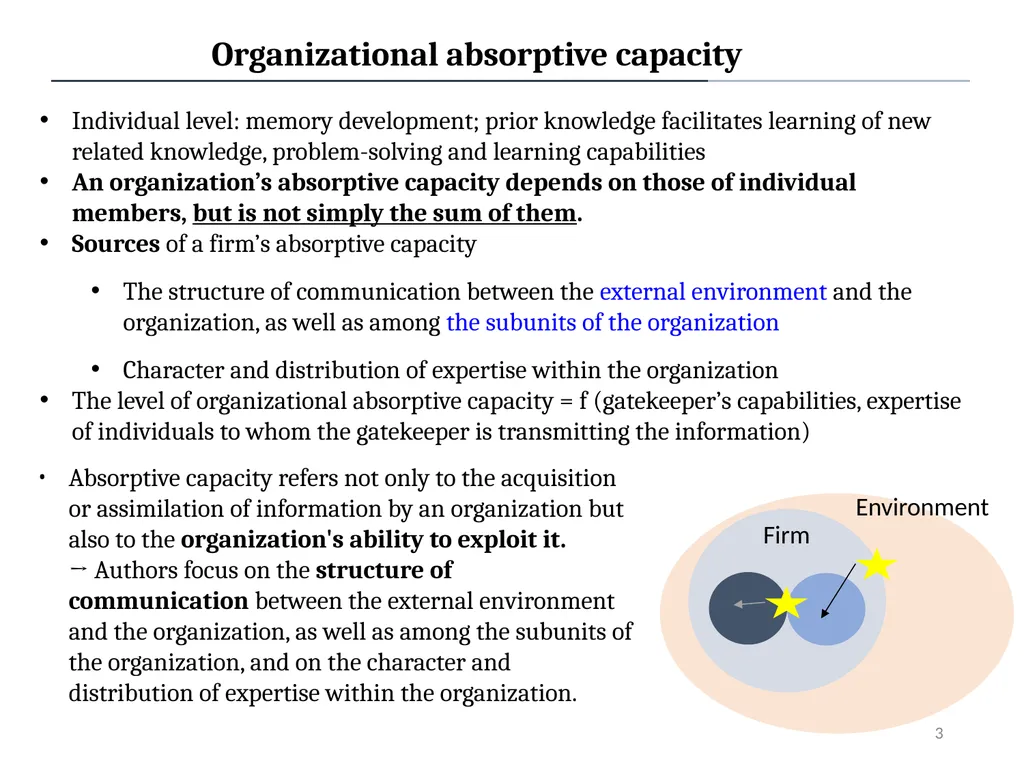
The level of organizational absorptive capacity = f (gatekeeper’s capabilities, expertise of individuals to whom the gatekeeper is transmitting the information) 3 Firm Environment Absorptive capacity refers not only to the acquisition or assimilation of information by an organization but also to the organization's ability to exploit it. → Authors focus on the structure of communication between the external environment and the organization, as well as among the subunits of the organization, and on the character and distribution of expertise within the organization.<br>
04
Organizational absorptive capacity Tradeoff between inward-looking vs. outward-looking absorptive capacities
While some overlap of knowledge across individuals is necessary for internal communication, there are benefits to diversity of knowledge structures across individuals that parallel the benefits to diversity of knowledge within individuals.
Cross-function absorptive capacity necessitates redundancies as overlaps, requires depth AND breadth of knowledge for effectiveness. 4 Whether absorptive capacity should be internally developed or bought outside?
A critical component of the requisite absorptive capacity is sometimes firm-specific and therefore cannot be bought and quickly integrated into the firm.<br>
05
Path dependence and absorptive capacity Two features of absorptive capacity: (1) cumulativeness, and (2) effect on expectation formation
🡪 Implies that its development is domain-specific and path-dependent 5 If the firm does not develop its absorptive capacity in the initial period, when new opportunities emerge, the firm may not appreciate them. (“lockout”)
The lack of early investment in absorptive capacity makes it more costly to develop a given level of it in a subsequent period.
Self-reinforcing cycle
If an organization has a high aspiration level, it will conduct more innovative activities and thereby increase its awareness of outside opportunities. Consequently, its aspiration level will remain high.<br>
06
Absorptive capacity and R&D investment R&D not only generates new knowledge but also contributes to the firm’s absorptive capacity.
Determinants of R&D intensity:
Demand: level of sales, price elasticity of demand
Appropriability: the degree to which firms capture the profits associated with their innovative activity and is considered as the degree to which valuable knowledge spills out into the public domain
Technological opportunity: quantity of extra-industry technological knowledge and the degree to which unit of new knowledge improves technological performance of firm’s manufacturing processes or products, thus profits
Measure of R&D intensity: R&D divided by sales
static measure
controls the effect of firm size 6<br>
07
Mechanism Goal: Empirically evaluate the the implications of absorptive capacity for innovative activity
A firm’s ability to exploit external knowledge is a byproduct of its R&D because technological change is often very similar to a firm’s ongoing R&D.
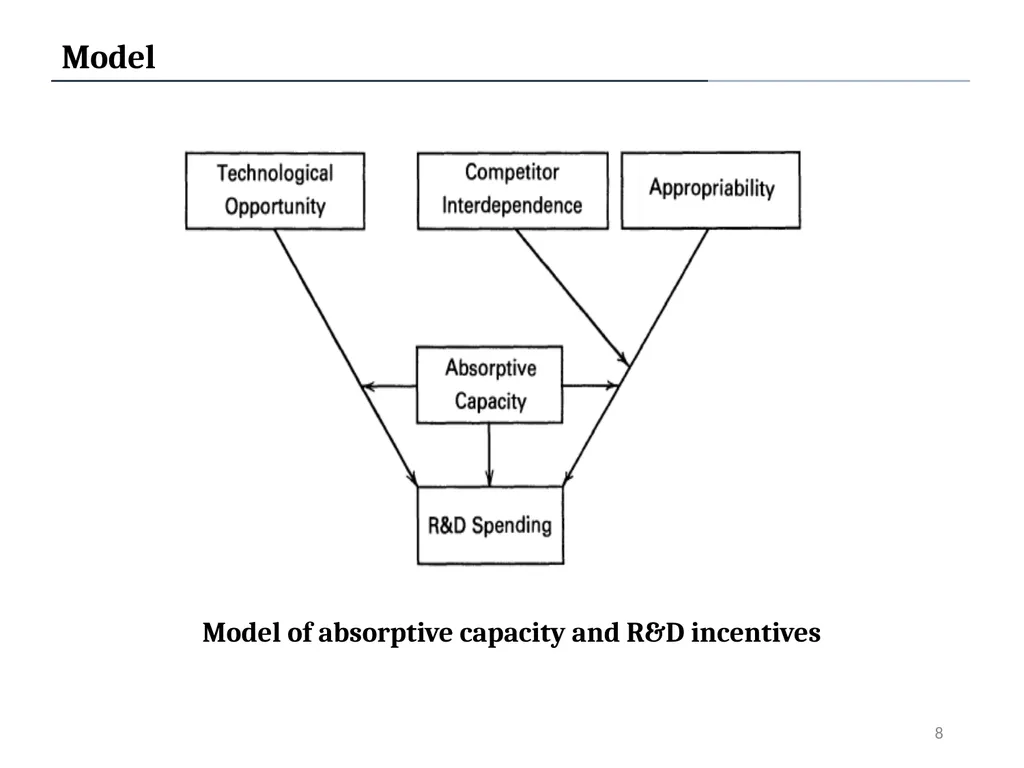
Assumes that R&D contributes to firm’s absorptive capacity. Hence, whatever conditions the firm’s incentives to learn (i.e., to build absorptive capacity) should also influence R&D spending.
Considers the responsiveness of R&D activity to learning incentives as an indication of the empirical importance of absorptive capacity. 7<br>
08
Model 8 Model of absorptive capacity and R&D incentives<br>
09
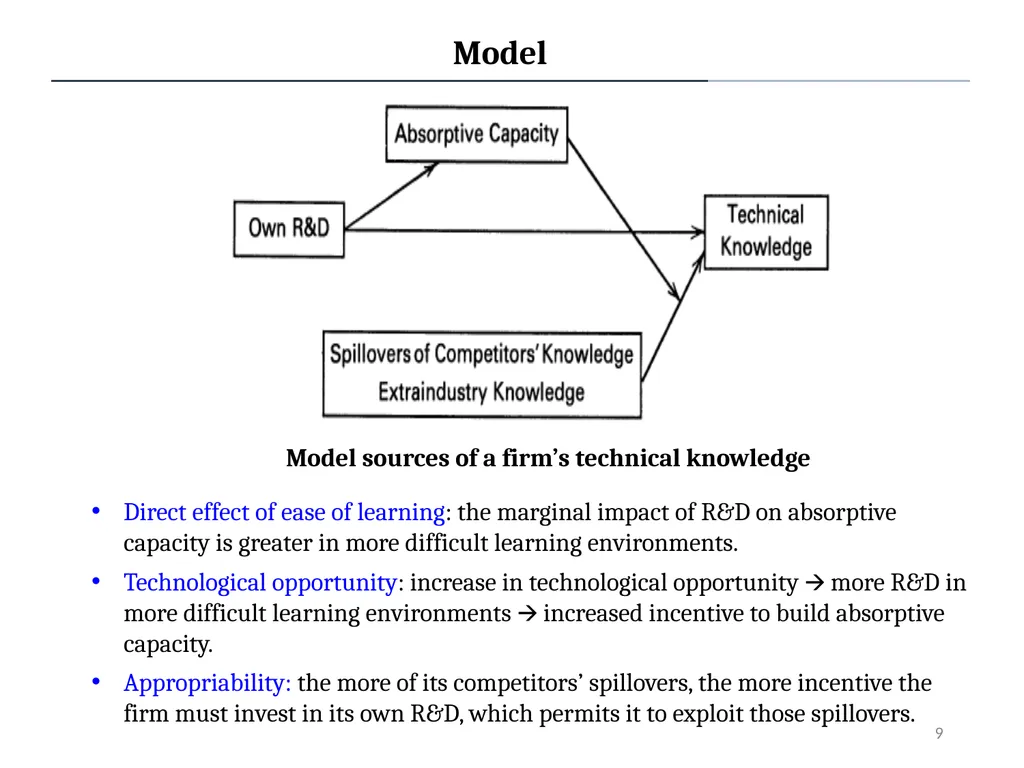
Model 9 Direct effect of ease of learning: the marginal impact of R&D on absorptive capacity is greater in more difficult learning environments.
Technological opportunity: increase in technological opportunity 🡪 more R&D in more difficult learning environments 🡪 increased incentive to build absorptive capacity.
Appropriability: the more of its competitors’ spillovers, the more incentive the firm must invest in its own R&D, which permits it to exploit those spillovers. Model sources of a firm’s technical knowledge<br>
10
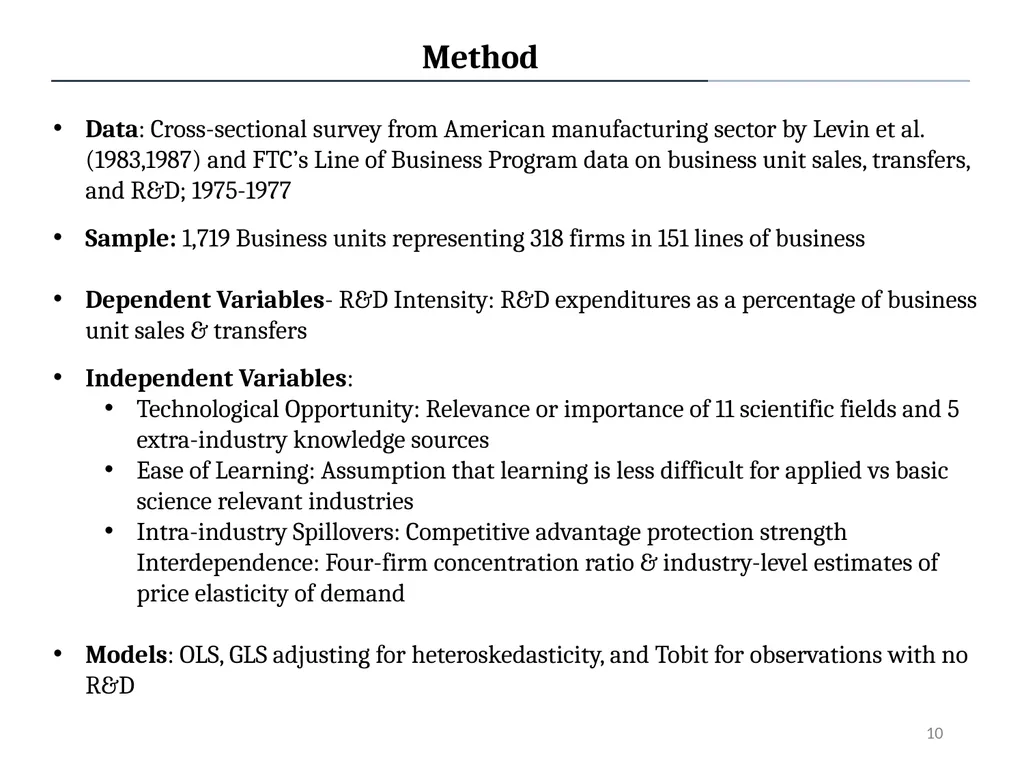
Method 10 Data: Cross-sectional survey from American manufacturing sector by Levin et al. (1983,1987) and FTC’s Line of Business Program data on business unit sales, transfers, and R&D; 1975-1977
Sample: 1,719 Business units representing 318 firms in 151 lines of business
Dependent Variables- R&D Intensity: R&D expenditures as a percentage of business unit sales & transfers
Independent Variables:
Technological Opportunity: Relevance or importance of 11 scientific fields and 5 extra-industry knowledge sources
Ease of Learning: Assumption that learning is less difficult for applied vs basic science relevant industries
Intra-industry Spillovers: Competitive advantage protection strength Interdependence: Four-firm concentration ratio & industry-level estimates of price elasticity of demand
Models: OLS, GLS adjusting for heteroskedasticity, and Tobit for observations with no R&D<br>
11
Results 11<br>
12
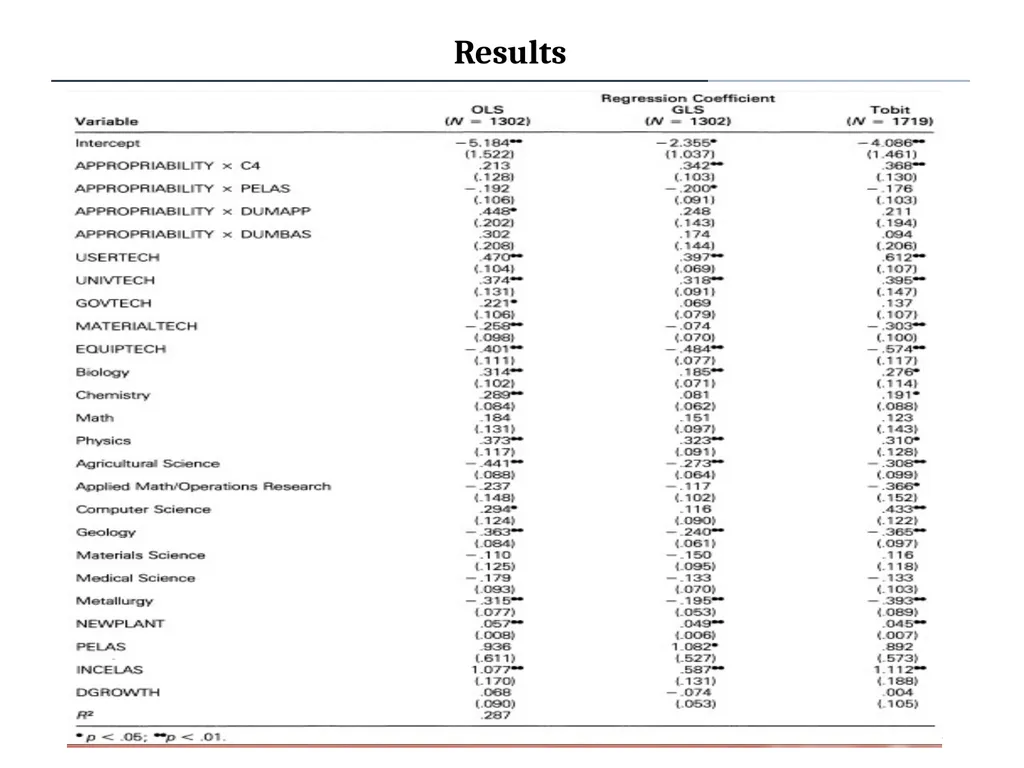
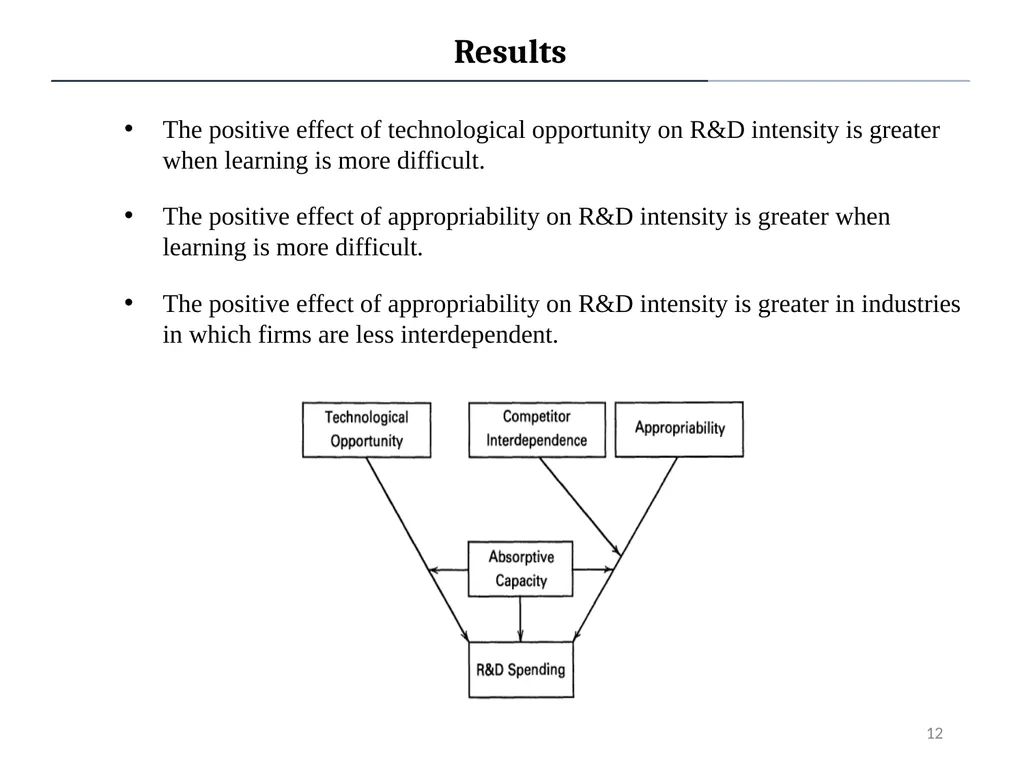
Results 12 The positive effect of technological opportunity on R&D intensity is greater when learning is more difficult.
The positive effect of appropriability on R&D intensity is greater when learning is more difficult.
The positive effect of appropriability on R&D intensity is greater in industries in which firms are less interdependent.<br>
13
Discussion If absorptive capacity and prior knowledge are so tightly tied, would anyone/firm be better off participating in spaces that are related to their previous knowledge?
If prior knowledge is a prerequisite to adapt to technological change (destructive innovation), how can firms without related prior knowledge to the new technology survive such change?
How can relatedness of knowledge be defined and measured? 13<br>