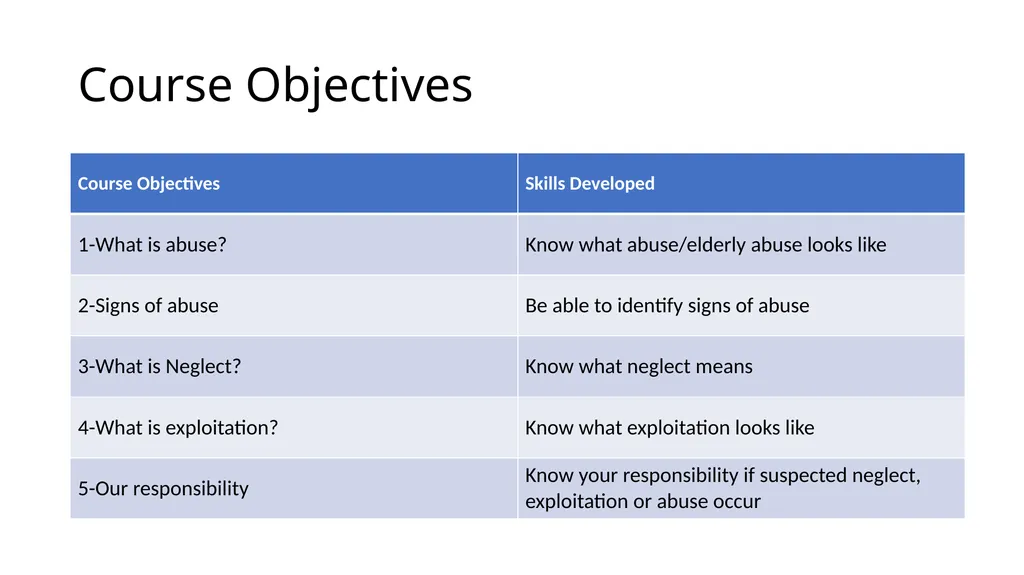
Abuse, Neglect, and Exploitation Helping Restore Ability Course Description In this course we will go over what abuse, neglect, and exploitation look like and how to address these issues Contact Information Required Trainings
"Abuse, Neglect, and Exploitation Helping Restore" is the property of its rightful owner. Permission is granted to
download and print the materials on this website for personal, non-commercial use only, and to display it
on your personal computer provided you do not modify the materials and that you retain all copyright
notices contained in the materials. By downloading content from our website, you accept the terms of this
agreement.
Presentation Transcript
01
Abuse, Neglect, and Exploitation Helping Restore Ability<br>
02
Course Description In this course we will go over what abuse, neglect, and exploitation look like and how to address these issues<br>
03
Contact Information<br>
04
Required Trainings https://learningportal.hhs.texas.gov/course/view.php?id=311
This link is for the Texas health and Human Services Commission online training on abuse neglect and exploitation. This is required of all attendants to complete within 2 weeks of orientation
Send completion of course to supervisor so it can be put in your file. To access online training manually-
https://learningportal.hhs.texas.gov/course/view.php?id=311
Select "Health and Human Services Commission Courses"
Select "ANE Competency Training and Exam (online)"
Register as a user to take the course, "create new account"
You must receive a score of at least 80% for completion of the quiz<br>
Section 1- Abuse Abuse is the physical, sexual verbal or emotional injury to a person or failure to prevent such injury.
Elderly and disabled persons are more vulnerable to become victims of abuse because of their dependence on others for care.
According to the NCEA (National Center on Elderly Abuse), "30% of adults with disabilities, who used ADS for support of activities of daily living, reported one or more types of mistreatment (i.e. physical abuse, verbal abuse, financial abuse) by their primary provider."
It's our job to begin changing this heartbreaking statistic!<br>
08
What makes this abuse so complex? Some diseases and chronic illnesses can mask/mimic the visible signs of abuse
e.g., certain medications, diseases causing easy bruising
No single characteristic identifies an abuser
Abuse is often subtle, especially when it is pre-meditated.
Abuse can also be spontaneous
Often the victims and abusers will attempt to hide the abuse<br>
09
Types of abuse Physical abuse- Non-accidental use of bodily force that results in physical pain, injury, or death
e.g., physical restraining, force-feeding, hitting, shaking, kicking, etc.
Verbal or Emotional abuse- Treatment in a way that causes psychological pain or distress
e.g., intimidation by yelling or threats, withholding attention, isolating client from the outside world, humiliation or ridicule, etc.
Sexual abuse- any sexual contact without consent or sexual activities with someone who is unable to give consent
Abandonment- deserting of a person in a public place or other location with no intention of returning for them or finding alternative care<br>
10
Why does abuse happen? (contributing factors) Mental illness
Drug addiction
Alcoholism
Financial stress
Caregiver stress
Lack of proper caregiver skills/training
Family history of violence
If you ever feel as though the situation is becoming too stressful, contact your supervisor immediately so proper arrangements of care can be made.<br>
11
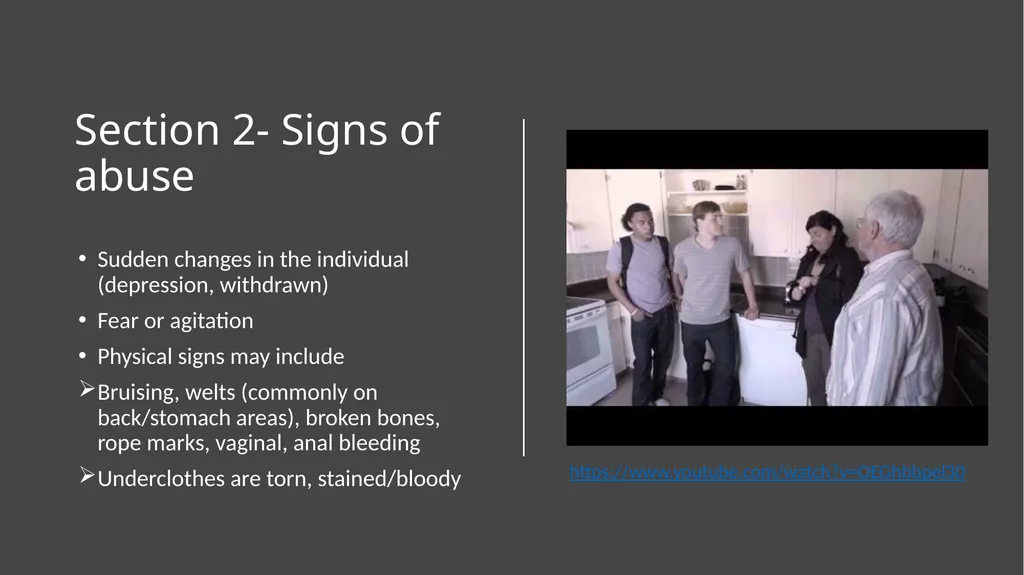
Section 2- Signs of abuse Sudden changes in the individual (depression, withdrawn)
Fear or agitation
Physical signs may include
Bruising, welts (commonly on back/stomach areas), broken bones, rope marks, vaginal, anal bleeding
Underclothes are torn, stained/bloody https://www.youtube.com/watch?v=OEGhbbpel30<br>
12
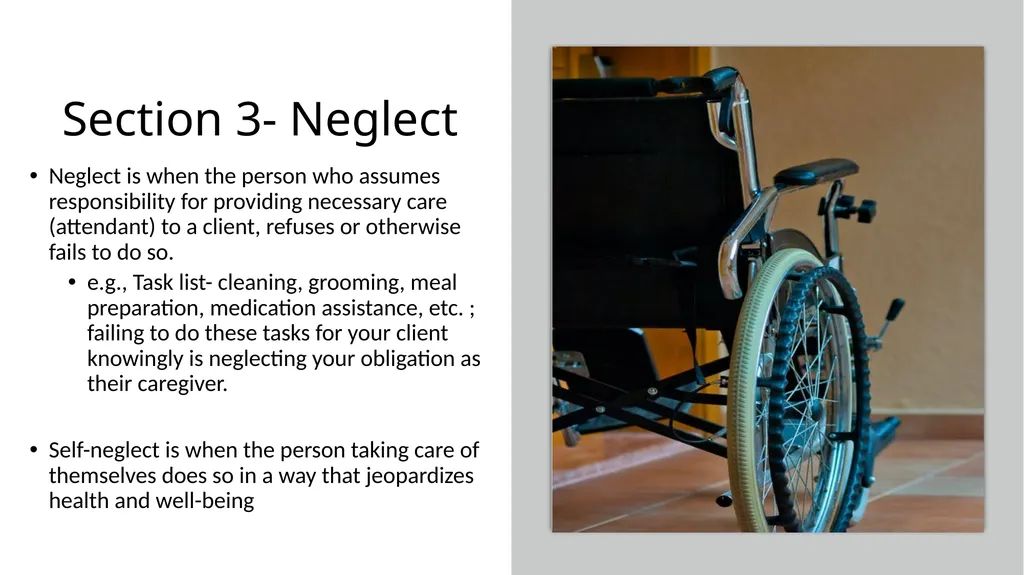
Section 3- Neglect Neglect is when the person who assumes responsibility for providing necessary care (attendant) to a client, refuses or otherwise fails to do so.
e.g., Task list- cleaning, grooming, meal preparation, medication assistance, etc. ; failing to do these tasks for your client knowingly is neglecting your obligation as their caregiver.
Self-neglect is when the person taking care of themselves does so in a way that jeopardizes health and well-being<br>
13
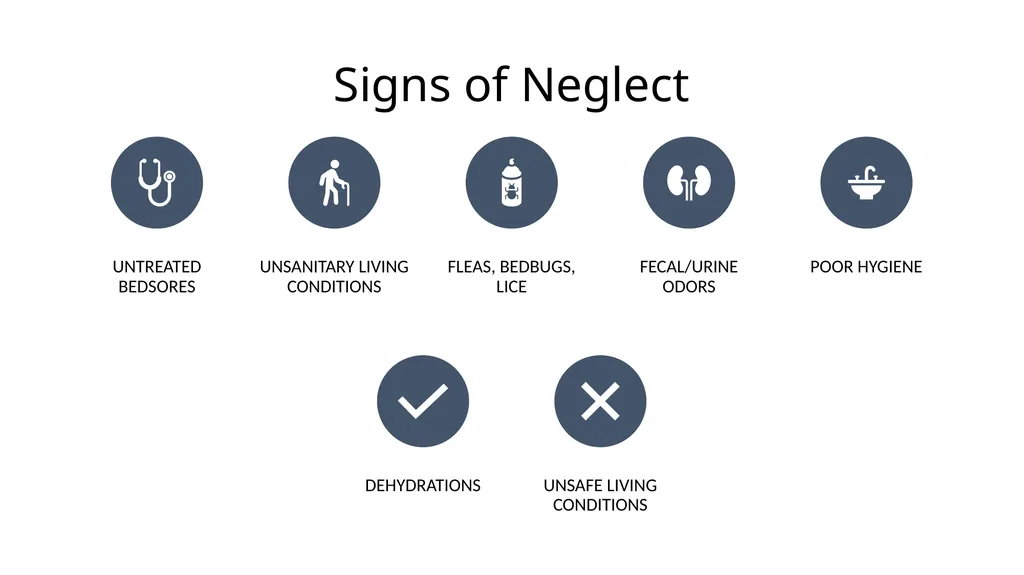
Signs of Neglect<br>
14
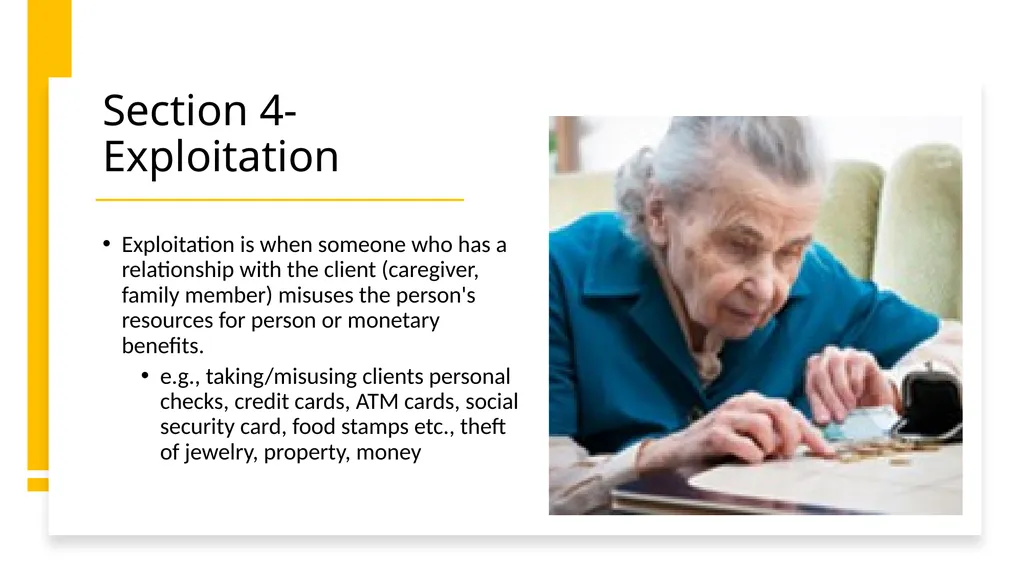
Section 4- Exploitation Exploitation is when someone who has a relationship with the client (caregiver, family member) misuses the person's resources for person or monetary benefits.
e.g., taking/misusing clients personal checks, credit cards, ATM cards, social security card, food stamps etc., theft of jewelry, property, money<br>
15
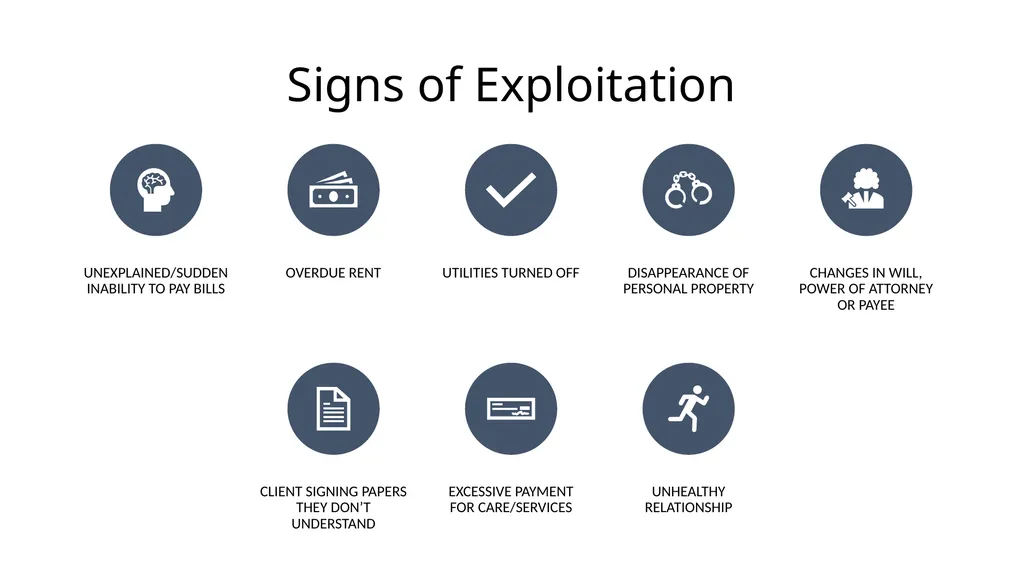
Signs of Exploitation<br>
16
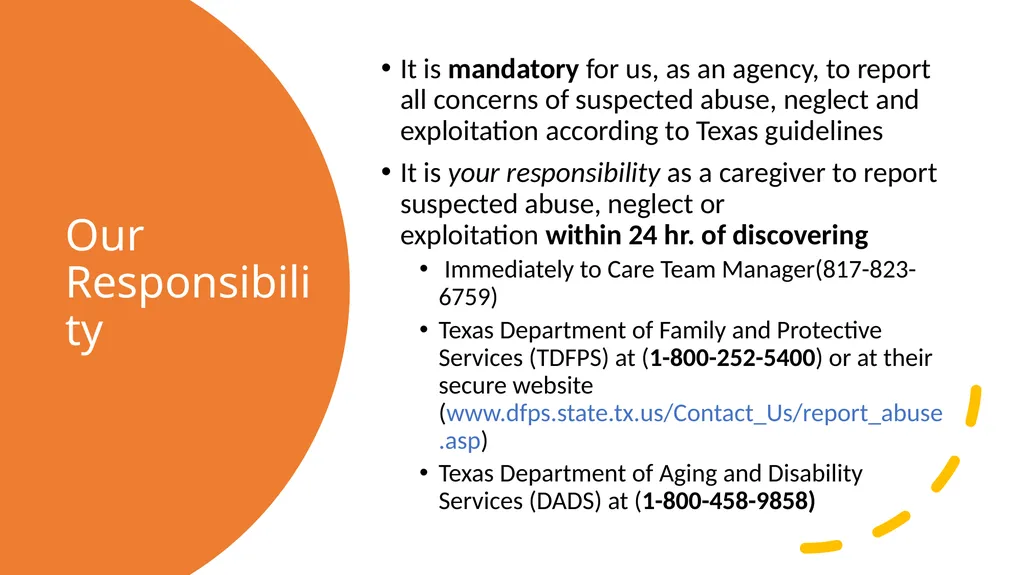
Our Responsibility It is mandatory for us, as an agency, to report all concerns of suspected abuse, neglect and exploitation according to Texas guidelines
It is your responsibility as a caregiver to report suspected abuse, neglect or exploitation within 24 hr. of discovering
Immediately to Care Team Manager(817-823-6759)
Texas Department of Family and Protective Services (TDFPS) at (1-800-252-5400) or at their secure website (www.dfps.state.tx.us/Contact_Us/report_abuse.asp)
Texas Department of Aging and Disability Services (DADS) at (1-800-458-9858)<br>