
Academic English II: The writing process BY:


Description: Academic English II: The writing process BY: DIMUTHU DE SILVA Structure of a piece of writing will have: An introduction A Body A Conclusion Structure What is the purpose of writing an introduction? Choose from the list below: Define terms
Related Topics
Download Presentation
"Academic English II: The writing process BY:" is the property of its rightful owner. Permission is granted to download and print the materials on this website for personal, non-commercial use only, and to display it on your personal computer provided you do not modify the materials and that you retain all copyright notices contained in the materials. By downloading content from our website, you accept the terms of this agreement.
Presentation Transcript
slide1. Academic English II:
The writing process BY: DIMUTHU DE SILVA<br>
slide2. Structure of a piece of writing will have:
An introduction
A Body
A Conclusion Structure<br>
slide3. What is the purpose of writing an introduction? Choose from the list below:
Define terms of the title
Give your opinion of the subject
To show that you have some research of the subject
To show the subject is worth writing about
To explain in a nutshell what the essay/ article/ document deals with
To get the reader’s attention with a provocative idea
To show how you need to organise your thoughts Structure: The Introduction<br>
slide4. Activity:
Read the introduction given below and see if your answers to the previous question match this.
“1.1 Introduction
Modern marketing defines the space between the consumer and the product as a separate and discrete but yet inextricably linked via the common thread of the brand. Against the backdrop of this link, understanding how a brand strategy is built to through brand equity is crucial to retain the consumer, the reputation and finally, the equity itself.
The purpose of this essay is to understand the concept as stated above and use them in the application of providing the context of branding strategy to introduce Starbucks Coffee to Sri Lanka.” Structure: The Introduction<br>
slide5. Remember!
There is no standard introduction structure but rather depends on the nature of the research, the conditions of the situation and style of the writer.
However, any introduction (exam condition or otherwise) should have some of the elements listed below:
Definitions of terms in the title that are unclear
Background information to the topic
Reference to other writers who have discussed the topic before
Your purpose in writing
Any limitations to the topic
Summary of main points Structure: The Introduction<br>
slide6. The main body of academic writing pieces generally follow the structures listed below:
Description/ Development
Kotler et al. (p.263, 2013) defines a brand as the unique space a product or service hold’s in a customer’s heart and mind while branding is how a customer/s own/s this unique space through effective advertising and marketing campaigns.
For and Against
Whether it is on TV, radio or hoardings at the side of the road, advertisements have become a part of our lives, advertising simply a means of informing the public or does it encourage consumers to purchase products they do not really need? Structure: The Body<br>
slide7. Comparison/ Evaluation
It is very difficult to get away from calendar time in literate societies. By contrast many people in oral communities have little idea of the calendar year of their birth.
Homework activity:
Read some essays published online and find examples of the above discussed writing techniques Structure: The Body<br>
slide8. The body generally includes the following sections:
Literature review – summary of main authorities on the topic
Experimental setup – technical descriptions on how the experiments are organised
Methods – how the experiment was carried out
Findings/ Results – results of the experiment conducted
Discussion/ Conclusion – examination of the results and the writer’s verdict
Sometimes there may be a case study that describes the topic being stupid in simple Structure: The Body<br>
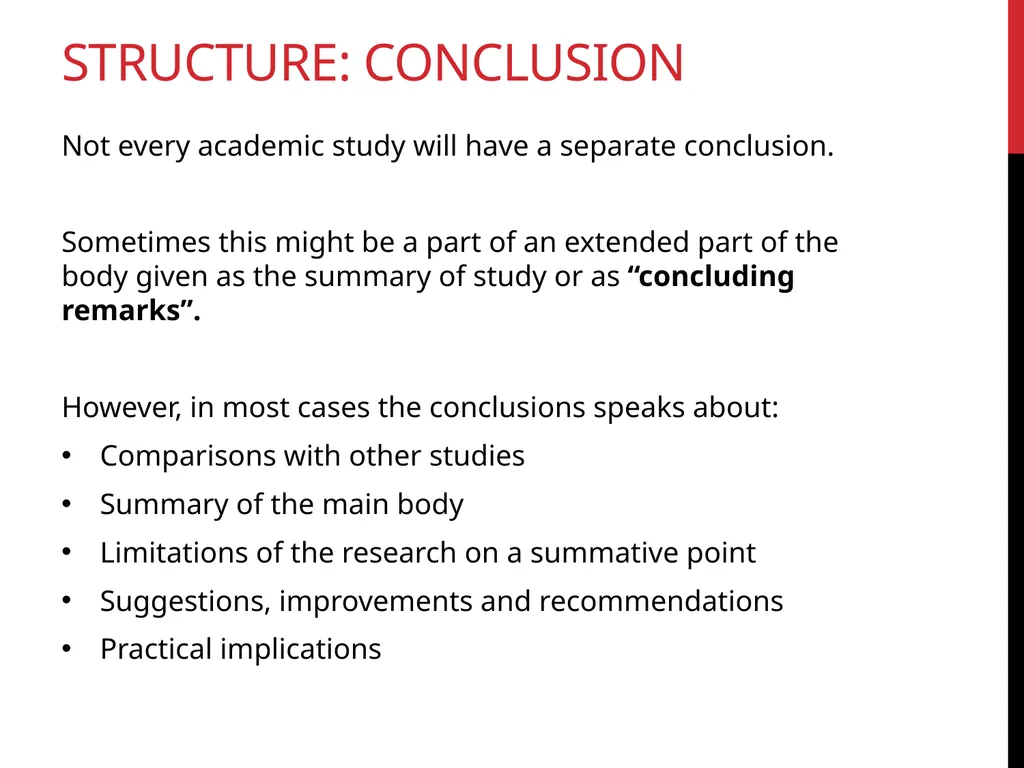
slide9. Not every academic study will have a separate conclusion.
Sometimes this might be a part of an extended part of the body given as the summary of study or as “concluding remarks”.
However, in most cases the conclusions speaks about:
Comparisons with other studies
Summary of the main body
Limitations of the research on a summative point
Suggestions, improvements and recommendations
Practical implications Structure: conclusion<br>
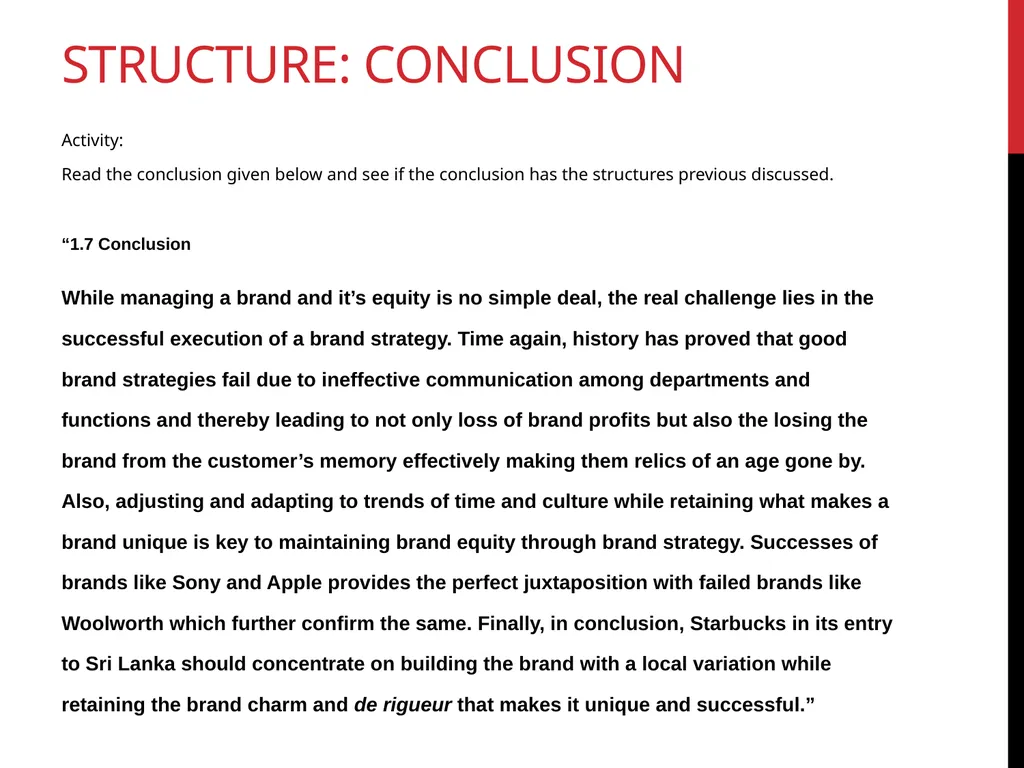
slide10. Activity:
Read the conclusion given below and see if the conclusion has the structures previous discussed.
“1.7 Conclusion
While managing a brand and it’s equity is no simple deal, the real challenge lies in the successful execution of a brand strategy. Time again, history has proved that good brand strategies fail due to ineffective communication among departments and functions and thereby leading to not only loss of brand profits but also the losing the brand from the customer’s memory effectively making them relics of an age gone by. Also, adjusting and adapting to trends of time and culture while retaining what makes a brand unique is key to maintaining brand equity through brand strategy. Successes of brands like Sony and Apple provides the perfect juxtaposition with failed brands like Woolworth which further confirm the same. Finally, in conclusion, Starbucks in its entry to Sri Lanka should concentrate on building the brand with a local variation while retaining the brand charm and de rigueur that makes it unique and successful.” Structure: conclusion<br>
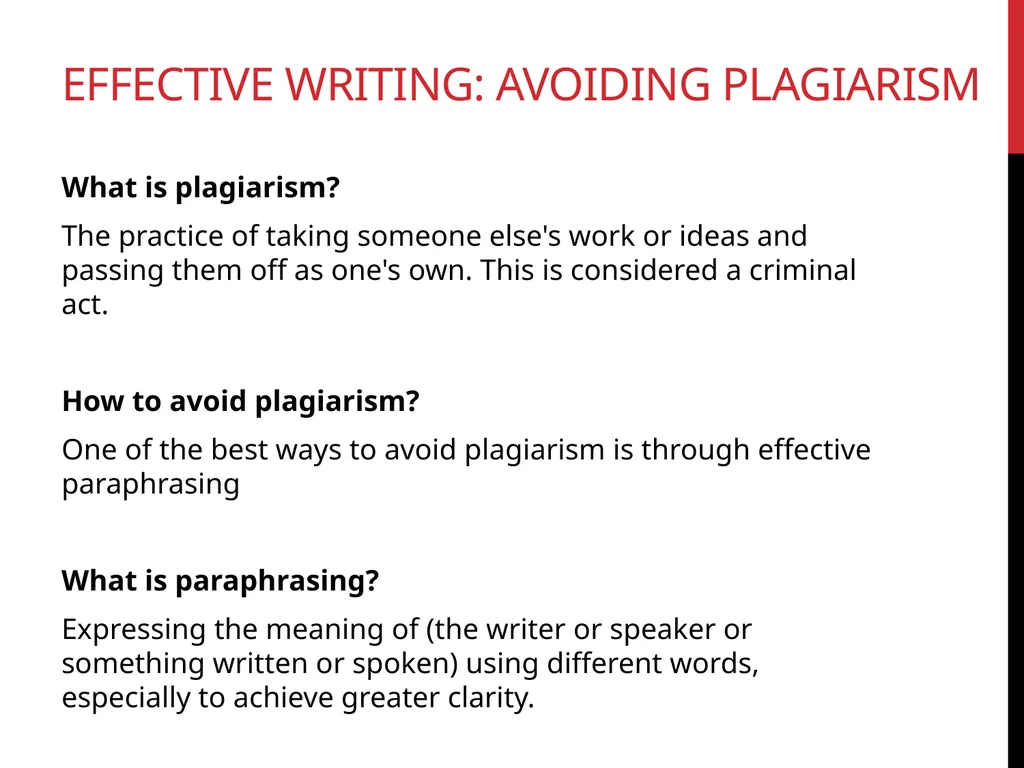
slide11. What is plagiarism?
The practice of taking someone else's work or ideas and passing them off as one's own. This is considered a criminal act.
How to avoid plagiarism?
One of the best ways to avoid plagiarism is through effective paraphrasing
What is paraphrasing?
Expressing the meaning of (the writer or speaker or something written or spoken) using different words, especially to achieve greater clarity. Effective writing: avoiding Plagiarism<br>
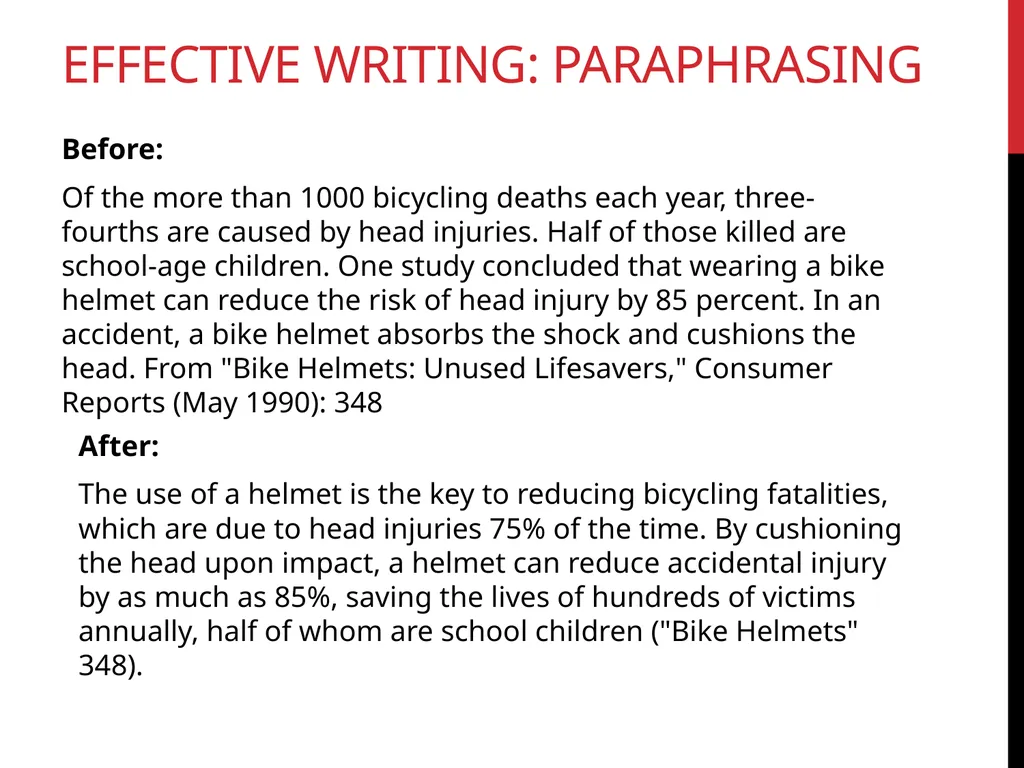
slide12. Before:
Of the more than 1000 bicycling deaths each year, three-fourths are caused by head injuries. Half of those killed are school-age children. One study concluded that wearing a bike helmet can reduce the risk of head injury by 85 percent. In an accident, a bike helmet absorbs the shock and cushions the head. From "Bike Helmets: Unused Lifesavers," Consumer Reports (May 1990): 348 Effective writing: paraphrasing After:
The use of a helmet is the key to reducing bicycling fatalities, which are due to head injuries 75% of the time. By cushioning the head upon impact, a helmet can reduce accidental injury by as much as 85%, saving the lives of hundreds of victims annually, half of whom are school children ("Bike Helmets" 348).<br>
slide13. "The Antarctic is the vast source of cold on our planet, just as the sun is the source of our heat, and it exerts tremendous control on our climate," [Jacques] Cousteau told the camera. "The cold ocean water around Antarctica flows north to mix with warmer water from the tropics, and its upwellings help to cool both the surface water and our atmosphere. Yet the fragility of this regulating system is now threatened by human activity." From "Captain Cousteau," Audubon (May 1990):17.
2. The twenties were the years when drinking was against the law, and the law was a bad joke because everyone knew of a local bar where liquor could be had. They were the years when organized crime ruled the cities, and the police seemed powerless to do anything against it. Classical music was forgotten while jazz spread throughout the land, and men like Bix Beiderbecke, Louis Armstrong, and Count Basie became the heroes of the young. The flapper was born in the twenties, and with her bobbed hair and short skirts, she symbolized, perhaps more than anyone or anything else, America's break with the past. From Kathleen Yancey, English 102 Supplemental Guide (1989): 25. Activity: paraphrasing<br>
slide14. What is referencing?
Academic writing relies on more than just the ideas and experience of one author. Referencing is used to tell the reader where ideas from other sources have been used in an assignment. There are many reasons why it is important to reference sources correctly:
It shows the reader that you can find and use sources to create a solid argument. It properly credits the originators of ideas, theories, and research findings
It shows the reader how your argument relates to the big picture and to how to avoid plagiarism
NEVILLE, C. (2010). The Complete Guide to Referencing and Avoiding Plagiarism.2ND edition. Open UP Study Skills. Maidenhead: Open University Press. Effective writing: referencing<br>
slide15. What needs to be referenced?
Whenever an assignment uses words, facts, ideas, theories, or interpretations from other sources, that source must be referenced. Referencing is needed when:
You have copied words from a book, article, or other source exactly.
You have used an idea or fact from an outside source, even if you haven't used their exact wording.
The common referencing styles include:
Harvard
Oxford
APA
Chicago Effective writing: referencing<br>
slide16. • Proofreading helps you to check that you have included everything you wanted to say in any piece of writing • It gives you a chance to review your work and add in anything you may have missed out
• It helps you iron out any little, unnecessary errors you may have made • Proofreading shows that you take pride in your work and that it is the best you can make it • It can help you gain extra marks in your exams and could even make the difference between an entire grade! Effective writing: Proofreading<br>
slide2. Structure of a piece of writing will have:
An introduction
A Body
A Conclusion Structure<br>
slide3. What is the purpose of writing an introduction? Choose from the list below:
Define terms of the title
Give your opinion of the subject
To show that you have some research of the subject
To show the subject is worth writing about
To explain in a nutshell what the essay/ article/ document deals with
To get the reader’s attention with a provocative idea
To show how you need to organise your thoughts Structure: The Introduction<br>
slide4. Activity:
Read the introduction given below and see if your answers to the previous question match this.
“1.1 Introduction
Modern marketing defines the space between the consumer and the product as a separate and discrete but yet inextricably linked via the common thread of the brand. Against the backdrop of this link, understanding how a brand strategy is built to through brand equity is crucial to retain the consumer, the reputation and finally, the equity itself.
The purpose of this essay is to understand the concept as stated above and use them in the application of providing the context of branding strategy to introduce Starbucks Coffee to Sri Lanka.” Structure: The Introduction<br>
slide5. Remember!
There is no standard introduction structure but rather depends on the nature of the research, the conditions of the situation and style of the writer.
However, any introduction (exam condition or otherwise) should have some of the elements listed below:
Definitions of terms in the title that are unclear
Background information to the topic
Reference to other writers who have discussed the topic before
Your purpose in writing
Any limitations to the topic
Summary of main points Structure: The Introduction<br>
slide6. The main body of academic writing pieces generally follow the structures listed below:
Description/ Development
Kotler et al. (p.263, 2013) defines a brand as the unique space a product or service hold’s in a customer’s heart and mind while branding is how a customer/s own/s this unique space through effective advertising and marketing campaigns.
For and Against
Whether it is on TV, radio or hoardings at the side of the road, advertisements have become a part of our lives, advertising simply a means of informing the public or does it encourage consumers to purchase products they do not really need? Structure: The Body<br>
slide7. Comparison/ Evaluation
It is very difficult to get away from calendar time in literate societies. By contrast many people in oral communities have little idea of the calendar year of their birth.
Homework activity:
Read some essays published online and find examples of the above discussed writing techniques Structure: The Body<br>
slide8. The body generally includes the following sections:
Literature review – summary of main authorities on the topic
Experimental setup – technical descriptions on how the experiments are organised
Methods – how the experiment was carried out
Findings/ Results – results of the experiment conducted
Discussion/ Conclusion – examination of the results and the writer’s verdict
Sometimes there may be a case study that describes the topic being stupid in simple Structure: The Body<br>
slide9. Not every academic study will have a separate conclusion.
Sometimes this might be a part of an extended part of the body given as the summary of study or as “concluding remarks”.
However, in most cases the conclusions speaks about:
Comparisons with other studies
Summary of the main body
Limitations of the research on a summative point
Suggestions, improvements and recommendations
Practical implications Structure: conclusion<br>
slide10. Activity:
Read the conclusion given below and see if the conclusion has the structures previous discussed.
“1.7 Conclusion
While managing a brand and it’s equity is no simple deal, the real challenge lies in the successful execution of a brand strategy. Time again, history has proved that good brand strategies fail due to ineffective communication among departments and functions and thereby leading to not only loss of brand profits but also the losing the brand from the customer’s memory effectively making them relics of an age gone by. Also, adjusting and adapting to trends of time and culture while retaining what makes a brand unique is key to maintaining brand equity through brand strategy. Successes of brands like Sony and Apple provides the perfect juxtaposition with failed brands like Woolworth which further confirm the same. Finally, in conclusion, Starbucks in its entry to Sri Lanka should concentrate on building the brand with a local variation while retaining the brand charm and de rigueur that makes it unique and successful.” Structure: conclusion<br>
slide11. What is plagiarism?
The practice of taking someone else's work or ideas and passing them off as one's own. This is considered a criminal act.
How to avoid plagiarism?
One of the best ways to avoid plagiarism is through effective paraphrasing
What is paraphrasing?
Expressing the meaning of (the writer or speaker or something written or spoken) using different words, especially to achieve greater clarity. Effective writing: avoiding Plagiarism<br>
slide12. Before:
Of the more than 1000 bicycling deaths each year, three-fourths are caused by head injuries. Half of those killed are school-age children. One study concluded that wearing a bike helmet can reduce the risk of head injury by 85 percent. In an accident, a bike helmet absorbs the shock and cushions the head. From "Bike Helmets: Unused Lifesavers," Consumer Reports (May 1990): 348 Effective writing: paraphrasing After:
The use of a helmet is the key to reducing bicycling fatalities, which are due to head injuries 75% of the time. By cushioning the head upon impact, a helmet can reduce accidental injury by as much as 85%, saving the lives of hundreds of victims annually, half of whom are school children ("Bike Helmets" 348).<br>
slide13. "The Antarctic is the vast source of cold on our planet, just as the sun is the source of our heat, and it exerts tremendous control on our climate," [Jacques] Cousteau told the camera. "The cold ocean water around Antarctica flows north to mix with warmer water from the tropics, and its upwellings help to cool both the surface water and our atmosphere. Yet the fragility of this regulating system is now threatened by human activity." From "Captain Cousteau," Audubon (May 1990):17.
2. The twenties were the years when drinking was against the law, and the law was a bad joke because everyone knew of a local bar where liquor could be had. They were the years when organized crime ruled the cities, and the police seemed powerless to do anything against it. Classical music was forgotten while jazz spread throughout the land, and men like Bix Beiderbecke, Louis Armstrong, and Count Basie became the heroes of the young. The flapper was born in the twenties, and with her bobbed hair and short skirts, she symbolized, perhaps more than anyone or anything else, America's break with the past. From Kathleen Yancey, English 102 Supplemental Guide (1989): 25. Activity: paraphrasing<br>
slide14. What is referencing?
Academic writing relies on more than just the ideas and experience of one author. Referencing is used to tell the reader where ideas from other sources have been used in an assignment. There are many reasons why it is important to reference sources correctly:
It shows the reader that you can find and use sources to create a solid argument. It properly credits the originators of ideas, theories, and research findings
It shows the reader how your argument relates to the big picture and to how to avoid plagiarism
NEVILLE, C. (2010). The Complete Guide to Referencing and Avoiding Plagiarism.2ND edition. Open UP Study Skills. Maidenhead: Open University Press. Effective writing: referencing<br>
slide15. What needs to be referenced?
Whenever an assignment uses words, facts, ideas, theories, or interpretations from other sources, that source must be referenced. Referencing is needed when:
You have copied words from a book, article, or other source exactly.
You have used an idea or fact from an outside source, even if you haven't used their exact wording.
The common referencing styles include:
Harvard
Oxford
APA
Chicago Effective writing: referencing<br>
slide16. • Proofreading helps you to check that you have included everything you wanted to say in any piece of writing • It gives you a chance to review your work and add in anything you may have missed out
• It helps you iron out any little, unnecessary errors you may have made • Proofreading shows that you take pride in your work and that it is the best you can make it • It can help you gain extra marks in your exams and could even make the difference between an entire grade! Effective writing: Proofreading<br>