
Academic Freedom: an overview USC Faculty Senate
TF
Published · 16 slides · 0 views

1 / 1


Description
Academic Freedom: an overview USC Faculty Senate Meeting December 3, 2025 Professor Scott R. Bauries University of South Carolina Joseph F. Rice School of Law Traditional Academic Freedom German Universities: Lehrfreiheit (freedom to
Related Topics
Share
Embed code
Download this presentation From Below
"Academic Freedom: an overview USC Faculty Senate" is the property of its rightful owner. Permission is granted to download and print the materials on this website for personal, non-commercial use only, and to display it on your personal computer provided you do not modify the materials and that you retain all copyright notices contained in the materials. By downloading content from our website, you accept the terms of this agreement.
Presentation Transcript
01
Academic Freedom:
an overview USC Faculty Senate Meeting December 3, 2025 Professor Scott R. Bauries
University of South Carolina
Joseph F. Rice School of Law<br>
University of South Carolina
Joseph F. Rice School of Law<br>
02
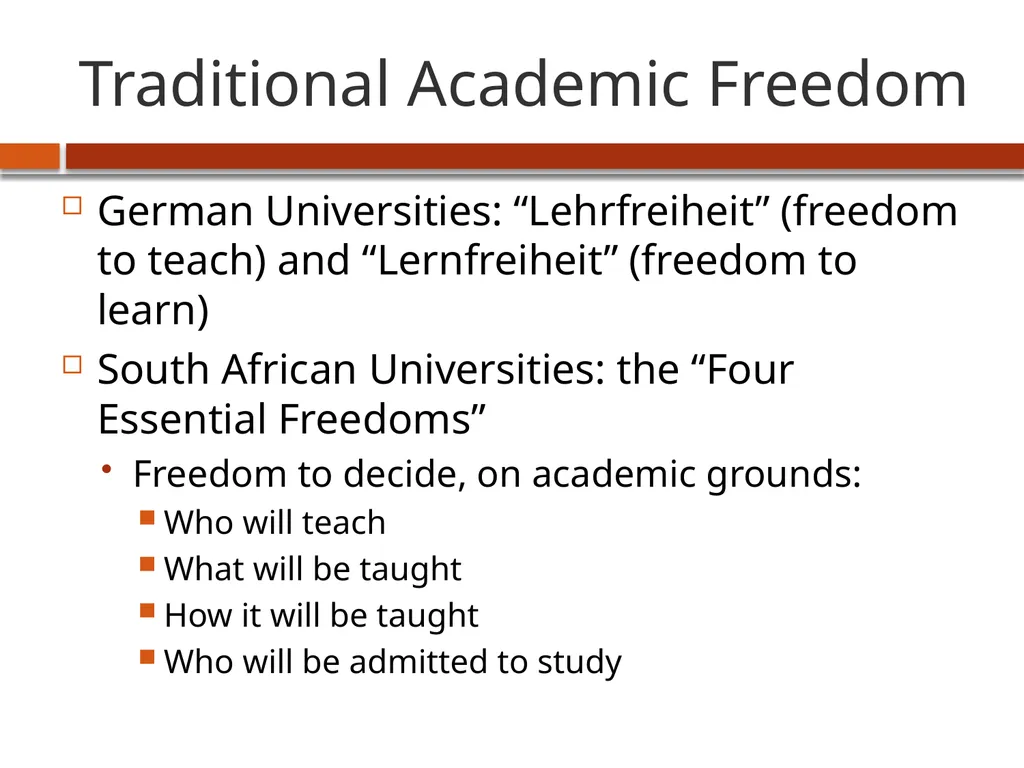
Traditional Academic Freedom German Universities: “Lehrfreiheit” (freedom to teach) and “Lernfreiheit” (freedom to learn)
South African Universities: the “Four Essential Freedoms”
Freedom to decide, on academic grounds:
Who will teach
What will be taught
How it will be taught
Who will be admitted to study<br>
South African Universities: the “Four Essential Freedoms”
Freedom to decide, on academic grounds:
Who will teach
What will be taught
How it will be taught
Who will be admitted to study<br>
03
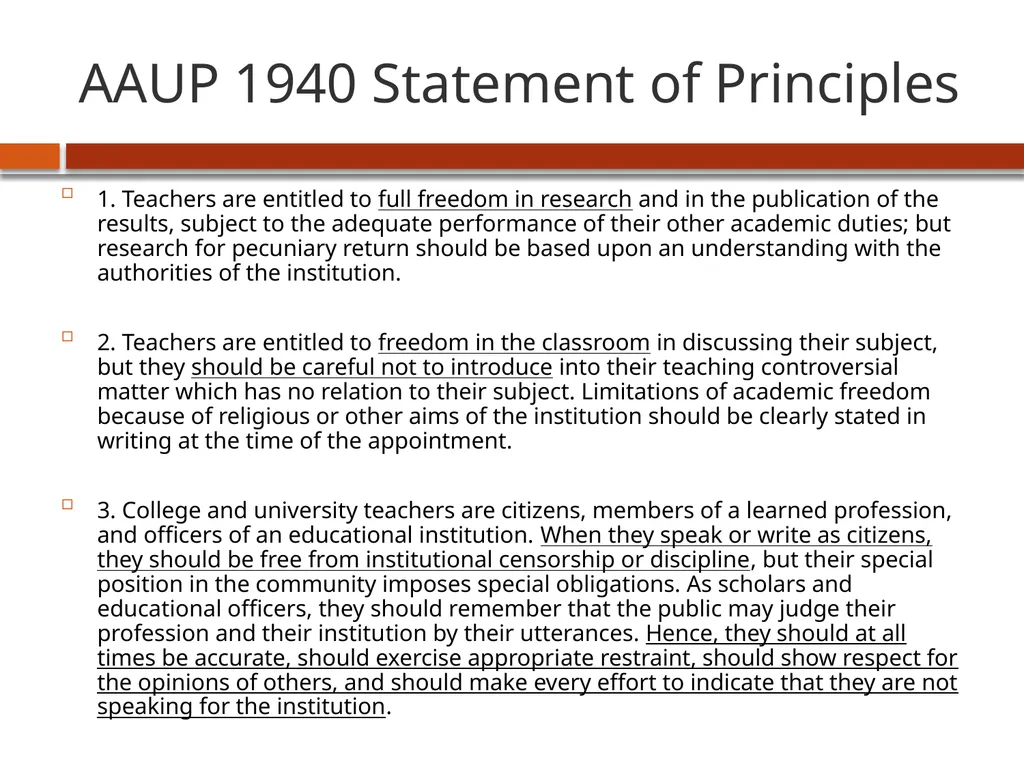
AAUP 1940 Statement of Principles 1. Teachers are entitled to full freedom in research and in the publication of the results, subject to the adequate performance of their other academic duties; but research for pecuniary return should be based upon an understanding with the authorities of the institution.
2. Teachers are entitled to freedom in the classroom in discussing their subject, but they should be careful not to introduce into their teaching controversial matter which has no relation to their subject. Limitations of academic freedom because of religious or other aims of the institution should be clearly stated in writing at the time of the appointment.
3. College and university teachers are citizens, members of a learned profession, and officers of an educational institution. When they speak or write as citizens, they should be free from institutional censorship or discipline, but their special position in the community imposes special obligations. As scholars and educational officers, they should remember that the public may judge their profession and their institution by their utterances. Hence, they should at all times be accurate, should exercise appropriate restraint, should show respect for the opinions of others, and should make every effort to indicate that they are not speaking for the institution.<br>
2. Teachers are entitled to freedom in the classroom in discussing their subject, but they should be careful not to introduce into their teaching controversial matter which has no relation to their subject. Limitations of academic freedom because of religious or other aims of the institution should be clearly stated in writing at the time of the appointment.
3. College and university teachers are citizens, members of a learned profession, and officers of an educational institution. When they speak or write as citizens, they should be free from institutional censorship or discipline, but their special position in the community imposes special obligations. As scholars and educational officers, they should remember that the public may judge their profession and their institution by their utterances. Hence, they should at all times be accurate, should exercise appropriate restraint, should show respect for the opinions of others, and should make every effort to indicate that they are not speaking for the institution.<br>
04
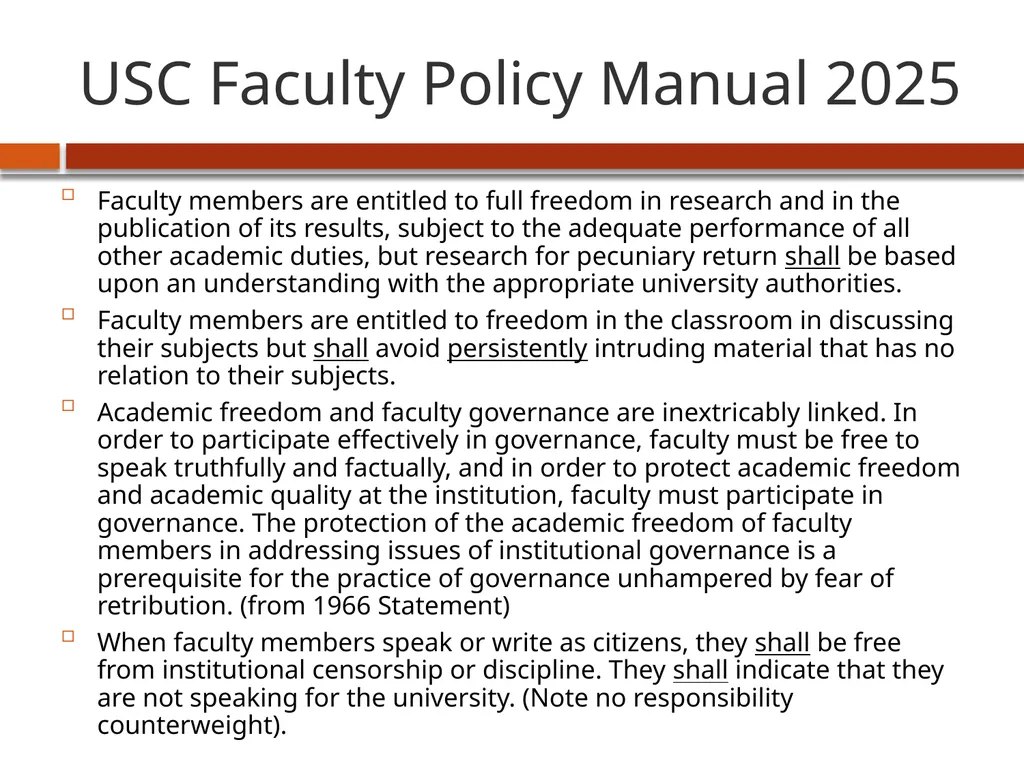
USC Faculty Policy Manual 2025 Faculty members are entitled to full freedom in research and in the publication of its results, subject to the adequate performance of all other academic duties, but research for pecuniary return shall be based upon an understanding with the appropriate university authorities.
Faculty members are entitled to freedom in the classroom in discussing their subjects but shall avoid persistently intruding material that has no relation to their subjects.
Academic freedom and faculty governance are inextricably linked. In order to participate effectively in governance, faculty must be free to speak truthfully and factually, and in order to protect academic freedom and academic quality at the institution, faculty must participate in governance. The protection of the academic freedom of faculty members in addressing issues of institutional governance is a prerequisite for the practice of governance unhampered by fear of retribution. (from 1966 Statement)
When faculty members speak or write as citizens, they shall be free from institutional censorship or discipline. They shall indicate that they are not speaking for the university. (Note no responsibility counterweight).<br>
Faculty members are entitled to freedom in the classroom in discussing their subjects but shall avoid persistently intruding material that has no relation to their subjects.
Academic freedom and faculty governance are inextricably linked. In order to participate effectively in governance, faculty must be free to speak truthfully and factually, and in order to protect academic freedom and academic quality at the institution, faculty must participate in governance. The protection of the academic freedom of faculty members in addressing issues of institutional governance is a prerequisite for the practice of governance unhampered by fear of retribution. (from 1966 Statement)
When faculty members speak or write as citizens, they shall be free from institutional censorship or discipline. They shall indicate that they are not speaking for the university. (Note no responsibility counterweight).<br>
05
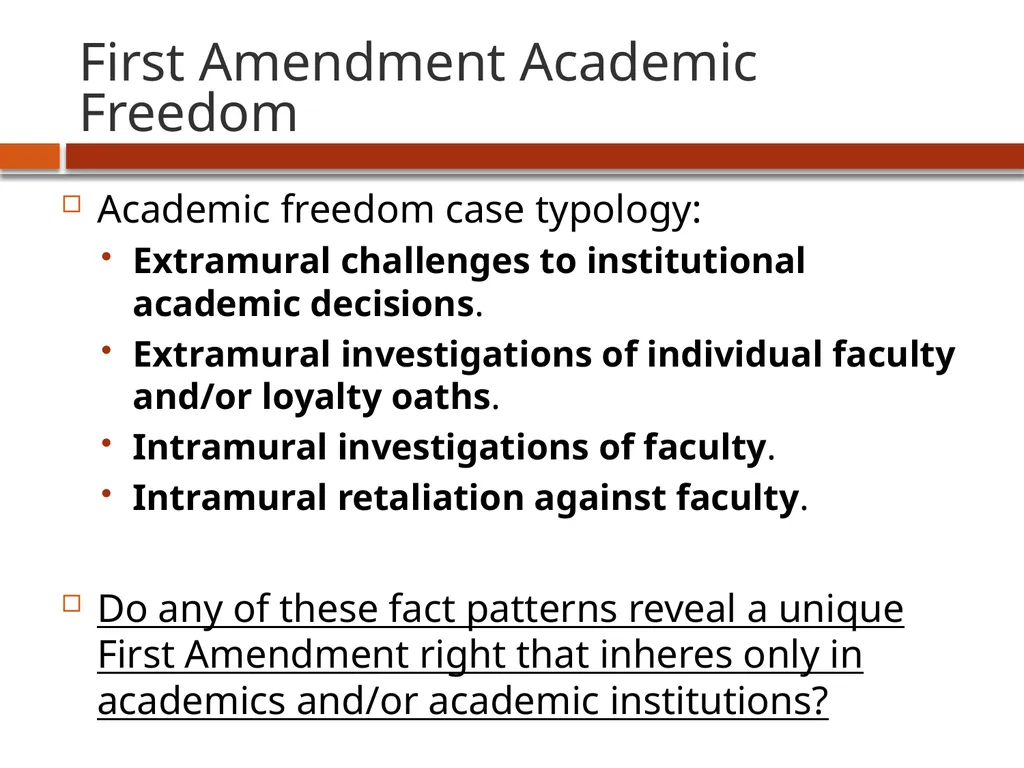
First Amendment Academic Freedom Academic freedom case typology:
Extramural challenges to institutional academic decisions.
Extramural investigations of individual faculty and/or loyalty oaths.
Intramural investigations of faculty.
Intramural retaliation against faculty.
Do any of these fact patterns reveal a unique First Amendment right that inheres only in academics and/or academic institutions?<br>
Extramural challenges to institutional academic decisions.
Extramural investigations of individual faculty and/or loyalty oaths.
Intramural investigations of faculty.
Intramural retaliation against faculty.
Do any of these fact patterns reveal a unique First Amendment right that inheres only in academics and/or academic institutions?<br>
06
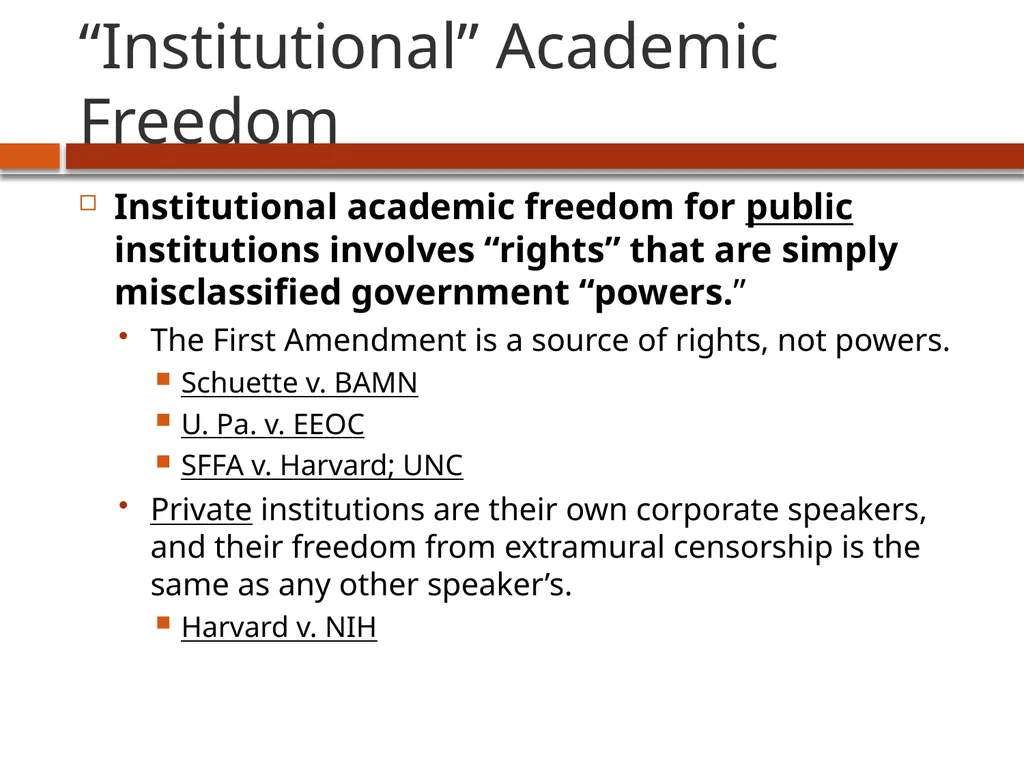
“Institutional” Academic Freedom Institutional academic freedom for public institutions involves “rights” that are simply misclassified government “powers.”
The First Amendment is a source of rights, not powers.
Schuette v. BAMN
U. Pa. v. EEOC
SFFA v. Harvard; UNC
Private institutions are their own corporate speakers, and their freedom from extramural censorship is the same as any other speaker’s.
Harvard v. NIH<br>
The First Amendment is a source of rights, not powers.
Schuette v. BAMN
U. Pa. v. EEOC
SFFA v. Harvard; UNC
Private institutions are their own corporate speakers, and their freedom from extramural censorship is the same as any other speaker’s.
Harvard v. NIH<br>
07
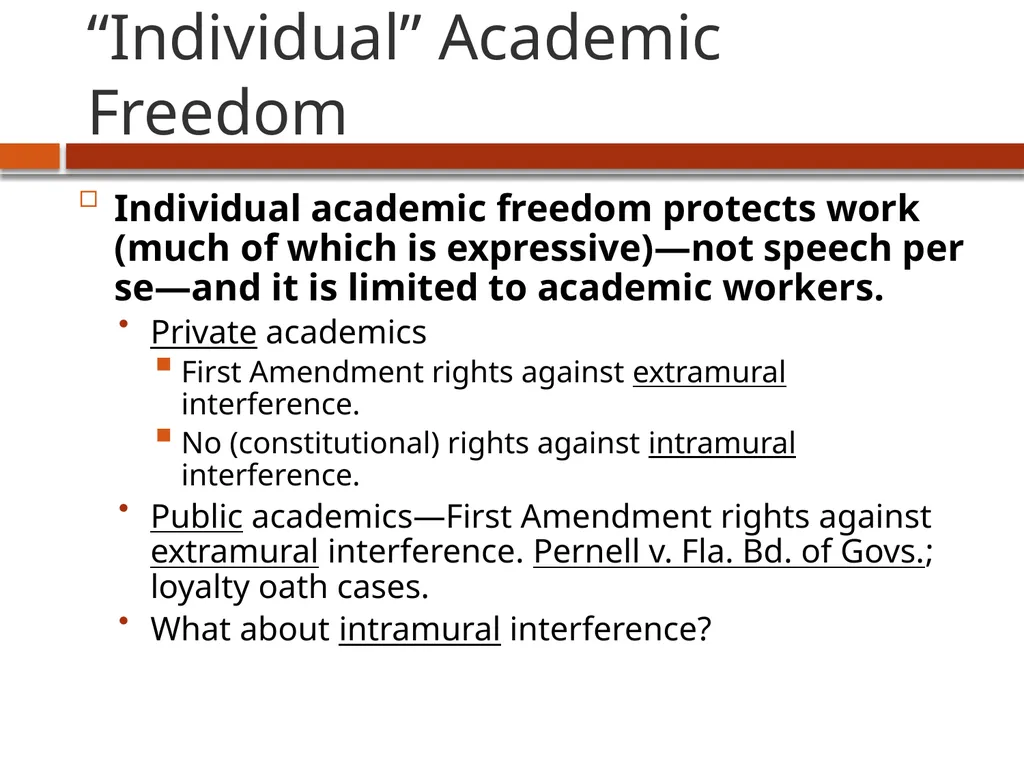
“Individual” Academic Freedom Individual academic freedom protects work (much of which is expressive)—not speech per se—and it is limited to academic workers.
Private academics
First Amendment rights against extramural interference.
No (constitutional) rights against intramural interference.
Public academics—First Amendment rights against extramural interference. Pernell v. Fla. Bd. of Govs.; loyalty oath cases.
What about intramural interference?<br>
Private academics
First Amendment rights against extramural interference.
No (constitutional) rights against intramural interference.
Public academics—First Amendment rights against extramural interference. Pernell v. Fla. Bd. of Govs.; loyalty oath cases.
What about intramural interference?<br>
08
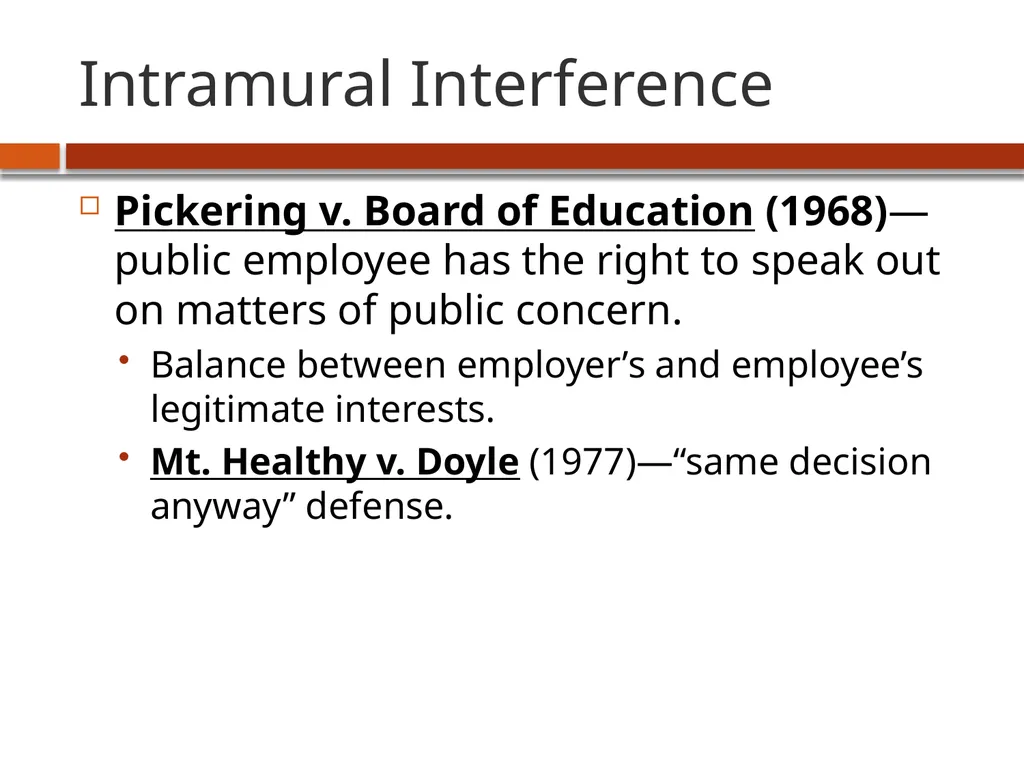
Intramural Interference Pickering v. Board of Education (1968)—public employee has the right to speak out on matters of public concern.
Balance between employer’s and employee’s legitimate interests.
Mt. Healthy v. Doyle (1977)—“same decision anyway” defense.<br>
Balance between employer’s and employee’s legitimate interests.
Mt. Healthy v. Doyle (1977)—“same decision anyway” defense.<br>
09
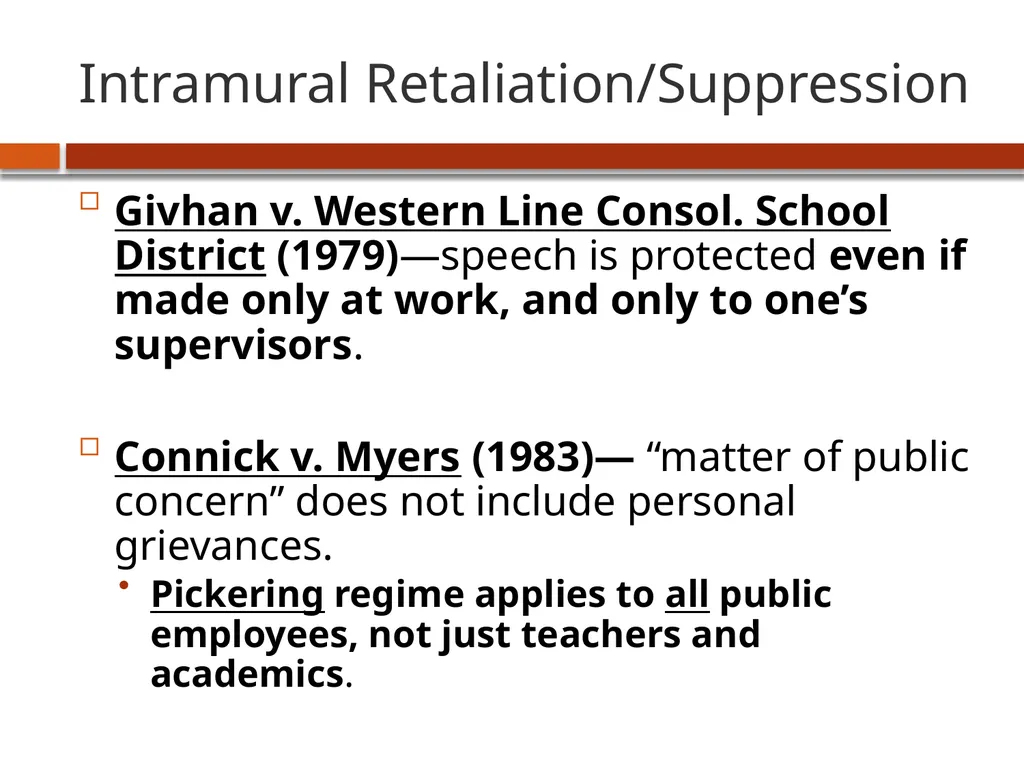
Intramural Retaliation/Suppression Givhan v. Western Line Consol. School District (1979)—speech is protected even if made only at work, and only to one’s supervisors.
Connick v. Myers (1983)— “matter of public concern” does not include personal grievances.
Pickering regime applies to all public employees, not just teachers and academics.<br>
Connick v. Myers (1983)— “matter of public concern” does not include personal grievances.
Pickering regime applies to all public employees, not just teachers and academics.<br>
10
Garcetti v. Ceballos, 547 U.S. 410 (2006). A “calendar deputy” advocated by memo for disclosure of exculpatory evidence to the defense and was allegedly retaliated against for the memo.
“We hold that, when public employees speak pursuant to their official duties, the First Amendment does not insulate their communications from employer discipline.”
Where speech is made pursuant to an official job duty, the government employer’s managerial interest is considered ex ante to be compelling enough to override the employee’s speech interest in every case.<br>
“We hold that, when public employees speak pursuant to their official duties, the First Amendment does not insulate their communications from employer discipline.”
Where speech is made pursuant to an official job duty, the government employer’s managerial interest is considered ex ante to be compelling enough to override the employee’s speech interest in every case.<br>
11
The “Garcetti paradox”—Byrne Academic freedom protects teaching and scholarship, but the First Amendment does not protect speech made “pursuant to one’s official duties.”
This results in a total lack of protection for academic teaching, scholarship, and governance, which is always “speech made pursuant to official duties.”
The paradox: according to the Supreme Court, academic speech is among the highest value speech there is—essential to a functioning democracy.
But according to Garcetti, it enjoys the same First Amendment protection as child pornography, probably the lowest value speech there is (i.e., none).<br>
This results in a total lack of protection for academic teaching, scholarship, and governance, which is always “speech made pursuant to official duties.”
The paradox: according to the Supreme Court, academic speech is among the highest value speech there is—essential to a functioning democracy.
But according to Garcetti, it enjoys the same First Amendment protection as child pornography, probably the lowest value speech there is (i.e., none).<br>
12
Where to Turn? Collective bargaining agreements (where available)
State constitutions?
University policy
Remember . . .<br>
State constitutions?
University policy
Remember . . .<br>
13
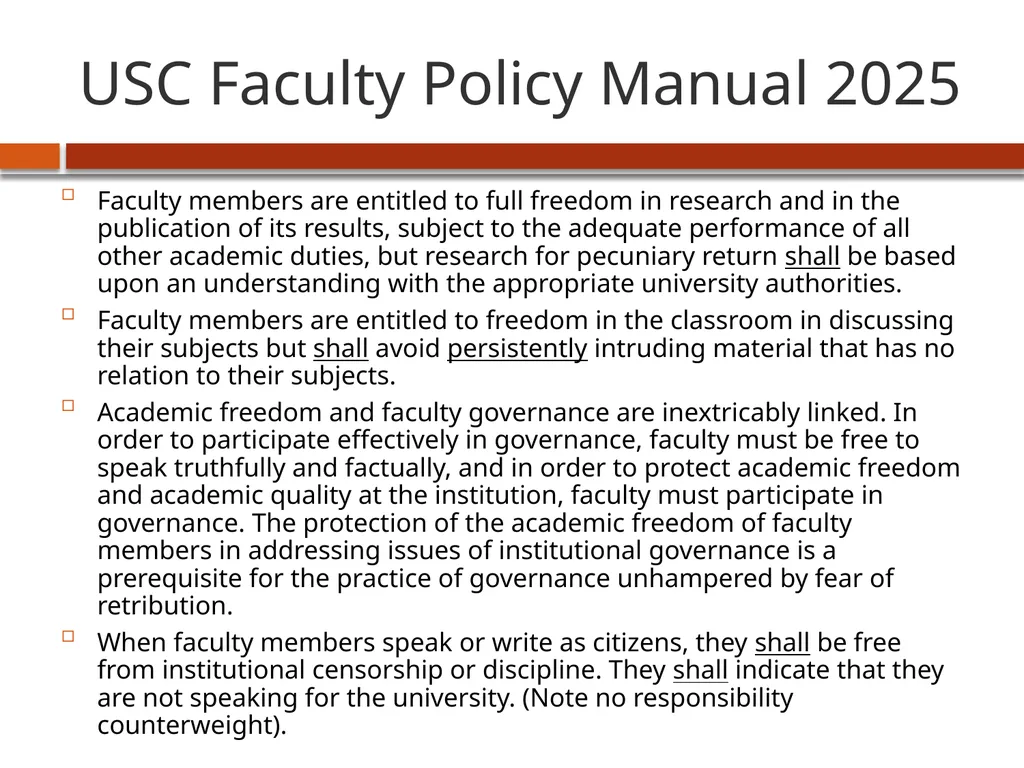
USC Faculty Policy Manual 2025 Faculty members are entitled to full freedom in research and in the publication of its results, subject to the adequate performance of all other academic duties, but research for pecuniary return shall be based upon an understanding with the appropriate university authorities.
Faculty members are entitled to freedom in the classroom in discussing their subjects but shall avoid persistently intruding material that has no relation to their subjects.
Academic freedom and faculty governance are inextricably linked. In order to participate effectively in governance, faculty must be free to speak truthfully and factually, and in order to protect academic freedom and academic quality at the institution, faculty must participate in governance. The protection of the academic freedom of faculty members in addressing issues of institutional governance is a prerequisite for the practice of governance unhampered by fear of retribution.
When faculty members speak or write as citizens, they shall be free from institutional censorship or discipline. They shall indicate that they are not speaking for the university. (Note no responsibility counterweight).<br>
Faculty members are entitled to freedom in the classroom in discussing their subjects but shall avoid persistently intruding material that has no relation to their subjects.
Academic freedom and faculty governance are inextricably linked. In order to participate effectively in governance, faculty must be free to speak truthfully and factually, and in order to protect academic freedom and academic quality at the institution, faculty must participate in governance. The protection of the academic freedom of faculty members in addressing issues of institutional governance is a prerequisite for the practice of governance unhampered by fear of retribution.
When faculty members speak or write as citizens, they shall be free from institutional censorship or discipline. They shall indicate that they are not speaking for the university. (Note no responsibility counterweight).<br>
14
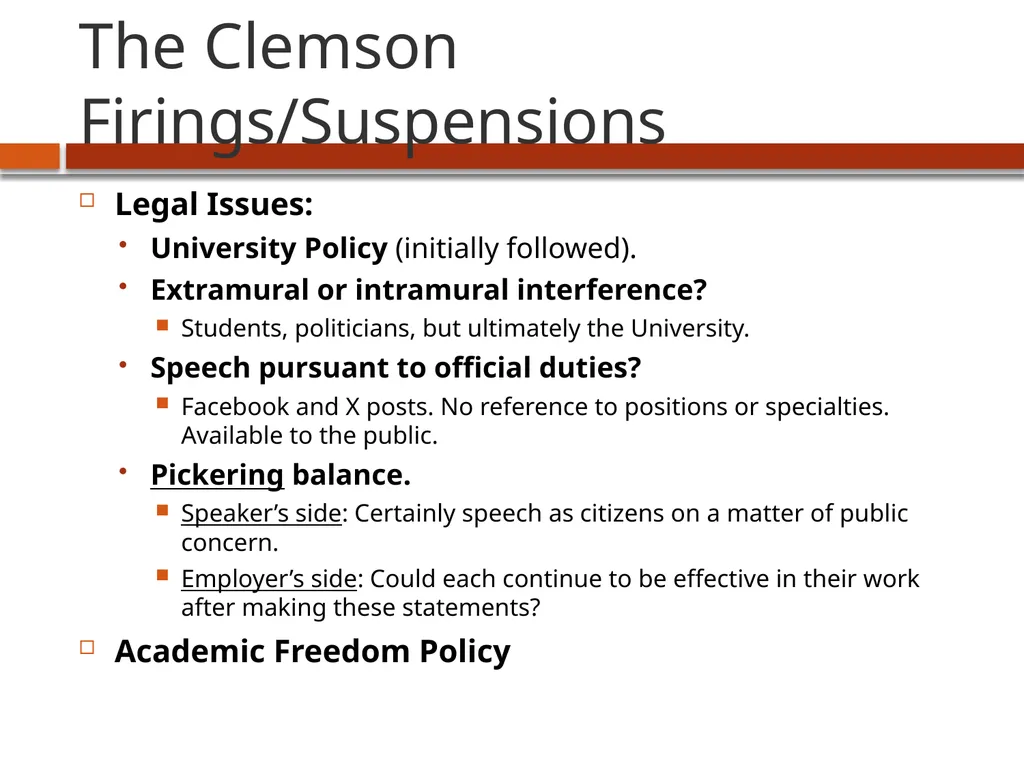
The Clemson Firings/Suspensions Legal Issues:
University Policy (initially followed).
Extramural or intramural interference?
Students, politicians, but ultimately the University.
Speech pursuant to official duties?
Facebook and X posts. No reference to positions or specialties. Available to the public.
Pickering balance.
Speaker’s side: Certainly speech as citizens on a matter of public concern.
Employer’s side: Could each continue to be effective in their work after making these statements?
Academic Freedom Policy<br>
University Policy (initially followed).
Extramural or intramural interference?
Students, politicians, but ultimately the University.
Speech pursuant to official duties?
Facebook and X posts. No reference to positions or specialties. Available to the public.
Pickering balance.
Speaker’s side: Certainly speech as citizens on a matter of public concern.
Employer’s side: Could each continue to be effective in their work after making these statements?
Academic Freedom Policy<br>
15
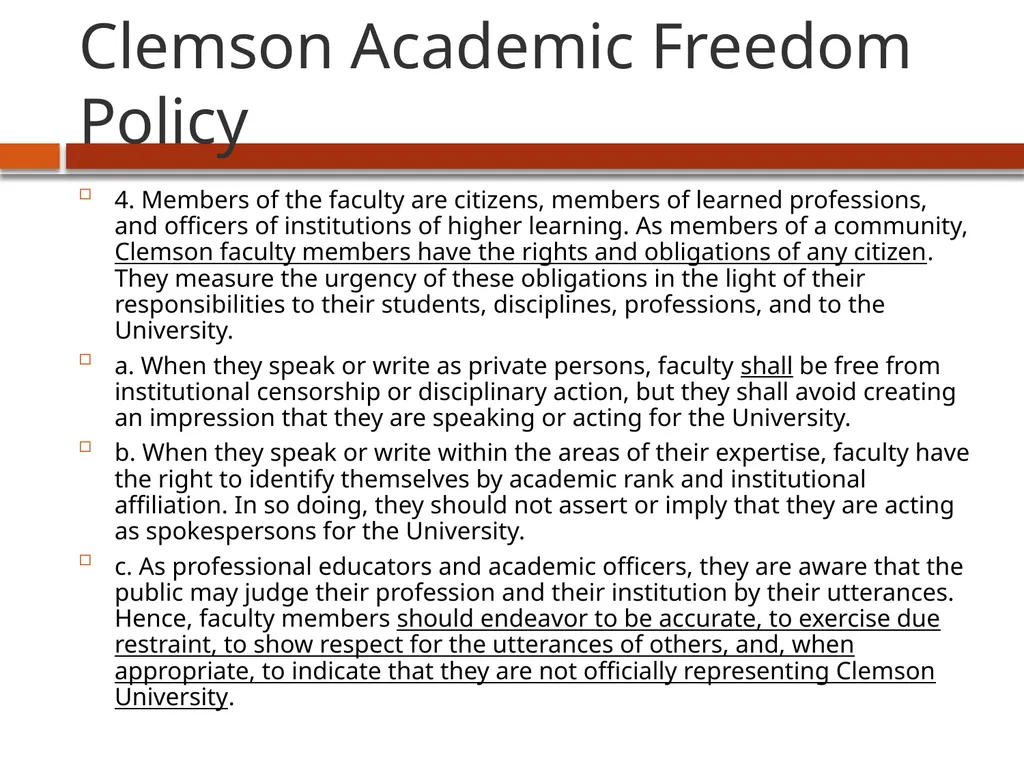
Clemson Academic Freedom Policy 4. Members of the faculty are citizens, members of learned professions, and officers of institutions of higher learning. As members of a community, Clemson faculty members have the rights and obligations of any citizen. They measure the urgency of these obligations in the light of their responsibilities to their students, disciplines, professions, and to the University.
a. When they speak or write as private persons, faculty shall be free from institutional censorship or disciplinary action, but they shall avoid creating an impression that they are speaking or acting for the University.
b. When they speak or write within the areas of their expertise, faculty have the right to identify themselves by academic rank and institutional affiliation. In so doing, they should not assert or imply that they are acting as spokespersons for the University.
c. As professional educators and academic officers, they are aware that the public may judge their profession and their institution by their utterances. Hence, faculty members should endeavor to be accurate, to exercise due restraint, to show respect for the utterances of others, and, when appropriate, to indicate that they are not officially representing Clemson University.<br>
a. When they speak or write as private persons, faculty shall be free from institutional censorship or disciplinary action, but they shall avoid creating an impression that they are speaking or acting for the University.
b. When they speak or write within the areas of their expertise, faculty have the right to identify themselves by academic rank and institutional affiliation. In so doing, they should not assert or imply that they are acting as spokespersons for the University.
c. As professional educators and academic officers, they are aware that the public may judge their profession and their institution by their utterances. Hence, faculty members should endeavor to be accurate, to exercise due restraint, to show respect for the utterances of others, and, when appropriate, to indicate that they are not officially representing Clemson University.<br>
16
Thank you! Scott R. Bauries
Professor of Law
sbauries@mailbox.sc.edu<br>
Professor of Law
sbauries@mailbox.sc.edu<br>