
Accelerating a Gender-Transformative Approach to
Description: Accelerating a Gender-Transformative Approach to Malaria in Pregnancy Advocacy: A Focus on Leadership, Research and Prevention Malaria in Pregnancy Working Group Annual Meeting 12th-13th September 2023 Geneva Deborah Atobrah, PhD Director
Related Topics
Download Presentation
"Accelerating a Gender-Transformative Approach to" is the property of its rightful owner. Permission is granted to download and print the materials on this website for personal, non-commercial use only, and to display it on your personal computer provided you do not modify the materials and that you retain all copyright notices contained in the materials. By downloading content from our website, you accept the terms of this agreement.
Presentation Transcript
slide1. Accelerating a Gender-Transformative Approach to Malaria in Pregnancy Advocacy: A Focus on Leadership, Research and Prevention Malaria in Pregnancy Working Group Annual Meeting
12th-13th September 2023
Geneva
Deborah Atobrah, PhD
Director
Centre for Gender Studies and Advocacy (CEGENSA)
University of Ghana<br>
slide3. Accelerating gender-balanced representation in MiP leadership. Priority 1:
Strengthen political will for gender-balanced representation in MiP leadership among policymakers, researchers, scientists, and workforce:
Advocacy Activities:
Develop tailored talking points on the value add of gender-balanced representation in malaria leadership at all levels and engage governments, civil society, donors, and partners to share the message.
Landscape current barriers to entry for would-be women leaders in key sectors for malaria-endemic countries and high transmission communities, also for retention<br>
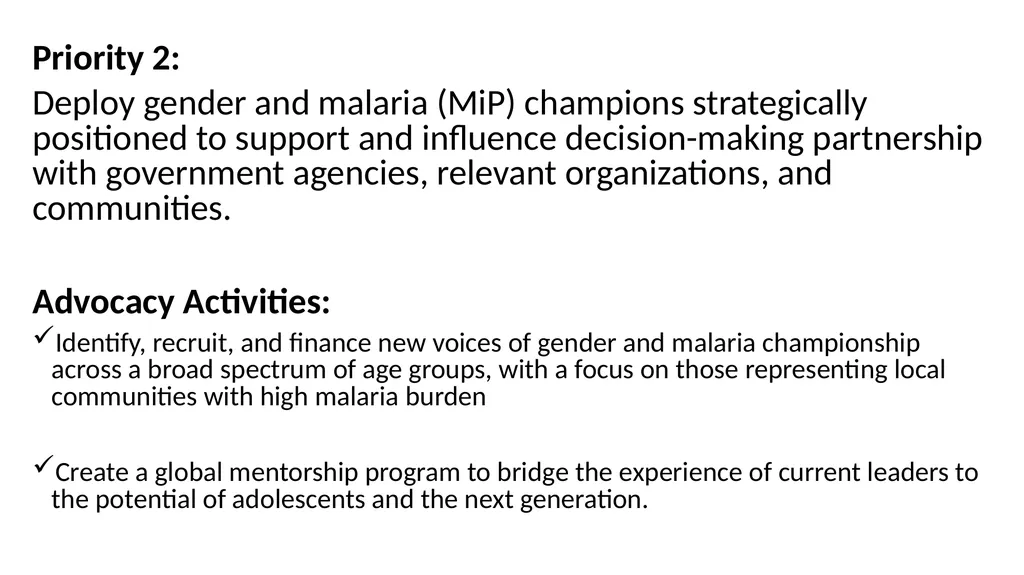
slide4. Priority 2:
Deploy gender and malaria (MiP) champions strategically positioned to support and influence decision-making partnership with government agencies, relevant organizations, and communities.
Advocacy Activities:
Identify, recruit, and finance new voices of gender and malaria championship across a broad spectrum of age groups, with a focus on those representing local communities with high malaria burden
Create a global mentorship program to bridge the experience of current leaders to the potential of adolescents and the next generation.<br>
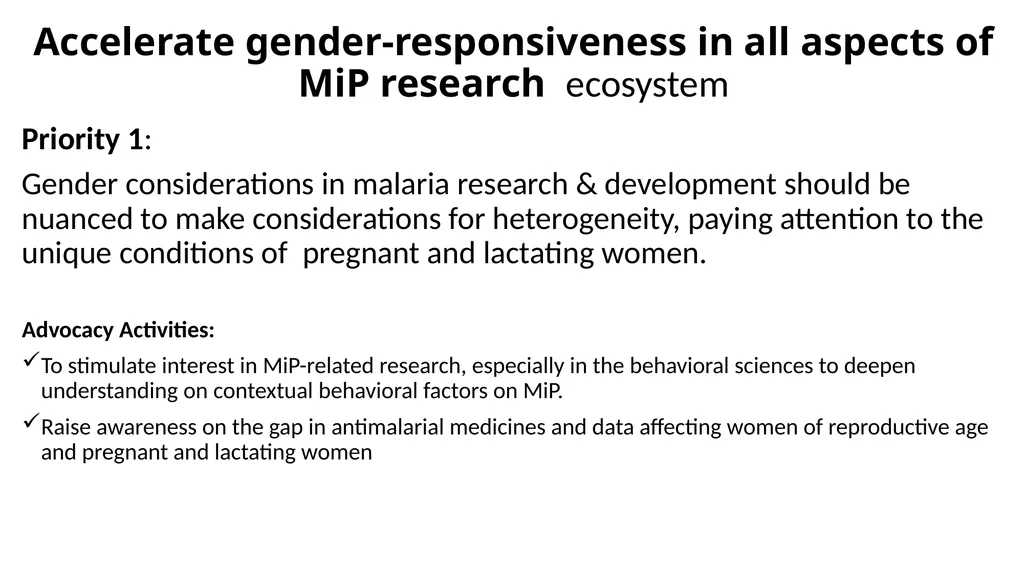
slide5. Accelerate gender-responsiveness in all aspects of MiP research ecosystem Priority 1:
Gender considerations in malaria research & development should be nuanced to make considerations for heterogeneity, paying attention to the unique conditions of pregnant and lactating women.
Advocacy Activities:
To stimulate interest in MiP-related research, especially in the behavioral sciences to deepen understanding on contextual behavioral factors on MiP.
Raise awareness on the gap in antimalarial medicines and data affecting women of reproductive age and pregnant and lactating women<br>
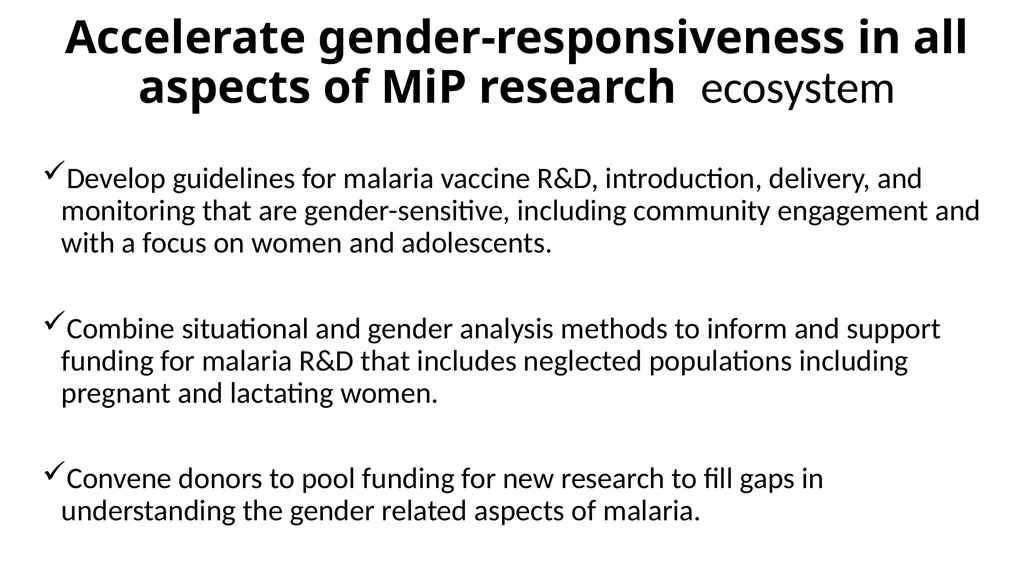
slide6. Accelerate gender-responsiveness in all aspects of MiP research ecosystem Develop guidelines for malaria vaccine R&D, introduction, delivery, and monitoring that are gender-sensitive, including community engagement and with a focus on women and adolescents.
Combine situational and gender analysis methods to inform and support funding for malaria R&D that includes neglected populations including pregnant and lactating women.
Convene donors to pool funding for new research to fill gaps in understanding the gender related aspects of malaria.<br>
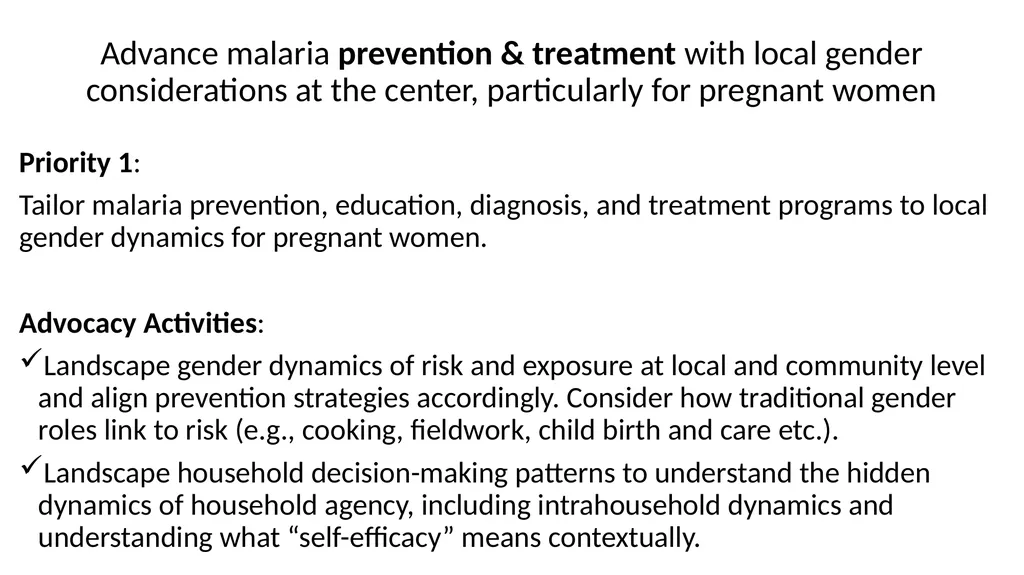
slide7. Advance malaria prevention & treatment with local gender considerations at the center, particularly for pregnant women Priority 1:
Tailor malaria prevention, education, diagnosis, and treatment programs to local gender dynamics for pregnant women.
Advocacy Activities:
Landscape gender dynamics of risk and exposure at local and community level and align prevention strategies accordingly. Consider how traditional gender roles link to risk (e.g., cooking, fieldwork, child birth and care etc.).
Landscape household decision-making patterns to understand the hidden dynamics of household agency, including intrahousehold dynamics and understanding what “self-efficacy” means contextually.<br>
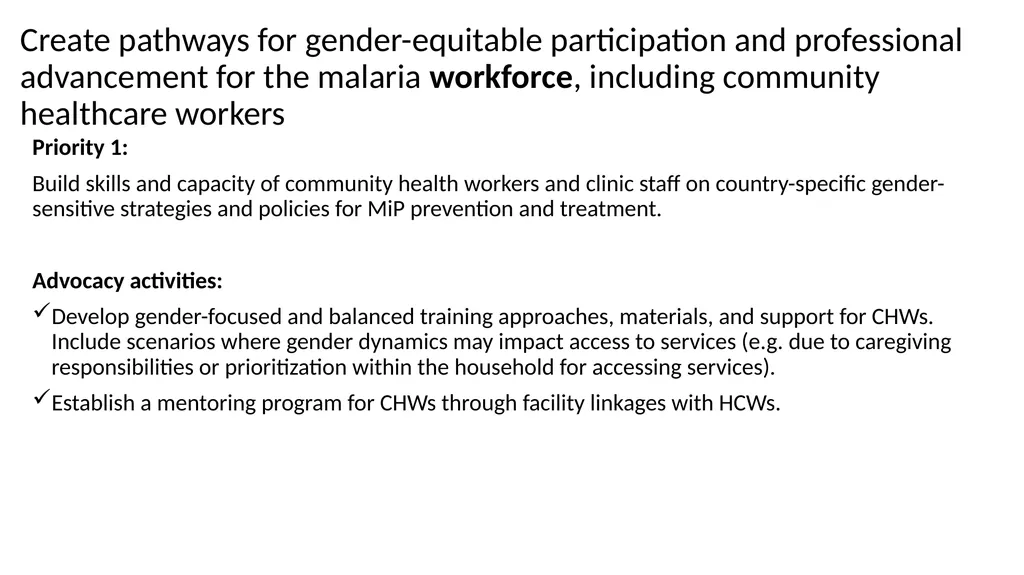
slide8. Create pathways for gender-equitable participation and professional advancement for the malaria workforce, including community healthcare workers Priority 1:
Build skills and capacity of community health workers and clinic staff on country-specific gender-sensitive strategies and policies for MiP prevention and treatment.
Advocacy activities:
Develop gender-focused and balanced training approaches, materials, and support for CHWs. Include scenarios where gender dynamics may impact access to services (e.g. due to caregiving responsibilities or prioritization within the household for accessing services).
Establish a mentoring program for CHWs through facility linkages with HCWs.<br>
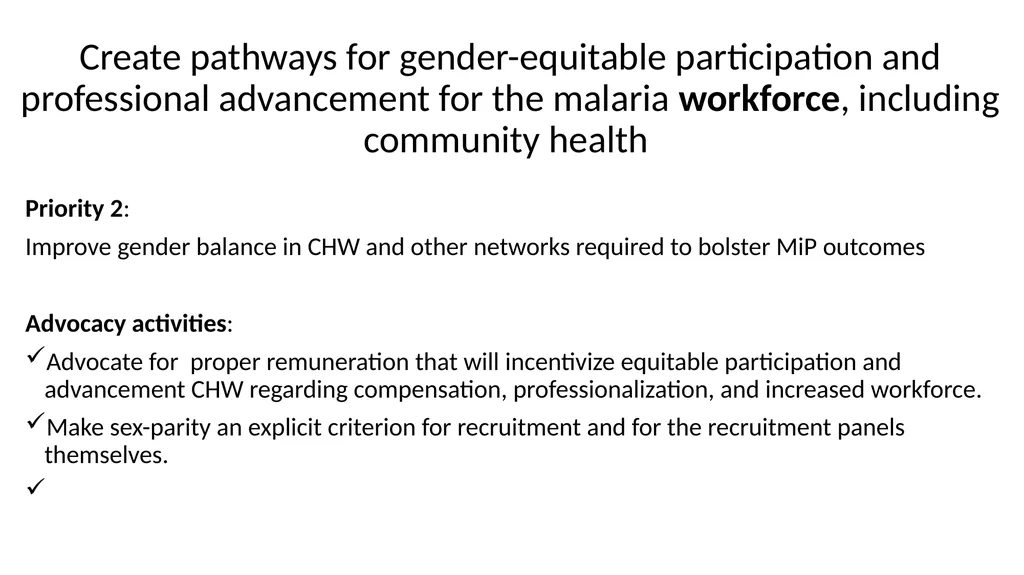
slide9. Create pathways for gender-equitable participation and professional advancement for the malaria workforce, including community health Priority 2:
Improve gender balance in CHW and other networks required to bolster MiP outcomes
Advocacy activities:
Advocate for proper remuneration that will incentivize equitable participation and advancement CHW regarding compensation, professionalization, and increased workforce.
Make sex-parity an explicit criterion for recruitment and for the recruitment panels themselves.<br>
slide10. Some reflection questions What has been our experience with pursuing these priorities?
How could we promote the advocacy agenda for MiP?
What are the likely barriers we face?<br>
12th-13th September 2023
Geneva
Deborah Atobrah, PhD
Director
Centre for Gender Studies and Advocacy (CEGENSA)
University of Ghana<br>
slide3. Accelerating gender-balanced representation in MiP leadership. Priority 1:
Strengthen political will for gender-balanced representation in MiP leadership among policymakers, researchers, scientists, and workforce:
Advocacy Activities:
Develop tailored talking points on the value add of gender-balanced representation in malaria leadership at all levels and engage governments, civil society, donors, and partners to share the message.
Landscape current barriers to entry for would-be women leaders in key sectors for malaria-endemic countries and high transmission communities, also for retention<br>
slide4. Priority 2:
Deploy gender and malaria (MiP) champions strategically positioned to support and influence decision-making partnership with government agencies, relevant organizations, and communities.
Advocacy Activities:
Identify, recruit, and finance new voices of gender and malaria championship across a broad spectrum of age groups, with a focus on those representing local communities with high malaria burden
Create a global mentorship program to bridge the experience of current leaders to the potential of adolescents and the next generation.<br>
slide5. Accelerate gender-responsiveness in all aspects of MiP research ecosystem Priority 1:
Gender considerations in malaria research & development should be nuanced to make considerations for heterogeneity, paying attention to the unique conditions of pregnant and lactating women.
Advocacy Activities:
To stimulate interest in MiP-related research, especially in the behavioral sciences to deepen understanding on contextual behavioral factors on MiP.
Raise awareness on the gap in antimalarial medicines and data affecting women of reproductive age and pregnant and lactating women<br>
slide6. Accelerate gender-responsiveness in all aspects of MiP research ecosystem Develop guidelines for malaria vaccine R&D, introduction, delivery, and monitoring that are gender-sensitive, including community engagement and with a focus on women and adolescents.
Combine situational and gender analysis methods to inform and support funding for malaria R&D that includes neglected populations including pregnant and lactating women.
Convene donors to pool funding for new research to fill gaps in understanding the gender related aspects of malaria.<br>
slide7. Advance malaria prevention & treatment with local gender considerations at the center, particularly for pregnant women Priority 1:
Tailor malaria prevention, education, diagnosis, and treatment programs to local gender dynamics for pregnant women.
Advocacy Activities:
Landscape gender dynamics of risk and exposure at local and community level and align prevention strategies accordingly. Consider how traditional gender roles link to risk (e.g., cooking, fieldwork, child birth and care etc.).
Landscape household decision-making patterns to understand the hidden dynamics of household agency, including intrahousehold dynamics and understanding what “self-efficacy” means contextually.<br>
slide8. Create pathways for gender-equitable participation and professional advancement for the malaria workforce, including community healthcare workers Priority 1:
Build skills and capacity of community health workers and clinic staff on country-specific gender-sensitive strategies and policies for MiP prevention and treatment.
Advocacy activities:
Develop gender-focused and balanced training approaches, materials, and support for CHWs. Include scenarios where gender dynamics may impact access to services (e.g. due to caregiving responsibilities or prioritization within the household for accessing services).
Establish a mentoring program for CHWs through facility linkages with HCWs.<br>
slide9. Create pathways for gender-equitable participation and professional advancement for the malaria workforce, including community health Priority 2:
Improve gender balance in CHW and other networks required to bolster MiP outcomes
Advocacy activities:
Advocate for proper remuneration that will incentivize equitable participation and advancement CHW regarding compensation, professionalization, and increased workforce.
Make sex-parity an explicit criterion for recruitment and for the recruitment panels themselves.<br>
slide10. Some reflection questions What has been our experience with pursuing these priorities?
How could we promote the advocacy agenda for MiP?
What are the likely barriers we face?<br>