Accepting Educational Responsibility as an International Mentor Creating Living Theory Cultures of Inquiry Jacqueline (Jackie) Delong abstract With the question, How can I improve my practice? as intention to improve the social order and
"Accepting Educational Responsibility as an" is the property of its rightful owner. Permission is granted to
download and print the materials on this website for personal, non-commercial use only, and to display it
on your personal computer provided you do not modify the materials and that you retain all copyright
notices contained in the materials. By downloading content from our website, you accept the terms of this
agreement.
Presentation Transcript
01
Accepting Educational Responsibility as an International Mentor Creating Living Theory Cultures of Inquiry Jacqueline (Jackie) Delong<br>
02
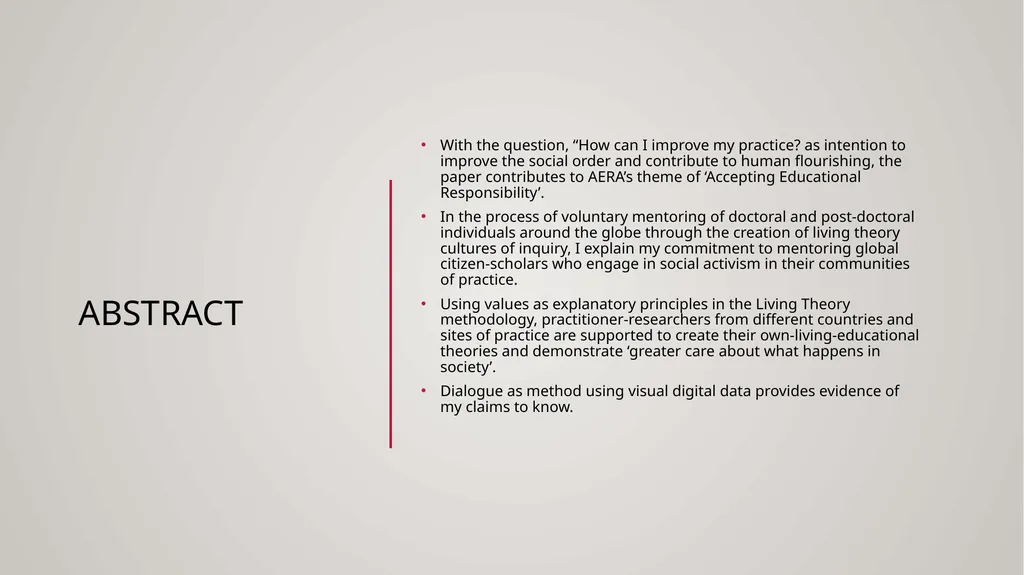
abstract With the question, “How can I improve my practice? as intention to improve the social order and contribute to human flourishing, the paper contributes to AERA’s theme of ‘Accepting Educational Responsibility’.
In the process of voluntary mentoring of doctoral and post-doctoral individuals around the globe through the creation of living theory cultures of inquiry, I explain my commitment to mentoring global citizen-scholars who engage in social activism in their communities of practice.
Using values as explanatory principles in the Living Theory methodology, practitioner-researchers from different countries and sites of practice are supported to create their own-living-educational theories and demonstrate ‘greater care about what happens in society’.
Dialogue as method using visual digital data provides evidence of my claims to know.<br>
03
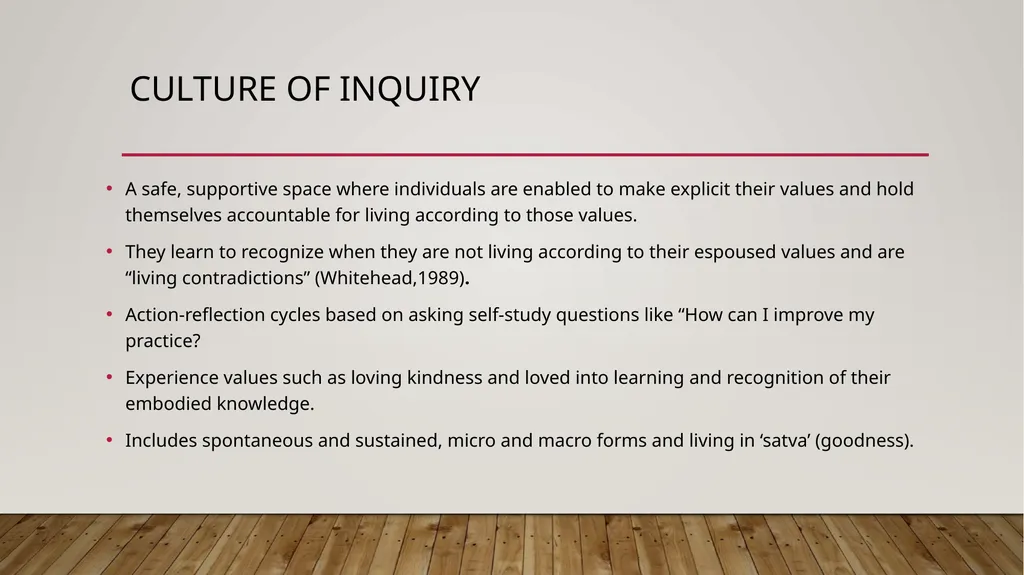
Culture of Inquiry A safe, supportive space where individuals are enabled to make explicit their values and hold themselves accountable for living according to those values.
They learn to recognize when they are not living according to their espoused values and are “living contradictions” (Whitehead,1989).
Action-reflection cycles based on asking self-study questions like “How can I improve my practice?
Experience values such as loving kindness and loved into learning and recognition of their embodied knowledge.
Includes spontaneous and sustained, micro and macro forms and living in ‘satva’ (goodness).<br>
04
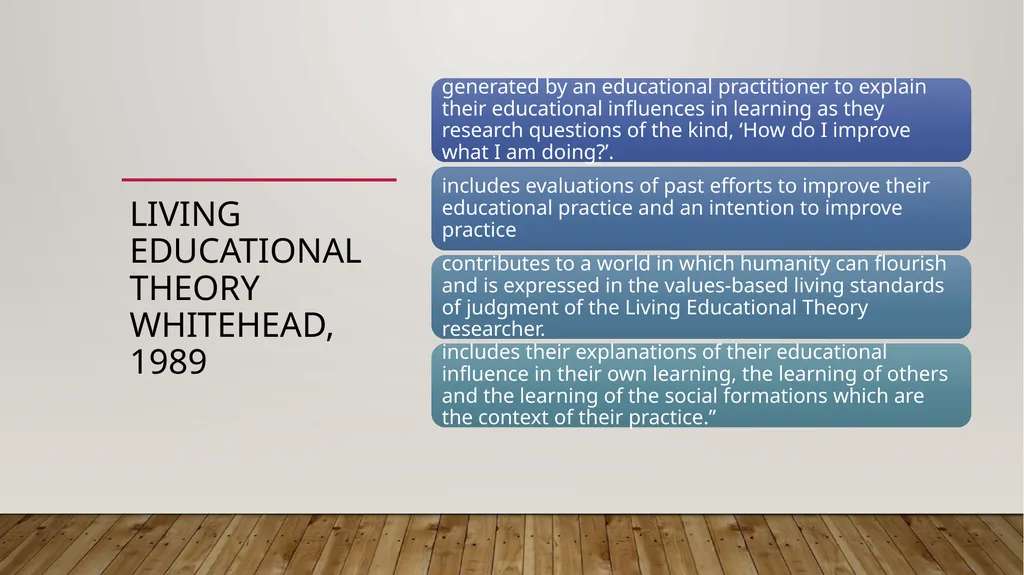
Living Educational Theory Whitehead, 1989<br>
05
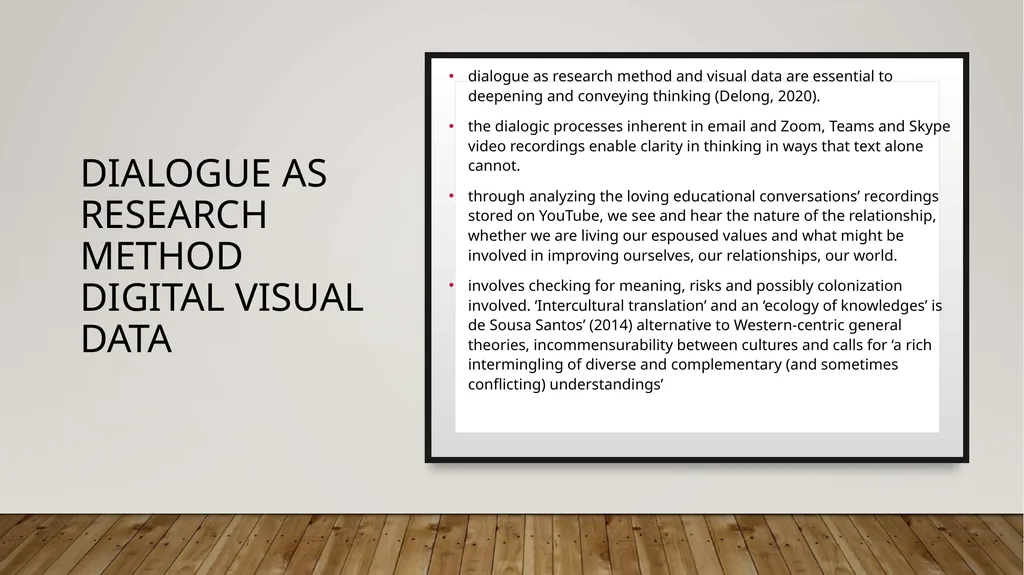
Dialogue As Research Method Digital visual data dialogue as research method and visual data are essential to deepening and conveying thinking (Delong, 2020).
the dialogic processes inherent in email and Zoom, Teams and Skype video recordings enable clarity in thinking in ways that text alone cannot.
through analyzing the loving educational conversations’ recordings stored on YouTube, we see and hear the nature of the relationship, whether we are living our espoused values and what might be involved in improving ourselves, our relationships, our world.
involves checking for meaning, risks and possibly colonization involved. ‘Intercultural translation’ and an ‘ecology of knowledges’ is de Sousa Santos’ (2014) alternative to Western-centric general theories, incommensurability between cultures and calls for ‘a rich intermingling of diverse and complementary (and sometimes conflicting) understandings’<br>
06
Parbati and Jackie on Culture of inquiry https://youtu.be/bSu3A80agSw<br>