
Accessing Services Through the Medicaid iBudget
Description: Accessing Services Through the Medicaid iBudget Waiver Patrick Heidemann, Advocate Investigator Systems Reform June 2023 Our Conference Registration was paid. We are employed full time employees for Disability Rights Florida, Inc. 1
Related Topics
Download Presentation
"Accessing Services Through the Medicaid iBudget" is the property of its rightful owner. Permission is granted to download and print the materials on this website for personal, non-commercial use only, and to display it on your personal computer provided you do not modify the materials and that you retain all copyright notices contained in the materials. By downloading content from our website, you accept the terms of this agreement.
Presentation Transcript
slide1. Accessing Services Through the Medicaid iBudget Waiver Patrick Heidemann,
Advocate Investigator
Systems Reform
June 2023 Our Conference Registration was paid.
We are employed full time employees for Disability Rights Florida, Inc. 1<br>
slide2. Disability Rights Florida Funding, responsibility, and authority under nine federal programs to protect the rights of Floridians with disabilities.
A not-for-profit corporation since 1987.
Offices in Tallahassee, Tampa, Gainesville and Fort Lauderdale. 2<br>
slide3. Our Mission Disability Rights Florida advocates, educates, investigates, and litigates to protect and advance the rights, dignity, equal opportunities, self-determination, and choices for all people with disabilities. 3<br>
slide4. Agenda Medicaid iBudget Waiver Eligibility Guidelines
iBudget Waiver Application Process
The intersection of developmental disability and mental illness in establishing eligibility
Significant Additional Needs Process
Tips for Obtaining Behavioral Analysis Services
Questions 4<br>
slide5. iBudget Waiver Eligibility Guidelines APD operates the Home & Community-Based Services (HCBS) Medicaid Waiver, also known as the iBudget Waiver
In order to be eligible to participate in the iBudget Waiver, an applicant must have been determined to have a qualifying developmental disability or be at high risk of a developmental disability, as defined by statute
“Developmental disability” means a disorder or syndrome that is attributable to intellectual disability, cerebral palsy, autism, spina bifida, Down syndrome, Phelan-McDermid syndrome, or Prader-Willi syndrome; that manifests before the age of 18; and that constitutes a substantial handicap that can reasonably be expected to continue indefinitely.
Eligibility guidelines can be found in Rule 65G-4.014 – 4.015, F.A.C. 5<br>
slide6. Statutory Definition of Autism Individuals with autism must meet the requirements of Section 393.063(5), F.S.:
“Autism” means a pervasive, neurologically based developmental disability of extended duration which causes severe learning, communication, and behavior disorders with age of onset during infancy or childhood. Individuals with autism exhibit impairment in reciprocal social interaction, impairment in verbal and nonverbal communication and imaginative ability, and a markedly restricted repertoire of activities and interests. 6<br>
slide7. Warning – APD’s Definition of “Autism” Differs in Significant Respects From Any Current Medical Understanding of the Condition Doctors and other clinicians are experts in current medical understanding of autism. They are not experts in APD’s definition of autism. 7<br>
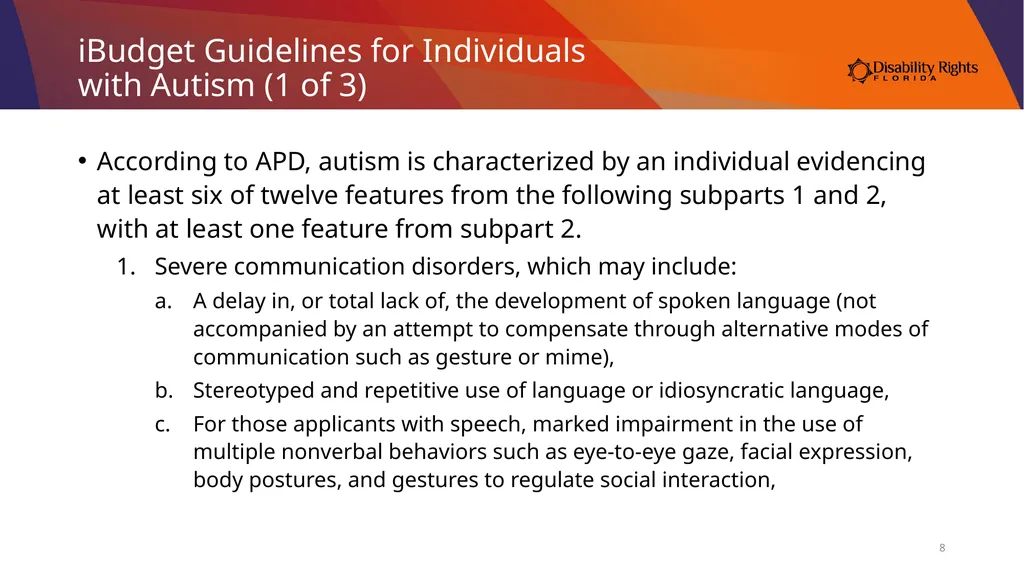
slide8. iBudget Guidelines for Individuals with Autism (1 of 3) According to APD, autism is characterized by an individual evidencing at least six of twelve features from the following subparts 1 and 2, with at least one feature from subpart 2.
Severe communication disorders, which may include:
A delay in, or total lack of, the development of spoken language (not accompanied by an attempt to compensate through alternative modes of communication such as gesture or mime),
Stereotyped and repetitive use of language or idiosyncratic language,
For those applicants with speech, marked impairment in the use of multiple nonverbal behaviors such as eye-to-eye gaze, facial expression, body postures, and gestures to regulate social interaction, 8<br>
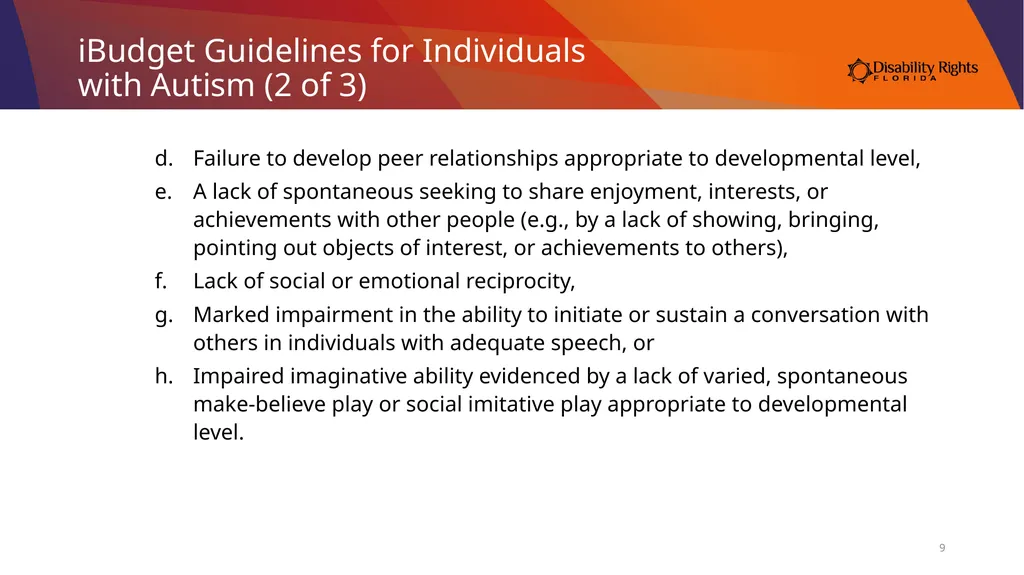
slide9. iBudget Guidelines for Individuals with Autism (2 of 3) Failure to develop peer relationships appropriate to developmental level,
A lack of spontaneous seeking to share enjoyment, interests, or achievements with other people (e.g., by a lack of showing, bringing, pointing out objects of interest, or achievements to others),
Lack of social or emotional reciprocity,
Marked impairment in the ability to initiate or sustain a conversation with others in individuals with adequate speech, or
Impaired imaginative ability evidenced by a lack of varied, spontaneous make-believe play or social imitative play appropriate to developmental level. 9<br>
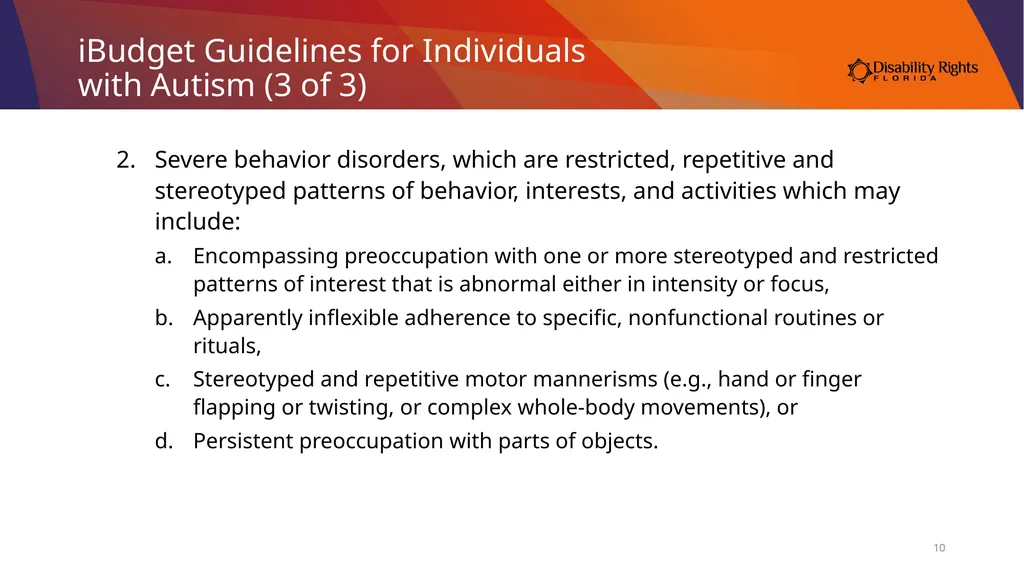
slide10. iBudget Guidelines for Individuals with Autism (3 of 3) Severe behavior disorders, which are restricted, repetitive and stereotyped patterns of behavior, interests, and activities which may include:
Encompassing preoccupation with one or more stereotyped and restricted patterns of interest that is abnormal either in intensity or focus,
Apparently inflexible adherence to specific, nonfunctional routines or rituals,
Stereotyped and repetitive motor mannerisms (e.g., hand or finger flapping or twisting, or complex whole-body movements), or
Persistent preoccupation with parts of objects. 10<br>
slide11. In ordinary psychological evaluations and examinations for autism, clinicians do not work to establish the eligibility criteria, as defined by APD. To establish APD eligibility, you must specifically demonstrate through evidence that you meet the severity criteria. An evaluation documenting APD eligibility criteria is essential! 11<br>
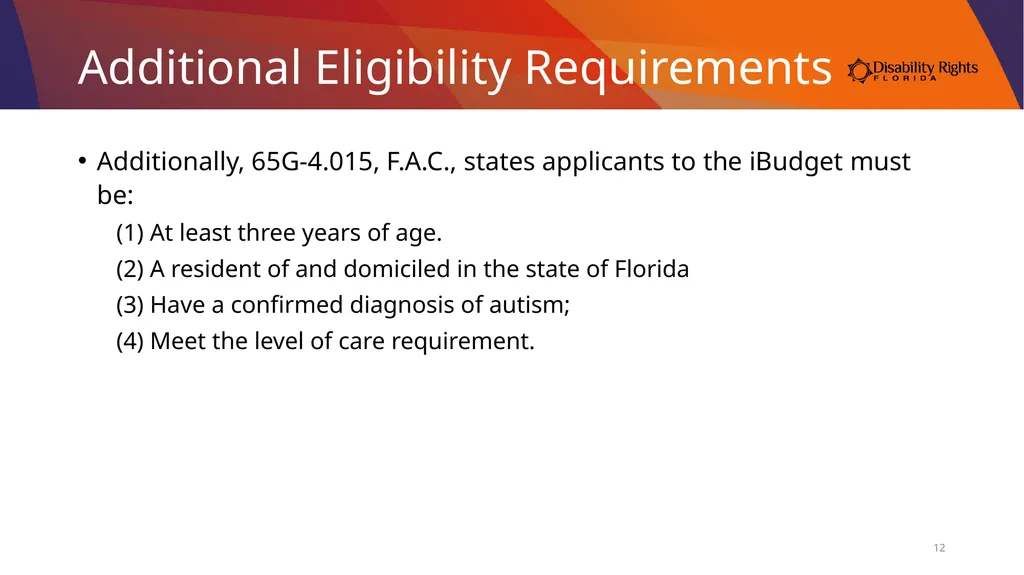
slide12. Additional Eligibility Requirements Additionally, 65G-4.015, F.A.C., states applicants to the iBudget must be:
(1) At least three years of age.
(2) A resident of and domiciled in the state of Florida
(3) Have a confirmed diagnosis of autism;
(4) Meet the level of care requirement. 12<br>
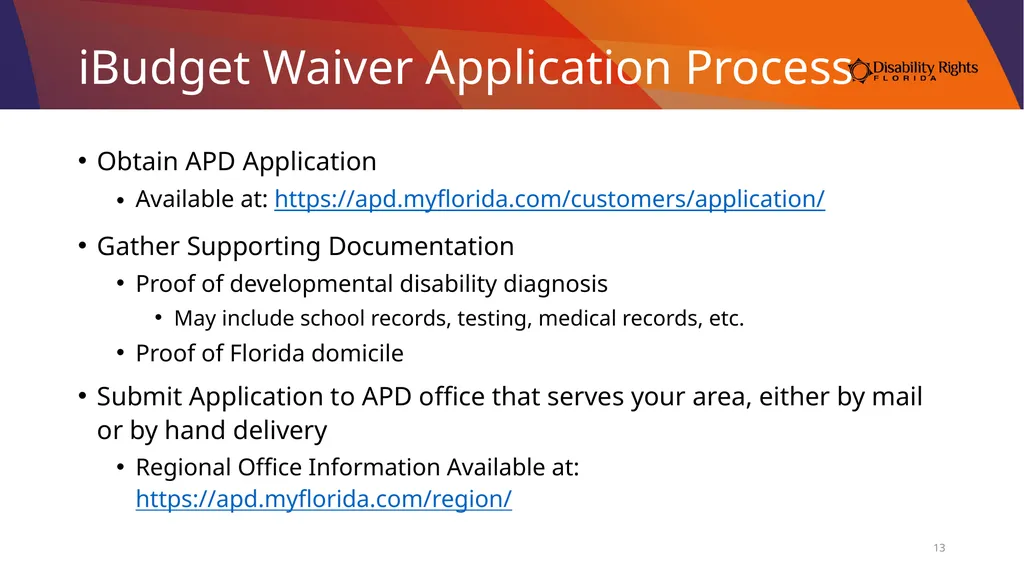
slide13. iBudget Waiver Application Process Obtain APD Application
Available at: https://apd.myflorida.com/customers/application/
Gather Supporting Documentation
Proof of developmental disability diagnosis
May include school records, testing, medical records, etc.
Proof of Florida domicile
Submit Application to APD office that serves your area, either by mail or by hand delivery
Regional Office Information Available at: https://apd.myflorida.com/region/ 13<br>
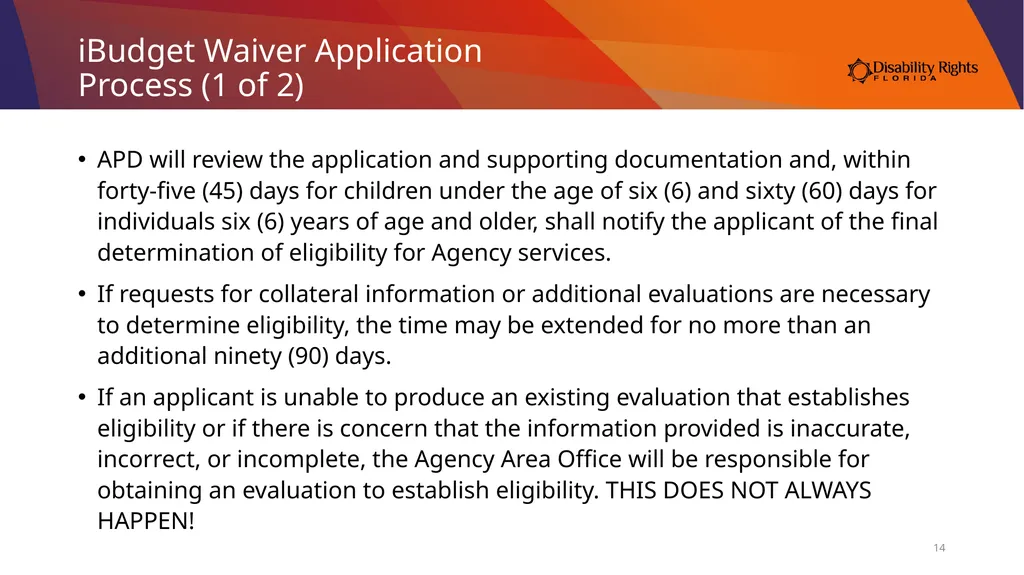
slide14. iBudget Waiver Application Process (1 of 2) APD will review the application and supporting documentation and, within forty-five (45) days for children under the age of six (6) and sixty (60) days for individuals six (6) years of age and older, shall notify the applicant of the final determination of eligibility for Agency services.
If requests for collateral information or additional evaluations are necessary to determine eligibility, the time may be extended for no more than an additional ninety (90) days.
If an applicant is unable to produce an existing evaluation that establishes eligibility or if there is concern that the information provided is inaccurate, incorrect, or incomplete, the Agency Area Office will be responsible for obtaining an evaluation to establish eligibility. THIS DOES NOT ALWAYS HAPPEN! 14<br>
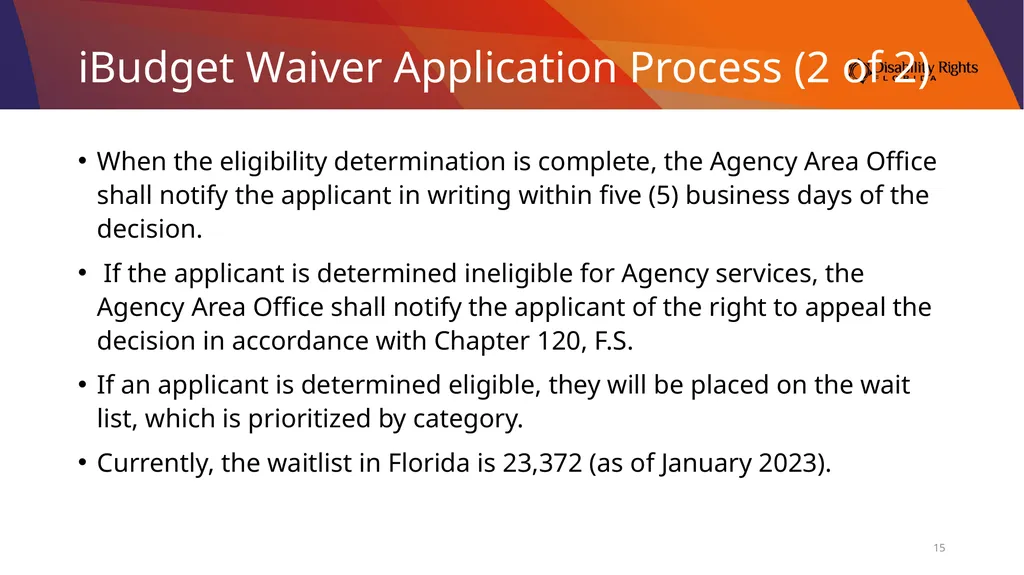
slide15. iBudget Waiver Application Process (2 of 2) When the eligibility determination is complete, the Agency Area Office shall notify the applicant in writing within five (5) business days of the decision.
If the applicant is determined ineligible for Agency services, the Agency Area Office shall notify the applicant of the right to appeal the decision in accordance with Chapter 120, F.S.
If an applicant is determined eligible, they will be placed on the wait list, which is prioritized by category.
Currently, the waitlist in Florida is 23,372 (as of January 2023). 15<br>
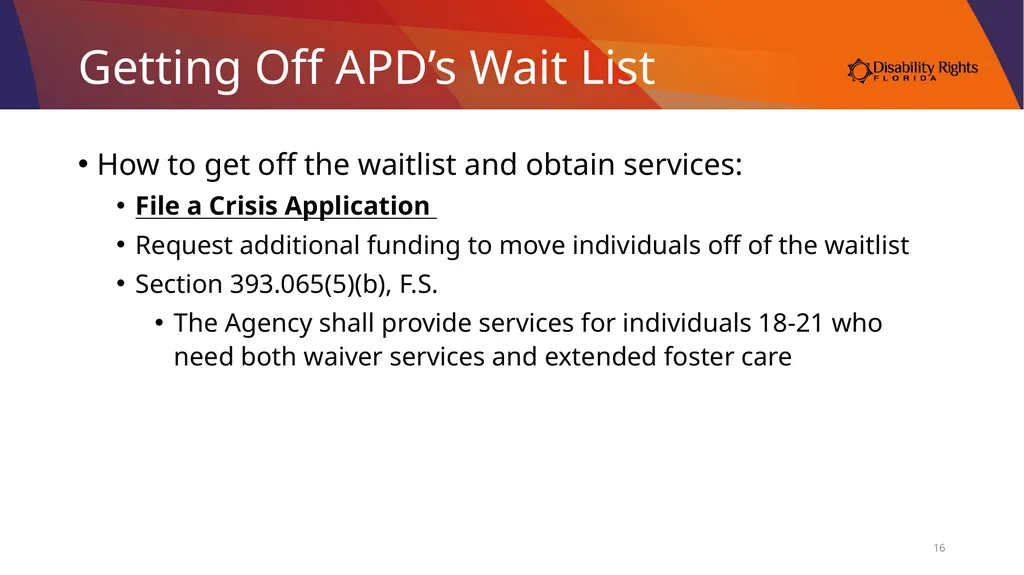
slide16. Getting Off APD’s Wait List How to get off the waitlist and obtain services:
File a Crisis Application
Request additional funding to move individuals off of the waitlist
Section 393.065(5)(b), F.S.
The Agency shall provide services for individuals 18-21 who need both waiver services and extended foster care 16<br>
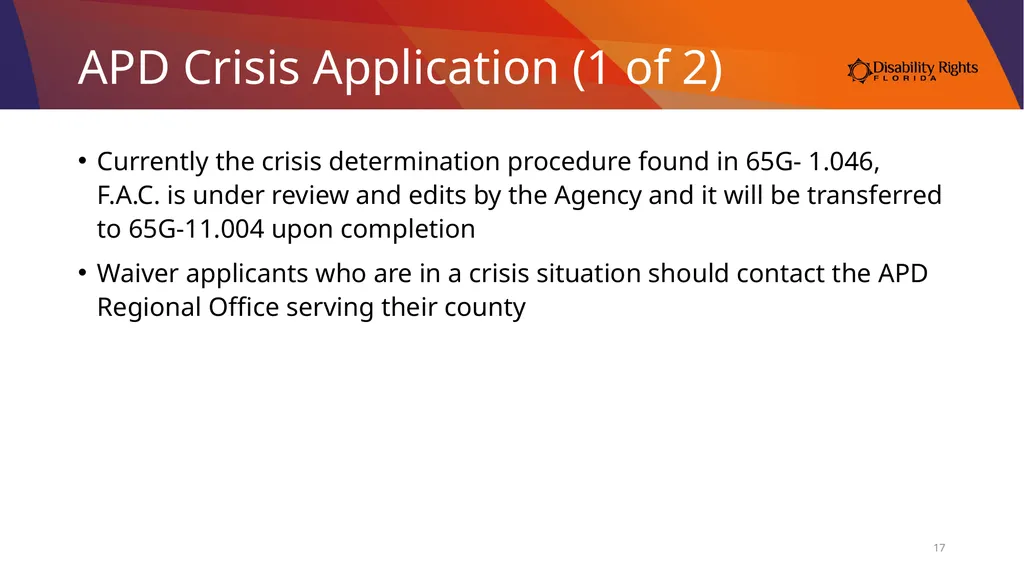
slide17. APD Crisis Application (1 of 2) Currently the crisis determination procedure found in 65G- 1.046, F.A.C. is under review and edits by the Agency and it will be transferred to 65G-11.004 upon completion
Waiver applicants who are in a crisis situation should contact the APD Regional Office serving their county 17<br>
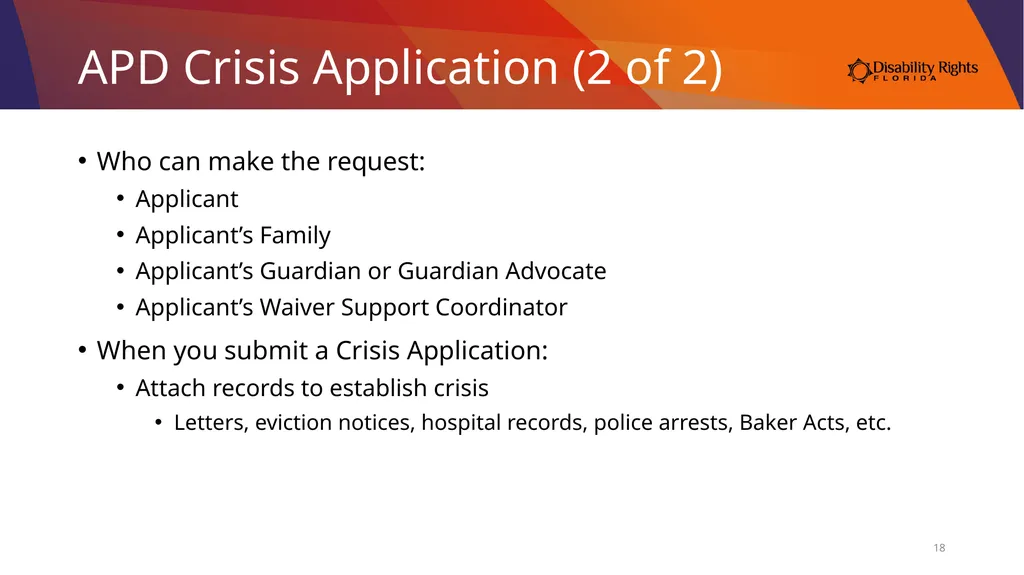
slide18. APD Crisis Application (2 of 2) Who can make the request:
Applicant
Applicant’s Family
Applicant’s Guardian or Guardian Advocate
Applicant’s Waiver Support Coordinator
When you submit a Crisis Application:
Attach records to establish crisis
Letters, eviction notices, hospital records, police arrests, Baker Acts, etc. 18<br>
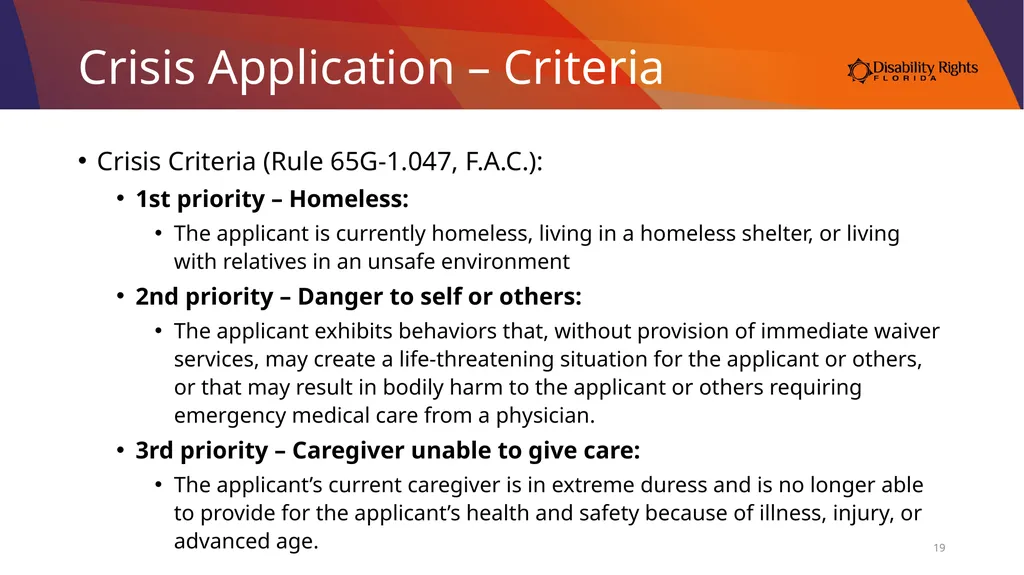
slide19. Crisis Application – Criteria Crisis Criteria (Rule 65G-1.047, F.A.C.):
1st priority – Homeless:
The applicant is currently homeless, living in a homeless shelter, or living with relatives in an unsafe environment
2nd priority – Danger to self or others:
The applicant exhibits behaviors that, without provision of immediate waiver services, may create a life-threatening situation for the applicant or others, or that may result in bodily harm to the applicant or others requiring emergency medical care from a physician.
3rd priority – Caregiver unable to give care:
The applicant’s current caregiver is in extreme duress and is no longer able to provide for the applicant’s health and safety because of illness, injury, or advanced age. 19<br>
slide20. Crisis Application – Decision If your application is denied at the APD Area Office Level:
The APD Area Office will notify the applicant or applicant’s representative in writing of a denial of crisis enrollment.
If the Area Office concludes that the applicant may meet crisis status and other programs cannot meet the applicant’s service needs, the Area Office will submit the initial assessment to the Central Office for review and final determination.
The Central Office will notify the Area Office of whether it has approved or denied the application.
The Area Office is responsible for notifying the applicant or applicant’s representative of the final crisis determination in writing. The notice will contain instructions on how to request an appeal of the decision 20<br>
slide21. Transition from Wait List to Waiver Establish Medicaid Eligibility
Choose a Waiver Support Coordinator (WSC)
Receive iBudget Allocation Algorithm Amount
Participate in AIM Meeting with your chosen WSC
Your WSC will submit the completed AIM worksheet, SAN request, and other supporting documents to APD
APD issues a Notice of Approval of Waiver Enrollment and iBudget Amount
During this process, APD can preapprove support coordination and any services critical to ensuring health and safety 21<br>
slide22. Establishing the iBudget Amount A Questionnaire for Situational Information (QSI) assessment indicating a client’s needs must be completed for applicants enrolled in the iBudget
The QSI is used in calculating the Allocation Algorithm Amount, which is the baseline budget
APD uses the “Amount Implementation Meeting Worksheet” or “AIM Worksheet” to:
Communicate a client’s Allocation Algorithm Amount
Identify proposed services based upon the Allocation Algorithm Amount; and
Identify additional services, if any, should the client or their legal representative feel that any Significant Additional Needs of the client cannot be met within the Allocation Algorithm Amount.
The iBudget Amount is the Allocation Algorithm Amount plus any approved Significant Additional Needs (SANs) funding 22<br>
slide23. Intersection of Developmental Disability and Mental Health Warning: Individuals with co-occurring developmental disability and mental illness face additional barriers to establishing eligibility for the iBudget Waiver.
APD will sometimes find that behaviors are the result of mental illness rather than autism.
APD will also sometimes find that IQ scores are not reflective of true intellectual functioning because of a co-occurring mental illness. 23<br>
slide24. Intersection of Developmental Disability and Mental Illness It’s important to work with evaluators to ensure that their reports are clear that behaviors are the result of developmental disability rather than mental illness (assuming of course this is their clinical view).
Evaluations which acknowledge underlying mental illness but state the report is based on the clinician’s view of developmental disability behaviors is helpful.
Ensuring compliance with medication and other treatments at time of IQ testing is important so that APD cannot point to factors associated with mental illness as skewing the IQ score is important. 24<br>
slide25. Updates to the Significant Additional Needs (SANs) Process The SANs process is governed by Rule 65G-4.0218, F.A.C., which was updated on July 1, 2021.
Previously, there were four bases for SAN requests.
Those bases have been eliminated in favor of a simpler definition.
Other key components have been updated to more closely match the new Waiver Support Coordinator requirements. 25<br>
slide26. Significant Additional Needs (SANs) Process (1 of 2) The presence of a significant additional need or significant change in condition or circumstance alone does not warrant an increase in the amount of funds allocated to a client’s iBudget as determined by the algorithm.
SANs may be of a one-time, temporary, or long-term nature.
SANs can only be approved after the determination of a client’s initial allocation amount and after the Waiver Support Coordinator (WSC) has documented the availability of non-Waiver resources on the Verification of Available Services form. 26<br>
slide27. Significant Additional Needs (SANs) Process (2 of 2) Requests for SANs require:
(a) The client to have a significant additional need; and
(b) A significant additional need cannot be created by failing to maintain sufficient funds to cover services previously authorized.
The WSC shall submit a SANs request indicating how the current budget allocation and requested SANs funds would be used. The request should also include an explanation of why additional funding is needed, and any additional documentation appropriate to support the request. 27<br>
slide28. Supporting Your SANs Request Documentation within the last thirty (30) days of attempts to locate natural or community supports, third party payers, or other sources of support to meet the individual’s health and safety needs must be submitted.
Support Plan
Updated Questionnaire for Situational Information (QSI)
Cost plans
Expenditure history
Updated evaluations or plans of care (if applicable)
Documentation from caregivers
Documentation from providers 28<br>
slide29. Incomplete SANs Requests APD will not consider incomplete SANs requests due to lacking material information.
APD will close incomplete SANs requests upon receipt. 29<br>
slide30. SAN Request Timeline The Agency shall provide a response:
Within 30 days from the date of the SAN request submission if the Agency does not request additional documentation
Within 60 days from the date of the SAN request submission if the Agency does request additional documentation
If you do not receive a notice within the thirty (30) or sixty (60) day timeframes, the client or WSC may notify the Agency in writing of the failure to issue a timely notice
Failure of the Agency to issue this notice within twenty (20) days shall mean the requested funding for services are authorized as of the twenty- first (21) day 30<br>
slide31. Individual Family Supports (IFS) Individuals and Family Supports (IFS): assistance the Agency provides in meeting critical services needs of individuals served by the Agency funded by Social Services Block Grant dollars and General Revenue.
IFS funding is available to individuals who are on the Agency waitlist.
IFS funding may cover temporary emergency services pursuant to Chapter 65G-13, F.A.C., while requests for Significant Additional Needs are being processed.
Allowable IFS Services include Specialized Therapies, Personal Supports, Medicaid and Dental services, etc.
NOTE: 65G-13, F.A.C. has been updated and the effective date is Dec. 25, 2022. 31<br>
slide32. Behavior Analysis Services (1 of 2) Behavior analysis services are provided to assist recipients to learn new, or increase existing, functionally equivalent replacement skills directly related to existing challenging behaviors. Challenging behaviors include those behaviors exhibited by the recipient that pose risk of harm to the recipient or others (i.e., aggression, self-injury, property destruction, behaviors that prevent inclusion in normal settings, or behaviors that the recipient does not exhibit with sufficient proficiency or skill to prevent harm to the recipient or others, including resisting basic hygiene, and refusal to take medications). 32<br>
slide33. Behavior Analysis Services (2 of 2) If Behavior Analysis Services are available through other payors, such as State-Plan Medicaid or private insurance, services must be requested through those primary payors first.
In the event Behavior Analysis Services are not available through other payors, a Behavioral Assessment will need to be requested and approved by APD.
The enrollee’s behavior is assessed to identify functional relationships between a particular behavior and the recipient’s environment. A variety of techniques, including positive reinforcement, are used in order to produce practical behavior change.
Behavior analysis services should be initiated with a plan for maintaining and generalizing behavioral improvements, as well as an initial criteria for the reduction and fading of behavioral services. The plan should also set forth target behavior criteria to be achieved by the recipient that lead to a specified reduction in the level of service. Subsequent to the initial plan, an updated fading plan must be addressed, at a minimum, as part of the annual report. 33<br>
slide34. Current Trends: Most Common Concerns Reasons that Behavior Analysis (BA) assessments and services are denied:
The request for a BA assessment does not contain all the necessary information
For example: the professional recommending BA services does not include a description of the maladaptive behaviors and how they impact the recipient daily
The Behavior Plan contains elements that are not standard practices within the field of BA
For example: cool down or meditation techniques
The behavioral data does not match the progress notes
For example: data shows an increase in behaviors, but the notes indicate the recipient is making progress in reducing behaviors
The level of services are not clearly defined in the Behavior Plan
For example: A requested increase in services is not clearly supported by data and recommendations in the Behavior Plan 34<br>
slide35. Tips for Behavior Plan Approval Description of maladaptive behaviors should be clear, concise, observable and measurable
Update data/graph time frame to one-year authorization period (for continuation of service requests) to clearly document individual’s progress with Behavior Analysis Services
Goals should be clearly tied to maladaptive behaviors
Plan should conform with standards of care within the field of Applied Behavioral Analysis
All requests for Behavior Analysis Services should be based only on medical necessity to treat maladaptive behaviors 35<br>
slide36. Questions? Please contact Disability Rights Florida at: 2473 Care Drive, Suite 200 Tallahassee, Florida 32308 800.342.0823 • TDD 800.346.4127 www.DisabilityRightsFlorida.org 36<br>
Advocate Investigator
Systems Reform
June 2023 Our Conference Registration was paid.
We are employed full time employees for Disability Rights Florida, Inc. 1<br>
slide2. Disability Rights Florida Funding, responsibility, and authority under nine federal programs to protect the rights of Floridians with disabilities.
A not-for-profit corporation since 1987.
Offices in Tallahassee, Tampa, Gainesville and Fort Lauderdale. 2<br>
slide3. Our Mission Disability Rights Florida advocates, educates, investigates, and litigates to protect and advance the rights, dignity, equal opportunities, self-determination, and choices for all people with disabilities. 3<br>
slide4. Agenda Medicaid iBudget Waiver Eligibility Guidelines
iBudget Waiver Application Process
The intersection of developmental disability and mental illness in establishing eligibility
Significant Additional Needs Process
Tips for Obtaining Behavioral Analysis Services
Questions 4<br>
slide5. iBudget Waiver Eligibility Guidelines APD operates the Home & Community-Based Services (HCBS) Medicaid Waiver, also known as the iBudget Waiver
In order to be eligible to participate in the iBudget Waiver, an applicant must have been determined to have a qualifying developmental disability or be at high risk of a developmental disability, as defined by statute
“Developmental disability” means a disorder or syndrome that is attributable to intellectual disability, cerebral palsy, autism, spina bifida, Down syndrome, Phelan-McDermid syndrome, or Prader-Willi syndrome; that manifests before the age of 18; and that constitutes a substantial handicap that can reasonably be expected to continue indefinitely.
Eligibility guidelines can be found in Rule 65G-4.014 – 4.015, F.A.C. 5<br>
slide6. Statutory Definition of Autism Individuals with autism must meet the requirements of Section 393.063(5), F.S.:
“Autism” means a pervasive, neurologically based developmental disability of extended duration which causes severe learning, communication, and behavior disorders with age of onset during infancy or childhood. Individuals with autism exhibit impairment in reciprocal social interaction, impairment in verbal and nonverbal communication and imaginative ability, and a markedly restricted repertoire of activities and interests. 6<br>
slide7. Warning – APD’s Definition of “Autism” Differs in Significant Respects From Any Current Medical Understanding of the Condition Doctors and other clinicians are experts in current medical understanding of autism. They are not experts in APD’s definition of autism. 7<br>
slide8. iBudget Guidelines for Individuals with Autism (1 of 3) According to APD, autism is characterized by an individual evidencing at least six of twelve features from the following subparts 1 and 2, with at least one feature from subpart 2.
Severe communication disorders, which may include:
A delay in, or total lack of, the development of spoken language (not accompanied by an attempt to compensate through alternative modes of communication such as gesture or mime),
Stereotyped and repetitive use of language or idiosyncratic language,
For those applicants with speech, marked impairment in the use of multiple nonverbal behaviors such as eye-to-eye gaze, facial expression, body postures, and gestures to regulate social interaction, 8<br>
slide9. iBudget Guidelines for Individuals with Autism (2 of 3) Failure to develop peer relationships appropriate to developmental level,
A lack of spontaneous seeking to share enjoyment, interests, or achievements with other people (e.g., by a lack of showing, bringing, pointing out objects of interest, or achievements to others),
Lack of social or emotional reciprocity,
Marked impairment in the ability to initiate or sustain a conversation with others in individuals with adequate speech, or
Impaired imaginative ability evidenced by a lack of varied, spontaneous make-believe play or social imitative play appropriate to developmental level. 9<br>
slide10. iBudget Guidelines for Individuals with Autism (3 of 3) Severe behavior disorders, which are restricted, repetitive and stereotyped patterns of behavior, interests, and activities which may include:
Encompassing preoccupation with one or more stereotyped and restricted patterns of interest that is abnormal either in intensity or focus,
Apparently inflexible adherence to specific, nonfunctional routines or rituals,
Stereotyped and repetitive motor mannerisms (e.g., hand or finger flapping or twisting, or complex whole-body movements), or
Persistent preoccupation with parts of objects. 10<br>
slide11. In ordinary psychological evaluations and examinations for autism, clinicians do not work to establish the eligibility criteria, as defined by APD. To establish APD eligibility, you must specifically demonstrate through evidence that you meet the severity criteria. An evaluation documenting APD eligibility criteria is essential! 11<br>
slide12. Additional Eligibility Requirements Additionally, 65G-4.015, F.A.C., states applicants to the iBudget must be:
(1) At least three years of age.
(2) A resident of and domiciled in the state of Florida
(3) Have a confirmed diagnosis of autism;
(4) Meet the level of care requirement. 12<br>
slide13. iBudget Waiver Application Process Obtain APD Application
Available at: https://apd.myflorida.com/customers/application/
Gather Supporting Documentation
Proof of developmental disability diagnosis
May include school records, testing, medical records, etc.
Proof of Florida domicile
Submit Application to APD office that serves your area, either by mail or by hand delivery
Regional Office Information Available at: https://apd.myflorida.com/region/ 13<br>
slide14. iBudget Waiver Application Process (1 of 2) APD will review the application and supporting documentation and, within forty-five (45) days for children under the age of six (6) and sixty (60) days for individuals six (6) years of age and older, shall notify the applicant of the final determination of eligibility for Agency services.
If requests for collateral information or additional evaluations are necessary to determine eligibility, the time may be extended for no more than an additional ninety (90) days.
If an applicant is unable to produce an existing evaluation that establishes eligibility or if there is concern that the information provided is inaccurate, incorrect, or incomplete, the Agency Area Office will be responsible for obtaining an evaluation to establish eligibility. THIS DOES NOT ALWAYS HAPPEN! 14<br>
slide15. iBudget Waiver Application Process (2 of 2) When the eligibility determination is complete, the Agency Area Office shall notify the applicant in writing within five (5) business days of the decision.
If the applicant is determined ineligible for Agency services, the Agency Area Office shall notify the applicant of the right to appeal the decision in accordance with Chapter 120, F.S.
If an applicant is determined eligible, they will be placed on the wait list, which is prioritized by category.
Currently, the waitlist in Florida is 23,372 (as of January 2023). 15<br>
slide16. Getting Off APD’s Wait List How to get off the waitlist and obtain services:
File a Crisis Application
Request additional funding to move individuals off of the waitlist
Section 393.065(5)(b), F.S.
The Agency shall provide services for individuals 18-21 who need both waiver services and extended foster care 16<br>
slide17. APD Crisis Application (1 of 2) Currently the crisis determination procedure found in 65G- 1.046, F.A.C. is under review and edits by the Agency and it will be transferred to 65G-11.004 upon completion
Waiver applicants who are in a crisis situation should contact the APD Regional Office serving their county 17<br>
slide18. APD Crisis Application (2 of 2) Who can make the request:
Applicant
Applicant’s Family
Applicant’s Guardian or Guardian Advocate
Applicant’s Waiver Support Coordinator
When you submit a Crisis Application:
Attach records to establish crisis
Letters, eviction notices, hospital records, police arrests, Baker Acts, etc. 18<br>
slide19. Crisis Application – Criteria Crisis Criteria (Rule 65G-1.047, F.A.C.):
1st priority – Homeless:
The applicant is currently homeless, living in a homeless shelter, or living with relatives in an unsafe environment
2nd priority – Danger to self or others:
The applicant exhibits behaviors that, without provision of immediate waiver services, may create a life-threatening situation for the applicant or others, or that may result in bodily harm to the applicant or others requiring emergency medical care from a physician.
3rd priority – Caregiver unable to give care:
The applicant’s current caregiver is in extreme duress and is no longer able to provide for the applicant’s health and safety because of illness, injury, or advanced age. 19<br>
slide20. Crisis Application – Decision If your application is denied at the APD Area Office Level:
The APD Area Office will notify the applicant or applicant’s representative in writing of a denial of crisis enrollment.
If the Area Office concludes that the applicant may meet crisis status and other programs cannot meet the applicant’s service needs, the Area Office will submit the initial assessment to the Central Office for review and final determination.
The Central Office will notify the Area Office of whether it has approved or denied the application.
The Area Office is responsible for notifying the applicant or applicant’s representative of the final crisis determination in writing. The notice will contain instructions on how to request an appeal of the decision 20<br>
slide21. Transition from Wait List to Waiver Establish Medicaid Eligibility
Choose a Waiver Support Coordinator (WSC)
Receive iBudget Allocation Algorithm Amount
Participate in AIM Meeting with your chosen WSC
Your WSC will submit the completed AIM worksheet, SAN request, and other supporting documents to APD
APD issues a Notice of Approval of Waiver Enrollment and iBudget Amount
During this process, APD can preapprove support coordination and any services critical to ensuring health and safety 21<br>
slide22. Establishing the iBudget Amount A Questionnaire for Situational Information (QSI) assessment indicating a client’s needs must be completed for applicants enrolled in the iBudget
The QSI is used in calculating the Allocation Algorithm Amount, which is the baseline budget
APD uses the “Amount Implementation Meeting Worksheet” or “AIM Worksheet” to:
Communicate a client’s Allocation Algorithm Amount
Identify proposed services based upon the Allocation Algorithm Amount; and
Identify additional services, if any, should the client or their legal representative feel that any Significant Additional Needs of the client cannot be met within the Allocation Algorithm Amount.
The iBudget Amount is the Allocation Algorithm Amount plus any approved Significant Additional Needs (SANs) funding 22<br>
slide23. Intersection of Developmental Disability and Mental Health Warning: Individuals with co-occurring developmental disability and mental illness face additional barriers to establishing eligibility for the iBudget Waiver.
APD will sometimes find that behaviors are the result of mental illness rather than autism.
APD will also sometimes find that IQ scores are not reflective of true intellectual functioning because of a co-occurring mental illness. 23<br>
slide24. Intersection of Developmental Disability and Mental Illness It’s important to work with evaluators to ensure that their reports are clear that behaviors are the result of developmental disability rather than mental illness (assuming of course this is their clinical view).
Evaluations which acknowledge underlying mental illness but state the report is based on the clinician’s view of developmental disability behaviors is helpful.
Ensuring compliance with medication and other treatments at time of IQ testing is important so that APD cannot point to factors associated with mental illness as skewing the IQ score is important. 24<br>
slide25. Updates to the Significant Additional Needs (SANs) Process The SANs process is governed by Rule 65G-4.0218, F.A.C., which was updated on July 1, 2021.
Previously, there were four bases for SAN requests.
Those bases have been eliminated in favor of a simpler definition.
Other key components have been updated to more closely match the new Waiver Support Coordinator requirements. 25<br>
slide26. Significant Additional Needs (SANs) Process (1 of 2) The presence of a significant additional need or significant change in condition or circumstance alone does not warrant an increase in the amount of funds allocated to a client’s iBudget as determined by the algorithm.
SANs may be of a one-time, temporary, or long-term nature.
SANs can only be approved after the determination of a client’s initial allocation amount and after the Waiver Support Coordinator (WSC) has documented the availability of non-Waiver resources on the Verification of Available Services form. 26<br>
slide27. Significant Additional Needs (SANs) Process (2 of 2) Requests for SANs require:
(a) The client to have a significant additional need; and
(b) A significant additional need cannot be created by failing to maintain sufficient funds to cover services previously authorized.
The WSC shall submit a SANs request indicating how the current budget allocation and requested SANs funds would be used. The request should also include an explanation of why additional funding is needed, and any additional documentation appropriate to support the request. 27<br>
slide28. Supporting Your SANs Request Documentation within the last thirty (30) days of attempts to locate natural or community supports, third party payers, or other sources of support to meet the individual’s health and safety needs must be submitted.
Support Plan
Updated Questionnaire for Situational Information (QSI)
Cost plans
Expenditure history
Updated evaluations or plans of care (if applicable)
Documentation from caregivers
Documentation from providers 28<br>
slide29. Incomplete SANs Requests APD will not consider incomplete SANs requests due to lacking material information.
APD will close incomplete SANs requests upon receipt. 29<br>
slide30. SAN Request Timeline The Agency shall provide a response:
Within 30 days from the date of the SAN request submission if the Agency does not request additional documentation
Within 60 days from the date of the SAN request submission if the Agency does request additional documentation
If you do not receive a notice within the thirty (30) or sixty (60) day timeframes, the client or WSC may notify the Agency in writing of the failure to issue a timely notice
Failure of the Agency to issue this notice within twenty (20) days shall mean the requested funding for services are authorized as of the twenty- first (21) day 30<br>
slide31. Individual Family Supports (IFS) Individuals and Family Supports (IFS): assistance the Agency provides in meeting critical services needs of individuals served by the Agency funded by Social Services Block Grant dollars and General Revenue.
IFS funding is available to individuals who are on the Agency waitlist.
IFS funding may cover temporary emergency services pursuant to Chapter 65G-13, F.A.C., while requests for Significant Additional Needs are being processed.
Allowable IFS Services include Specialized Therapies, Personal Supports, Medicaid and Dental services, etc.
NOTE: 65G-13, F.A.C. has been updated and the effective date is Dec. 25, 2022. 31<br>
slide32. Behavior Analysis Services (1 of 2) Behavior analysis services are provided to assist recipients to learn new, or increase existing, functionally equivalent replacement skills directly related to existing challenging behaviors. Challenging behaviors include those behaviors exhibited by the recipient that pose risk of harm to the recipient or others (i.e., aggression, self-injury, property destruction, behaviors that prevent inclusion in normal settings, or behaviors that the recipient does not exhibit with sufficient proficiency or skill to prevent harm to the recipient or others, including resisting basic hygiene, and refusal to take medications). 32<br>
slide33. Behavior Analysis Services (2 of 2) If Behavior Analysis Services are available through other payors, such as State-Plan Medicaid or private insurance, services must be requested through those primary payors first.
In the event Behavior Analysis Services are not available through other payors, a Behavioral Assessment will need to be requested and approved by APD.
The enrollee’s behavior is assessed to identify functional relationships between a particular behavior and the recipient’s environment. A variety of techniques, including positive reinforcement, are used in order to produce practical behavior change.
Behavior analysis services should be initiated with a plan for maintaining and generalizing behavioral improvements, as well as an initial criteria for the reduction and fading of behavioral services. The plan should also set forth target behavior criteria to be achieved by the recipient that lead to a specified reduction in the level of service. Subsequent to the initial plan, an updated fading plan must be addressed, at a minimum, as part of the annual report. 33<br>
slide34. Current Trends: Most Common Concerns Reasons that Behavior Analysis (BA) assessments and services are denied:
The request for a BA assessment does not contain all the necessary information
For example: the professional recommending BA services does not include a description of the maladaptive behaviors and how they impact the recipient daily
The Behavior Plan contains elements that are not standard practices within the field of BA
For example: cool down or meditation techniques
The behavioral data does not match the progress notes
For example: data shows an increase in behaviors, but the notes indicate the recipient is making progress in reducing behaviors
The level of services are not clearly defined in the Behavior Plan
For example: A requested increase in services is not clearly supported by data and recommendations in the Behavior Plan 34<br>
slide35. Tips for Behavior Plan Approval Description of maladaptive behaviors should be clear, concise, observable and measurable
Update data/graph time frame to one-year authorization period (for continuation of service requests) to clearly document individual’s progress with Behavior Analysis Services
Goals should be clearly tied to maladaptive behaviors
Plan should conform with standards of care within the field of Applied Behavioral Analysis
All requests for Behavior Analysis Services should be based only on medical necessity to treat maladaptive behaviors 35<br>
slide36. Questions? Please contact Disability Rights Florida at: 2473 Care Drive, Suite 200 Tallahassee, Florida 32308 800.342.0823 • TDD 800.346.4127 www.DisabilityRightsFlorida.org 36<br>