Accident Prevention through Near Miss Reporting All rights reserved, Feb 2021. The information provided in this training slides is accurate at time of publication. All examples shared in this training slides are meant for learning purposes
"Accident Prevention through Near Miss Reporting" is the property of its rightful owner. Permission is granted to
download and print the materials on this website for personal, non-commercial use only, and to display it
on your personal computer provided you do not modify the materials and that you retain all copyright
notices contained in the materials. By downloading content from our website, you accept the terms of this
agreement.
Presentation Transcript
01
Accident Prevention through Near Miss Reporting All rights reserved, Feb 2021. The information provided in this training slides is accurate at time of publication. All examples shared in this training slides are meant for learning purposes only. The learning points for each example are not exhaustive and should not be taken to encapsulate all the responsibilities and obligations of the user of this training slides under the law. The Workplace Safety and Health Council does not accept any liability or responsibility for any modifications made to this set of training slides. WSH Training Slides
(with Manufacturing Examples)<br>
02
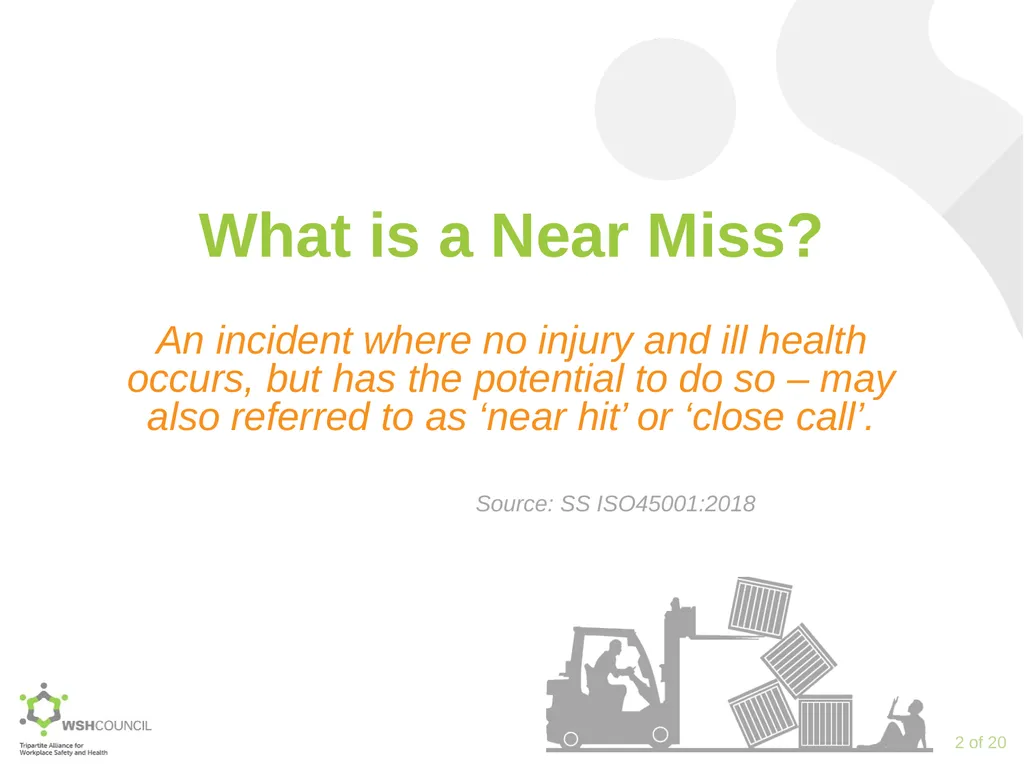
What is a Near Miss?
An incident where no injury and ill health occurs, but has the potential to do so – may also referred to as ‘near hit’ or ‘close call’. Source: SS ISO45001:2018 2 of 20<br>
03
Activity 1: Near Miss vs Accident Explain the difference between:
Unsafe Condition
Unsafe Act
Near Miss
Accident [Allocated time: 10 mins discussion + 10 min presentation] 3 of 20<br>
04
Video - Meet Chef Chan Source: YouTube - Ying Yang Twins by WSH Council 4 of 20<br>
05
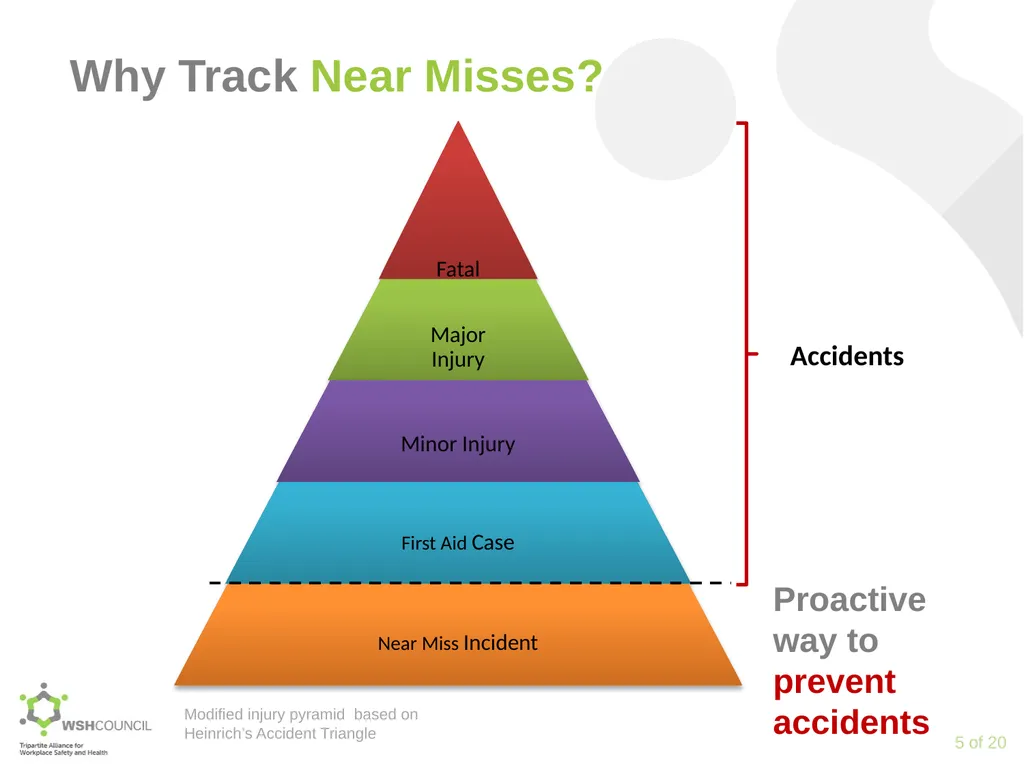
Why Track Near Misses? Modified injury pyramid based on
Heinrich’s Accident Triangle Proactive way to prevent accidents 5 of 20<br>
06
“Companies should report near misses to bring down industrial accident rate.”
Minister of State for Manpower and National Development, Zaqy Mohamad
during launch of Safe Hands Campaign 2019 (Source: Straits Times) 6 of 20<br>
07
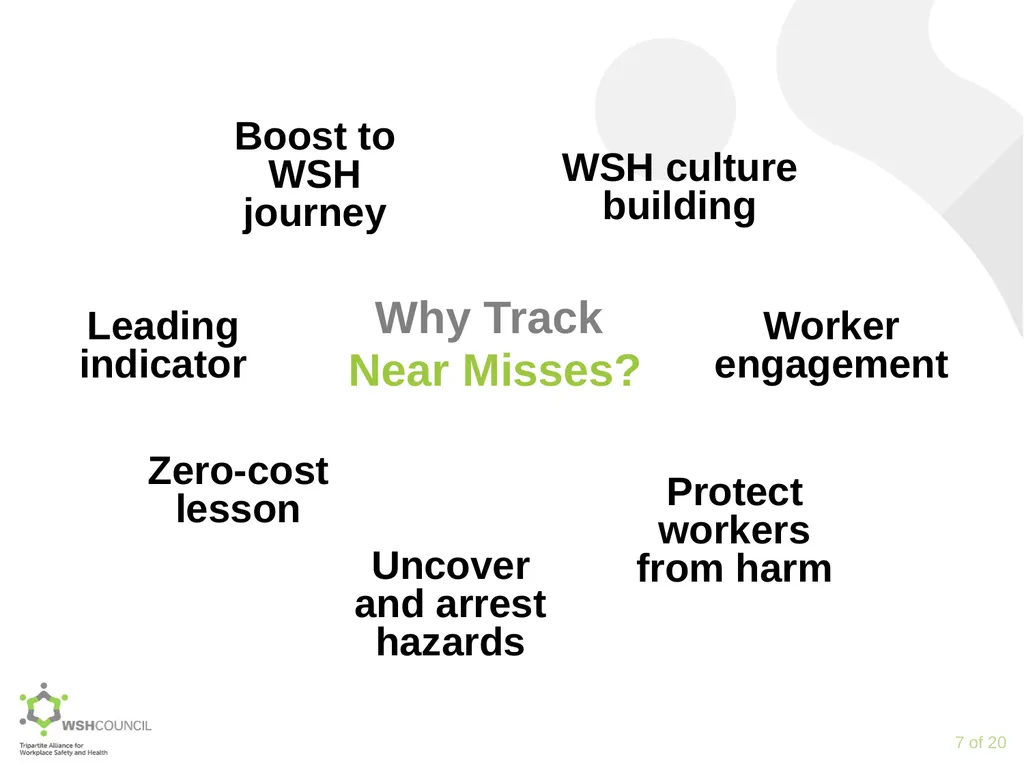
Why Track
Near Misses? Uncover and arrest hazards Leading indicator Boost to WSH journey Worker engagement Zero-cost lesson Protect workers from harm WSH culture building 7 of 20<br>
08
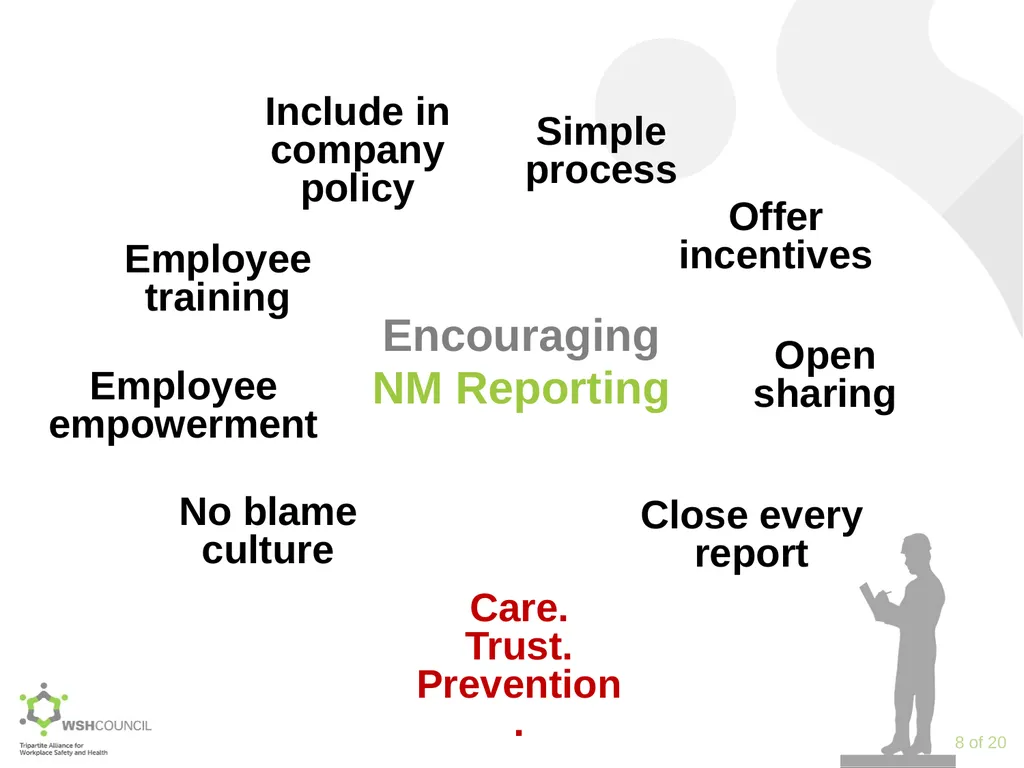
Encouraging
NM Reporting Care. Trust. Prevention. Employee empowerment Employee training Open sharing No blame culture Offer incentives Close every report Simple process Include in company policy 8 of 20<br>
09
Question
Should companies set a quota for NM reports? 9 of 20<br>
10
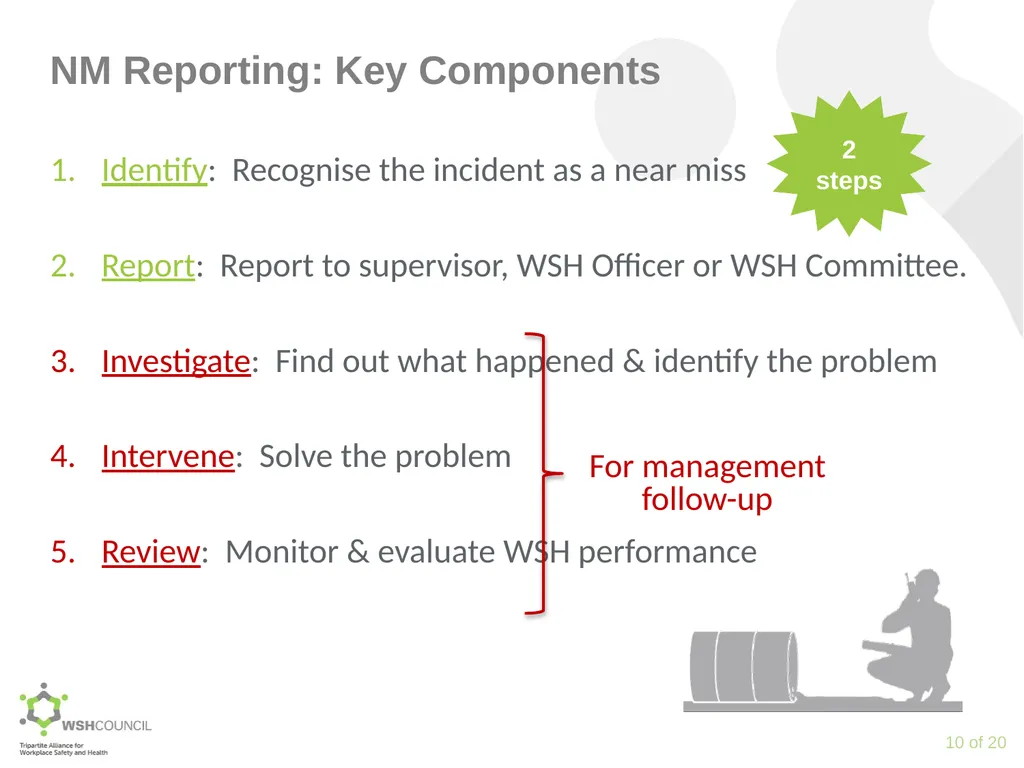
NM Reporting: Key Components Identify: Recognise the incident as a near miss
Report: Report to supervisor, WSH Officer or WSH Committee.
Investigate: Find out what happened & identify the problem
Intervene: Solve the problem
Review: Monitor & evaluate WSH performance For management follow-up 2 steps 10 of 20<br>
11
Step 1 – Identify Recognise the NM incident
You will improve with practice
Refer to past reports for examples
It is OK to work in teams and discuss with your colleagues 11 of 20<br>
12
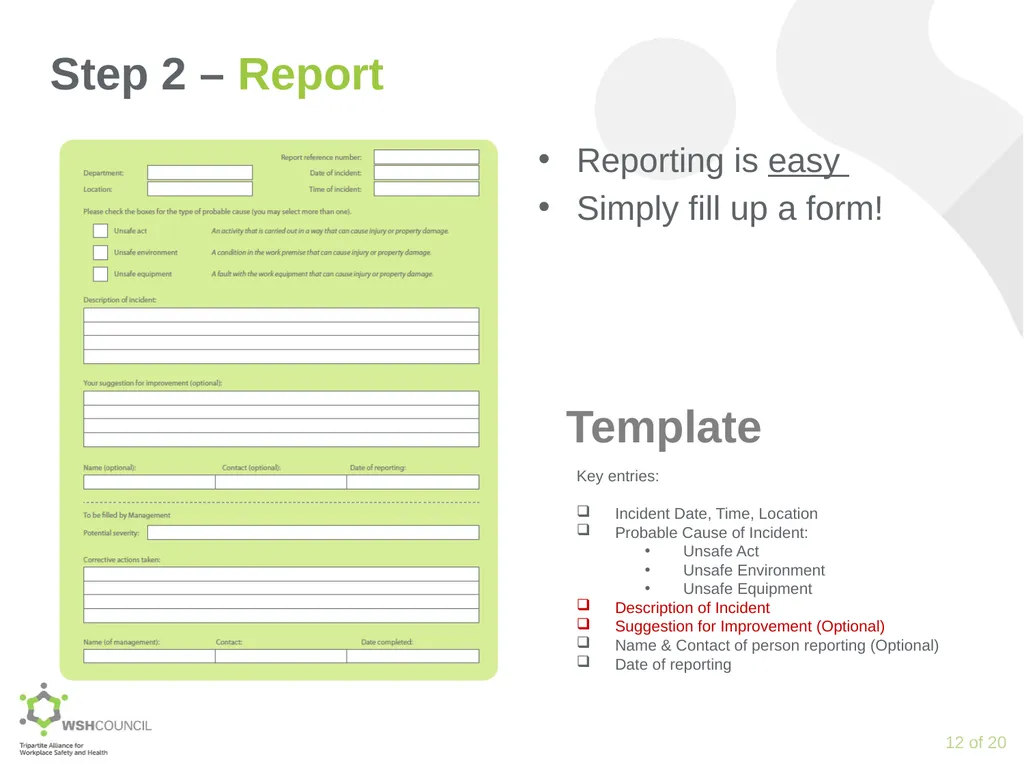
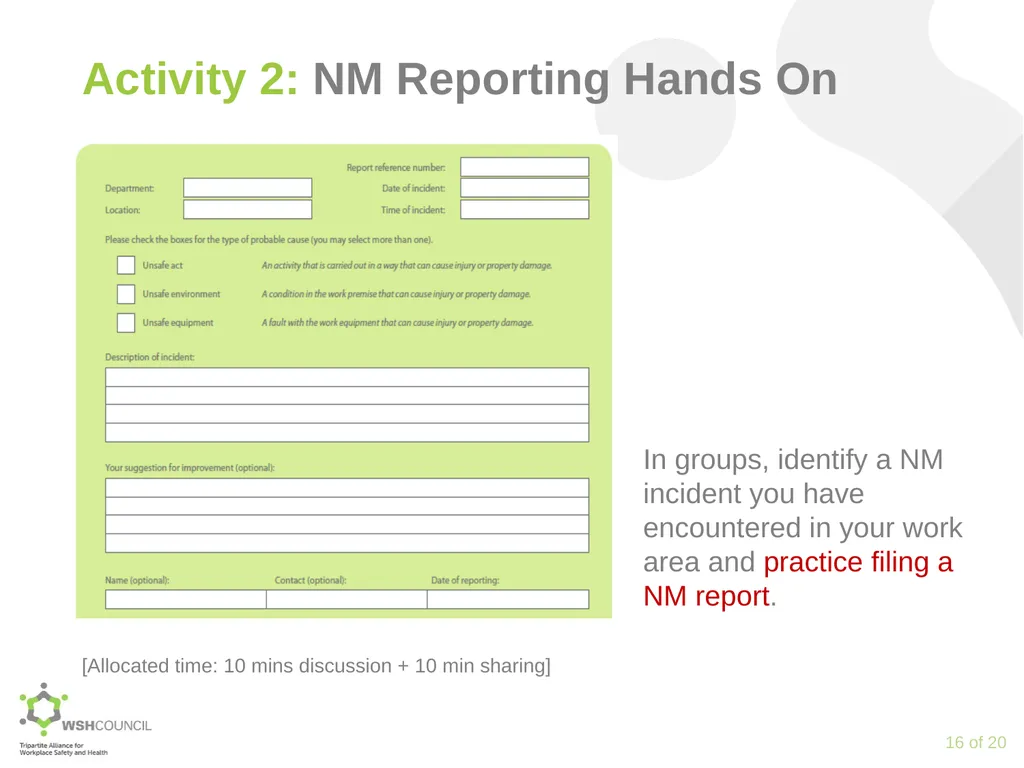
Step 2 – Report Reporting is easy
Simply fill up a form! Template Key entries:
Incident Date, Time, Location
Probable Cause of Incident:
Unsafe Act
Unsafe Environment
Unsafe Equipment
Description of Incident
Suggestion for Improvement (Optional)
Name & Contact of person reporting (Optional)
Date of reporting 12 of 20<br>
13
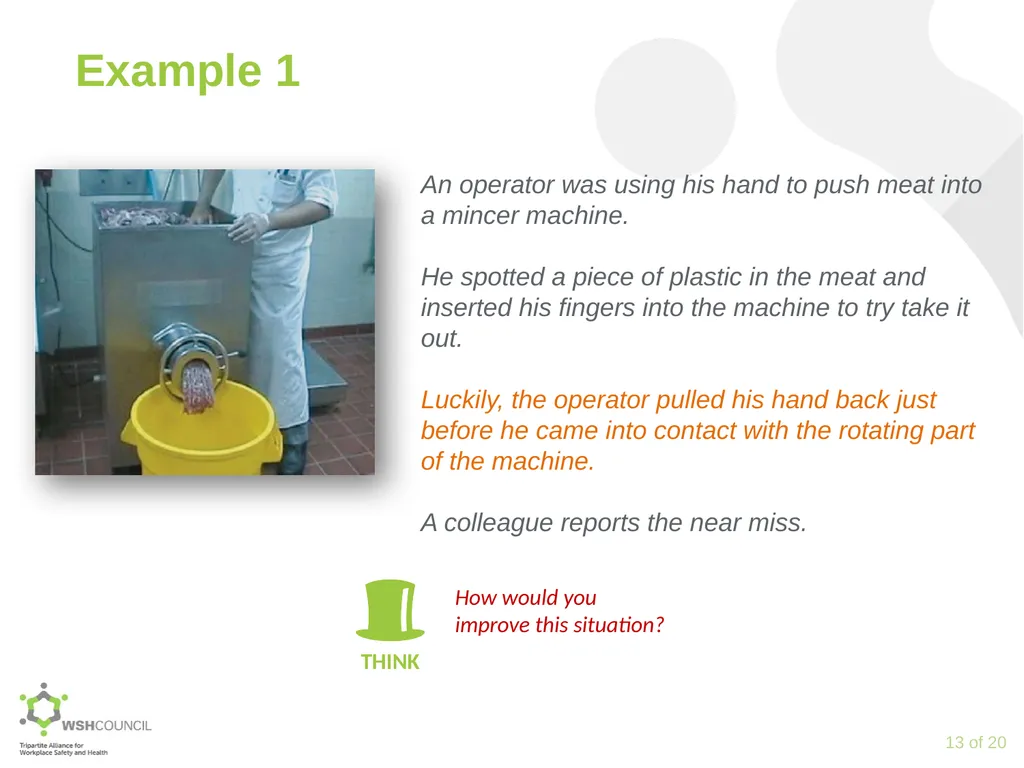
Example 1 An operator was using his hand to push meat into a mincer machine.
He spotted a piece of plastic in the meat and inserted his fingers into the machine to try take it out.
Luckily, the operator pulled his hand back just before he came into contact with the rotating part of the machine.
A colleague reports the near miss. How would you improve this situation? 13 of 20<br>
14
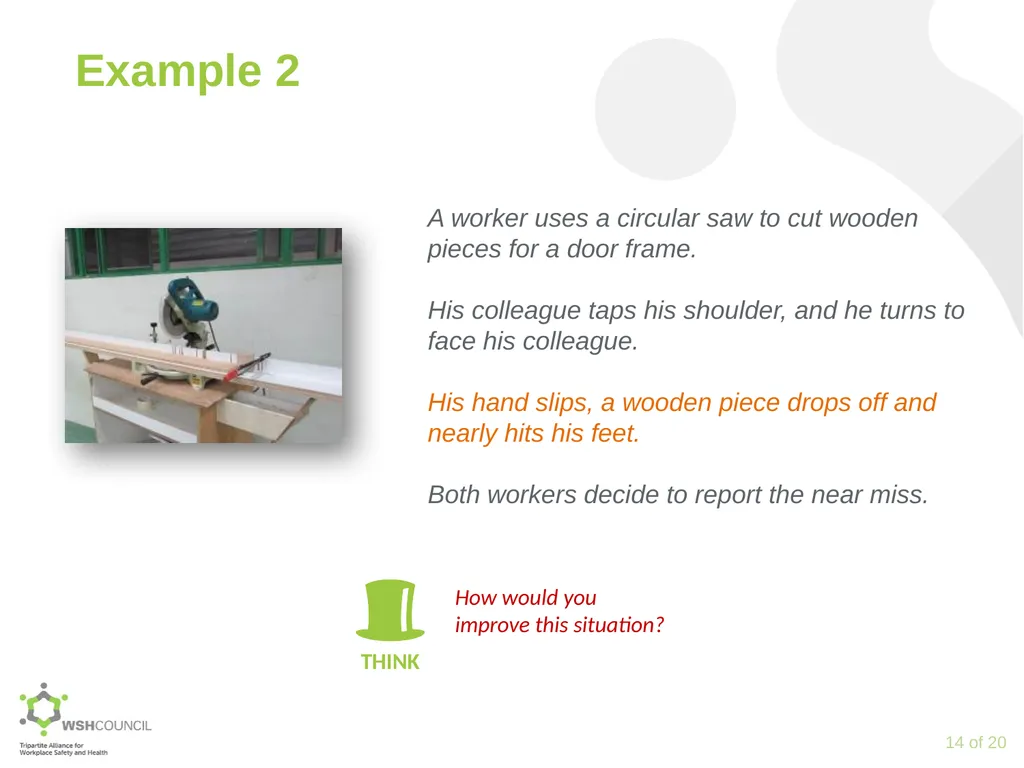
Example 2 A worker uses a circular saw to cut wooden pieces for a door frame.
His colleague taps his shoulder, and he turns to face his colleague.
His hand slips, a wooden piece drops off and nearly hits his feet.
Both workers decide to report the near miss. How would you improve this situation? 14 of 20<br>
15
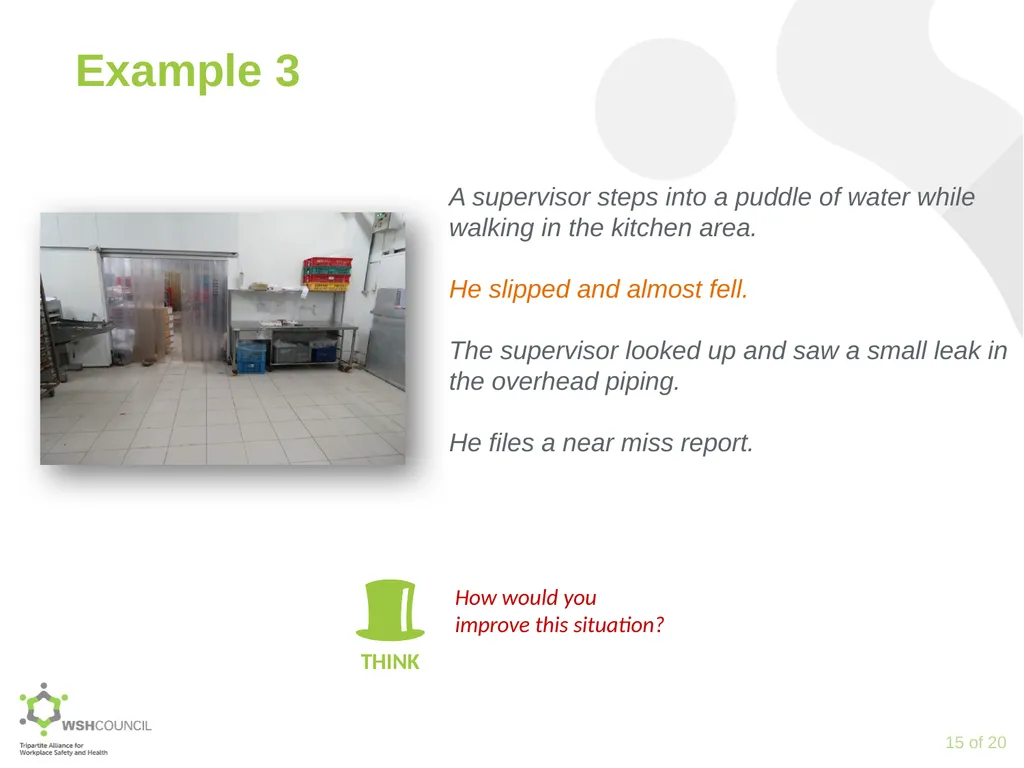
Example 3 A supervisor steps into a puddle of water while walking in the kitchen area.
He slipped and almost fell.
The supervisor looked up and saw a small leak in the overhead piping.
He files a near miss report. How would you improve this situation? 15 of 20<br>
16
Activity 2: NM Reporting Hands On [Allocated time: 10 mins discussion + 10 min sharing] In groups, identify a NM incident you have encountered in your work area and practice filing a NM report. 16 of 20<br>
17
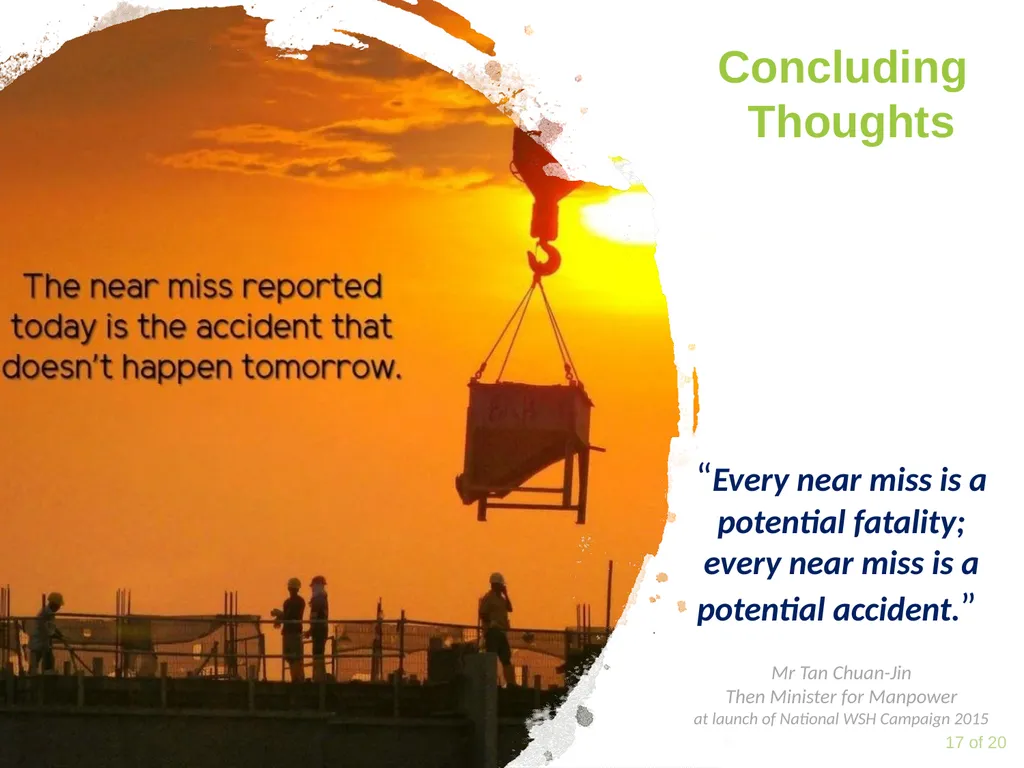
“Every near miss is a potential fatality; every near miss is a potential accident.”
Mr Tan Chuan-Jin
Then Minister for Manpower
at launch of National WSH Campaign 2015 Concluding Thoughts 17 of 20<br>