
Accreditation in Sworn Translation Prerequisites
MJ
Published · 23 slides · 0 views

1 / 1
Description
Accreditation in Sworn Translation Prerequisites Active and paid SATI membership of at least three months (student membership does not qualify), plus A post-secondary language practice qualification plus evidence of at least three years
Related Topics
Share
Embed code
Download this presentation From Below
"Accreditation in Sworn Translation Prerequisites" is the property of its rightful owner. Permission is granted to download and print the materials on this website for personal, non-commercial use only, and to display it on your personal computer provided you do not modify the materials and that you retain all copyright notices contained in the materials. By downloading content from our website, you accept the terms of this agreement.
Presentation Transcript
01
Accreditation in Sworn Translation<br>
02
Prerequisites Active and paid SATI membership of at least three months (student membership does not qualify), plus
A post-secondary language practice qualification plus evidence of at least three years’ language practice work in general translation (with professional references)
If the applicant does not have a post-secondary language practice qualification, evidence of at least five years’ language practice work general translation, with professional references, will be required.
OR
Current SATI accreditation
OR
Membership or current accreditation by a FIT member association accepted by the SATI Council 51 SWORN TRANSLATION Presentation<br>
A post-secondary language practice qualification plus evidence of at least three years’ language practice work in general translation (with professional references)
If the applicant does not have a post-secondary language practice qualification, evidence of at least five years’ language practice work general translation, with professional references, will be required.
OR
Current SATI accreditation
OR
Membership or current accreditation by a FIT member association accepted by the SATI Council 51 SWORN TRANSLATION Presentation<br>
03
Important information Candidates must take a compulsory practice test in sworn translation before applying for the exam.
Candidates must study the SATI sworn translation manual (2020 edition) before applying for the practice test and exam.
Candidates must follow the conventions in the SATI sworn translation manual (2020 edition) to pass the exam.
Candidates should have a legal background or thorough knowledge of the legal systems relevant to the languages they are translating.
Once the candidate passes the accreditation exam, they have to be sworn in at the High Court of South Africa to complete the process. The court application procedure is explained in the SATI sworn translation manual (2020 edition). 51 SWORN TRANSLATION Presentation<br>
Candidates must study the SATI sworn translation manual (2020 edition) before applying for the practice test and exam.
Candidates must follow the conventions in the SATI sworn translation manual (2020 edition) to pass the exam.
Candidates should have a legal background or thorough knowledge of the legal systems relevant to the languages they are translating.
Once the candidate passes the accreditation exam, they have to be sworn in at the High Court of South Africa to complete the process. The court application procedure is explained in the SATI sworn translation manual (2020 edition). 51 SWORN TRANSLATION Presentation<br>
04
The practice test in sworn translation will give candidates an idea of what to expect in the exam.
After taking the test, candidates will be able to determine
whether their legal knowledge is sufficient to pass the accreditation exam; and
whether they understand the correct use of the required certification, translator’s notes and format.
Note that writing the practice test is compulsory, but passing the test is not a guarantee that the candidate will pass the exam. 51 SWORN TRANSLATION Presentation Practice Test<br>
After taking the test, candidates will be able to determine
whether their legal knowledge is sufficient to pass the accreditation exam; and
whether they understand the correct use of the required certification, translator’s notes and format.
Note that writing the practice test is compulsory, but passing the test is not a guarantee that the candidate will pass the exam. 51 SWORN TRANSLATION Presentation Practice Test<br>
05
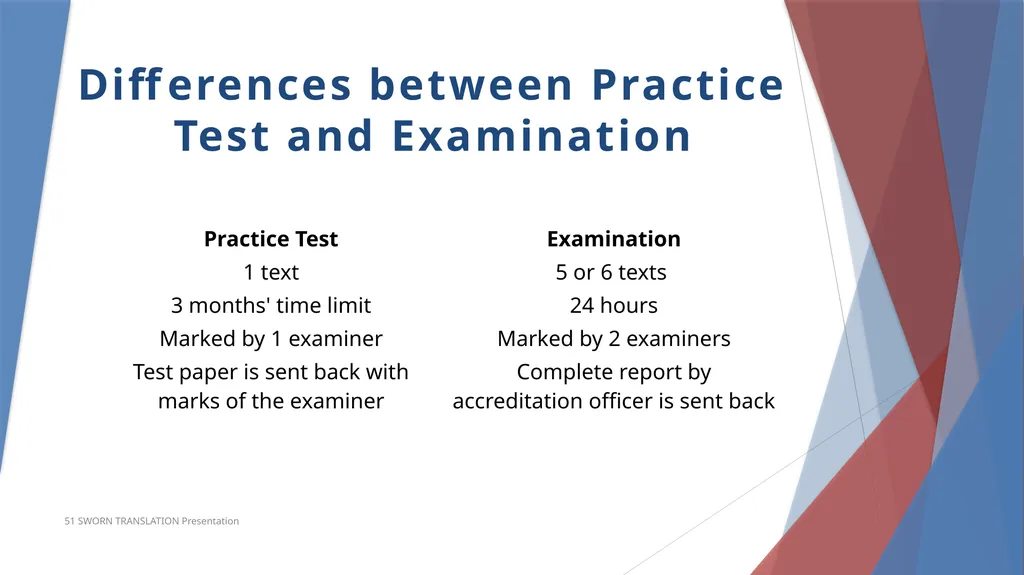
51 SWORN TRANSLATION Presentation Differences between Practice Test and Examination<br>
06
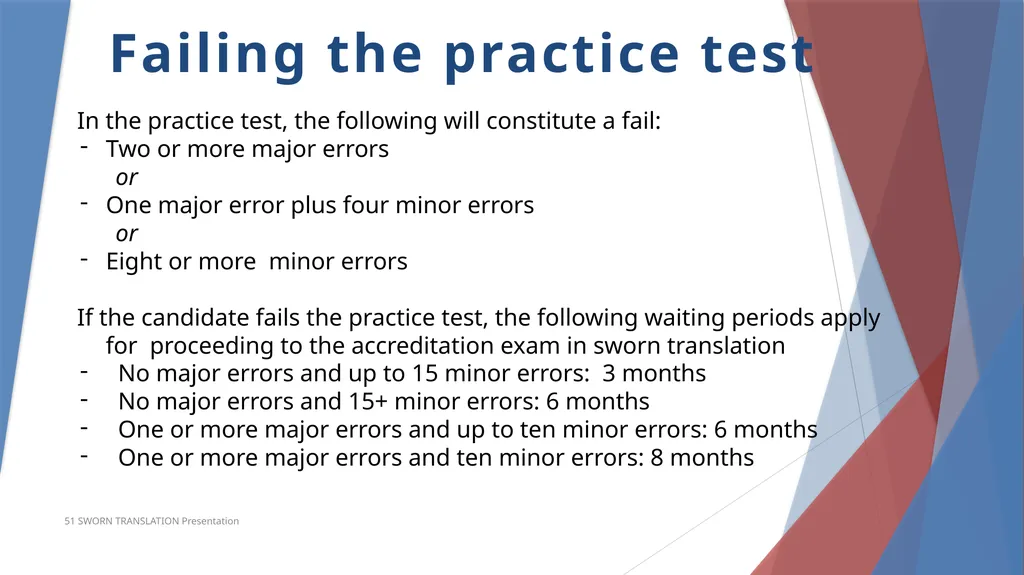
In the practice test, the following will constitute a fail:
Two or more major errors
or
One major error plus four minor errors
or
Eight or more minor errors
If the candidate fails the practice test, the following waiting periods apply for proceeding to the accreditation exam in sworn translation
No major errors and up to 15 minor errors: 3 months
No major errors and 15+ minor errors: 6 months
One or more major errors and up to ten minor errors: 6 months
One or more major errors and ten minor errors: 8 months 51 SWORN TRANSLATION Presentation Failing the practice test<br>
Two or more major errors
or
One major error plus four minor errors
or
Eight or more minor errors
If the candidate fails the practice test, the following waiting periods apply for proceeding to the accreditation exam in sworn translation
No major errors and up to 15 minor errors: 3 months
No major errors and 15+ minor errors: 6 months
One or more major errors and up to ten minor errors: 6 months
One or more major errors and ten minor errors: 8 months 51 SWORN TRANSLATION Presentation Failing the practice test<br>
07
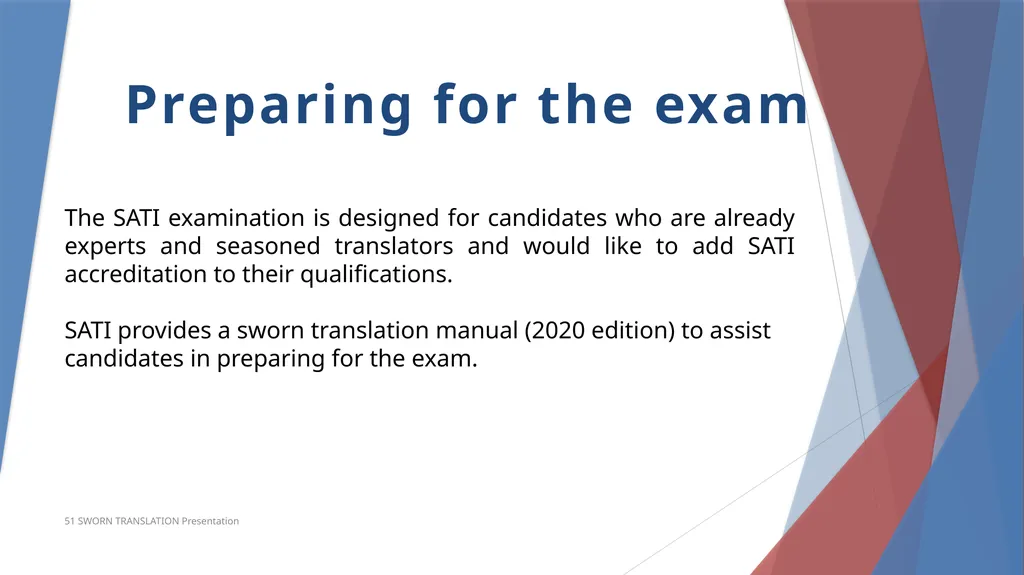
Preparing for the exam The SATI examination is designed for candidates who are already experts and seasoned translators and would like to add SATI accreditation to their qualifications.
SATI provides a sworn translation manual (2020 edition) to assist candidates in preparing for the exam. 51 SWORN TRANSLATION Presentation<br>
SATI provides a sworn translation manual (2020 edition) to assist candidates in preparing for the exam. 51 SWORN TRANSLATION Presentation<br>
08
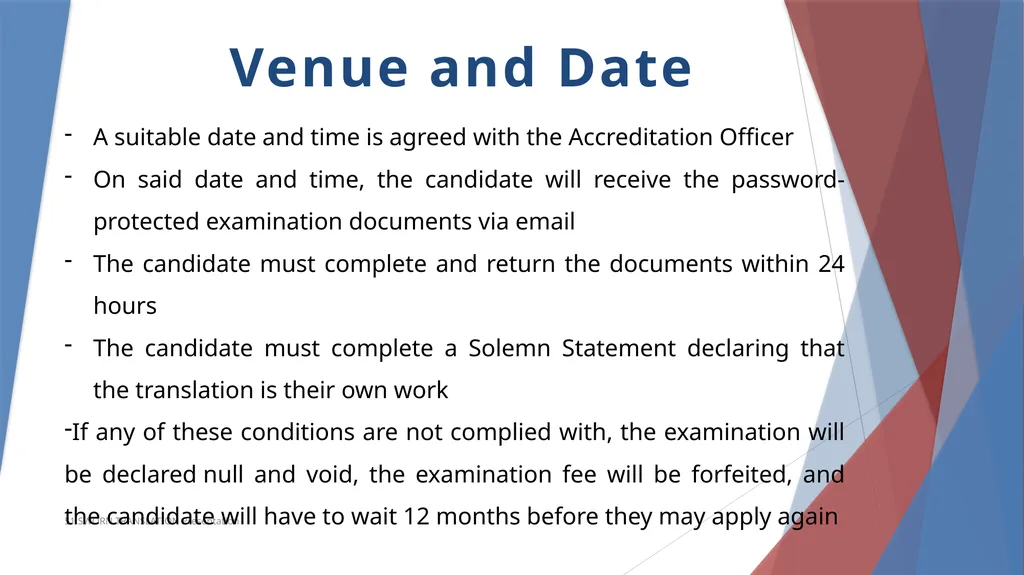
A suitable date and time is agreed with the Accreditation Officer
On said date and time, the candidate will receive the password-protected examination documents via email
The candidate must complete and return the documents within 24 hours
The candidate must complete a Solemn Statement declaring that the translation is their own work
If any of these conditions are not complied with, the examination will be declared null and void, the examination fee will be forfeited, and the candidate will have to wait 12 months before they may apply again 51 SWORN TRANSLATION Presentation Venue and Date<br>
On said date and time, the candidate will receive the password-protected examination documents via email
The candidate must complete and return the documents within 24 hours
The candidate must complete a Solemn Statement declaring that the translation is their own work
If any of these conditions are not complied with, the examination will be declared null and void, the examination fee will be forfeited, and the candidate will have to wait 12 months before they may apply again 51 SWORN TRANSLATION Presentation Venue and Date<br>
09
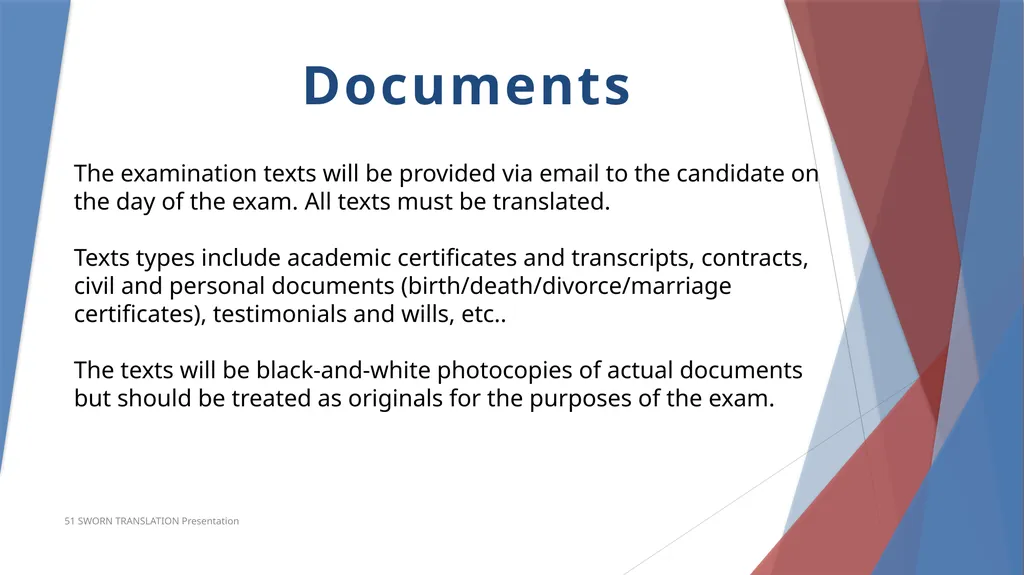
Documents The examination texts will be provided via email to the candidate on the day of the exam. All texts must be translated.
Texts types include academic certificates and transcripts, contracts, civil and personal documents (birth/death/divorce/marriage certificates), testimonials and wills, etc..
The texts will be black-and-white photocopies of actual documents but should be treated as originals for the purposes of the exam. 51 SWORN TRANSLATION Presentation<br>
Texts types include academic certificates and transcripts, contracts, civil and personal documents (birth/death/divorce/marriage certificates), testimonials and wills, etc..
The texts will be black-and-white photocopies of actual documents but should be treated as originals for the purposes of the exam. 51 SWORN TRANSLATION Presentation<br>
10
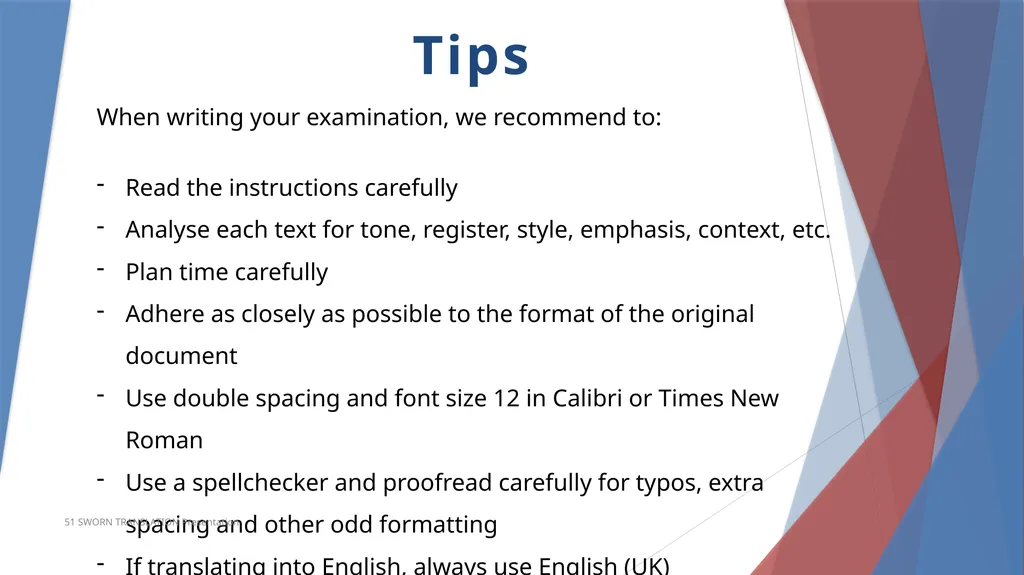
Tips When writing your examination, we recommend to:
Read the instructions carefully
Analyse each text for tone, register, style, emphasis, context, etc.
Plan time carefully
Adhere as closely as possible to the format of the original document
Use double spacing and font size 12 in Calibri or Times New Roman
Use a spellchecker and proofread carefully for typos, extra spacing and other odd formatting
If translating into English, always use English (UK) 51 SWORN TRANSLATION Presentation<br>
Read the instructions carefully
Analyse each text for tone, register, style, emphasis, context, etc.
Plan time carefully
Adhere as closely as possible to the format of the original document
Use double spacing and font size 12 in Calibri or Times New Roman
Use a spellchecker and proofread carefully for typos, extra spacing and other odd formatting
If translating into English, always use English (UK) 51 SWORN TRANSLATION Presentation<br>
11
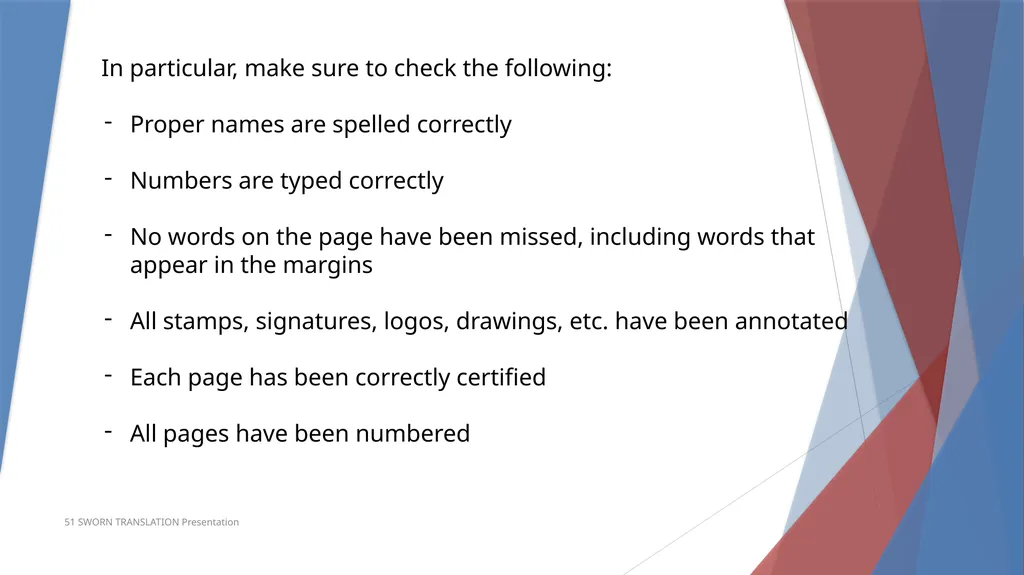
In particular, make sure to check the following:
Proper names are spelled correctly
Numbers are typed correctly
No words on the page have been missed, including words that appear in the margins
All stamps, signatures, logos, drawings, etc. have been annotated
Each page has been correctly certified
All pages have been numbered 51 SWORN TRANSLATION Presentation<br>
Proper names are spelled correctly
Numbers are typed correctly
No words on the page have been missed, including words that appear in the margins
All stamps, signatures, logos, drawings, etc. have been annotated
Each page has been correctly certified
All pages have been numbered 51 SWORN TRANSLATION Presentation<br>
12
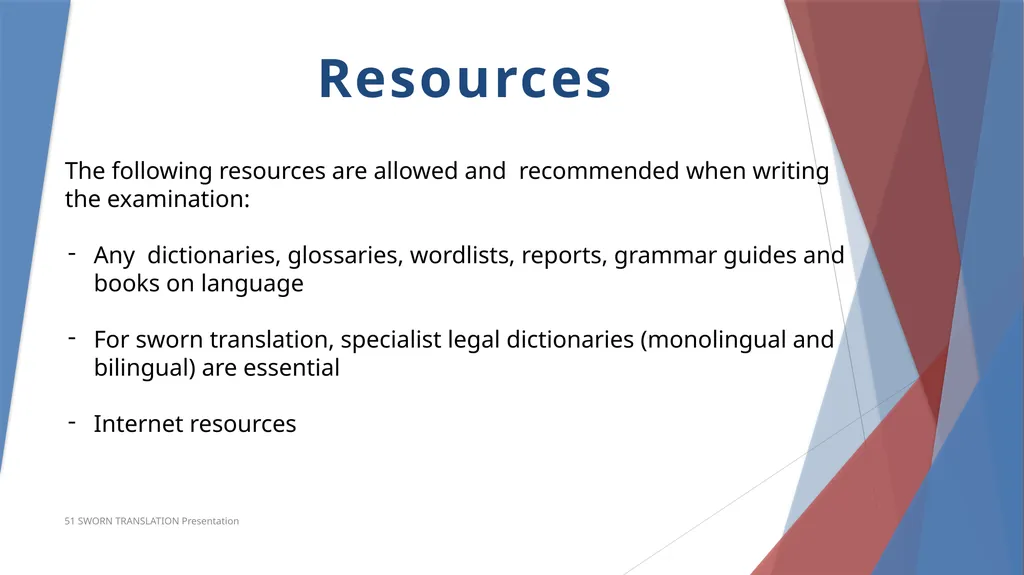
Resources The following resources are allowed and recommended when writing the examination:
Any dictionaries, glossaries, wordlists, reports, grammar guides and books on language
For sworn translation, specialist legal dictionaries (monolingual and bilingual) are essential
Internet resources 51 SWORN TRANSLATION Presentation<br>
Any dictionaries, glossaries, wordlists, reports, grammar guides and books on language
For sworn translation, specialist legal dictionaries (monolingual and bilingual) are essential
Internet resources 51 SWORN TRANSLATION Presentation<br>
13
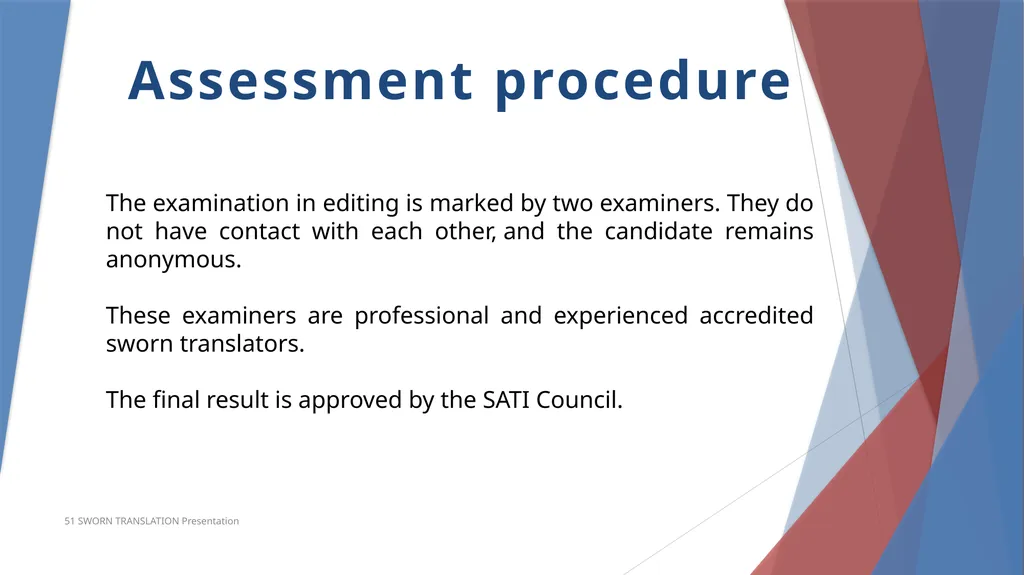
Assessment procedure The examination in editing is marked by two examiners. They do not have contact with each other, and the candidate remains anonymous.
These examiners are professional and experienced accredited sworn translators.
The final result is approved by the SATI Council. 51 SWORN TRANSLATION Presentation<br>
These examiners are professional and experienced accredited sworn translators.
The final result is approved by the SATI Council. 51 SWORN TRANSLATION Presentation<br>
14
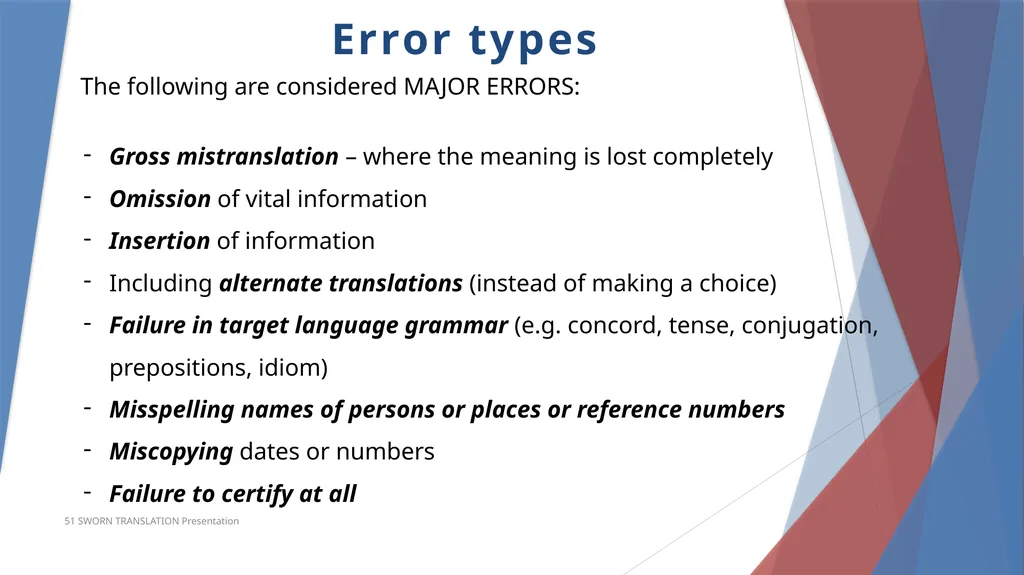
Error types The following are considered MAJOR ERRORS:
Gross mistranslation – where the meaning is lost completely
Omission of vital information
Insertion of information
Including alternate translations (instead of making a choice)
Failure in target language grammar (e.g. concord, tense, conjugation, prepositions, idiom)
Misspelling names of persons or places or reference numbers
Miscopying dates or numbers
Failure to certify at all 51 SWORN TRANSLATION Presentation<br>
Gross mistranslation – where the meaning is lost completely
Omission of vital information
Insertion of information
Including alternate translations (instead of making a choice)
Failure in target language grammar (e.g. concord, tense, conjugation, prepositions, idiom)
Misspelling names of persons or places or reference numbers
Miscopying dates or numbers
Failure to certify at all 51 SWORN TRANSLATION Presentation<br>
15
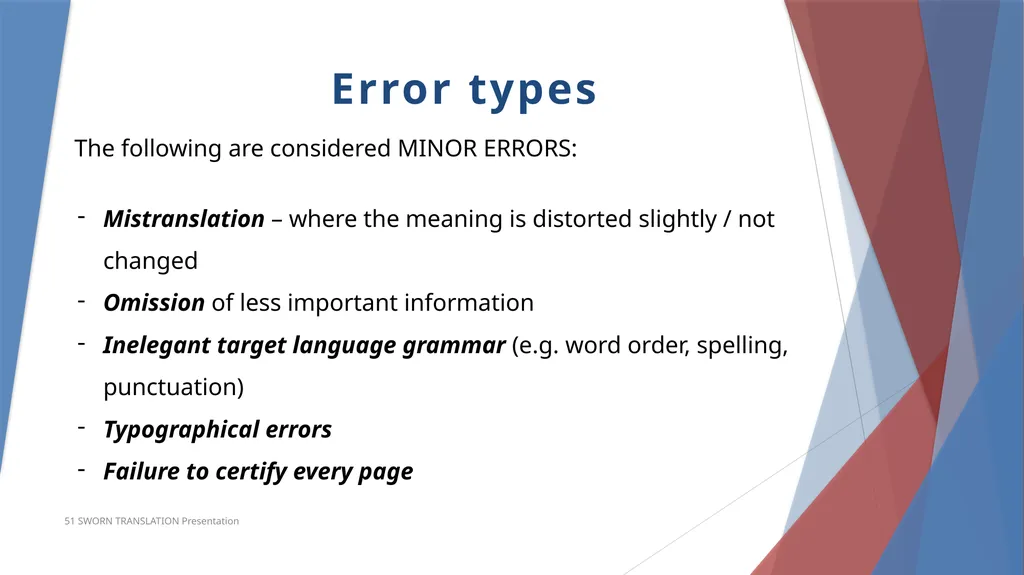
The following are considered MINOR ERRORS:
Mistranslation – where the meaning is distorted slightly / not changed
Omission of less important information
Inelegant target language grammar (e.g. word order, spelling, punctuation)
Typographical errors
Failure to certify every page 51 SWORN TRANSLATION Presentation Error types<br>
Mistranslation – where the meaning is distorted slightly / not changed
Omission of less important information
Inelegant target language grammar (e.g. word order, spelling, punctuation)
Typographical errors
Failure to certify every page 51 SWORN TRANSLATION Presentation Error types<br>
16
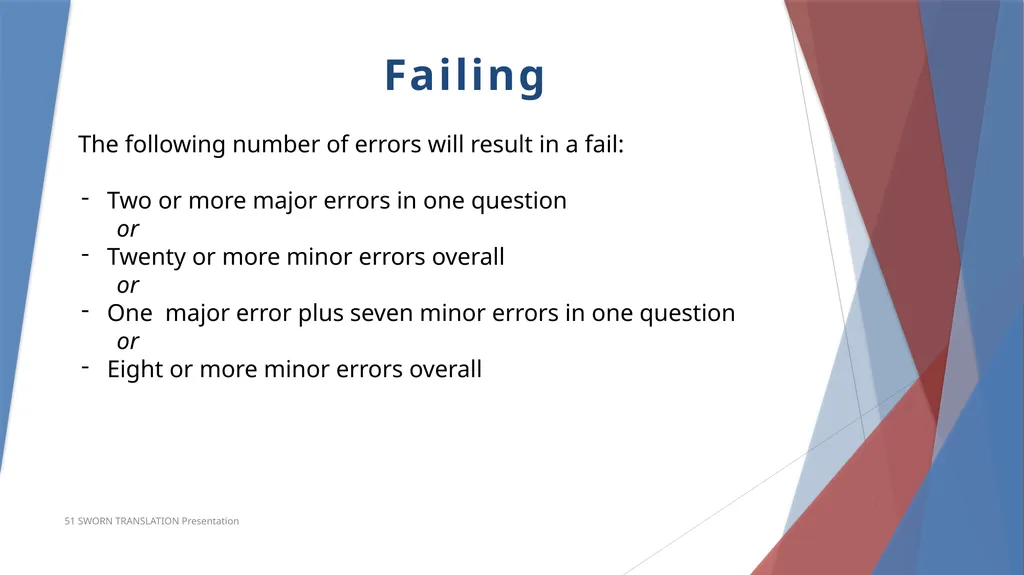
Failing The following number of errors will result in a fail:
Two or more major errors in one question
or
Twenty or more minor errors overall
or
One major error plus seven minor errors in one question
or
Eight or more minor errors overall 51 SWORN TRANSLATION Presentation<br>
Two or more major errors in one question
or
Twenty or more minor errors overall
or
One major error plus seven minor errors in one question
or
Eight or more minor errors overall 51 SWORN TRANSLATION Presentation<br>
17
Other The following aspects are also considered:
The target text must stand as a text in its own right, it must read like an original
The equivalent pass mark (e.g., in an academic exam) would be around 90%
Candidates are allowed to use annotations (footnotes) to communicate with the examiner, for instance to explain a particular decision. However, annotations should be used sparingly. 51 SWORN TRANSLATION Presentation<br>
The target text must stand as a text in its own right, it must read like an original
The equivalent pass mark (e.g., in an academic exam) would be around 90%
Candidates are allowed to use annotations (footnotes) to communicate with the examiner, for instance to explain a particular decision. However, annotations should be used sparingly. 51 SWORN TRANSLATION Presentation<br>
18
Results The examination's assessment can take up to six weeks. Candidates will receive a report with a selection of examiners’ comments.
Note:
Not all errors will be listed in the report
Candidates will not see their marked scripts
Candidates cannot discuss their results with the accreditation officer 51 SWORN TRANSLATION Presentation<br>
Note:
Not all errors will be listed in the report
Candidates will not see their marked scripts
Candidates cannot discuss their results with the accreditation officer 51 SWORN TRANSLATION Presentation<br>
19
Accreditation certification Successful candidates:
Will receive an accreditation certificate
Will be listed on SATI’s website as accredited members
May use their accreditation status in communication with clients, i.e., in an email signature
Please note: passing the exam does not make you a sworn translator, the process will be completed after the sworn-in event at the High Court. 51 SWORN TRANSLATION Presentation<br>
Will receive an accreditation certificate
Will be listed on SATI’s website as accredited members
May use their accreditation status in communication with clients, i.e., in an email signature
Please note: passing the exam does not make you a sworn translator, the process will be completed after the sworn-in event at the High Court. 51 SWORN TRANSLATION Presentation<br>
20
Unsuccessful result If a candidate fails to meet the required standard for accreditation in sworn translation on the day of the examination, they may apply to re-take the exam after one year.
The candidate should read the comments carefully and follow the advice given. 51 SWORN TRANSLATION Presentation<br>
The candidate should read the comments carefully and follow the advice given. 51 SWORN TRANSLATION Presentation<br>
21
Appeal A candidate who wants to lodge an appeal should submit the application form and proof of payment within 8 weeks after having received the result.
The original examination script will be marked by a third examiner and that report will be the final result. No further correspondence will be entered into after the final result is made available.
If the ‘Fail’ result is overturned, the candidate will be refunded for the appeal and will be considered accredited in sworn translation. 51 SWORN TRANSLATION Presentation<br>
The original examination script will be marked by a third examiner and that report will be the final result. No further correspondence will be entered into after the final result is made available.
If the ‘Fail’ result is overturned, the candidate will be refunded for the appeal and will be considered accredited in sworn translation. 51 SWORN TRANSLATION Presentation<br>
22
Accreditation validity Accreditation remains valid as long as the language practitioner remains a member of SATI.
Accreditation lapses when membership lapses. Should the practitioner wish to become re-accredited, they will have to re-apply to do the examination and pass it again. 51 SWORN TRANSLATION Presentation<br>
Accreditation lapses when membership lapses. Should the practitioner wish to become re-accredited, they will have to re-apply to do the examination and pass it again. 51 SWORN TRANSLATION Presentation<br>
23
For more info, please email SATI's Accreditation Officer Erica du Preez:
accreditation@translators.org.za<br>