
Achieving Gaming Goals What we will cover.
T
Published · 36 slides · 0 views

1 / 1

Description
Achieving Gaming Goals What we will cover. Planning Architecture Goals in RTS type games Multi-Tiered AI Framework Sonys Goal Tree Implementation Console-Based Achievements Game-Based Achievements Planning Architecture Game Analysis Plan
Related Topics
Share
Embed code
Download this presentation From Below
"Achieving Gaming Goals What we will cover." is the property of its rightful owner. Permission is granted to download and print the materials on this website for personal, non-commercial use only, and to display it on your personal computer provided you do not modify the materials and that you retain all copyright notices contained in the materials. By downloading content from our website, you accept the terms of this agreement.
Presentation Transcript
01
Achieving Gaming Goals<br>
02
What we will cover. Planning Architecture
Goals in RTS type games
Multi-Tiered AI Framework
Sony’s Goal Tree Implementation
Console-Based Achievements
Game-Based Achievements<br>
Goals in RTS type games
Multi-Tiered AI Framework
Sony’s Goal Tree Implementation
Console-Based Achievements
Game-Based Achievements<br>
03
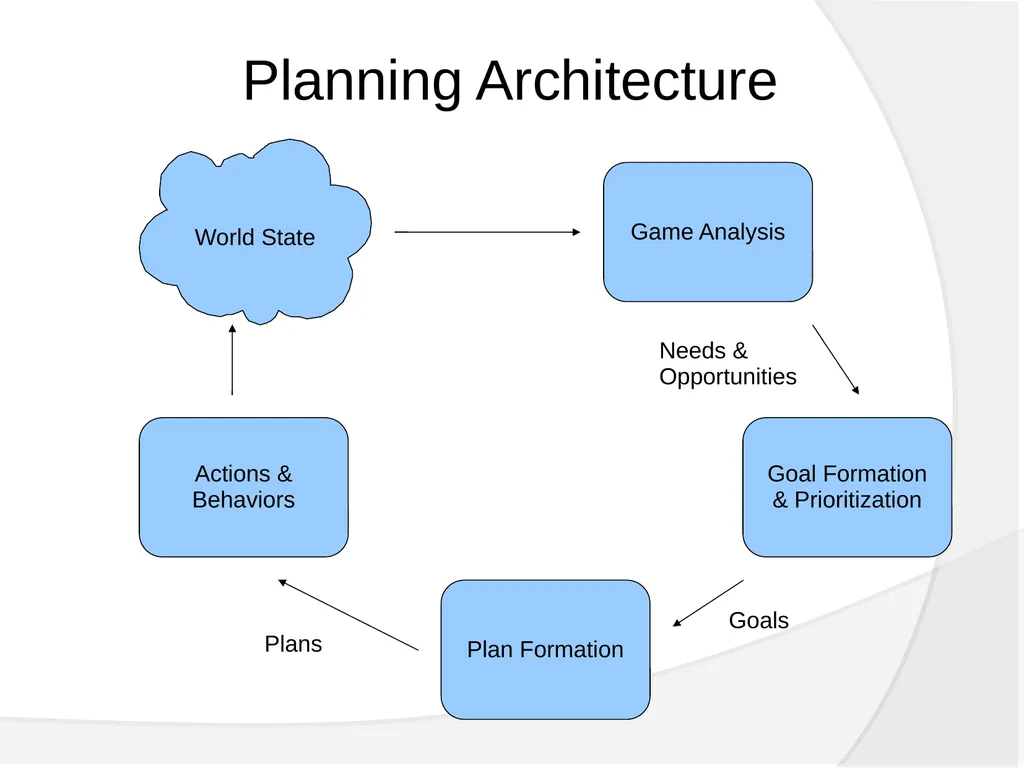
Planning Architecture Game Analysis Plan Formation Actions &
Behaviors Goal Formation
& Prioritization World State Needs &
Opportunities Goals Plans<br>
Behaviors Goal Formation
& Prioritization World State Needs &
Opportunities Goals Plans<br>
04
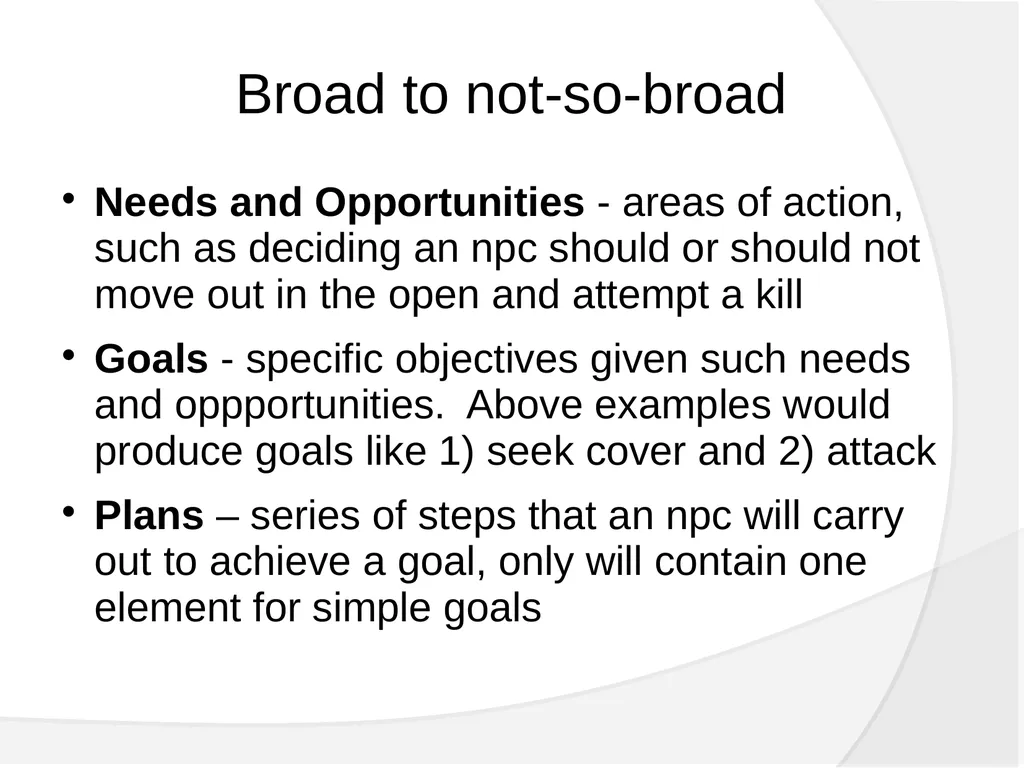
Broad to not-so-broad Needs and Opportunities - areas of action, such as deciding an npc should or should not move out in the open and attempt a kill
Goals - specific objectives given such needs and oppportunities. Above examples would produce goals like 1) seek cover and 2) attack
Plans – series of steps that an npc will carry out to achieve a goal, only will contain one element for simple goals<br>
Goals - specific objectives given such needs and oppportunities. Above examples would produce goals like 1) seek cover and 2) attack
Plans – series of steps that an npc will carry out to achieve a goal, only will contain one element for simple goals<br>
05
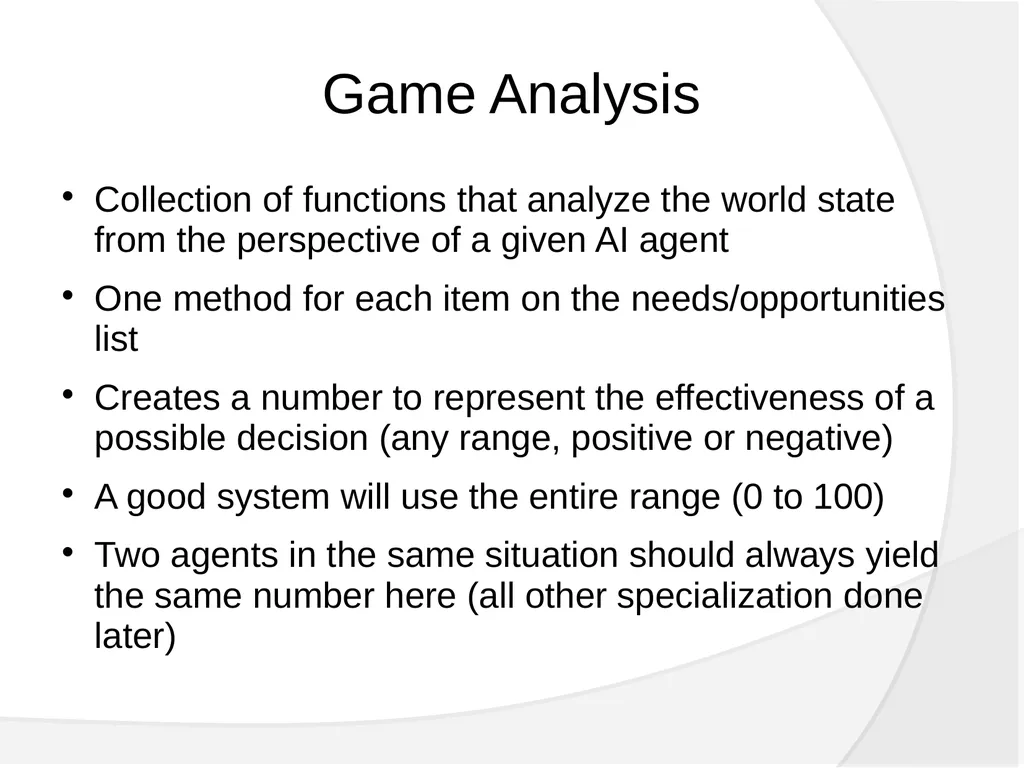
Game Analysis Collection of functions that analyze the world state from the perspective of a given AI agent
One method for each item on the needs/opportunities list
Creates a number to represent the effectiveness of a possible decision (any range, positive or negative)
A good system will use the entire range (0 to 100)
Two agents in the same situation should always yield the same number here (all other specialization done later)<br>
One method for each item on the needs/opportunities list
Creates a number to represent the effectiveness of a possible decision (any range, positive or negative)
A good system will use the entire range (0 to 100)
Two agents in the same situation should always yield the same number here (all other specialization done later)<br>
06
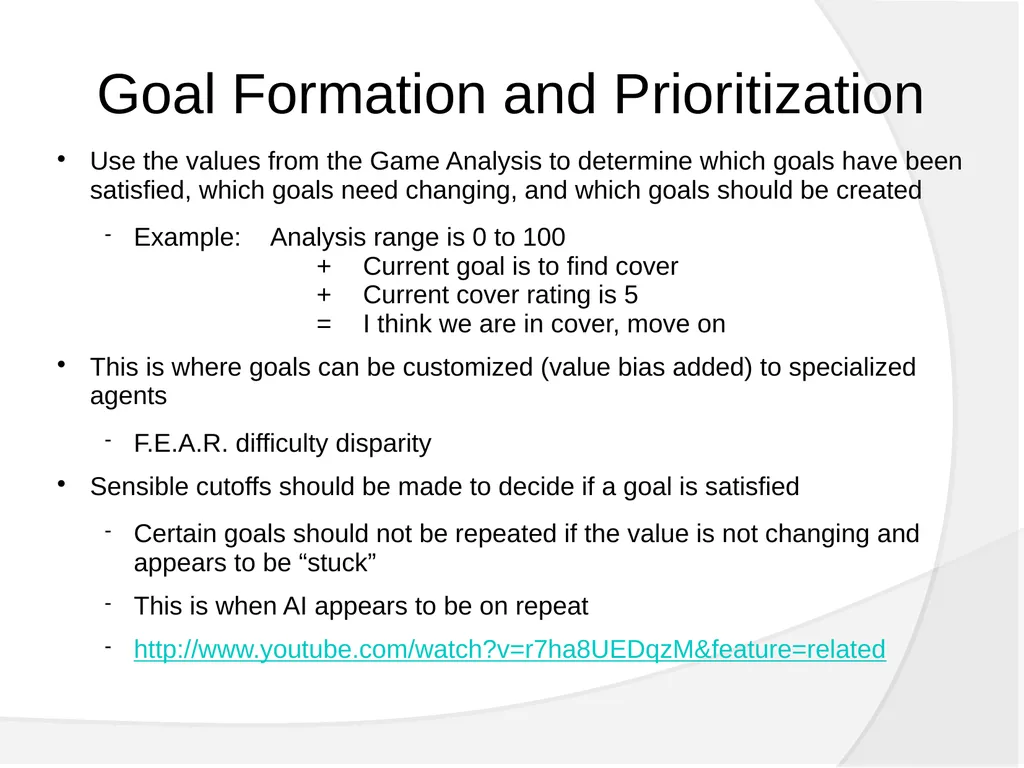
Goal Formation and Prioritization Use the values from the Game Analysis to determine which goals have been satisfied, which goals need changing, and which goals should be created
Example: Analysis range is 0 to 100 + Current goal is to find cover + Current cover rating is 5 = I think we are in cover, move on
This is where goals can be customized (value bias added) to specialized agents
F.E.A.R. difficulty disparity
Sensible cutoffs should be made to decide if a goal is satisfied
Certain goals should not be repeated if the value is not changing and appears to be “stuck”
This is when AI appears to be on repeat
http://www.youtube.com/watch?v=r7ha8UEDqzM&feature=related<br>
Example: Analysis range is 0 to 100 + Current goal is to find cover + Current cover rating is 5 = I think we are in cover, move on
This is where goals can be customized (value bias added) to specialized agents
F.E.A.R. difficulty disparity
Sensible cutoffs should be made to decide if a goal is satisfied
Certain goals should not be repeated if the value is not changing and appears to be “stuck”
This is when AI appears to be on repeat
http://www.youtube.com/watch?v=r7ha8UEDqzM&feature=related<br>
07
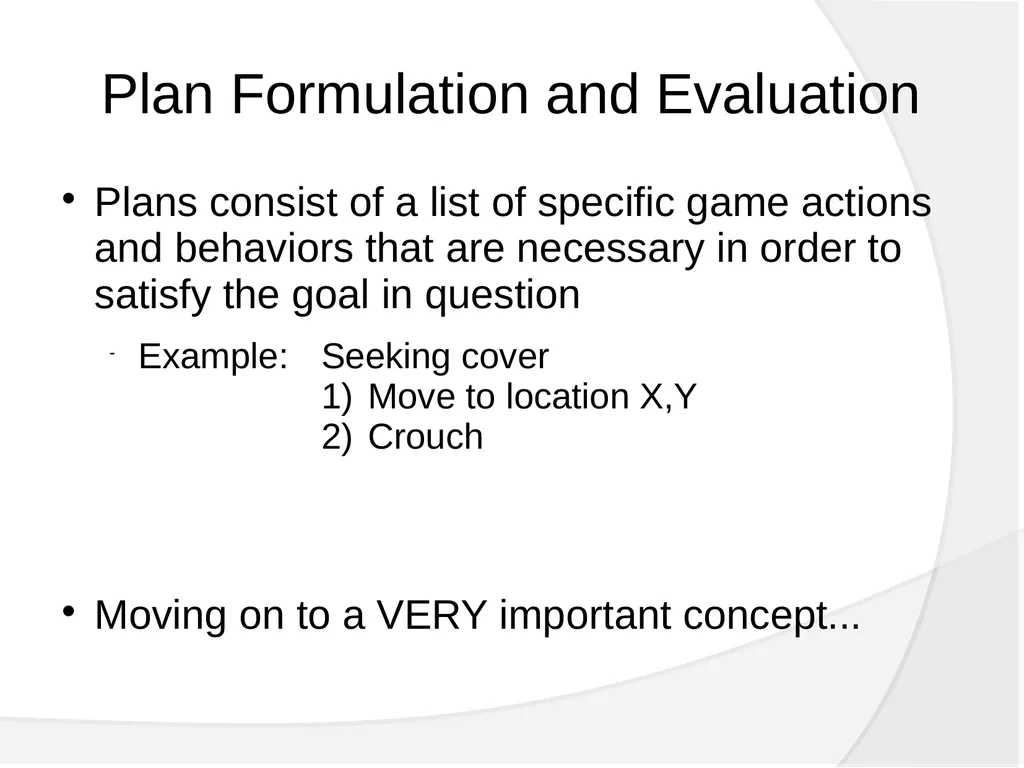
Plan Formulation and Evaluation Plans consist of a list of specific game actions and behaviors that are necessary in order to satisfy the goal in question
Example: Seeking cover 1) Move to location X,Y 2) Crouch
Moving on to a VERY important concept...<br>
Example: Seeking cover 1) Move to location X,Y 2) Crouch
Moving on to a VERY important concept...<br>
08
There is more than one way to achieve a goal Most good games have several ways of attaining the same goal
Age Of Empires: Goal: Winning
conquering enemy
accumulating wealth by extensive trading and diplomacy
building and defending wonders of the world
We will cover RTS games<br>
Age Of Empires: Goal: Winning
conquering enemy
accumulating wealth by extensive trading and diplomacy
building and defending wonders of the world
We will cover RTS games<br>
09
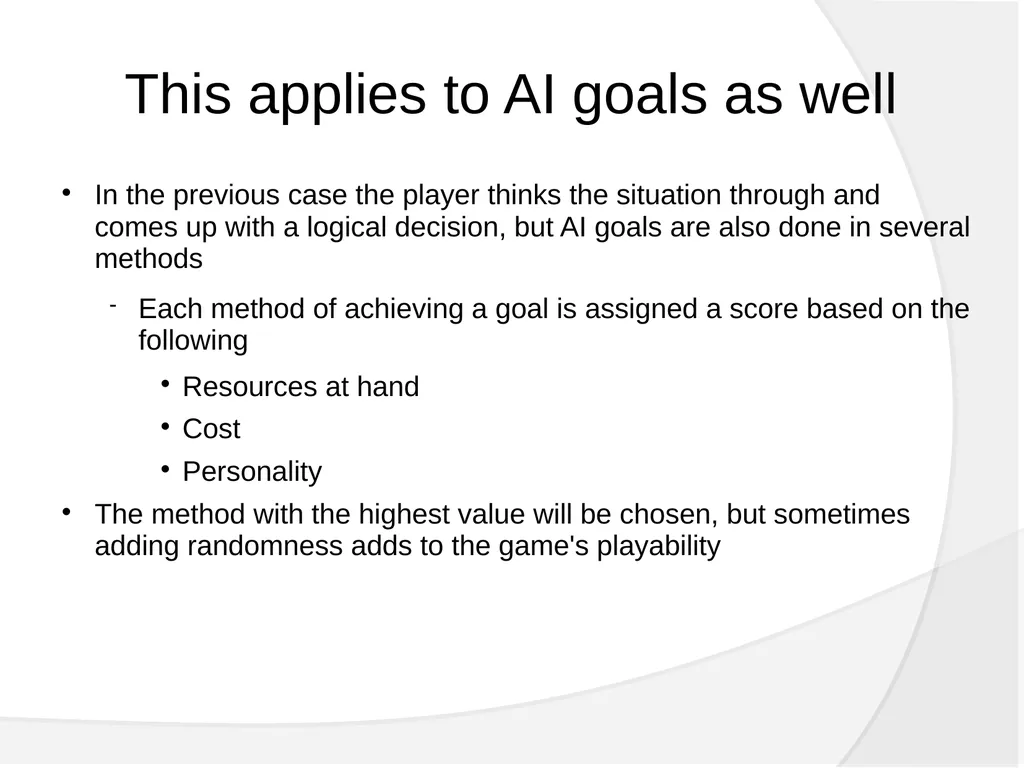
This applies to AI goals as well In the previous case the player thinks the situation through and comes up with a logical decision, but AI goals are also done in several methods
Each method of achieving a goal is assigned a score based on the following
Resources at hand
Cost
Personality
The method with the highest value will be chosen, but sometimes adding randomness adds to the game's playability<br>
Each method of achieving a goal is assigned a score based on the following
Resources at hand
Cost
Personality
The method with the highest value will be chosen, but sometimes adding randomness adds to the game's playability<br>
10
Converting Plans into Actions and Behaviors Now that you have analyzed all possibilities and methods of completing these possible goals, the coding only determines what goals will be applied first and obtains appropriate resources to carry out these goals
If current goal is to build a Supply Depot (cost of 100 minerals) and the bot currently has 73 minerals, the behavior would obviously be to mine more minerals until the requirement is met
Will not cause an issue because we have already prioritized the goals<br>
If current goal is to build a Supply Depot (cost of 100 minerals) and the bot currently has 73 minerals, the behavior would obviously be to mine more minerals until the requirement is met
Will not cause an issue because we have already prioritized the goals<br>
11
Goals and RTS We're going to cover the philosophy that AI can to an extent reason through situations rather that solely using scripting to execute predictable responses
One architecture that supports such a philosophy is known as The Goal Engine Architecture
Elements of the engine:
Actors
Goals
Egos
The Think Cycle
The Reactive Cycle<br>
One architecture that supports such a philosophy is known as The Goal Engine Architecture
Elements of the engine:
Actors
Goals
Egos
The Think Cycle
The Reactive Cycle<br>
12
Actors Anything that is controlled by a human or AI player or that has an effect on the game
Immobile Actors (Buildings)
Defensive Structures – buildings that can attack things (photon cannon)
Economic Buildings – buildings that provide nonmilitary advantage (supply depot)
Mobile Actors (Units)
Military Units – units that can attack things (goliath)
Builders – units that construct and/or repair buildings (drone)
Has a CV (combat value)
A 50 CV unit can beat 2 20 CV units, but not 3<br>
Immobile Actors (Buildings)
Defensive Structures – buildings that can attack things (photon cannon)
Economic Buildings – buildings that provide nonmilitary advantage (supply depot)
Mobile Actors (Units)
Military Units – units that can attack things (goliath)
Builders – units that construct and/or repair buildings (drone)
Has a CV (combat value)
A 50 CV unit can beat 2 20 CV units, but not 3<br>
13
Goals Exactly how described before (actions a player or AI can take)
Goals are active or inactive
Base priority – Takes into account the current game state
Fuzzy Factor: Random bonus value added to the base priority of each goal
Goal Inertia: Random bonus value added to the base priority of all goals 'thought' of last cycle
Need to find golden mean between Fuzzy Factor and Goal Inertia
Current priority – Same as base but also considers resources<br>
Goals are active or inactive
Base priority – Takes into account the current game state
Fuzzy Factor: Random bonus value added to the base priority of each goal
Goal Inertia: Random bonus value added to the base priority of all goals 'thought' of last cycle
Need to find golden mean between Fuzzy Factor and Goal Inertia
Current priority – Same as base but also considers resources<br>
14
Egos Sets of values that define the AI's behavior
Headcrab Ego
Not preoccupied with self-preservation
Will lunge at an enemy within distance despite the environment
Completely offense-oriented
Each AI can have several egos that change with the game state
Headcrab will occasional just want to chill on a guy's head and make him attack you<br>
Headcrab Ego
Not preoccupied with self-preservation
Will lunge at an enemy within distance despite the environment
Completely offense-oriented
Each AI can have several egos that change with the game state
Headcrab will occasional just want to chill on a guy's head and make him attack you<br>
15
The Think Cycle Each cycle of the engine is called a think and has the following steps
1) Select the appropriate ego
2) Delete finished goals and cull inactive ones from list of consideration
3) Calculate the base priority of each active goal
4) Assign initial resources to the goals to make sure high priority goals can be accomplished before low priority goals consume resources
5) Optimize resources to increase total current priority
6) Mark every goal that has enough resources assigned to make execution possible as selected, send commands to actors involved
Each 'think' is computationally expensive therefore should only be done occasionally<br>
Each 'think' is computationally expensive therefore should only be done occasionally<br>
16
The Reactive AI Picks up where the goal engine leaves off, selecting movement formations, coordinating arrival of actors, ordering damaged units to retreat, selecting targets
Handles second-to-second decisions that 'thinks' take too long to execute
Acts as a babysitter for the more broad-minded think cycle while it is away<br>
Handles second-to-second decisions that 'thinks' take too long to execute
Acts as a babysitter for the more broad-minded think cycle while it is away<br>
17
RTS Goals in action – Attack Goal First the friendly CV / hostile CV ratio is calculated
Friendly CV is the sum of:
Total CV of units performing the attack
Total CV of units performing attack or defense goals nearby
Combined Arms Bonus based on the CV of units assigned if they are unit types that work well together, acts as a multiplier
One exception for applying CV values
Step through areas needed to travel through to get to target area
If they include any hostile forces, the CV is set to 0 for that unit<br>
Friendly CV is the sum of:
Total CV of units performing the attack
Total CV of units performing attack or defense goals nearby
Combined Arms Bonus based on the CV of units assigned if they are unit types that work well together, acts as a multiplier
One exception for applying CV values
Step through areas needed to travel through to get to target area
If they include any hostile forces, the CV is set to 0 for that unit<br>
18
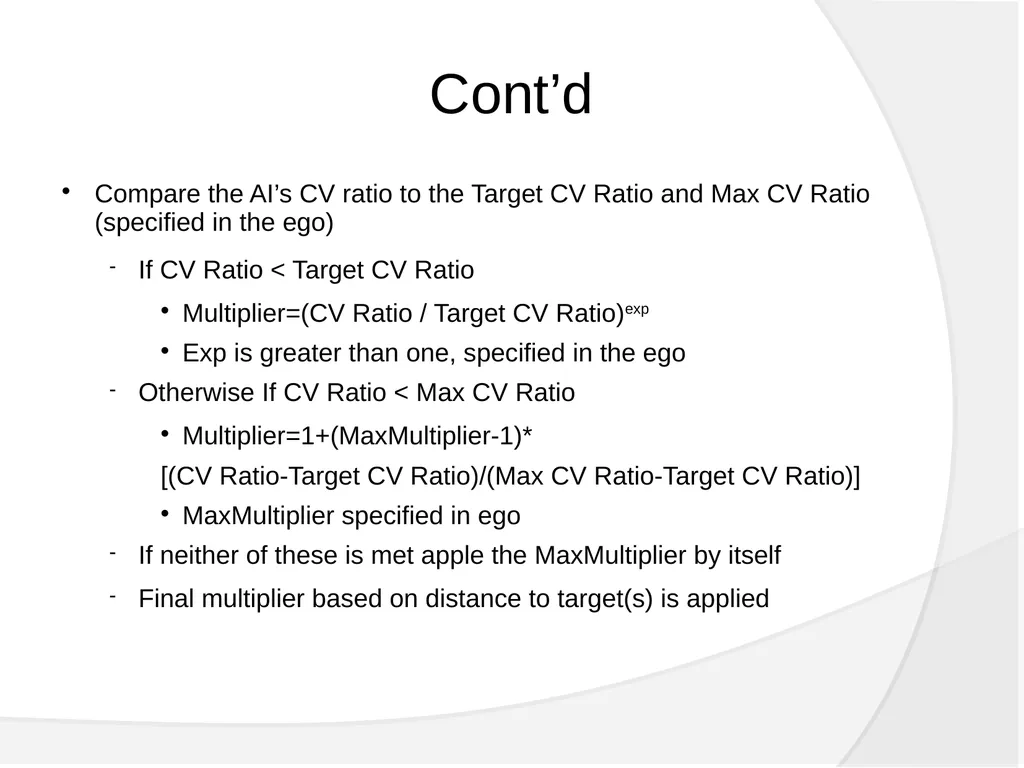
Cont’d Compare the AI’s CV ratio to the Target CV Ratio and Max CV Ratio (specified in the ego)
If CV Ratio < Target CV Ratio
Multiplier=(CV Ratio / Target CV Ratio)exp
Exp is greater than one, specified in the ego
Otherwise If CV Ratio < Max CV Ratio
Multiplier=1+(MaxMultiplier-1)*
[(CV Ratio-Target CV Ratio)/(Max CV Ratio-Target CV Ratio)]
MaxMultiplier specified in ego
If neither of these is met apple the MaxMultiplier by itself
Final multiplier based on distance to target(s) is applied<br>
If CV Ratio < Target CV Ratio
Multiplier=(CV Ratio / Target CV Ratio)exp
Exp is greater than one, specified in the ego
Otherwise If CV Ratio < Max CV Ratio
Multiplier=1+(MaxMultiplier-1)*
[(CV Ratio-Target CV Ratio)/(Max CV Ratio-Target CV Ratio)]
MaxMultiplier specified in ego
If neither of these is met apple the MaxMultiplier by itself
Final multiplier based on distance to target(s) is applied<br>
19
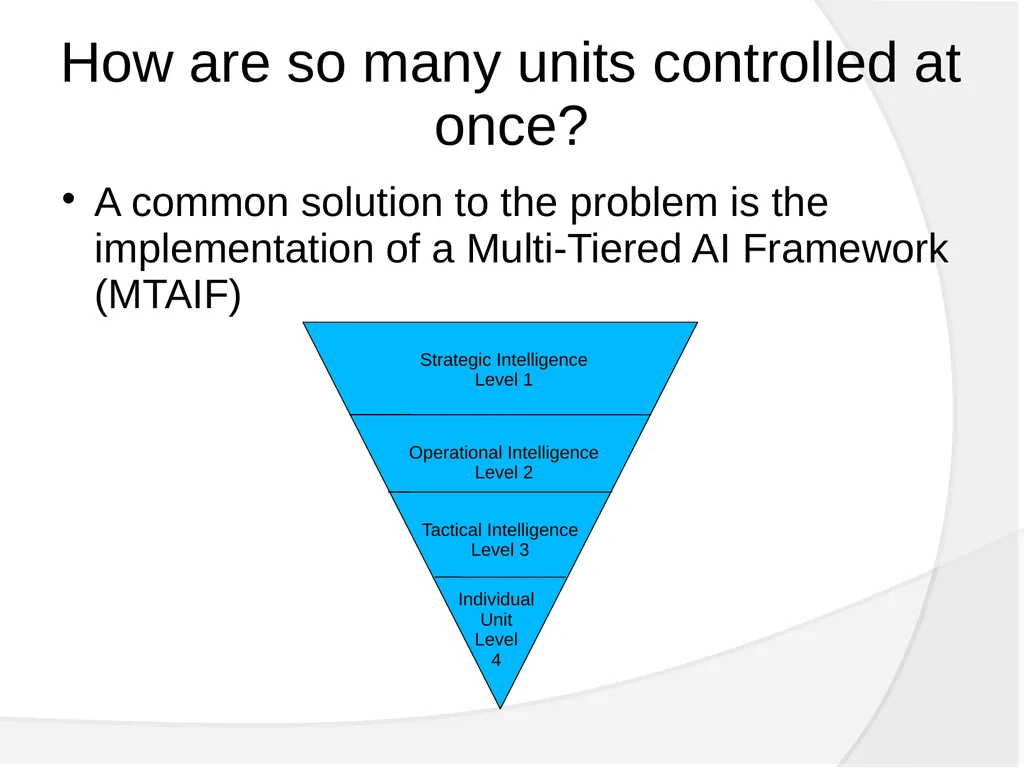
How are so many units controlled at once? A common solution to the problem is the implementation of a Multi-Tiered AI Framework (MTAIF) Strategic Intelligence
Level 1 Operational Intelligence
Level 2 Tactical Intelligence
Level 3 Individual
Unit
Level
4<br>
Level 1 Operational Intelligence
Level 2 Tactical Intelligence
Level 3 Individual
Unit
Level
4<br>
20
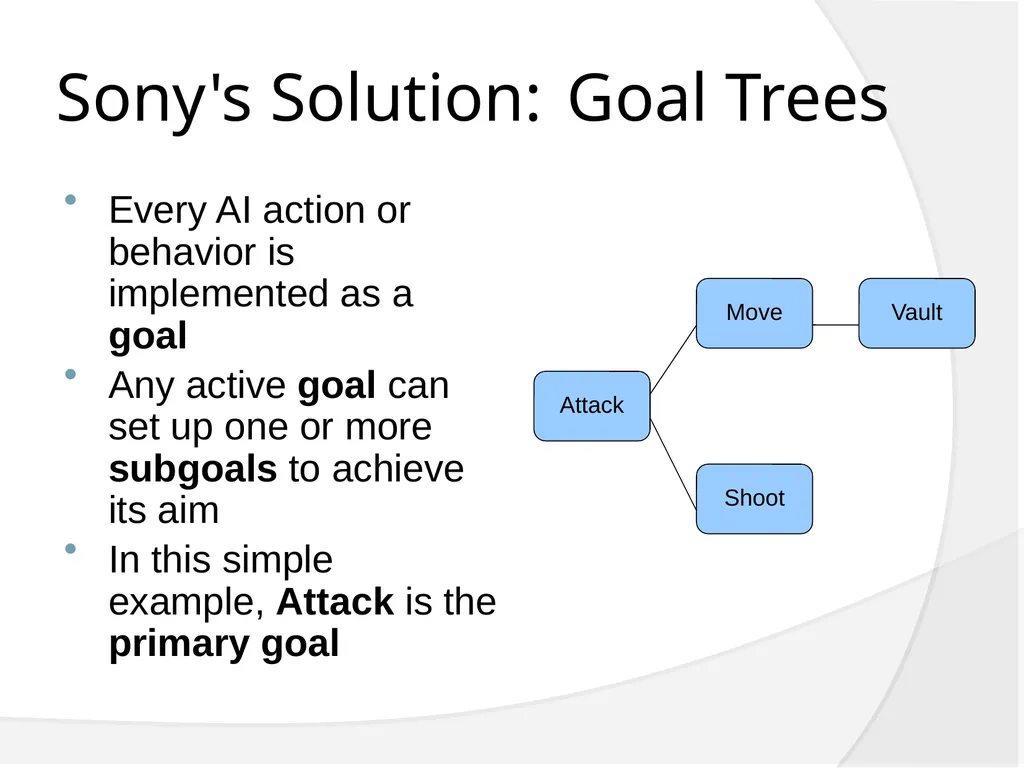
Sony's Solution: Goal Trees Every AI action or behavior is implemented as a goal
Any active goal can set up one or more subgoals to achieve its aim
In this simple example, Attack is the primary goal Attack Move Shoot Vault<br>
Any active goal can set up one or more subgoals to achieve its aim
In this simple example, Attack is the primary goal Attack Move Shoot Vault<br>
21
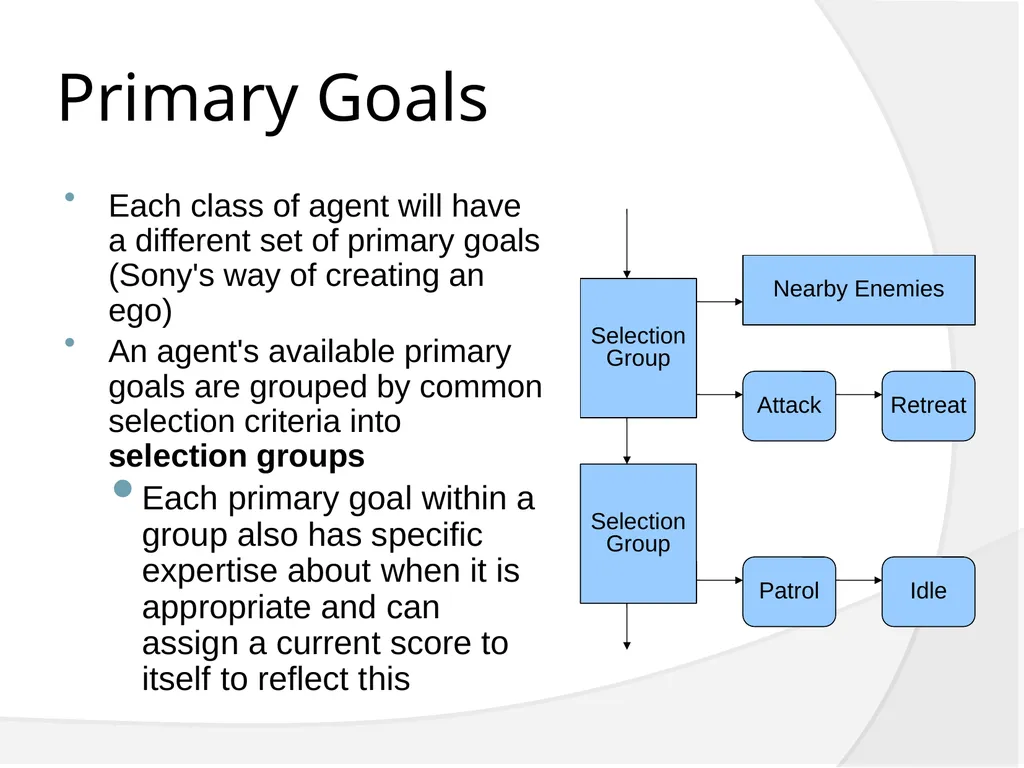
Primary Goals Each class of agent will have a different set of primary goals (Sony's way of creating an ego)
An agent's available primary goals are grouped by common selection criteria into selection groups
Each primary goal within a group also has specific expertise about when it is appropriate and can assign a current score to itself to reflect this Selection Group Selection Group Nearby Enemies Attack Retreat Patrol Idle<br>
An agent's available primary goals are grouped by common selection criteria into selection groups
Each primary goal within a group also has specific expertise about when it is appropriate and can assign a current score to itself to reflect this Selection Group Selection Group Nearby Enemies Attack Retreat Patrol Idle<br>
22
Attacking the “Stuck” Issue Very common and serious issue
Solution(?):
A time-limited boost is given to goal selection scores
When an AI is doomed to be “stuck”, the current goal temporarily loses its dominating value and a more realistic goal takes over<br>
Solution(?):
A time-limited boost is given to goal selection scores
When an AI is doomed to be “stuck”, the current goal temporarily loses its dominating value and a more realistic goal takes over<br>
23
Controlling the Agent Each goal is directly responsible for changing the state of the agent
Inducing movement, firing, and animations
All goals are subclasses of a base Goal class with the following functions:
virtual void OnSelected() { }
Called when the goal becomes active
Initialize any change in the state of the agent
virtual void Update() { }
Refreshes the state of the agent
Monitors the progress of subgoals
virtual void OnDeselected() { }
Called when the goal becomes inactive
Clean up any change in the state of the agent<br>
Inducing movement, firing, and animations
All goals are subclasses of a base Goal class with the following functions:
virtual void OnSelected() { }
Called when the goal becomes active
Initialize any change in the state of the agent
virtual void Update() { }
Refreshes the state of the agent
Monitors the progress of subgoals
virtual void OnDeselected() { }
Called when the goal becomes inactive
Clean up any change in the state of the agent<br>
24
More Controlling The amount that the Update() function is called depends on the goal
Movement is updated every frame for fluidity
Attacks are updated within seconds of each other
The game needs to recursively traverse the entire goal tree to check for goals that need updating
Attack might not need updating, but Vault might<br>
Movement is updated every frame for fluidity
Attacks are updated within seconds of each other
The game needs to recursively traverse the entire goal tree to check for goals that need updating
Attack might not need updating, but Vault might<br>
25
Subgoal Creation The OnSelected() and Update() goals are both commonly used to create subgoals using the following process:
Choose the subgoal
Initialize the subgoal
Place subgoal in the “array” (Sony really means Linked List)
Base class supplies these functions:
void AddSubGoal(int slot, Goal* pGoal);
pGoal is the Parent Goal
void RemoveSubgoal(int slot);
Removes all subgoals as well<br>
Choose the subgoal
Initialize the subgoal
Place subgoal in the “array” (Sony really means Linked List)
Base class supplies these functions:
void AddSubGoal(int slot, Goal* pGoal);
pGoal is the Parent Goal
void RemoveSubgoal(int slot);
Removes all subgoals as well<br>
26
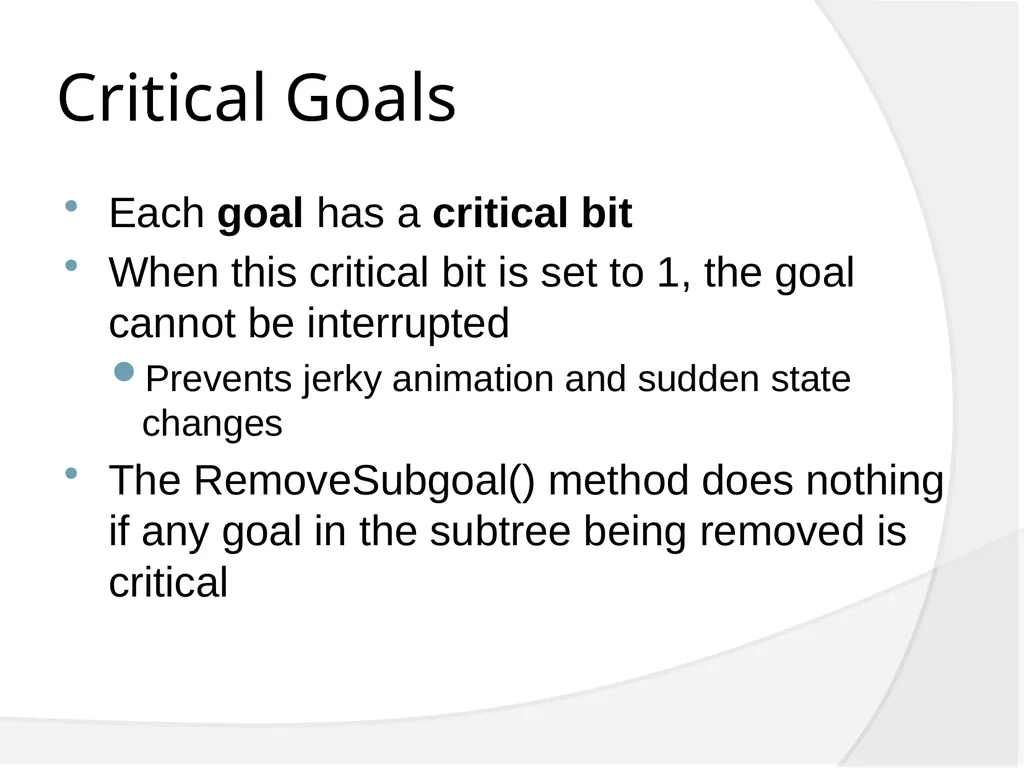
Critical Goals Each goal has a critical bit
When this critical bit is set to 1, the goal cannot be interrupted
Prevents jerky animation and sudden state changes
The RemoveSubgoal() method does nothing if any goal in the subtree being removed is critical<br>
When this critical bit is set to 1, the goal cannot be interrupted
Prevents jerky animation and sudden state changes
The RemoveSubgoal() method does nothing if any goal in the subtree being removed is critical<br>
27
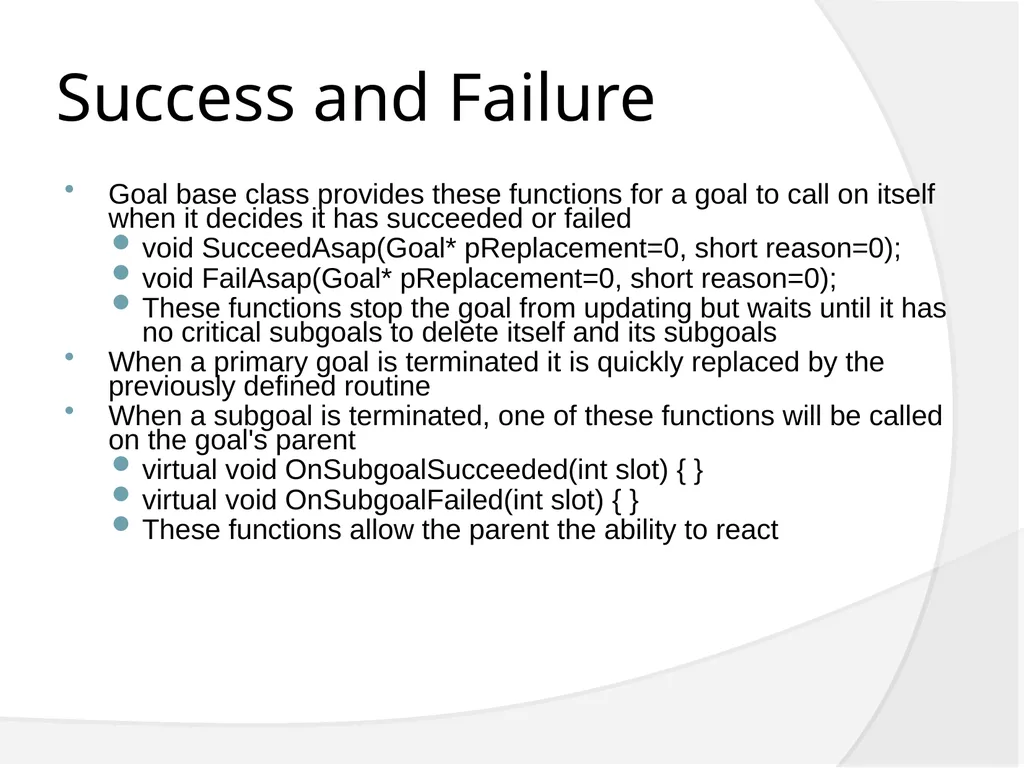
Success and Failure Goal base class provides these functions for a goal to call on itself when it decides it has succeeded or failed
void SucceedAsap(Goal* pReplacement=0, short reason=0);
void FailAsap(Goal* pReplacement=0, short reason=0);
These functions stop the goal from updating but waits until it has no critical subgoals to delete itself and its subgoals
When a primary goal is terminated it is quickly replaced by the previously defined routine
When a subgoal is terminated, one of these functions will be called on the goal's parent
virtual void OnSubgoalSucceeded(int slot) { }
virtual void OnSubgoalFailed(int slot) { }
These functions allow the parent the ability to react<br>
void SucceedAsap(Goal* pReplacement=0, short reason=0);
void FailAsap(Goal* pReplacement=0, short reason=0);
These functions stop the goal from updating but waits until it has no critical subgoals to delete itself and its subgoals
When a primary goal is terminated it is quickly replaced by the previously defined routine
When a subgoal is terminated, one of these functions will be called on the goal's parent
virtual void OnSubgoalSucceeded(int slot) { }
virtual void OnSubgoalFailed(int slot) { }
These functions allow the parent the ability to react<br>
28
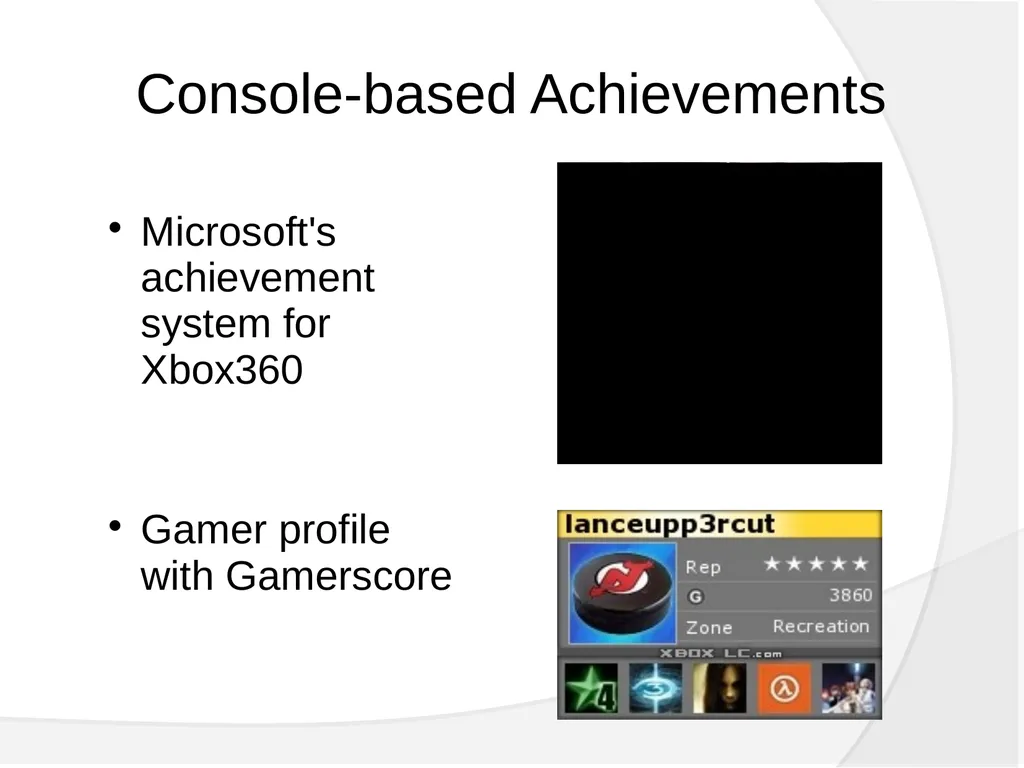
Console-based Achievements Microsoft's achievement system for Xbox360
Gamer profile with Gamerscore<br>
Gamer profile with Gamerscore<br>
29
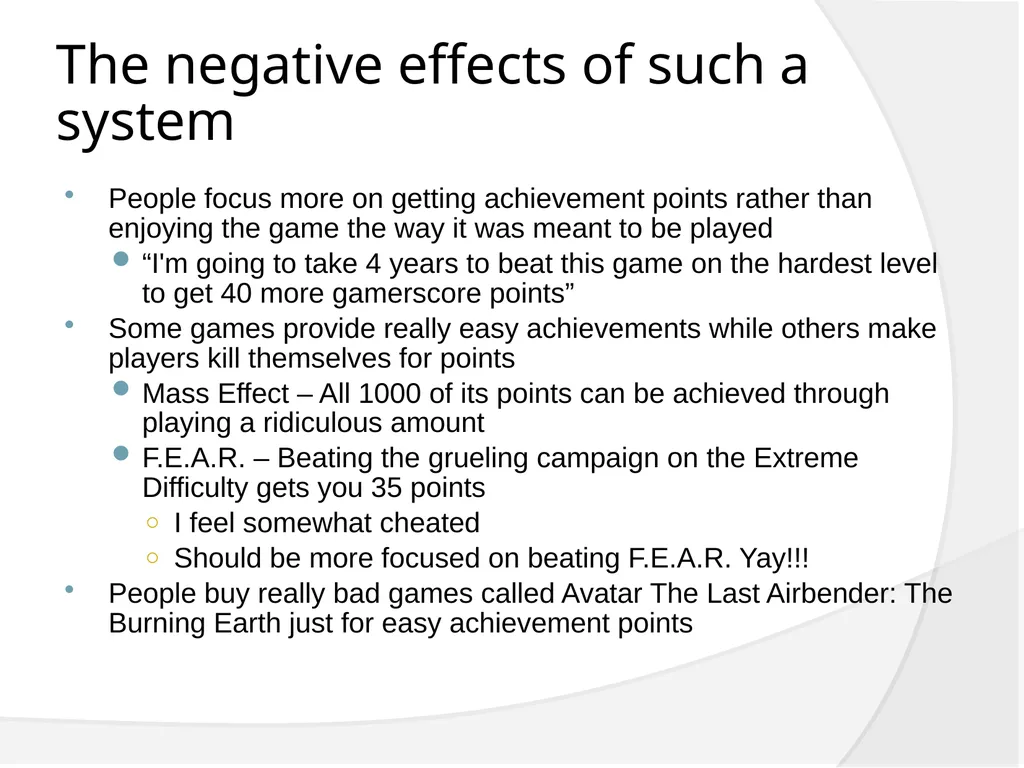
The negative effects of such a system People focus more on getting achievement points rather than enjoying the game the way it was meant to be played
“I'm going to take 4 years to beat this game on the hardest level to get 40 more gamerscore points”
Some games provide really easy achievements while others make players kill themselves for points
Mass Effect – All 1000 of its points can be achieved through playing a ridiculous amount
F.E.A.R. – Beating the grueling campaign on the Extreme Difficulty gets you 35 points
I feel somewhat cheated
Should be more focused on beating F.E.A.R. Yay!!!
People buy really bad games called Avatar The Last Airbender: The Burning Earth just for easy achievement points<br>
“I'm going to take 4 years to beat this game on the hardest level to get 40 more gamerscore points”
Some games provide really easy achievements while others make players kill themselves for points
Mass Effect – All 1000 of its points can be achieved through playing a ridiculous amount
F.E.A.R. – Beating the grueling campaign on the Extreme Difficulty gets you 35 points
I feel somewhat cheated
Should be more focused on beating F.E.A.R. Yay!!!
People buy really bad games called Avatar The Last Airbender: The Burning Earth just for easy achievement points<br>
30
The positive effects of such a system... Makes people strive for goals or use tactics that they would not usually use.
Adds to replay value and adds a certain amount of satisfaction
This score can be seen by your friends or anyone playing with you online, which motivates many players to “appear” better<br>
Adds to replay value and adds a certain amount of satisfaction
This score can be seen by your friends or anyone playing with you online, which motivates many players to “appear” better<br>
31
So addictive its catching on.. This month D3 Games Publishing announced that its upcoming title “dark sector” will contain not only Xbox 360 Achievements but also PS3 Entitlements
Sony has taken heavy abuse for their new “word-ends-with-ments” points system
Achievements, if they do anything, add to player satisfaction and motivate players to go beyond their normal play
This is arguably a positive for Sony and ps3 players
What do YOU think?<br>
Sony has taken heavy abuse for their new “word-ends-with-ments” points system
Achievements, if they do anything, add to player satisfaction and motivate players to go beyond their normal play
This is arguably a positive for Sony and ps3 players
What do YOU think?<br>
32
In-Game Rewards Offline
Ability to level-up, access new equipment, or even just advance in a level
Used in basically any game
Online
Contains all of the above characteristics but also adds the ability to interact and see other players' achievements<br>
Ability to level-up, access new equipment, or even just advance in a level
Used in basically any game
Online
Contains all of the above characteristics but also adds the ability to interact and see other players' achievements<br>
33
Offline (Single-Player) Rewards Almost any game will have these
Usually given when a player does something correctly or quickly
Sometimes given when they feel bad for you
One of those games is Half-Life 2!
http://www.youtube.com/watch?v=S9c15TCvXOY&feature=related
Cake can also be involved<br>
Usually given when a player does something correctly or quickly
Sometimes given when they feel bad for you
One of those games is Half-Life 2!
http://www.youtube.com/watch?v=S9c15TCvXOY&feature=related
Cake can also be involved<br>
34
Online (Multiplayer) Rewards: Call Of Duty 4 Challenges Stress risky tactics and overall high stats
Players use several tactics that they would otherwise never try or consider rational
Goodbye and Airborne Combination
Misery Loves Company
Think Fast
Adds to satisfaction and arguably creates a more complete experience
http://www.youtube.com/watch?v=zTGbwh1ANOU
http://www.youtube.com/watch?v=PpfTEsiFQIA&feature=related<br>
Players use several tactics that they would otherwise never try or consider rational
Goodbye and Airborne Combination
Misery Loves Company
Think Fast
Adds to satisfaction and arguably creates a more complete experience
http://www.youtube.com/watch?v=zTGbwh1ANOU
http://www.youtube.com/watch?v=PpfTEsiFQIA&feature=related<br>
35
Conclusion Gaming goals are used in many aspects of gaming
On-screen and behind the scenes
Player-controlled and AI-controlled
Some games (such as RTS) require several levels of goals in their framework<br>
On-screen and behind the scenes
Player-controlled and AI-controlled
Some games (such as RTS) require several levels of goals in their framework<br>
36
The End<br>