
Acid-Base Titration. Acid-Base Titration.
DP
Published · 7 slides · 0 views
1 / 1


Description
Acid-Base Titration. Acid-Base Titration. Acid-Base Titration. المحاضرة الثانية للجزء العملي Acid-Base Titration Analytical chemistry: is the analysis of material samples to understanding of their chemical composition and structure. It has
Related Topics
Share
Embed code
Download this presentation From Below
"Acid-Base Titration. Acid-Base Titration." is the property of its rightful owner. Permission is granted to download and print the materials on this website for personal, non-commercial use only, and to display it on your personal computer provided you do not modify the materials and that you retain all copyright notices contained in the materials. By downloading content from our website, you accept the terms of this agreement.
Presentation Transcript
01
Acid-Base Titration. Acid-Base Titration. Acid-Base Titration.<br>
02
المحاضرة الثانية للجزء العملي
Acid-Base Titration Analytical chemistry: is the analysis of material samples to understanding of their chemical composition and structure. It has a wide range of monitoring pollution in the environment, development of new materials, and drug manufacture.
Titration technique: Titration is a technique used to determine the concentration of an unknown solution by using known concentration solution. Typically, the titrant (the known solution) is added in a burette to balance a known quantity (volume) of the analyte (the unknown solution). By knowing the volume of titrant added you can determine the unknown concentration solution.
Neutralization: is a complete reaction of acid and base to form salt, and water the solution is called a neutral solution.
NaOH + HCl −→ H₂O + NaCl
Acid-base reactions are important for living things. Thus, it is important to know the concentration, of acids and bases in certain situations. During a titration, use a known volume of an acidic sample, and add base to it until the solution is neutral. Often, a pH indicator is used, to signal the end, of the reaction, the endpoint is the equilibrium point, where the amount of acid is equal to the amount of base present.
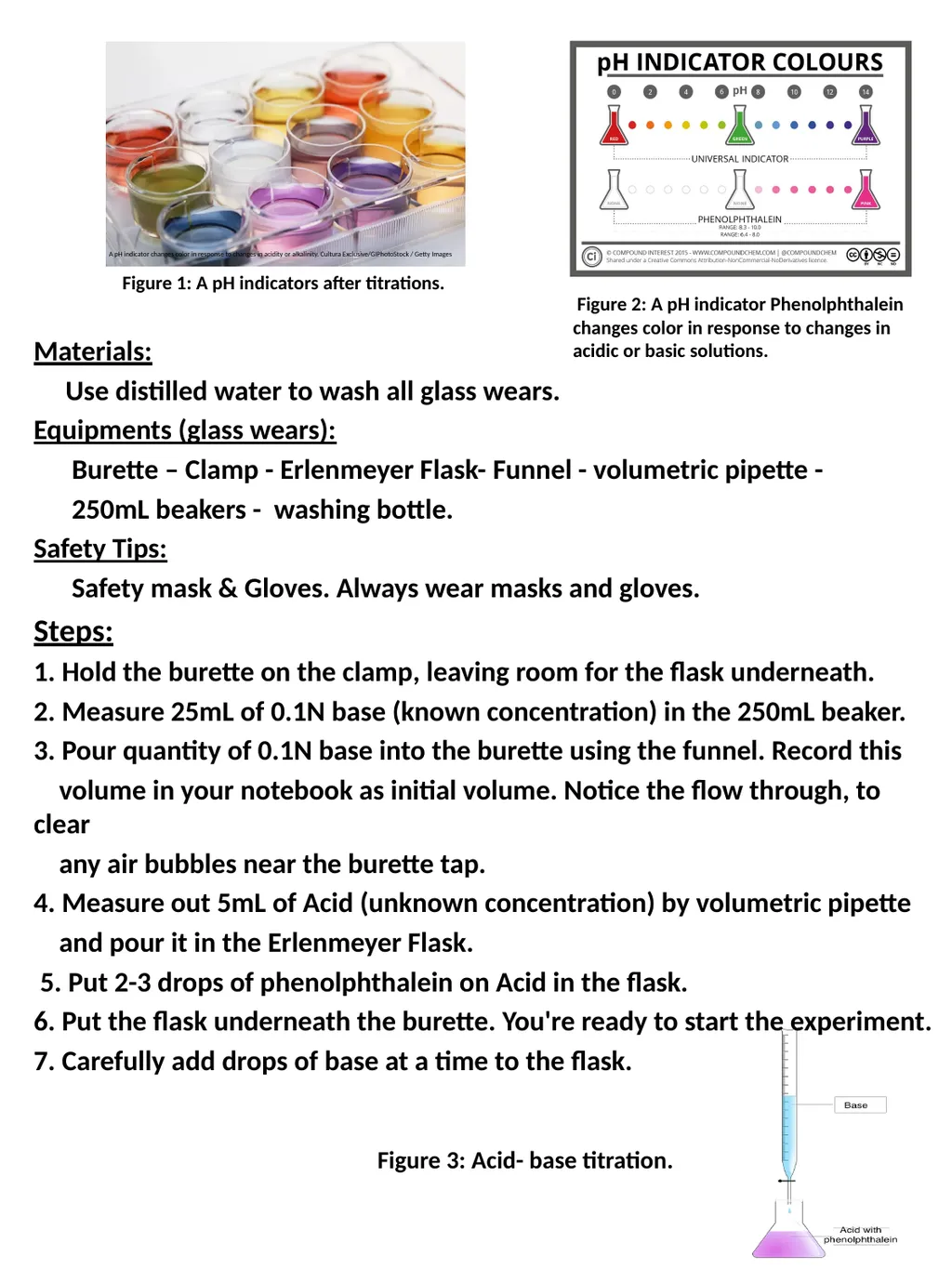
pH indicators: Indicators are used in a titration, to show the completion of an acid-base reaction. The pH indicator is an chemical detector, for hydronium ions (H3O+) or hydrogen ions (H+) giving two or colors at the same solution depending on pH (Figure 1).
Phenolphthalein is a colorless, weak acid which dissociates in water forming pink color, slight pink and colorless solution depending on a pH. The pink color is due to the presence of hydronium ions H3O+. Under acidic conditions, the concentration of the hydrogen ions (H+) cause the colorless solution to be observed (Figure 2).<br>
Titration technique: Titration is a technique used to determine the concentration of an unknown solution by using known concentration solution. Typically, the titrant (the known solution) is added in a burette to balance a known quantity (volume) of the analyte (the unknown solution). By knowing the volume of titrant added you can determine the unknown concentration solution.
Neutralization: is a complete reaction of acid and base to form salt, and water the solution is called a neutral solution.
NaOH + HCl −→ H₂O + NaCl
Acid-base reactions are important for living things. Thus, it is important to know the concentration, of acids and bases in certain situations. During a titration, use a known volume of an acidic sample, and add base to it until the solution is neutral. Often, a pH indicator is used, to signal the end, of the reaction, the endpoint is the equilibrium point, where the amount of acid is equal to the amount of base present.
pH indicators: Indicators are used in a titration, to show the completion of an acid-base reaction. The pH indicator is an chemical detector, for hydronium ions (H3O+) or hydrogen ions (H+) giving two or colors at the same solution depending on pH (Figure 1).
Phenolphthalein is a colorless, weak acid which dissociates in water forming pink color, slight pink and colorless solution depending on a pH. The pink color is due to the presence of hydronium ions H3O+. Under acidic conditions, the concentration of the hydrogen ions (H+) cause the colorless solution to be observed (Figure 2).<br>
03
Materials:
Use distilled water to wash all glass wears.
Equipments (glass wears):
Burette – Clamp - Erlenmeyer Flask- Funnel - volumetric pipette -
250mL beakers - washing bottle.
Safety Tips:
Safety mask & Gloves. Always wear masks and gloves.
Steps:
1. Hold the burette on the clamp, leaving room for the flask underneath.
2. Measure 25mL of 0.1N base (known concentration) in the 250mL beaker.
3. Pour quantity of 0.1N base into the burette using the funnel. Record this
volume in your notebook as initial volume. Notice the flow through, to clear
any air bubbles near the burette tap.
4. Measure out 5mL of Acid (unknown concentration) by volumetric pipette
and pour it in the Erlenmeyer Flask.
5. Put 2-3 drops of phenolphthalein on Acid in the flask.
6. Put the flask underneath the burette. You're ready to start the experiment.
7. Carefully add drops of base at a time to the flask. A pH indicator changes color in response to changes in acidity or alkalinity. Cultura Exclusive/GIPhotoStock / Getty Images Figure 2: A pH indicator Phenolphthalein changes color in response to changes in acidic or basic solutions. Figure 1: A pH indicators after titrations. Figure 3: Acid- base titration.<br>
Use distilled water to wash all glass wears.
Equipments (glass wears):
Burette – Clamp - Erlenmeyer Flask- Funnel - volumetric pipette -
250mL beakers - washing bottle.
Safety Tips:
Safety mask & Gloves. Always wear masks and gloves.
Steps:
1. Hold the burette on the clamp, leaving room for the flask underneath.
2. Measure 25mL of 0.1N base (known concentration) in the 250mL beaker.
3. Pour quantity of 0.1N base into the burette using the funnel. Record this
volume in your notebook as initial volume. Notice the flow through, to clear
any air bubbles near the burette tap.
4. Measure out 5mL of Acid (unknown concentration) by volumetric pipette
and pour it in the Erlenmeyer Flask.
5. Put 2-3 drops of phenolphthalein on Acid in the flask.
6. Put the flask underneath the burette. You're ready to start the experiment.
7. Carefully add drops of base at a time to the flask. A pH indicator changes color in response to changes in acidity or alkalinity. Cultura Exclusive/GIPhotoStock / Getty Images Figure 2: A pH indicator Phenolphthalein changes color in response to changes in acidic or basic solutions. Figure 1: A pH indicators after titrations. Figure 3: Acid- base titration.<br>
04
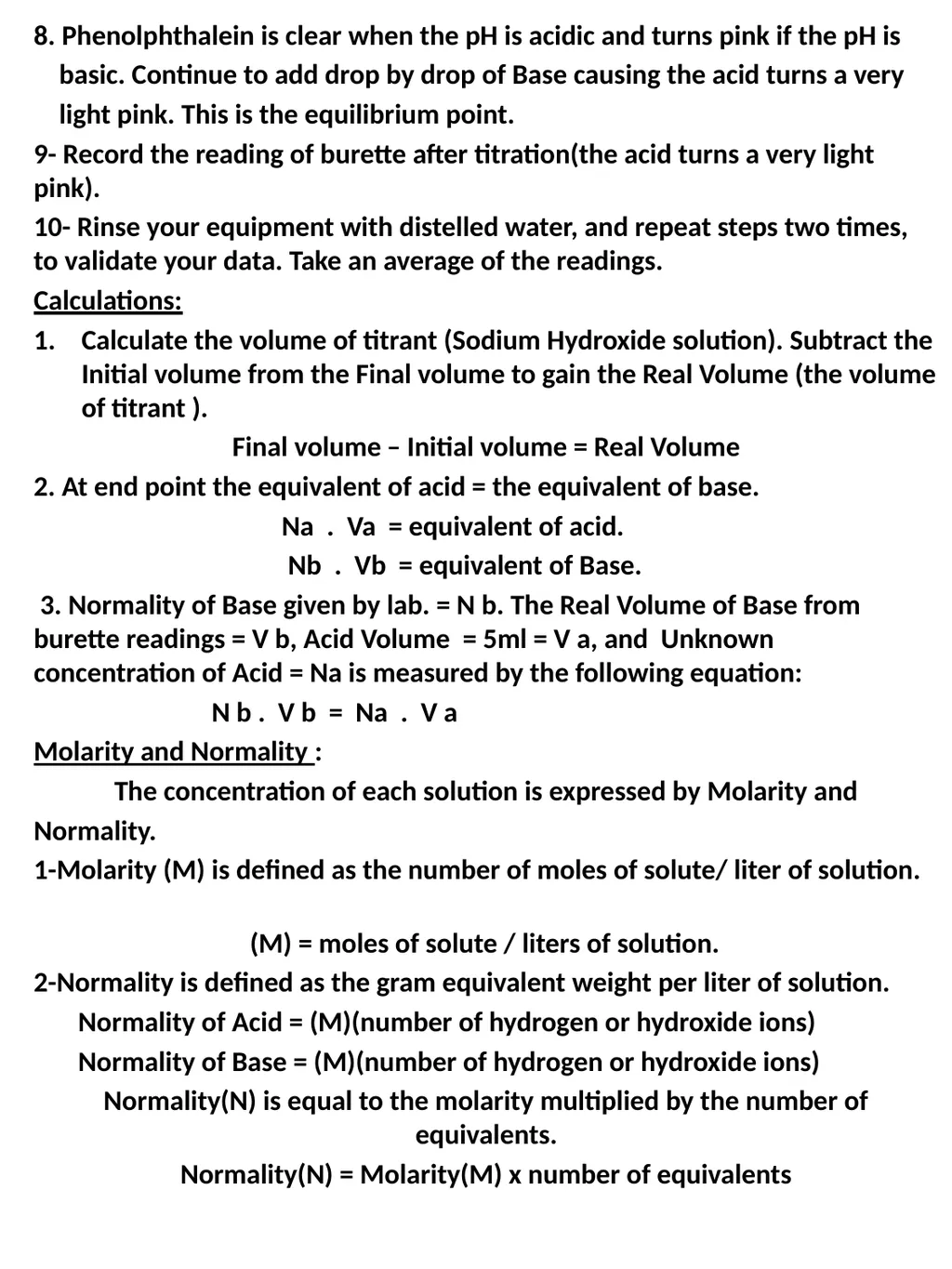
8. Phenolphthalein is clear when the pH is acidic and turns pink if the pH is
basic. Continue to add drop by drop of Base causing the acid turns a very
light pink. This is the equilibrium point.
9- Record the reading of burette after titration(the acid turns a very light pink).
10- Rinse your equipment with distelled water, and repeat steps two times, to validate your data. Take an average of the readings.
Calculations:
Calculate the volume of titrant (Sodium Hydroxide solution). Subtract the Initial volume from the Final volume to gain the Real Volume (the volume of titrant ).
Final volume ̶ Initial volume = Real Volume
2. At end point the equivalent of acid = the equivalent of base.
Na . Va = equivalent of acid.
Nb . Vb = equivalent of Base.
3. Normality of Base given by lab. = N b. The Real Volume of Base from burette readings = V b, Acid Volume = 5ml = V a, and Unknown concentration of Acid = Na is measured by the following equation:
N b . V b = Na . V a
Molarity and Normality :
The concentration of each solution is expressed by Molarity and
Normality.
1-Molarity (M) is defined as the number of moles of solute/ liter of solution.
(M) = moles of solute / liters of solution.
2-Normality is defined as the gram equivalent weight per liter of solution.
Normality of Acid = (M)(number of hydrogen or hydroxide ions)
Normality of Base = (M)(number of hydrogen or hydroxide ions)
Normality(N) is equal to the molarity multiplied by the number of equivalents.
Normality(N) = Molarity(M) x number of equivalents<br>
basic. Continue to add drop by drop of Base causing the acid turns a very
light pink. This is the equilibrium point.
9- Record the reading of burette after titration(the acid turns a very light pink).
10- Rinse your equipment with distelled water, and repeat steps two times, to validate your data. Take an average of the readings.
Calculations:
Calculate the volume of titrant (Sodium Hydroxide solution). Subtract the Initial volume from the Final volume to gain the Real Volume (the volume of titrant ).
Final volume ̶ Initial volume = Real Volume
2. At end point the equivalent of acid = the equivalent of base.
Na . Va = equivalent of acid.
Nb . Vb = equivalent of Base.
3. Normality of Base given by lab. = N b. The Real Volume of Base from burette readings = V b, Acid Volume = 5ml = V a, and Unknown concentration of Acid = Na is measured by the following equation:
N b . V b = Na . V a
Molarity and Normality :
The concentration of each solution is expressed by Molarity and
Normality.
1-Molarity (M) is defined as the number of moles of solute/ liter of solution.
(M) = moles of solute / liters of solution.
2-Normality is defined as the gram equivalent weight per liter of solution.
Normality of Acid = (M)(number of hydrogen or hydroxide ions)
Normality of Base = (M)(number of hydrogen or hydroxide ions)
Normality(N) is equal to the molarity multiplied by the number of equivalents.
Normality(N) = Molarity(M) x number of equivalents<br>
05
المختبر الرابع
Determination of Solution Strength For Acetic Acid
Content In Vinegar By Titration.
The aim is to calculate the concentration of solute by comparing the weight of solute with the total volume of solution percent. Its similar to express the level of any blood or urine component, in milligram of component per 100 milliliter of blood or urine samples.
Vinegar solution consists of (4-5%) acetic acid concentration, flavoring, and coloring agent. This means the vinegar solution prepared by dissolving a measured weight, of solute, or acetic acid (gm.) dissolved, in a solvent , or water to give (100ml.), of the final solution.
So the Weight/ Volume percentage (W/V%) indicates the Solution Strength of solution were:
Weight of Solute
Weight/ Volume percentage = ………………… X 100%.
Volume of Solvent
Some of the possible health benefits of vinegar include:
Blood sugar control: ingesting vinegar may reduce both blood sugar after a meal, and Insulin.
Weight management: consuming vinegar may leads to reduced calorie intake.
Reduced cholesterol: Animal studies have shown reduced cholesterol in mice given vinegar.
Antimicrobial: Because of its antimicrobial properties, vinegar is useful and effective for treatment skin infections and burns. 5<br>
Determination of Solution Strength For Acetic Acid
Content In Vinegar By Titration.
The aim is to calculate the concentration of solute by comparing the weight of solute with the total volume of solution percent. Its similar to express the level of any blood or urine component, in milligram of component per 100 milliliter of blood or urine samples.
Vinegar solution consists of (4-5%) acetic acid concentration, flavoring, and coloring agent. This means the vinegar solution prepared by dissolving a measured weight, of solute, or acetic acid (gm.) dissolved, in a solvent , or water to give (100ml.), of the final solution.
So the Weight/ Volume percentage (W/V%) indicates the Solution Strength of solution were:
Weight of Solute
Weight/ Volume percentage = ………………… X 100%.
Volume of Solvent
Some of the possible health benefits of vinegar include:
Blood sugar control: ingesting vinegar may reduce both blood sugar after a meal, and Insulin.
Weight management: consuming vinegar may leads to reduced calorie intake.
Reduced cholesterol: Animal studies have shown reduced cholesterol in mice given vinegar.
Antimicrobial: Because of its antimicrobial properties, vinegar is useful and effective for treatment skin infections and burns. 5<br>
06
Titrations:
A titration is needed to determine the amount of acid present in vinegar, by the reaction of acetic acid, with sodium hydroxide,and the reaction is:
CH3COOH + NaOH → CH3COO- Na+ + H2O
At the end point of the titration, the volume of NaOH added at this point will be used to calculate the acetic acid content of vinegar. Steps:
1. Hold the burette on the clamp, leaving room for the flask underneath.
2. Then measure a volume of NaOH of 0.1N (known concentration) in the 250mL beaker, pour a quantity of 0.1N NaOH into the burette using the funnel. Notice the flow through, to clear any air bubbles near the burette tap.
3. Record this initial volume in your notebook.
4. Measure out 5mL of Vinegar (unknown concentration) by volumetric pipette, pour it in the Erlenmeyer Flask.
5. Put 1 drops of phenolphthalein on Acid in the flask.
6. Put the flask underneath the burette. You're ready to start the titration.
7. Carefully add drops of NaOH at a time to the flask.
8. Phenolphthalein is clear when the pH is acidic and turns pink if the pH is basic. Continue to add drop by drop of Base causing the acid turns a very light pink. This is the equilibrium point.
9- Record the reading of burette after titration(the acid turns a very light pink) Figure 1.
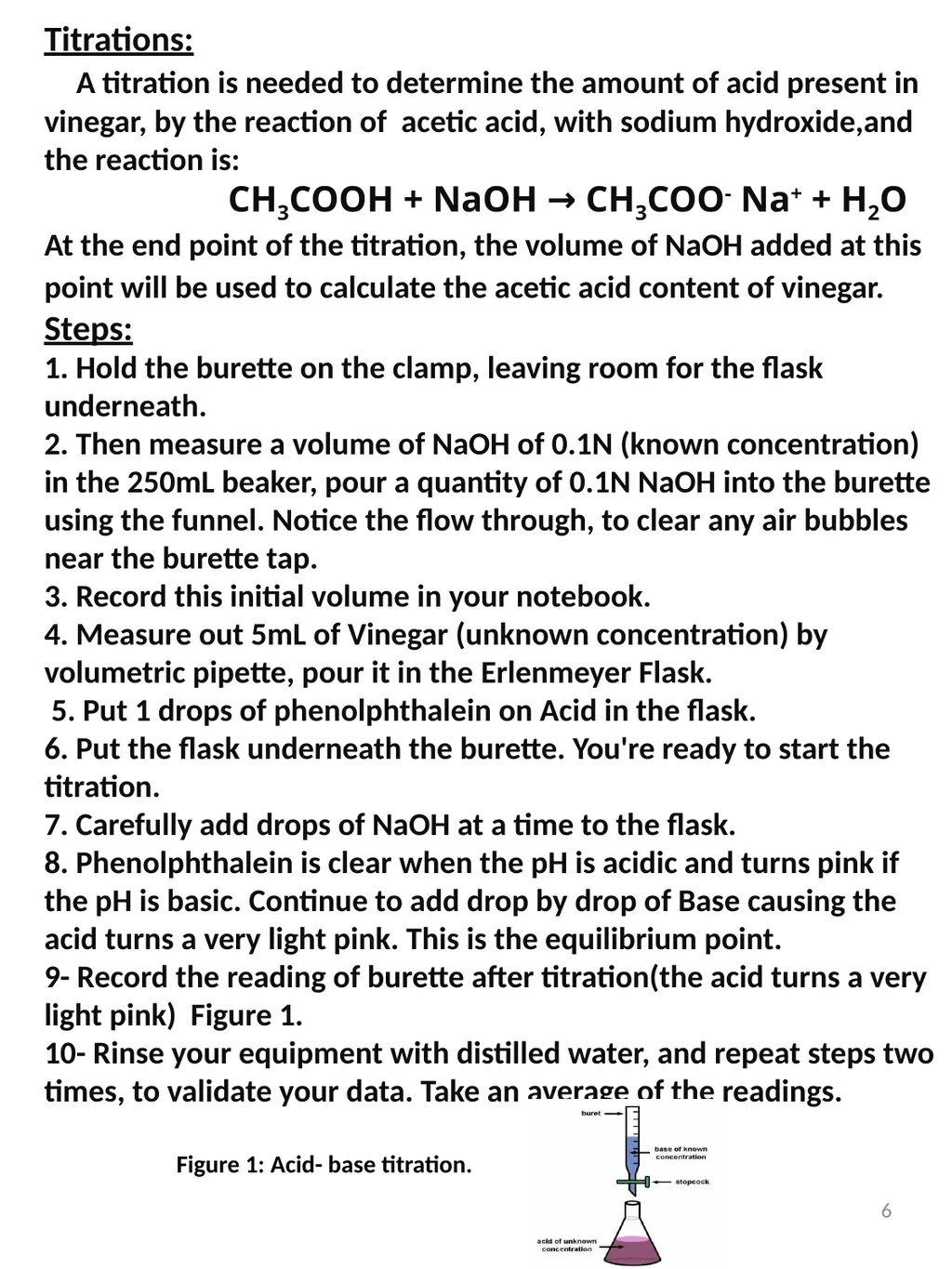
10- Rinse your equipment with distilled water, and repeat steps two times, to validate your data. Take an average of the readings. Figure 1: Acid- base titration. 6<br>
A titration is needed to determine the amount of acid present in vinegar, by the reaction of acetic acid, with sodium hydroxide,and the reaction is:
CH3COOH + NaOH → CH3COO- Na+ + H2O
At the end point of the titration, the volume of NaOH added at this point will be used to calculate the acetic acid content of vinegar. Steps:
1. Hold the burette on the clamp, leaving room for the flask underneath.
2. Then measure a volume of NaOH of 0.1N (known concentration) in the 250mL beaker, pour a quantity of 0.1N NaOH into the burette using the funnel. Notice the flow through, to clear any air bubbles near the burette tap.
3. Record this initial volume in your notebook.
4. Measure out 5mL of Vinegar (unknown concentration) by volumetric pipette, pour it in the Erlenmeyer Flask.
5. Put 1 drops of phenolphthalein on Acid in the flask.
6. Put the flask underneath the burette. You're ready to start the titration.
7. Carefully add drops of NaOH at a time to the flask.
8. Phenolphthalein is clear when the pH is acidic and turns pink if the pH is basic. Continue to add drop by drop of Base causing the acid turns a very light pink. This is the equilibrium point.
9- Record the reading of burette after titration(the acid turns a very light pink) Figure 1.
10- Rinse your equipment with distilled water, and repeat steps two times, to validate your data. Take an average of the readings. Figure 1: Acid- base titration. 6<br>
07
Calculations:
1-Calculate the Normality of acid = N a. The Real Volume of Base from burette readings = V b, Acid Volume = 5ml = V a, unknown concentration of Acid = Na is measured by the following equation:
Na = N b . V b / V a
2-Find Normality of Acid.
3-For acetic acid the number of equivalents x Normality = gram
molecular weight.
W = Na . eq.
Normality = Na
number of equivalents = W/MW/1 = W/60.035gm.
Weight (gm.), of acetic acid = unknown.
MW of acetic acid = 60.035 ≈ 60.
W = Na . 60.035.
Solution Strength (Percent Composition):
Solution Strength : is the concentration of a solution, expressed as a composition percentage.
Composition % = W / VC . 100 %
W
Composition % = --------- x 100 %
1000
Weight/ Volume percentage % of (acetic acid ) = Composition %
Weight of Solute (acetic acid )= W.
A volume of a solution concentration (acetic acid) concentration in Vinegar= VC = 1000 ml.
Its important to know that, at the end point, calculate the concentration of solute, by comparing the percent (%) of weight of solute with the total volume of solution.Its similar to express the level of any blood or urine component, in milligram of component per 100 milliliter (mg/100ml)of blood or urine samples. 7<br>
1-Calculate the Normality of acid = N a. The Real Volume of Base from burette readings = V b, Acid Volume = 5ml = V a, unknown concentration of Acid = Na is measured by the following equation:
Na = N b . V b / V a
2-Find Normality of Acid.
3-For acetic acid the number of equivalents x Normality = gram
molecular weight.
W = Na . eq.
Normality = Na
number of equivalents = W/MW/1 = W/60.035gm.
Weight (gm.), of acetic acid = unknown.
MW of acetic acid = 60.035 ≈ 60.
W = Na . 60.035.
Solution Strength (Percent Composition):
Solution Strength : is the concentration of a solution, expressed as a composition percentage.
Composition % = W / VC . 100 %
W
Composition % = --------- x 100 %
1000
Weight/ Volume percentage % of (acetic acid ) = Composition %
Weight of Solute (acetic acid )= W.
A volume of a solution concentration (acetic acid) concentration in Vinegar= VC = 1000 ml.
Its important to know that, at the end point, calculate the concentration of solute, by comparing the percent (%) of weight of solute with the total volume of solution.Its similar to express the level of any blood or urine component, in milligram of component per 100 milliliter (mg/100ml)of blood or urine samples. 7<br>