
ACT 1 SCENE 1-5 Summaries, character sketch,
A
Published · 48 slides · 0 views

1 / 1






Description
ACT 1 SCENE 1-5 Summaries, character sketch, questions and answers. You should be making your own summaries as you read. Good Luck! ROMEO AND JULIET Scene Summary Character Sketch Questions Answers. The story of Romeo and Juliet took
Related Topics
Share
Embed code
Download this presentation From Below
"ACT 1 SCENE 1-5 Summaries, character sketch," is the property of its rightful owner. Permission is granted to download and print the materials on this website for personal, non-commercial use only, and to display it on your personal computer provided you do not modify the materials and that you retain all copyright notices contained in the materials. By downloading content from our website, you accept the terms of this agreement.
Presentation Transcript
01
ACT 1 SCENE 1-5
Summaries, character sketch, questions and answers.
You should be making your own summaries as you read. Good Luck!<br>
Summaries, character sketch, questions and answers.
You should be making your own summaries as you read. Good Luck!<br>
02
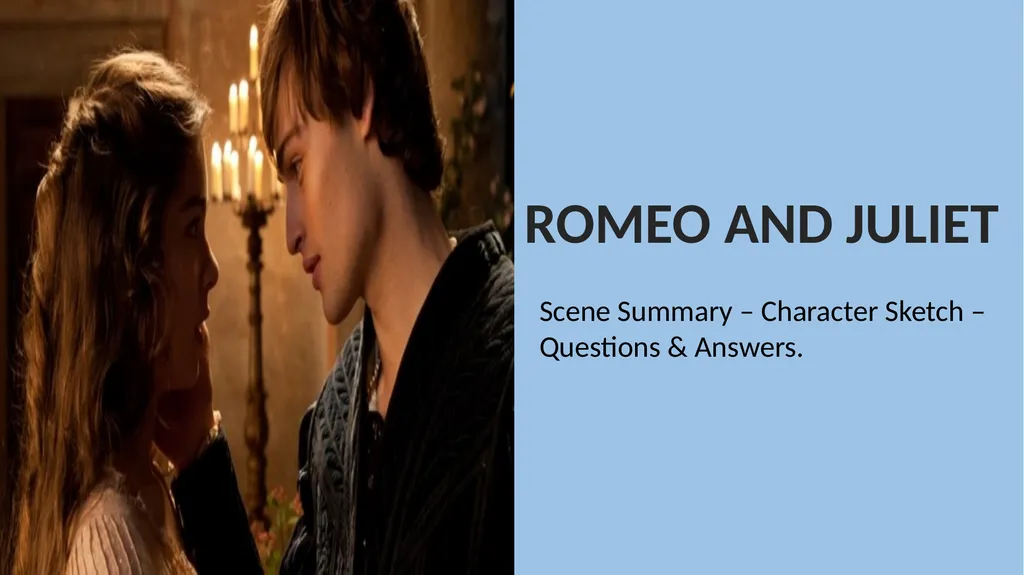
ROMEO AND JULIET Scene Summary – Character Sketch – Questions & Answers.<br>
03
The story of Romeo and Juliet took place in a town called Verona in Italy during the 1400s (fifteenth century).
Italy wasn’t a united country at the time. It was divided up into small city-states which would fight between themselves for control of cities like Verona.
The people were governed by nobles, such as a prince. Most people in Italy at that time were Roman Catholic and attended church regularly.
There are many references to religious images and symbols in the play, for example, shrines, saints and pilgrims. SETTING:<br>
04
The Prologue is the introduction to the play.
It is a tradition from ancient Greek theatre.
It gives an outline of the plot. (Set the scene and gives the audience some idea of what the play is about).
Prologue presented by a group of actors- ‘chorus’.
It prepares the audience for a sad story.
The structure of this poem in the Prologue is a Shakespearean Sonnet.
It is 14 lines long, divided into three quatrains (four lines each), and ends in a rhyming couplet (two lines). The rhyming pattern is abab cdcd efef gg. WHAT IS A PROLOGUE?<br>
05
PROLOGUE EXPLAINED: • Two families, both noble and of the roughly the same social status, live in beautiful Verona.
• They have been arguing for years. This feud is again turning violent. Even ordinary citizens are involved.
• Fate steps in when these feuding families give birth to two unfortunate lovers. The stars predict a tragic fate for them.
• They become the victims of unkind fate and face unfortunate, tragic accidents. Only with their deaths is their parents’ feud ended.
• The course of their doomed love and their deaths eventually bring an end to the hatred. (A little too late?)
• The topic that we will act out on stage for the next two hours will be filled in by our devoted acting – in case we have left out something in this Prologue.<br>
06
ACT 1, SCENE 1: A fight occurs between the Montagues and Capulets.
Setting: A public street in Verona.
• Sampson and Gregory are Capulet servants. They are boasting and joking in the street.
• Abraham and Balthasar, two Montague servants, arrive. The Capulet servants deliberately insult the others to start a fight.
• Benvolio, Romeo’s friend, arrives and stops their fight.
• Tybalt arrives and fights Benvolio.
• Officers of the law come with some other citizens and try to stop the fighting.
• Lords Capulet and Montague arrive and want to fight each other, but their wives try to stop them.<br>
07
Prince Escalus arrives and orders them all to throw down their weapons. There have been three street fights now between the Capulets and Montagues. He warns them that if they fight again they will be put to death (executed). He wants to see Lord Montague and Lord Capulet at his palace.
• Benvolio explains to Lord Montague how the fight started.
• Lady Montague asks Benvolio if he knows where Romeo is. Lord Montague has noticed that Romeo seems sad these days. Benvolio says that he will find out why Romeo is upset.
• When Romeo arrives, he tells Benvolio that he is in love with Rosaline. He is sad because Rosaline is not interested in him.<br>
08
Sampson: A simpleton and a coward. He says that he will rape any of the Montague women that they may encounter and rob them of their virginity. He uses a number of obscene puns to brag about his sexual powers. Sampson bites his thumb at the two men of Montague (an insult)
Gregory: Mocks Sampson during their discussion. He says that he will frown at the two servants of the house of Montague. (The men are reluctant to accost/ fight them directly. When Gregory sees Tybalt approaching, he urges Sampson to fight. CHARACTER SKETCH:<br>
Gregory: Mocks Sampson during their discussion. He says that he will frown at the two servants of the house of Montague. (The men are reluctant to accost/ fight them directly. When Gregory sees Tybalt approaching, he urges Sampson to fight. CHARACTER SKETCH:<br>
09
Benvolio: Romeo’s cousin. Tries to keep the peace. His name is derived from the Latin bene, meaning ‘good’ or ‘well’ and volo, ‘to wish’ (as the English word ‘benevolent’). He is an honest and reliable person as he gives an honest account of how the fight first started. He is naïve.
Tybalt: Reveals himself to be an aggressive and violent character who hates the Montague family with an uncontrollable passion. He has a dangerously volatile (explosive) personality which will lead almost directly to the final tragedy of the story.
The Prince: Respected and powerful leader and his decree that anyone starting a fight in the streets of Verona will be executed is to be taken seriously. It is this decree that will lead to Romeo being banished and the final tragic confusion.<br>
10
Romeo: When we are introduced to Romeo for the first time he comes across as a lovesick young man, infatuated with Rosaline. He seems to be more in love with the idea of love than in love with the actual person. (We see this in his poem- he uses elaborate stylised language, with fanciful images, word play and rhyming couplets).
Shakespeare prepares us for the contrast between this posing and how Romeo will react when he sees Juliet for the first time. His expressions of his love for Juliet will be REAL.
Romeo’s reaction when he sees that there had been fighting in the streets suggests that he is disappointed. He is sad to see that a brawl had taken place. He is not aggressive like Tybalt is<br>
11
https://www.youtube.com/watch?v=beV56hp4T3w<br>
12
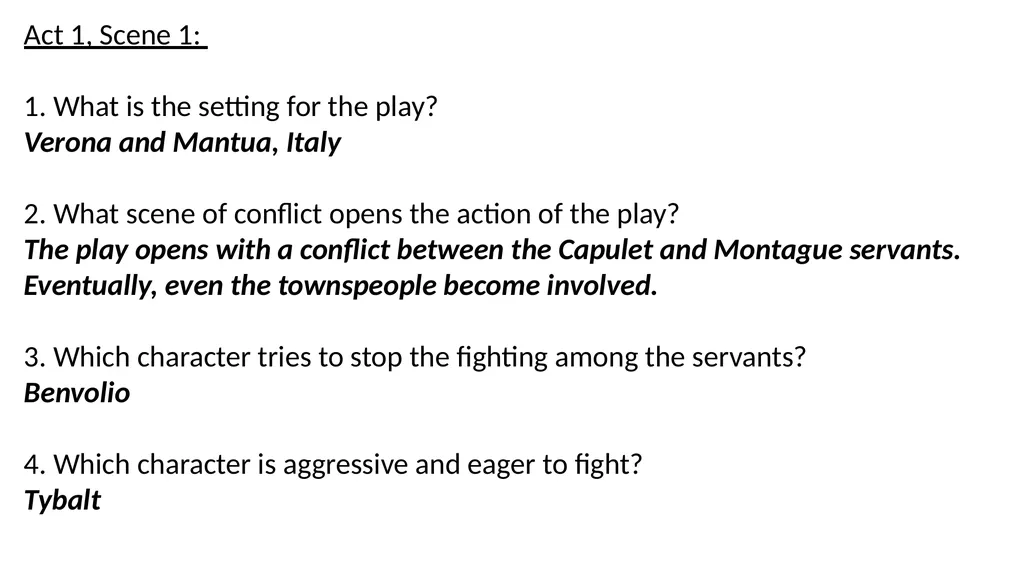
Act 1, Scene 1:
1. What is the setting for the play?
Verona and Mantua, Italy
2. What scene of conflict opens the action of the play?
The play opens with a conflict between the Capulet and Montague servants. Eventually, even the townspeople become involved.
3. Which character tries to stop the fighting among the servants?
Benvolio
4. Which character is aggressive and eager to fight?
Tybalt<br>
13
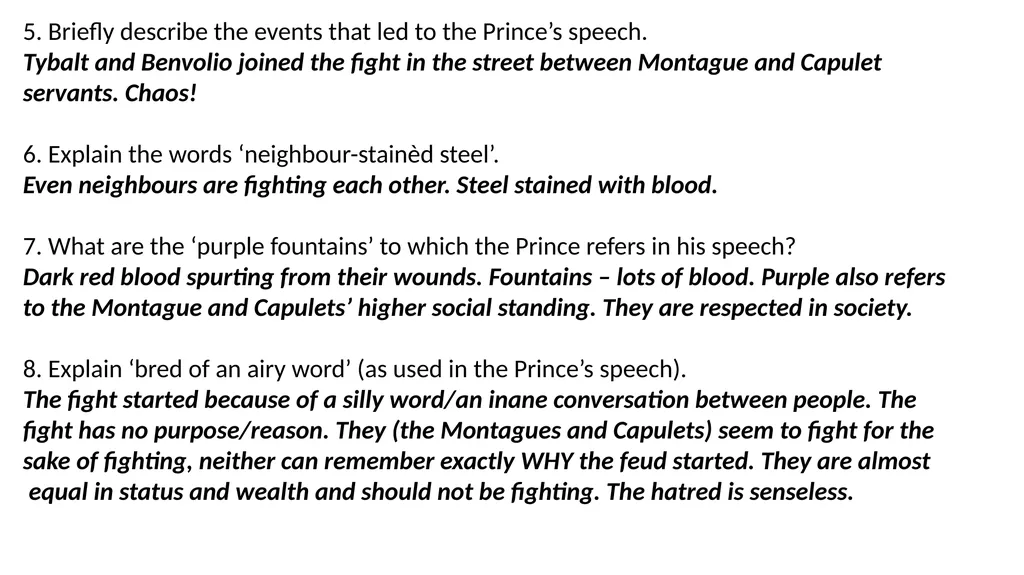
5. Briefly describe the events that led to the Prince’s speech.
Tybalt and Benvolio joined the fight in the street between Montague and Capulet servants. Chaos!
6. Explain the words ‘neighbour-stainèd steel’.
Even neighbours are fighting each other. Steel stained with blood.
7. What are the ‘purple fountains’ to which the Prince refers in his speech?
Dark red blood spurting from their wounds. Fountains – lots of blood. Purple also refers to the Montague and Capulets’ higher social standing. They are respected in society.
8. Explain ‘bred of an airy word’ (as used in the Prince’s speech).
The fight started because of a silly word/an inane conversation between people. The fight has no purpose/reason. They (the Montagues and Capulets) seem to fight for the sake of fighting, neither can remember exactly WHY the feud started. They are almost
equal in status and wealth and should not be fighting. The hatred is senseless.<br>
14
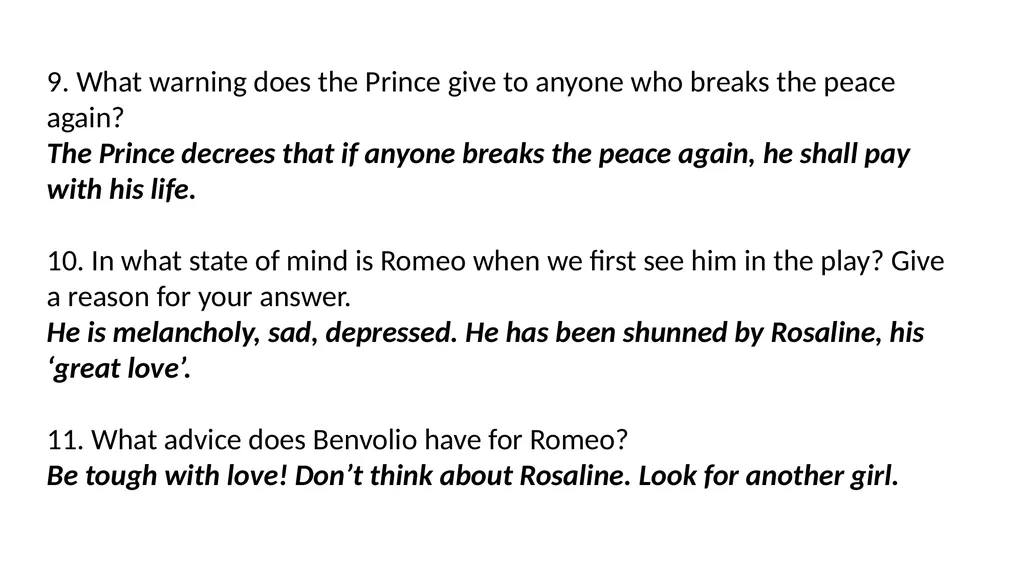
9. What warning does the Prince give to anyone who breaks the peace again?
The Prince decrees that if anyone breaks the peace again, he shall pay with his life.
10. In what state of mind is Romeo when we first see him in the play? Give a reason for your answer.
He is melancholy, sad, depressed. He has been shunned by Rosaline, his ‘great love’.
11. What advice does Benvolio have for Romeo?
Be tough with love! Don’t think about Rosaline. Look for another girl.<br>
15
ACT 1, SCENE 2: Lord Capulet plans his party.
Setting: Capulet’s Mansion<br>
Setting: Capulet’s Mansion<br>
16
ACT 1, SCENE 2: • The scene opens with Lord Capulet telling Paris that he and Lord Montague have been ordered not to fight, and he thinks they will be able to “keep the peace”.
• Paris asks Lord Capulet for permission to marry Juliet.
• Lord Capulet explains to Paris that Juliet is only 13, too young to marry. He suggests waiting another two years. He also says that Juliet needs to agree to the marriage.
• Lord Capulet invites Paris to a party (feast) that night. There he will see Juliet, as well as other ladies with whom to compare her.
• Lord Capulet gives his servant a list of people and tells him to invite them to the party. But the servant cannot read, so when he meets Romeo and Benvolio in the street, he asks them to read the names for him.<br>
17
• Romeo sees that Rosaline, the woman he loves, is invited.
• The servant says that if Romeo and Benvolio are not Montagues, they can come to the party.
• Benvolio tells Romeo that many ladies will be at the party, and maybe Romeo might meet someone new.<br>
• The servant says that if Romeo and Benvolio are not Montagues, they can come to the party.
• Benvolio tells Romeo that many ladies will be at the party, and maybe Romeo might meet someone new.<br>
18
Act 1, Scene 2:
Who has asked for Juliet’s hand in marriage?
Paris has asked for Juliet’s hand in marriage.
2. What does Capulet mean by ‘My child is yet a stranger in the world’?
She is young.
3. How old is Juliet? Provide evidence for your answer.
13 years old – “hath not seen the change of fourteen years”
4. What is Paris’s reaction to Capulet’s statement about his daughter’s age?
He states that many younger girls have been married and have had babies.
5. How does Capulet defend his statement in response?
He states that many of those (married) young girls lose their beauty. They are unhappy too. He states that Juliet may marry whom she pleases, he will not force her to marry Paris. She has a choice – “within her scope of choice Lies my consent and fair according voice”.<br>
19
6. Explain ‘an old accustomed feast’.
Traditional. It has been happening annually for many years.
7. What modern saying means the same as when Capulet says, ‘One more, most welcome, makes my number more.’
‘The more, the merrier’
8. What are the ‘earth-treading stars’ of which Capulet speak? Comment on what this tells us about him.
Girls/women who are as beautiful as the stars. He is shallow.
9. Explain how Romeo finds out about the Capulet ball.
Romeo finds out about the Capulet ball when an illiterate Capulet servant asks him to read the invitation list to him.<br>
20
10. How does Benvolio try to remedy Romeo’s love sickness? Is Romeo convinced?
Benvolio tries to remedy Romeo’s love-sickness by getting him to consent to go to the Capulet ball and examine other beauties. Romeo is unconvinced and vows to remain true to Rosaline.<br>
Benvolio tries to remedy Romeo’s love-sickness by getting him to consent to go to the Capulet ball and examine other beauties. Romeo is unconvinced and vows to remain true to Rosaline.<br>
21
ACT 1 SCENE 3: Where: A room in Capulet’s mansion
Who: Lady Capulet, Juliet, Servingman and Nurse
We are introduced to Juliet, the Nurse and Lady Capulet for the first time.
The Nurse who raised Juliet chatters on, telling lewd (vulgar) jokes which contrast with Juliet’s genuine innocence.
Lady Capulet tries to persuade Juliet to consider Paris’s offer of marriage.
Juliet says that she will think about it.
Lady Capulet and the Nurse discuss Juliet’s age.
We learn that the Nurse had a daughter, Susan, who was the same age as Juliet.
The daughter died and the Nurse then became a wet nurse (she breast-fed Juliet as a baby).
The Nurse rambles on about her memories of Juliet and her own husband.<br>
22
She recounts an incident when Juliet, as a little girl, fell forward onto her face and damaged her brow.
Her husband joked about how when she was older she would fall on her back rather than her front, to which young Juliet agreed, much to their amusement.
The Nurse says that if she lives long enough to see Juliet get married, she will have her wish come true.
Lady Capulet uses the opportunity to ask Juliet how she feels about being married.
Juliet replies that it is an honour she has not dreamt of.
Her mother reminds her that girls younger than Juliet had already become mothers, and that she herself had already given birth to Juliet by the time she was her age.
Since Juliet is 13 it means that her mother is 26.
She then reveals that Paris wants to marry her.
The Nurse is very impressed, saying what a great catch Paris would be.
Lady Capulet tells Juliet to examine him at the party to see how handsome he is. She asks Juliet whether she would like to marry Paris.<br>
23
Juliet replies that she will look at Paris and she if she is moved to like him, but she says, she will do nothing without her parents’ consent.
A servant arrives to tell them all the guests have arrived and supper has been served, and that they should hurry to the party.<br>
A servant arrives to tell them all the guests have arrived and supper has been served, and that they should hurry to the party.<br>
24
CHARACTER SKETCH… The Nurse:
The Nurse plays a very important role in the play. Firstly, she provides comic relief amusing us with her bawdy (rude/ vulgar) jokes. In her very first line she swears by her virginity, which she says she lost when she was twelve years old. We know from the start what to expect from her.
The Nurse plays the role of Juliet’s confidante, as well as surrogate mother. We learn that she reared Juliet from birth, breastfeeding her with the milk she would have had after her own baby died. Juliet turns to the Nurse when she needs help and guidance.
The Nurse is not very intelligent. The scene ends with her advice to Juliet to ‘seek happy nights’, an obviously sexual allusion (suggestion/ insinuation), showing how shallow and simple she is. She equates marriage with sex.<br>
25
Lady Capulet:
Lady Capulet is not a very good mother, being self- centred and full of self- importance.
In trying to persuade Juliet to consider Paris’s offer of marriage, Lady Capulet reveals herself to be just as shallow as her husband.
She is interested only in the prestige that Paris would bring to their family.
Juliet:
Juliet shows herself to be a polite, obedient daughter who has a good relationship with her mother and we can presume, with her father.
We can judge this from the conversation he has with Paris at the beginning of scene 2, where he says of Juliet, “She’s the hopeful lady of my earth.” This will soon change.<br>
26
Act 1, Scene 3:
Who is Susan?
Susan is the Nurse’s daughter who was born on the same day as Juliet; however, she died.
2. When is Juliet’s birthday?
Juliet’s birthday is on Lammas Eve. 31 July – Lammastide is 1 August
3. Why does Lady Capulet visit with Juliet? What questions does she ask her?
Lady Capulet visits with Juliet to ask her if she is ready for marriage. She asks Juliet to look at Paris at the feast that night.
4. How do the Nurse and Lady Capulet feel about Paris?
The Nurse and Lady Capulet feel that Paris is a perfect match for Juliet and are in favour of the marriage.
5. Which other character in the play is a relative of Paris?
Prince Escalus
6. Describe the relationship between Juliet and the Nurse.
The Nurse basically raised Juliet – she breastfed her and attended to her in all things. The Nurse and Juliet have a much closer relationship than Juliet has with her mother.<br>
27
7. Explain why the Nurse is present during this very personal conversation between Juliet and her mother.
She has a very close relationship with Juliet. Juliet’s mother knows that Juliet will repeat the conversation to the Nurse and this welcomes her input and support in the matter.
8. “Marry, that ‘marry’ is the very theme…” (line 64). Explain the pun in this line.
“Marry” means indeed. But here Lady Capulet is referring to the concept of marriage.
9. How does Lady Capulet try to persuade Juliet that she is not too young to get married?
She tells Juliet that she (Lady Capulet) was married when she was even younger than Juliet is now.<br>
28
10. Explain the meaning of the word ‘valiant’.
brave
11. What does the nurse mean when she describes Paris as a ‘man of wax’?
He is a perfect man, like a wax model. Handsome
12. “He’s a flower, in faith, a very flower.” Identify and explain this figure of speech used to describe Paris.
Metaphor - Paris is compared to a perfect flower. He is handsome, rich, admired.
13. ‘This night you shall behold him at our feast.’ To whom is Lady Capulet refer? What actually happens?
She refers to Paris. However, Juliet will meet and fall in love with ROMEO at the feast, not Paris.
14. ‘Read o’er the volume of young Paris’ face and find delight writ thee with beauty’s pen. Examine every married lineament…” To what does Lady Capulet compare Paris? Explain the comparison.<br>
29
Lady Capulet compares Paris to a book – he is perfectly written, well-balanced, unmarried (‘unbound’), he needs a ‘cover’ – a wife, he is rich and needs a wife to complete him. The golden clasps/golden story refer to expensive books of the time – she wants Juliet to marry Paris because he is rich.
15. Are the Capulets justified in arranging Juliet’s marriage? Are they acting in her best interest? Discuss.
Yes – they can decide on a suitable match for her. It was the parents’ prerogative to arrange their daughters’ marriages . Surely they would choose someone who would make her happy? Paris seems like a genuinely nice man. He has a good social standing and is rich. He will be able to take care of Juliet.
No – Juliet should have the power to choose a husband of her liking. She might not like the partner chosen by her parents and end up in an unhappy marriage. Their motivation seems to be led by money. Paris is rich and a good social match for Juliet. However, they also know that he is a gentleman and will take good care of Juliet.<br>
30
16. Discuss your opinion of Lady Capulet as a mother.
Distant, aloof, seems uncaring, materialistic, most aware of her social standing
17. Explain Juliet’s response to her mother’s ‘nudging’ her towards Paris.
Juliet states that she will look at Paris and allow him to woo her should she like what she sees. She does not make any promises, though.<br>
Distant, aloof, seems uncaring, materialistic, most aware of her social standing
17. Explain Juliet’s response to her mother’s ‘nudging’ her towards Paris.
Juliet states that she will look at Paris and allow him to woo her should she like what she sees. She does not make any promises, though.<br>
31
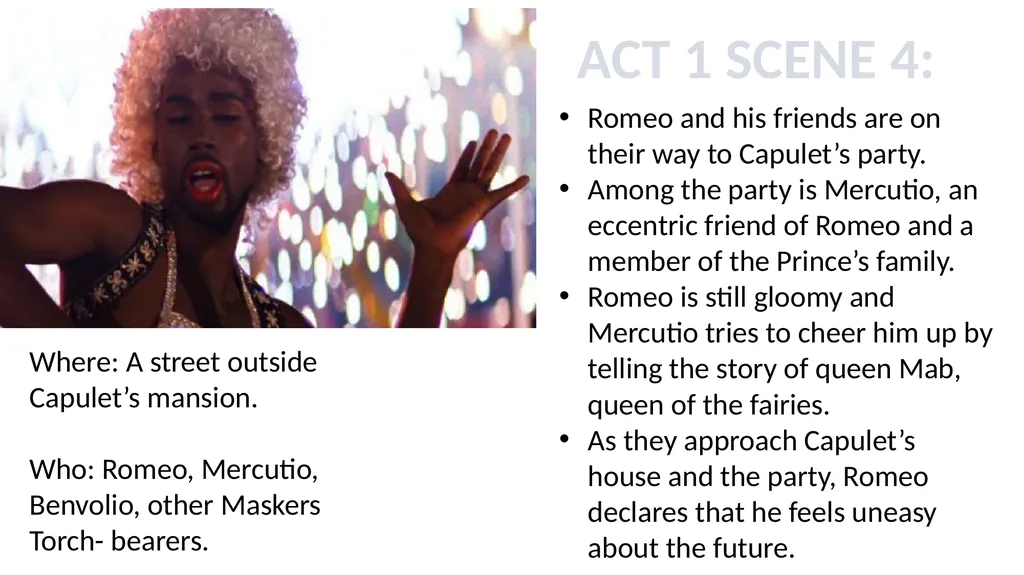
ACT 1 SCENE 4: Romeo and his friends are on their way to Capulet’s party.
Among the party is Mercutio, an eccentric friend of Romeo and a member of the Prince’s family.
Romeo is still gloomy and Mercutio tries to cheer him up by telling the story of queen Mab, queen of the fairies.
As they approach Capulet’s house and the party, Romeo declares that he feels uneasy about the future. Where: A street outside Capulet’s mansion.
Who: Romeo, Mercutio, Benvolio, other Maskers Torch- bearers.<br>
32
Romeo, Benvolio, Mercutio and others, all wearing masks, are on their way uninvited, to Capulet’s party.
Many of the guests would have been wearing masks, as was the custom of the day.
Romeo asks whether they will deliver a speech to excuse themselves for arriving without an invitation, but Benvolio says that such excuses are outdated and the Capulets must make of them what they will.
They will dance and leave.
Romeo says he will hold the light , and not dance because his heart is heavy.
He and his friend Mercutio exchange ideas about the nature of love.<br>
33
Mercutio relates the dream he had of Queen Mab.
A mischievous tiny fairy who travels in a chariot made out of a hazel-nut shell and driven by a gnat.
She enters minds of sleeping people and like a midwife, gives birth to dreams.
Mercutio becomes excited telling the story and Romeo stops him, calming him down and saying that he is talking nonsense. Mercutio agrees, saying that the dreams are the product of an idle brain.
Benvolio says they will be late for the party.<br>
34
https://www.youtube.com/watch?v=s8q8S0ScJ1w Watch Mercutio tell of his dream….
Mercutio is a very important character in the play
He is Romeo’s BEST FRIEND and not a member of either the Capulet and Montague families.
He is in fact a kinsman of the Prince.
He will meet a tragic end and this will lead to the play’s conclusion. MERCUTIO: Mercutio is an intelligent, witty and extremely energetic young man with a cynical (pessimistic/ distrustful), sarcastic, mocking attitude<br>
35
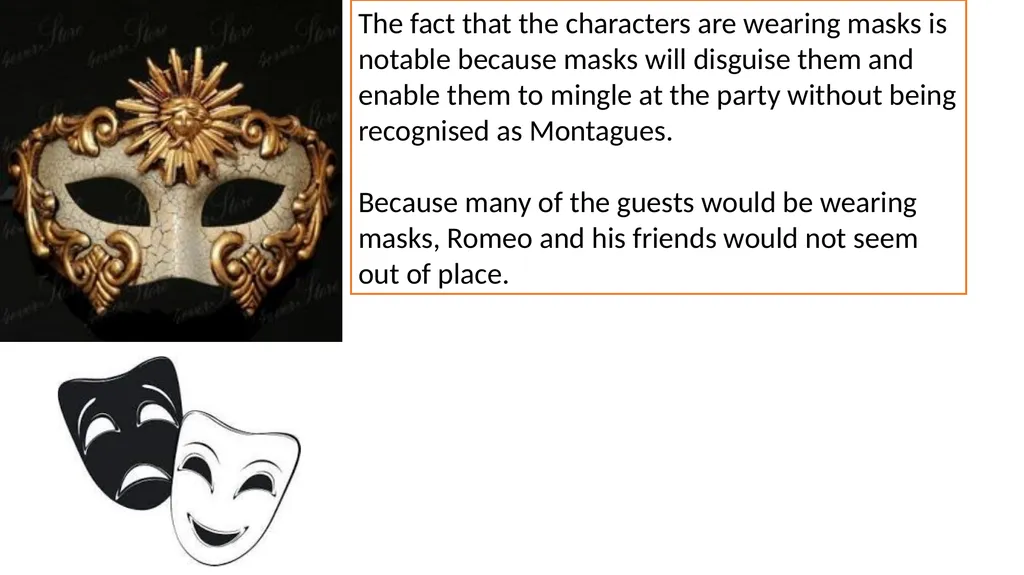
The fact that the characters are wearing masks is notable because masks will disguise them and enable them to mingle at the party without being recognised as Montagues.
Because many of the guests would be wearing masks, Romeo and his friends would not seem out of place.<br>
Because many of the guests would be wearing masks, Romeo and his friends would not seem out of place.<br>
36
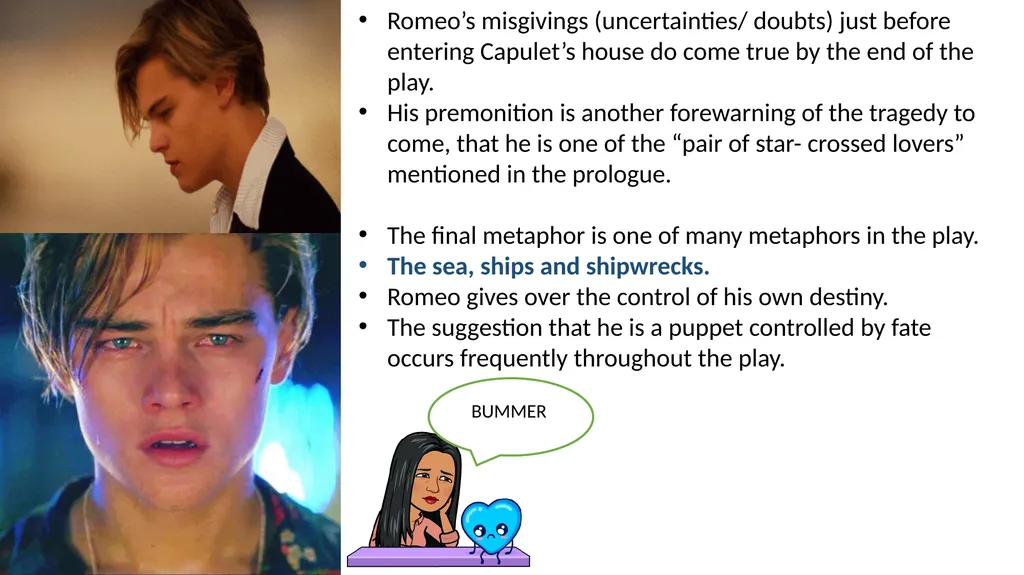
Romeo’s misgivings (uncertainties/ doubts) just before entering Capulet’s house do come true by the end of the play.
His premonition is another forewarning of the tragedy to come, that he is one of the “pair of star- crossed lovers” mentioned in the prologue.
The final metaphor is one of many metaphors in the play.
The sea, ships and shipwrecks.
Romeo gives over the control of his own destiny.
The suggestion that he is a puppet controlled by fate occurs frequently throughout the play. BUMMER<br>
37
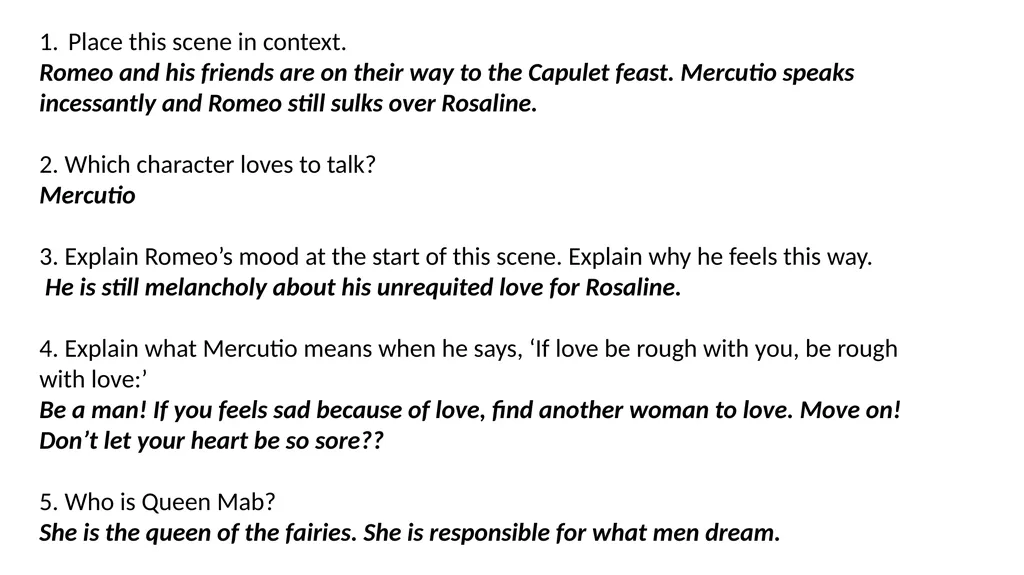
Write a description of Mercutio.
Who is Queen Mab? Describe her briefly?<br>
Who is Queen Mab? Describe her briefly?<br>
38
Place this scene in context.
Romeo and his friends are on their way to the Capulet feast. Mercutio speaks incessantly and Romeo still sulks over Rosaline.
2. Which character loves to talk?
Mercutio
3. Explain Romeo’s mood at the start of this scene. Explain why he feels this way.
He is still melancholy about his unrequited love for Rosaline.
4. Explain what Mercutio means when he says, ‘If love be rough with you, be rough with love:’
Be a man! If you feels sad because of love, find another woman to love. Move on! Don’t let your heart be so sore??
5. Who is Queen Mab?
She is the queen of the fairies. She is responsible for what men dream.<br>
39
6. What is the purpose of this soliloquy?
Mercutio makes it clear that he believes that dreams are but idle fantasies. Links to Juliet and Romeo’s future premonitions/dreams. Also – this soliloquy is humorous and fills the time while they are walking to the Capulet compound. In terms of staging, this would have given the ‘backstage crew’ time to set up the banquet scene behind the curtain.
7. What does Romeo mean when he says, ‘Peace, Mercutio! Thou talk’st of nothing.’
Be quiet, you speak nonsense!
8. What premonition does Romeo have?
He fears that the day will end badly. He has a bad feeling about that night. He fears his mortality.<br>
40
ACT 1 Scene 5: Where: The Great Hall in Capulet’s mansion.
Who: Servingmen, Capulet, Cousin Capulet, Juliet, Romeo, Tybalt and his page, Nurse, Guests and gentlewomen to the Maskers.
BRIEF SUMMARY:
Capulet’s servants are busily preparing for the party before Capulet welcomes his guests among whom are Romeo and his friends.
When Romeo sees Juliet, he immediately falls in love.
He expresses aloud his admiration for her beauty.
Tybalt recognizes his voice as Romeo, the Montague and immediately wants to fight with him..
Capulet stops him (Tybalt) and scold him for wanting to start a fight at his party.
Tybalt is angry and vows to get revenge<br>
41
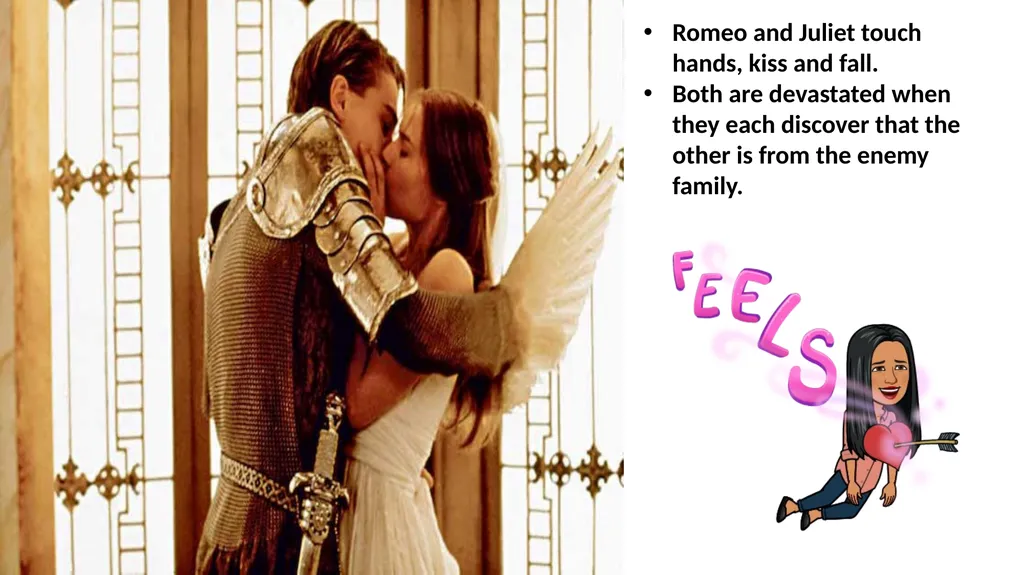
Romeo and Juliet touch hands, kiss and fall.
Both are devastated when they each discover that the other is from the enemy family.<br>
Both are devastated when they each discover that the other is from the enemy family.<br>
42
DETAILED SUMMARY:
In the hall in Capulet’s house, the servants are joking together as they prepare for Capulet’s party.
Capulet welcomes the guests, including Romeo and his friends (at this point he doesn’t know that Montagues have entered the party.)
He tells all the guests to dance and says that any lady who refuses to dance must have corns.
This comment ensures that all the ladies dance.
He proceeds to talk of how he would party when he was young.<br>
43
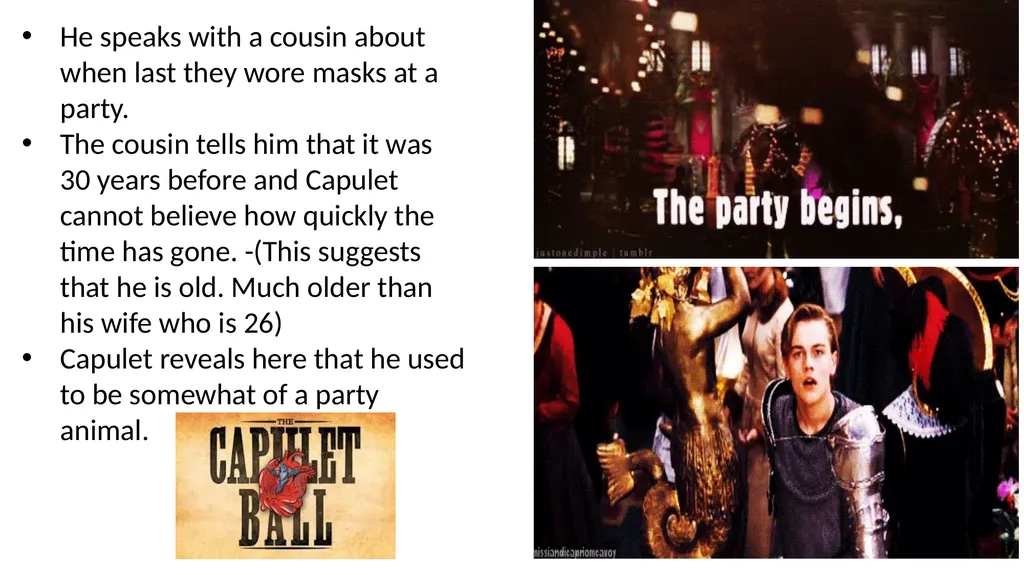
He speaks with a cousin about when last they wore masks at a party.
The cousin tells him that it was 30 years before and Capulet cannot believe how quickly the time has gone. -(This suggests that he is old. Much older than his wife who is 26)
Capulet reveals here that he used to be somewhat of a party animal.<br>
The cousin tells him that it was 30 years before and Capulet cannot believe how quickly the time has gone. -(This suggests that he is old. Much older than his wife who is 26)
Capulet reveals here that he used to be somewhat of a party animal.<br>
44
Romeo sees Juliet for the first time and is smitten by her beauty.
He says that he has never seen true beauty before this.
Romeo’s reaction to Juliet reveals that we were not wrong in interpreting his infatuation with Rosaline as insincere.
He forgets all about his former “love”.
He speaks of Juliet in terms so sincere that we are convinced that this is real love.<br>
45
QUESTIONS: ACT 1 Scene 5: Explain the purpose of the servants’ ‘scene’ at the beginning of this scene.
Creates a party atmosphere. Humorous banter. Sets the scene for the ensuing banquet.
2. How did Lord Capulet force the young ladies to dance with him?
He insinuates that only those without corns/bunions will dance. So those who sit out will seem to be plagued with the foot ‘deformities’ and feel embarrassed.
3. Explain Romeo’s description of Juliet when he says, ‘O she doth teach the torches to burn bright!’
She is more beautiful than the torches/stars – she ‘teaches’ them how to shine brightly.<br>
46
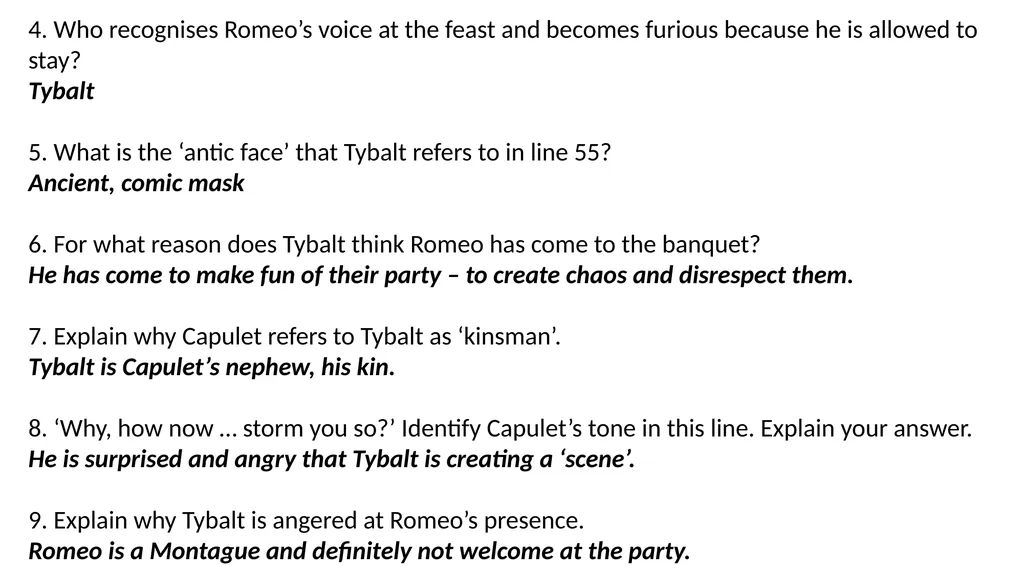
4. Who recognises Romeo’s voice at the feast and becomes furious because he is allowed to stay?
Tybalt
5. What is the ‘antic face’ that Tybalt refers to in line 55?
Ancient, comic mask
6. For what reason does Tybalt think Romeo has come to the banquet?
He has come to make fun of their party – to create chaos and disrespect them.
7. Explain why Capulet refers to Tybalt as ‘kinsman’.
Tybalt is Capulet’s nephew, his kin.
8. ‘Why, how now … storm you so?’ Identify Capulet’s tone in this line. Explain your answer.
He is surprised and angry that Tybalt is creating a ‘scene’.
9. Explain why Tybalt is angered at Romeo’s presence.
Romeo is a Montague and definitely not welcome at the party.<br>
47
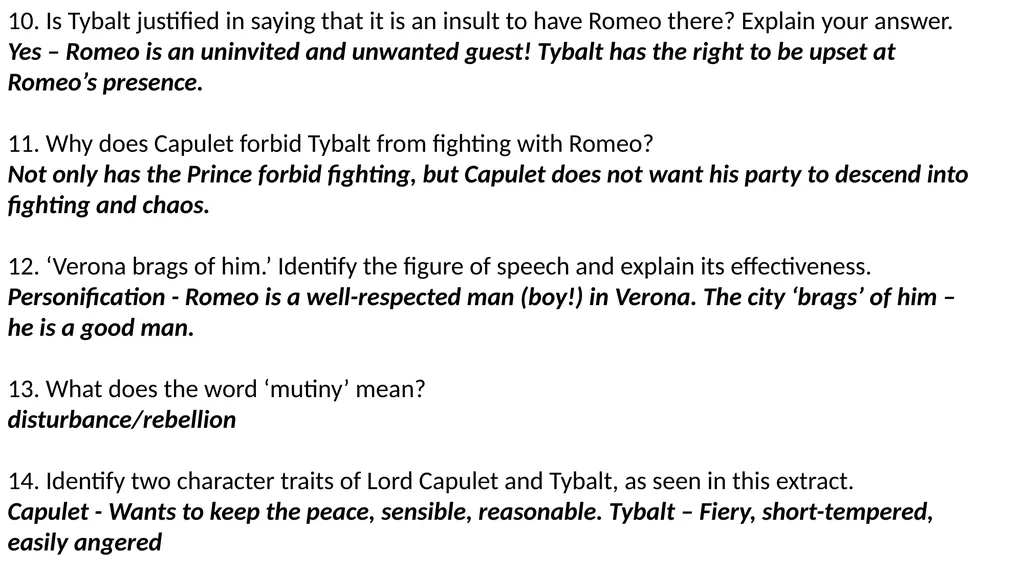
10. Is Tybalt justified in saying that it is an insult to have Romeo there? Explain your answer.
Yes – Romeo is an uninvited and unwanted guest! Tybalt has the right to be upset at Romeo’s presence.
11. Why does Capulet forbid Tybalt from fighting with Romeo?
Not only has the Prince forbid fighting, but Capulet does not want his party to descend into fighting and chaos.
12. ‘Verona brags of him.’ Identify the figure of speech and explain its effectiveness.
Personification - Romeo is a well-respected man (boy!) in Verona. The city ‘brags’ of him – he is a good man.
13. What does the word ‘mutiny’ mean?
disturbance/rebellion
14. Identify two character traits of Lord Capulet and Tybalt, as seen in this extract.
Capulet - Wants to keep the peace, sensible, reasonable. Tybalt – Fiery, short-tempered, easily angered<br>