
Activity 0.2 - Consortium meetings and workshops







Description: Activity 0.2 - Consortium meetings and workshops among partners Consortium meeting 5 WORKSHOP 2 Capacity building of the Russian Project partners on The Governance Approach 22 MAY 2020 What are the topics? Coordination mechanisms and
Related Topics
Download Presentation
"Activity 0.2 - Consortium meetings and workshops" is the property of its rightful owner. Permission is granted to download and print the materials on this website for personal, non-commercial use only, and to display it on your personal computer provided you do not modify the materials and that you retain all copyright notices contained in the materials. By downloading content from our website, you accept the terms of this agreement.
Presentation Transcript
slide1. Activity 0.2 - Consortium meetings and workshops among partners
Consortium meeting № 5 – WORKSHOP 2
Capacity building of the Russian Project partners on
“The Governance Approach” 22 MAY 2020<br>
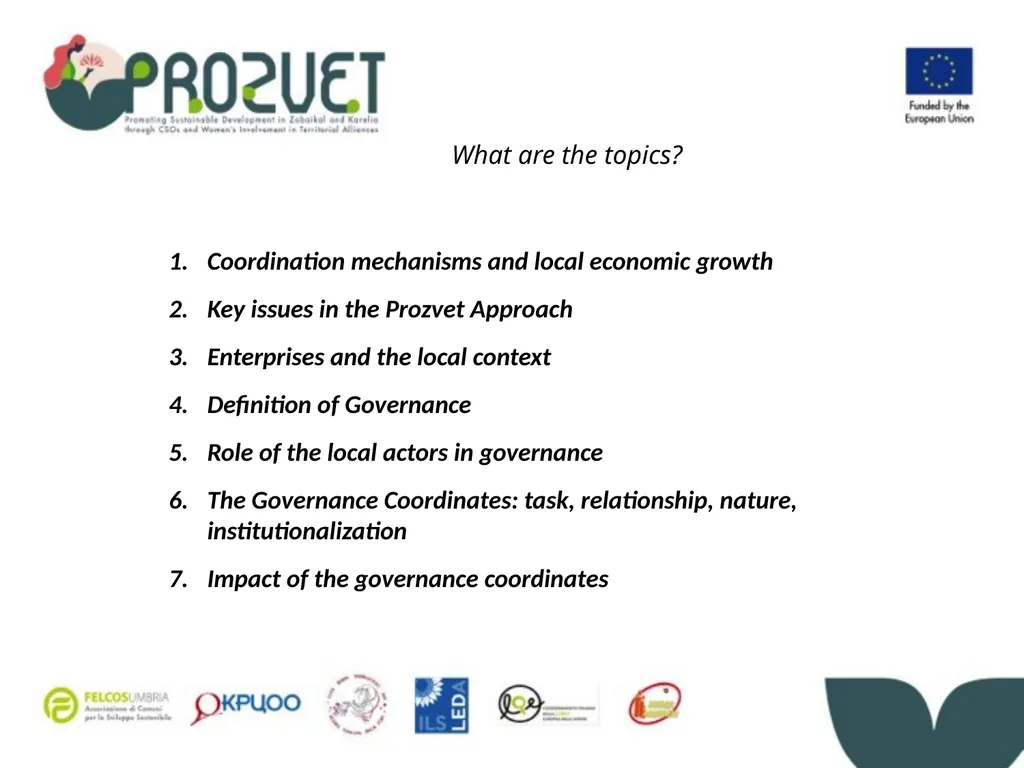
slide2. What are the topics? Coordination mechanisms and local economic growth
Key issues in the Prozvet Approach
Enterprises and the local context
Definition of Governance
Role of the local actors in governance
The Governance Coordinates: task, relationship, nature, institutionalization
Impact of the governance coordinates<br>
slide3. entrevista a L carrino<br>
slide4. entrevista a L carrino Ant the farmers had to sell the milk at 25 рублей / литр<br>
slide5. entrevista a L carrino Ranchers in response did the same thinking 35 рублей / литр In this way, we can ask the dairy entrepreneurs
35 рублей / литр<br>
slide6. entrevista a L carrino X After a while, the large foreign company closed its factory and moved<br>
slide7. entrevista a L carrino X<br>
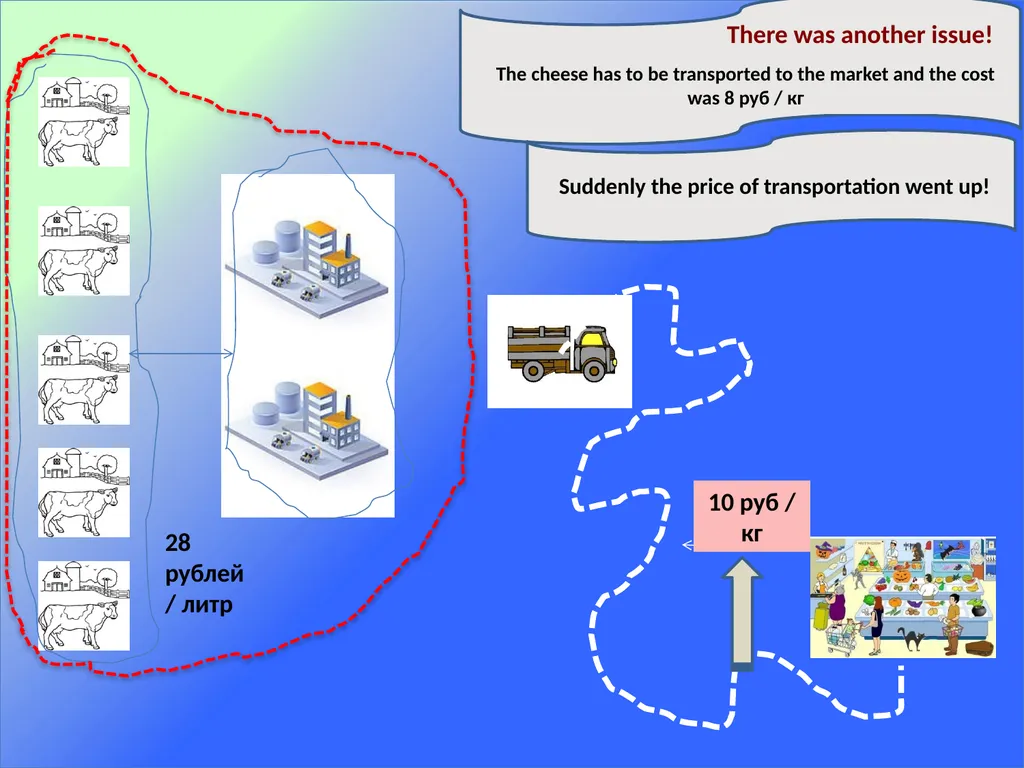
slide8. There was another issue!<br>
slide9. entrevista a L carrino 1st Solution 2nd Solution Ranchers and dairy producers got together, reflected and thought about 3 solutions<br>
slide10. entrevista a L carrino 3rd Solution<br>
slide11. entrevista a L carrino<br>
slide12. entrevista a L carrino More dairy enterprises More cows More transportation<br>
slide13. entrevista a L carrino<br>
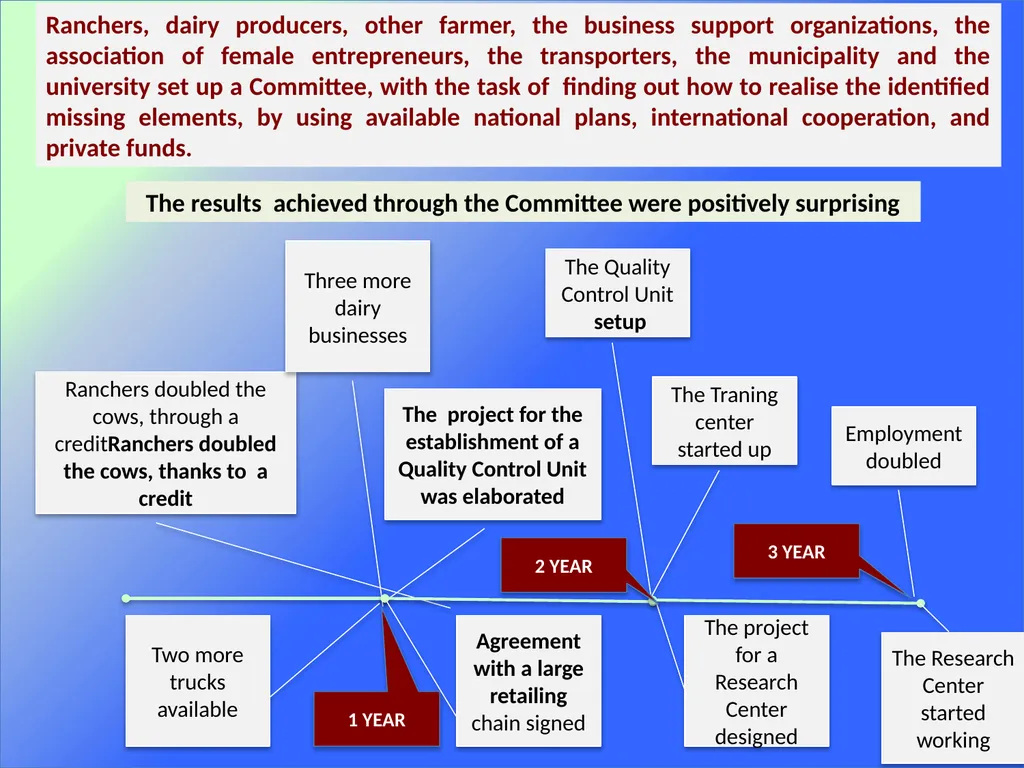
slide14. The results achieved through the Committee were positively surprising Ranchers doubled the cows, through a creditRanchers doubled the cows, thanks to a credit Three more dairy businesses The project for the establishment of a Quality Control Unit was elaborated The Quality Control Unit
setup Two more trucks available The Traning center started up The project for a Research Center designed Employment doubled Agreement with a large retailing chain signed The Research Center started working 1 YEAR 2 YEAR 3 YEAR Ranchers, dairy producers, other farmer, the business support organizations, the association of female entrepreneurs, the transporters, the municipality and the university set up a Committee, with the task of finding out how to realise the identified missing elements, by using available national plans, international cooperation, and private funds.<br>
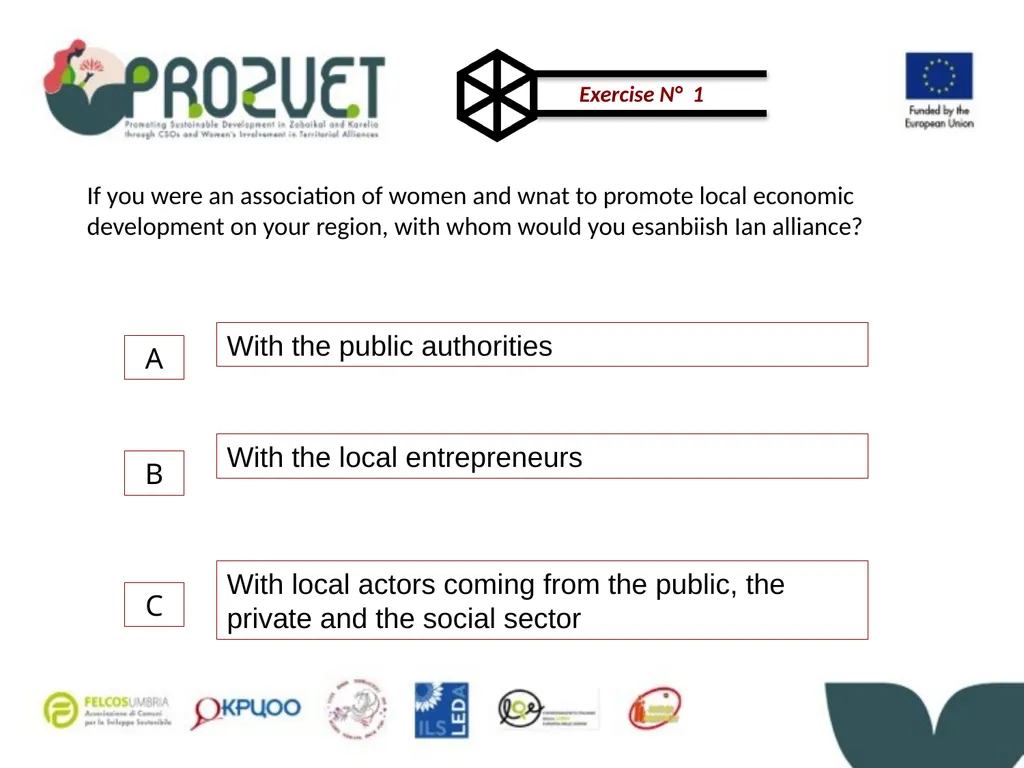
slide15. Exercise N° 1 With the local entrepreneurs With the public authorities With local actors coming from the public, the private and the social sector A B C If you were an association of women and wnat to promote local economic development on your region, with whom would you esanbiish Ian alliance?<br>
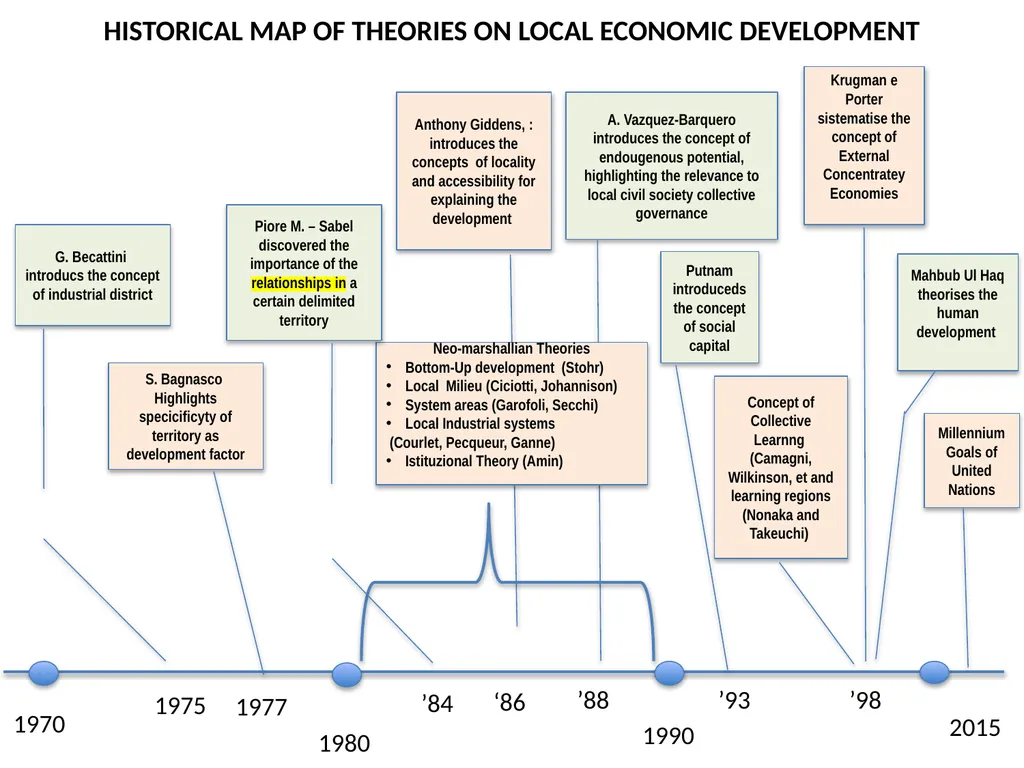
slide16. 1970 1980 1990 2015 S. Bagnasco
Highlights specicificyty of territory as development factor 1977 ’84 1975 Anthony Giddens, : introduces the concepts of locality and accessibility for explaining the development ‘86 A. Vazquez-Barquero introduces the concept of endougenous potential, highlighting the relevance to local civil society collective governance ’88 Concept of Collective Learnng
(Camagni, Wilkinson, et and learning regions (Nonaka and Takeuchi) Millennium
Goals of United Nations ’98 Putnam introduceds the concept of social capital ’93 Neo-marshallian Theories
Bottom-Up development (Stohr)
Local Milieu (Ciciotti, Johannison)
System areas (Garofoli, Secchi)
Local Industrial systems
(Courlet, Pecqueur, Ganne)
Istituzional Theory (Amin) Krugman e Porter sistematise the concept of External Concentratey Economies HISTORICAL MAP OF THEORIES ON LOCAL ECONOMIC DEVELOPMENT<br>
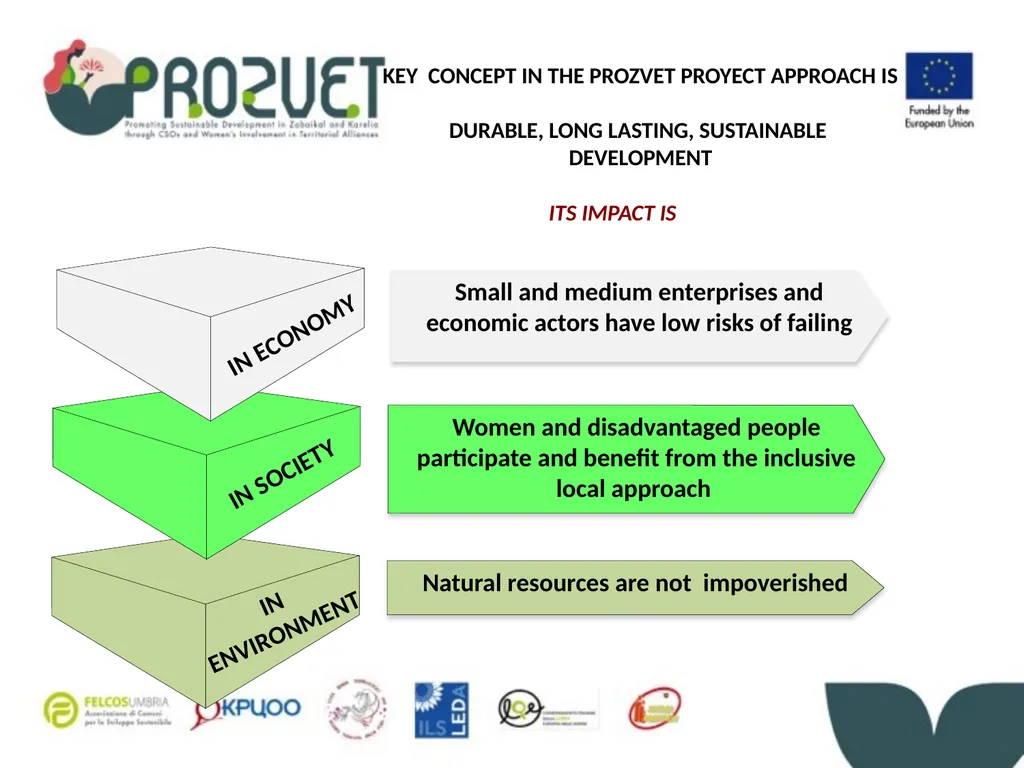
slide17. KEY CONCEPT IN THE PROZVET PROYECT APPROACH IS
DURABLE, LONG LASTING, SUSTAINABLE
DEVELOPMENT Natural resources are not impoverished Small and medium enterprises and economic actors have low risks of failing Women and disadvantaged people participate and benefit from the inclusive local approach ITS IMPACT IS<br>
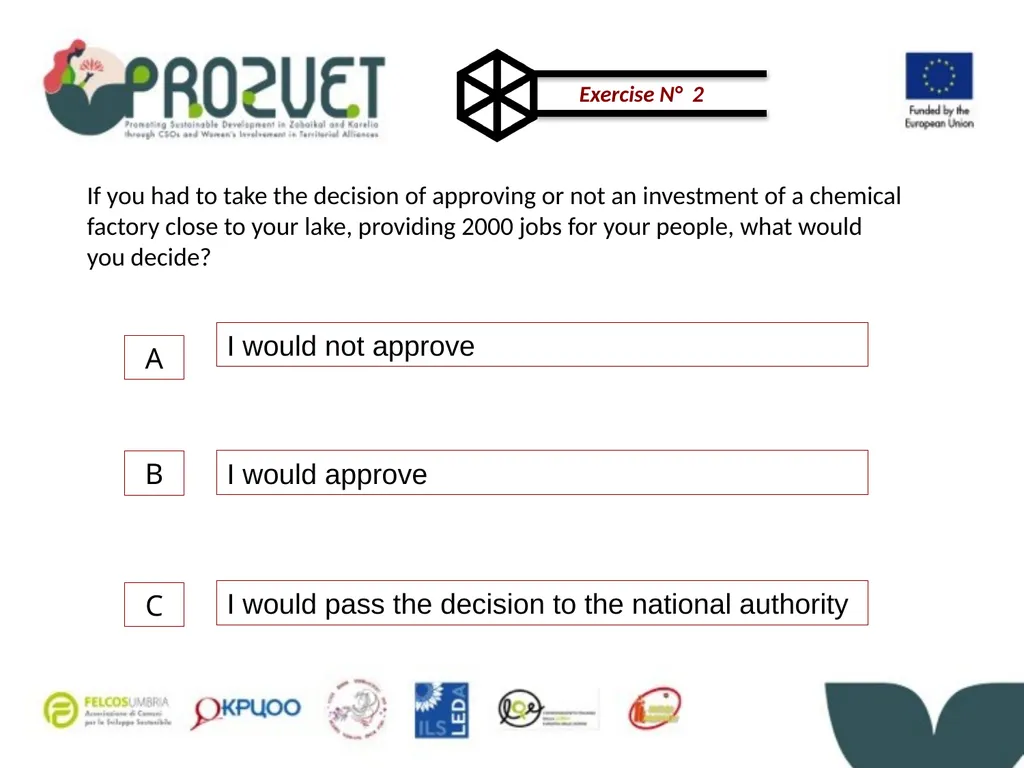
slide18. Exercise N° 2 I would approve I would not approve I would pass the decision to the national authority A B C If you had to take the decision of approving or not an investment of a chemical factory close to your lake, providing 2000 jobs for your people, what would you decide?<br>
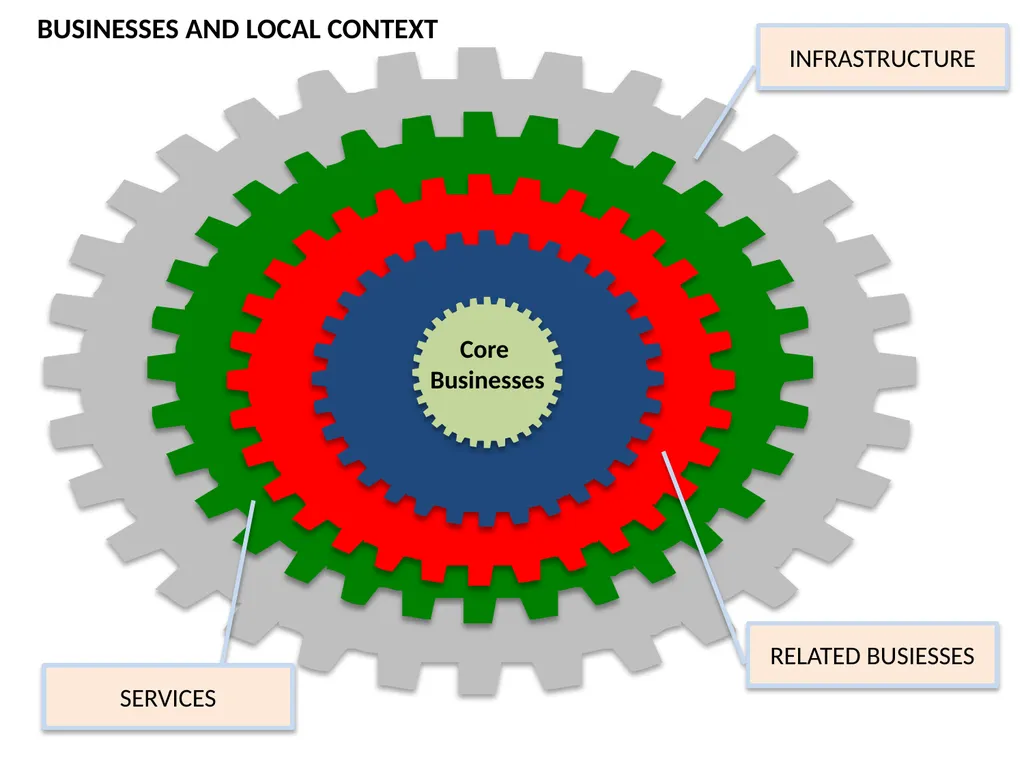
slide19. Core
Businesses INFRASTRUCTURE SERVICES RELATED BUSIESSES BUSINESSES AND LOCAL CONTEXT<br>
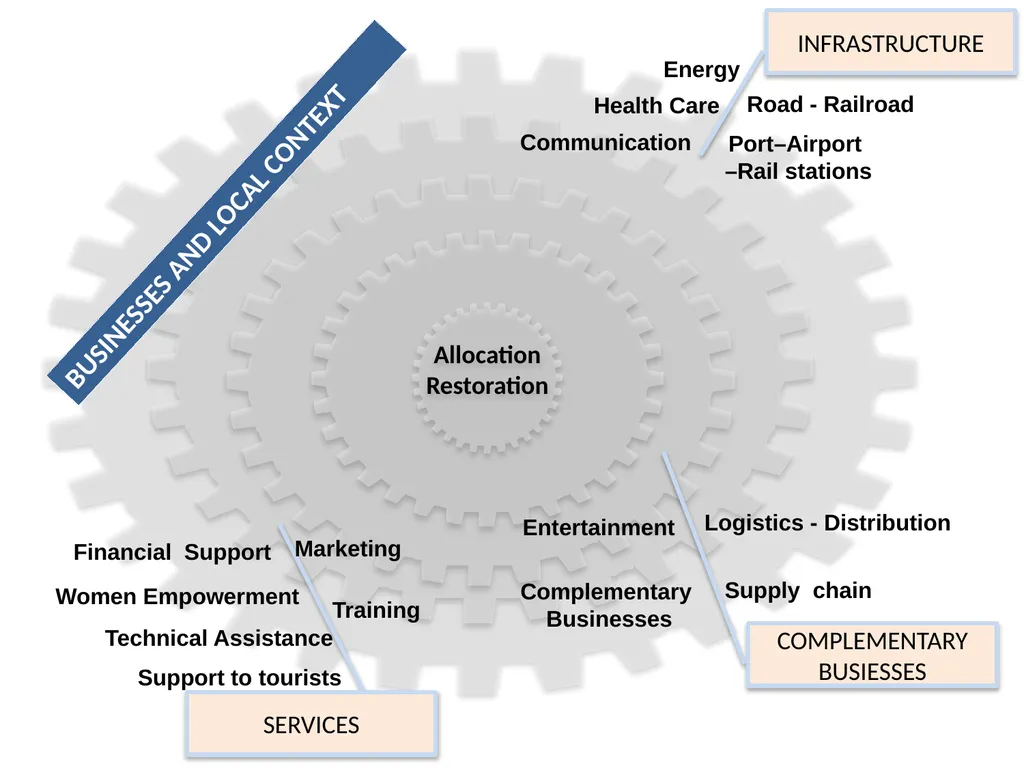
slide20. INFRASTRUCTURE SERVICES COMPLEMENTARY BUSIESSES BUSINESSES AND LOCAL CONTEXT Supply chain Complementary
Businesses Logistics - Distribution Technical Assistance Women Empowerment Financial Support Training Marketing Support to tourists Road - Railroad Port–Airport
–Rail stations Communication Energy Health Care Entertainment<br>
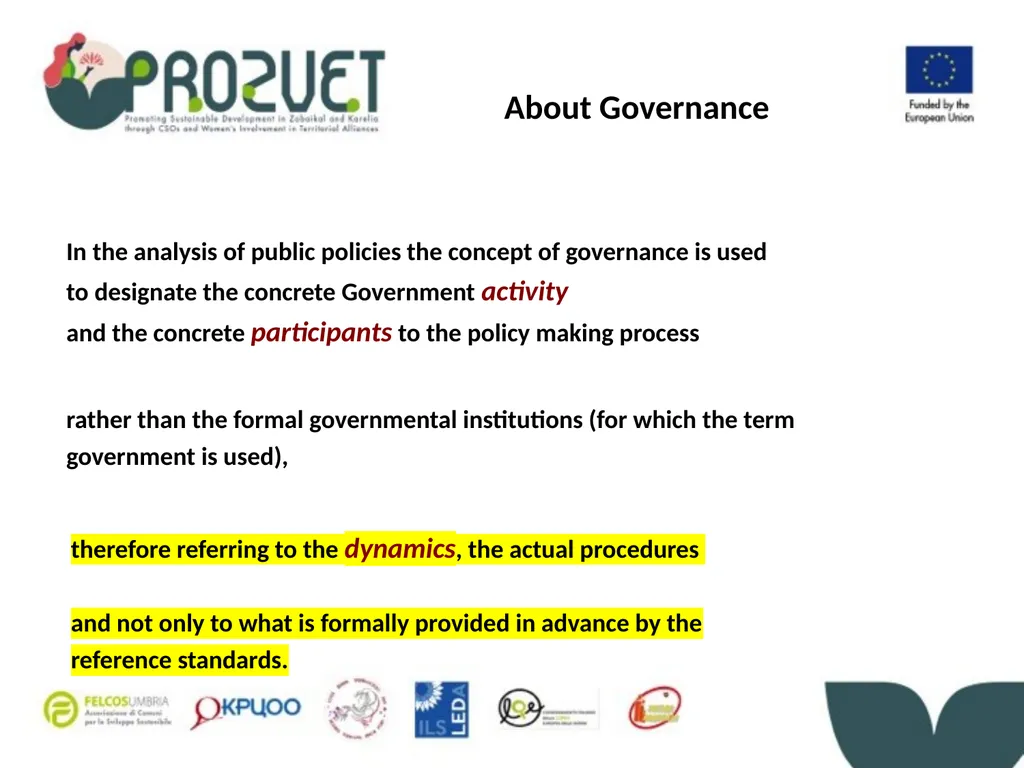
slide21. In the analysis of public policies the concept of governance is used to designate the concrete Government activity
and the concrete participants to the policy making process About Governance rather than the formal governmental institutions (for which the term government is used), therefore referring to the dynamics, the actual procedures and not only to what is formally provided in advance by the reference standards.<br>
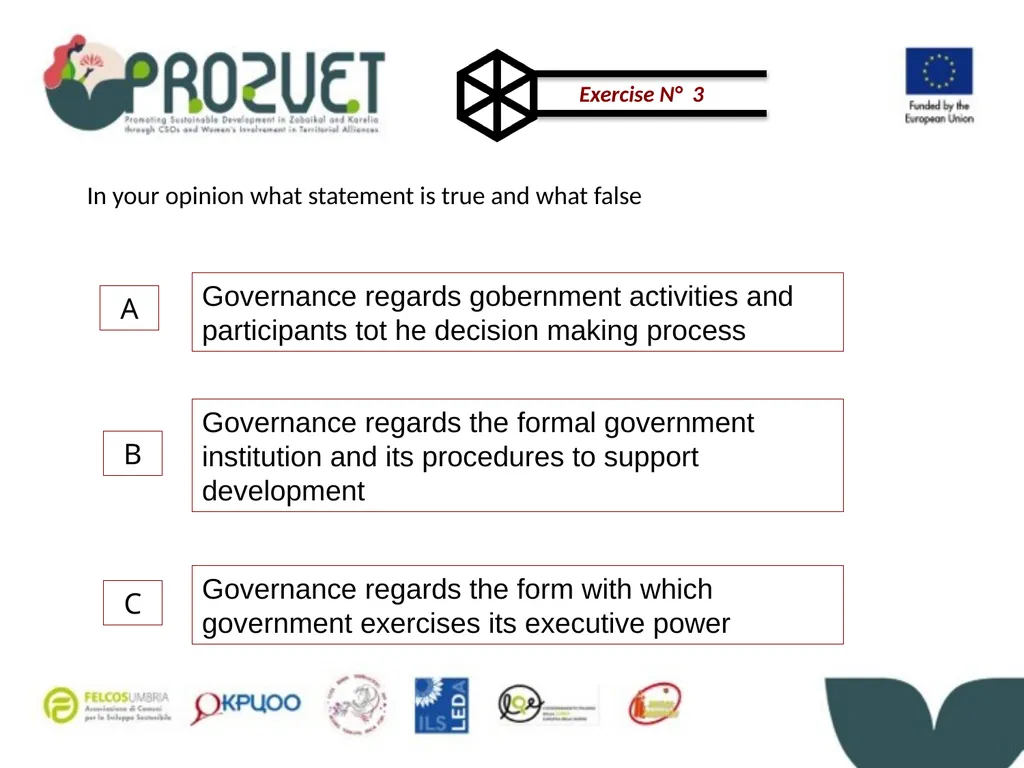
slide22. Exercise N° 3 Governance regards the formal government institution and its procedures to support development Governance regards gobernment activities and participants tot he decision making process Governance regards the form with which government exercises its executive power A B C In your opinion what statement is true and what false<br>
slide23. UNAD
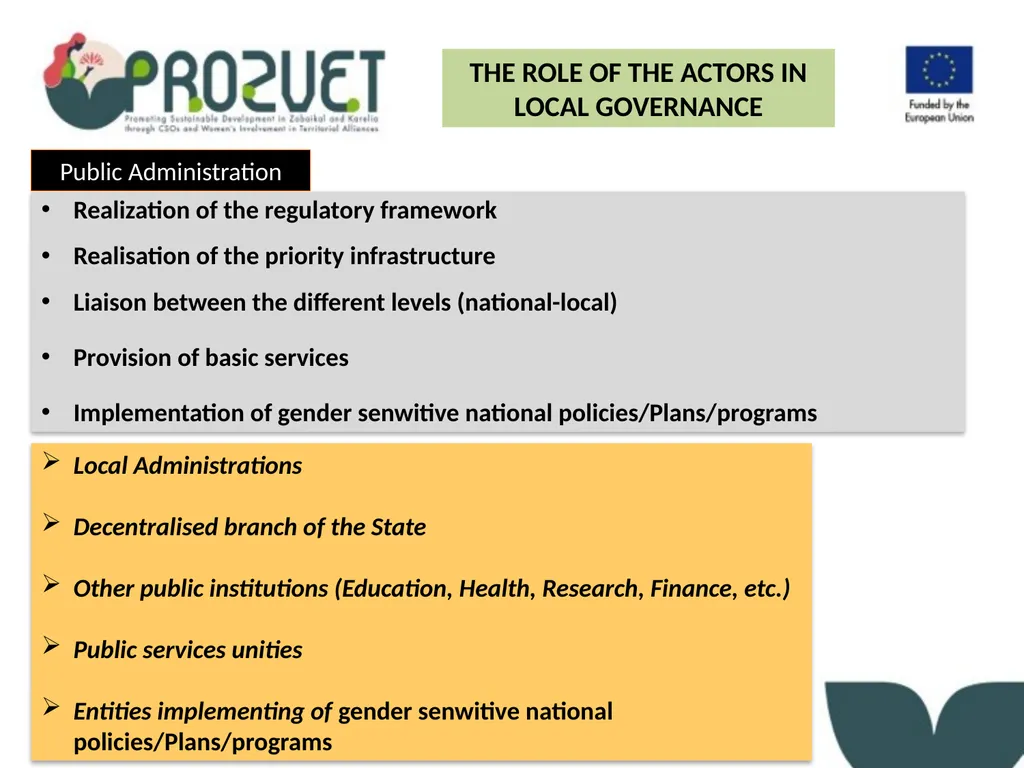
ILS LEDA-REDADELCO THE ROLE OF THE ACTORS IN LOCAL GOVERNANCE Public Administration Realization of the regulatory framework
Realisation of the priority infrastructure
Liaison between the different levels (national-local)
Provision of basic services
Implementation of gender senwitive national policies/Plans/programs Local Administrations
Decentralised branch of the State
Other public institutions (Education, Health, Research, Finance, etc.)
Public services unities
Entities implementing of gender senwitive national policies/Plans/programs<br>
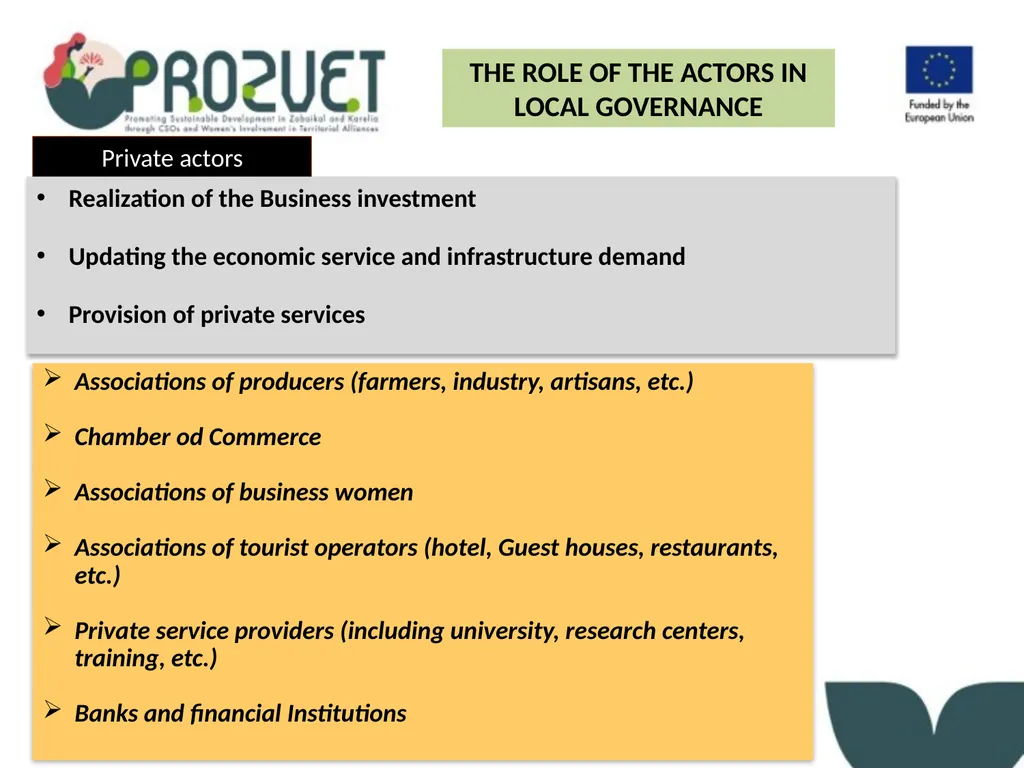
slide24. THE ROLE OF THE ACTORS IN LOCAL GOVERNANCE Private actors Realization of the Business investment
Updating the economic service and infrastructure demand
Provision of private services Associations of producers (farmers, industry, artisans, etc.)
Chamber od Commerce
Associations of business women
Associations of tourist operators (hotel, Guest houses, restaurants, etc.)
Private service providers (including university, research centers, training, etc.)
Banks and financial Institutions<br>
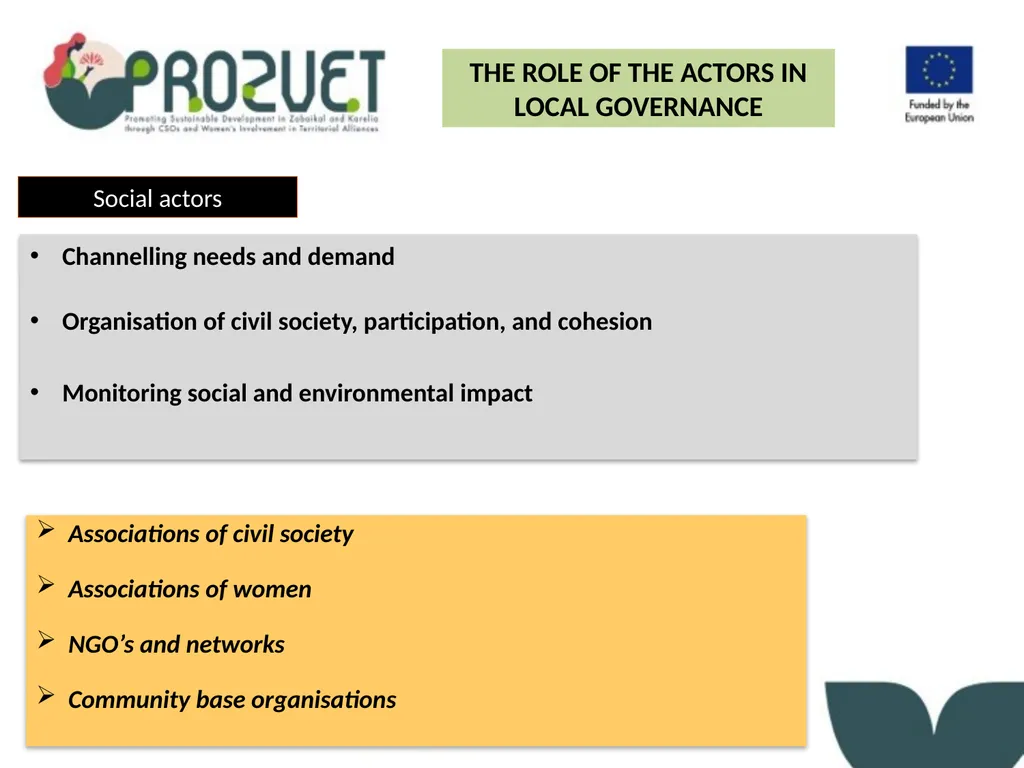
slide25. THE ROLE OF THE ACTORS IN LOCAL GOVERNANCE Social actors Channelling needs and demand
Organisation of civil society, participation, and cohesion
Monitoring social and environmental impact Associations of civil society
Associations of women
NGO’s and networks
Community base organisations<br>
slide26. LOCAL GOVERNANCE
COORDINATES Decision-making level Typology of actors Contractual/Structural Formal/Informal<br>
slide27. LOCAL GOVERNANCE
COORDINATES Lobbyng Bottom-up pressure for influencing decision makers Consulting Decision makers consult other actors, and take decisions accordingly (or not) Semi-decisional Decision makers entrust the governance mechanism decisions about some specific component of the public budget (participatory budgeting) Co-decisional The governance mechanism include all the actors and they take decision on specific issues<br>
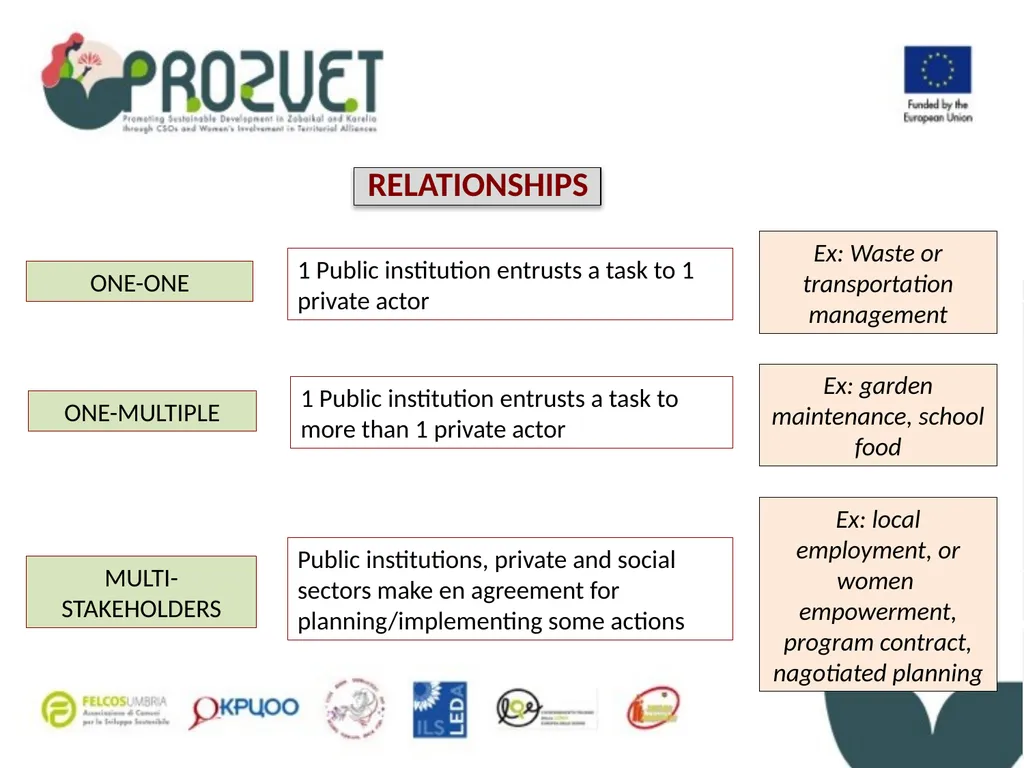
slide28. ONE-ONE 1 Public institution entrusts a task to 1 private actor ONE-MULTIPLE 1 Public institution entrusts a task to more than 1 private actor MULTI-STAKEHOLDERS Public institutions, private and social sectors make en agreement for planning/implementing some actions Ex: Waste or transportation management Ex: garden maintenance, school food Ex: local employment, or women empowerment, program contract,
nagotiated planning<br>
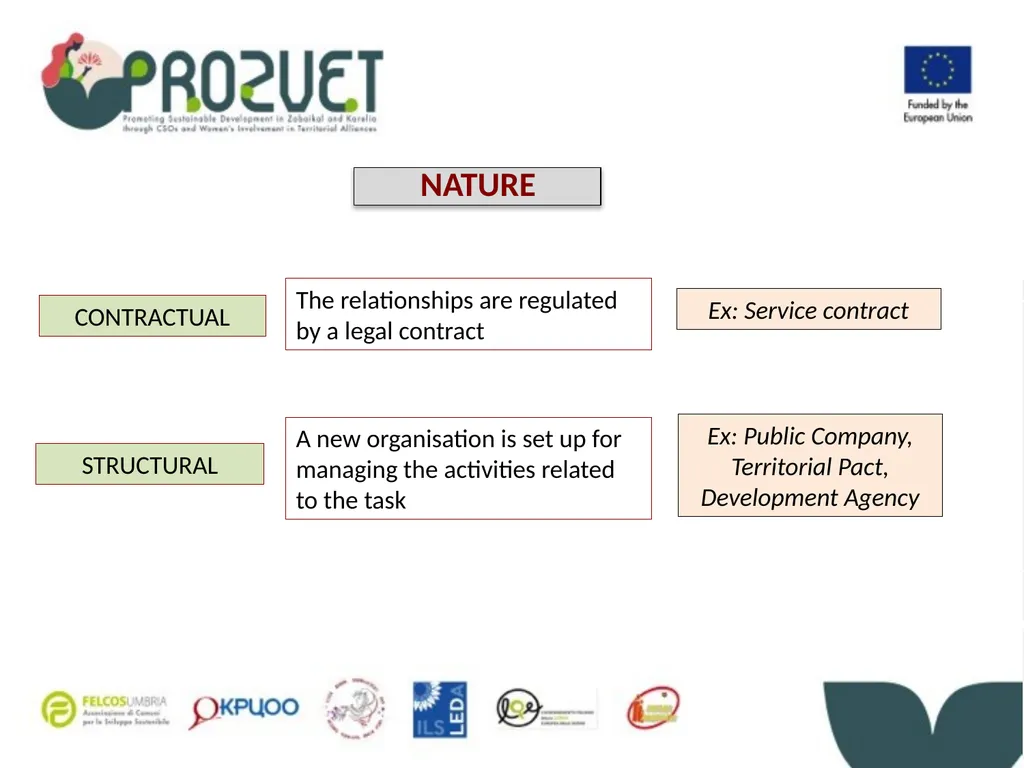
slide29. CONTRACTUAL The relationships are regulated by a legal contract STRUCTURAL A new organisation is set up for managing the activities related to the task Ex: Service contract Ex: Public Company,
Territorial Pact,
Development Agency<br>
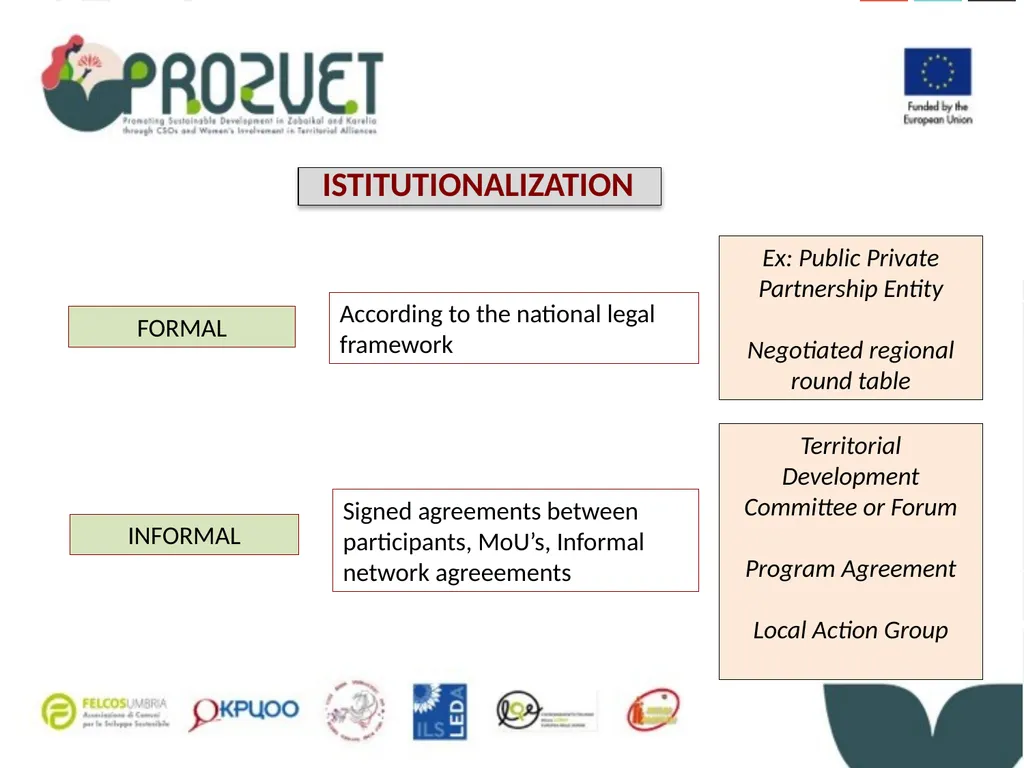
slide30. ISTITUTIONALIZATION FORMAL According to the national legal framework INFORMAL Signed agreements between participants, MoU’s, Informal network agreeements Ex: Public Private Partnership Entity
Negotiated regional round table Territorial Development Committee or Forum
Program Agreement
Local Action Group<br>
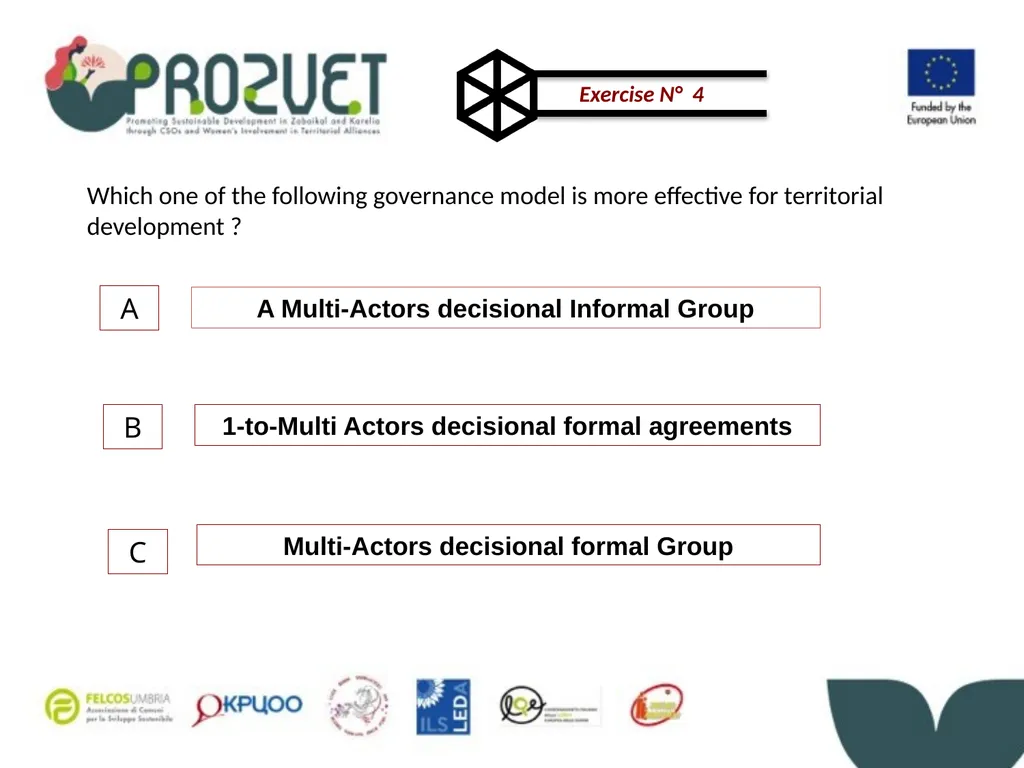
slide31. Exercise N° 4 1-to-Multi Actors decisional formal agreements Multi-Actors decisional formal Group A B C Which one of the following governance model is more effective for territorial development ? A Multi-Actors decisional Informal Group<br>
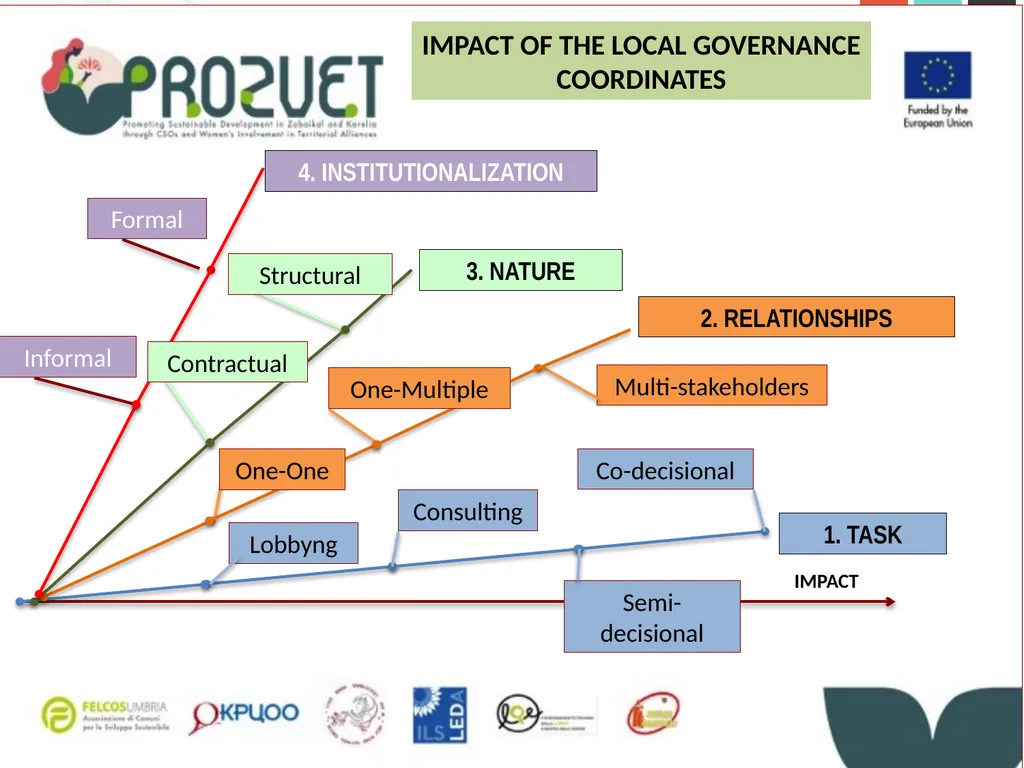
slide32. 1. TASK IMPACT Lobbyng Consulting Semi-decisional Co-decisional Multi-stakeholders 2. RELATIONSHIPS 3. NATURE Formal Informal 4. INSTITUTIONALIZATION IMPACT OF THE LOCAL GOVERNANCE
COORDINATES One-One Contractual One-Multiple Structural<br>
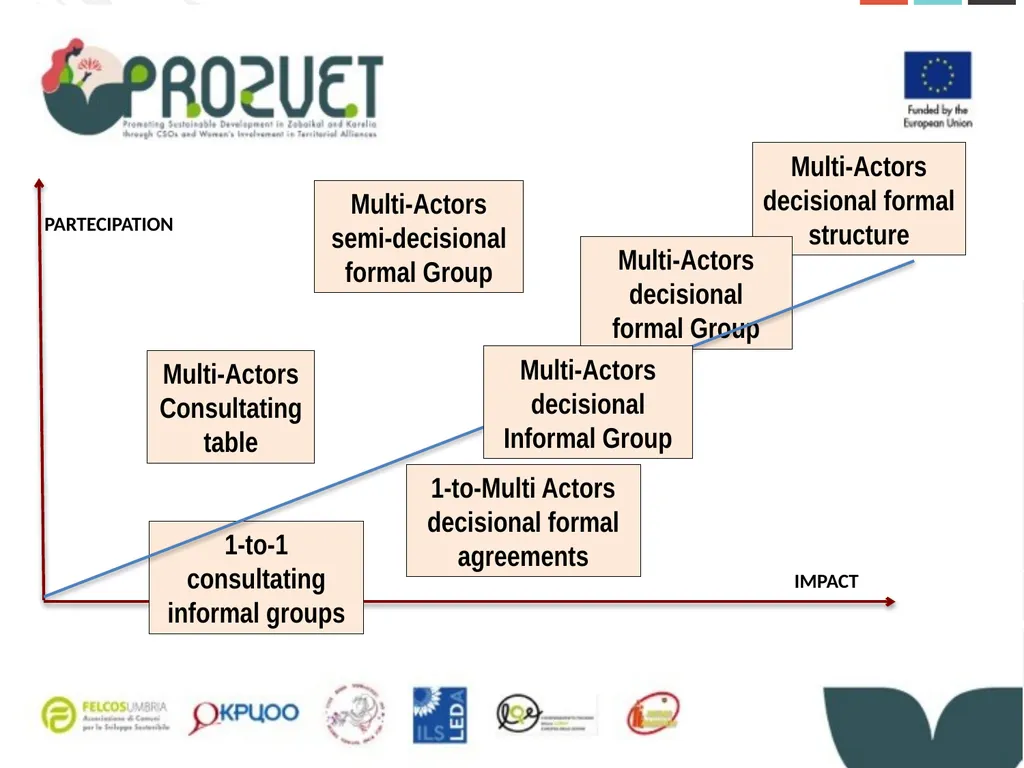
slide33. Multi-Actors decisional formal structure Multi-Actors decisional formal Group Multi-Actors semi-decisional formal Group Multi-Actors Consultating table 1-to-1 consultating informal groups 1-to-Multi Actors decisional formal agreements PARTECIPATION IMPACT Multi-Actors decisional Informal Group<br>
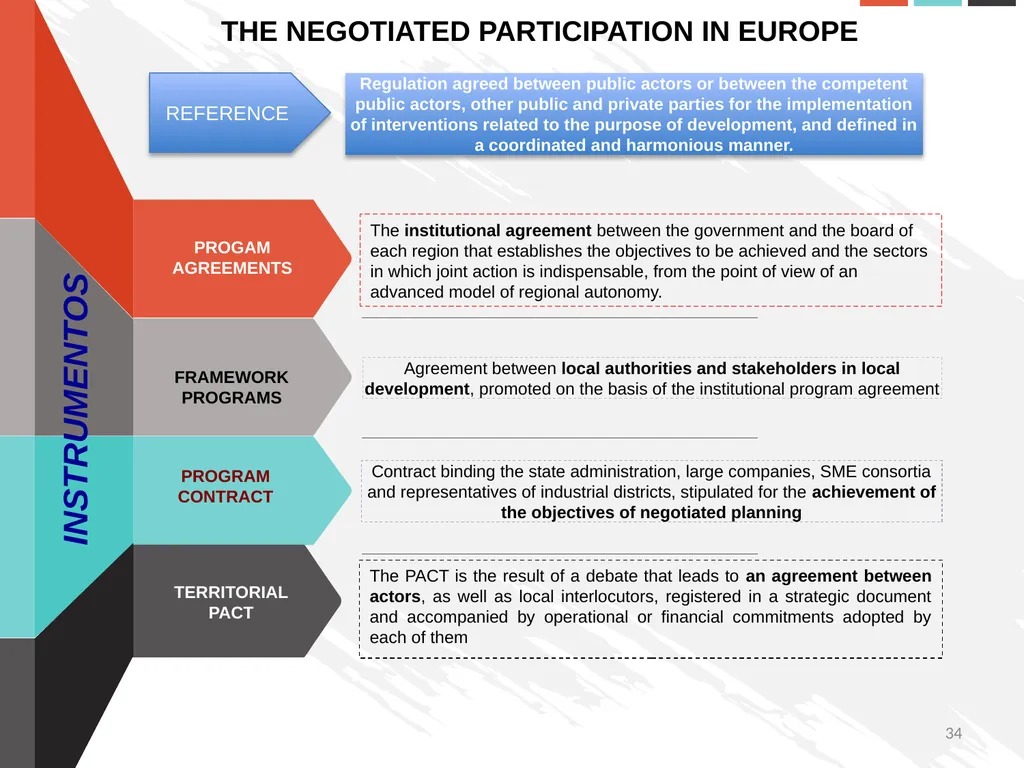
slide34. 34 PROGAM AGREEMENTS FRAMEWORK PROGRAMS PROGRAM CONTRACT TERRITORIAL PACT Regulation agreed between public actors or between the competent public actors, other public and private parties for the implementation of interventions related to the purpose of development, and defined in a coordinated and harmonious manner. Agreement between local authorities and stakeholders in local development, promoted on the basis of the institutional program agreement Contract binding the state administration, large companies, SME consortia and representatives of industrial districts, stipulated for the achievement of the objectives of negotiated planning The institutional agreement between the government and the board of each region that establishes the objectives to be achieved and the sectors in which joint action is indispensable, from the point of view of an advanced model of regional autonomy. REFERENCE INSTRUMENTOS The PACT is the result of a debate that leads to an agreement between actors, as well as local interlocutors, registered in a strategic document and accompanied by operational or financial commitments adopted by each of them THE NEGOTIATED PARTICIPATION IN EUROPE<br>
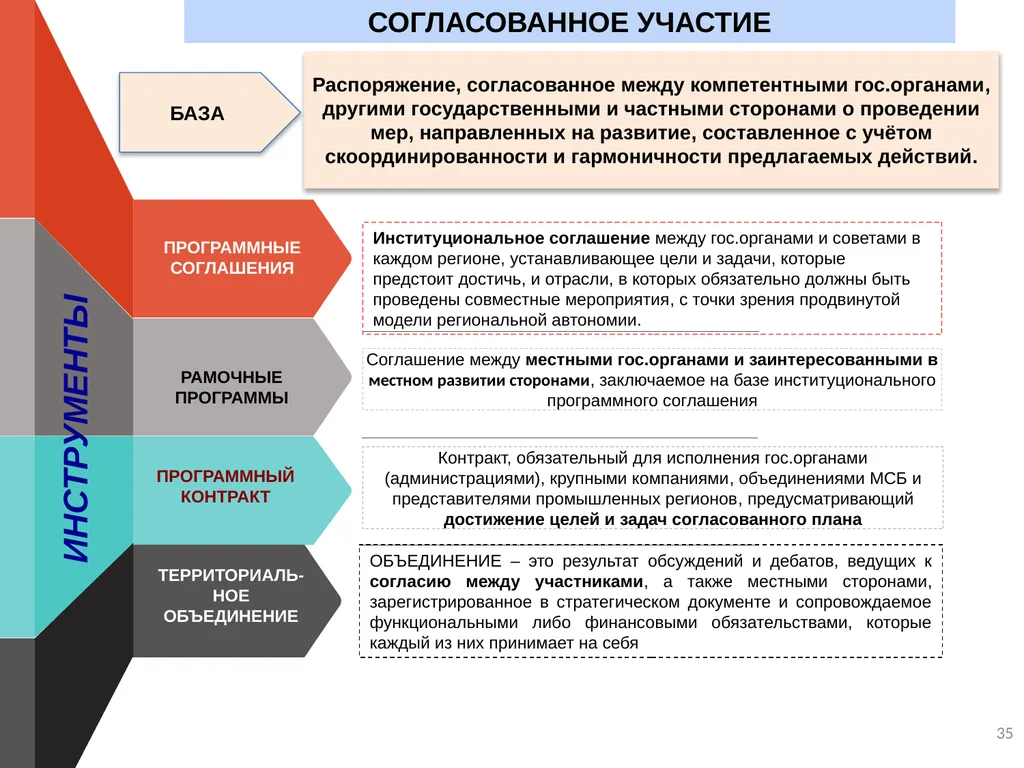
slide35. 35 ПРОГРАММНЫЕ СОГЛАШЕНИЯ РАМОЧНЫЕ ПРОГРАММЫ ПРОГРАММНЫЙ КОНТРАКТ ТЕРРИТОРИАЛЬ-НОЕ ОБЪЕДИНЕНИЕ Распоряжение, согласованное между компетентными гос.органами, другими государственными и частными сторонами о проведении мер, направленных на развитие, составленное с учётом скоординированности и гармоничности предлагаемых действий. Соглашение между местными гос.органами и заинтересованными в местном развитии сторонами, заключаемое на базе институционального программного соглашения Контракт, обязательный для исполнения гос.органами (администрациями), крупными компаниями, объединениями МСБ и представителями промышленных регионов, предусматривающий достижение целей и задач согласованного плана Институциональное соглашение между гос.органами и советами в каждом регионе, устанавливающее цели и задачи, которые предстоит достичь, и отрасли, в которых обязательно должны быть проведены совместные мероприятия, с точки зрения продвинутой модели региональной автономии. БАЗА ИНСТРУМЕНТЫ ОБЪЕДИНЕНИЕ – это результат обсуждений и дебатов, ведущих к согласию между участниками, а также местными сторонами, зарегистрированное в стратегическом документе и сопровождаемое функциональными либо финансовыми обязательствами, которые каждый из них принимает на себя СОГЛАСОВАННОЕ УЧАСТИЕ<br>
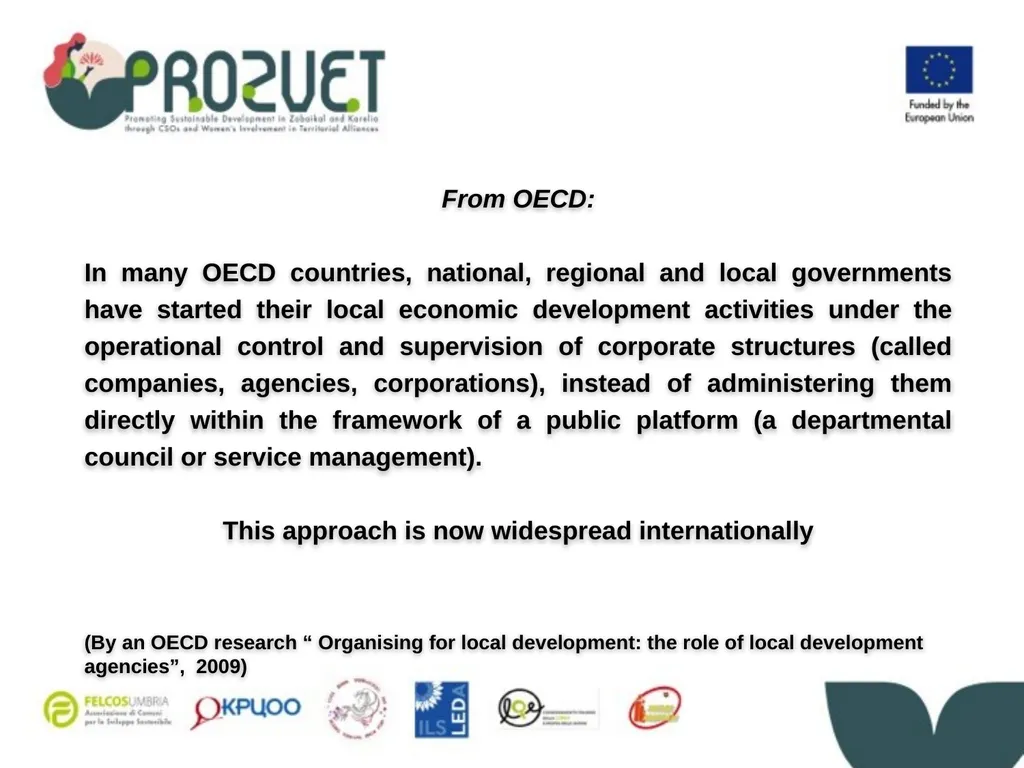
slide36. From OECD:
In many OECD countries, national, regional and local governments have started their local economic development activities under the operational control and supervision of corporate structures (called companies, agencies, corporations), instead of administering them directly within the framework of a public platform (a departmental council or service management).
This approach is now widespread internationally
(By an OECD research “ Organising for local development: the role of local development agencies”, 2009)<br>
Consortium meeting № 5 – WORKSHOP 2
Capacity building of the Russian Project partners on
“The Governance Approach” 22 MAY 2020<br>
slide2. What are the topics? Coordination mechanisms and local economic growth
Key issues in the Prozvet Approach
Enterprises and the local context
Definition of Governance
Role of the local actors in governance
The Governance Coordinates: task, relationship, nature, institutionalization
Impact of the governance coordinates<br>
slide3. entrevista a L carrino<br>
slide4. entrevista a L carrino Ant the farmers had to sell the milk at 25 рублей / литр<br>
slide5. entrevista a L carrino Ranchers in response did the same thinking 35 рублей / литр In this way, we can ask the dairy entrepreneurs
35 рублей / литр<br>
slide6. entrevista a L carrino X After a while, the large foreign company closed its factory and moved<br>
slide7. entrevista a L carrino X<br>
slide8. There was another issue!<br>
slide9. entrevista a L carrino 1st Solution 2nd Solution Ranchers and dairy producers got together, reflected and thought about 3 solutions<br>
slide10. entrevista a L carrino 3rd Solution<br>
slide11. entrevista a L carrino<br>
slide12. entrevista a L carrino More dairy enterprises More cows More transportation<br>
slide13. entrevista a L carrino<br>
slide14. The results achieved through the Committee were positively surprising Ranchers doubled the cows, through a creditRanchers doubled the cows, thanks to a credit Three more dairy businesses The project for the establishment of a Quality Control Unit was elaborated The Quality Control Unit
setup Two more trucks available The Traning center started up The project for a Research Center designed Employment doubled Agreement with a large retailing chain signed The Research Center started working 1 YEAR 2 YEAR 3 YEAR Ranchers, dairy producers, other farmer, the business support organizations, the association of female entrepreneurs, the transporters, the municipality and the university set up a Committee, with the task of finding out how to realise the identified missing elements, by using available national plans, international cooperation, and private funds.<br>
slide15. Exercise N° 1 With the local entrepreneurs With the public authorities With local actors coming from the public, the private and the social sector A B C If you were an association of women and wnat to promote local economic development on your region, with whom would you esanbiish Ian alliance?<br>
slide16. 1970 1980 1990 2015 S. Bagnasco
Highlights specicificyty of territory as development factor 1977 ’84 1975 Anthony Giddens, : introduces the concepts of locality and accessibility for explaining the development ‘86 A. Vazquez-Barquero introduces the concept of endougenous potential, highlighting the relevance to local civil society collective governance ’88 Concept of Collective Learnng
(Camagni, Wilkinson, et and learning regions (Nonaka and Takeuchi) Millennium
Goals of United Nations ’98 Putnam introduceds the concept of social capital ’93 Neo-marshallian Theories
Bottom-Up development (Stohr)
Local Milieu (Ciciotti, Johannison)
System areas (Garofoli, Secchi)
Local Industrial systems
(Courlet, Pecqueur, Ganne)
Istituzional Theory (Amin) Krugman e Porter sistematise the concept of External Concentratey Economies HISTORICAL MAP OF THEORIES ON LOCAL ECONOMIC DEVELOPMENT<br>
slide17. KEY CONCEPT IN THE PROZVET PROYECT APPROACH IS
DURABLE, LONG LASTING, SUSTAINABLE
DEVELOPMENT Natural resources are not impoverished Small and medium enterprises and economic actors have low risks of failing Women and disadvantaged people participate and benefit from the inclusive local approach ITS IMPACT IS<br>
slide18. Exercise N° 2 I would approve I would not approve I would pass the decision to the national authority A B C If you had to take the decision of approving or not an investment of a chemical factory close to your lake, providing 2000 jobs for your people, what would you decide?<br>
slide19. Core
Businesses INFRASTRUCTURE SERVICES RELATED BUSIESSES BUSINESSES AND LOCAL CONTEXT<br>
slide20. INFRASTRUCTURE SERVICES COMPLEMENTARY BUSIESSES BUSINESSES AND LOCAL CONTEXT Supply chain Complementary
Businesses Logistics - Distribution Technical Assistance Women Empowerment Financial Support Training Marketing Support to tourists Road - Railroad Port–Airport
–Rail stations Communication Energy Health Care Entertainment<br>
slide21. In the analysis of public policies the concept of governance is used to designate the concrete Government activity
and the concrete participants to the policy making process About Governance rather than the formal governmental institutions (for which the term government is used), therefore referring to the dynamics, the actual procedures and not only to what is formally provided in advance by the reference standards.<br>
slide22. Exercise N° 3 Governance regards the formal government institution and its procedures to support development Governance regards gobernment activities and participants tot he decision making process Governance regards the form with which government exercises its executive power A B C In your opinion what statement is true and what false<br>
slide23. UNAD
ILS LEDA-REDADELCO THE ROLE OF THE ACTORS IN LOCAL GOVERNANCE Public Administration Realization of the regulatory framework
Realisation of the priority infrastructure
Liaison between the different levels (national-local)
Provision of basic services
Implementation of gender senwitive national policies/Plans/programs Local Administrations
Decentralised branch of the State
Other public institutions (Education, Health, Research, Finance, etc.)
Public services unities
Entities implementing of gender senwitive national policies/Plans/programs<br>
slide24. THE ROLE OF THE ACTORS IN LOCAL GOVERNANCE Private actors Realization of the Business investment
Updating the economic service and infrastructure demand
Provision of private services Associations of producers (farmers, industry, artisans, etc.)
Chamber od Commerce
Associations of business women
Associations of tourist operators (hotel, Guest houses, restaurants, etc.)
Private service providers (including university, research centers, training, etc.)
Banks and financial Institutions<br>
slide25. THE ROLE OF THE ACTORS IN LOCAL GOVERNANCE Social actors Channelling needs and demand
Organisation of civil society, participation, and cohesion
Monitoring social and environmental impact Associations of civil society
Associations of women
NGO’s and networks
Community base organisations<br>
slide26. LOCAL GOVERNANCE
COORDINATES Decision-making level Typology of actors Contractual/Structural Formal/Informal<br>
slide27. LOCAL GOVERNANCE
COORDINATES Lobbyng Bottom-up pressure for influencing decision makers Consulting Decision makers consult other actors, and take decisions accordingly (or not) Semi-decisional Decision makers entrust the governance mechanism decisions about some specific component of the public budget (participatory budgeting) Co-decisional The governance mechanism include all the actors and they take decision on specific issues<br>
slide28. ONE-ONE 1 Public institution entrusts a task to 1 private actor ONE-MULTIPLE 1 Public institution entrusts a task to more than 1 private actor MULTI-STAKEHOLDERS Public institutions, private and social sectors make en agreement for planning/implementing some actions Ex: Waste or transportation management Ex: garden maintenance, school food Ex: local employment, or women empowerment, program contract,
nagotiated planning<br>
slide29. CONTRACTUAL The relationships are regulated by a legal contract STRUCTURAL A new organisation is set up for managing the activities related to the task Ex: Service contract Ex: Public Company,
Territorial Pact,
Development Agency<br>
slide30. ISTITUTIONALIZATION FORMAL According to the national legal framework INFORMAL Signed agreements between participants, MoU’s, Informal network agreeements Ex: Public Private Partnership Entity
Negotiated regional round table Territorial Development Committee or Forum
Program Agreement
Local Action Group<br>
slide31. Exercise N° 4 1-to-Multi Actors decisional formal agreements Multi-Actors decisional formal Group A B C Which one of the following governance model is more effective for territorial development ? A Multi-Actors decisional Informal Group<br>
slide32. 1. TASK IMPACT Lobbyng Consulting Semi-decisional Co-decisional Multi-stakeholders 2. RELATIONSHIPS 3. NATURE Formal Informal 4. INSTITUTIONALIZATION IMPACT OF THE LOCAL GOVERNANCE
COORDINATES One-One Contractual One-Multiple Structural<br>
slide33. Multi-Actors decisional formal structure Multi-Actors decisional formal Group Multi-Actors semi-decisional formal Group Multi-Actors Consultating table 1-to-1 consultating informal groups 1-to-Multi Actors decisional formal agreements PARTECIPATION IMPACT Multi-Actors decisional Informal Group<br>
slide34. 34 PROGAM AGREEMENTS FRAMEWORK PROGRAMS PROGRAM CONTRACT TERRITORIAL PACT Regulation agreed between public actors or between the competent public actors, other public and private parties for the implementation of interventions related to the purpose of development, and defined in a coordinated and harmonious manner. Agreement between local authorities and stakeholders in local development, promoted on the basis of the institutional program agreement Contract binding the state administration, large companies, SME consortia and representatives of industrial districts, stipulated for the achievement of the objectives of negotiated planning The institutional agreement between the government and the board of each region that establishes the objectives to be achieved and the sectors in which joint action is indispensable, from the point of view of an advanced model of regional autonomy. REFERENCE INSTRUMENTOS The PACT is the result of a debate that leads to an agreement between actors, as well as local interlocutors, registered in a strategic document and accompanied by operational or financial commitments adopted by each of them THE NEGOTIATED PARTICIPATION IN EUROPE<br>
slide35. 35 ПРОГРАММНЫЕ СОГЛАШЕНИЯ РАМОЧНЫЕ ПРОГРАММЫ ПРОГРАММНЫЙ КОНТРАКТ ТЕРРИТОРИАЛЬ-НОЕ ОБЪЕДИНЕНИЕ Распоряжение, согласованное между компетентными гос.органами, другими государственными и частными сторонами о проведении мер, направленных на развитие, составленное с учётом скоординированности и гармоничности предлагаемых действий. Соглашение между местными гос.органами и заинтересованными в местном развитии сторонами, заключаемое на базе институционального программного соглашения Контракт, обязательный для исполнения гос.органами (администрациями), крупными компаниями, объединениями МСБ и представителями промышленных регионов, предусматривающий достижение целей и задач согласованного плана Институциональное соглашение между гос.органами и советами в каждом регионе, устанавливающее цели и задачи, которые предстоит достичь, и отрасли, в которых обязательно должны быть проведены совместные мероприятия, с точки зрения продвинутой модели региональной автономии. БАЗА ИНСТРУМЕНТЫ ОБЪЕДИНЕНИЕ – это результат обсуждений и дебатов, ведущих к согласию между участниками, а также местными сторонами, зарегистрированное в стратегическом документе и сопровождаемое функциональными либо финансовыми обязательствами, которые каждый из них принимает на себя СОГЛАСОВАННОЕ УЧАСТИЕ<br>
slide36. From OECD:
In many OECD countries, national, regional and local governments have started their local economic development activities under the operational control and supervision of corporate structures (called companies, agencies, corporations), instead of administering them directly within the framework of a public platform (a departmental council or service management).
This approach is now widespread internationally
(By an OECD research “ Organising for local development: the role of local development agencies”, 2009)<br>