
Adam Norton Associate Director, New England

Description: Adam Norton Associate Director, New England Robotics Validation Experimentation (NERVE) Center University of Massachusetts Lowell adamnortonuml.edu ASTM Robotics Committees Terminology ASTM Robotics Committees E54.09 Committee on Homeland
Related Topics
Download Presentation
"Adam Norton Associate Director, New England" is the property of its rightful owner. Permission is granted to download and print the materials on this website for personal, non-commercial use only, and to display it on your personal computer provided you do not modify the materials and that you retain all copyright notices contained in the materials. By downloading content from our website, you accept the terms of this agreement.
Presentation Transcript
slide1. Adam Norton
Associate Director, New England Robotics Validation Experimentation (NERVE) Center
University of Massachusetts Lowell
adam_norton@uml.edu ASTM Robotics Committees Terminology<br>
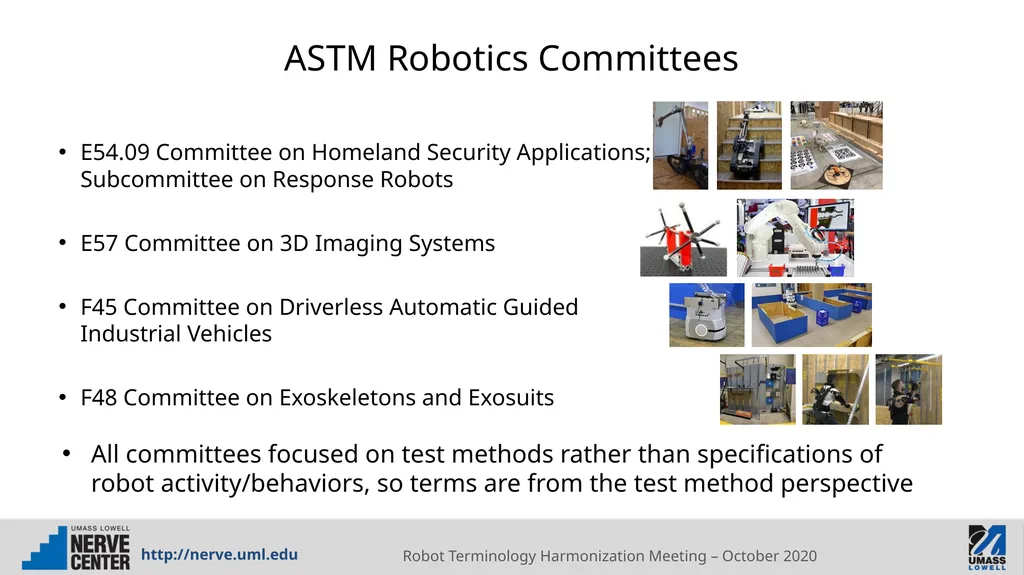
slide2. ASTM Robotics Committees E54.09 Committee on Homeland Security Applications; Subcommittee on Response Robots
E57 Committee on 3D Imaging Systems
F45 Committee on Driverless Automatic Guided Industrial Vehicles
F48 Committee on Exoskeletons and Exosuits All committees focused on test methods rather than specifications of robot activity/behaviors, so terms are from the test method perspective<br>
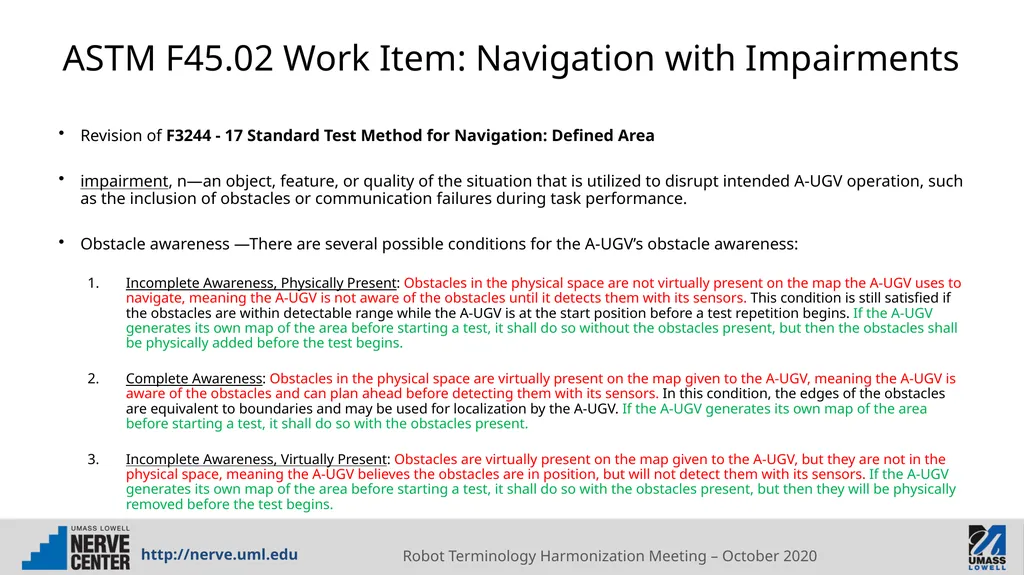
slide3. ASTM F45.02 Work Item: Navigation with Impairments Revision of F3244 - 17 Standard Test Method for Navigation: Defined Area
impairment, n—an object, feature, or quality of the situation that is utilized to disrupt intended A-UGV operation, such as the inclusion of obstacles or communication failures during task performance.
Obstacle awareness —There are several possible conditions for the A-UGV’s obstacle awareness:
Incomplete Awareness, Physically Present: Obstacles in the physical space are not virtually present on the map the A-UGV uses to navigate, meaning the A-UGV is not aware of the obstacles until it detects them with its sensors. This condition is still satisfied if the obstacles are within detectable range while the A-UGV is at the start position before a test repetition begins. If the A-UGV generates its own map of the area before starting a test, it shall do so without the obstacles present, but then the obstacles shall be physically added before the test begins.
Complete Awareness: Obstacles in the physical space are virtually present on the map given to the A-UGV, meaning the A-UGV is aware of the obstacles and can plan ahead before detecting them with its sensors. In this condition, the edges of the obstacles are equivalent to boundaries and may be used for localization by the A-UGV. If the A-UGV generates its own map of the area before starting a test, it shall do so with the obstacles present.
Incomplete Awareness, Virtually Present: Obstacles are virtually present on the map given to the A-UGV, but they are not in the physical space, meaning the A-UGV believes the obstacles are in position, but will not detect them with its sensors. If the A-UGV generates its own map of the area before starting a test, it shall do so with the obstacles present, but then they will be physically removed before the test begins.<br>
slide4. Action E54.09: test repetition or repetition – robot’s completion of the task as specified in the test method and readiness for repeating the same task when required.
F45: repetition – performance of a task.
F48: activity – execution of a task or action by a user or their exoskeleton or exosuit, or both.<br>
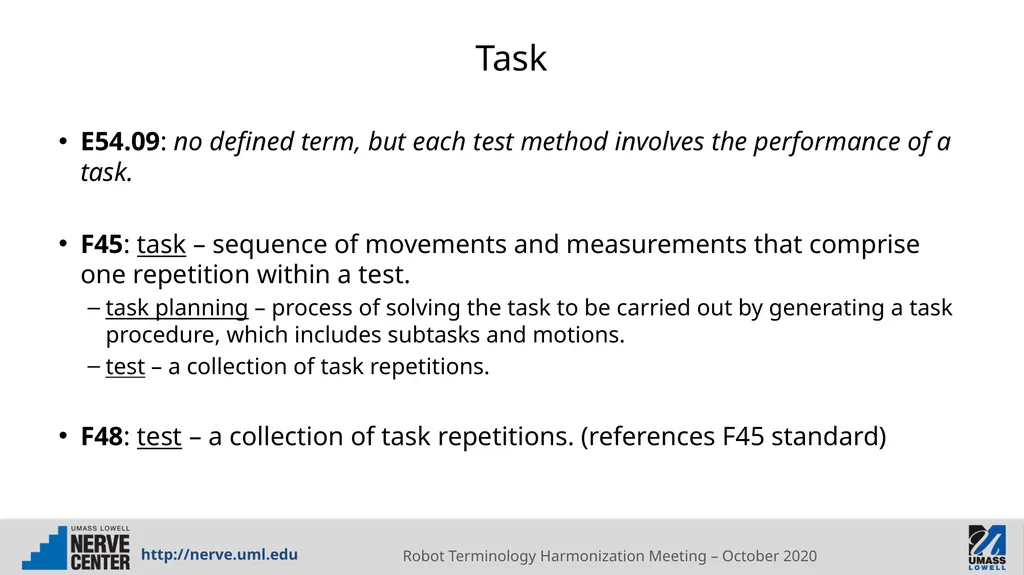
slide5. Task E54.09: no defined term, but each test method involves the performance of a task.
F45: task – sequence of movements and measurements that comprise one repetition within a test.
task planning – process of solving the task to be carried out by generating a task procedure, which includes subtasks and motions.
test – a collection of task repetitions.
F48: test – a collection of task repetitions. (references F45 standard)<br>
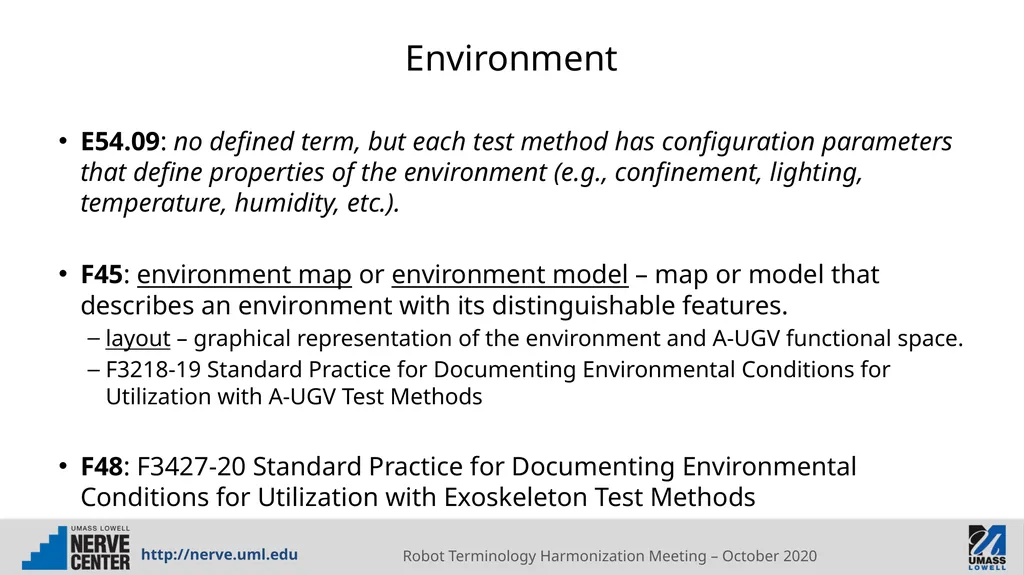
slide6. Environment E54.09: no defined term, but each test method has configuration parameters that define properties of the environment (e.g., confinement, lighting, temperature, humidity, etc.).
F45: environment map or environment model – map or model that describes an environment with its distinguishable features.
layout – graphical representation of the environment and A-UGV functional space.
F3218-19 Standard Practice for Documenting Environmental Conditions for Utilization with A-UGV Test Methods
F48: F3427-20 Standard Practice for Documenting Environmental Conditions for Utilization with Exoskeleton Test Methods<br>
Associate Director, New England Robotics Validation Experimentation (NERVE) Center
University of Massachusetts Lowell
adam_norton@uml.edu ASTM Robotics Committees Terminology<br>
slide2. ASTM Robotics Committees E54.09 Committee on Homeland Security Applications; Subcommittee on Response Robots
E57 Committee on 3D Imaging Systems
F45 Committee on Driverless Automatic Guided Industrial Vehicles
F48 Committee on Exoskeletons and Exosuits All committees focused on test methods rather than specifications of robot activity/behaviors, so terms are from the test method perspective<br>
slide3. ASTM F45.02 Work Item: Navigation with Impairments Revision of F3244 - 17 Standard Test Method for Navigation: Defined Area
impairment, n—an object, feature, or quality of the situation that is utilized to disrupt intended A-UGV operation, such as the inclusion of obstacles or communication failures during task performance.
Obstacle awareness —There are several possible conditions for the A-UGV’s obstacle awareness:
Incomplete Awareness, Physically Present: Obstacles in the physical space are not virtually present on the map the A-UGV uses to navigate, meaning the A-UGV is not aware of the obstacles until it detects them with its sensors. This condition is still satisfied if the obstacles are within detectable range while the A-UGV is at the start position before a test repetition begins. If the A-UGV generates its own map of the area before starting a test, it shall do so without the obstacles present, but then the obstacles shall be physically added before the test begins.
Complete Awareness: Obstacles in the physical space are virtually present on the map given to the A-UGV, meaning the A-UGV is aware of the obstacles and can plan ahead before detecting them with its sensors. In this condition, the edges of the obstacles are equivalent to boundaries and may be used for localization by the A-UGV. If the A-UGV generates its own map of the area before starting a test, it shall do so with the obstacles present.
Incomplete Awareness, Virtually Present: Obstacles are virtually present on the map given to the A-UGV, but they are not in the physical space, meaning the A-UGV believes the obstacles are in position, but will not detect them with its sensors. If the A-UGV generates its own map of the area before starting a test, it shall do so with the obstacles present, but then they will be physically removed before the test begins.<br>
slide4. Action E54.09: test repetition or repetition – robot’s completion of the task as specified in the test method and readiness for repeating the same task when required.
F45: repetition – performance of a task.
F48: activity – execution of a task or action by a user or their exoskeleton or exosuit, or both.<br>
slide5. Task E54.09: no defined term, but each test method involves the performance of a task.
F45: task – sequence of movements and measurements that comprise one repetition within a test.
task planning – process of solving the task to be carried out by generating a task procedure, which includes subtasks and motions.
test – a collection of task repetitions.
F48: test – a collection of task repetitions. (references F45 standard)<br>
slide6. Environment E54.09: no defined term, but each test method has configuration parameters that define properties of the environment (e.g., confinement, lighting, temperature, humidity, etc.).
F45: environment map or environment model – map or model that describes an environment with its distinguishable features.
layout – graphical representation of the environment and A-UGV functional space.
F3218-19 Standard Practice for Documenting Environmental Conditions for Utilization with A-UGV Test Methods
F48: F3427-20 Standard Practice for Documenting Environmental Conditions for Utilization with Exoskeleton Test Methods<br>