
Adaptations- xerophytes Dr.a.Maajitha begam

Description: Adaptations- xerophytes Dr.a.Maajitha begam Assistant professor of botany Hajee karutha rowther howdia college(autonomous) uthamapalayam 2. Xerophytes Plants that grow in dry habitat are called xerophytes. These plants develop special
Related Topics
Download Presentation
"Adaptations- xerophytes Dr.a.Maajitha begam" is the property of its rightful owner. Permission is granted to download and print the materials on this website for personal, non-commercial use only, and to display it on your personal computer provided you do not modify the materials and that you retain all copyright notices contained in the materials. By downloading content from our website, you accept the terms of this agreement.
Presentation Transcript
slide1. Adaptations- xerophytes Dr.a.Maajitha begam
Assistant professor of botany
Hajee karutha rowther howdia college(autonomous)
uthamapalayam<br>
slide2. 2. Xerophytes
Plants that grow in dry habitat are called xerophytes. These plants develop special structural and physiological characteristics to meet the following conditions:
(i) To absorb as much water as they can get from the surroundings.
(ii) To retain water in their organs for very long time.
(iii) To reduce the transpiration rate.
(iv) To reduce consumption of water.<br>
slide3. Adaptations of xerophytes
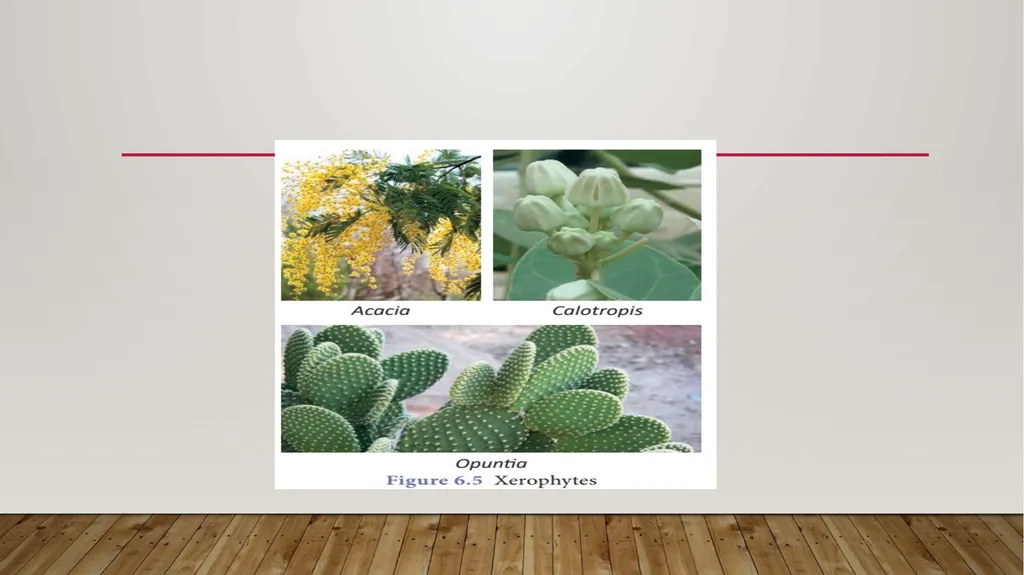
· They have well developed roots. Roots grow very deep and reach the layers where water is available as in Calotropis.
· They store water in succulent water storing parenchymatous tissues. e.g. Opuntia, Aloe vera.
· They have small sized leaves with waxy coating. e.g. Acacia. In some plants, leaves are modified into spines. e.g. Opuntia.
· Some of the xerophytes complete their life cycle within a very short period when sufficient moisture is available.<br>
slide5. Morphological Adaptations of Xerophytes
1. The root system is very well developed with root hairs and root caps. e.g. Calotropis.
2. The roots are fasciculated as in Asparagus.
3. Stems are stunted, woody, dry, hard, ridged, and covered with thick bark, may be underground, e.g. Saccharum. In Opuntiaphylloclade is covered with spines.
4. Stem is covered with thick coating of wax and silica in Equisetum or dense hairs as in Calotropis.
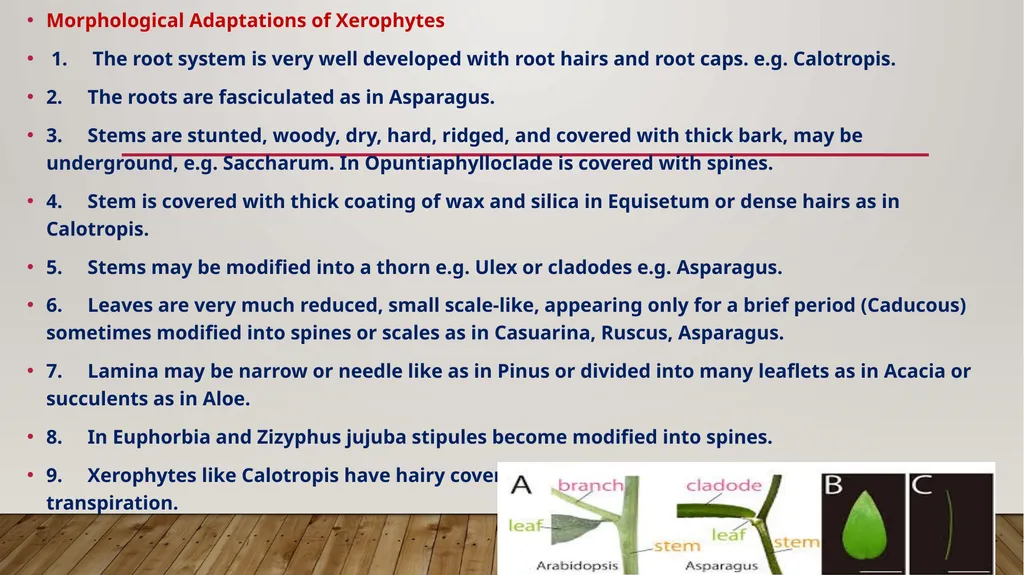
5. Stems may be modified into a thorn e.g. Ulex or cladodes e.g. Asparagus.
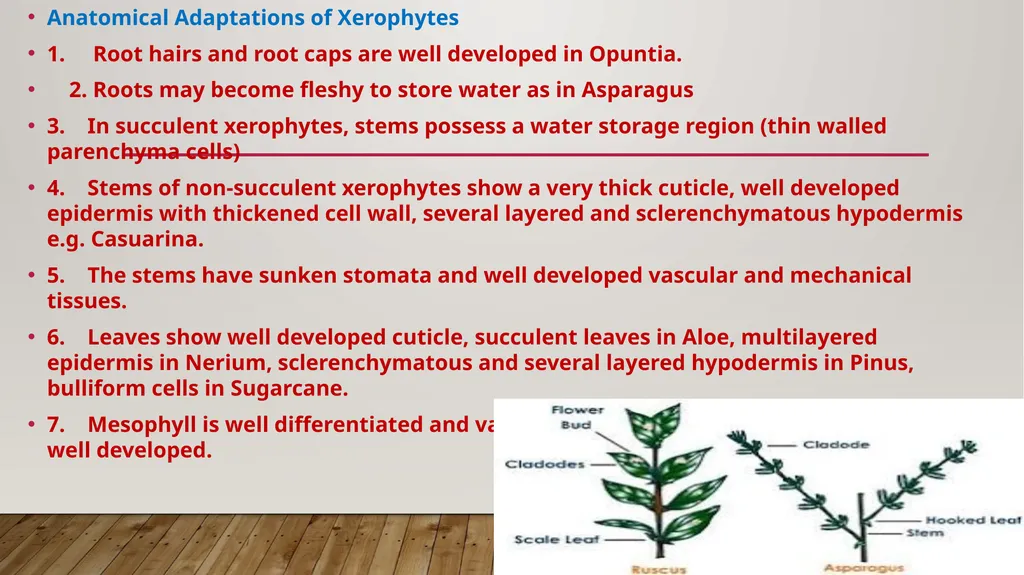
6. Leaves are very much reduced, small scale-like, appearing only for a brief period (Caducous) sometimes modified into spines or scales as in Casuarina, Ruscus, Asparagus.
7. Lamina may be narrow or needle like as in Pinus or divided into many leaflets as in Acacia or succulents as in Aloe.
8. In Euphorbia and Zizyphus jujuba stipules become modified into spines.
9. Xerophytes like Calotropis have hairy covering on the leaves and stems to check transpiration.<br>
slide6. Anatomical Adaptations of Xerophytes
1. Root hairs and root caps are well developed in Opuntia.
2. Roots may become fleshy to store water as in Asparagus
3. In succulent xerophytes, stems possess a water storage region (thin walled parenchyma cells)
4. Stems of non-succulent xerophytes show a very thick cuticle, well developed epidermis with thickened cell wall, several layered and sclerenchymatous hypodermis e.g. Casuarina.
5. The stems have sunken stomata and well developed vascular and mechanical tissues.
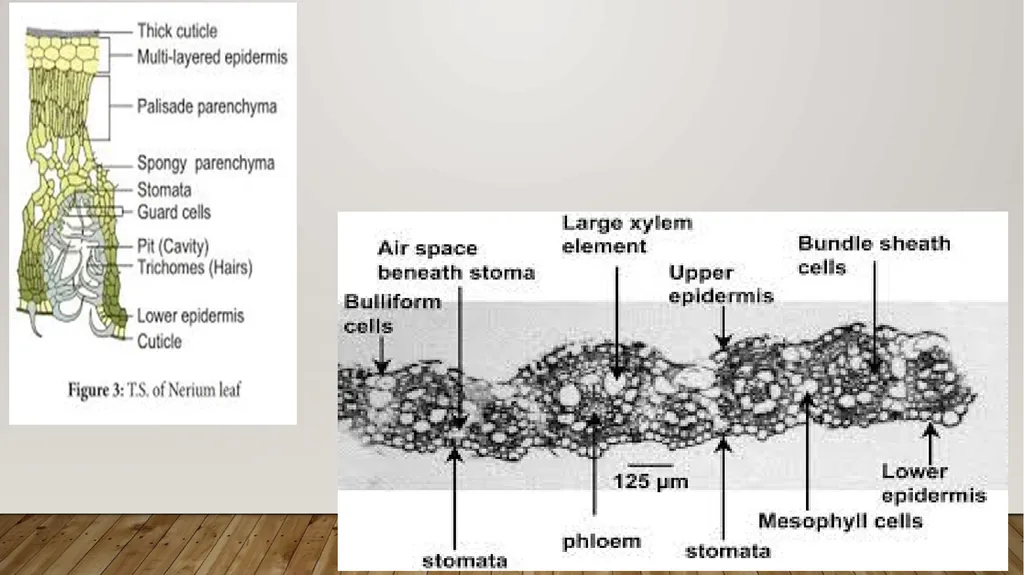
6. Leaves show well developed cuticle, succulent leaves in Aloe, multilayered epidermis in Nerium, sclerenchymatous and several layered hypodermis in Pinus, bulliform cells in Sugarcane.
7. Mesophyll is well differentiated and vascular tissues and mechanical tissues are well developed.<br>
slide8. THANK YOU<br>
Assistant professor of botany
Hajee karutha rowther howdia college(autonomous)
uthamapalayam<br>
slide2. 2. Xerophytes
Plants that grow in dry habitat are called xerophytes. These plants develop special structural and physiological characteristics to meet the following conditions:
(i) To absorb as much water as they can get from the surroundings.
(ii) To retain water in their organs for very long time.
(iii) To reduce the transpiration rate.
(iv) To reduce consumption of water.<br>
slide3. Adaptations of xerophytes
· They have well developed roots. Roots grow very deep and reach the layers where water is available as in Calotropis.
· They store water in succulent water storing parenchymatous tissues. e.g. Opuntia, Aloe vera.
· They have small sized leaves with waxy coating. e.g. Acacia. In some plants, leaves are modified into spines. e.g. Opuntia.
· Some of the xerophytes complete their life cycle within a very short period when sufficient moisture is available.<br>
slide5. Morphological Adaptations of Xerophytes
1. The root system is very well developed with root hairs and root caps. e.g. Calotropis.
2. The roots are fasciculated as in Asparagus.
3. Stems are stunted, woody, dry, hard, ridged, and covered with thick bark, may be underground, e.g. Saccharum. In Opuntiaphylloclade is covered with spines.
4. Stem is covered with thick coating of wax and silica in Equisetum or dense hairs as in Calotropis.
5. Stems may be modified into a thorn e.g. Ulex or cladodes e.g. Asparagus.
6. Leaves are very much reduced, small scale-like, appearing only for a brief period (Caducous) sometimes modified into spines or scales as in Casuarina, Ruscus, Asparagus.
7. Lamina may be narrow or needle like as in Pinus or divided into many leaflets as in Acacia or succulents as in Aloe.
8. In Euphorbia and Zizyphus jujuba stipules become modified into spines.
9. Xerophytes like Calotropis have hairy covering on the leaves and stems to check transpiration.<br>
slide6. Anatomical Adaptations of Xerophytes
1. Root hairs and root caps are well developed in Opuntia.
2. Roots may become fleshy to store water as in Asparagus
3. In succulent xerophytes, stems possess a water storage region (thin walled parenchyma cells)
4. Stems of non-succulent xerophytes show a very thick cuticle, well developed epidermis with thickened cell wall, several layered and sclerenchymatous hypodermis e.g. Casuarina.
5. The stems have sunken stomata and well developed vascular and mechanical tissues.
6. Leaves show well developed cuticle, succulent leaves in Aloe, multilayered epidermis in Nerium, sclerenchymatous and several layered hypodermis in Pinus, bulliform cells in Sugarcane.
7. Mesophyll is well differentiated and vascular tissues and mechanical tissues are well developed.<br>
slide8. THANK YOU<br>