
Addressing Inequality: ICTs, Solidarity and


Description: Addressing Inequality: ICTs, Solidarity and Resistance Silvia Masiero silvimaifi.uio.no IN5370 ICTs and Global Inequalities 02.10.2025 Overview ...what did we learn so far? The present: ICT4D and adverse digital incorporation Imagining
Related Topics
Download Presentation
"Addressing Inequality: ICTs, Solidarity and" is the property of its rightful owner. Permission is granted to download and print the materials on this website for personal, non-commercial use only, and to display it on your personal computer provided you do not modify the materials and that you retain all copyright notices contained in the materials. By downloading content from our website, you accept the terms of this agreement.
Presentation Transcript
slide1. Addressing Inequality: ICTs, Solidarity and Resistance Silvia Masiero
silvima@ifi.uio.no IN5370 – ICTs and Global Inequalities
02.10.2025<br>
slide2. Overview ...what did we learn so far?
The present: ICT4D and adverse digital incorporation
Imagining the future: decolonial approaches to ICT4D<br>
slide3. After this lecture, you can… Recap the core theories and themes dealt with in this course, taking a stance on the different debates that we faced across the lectures
Comment on the present-day status of ICT4D research, and discuss decolonial approaches to ICT4D as an important trend informing the future evolutions of our research field
Using the knowledge gained in the course, take your own stance on the question: how are ICTs participating in different types of global inequalities, and what can be done about it?<br>
slide4. To begin with...<br>
slide5. To begin with... Write (2-3 sentences) about one thing that has stuck with you from this course :-)
Can be a story, a theory, one of the lectures... just let it be something that has stuck, or has especially inspired you.<br>
slide6. Course recap! We have started with early understandings of ICTs for Development (ICT4D), centred on a technology transfer discourse (Avgerou, 2008) and on the overall global objective to reduce the digital divide.
We have then introduced the concept of adverse digital incorporation (Heeks, 2022), to conceptualise the negative, rather than positive, effects of being incorporated in digital systems in the current historical phase.
We have then encountered different instances of adverse digital incorporation: we saw it stemming from digital platforms, digital identity systems, biometric borderwork and digital humanitarian systems, among others.<br>
slide7. Course recap! Our first lectures focused on essential tools to understand ICT4D debates. We met the shift from a growth-centred view of «development» to a multidimensional view, involving dimensions of health, education, and satisfaction of basic human needs.
We introduced Sen’s capabilities approach to understand development as freedom, conceptualising development as a process of expanding the real freedoms that people enjoy.
In a way, Sen’s perspective has acted as a common thread through the course, informing our understanding of development interventions from the eyes of their intended recipients.<br>
slide8. Course recap! We have introduced the UN Sustainable Development Goals (SDGs) as an agenda of interest to present-day ICT4D research. We have discussed how ICTs can participate in the fulfilment of one or more SDGs: global health; gender equality; justice and strong institutions...
...at the same time, we have problematised the ability of ICTs to contribute to the pursuit of the goals. We have introduced critical approaches that highlight issues of surveillance, data injustice, epistemic and structural violence perpetrated on the intended subjects of «development».
This puts in perspective an understanding of ICT4D where technology is a «route» to development, and faced us with many instantiations of the problematic role that technology can play.<br>
slide9. But so… …what can be done about the participation of ICTs in global inequalities?<br>
slide10. Well… You are now equipped to take a stance on this overarching question, as well as on the many theoretical and thematic debates discussed in the course!
Taking a stance is a the result of a process of critical thinking: making sense of a problem; considering different standpoints on it; comparing and contrasting different perspectives on the same problem; and then taking a position informed by what has been read, learned and understood on the topic.
The IN5370 exam is a critical thinking exercise, where you will be asked to write about topics dealt with in the course, using literature and examples but stating your own perspective on the questions asked.<br>
slide11. But if you ask me... We have discussed how a new agenda, at the interface with critical data studies, is informing ICT4D field.
Themes in this agenda are continuously evolving. I find that three of them are especially prominent in today’s landscape:
- Decolonial approaches to ICT4D;
- Data Harm generated through data-based technologies;
- Artificial Intelligence (AI) in the development space.<br>
slide12. Decolonial approaches to ICT4D Davison & Diaz Andrade (2018): an overwhelming majority of theories in the Information Systems (IS) field come from authors from the West, a bias resulting in silencing of the Majority World in our theories.
Jimenez et al. (2022) illuminate the importance of decolonial approaches in ICT4D. These are approaches that delink the production of knowledge from Western science and paradigms, giving value to Indigenous theories built by people from a given context, for people from the context in point.
For example: Jimenez & Roberts (2019) use the Latin American philosophy of Buen Vivir to reimagine neoliberal knowledge on innovation hubs. Mawere and van Stam (2019) problematise global North-led research on Africa, illustrating the value and explanatory power of Indigenous theorisation.<br>
slide13. Harm and data-based technologies A new concept, data harm, can be seen as harm produced, sustained and enacted through the means of datafication.
Three central properties of data harm
Produced through the core of datafied systems, not by their peripheral sides (see our discussion on the limitations of the “dark side” of technology)
Sustained by issues of data justice, i.e. fairness in the visualisation, representation and treatment of people through their production of digital data
Inherent to technologies of datafication, which convert (not only people, but) objects, systems and the environment into machine-readable representations of their original selves.<br>
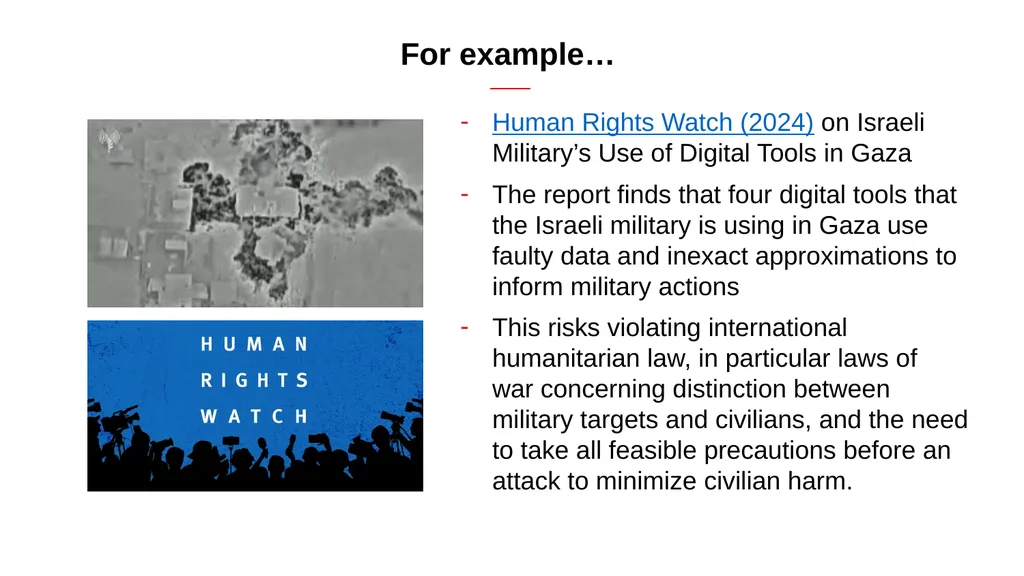
slide14. For example… Human Rights Watch (2024) on Israeli Military’s Use of Digital Tools in Gaza
The report finds that four digital tools that the Israeli military is using in Gaza use faulty data and inexact approximations to inform military actions
This risks violating international humanitarian law, in particular laws of war concerning distinction between military targets and civilians, and the need to take all feasible precautions before an attack to minimize civilian harm.<br>
slide15. AI in the development space AI for Development (AI4D) as a novel frontier of ICT4D research
But: can we really talk about AI for development in a context of widespread data harm, sustained also, and in some cases primarily, by AI tools?
Iazzolino & Stremlau (2024): AI for social good and the corporate capture of global development. AI-driven solutionism is entering the development space, e.g. through the new algorithmic management of social protection schemes.
Tapasya et al. (2024): even India’s Public Distribution System, studied in this course, is moving to algorithmic management, with states (Telangana) reporting widespread cancellation of ration cards through algorithmic decisions
One question is which development mechanisms is AI becoming a part of: Bonini & Treré (2025) study algorithmic resistance, where algorithms make part of solidarity mechanisms enacted by and for the people.<br>
slide16. But then… …should we still be doing ICT4D research?
My answer, and a positive conclusion: ABSOLUTELY YES!!
Issues of adverse digital incorporation are more pressing than ever today, and they affect people’s lives thoroughly and severely. ICT4D research is in a unique position to research such issues, devising routes for a «better world» that challenge violence, injustice and harm induced through datafication.
I hope this course has been a way for us to learn together how to build a critical argument, and to use literature and examples to form our own, informed standpoint on different topics.<br>
slide17. Thank you! silvima@ifi.uio.no<br>
slide18. Readings Core Reading
Jimenez, A., Delgado, D., Merino, R., & Argumedo, A. (2022). A Decolonial Approach to Innovation? Building Paths Towards Buen Vivir. Journal of Development Studies, 1-18.
Davison, R. M., & Díaz Andrade, A. (2018). Promoting indigenous theory. Information Systems Journal, 28(5), 759– 764.
Supplementary Reading
Jimenez, A., & Roberts, T. (2019). Decolonising neo-liberal innovation: Using the Andean philosophy of ‘Buen Vivir’ to reimagine innovation hubs. Proceedings of the 15th IFIP 9.4 Conference (pp. 180– 191). Springer.
Mawere, M., & van Stam, G. (2019). Research in Africa for Africa? Probing the effect and credibility of research done by foreigners for Africa. Proceedings of the 15th IFIP 9.4 Conference (pp. 168– 179). Springer.<br>
silvima@ifi.uio.no IN5370 – ICTs and Global Inequalities
02.10.2025<br>
slide2. Overview ...what did we learn so far?
The present: ICT4D and adverse digital incorporation
Imagining the future: decolonial approaches to ICT4D<br>
slide3. After this lecture, you can… Recap the core theories and themes dealt with in this course, taking a stance on the different debates that we faced across the lectures
Comment on the present-day status of ICT4D research, and discuss decolonial approaches to ICT4D as an important trend informing the future evolutions of our research field
Using the knowledge gained in the course, take your own stance on the question: how are ICTs participating in different types of global inequalities, and what can be done about it?<br>
slide4. To begin with...<br>
slide5. To begin with... Write (2-3 sentences) about one thing that has stuck with you from this course :-)
Can be a story, a theory, one of the lectures... just let it be something that has stuck, or has especially inspired you.<br>
slide6. Course recap! We have started with early understandings of ICTs for Development (ICT4D), centred on a technology transfer discourse (Avgerou, 2008) and on the overall global objective to reduce the digital divide.
We have then introduced the concept of adverse digital incorporation (Heeks, 2022), to conceptualise the negative, rather than positive, effects of being incorporated in digital systems in the current historical phase.
We have then encountered different instances of adverse digital incorporation: we saw it stemming from digital platforms, digital identity systems, biometric borderwork and digital humanitarian systems, among others.<br>
slide7. Course recap! Our first lectures focused on essential tools to understand ICT4D debates. We met the shift from a growth-centred view of «development» to a multidimensional view, involving dimensions of health, education, and satisfaction of basic human needs.
We introduced Sen’s capabilities approach to understand development as freedom, conceptualising development as a process of expanding the real freedoms that people enjoy.
In a way, Sen’s perspective has acted as a common thread through the course, informing our understanding of development interventions from the eyes of their intended recipients.<br>
slide8. Course recap! We have introduced the UN Sustainable Development Goals (SDGs) as an agenda of interest to present-day ICT4D research. We have discussed how ICTs can participate in the fulfilment of one or more SDGs: global health; gender equality; justice and strong institutions...
...at the same time, we have problematised the ability of ICTs to contribute to the pursuit of the goals. We have introduced critical approaches that highlight issues of surveillance, data injustice, epistemic and structural violence perpetrated on the intended subjects of «development».
This puts in perspective an understanding of ICT4D where technology is a «route» to development, and faced us with many instantiations of the problematic role that technology can play.<br>
slide9. But so… …what can be done about the participation of ICTs in global inequalities?<br>
slide10. Well… You are now equipped to take a stance on this overarching question, as well as on the many theoretical and thematic debates discussed in the course!
Taking a stance is a the result of a process of critical thinking: making sense of a problem; considering different standpoints on it; comparing and contrasting different perspectives on the same problem; and then taking a position informed by what has been read, learned and understood on the topic.
The IN5370 exam is a critical thinking exercise, where you will be asked to write about topics dealt with in the course, using literature and examples but stating your own perspective on the questions asked.<br>
slide11. But if you ask me... We have discussed how a new agenda, at the interface with critical data studies, is informing ICT4D field.
Themes in this agenda are continuously evolving. I find that three of them are especially prominent in today’s landscape:
- Decolonial approaches to ICT4D;
- Data Harm generated through data-based technologies;
- Artificial Intelligence (AI) in the development space.<br>
slide12. Decolonial approaches to ICT4D Davison & Diaz Andrade (2018): an overwhelming majority of theories in the Information Systems (IS) field come from authors from the West, a bias resulting in silencing of the Majority World in our theories.
Jimenez et al. (2022) illuminate the importance of decolonial approaches in ICT4D. These are approaches that delink the production of knowledge from Western science and paradigms, giving value to Indigenous theories built by people from a given context, for people from the context in point.
For example: Jimenez & Roberts (2019) use the Latin American philosophy of Buen Vivir to reimagine neoliberal knowledge on innovation hubs. Mawere and van Stam (2019) problematise global North-led research on Africa, illustrating the value and explanatory power of Indigenous theorisation.<br>
slide13. Harm and data-based technologies A new concept, data harm, can be seen as harm produced, sustained and enacted through the means of datafication.
Three central properties of data harm
Produced through the core of datafied systems, not by their peripheral sides (see our discussion on the limitations of the “dark side” of technology)
Sustained by issues of data justice, i.e. fairness in the visualisation, representation and treatment of people through their production of digital data
Inherent to technologies of datafication, which convert (not only people, but) objects, systems and the environment into machine-readable representations of their original selves.<br>
slide14. For example… Human Rights Watch (2024) on Israeli Military’s Use of Digital Tools in Gaza
The report finds that four digital tools that the Israeli military is using in Gaza use faulty data and inexact approximations to inform military actions
This risks violating international humanitarian law, in particular laws of war concerning distinction between military targets and civilians, and the need to take all feasible precautions before an attack to minimize civilian harm.<br>
slide15. AI in the development space AI for Development (AI4D) as a novel frontier of ICT4D research
But: can we really talk about AI for development in a context of widespread data harm, sustained also, and in some cases primarily, by AI tools?
Iazzolino & Stremlau (2024): AI for social good and the corporate capture of global development. AI-driven solutionism is entering the development space, e.g. through the new algorithmic management of social protection schemes.
Tapasya et al. (2024): even India’s Public Distribution System, studied in this course, is moving to algorithmic management, with states (Telangana) reporting widespread cancellation of ration cards through algorithmic decisions
One question is which development mechanisms is AI becoming a part of: Bonini & Treré (2025) study algorithmic resistance, where algorithms make part of solidarity mechanisms enacted by and for the people.<br>
slide16. But then… …should we still be doing ICT4D research?
My answer, and a positive conclusion: ABSOLUTELY YES!!
Issues of adverse digital incorporation are more pressing than ever today, and they affect people’s lives thoroughly and severely. ICT4D research is in a unique position to research such issues, devising routes for a «better world» that challenge violence, injustice and harm induced through datafication.
I hope this course has been a way for us to learn together how to build a critical argument, and to use literature and examples to form our own, informed standpoint on different topics.<br>
slide17. Thank you! silvima@ifi.uio.no<br>
slide18. Readings Core Reading
Jimenez, A., Delgado, D., Merino, R., & Argumedo, A. (2022). A Decolonial Approach to Innovation? Building Paths Towards Buen Vivir. Journal of Development Studies, 1-18.
Davison, R. M., & Díaz Andrade, A. (2018). Promoting indigenous theory. Information Systems Journal, 28(5), 759– 764.
Supplementary Reading
Jimenez, A., & Roberts, T. (2019). Decolonising neo-liberal innovation: Using the Andean philosophy of ‘Buen Vivir’ to reimagine innovation hubs. Proceedings of the 15th IFIP 9.4 Conference (pp. 180– 191). Springer.
Mawere, M., & van Stam, G. (2019). Research in Africa for Africa? Probing the effect and credibility of research done by foreigners for Africa. Proceedings of the 15th IFIP 9.4 Conference (pp. 168– 179). Springer.<br>