
Adjusting effects for treatment switching in HTA
MS
Published · 20 slides · 0 views

1 / 1

Description
Adjusting effects for treatment switching in HTA Claire Watkins Director and Consultant Statistician, Clarostat Consulting Ltd PSI Conference, 16th May 2017 Why, when, which and how? We might build this into the trial protocol e.g.
Related Topics
Share
Embed code
Download this presentation From Below
"Adjusting effects for treatment switching in HTA" is the property of its rightful owner. Permission is granted to download and print the materials on this website for personal, non-commercial use only, and to display it on your personal computer provided you do not modify the materials and that you retain all copyright notices contained in the materials. By downloading content from our website, you accept the terms of this agreement.
Presentation Transcript
01
Adjusting effects for treatment switching in HTA Claire Watkins
Director and Consultant Statistician, Clarostat Consulting Ltd
PSI Conference, 16th May 2017 Why, when, which and how?<br>
Director and Consultant Statistician, Clarostat Consulting Ltd
PSI Conference, 16th May 2017 Why, when, which and how?<br>
02
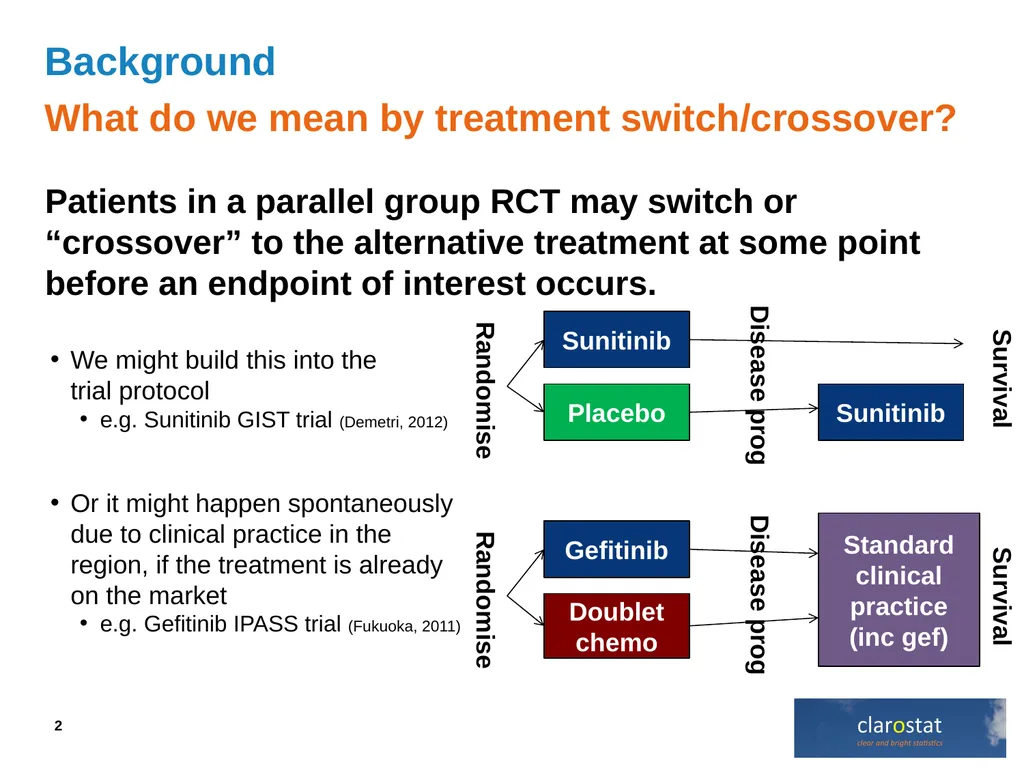
We might build this into the trial protocol
e.g. Sunitinib GIST trial (Demetri, 2012)
Or it might happen spontaneously due to clinical practice in the region, if the treatment is already on the market
e.g. Gefitinib IPASS trial (Fukuoka, 2011) Patients in a parallel group RCT may switch or “crossover” to the alternative treatment at some point before an endpoint of interest occurs. Background What do we mean by treatment switch/crossover? 2 Gefitinib Doublet chemo Disease prog Standard clinical practice (inc gef) Randomise Sunitinib Placebo Disease prog Randomise Sunitinib Survival Survival<br>
03
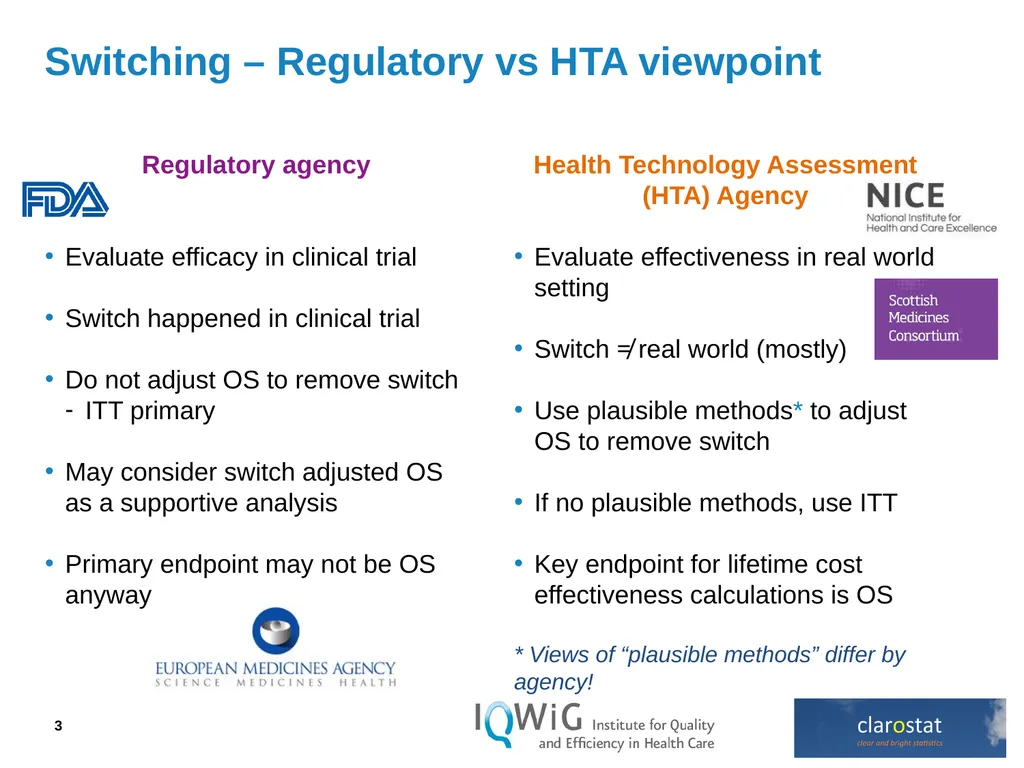
Switching – Regulatory vs HTA viewpoint Health Technology Assessment (HTA) Agency
Evaluate effectiveness in real world setting
Switch ≠ real world (mostly)
Use plausible methods* to adjust OS to remove switch
If no plausible methods, use ITT
Key endpoint for lifetime cost effectiveness calculations is OS
* Views of “plausible methods” differ by agency! Regulatory agency
Evaluate efficacy in clinical trial
Switch happened in clinical trial
Do not adjust OS to remove switch
ITT primary
May consider switch adjusted OS as a supportive analysis
Primary endpoint may not be OS anyway 3<br>
04
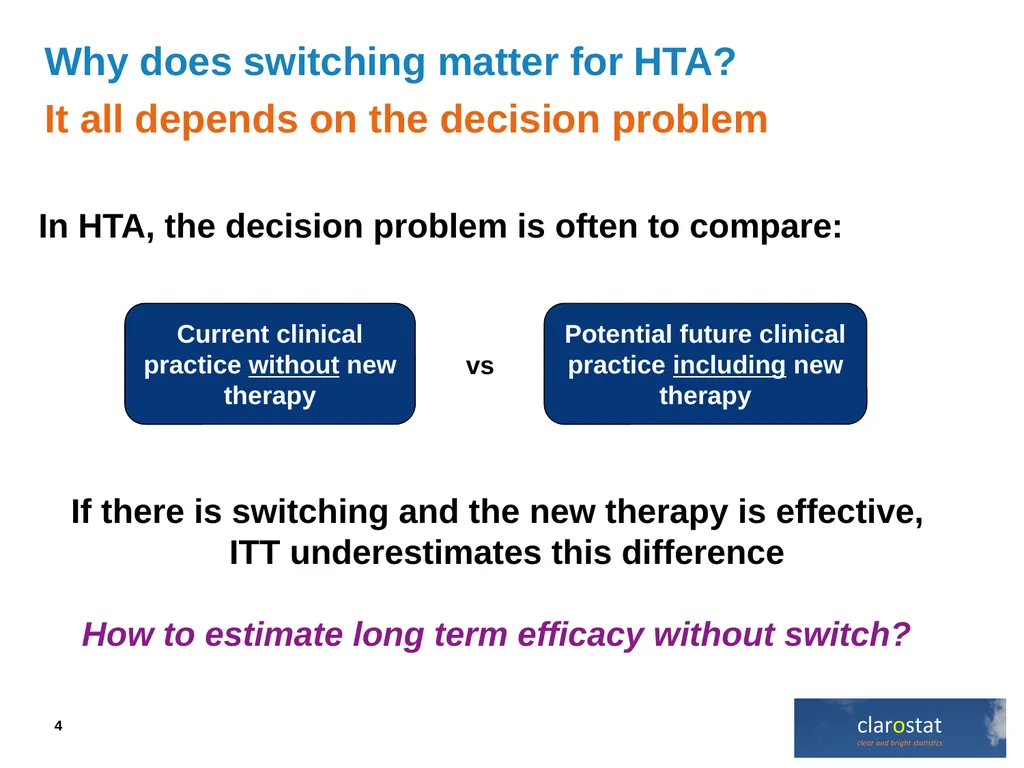
In HTA, the decision problem is often to compare: Why does switching matter for HTA? It all depends on the decision problem If there is switching and the new therapy is effective, ITT underestimates this difference
How to estimate long term efficacy without switch? 4 Current clinical practice without new therapy Potential future clinical practice including new therapy vs<br>
How to estimate long term efficacy without switch? 4 Current clinical practice without new therapy Potential future clinical practice including new therapy vs<br>
05
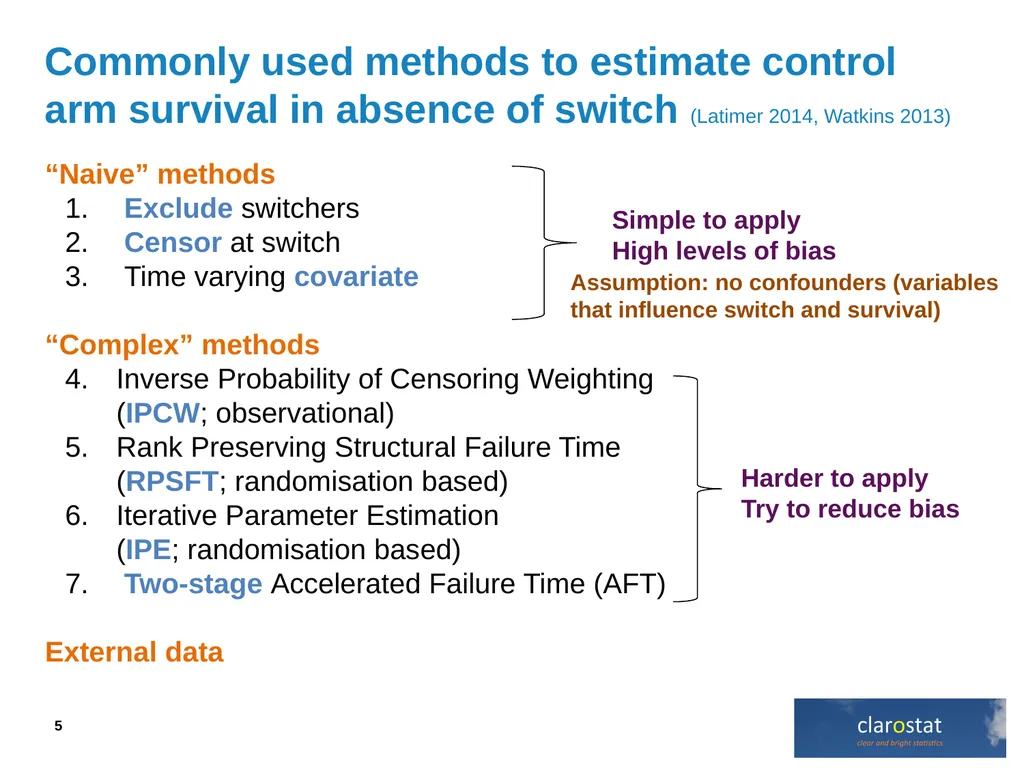
Commonly used methods to estimate control arm survival in absence of switch (Latimer 2014, Watkins 2013) “Naive” methods
Exclude switchers
Censor at switch
Time varying covariate
“Complex” methods
Inverse Probability of Censoring Weighting (IPCW; observational)
Rank Preserving Structural Failure Time (RPSFT; randomisation based)
Iterative Parameter Estimation (IPE; randomisation based)
Two-stage Accelerated Failure Time (AFT)
External data 5 Simple to apply
High levels of bias Harder to apply
Try to reduce bias Assumption: no confounders (variables that influence switch and survival)<br>
06
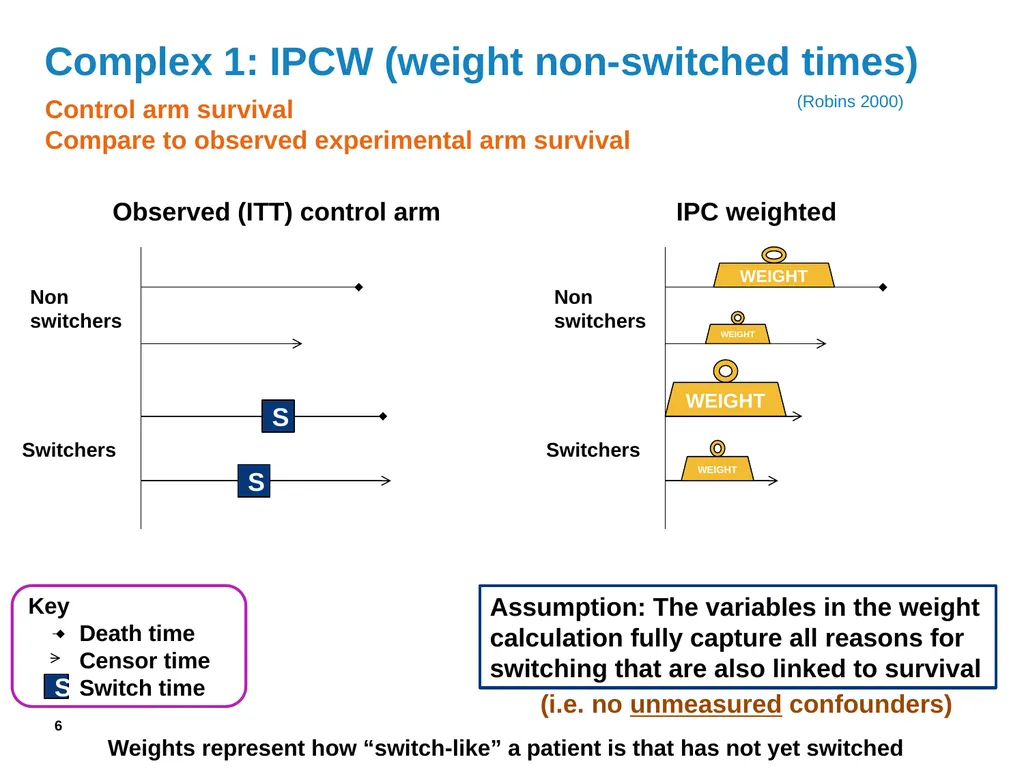
Complex 1: IPCW (weight non-switched times) Control arm survival
Compare to observed experimental arm survival 6 S S Non switchers Switchers Non switchers Switchers Observed (ITT) control arm IPC weighted Assumption: The variables in the weight calculation fully capture all reasons for switching that are also linked to survival Weights represent how “switch-like” a patient is that has not yet switched (i.e. no unmeasured confounders) (Robins 2000)<br>
Compare to observed experimental arm survival 6 S S Non switchers Switchers Non switchers Switchers Observed (ITT) control arm IPC weighted Assumption: The variables in the weight calculation fully capture all reasons for switching that are also linked to survival Weights represent how “switch-like” a patient is that has not yet switched (i.e. no unmeasured confounders) (Robins 2000)<br>
07
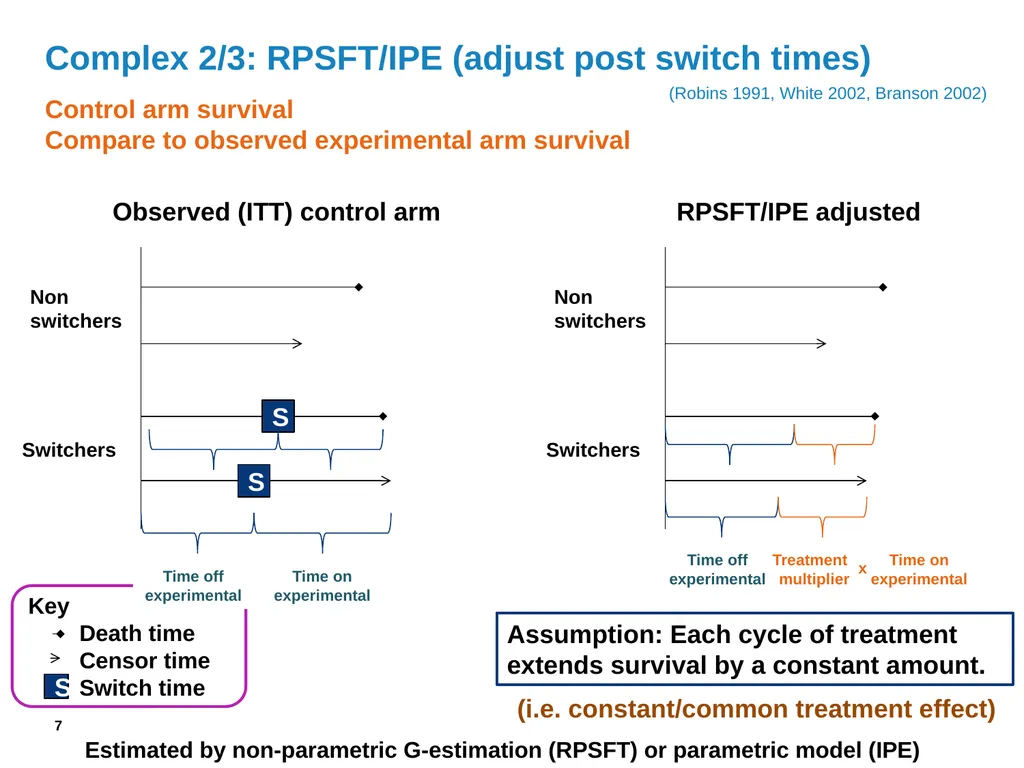
Complex 2/3: RPSFT/IPE (adjust post switch times) Control arm survival
Compare to observed experimental arm survival 7 S S Non switchers Switchers Non switchers Switchers Observed (ITT) control arm RPSFT/IPE adjusted Assumption: Each cycle of treatment extends survival by a constant amount. Time on experimental Time off experimental Time on experimental Treatment multiplier x Time off experimental (i.e. constant/common treatment effect) Estimated by non-parametric G-estimation (RPSFT) or parametric model (IPE) (Robins 1991, White 2002, Branson 2002)<br>
Compare to observed experimental arm survival 7 S S Non switchers Switchers Non switchers Switchers Observed (ITT) control arm RPSFT/IPE adjusted Assumption: Each cycle of treatment extends survival by a constant amount. Time on experimental Time off experimental Time on experimental Treatment multiplier x Time off experimental (i.e. constant/common treatment effect) Estimated by non-parametric G-estimation (RPSFT) or parametric model (IPE) (Robins 1991, White 2002, Branson 2002)<br>
08
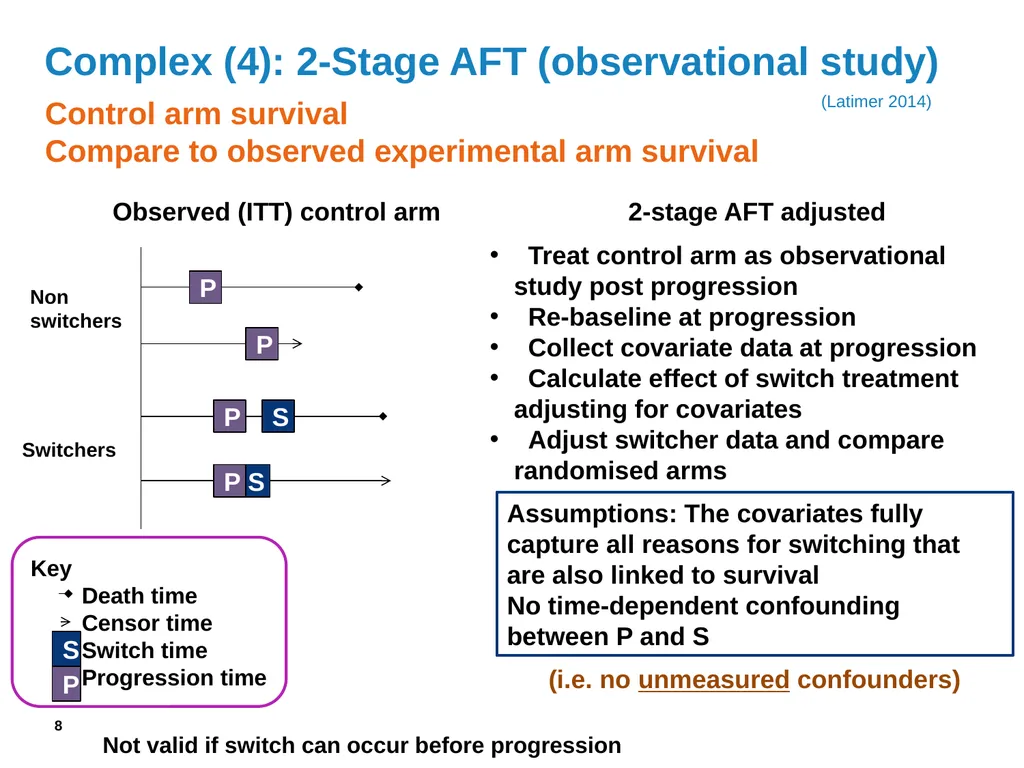
Complex (4): 2-Stage AFT (observational study) Control arm survival
Compare to observed experimental arm survival 8 S S Non switchers Switchers Observed (ITT) control arm P P P P P Treat control arm as observational study post progression
Re-baseline at progression
Collect covariate data at progression
Calculate effect of switch treatment adjusting for covariates
Adjust switcher data and compare randomised arms Assumptions: The covariates fully capture all reasons for switching that are also linked to survival
No time-dependent confounding between P and S 2-stage AFT adjusted Not valid if switch can occur before progression (i.e. no unmeasured confounders) (Latimer 2014)<br>
09
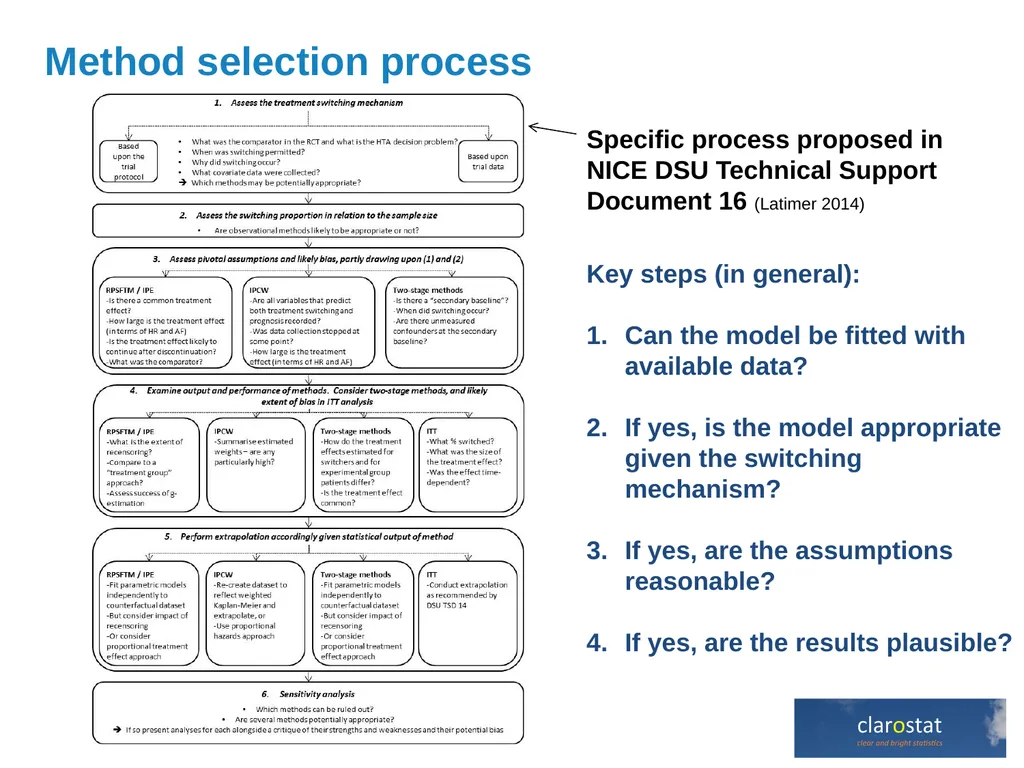
Method selection process Key steps (in general):
Can the model be fitted with available data?
If yes, is the model appropriate given the switching mechanism?
If yes, are the assumptions reasonable?
If yes, are the results plausible? Specific process proposed in NICE DSU Technical Support Document 16 (Latimer 2014)<br>
Can the model be fitted with available data?
If yes, is the model appropriate given the switching mechanism?
If yes, are the assumptions reasonable?
If yes, are the results plausible? Specific process proposed in NICE DSU Technical Support Document 16 (Latimer 2014)<br>
10
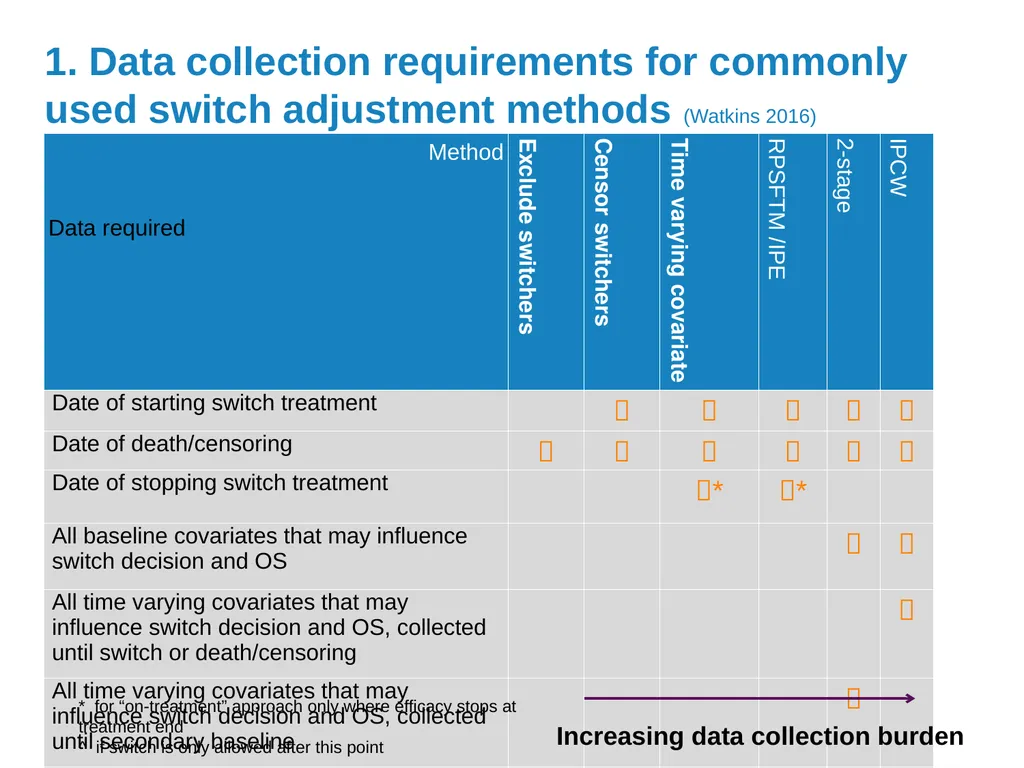
1. Data collection requirements for commonly used switch adjustment methods (Watkins 2016) 10 * for “on-treatment” approach only where efficacy stops at treatment end
^ if switch is only allowed after this point Increasing data collection burden<br>
^ if switch is only allowed after this point Increasing data collection burden<br>
11
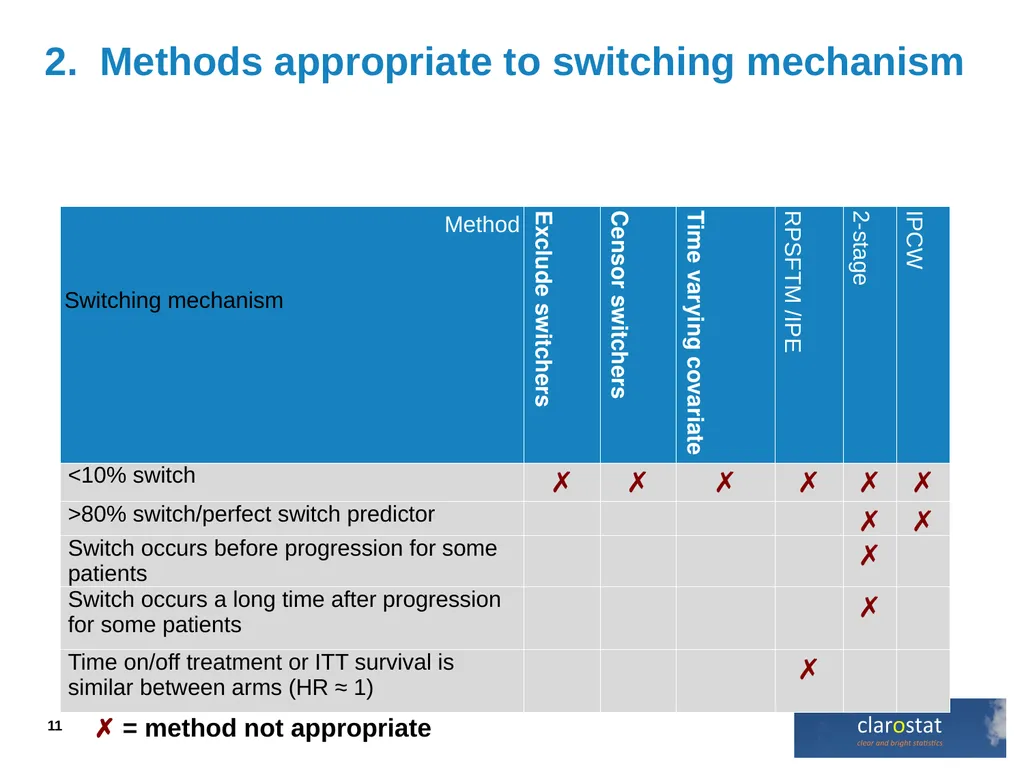
2. Methods appropriate to switching mechanism 11 ✗ = method not appropriate<br>
12
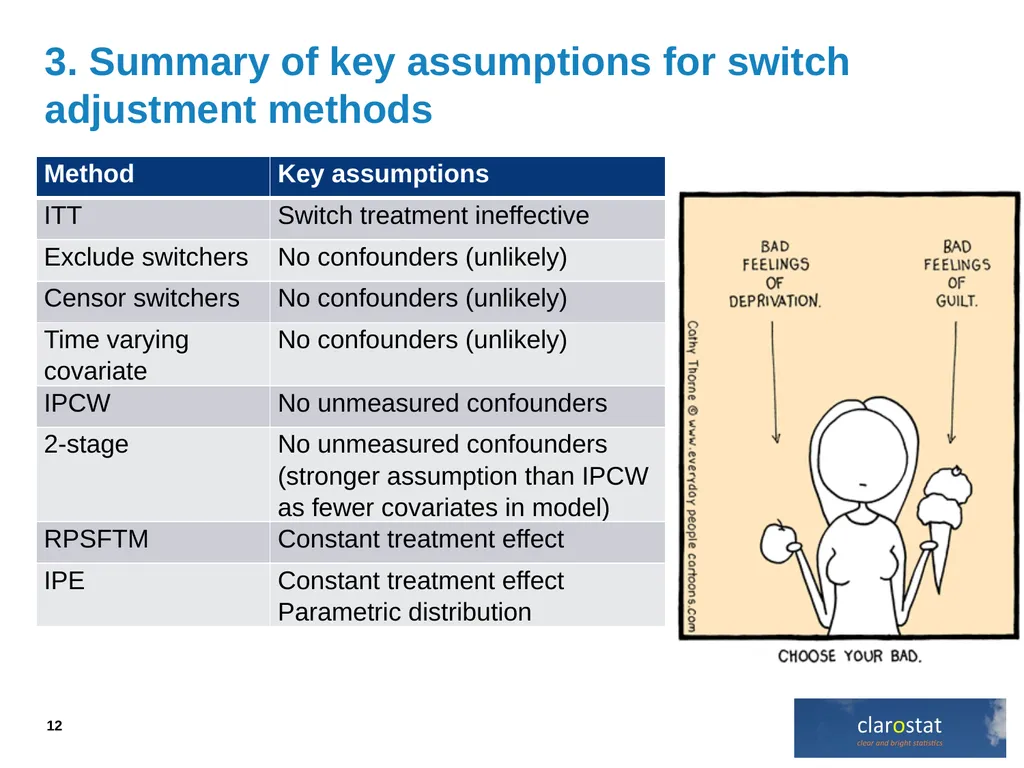
3. Summary of key assumptions for switch adjustment methods 12<br>
13
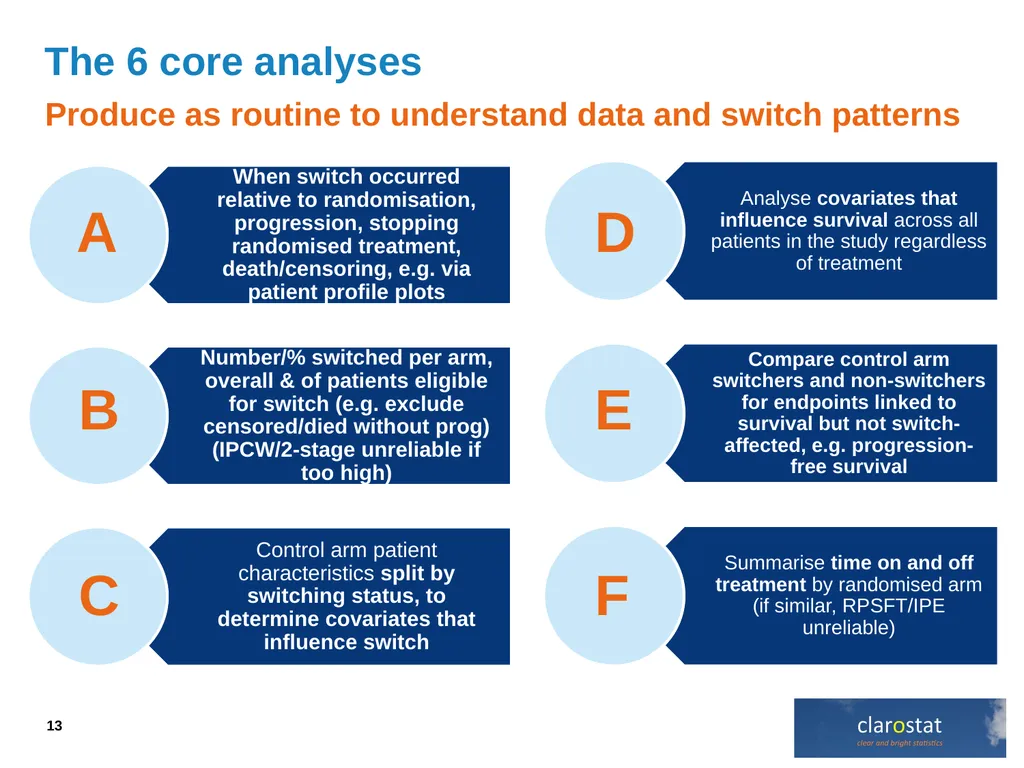
The 6 core analyses Produce as routine to understand data and switch patterns 13 A F E D C B<br>
14
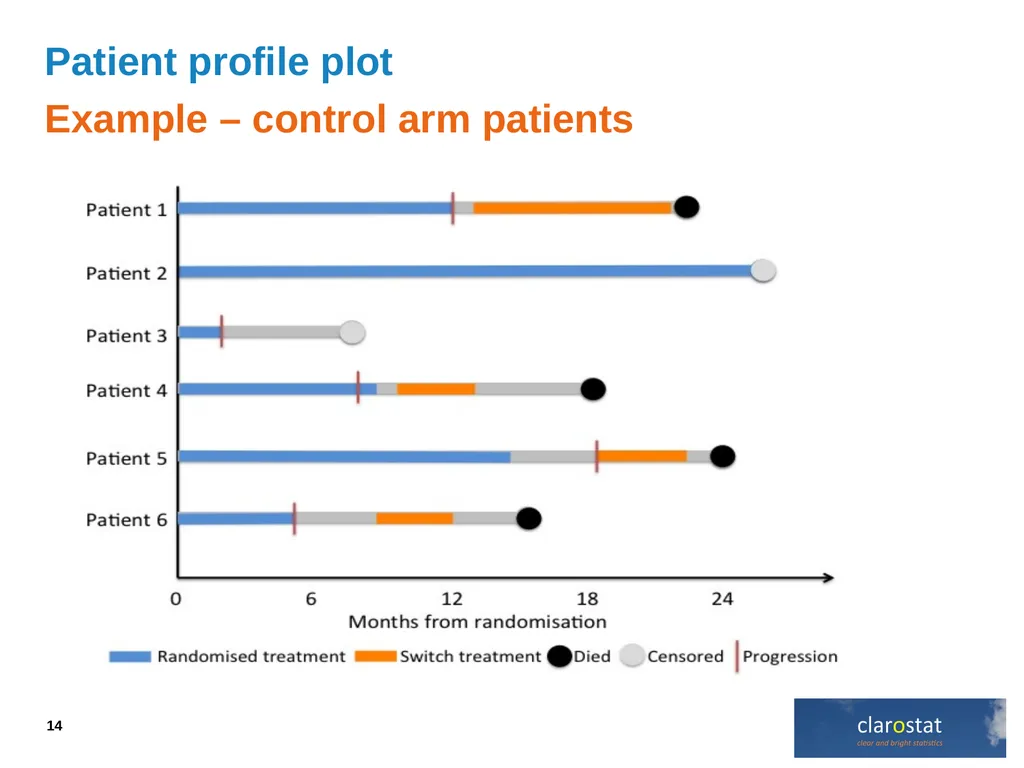
Patient profile plot Example – control arm patients 14<br>
15
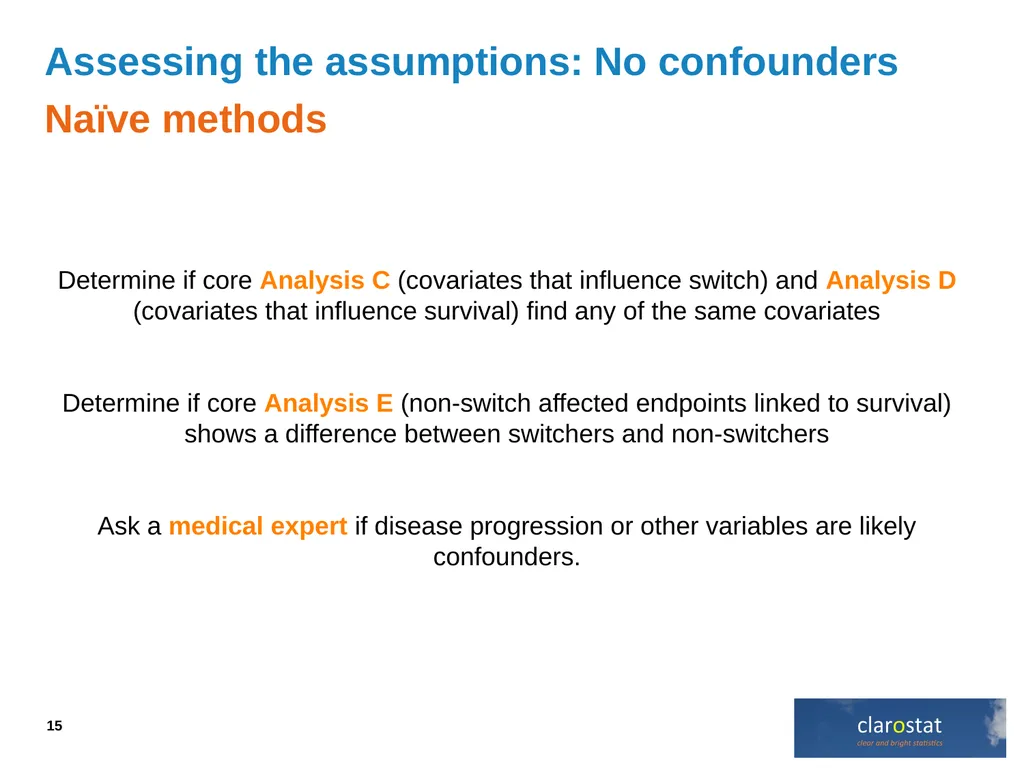
Assessing the assumptions: No confounders Naïve methods Determine if core Analysis C (covariates that influence switch) and Analysis D (covariates that influence survival) find any of the same covariates
Determine if core Analysis E (non-switch affected endpoints linked to survival) shows a difference between switchers and non-switchers
Ask a medical expert if disease progression or other variables are likely confounders. 15<br>
Determine if core Analysis E (non-switch affected endpoints linked to survival) shows a difference between switchers and non-switchers
Ask a medical expert if disease progression or other variables are likely confounders. 15<br>
16
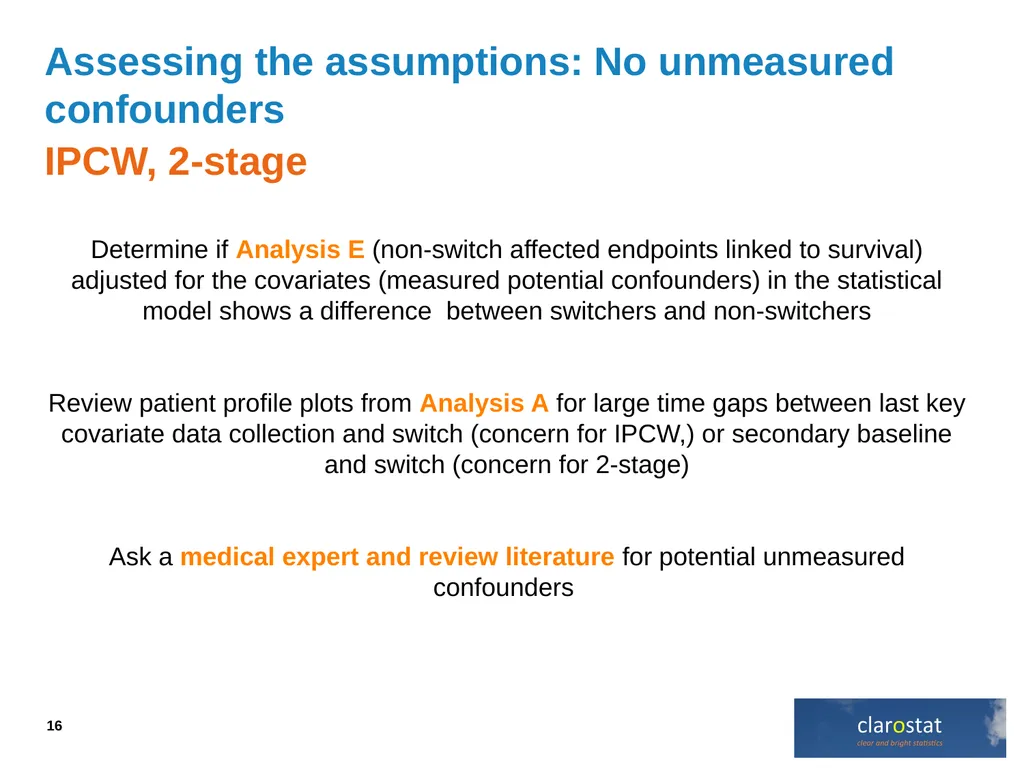
Assessing the assumptions: No unmeasured confounders IPCW, 2-stage Determine if Analysis E (non-switch affected endpoints linked to survival) adjusted for the covariates (measured potential confounders) in the statistical model shows a difference between switchers and non-switchers
Review patient profile plots from Analysis A for large time gaps between last key covariate data collection and switch (concern for IPCW,) or secondary baseline and switch (concern for 2-stage)
Ask a medical expert and review literature for potential unmeasured confounders 16<br>
Review patient profile plots from Analysis A for large time gaps between last key covariate data collection and switch (concern for IPCW,) or secondary baseline and switch (concern for 2-stage)
Ask a medical expert and review literature for potential unmeasured confounders 16<br>
17
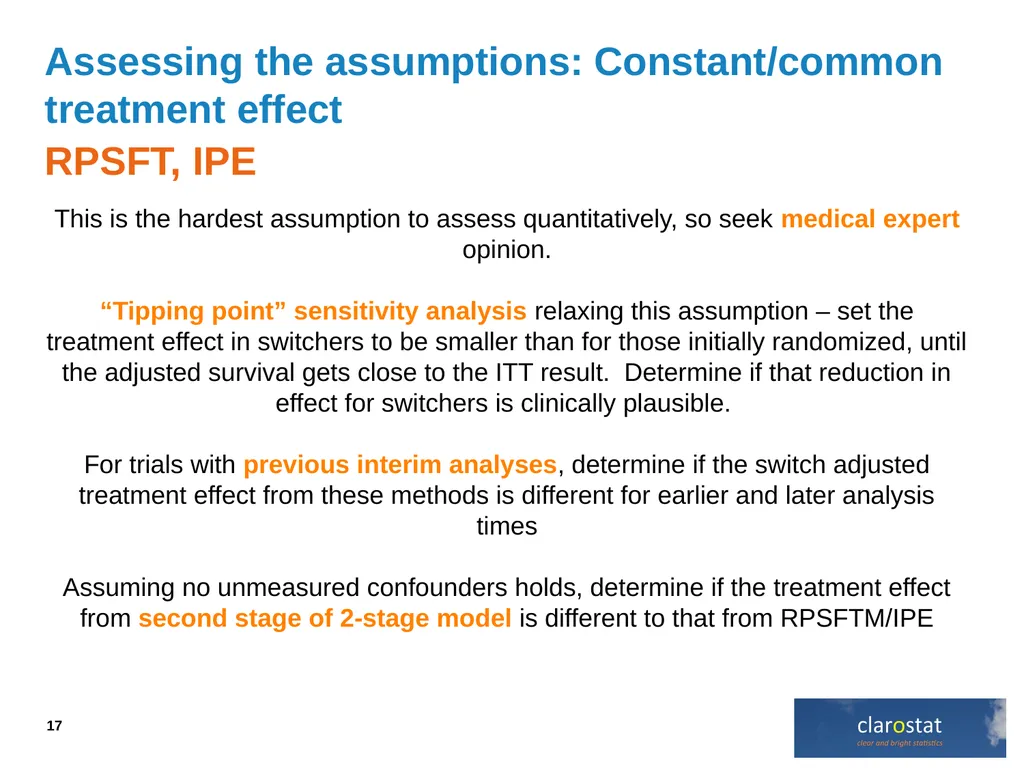
Assessing the assumptions: Constant/common treatment effect RPSFT, IPE This is the hardest assumption to assess quantitatively, so seek medical expert opinion.
“Tipping point” sensitivity analysis relaxing this assumption – set the treatment effect in switchers to be smaller than for those initially randomized, until the adjusted survival gets close to the ITT result. Determine if that reduction in effect for switchers is clinically plausible.
For trials with previous interim analyses, determine if the switch adjusted treatment effect from these methods is different for earlier and later analysis times
Assuming no unmeasured confounders holds, determine if the treatment effect from second stage of 2-stage model is different to that from RPSFTM/IPE 17<br>
18
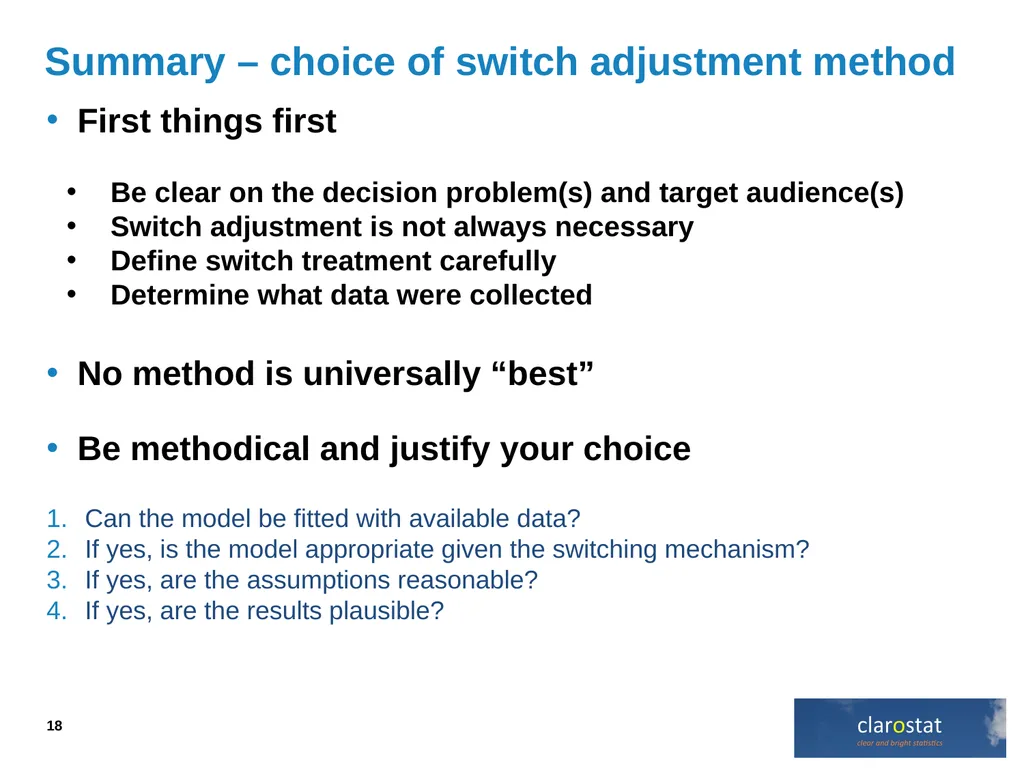
Summary – choice of switch adjustment method First things first
Be clear on the decision problem(s) and target audience(s)
Switch adjustment is not always necessary
Define switch treatment carefully
Determine what data were collected
No method is universally “best”
Be methodical and justify your choice
Can the model be fitted with available data?
If yes, is the model appropriate given the switching mechanism?
If yes, are the assumptions reasonable?
If yes, are the results plausible? 18<br>
19
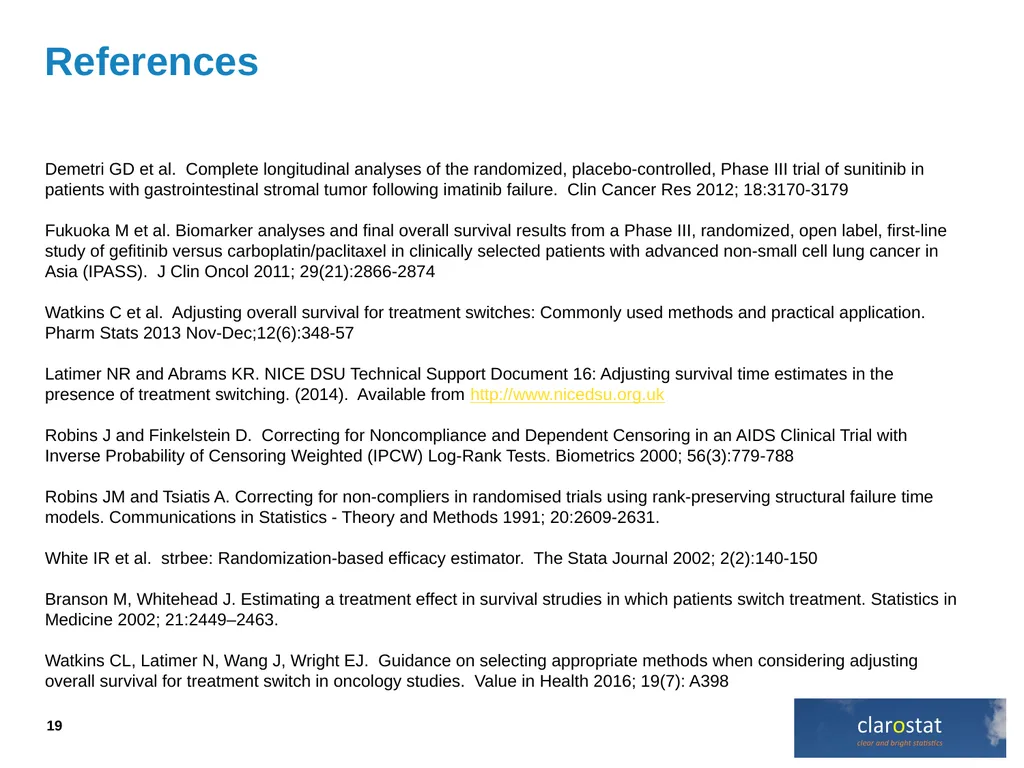
References 19 Demetri GD et al. Complete longitudinal analyses of the randomized, placebo-controlled, Phase III trial of sunitinib in patients with gastrointestinal stromal tumor following imatinib failure. Clin Cancer Res 2012; 18:3170-3179
Fukuoka M et al. Biomarker analyses and final overall survival results from a Phase III, randomized, open label, first-line study of gefitinib versus carboplatin/paclitaxel in clinically selected patients with advanced non-small cell lung cancer in Asia (IPASS). J Clin Oncol 2011; 29(21):2866-2874
Watkins C et al. Adjusting overall survival for treatment switches: Commonly used methods and practical application. Pharm Stats 2013 Nov-Dec;12(6):348-57
Latimer NR and Abrams KR. NICE DSU Technical Support Document 16: Adjusting survival time estimates in the presence of treatment switching. (2014). Available from http://www.nicedsu.org.uk
Robins J and Finkelstein D. Correcting for Noncompliance and Dependent Censoring in an AIDS Clinical Trial with Inverse Probability of Censoring Weighted (IPCW) Log-Rank Tests. Biometrics 2000; 56(3):779-788
Robins JM and Tsiatis A. Correcting for non-compliers in randomised trials using rank-preserving structural failure time models. Communications in Statistics - Theory and Methods 1991; 20:2609-2631.
White IR et al. strbee: Randomization-based efficacy estimator. The Stata Journal 2002; 2(2):140-150
Branson M, Whitehead J. Estimating a treatment effect in survival strudies in which patients switch treatment. Statistics in Medicine 2002; 21:2449–2463.
Watkins CL, Latimer N, Wang J, Wright EJ. Guidance on selecting appropriate methods when considering adjusting overall survival for treatment switch in oncology studies. Value in Health 2016; 19(7): A398<br>
20
20 Q & A<br>