
Administrative Details Attendees are in listen
TA
Published · 34 slides · 0 views

1 / 1

Description
Administrative Details Attendees are in listen only mode. Questions? Please use the Gotowebinar questions feature in the upper right and we will do our best to respond. For panelist questions after the webinar: Bob Skow-Bob.Skowiiaiowa.org
Related Topics
Share
Embed code
Download this presentation From Below
"Administrative Details Attendees are in listen" is the property of its rightful owner. Permission is granted to download and print the materials on this website for personal, non-commercial use only, and to display it on your personal computer provided you do not modify the materials and that you retain all copyright notices contained in the materials. By downloading content from our website, you accept the terms of this agreement.
Presentation Transcript
01
Administrative Details Attendees are in listen only mode.
Questions? Please use the Gotowebinar questions feature in the upper right and we will do our best to respond.
For panelist questions after the webinar:
Bob Skow-Bob.Skow@iiaiowa.org
Dirk Nohre- dirk@nohre.com
Matt Davis- Matthew_Davis@swissre.com
Jim Redeker- James_Redeker@swissre.com
Annette Ardler- Annette_Ardler@swissre.com
No CE or loss control credit for listening to today’s discussion.
The slides and audio will be available on E&O Happens soon.<br>
Questions? Please use the Gotowebinar questions feature in the upper right and we will do our best to respond.
For panelist questions after the webinar:
Bob Skow-Bob.Skow@iiaiowa.org
Dirk Nohre- dirk@nohre.com
Matt Davis- Matthew_Davis@swissre.com
Jim Redeker- James_Redeker@swissre.com
Annette Ardler- Annette_Ardler@swissre.com
No CE or loss control credit for listening to today’s discussion.
The slides and audio will be available on E&O Happens soon.<br>
02
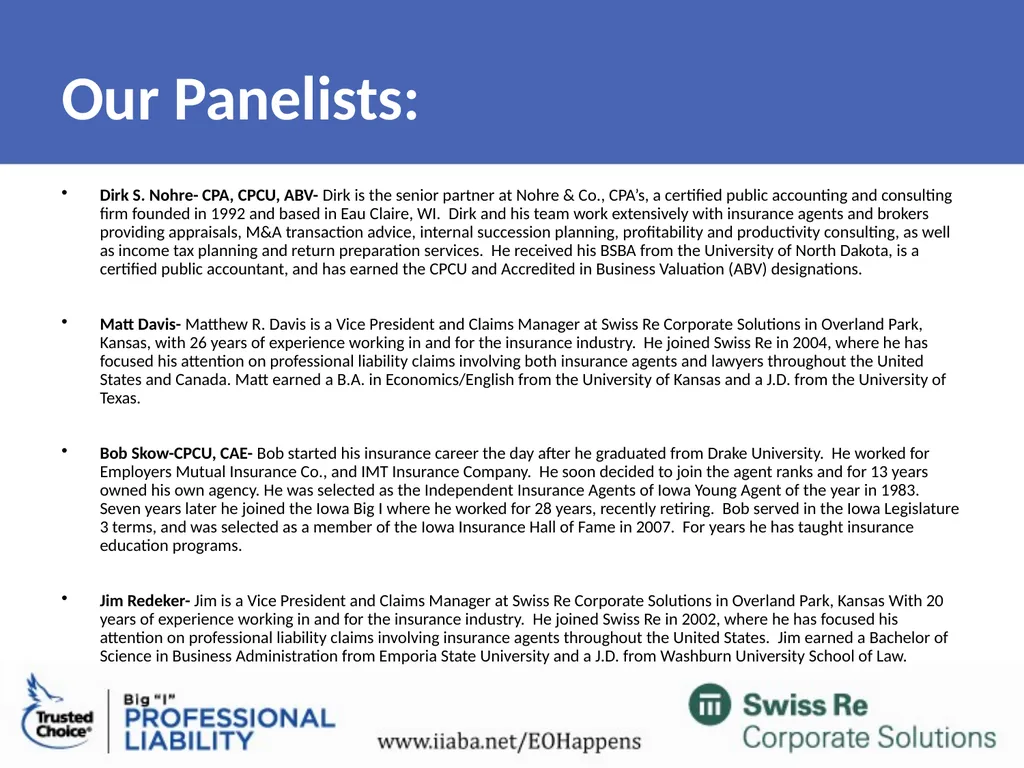
Our Panelists: Dirk S. Nohre- CPA, CPCU, ABV- Dirk is the senior partner at Nohre & Co., CPA’s, a certified public accounting and consulting firm founded in 1992 and based in Eau Claire, WI. Dirk and his team work extensively with insurance agents and brokers providing appraisals, M&A transaction advice, internal succession planning, profitability and productivity consulting, as well as income tax planning and return preparation services. He received his BSBA from the University of North Dakota, is a certified public accountant, and has earned the CPCU and Accredited in Business Valuation (ABV) designations.
Matt Davis- Matthew R. Davis is a Vice President and Claims Manager at Swiss Re Corporate Solutions in Overland Park, Kansas, with 26 years of experience working in and for the insurance industry. He joined Swiss Re in 2004, where he has focused his attention on professional liability claims involving both insurance agents and lawyers throughout the United States and Canada. Matt earned a B.A. in Economics/English from the University of Kansas and a J.D. from the University of Texas.
Bob Skow-CPCU, CAE- Bob started his insurance career the day after he graduated from Drake University. He worked for Employers Mutual Insurance Co., and IMT Insurance Company. He soon decided to join the agent ranks and for 13 years owned his own agency. He was selected as the Independent Insurance Agents of Iowa Young Agent of the year in 1983. Seven years later he joined the Iowa Big I where he worked for 28 years, recently retiring. Bob served in the Iowa Legislature 3 terms, and was selected as a member of the Iowa Insurance Hall of Fame in 2007. For years he has taught insurance education programs.
Jim Redeker- Jim is a Vice President and Claims Manager at Swiss Re Corporate Solutions in Overland Park, Kansas With 20 years of experience working in and for the insurance industry. He joined Swiss Re in 2002, where he has focused his attention on professional liability claims involving insurance agents throughout the United States. Jim earned a Bachelor of Science in Business Administration from Emporia State University and a J.D. from Washburn University School of Law.<br>
Matt Davis- Matthew R. Davis is a Vice President and Claims Manager at Swiss Re Corporate Solutions in Overland Park, Kansas, with 26 years of experience working in and for the insurance industry. He joined Swiss Re in 2004, where he has focused his attention on professional liability claims involving both insurance agents and lawyers throughout the United States and Canada. Matt earned a B.A. in Economics/English from the University of Kansas and a J.D. from the University of Texas.
Bob Skow-CPCU, CAE- Bob started his insurance career the day after he graduated from Drake University. He worked for Employers Mutual Insurance Co., and IMT Insurance Company. He soon decided to join the agent ranks and for 13 years owned his own agency. He was selected as the Independent Insurance Agents of Iowa Young Agent of the year in 1983. Seven years later he joined the Iowa Big I where he worked for 28 years, recently retiring. Bob served in the Iowa Legislature 3 terms, and was selected as a member of the Iowa Insurance Hall of Fame in 2007. For years he has taught insurance education programs.
Jim Redeker- Jim is a Vice President and Claims Manager at Swiss Re Corporate Solutions in Overland Park, Kansas With 20 years of experience working in and for the insurance industry. He joined Swiss Re in 2002, where he has focused his attention on professional liability claims involving insurance agents throughout the United States. Jim earned a Bachelor of Science in Business Administration from Emporia State University and a J.D. from Washburn University School of Law.<br>
03
Bob Skow-CPCU, CAE<br>
04
Buying or Selling your agency, do your due diligence Start out by executing a confidentiality agreement so you can share important information
Consider having a third party help establish market value – you wouldn’t buy or sell a home without an appraisal
Sit down with your CPA early in the process and review tax issues that may impact the sale or buying of an agency
Visit with your current Errors and Omissions carrier about any issues you should know about that might impact your exposure<br>
Consider having a third party help establish market value – you wouldn’t buy or sell a home without an appraisal
Sit down with your CPA early in the process and review tax issues that may impact the sale or buying of an agency
Visit with your current Errors and Omissions carrier about any issues you should know about that might impact your exposure<br>
05
Do an inspection Ask to see the agency files and financial records
Check out the automation system
E & O loss run<br>
Check out the automation system
E & O loss run<br>
06
Valuating an agency Annual retention on the book of business – type of business Personal, Commercial, Crop, Health Insurance (niche markets?)
Compatibility of the book – companies similar, etc.
Are you buying expirations or renewals (target accounts exposure)?
Loss Ratio with carriers and is the book meeting current volume requirements - profit share earned?
Competition in the area-market area and population trends (location, location, location!!)
Is the agency automated and is data transferable?
Staff experienced – are covenants not to compete transferable – will owners stay on for a period of time or leave – office building (lease/buy)?
Contract or Cash?<br>
Compatibility of the book – companies similar, etc.
Are you buying expirations or renewals (target accounts exposure)?
Loss Ratio with carriers and is the book meeting current volume requirements - profit share earned?
Competition in the area-market area and population trends (location, location, location!!)
Is the agency automated and is data transferable?
Staff experienced – are covenants not to compete transferable – will owners stay on for a period of time or leave – office building (lease/buy)?
Contract or Cash?<br>
07
Get it in writing! The more you get spelled out the less likely you will have issues. Utilize an Attorney and a CPA who understand agency buy/sell agreements and issues.<br>
08
Dirk S. Nohre, CPA, CPCU, ABV<br>
09
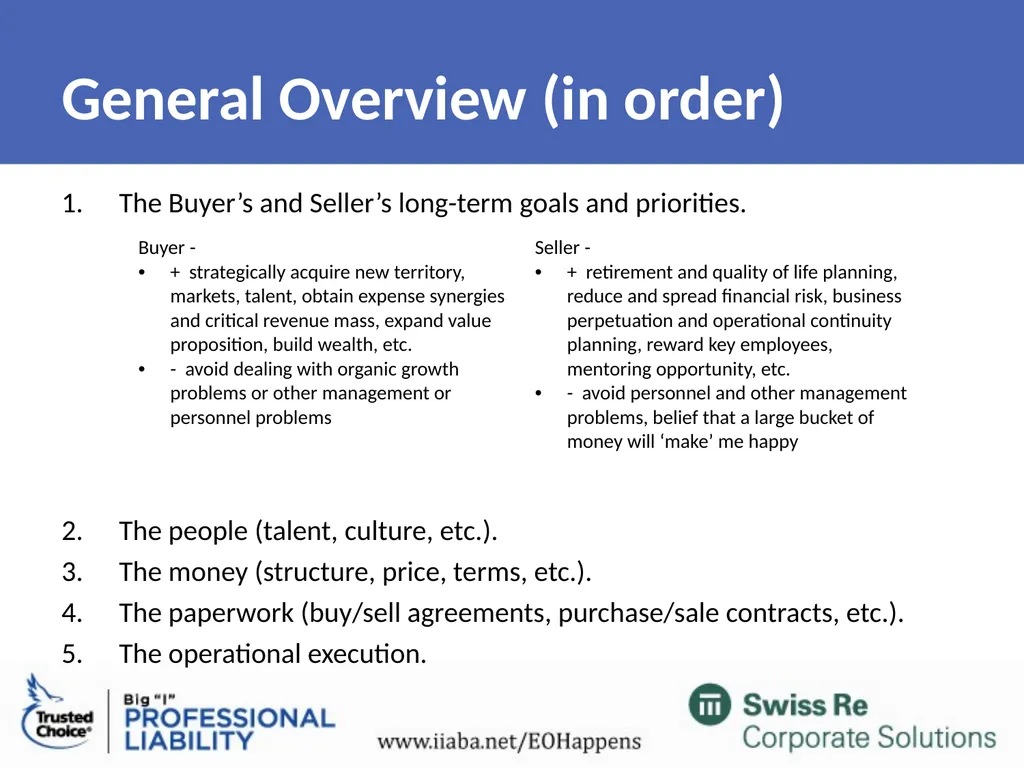
General Overview (in order) The Buyer’s and Seller’s long-term goals and priorities.
The people (talent, culture, etc.).
The money (structure, price, terms, etc.).
The paperwork (buy/sell agreements, purchase/sale contracts, etc.).
The operational execution.<br>
The people (talent, culture, etc.).
The money (structure, price, terms, etc.).
The paperwork (buy/sell agreements, purchase/sale contracts, etc.).
The operational execution.<br>
10
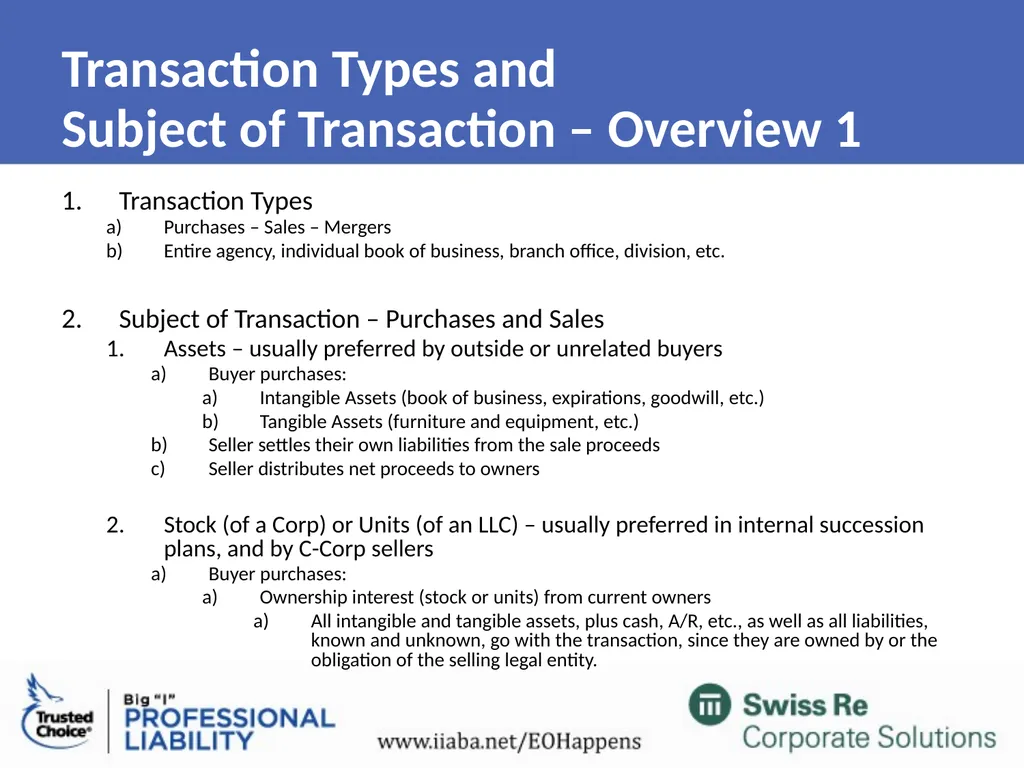
Transaction Types and
Subject of Transaction – Overview 1 Transaction Types
Purchases – Sales – Mergers
Entire agency, individual book of business, branch office, division, etc.
Subject of Transaction – Purchases and Sales
Assets – usually preferred by outside or unrelated buyers
Buyer purchases:
Intangible Assets (book of business, expirations, goodwill, etc.)
Tangible Assets (furniture and equipment, etc.)
Seller settles their own liabilities from the sale proceeds
Seller distributes net proceeds to owners
Stock (of a Corp) or Units (of an LLC) – usually preferred in internal succession plans, and by C-Corp sellers
Buyer purchases:
Ownership interest (stock or units) from current owners
All intangible and tangible assets, plus cash, A/R, etc., as well as all liabilities, known and unknown, go with the transaction, since they are owned by or the obligation of the selling legal entity.<br>
Purchases – Sales – Mergers
Entire agency, individual book of business, branch office, division, etc.
Subject of Transaction – Purchases and Sales
Assets – usually preferred by outside or unrelated buyers
Buyer purchases:
Intangible Assets (book of business, expirations, goodwill, etc.)
Tangible Assets (furniture and equipment, etc.)
Seller settles their own liabilities from the sale proceeds
Seller distributes net proceeds to owners
Stock (of a Corp) or Units (of an LLC) – usually preferred in internal succession plans, and by C-Corp sellers
Buyer purchases:
Ownership interest (stock or units) from current owners
All intangible and tangible assets, plus cash, A/R, etc., as well as all liabilities, known and unknown, go with the transaction, since they are owned by or the obligation of the selling legal entity.<br>
11
Transaction Types and
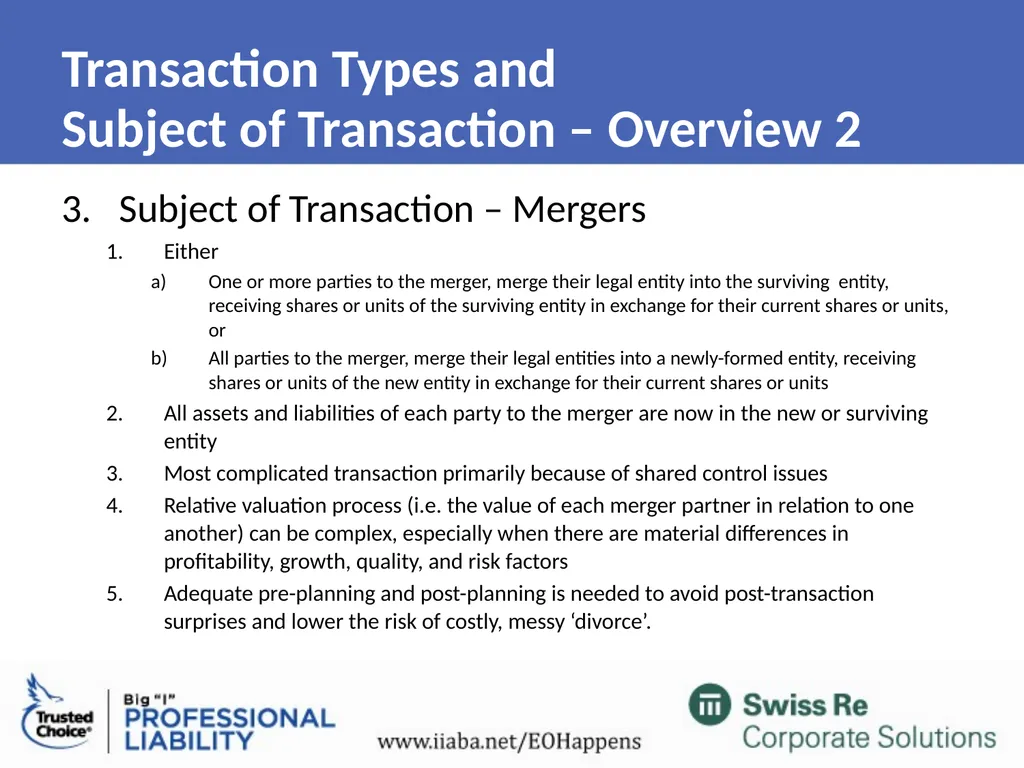
Subject of Transaction – Overview 2 Subject of Transaction – Mergers
Either
One or more parties to the merger, merge their legal entity into the surviving entity, receiving shares or units of the surviving entity in exchange for their current shares or units, or
All parties to the merger, merge their legal entities into a newly-formed entity, receiving shares or units of the new entity in exchange for their current shares or units
All assets and liabilities of each party to the merger are now in the new or surviving entity
Most complicated transaction primarily because of shared control issues
Relative valuation process (i.e. the value of each merger partner in relation to one another) can be complex, especially when there are material differences in profitability, growth, quality, and risk factors
Adequate pre-planning and post-planning is needed to avoid post-transaction surprises and lower the risk of costly, messy ‘divorce’.<br>
Either
One or more parties to the merger, merge their legal entity into the surviving entity, receiving shares or units of the surviving entity in exchange for their current shares or units, or
All parties to the merger, merge their legal entities into a newly-formed entity, receiving shares or units of the new entity in exchange for their current shares or units
All assets and liabilities of each party to the merger are now in the new or surviving entity
Most complicated transaction primarily because of shared control issues
Relative valuation process (i.e. the value of each merger partner in relation to one another) can be complex, especially when there are material differences in profitability, growth, quality, and risk factors
Adequate pre-planning and post-planning is needed to avoid post-transaction surprises and lower the risk of costly, messy ‘divorce’.<br>
12
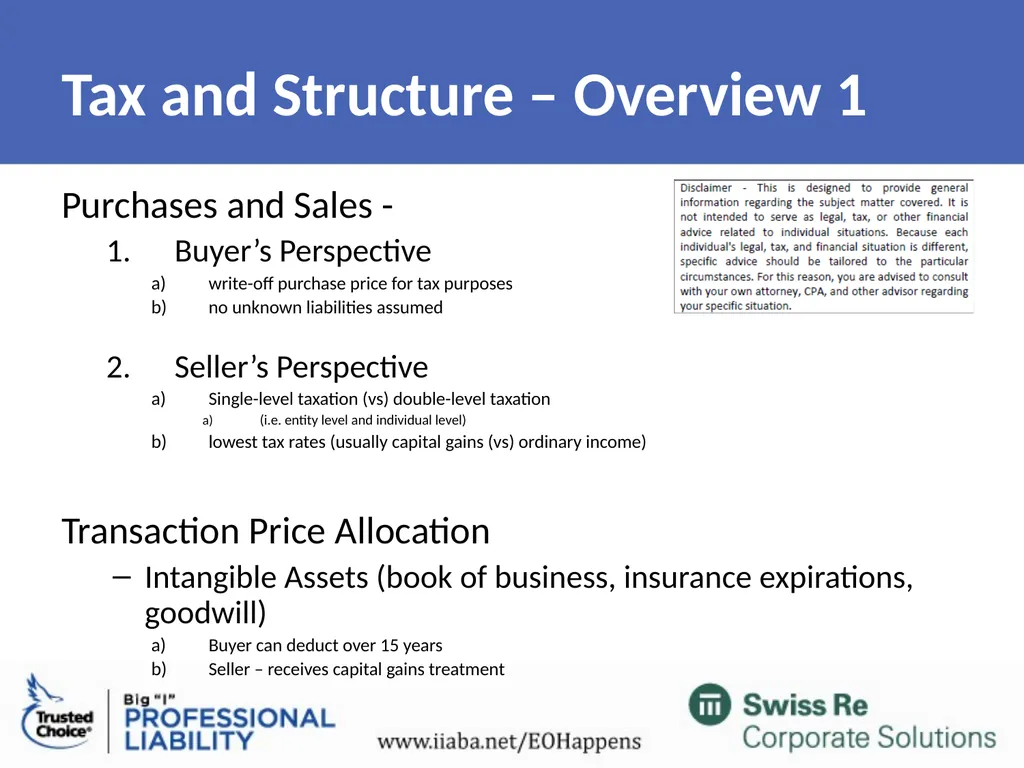
Tax and Structure – Overview 1 Purchases and Sales -
Buyer’s Perspective
write-off purchase price for tax purposes
no unknown liabilities assumed
Seller’s Perspective
Single-level taxation (vs) double-level taxation
(i.e. entity level and individual level)
lowest tax rates (usually capital gains (vs) ordinary income)
Transaction Price Allocation
Intangible Assets (book of business, insurance expirations, goodwill)
Buyer can deduct over 15 years
Seller – receives capital gains treatment<br>
Buyer’s Perspective
write-off purchase price for tax purposes
no unknown liabilities assumed
Seller’s Perspective
Single-level taxation (vs) double-level taxation
(i.e. entity level and individual level)
lowest tax rates (usually capital gains (vs) ordinary income)
Transaction Price Allocation
Intangible Assets (book of business, insurance expirations, goodwill)
Buyer can deduct over 15 years
Seller – receives capital gains treatment<br>
13
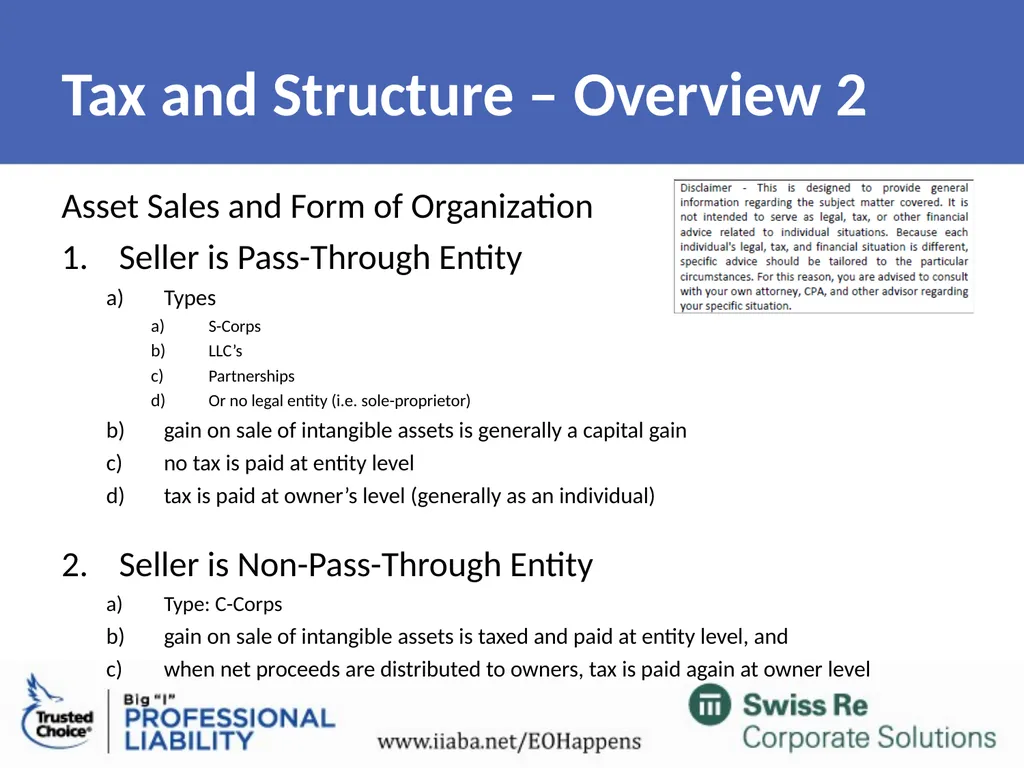
Tax and Structure – Overview 2 Asset Sales and Form of Organization
Seller is Pass-Through Entity
Types
S-Corps
LLC’s
Partnerships
Or no legal entity (i.e. sole-proprietor)
gain on sale of intangible assets is generally a capital gain
no tax is paid at entity level
tax is paid at owner’s level (generally as an individual)
Seller is Non-Pass-Through Entity
Type: C-Corps
gain on sale of intangible assets is taxed and paid at entity level, and
when net proceeds are distributed to owners, tax is paid again at owner level<br>
Seller is Pass-Through Entity
Types
S-Corps
LLC’s
Partnerships
Or no legal entity (i.e. sole-proprietor)
gain on sale of intangible assets is generally a capital gain
no tax is paid at entity level
tax is paid at owner’s level (generally as an individual)
Seller is Non-Pass-Through Entity
Type: C-Corps
gain on sale of intangible assets is taxed and paid at entity level, and
when net proceeds are distributed to owners, tax is paid again at owner level<br>
14
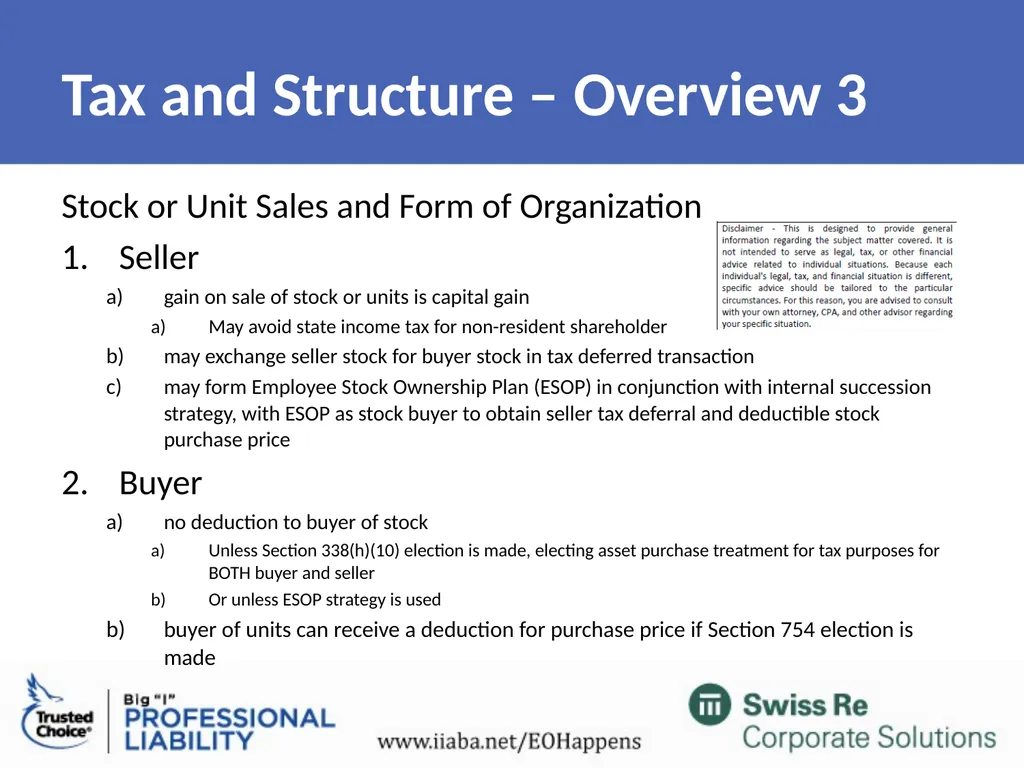
Tax and Structure – Overview 3 Stock or Unit Sales and Form of Organization
Seller
gain on sale of stock or units is capital gain
May avoid state income tax for non-resident shareholder
may exchange seller stock for buyer stock in tax deferred transaction
may form Employee Stock Ownership Plan (ESOP) in conjunction with internal succession strategy, with ESOP as stock buyer to obtain seller tax deferral and deductible stock purchase price
Buyer
no deduction to buyer of stock
Unless Section 338(h)(10) election is made, electing asset purchase treatment for tax purposes for BOTH buyer and seller
Or unless ESOP strategy is used
buyer of units can receive a deduction for purchase price if Section 754 election is made<br>
Seller
gain on sale of stock or units is capital gain
May avoid state income tax for non-resident shareholder
may exchange seller stock for buyer stock in tax deferred transaction
may form Employee Stock Ownership Plan (ESOP) in conjunction with internal succession strategy, with ESOP as stock buyer to obtain seller tax deferral and deductible stock purchase price
Buyer
no deduction to buyer of stock
Unless Section 338(h)(10) election is made, electing asset purchase treatment for tax purposes for BOTH buyer and seller
Or unless ESOP strategy is used
buyer of units can receive a deduction for purchase price if Section 754 election is made<br>
15
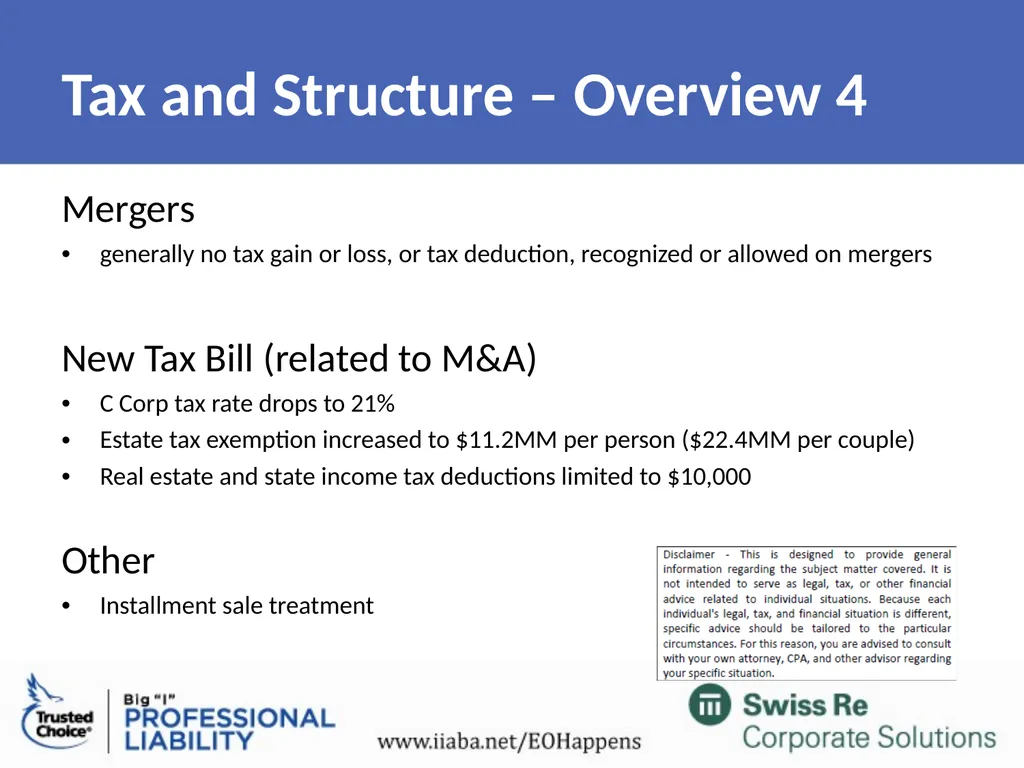
Tax and Structure – Overview 4 Mergers
generally no tax gain or loss, or tax deduction, recognized or allowed on mergers
New Tax Bill (related to M&A)
C Corp tax rate drops to 21%
Estate tax exemption increased to $11.2MM per person ($22.4MM per couple)
Real estate and state income tax deductions limited to $10,000
Other
Installment sale treatment<br>
generally no tax gain or loss, or tax deduction, recognized or allowed on mergers
New Tax Bill (related to M&A)
C Corp tax rate drops to 21%
Estate tax exemption increased to $11.2MM per person ($22.4MM per couple)
Real estate and state income tax deductions limited to $10,000
Other
Installment sale treatment<br>
16
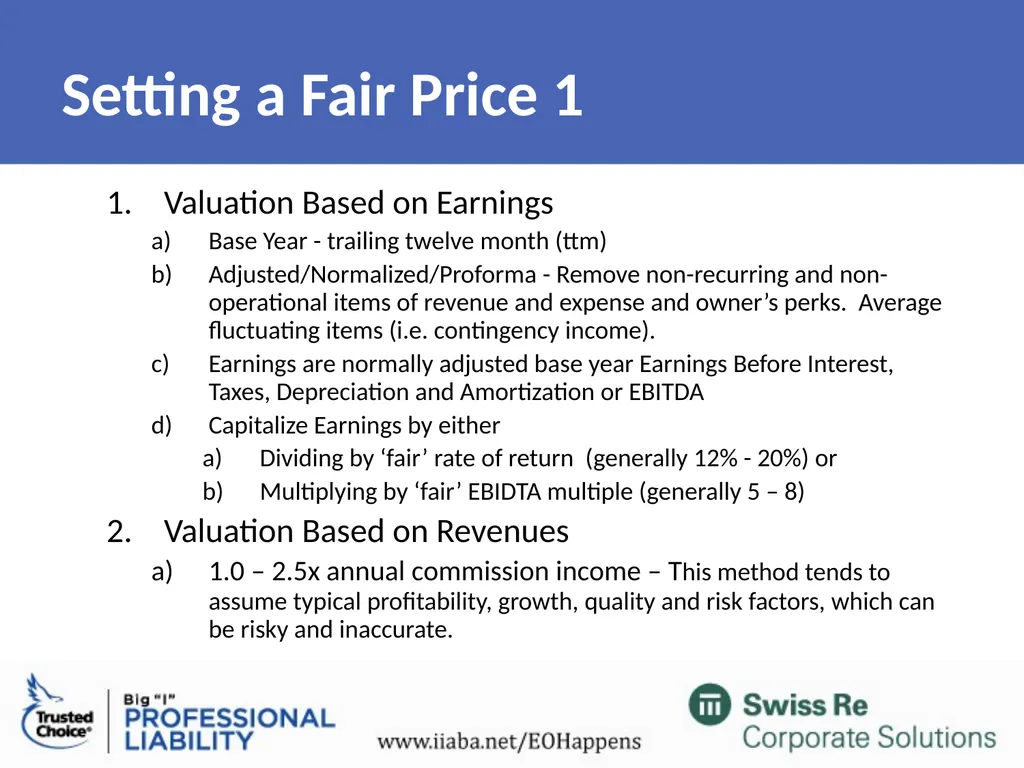
Setting a Fair Price 1 Valuation Based on Earnings
Base Year - trailing twelve month (ttm)
Adjusted/Normalized/Proforma - Remove non-recurring and non-operational items of revenue and expense and owner’s perks. Average fluctuating items (i.e. contingency income).
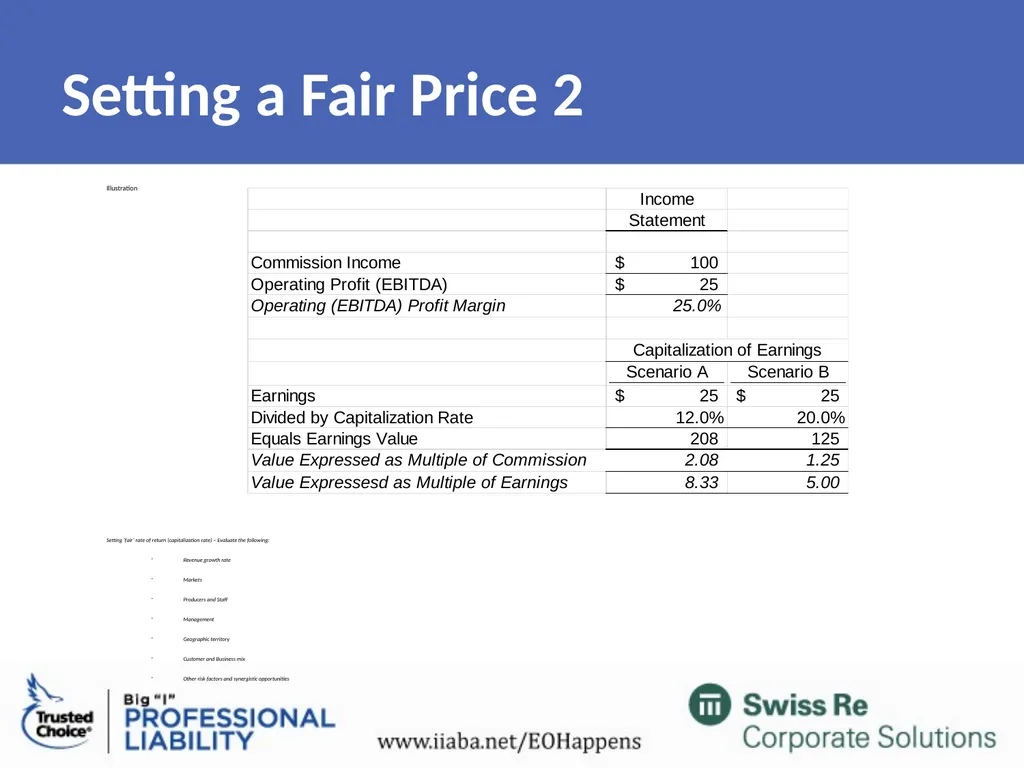
Earnings are normally adjusted base year Earnings Before Interest, Taxes, Depreciation and Amortization or EBITDA
Capitalize Earnings by either
Dividing by ‘fair’ rate of return (generally 12% - 20%) or
Multiplying by ‘fair’ EBIDTA multiple (generally 5 – 8)
Valuation Based on Revenues
1.0 – 2.5x annual commission income – This method tends to assume typical profitability, growth, quality and risk factors, which can be risky and inaccurate.<br>
Base Year - trailing twelve month (ttm)
Adjusted/Normalized/Proforma - Remove non-recurring and non-operational items of revenue and expense and owner’s perks. Average fluctuating items (i.e. contingency income).
Earnings are normally adjusted base year Earnings Before Interest, Taxes, Depreciation and Amortization or EBITDA
Capitalize Earnings by either
Dividing by ‘fair’ rate of return (generally 12% - 20%) or
Multiplying by ‘fair’ EBIDTA multiple (generally 5 – 8)
Valuation Based on Revenues
1.0 – 2.5x annual commission income – This method tends to assume typical profitability, growth, quality and risk factors, which can be risky and inaccurate.<br>
17
Setting a Fair Price 2 Illustration
Setting ‘fair’ rate of return (capitalization rate) – Evaluate the following:
Revenue growth rate
Markets
Producers and Staff
Management
Geographic territory
Customer and Business mix
Other risk factors and synergistic opportunities<br>
Setting ‘fair’ rate of return (capitalization rate) – Evaluate the following:
Revenue growth rate
Markets
Producers and Staff
Management
Geographic territory
Customer and Business mix
Other risk factors and synergistic opportunities<br>
18
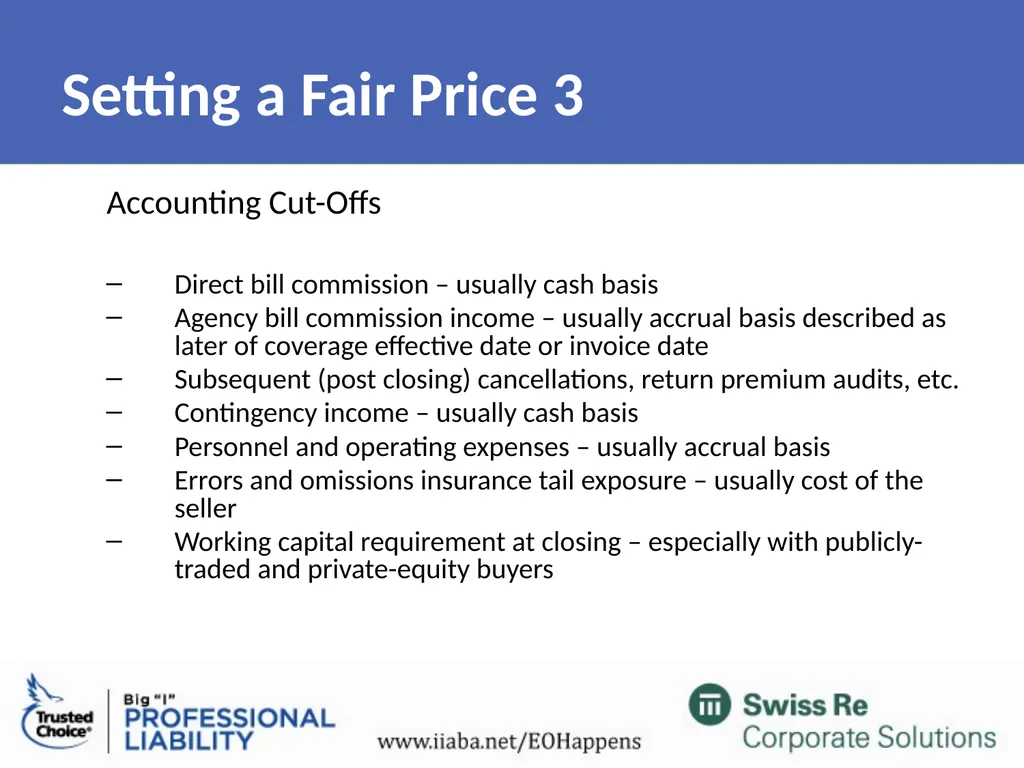
Setting a Fair Price 3 Accounting Cut-Offs
Direct bill commission – usually cash basis
Agency bill commission income – usually accrual basis described as later of coverage effective date or invoice date
Subsequent (post closing) cancellations, return premium audits, etc.
Contingency income – usually cash basis
Personnel and operating expenses – usually accrual basis
Errors and omissions insurance tail exposure – usually cost of the seller
Working capital requirement at closing – especially with publicly-traded and private-equity buyers<br>
Direct bill commission – usually cash basis
Agency bill commission income – usually accrual basis described as later of coverage effective date or invoice date
Subsequent (post closing) cancellations, return premium audits, etc.
Contingency income – usually cash basis
Personnel and operating expenses – usually accrual basis
Errors and omissions insurance tail exposure – usually cost of the seller
Working capital requirement at closing – especially with publicly-traded and private-equity buyers<br>
19
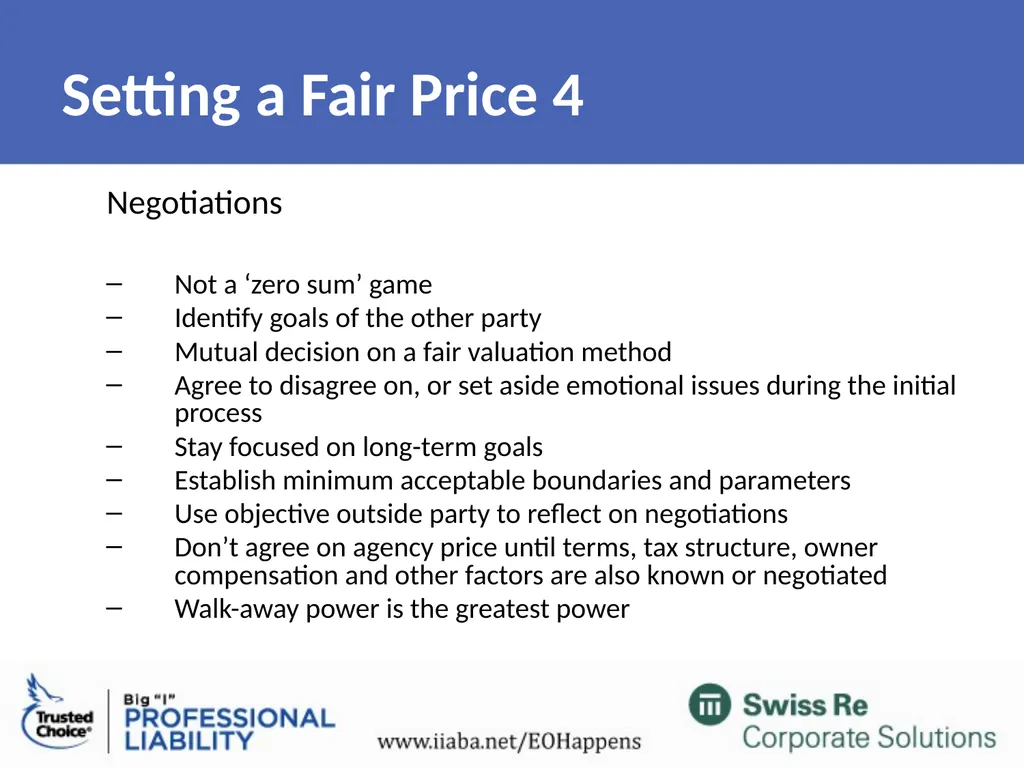
Setting a Fair Price 4 Negotiations
Not a ‘zero sum’ game
Identify goals of the other party
Mutual decision on a fair valuation method
Agree to disagree on, or set aside emotional issues during the initial process
Stay focused on long-term goals
Establish minimum acceptable boundaries and parameters
Use objective outside party to reflect on negotiations
Don’t agree on agency price until terms, tax structure, owner compensation and other factors are also known or negotiated
Walk-away power is the greatest power<br>
Not a ‘zero sum’ game
Identify goals of the other party
Mutual decision on a fair valuation method
Agree to disagree on, or set aside emotional issues during the initial process
Stay focused on long-term goals
Establish minimum acceptable boundaries and parameters
Use objective outside party to reflect on negotiations
Don’t agree on agency price until terms, tax structure, owner compensation and other factors are also known or negotiated
Walk-away power is the greatest power<br>
20
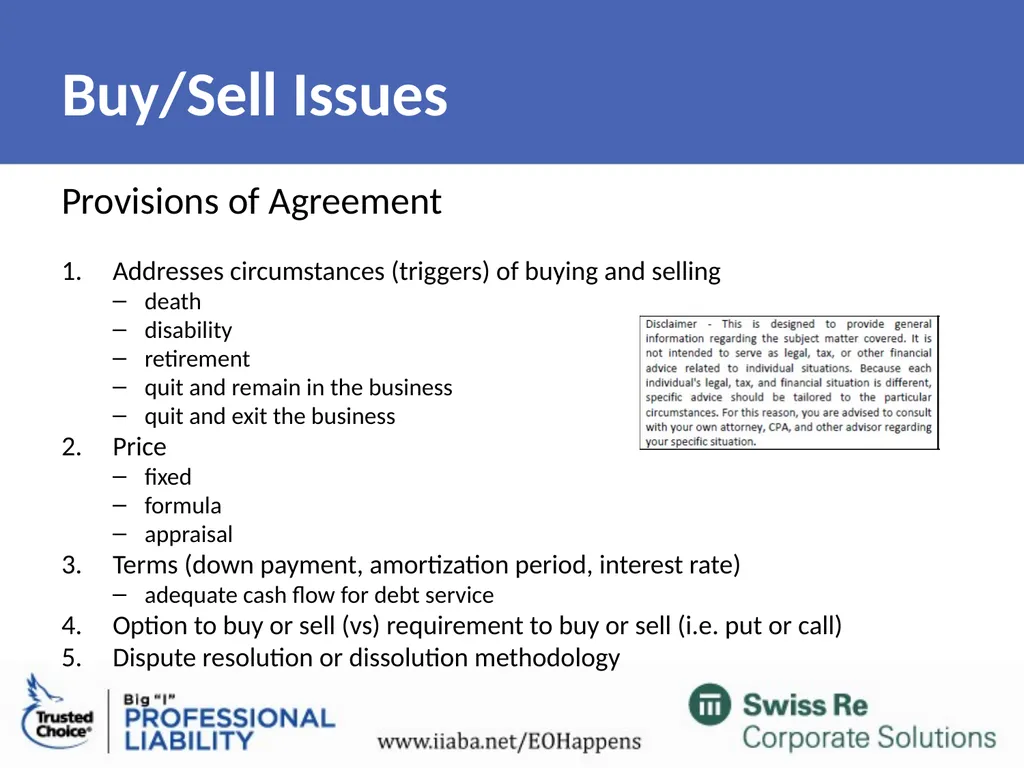
Buy/Sell Issues Provisions of Agreement
Addresses circumstances (triggers) of buying and selling
death
disability
retirement
quit and remain in the business
quit and exit the business
Price
fixed
formula
appraisal
Terms (down payment, amortization period, interest rate)
adequate cash flow for debt service
Option to buy or sell (vs) requirement to buy or sell (i.e. put or call)
Dispute resolution or dissolution methodology<br>
Addresses circumstances (triggers) of buying and selling
death
disability
retirement
quit and remain in the business
quit and exit the business
Price
fixed
formula
appraisal
Terms (down payment, amortization period, interest rate)
adequate cash flow for debt service
Option to buy or sell (vs) requirement to buy or sell (i.e. put or call)
Dispute resolution or dissolution methodology<br>
21
Matt Davis,
Claims Manager, Vice President
Swiss Re Corporate Solutions
& Jim Redeker, Claims Manager, Vice President Swiss Re Corporate Solutions<br>
& Jim Redeker, Claims Manager, Vice President Swiss Re Corporate Solutions<br>
22
Ready, fire, aim? When to get your E&O carrier involved in the purchase/sale?
Wait until the ink is dry?
What your underwriter can tell you
What most lawyers don’t know
To whom should you listen: your underwriter, lawyer or accountant?<br>
Wait until the ink is dry?
What your underwriter can tell you
What most lawyers don’t know
To whom should you listen: your underwriter, lawyer or accountant?<br>
23
The selling agency perspective Considerations when selling a book of business
You want protection in your retirement
You want protection if you’ve sold the business
You want to cut off liability for future problems
How much of a tail?<br>
You want protection in your retirement
You want protection if you’ve sold the business
You want to cut off liability for future problems
How much of a tail?<br>
24
The buying agency perspective When buying a book of business, why is acquiring only the assets of an agency (or a line of business) preferable to absorbing the entire agency (from an E&O standpoint)?
Because this is ‘claims made’ coverage, there must be a current policy in place that will cover errors/omissions by the Old Agency
Three options: continuing coverage by the selling agency, an ERP or the buying agency’s policy
Due diligence only goes so far
Impact on current policy pricing<br>
Because this is ‘claims made’ coverage, there must be a current policy in place that will cover errors/omissions by the Old Agency
Three options: continuing coverage by the selling agency, an ERP or the buying agency’s policy
Due diligence only goes so far
Impact on current policy pricing<br>
25
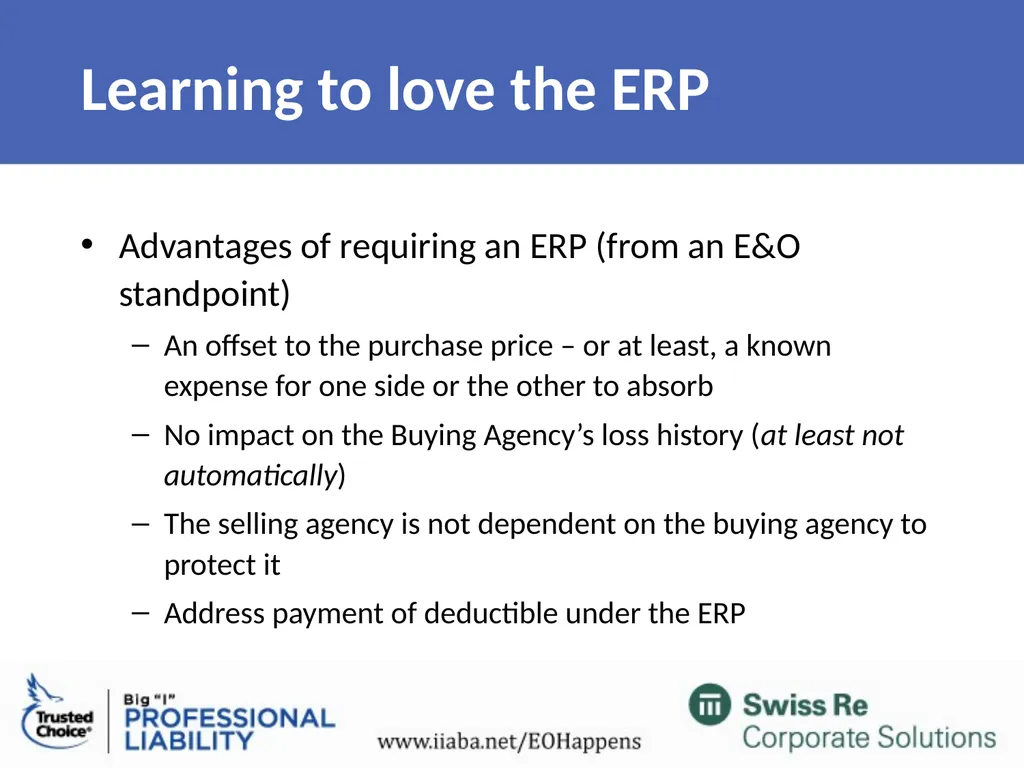
Learning to love the ERP Advantages of requiring an ERP (from an E&O standpoint)
An offset to the purchase price – or at least, a known expense for one side or the other to absorb
No impact on the Buying Agency’s loss history (at least not automatically)
The selling agency is not dependent on the buying agency to protect it
Address payment of deductible under the ERP<br>
An offset to the purchase price – or at least, a known expense for one side or the other to absorb
No impact on the Buying Agency’s loss history (at least not automatically)
The selling agency is not dependent on the buying agency to protect it
Address payment of deductible under the ERP<br>
26
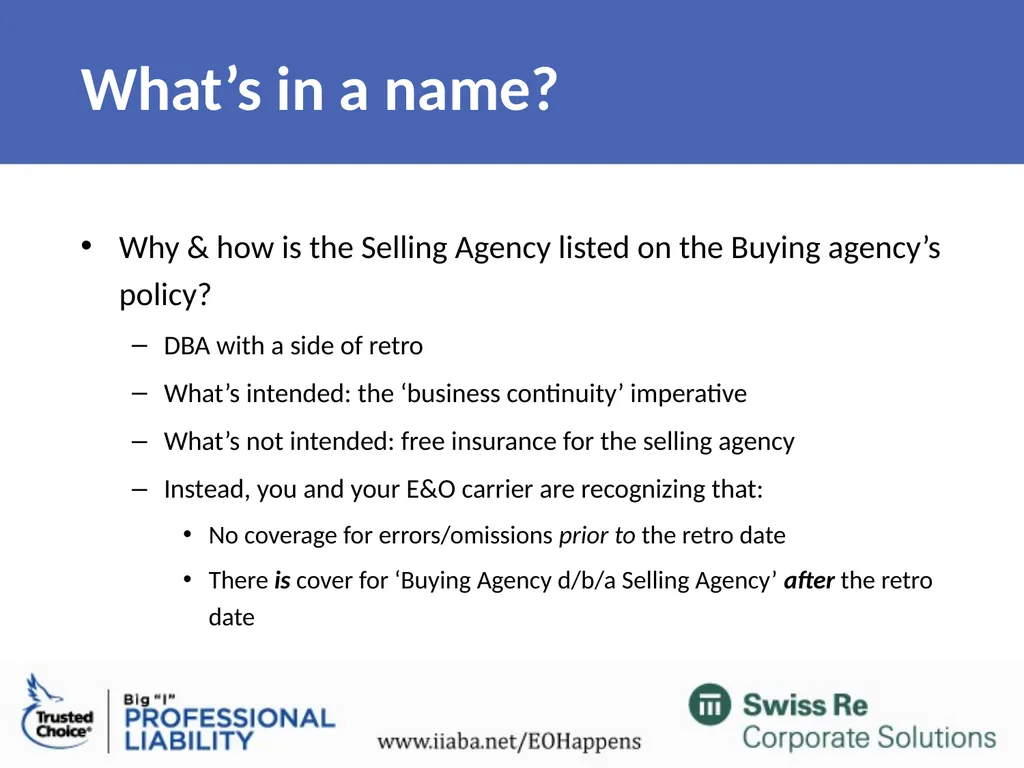
What’s in a name? Why & how is the Selling Agency listed on the Buying agency’s policy?
DBA with a side of retro
What’s intended: the ‘business continuity’ imperative
What’s not intended: free insurance for the selling agency
Instead, you and your E&O carrier are recognizing that:
No coverage for errors/omissions prior to the retro date
There is cover for ‘Buying Agency d/b/a Selling Agency’ after the retro date<br>
DBA with a side of retro
What’s intended: the ‘business continuity’ imperative
What’s not intended: free insurance for the selling agency
Instead, you and your E&O carrier are recognizing that:
No coverage for errors/omissions prior to the retro date
There is cover for ‘Buying Agency d/b/a Selling Agency’ after the retro date<br>
27
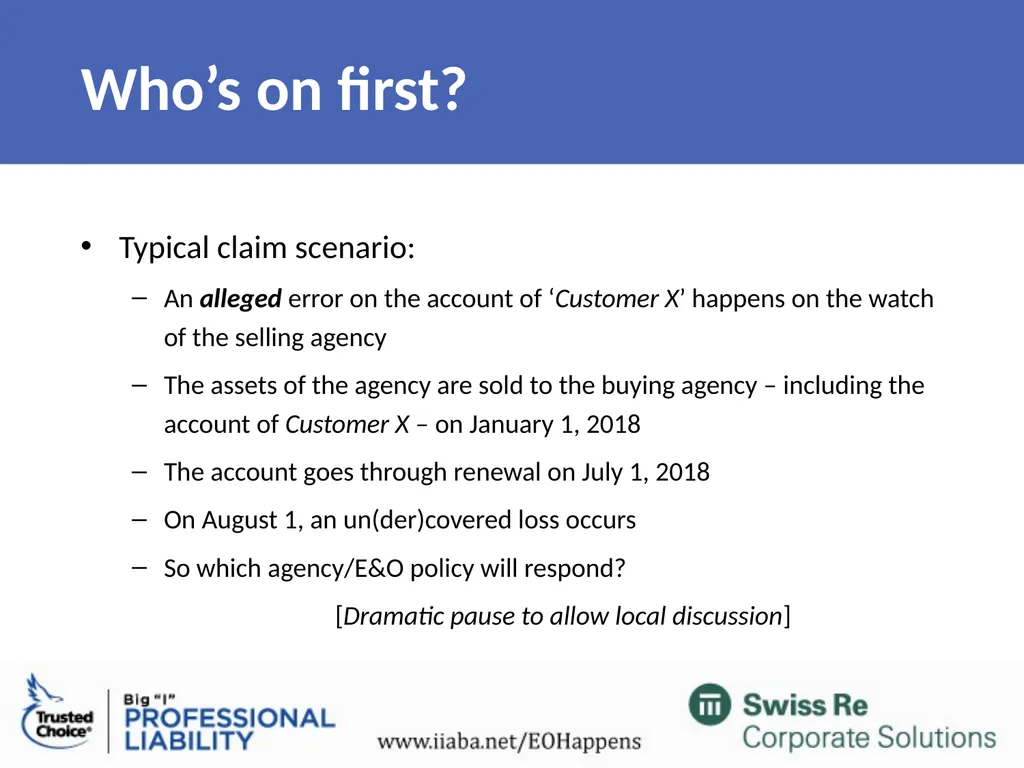
Who’s on first? Typical claim scenario:
An alleged error on the account of ‘Customer X’ happens on the watch of the selling agency
The assets of the agency are sold to the buying agency – including the account of Customer X – on January 1, 2018
The account goes through renewal on July 1, 2018
On August 1, an un(der)covered loss occurs
So which agency/E&O policy will respond?
[Dramatic pause to allow local discussion]<br>
An alleged error on the account of ‘Customer X’ happens on the watch of the selling agency
The assets of the agency are sold to the buying agency – including the account of Customer X – on January 1, 2018
The account goes through renewal on July 1, 2018
On August 1, an un(der)covered loss occurs
So which agency/E&O policy will respond?
[Dramatic pause to allow local discussion]<br>
28
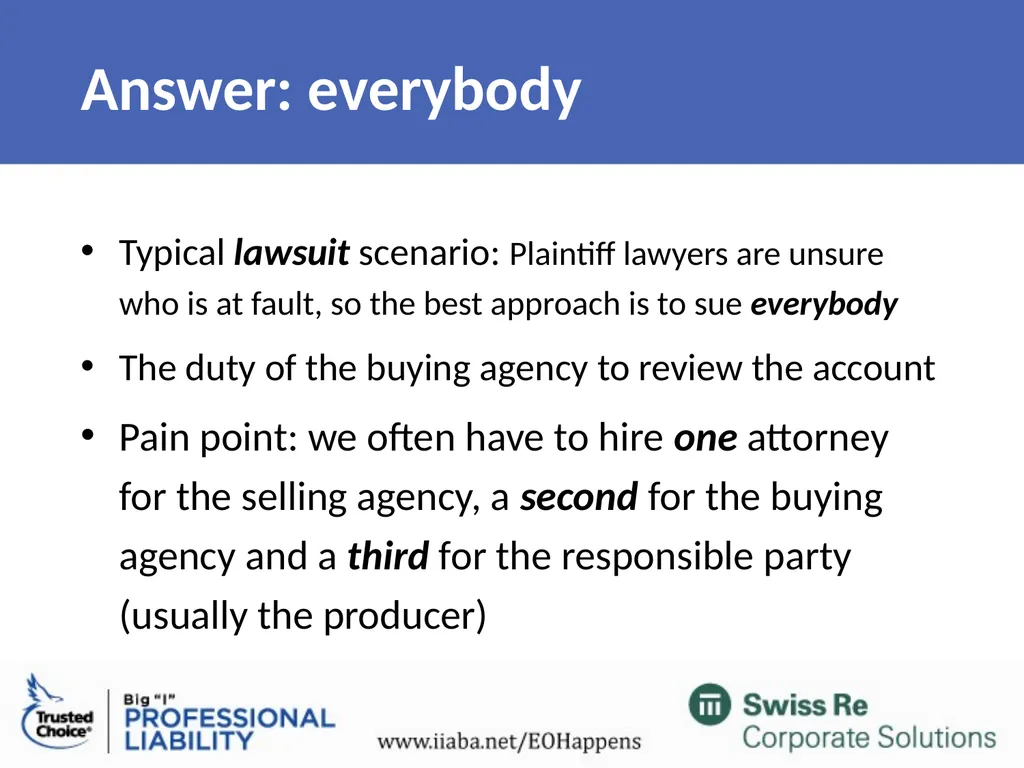
Answer: everybody Typical lawsuit scenario: Plaintiff lawyers are unsure who is at fault, so the best approach is to sue everybody
The duty of the buying agency to review the account
Pain point: we often have to hire one attorney for the selling agency, a second for the buying agency and a third for the responsible party (usually the producer)<br>
The duty of the buying agency to review the account
Pain point: we often have to hire one attorney for the selling agency, a second for the buying agency and a third for the responsible party (usually the producer)<br>
29
The tragedy of divorce If you think divorcing your spouse is complicated, try divorcing an insurance agency
Your dying wishes are difficult to discern when there’s no ‘succession plan’<br>
Your dying wishes are difficult to discern when there’s no ‘succession plan’<br>
30
E&O Takeaways Ready, aim, then fire – consult with your experts first
Learn to love the ERP – Old errors on the selling agency, new errors on the buying agency
It’s as important to sell to a good agency as it is to buy from a good agency
Beware the blind owner/producer – Nothing beats a fresh set of eyes when you’re reviewing a new account for old mistakes
Merger divorce is messy. So is dying without a plan to dispose of your agency. You must anticipate those situations…<br>
Learn to love the ERP – Old errors on the selling agency, new errors on the buying agency
It’s as important to sell to a good agency as it is to buy from a good agency
Beware the blind owner/producer – Nothing beats a fresh set of eyes when you’re reviewing a new account for old mistakes
Merger divorce is messy. So is dying without a plan to dispose of your agency. You must anticipate those situations…<br>
31
Related Resources: Is Bigger Always Better?- Barbara Rocco
2. Mergers & Acquisitions Checklist
3. Buying, Selling and Merging an Agency- What should you do? Ronald Kettner & Richard Lund
4. 2017 Best Practices Study Update- www.independentagent.com/bestpractices<br>
2. Mergers & Acquisitions Checklist
3. Buying, Selling and Merging an Agency- What should you do? Ronald Kettner & Richard Lund
4. 2017 Best Practices Study Update- www.independentagent.com/bestpractices<br>
32
Panelist Contact Information: Bob Skow-Bob.Skow@iiaiowa.org
Dirk Nohre- dirk@nohre.com
Matt Davis- Matthew_Davis@swissre.com
Jim Redeker- James_Redeker@swissre.com
Annette Ardler-Annette_Ardler@swissre.com<br>
Dirk Nohre- dirk@nohre.com
Matt Davis- Matthew_Davis@swissre.com
Jim Redeker- James_Redeker@swissre.com
Annette Ardler-Annette_Ardler@swissre.com<br>
33
Thank you!<br>