Administrative This was the last homework for the semester (yay!) First run of games: October 16nd in class Short document describing: goal operational rules (1-2 pages) Main point: bring a working prototype Even rudimentary and short But
"Administrative This was the last homework for the" is the property of its rightful owner. Permission is granted to
download and print the materials on this website for personal, non-commercial use only, and to display it
on your personal computer provided you do not modify the materials and that you retain all copyright
notices contained in the materials. By downloading content from our website, you accept the terms of this
agreement.
Presentation Transcript
01
Administrative This was the last homework for the semester (yay!)
First run of games: October 16nd in class
Short document describing: goal + operational rules (1-2 pages)
Main point: bring a working prototype
Even rudimentary and short
But needs to be interactive
Class will be given a questionnaire for evaluating your game
Answered questionnaire will be returned to game designers
I’ll give pointed feedback of what needs to be done to be exempt from the final<br>
02
Rules for Digital Games and Categorization of Games based on AI (Ch. 13)<br>
03
RECAP from previous class Characteristics of rules in games
Rules in any game exists on 3 levels: Rules limit player action
Rules are explicit and unambiguous
Rule are shared by all players
Rules are fixed
Rules are binding
Rules are repeatable Constitutive rules
Operational rules
Implicit rules Now we are going to look at these definitions in the context of digital games<br>
04
One Question Are the rules of a digital game the same as the program that codes this game (because if so why bother with rules levels and such…)? Parts of the program that are unrelated to the rules of the game: “allocate” more memory for program
Load a software library to build complex pieces of code
“garbage collection”
…<br>
05
Example: Rules of Tetris Let us list the operational rules of Tetris
For this version<br>
06
Example: Rules versus Non rules in Digital games Examples of “non rules”
Background in Tetris
Are visuals part of the operational rules of games? Example where the answer is “yes”:
HW: Give an example of an element in the graphical user interface of the game that is part of the game’s rules
Examples where the answer is “no”
HW: Give an example of an element in the graphical user interface that is not part of the game’s rules
HW: Do they affect the experience?<br>
07
Thief: Some Operational Rules Check the video
Factors influencing NPCs detection:
Lighting
Your location
Environment (torches)
Proximity to NPC
Line of view of NPC
Your movement Thus, visuals
are an integral part
of the operational
rules for this game<br>
08
Constitutive Rules for Digital Games Same constitutive rules as for non digital games
Why? They concern with the game logic
Internal events (how choice is processed)
As opposed to external events (how choice is represented) Lets think of the constitutive rules for a digital Chutes and Ladders versus a non digital one. Any difference?<br>
09
Operational Rules for Digital Games Include input devices (keyboard, etc)
Lets think of the operational rules for a digital Tic-Tac-Toe (versus non-digital)
Operational rules focuses on external events (how choice is represented)<br>
10
Implicit Rules for Digital Games Examples of implicit rules in digital games? (HW) Move mouse cursor moves
Playing the game won’t affect my computer!
…<br>
11
Categories of Games from an Artificial Intelligence (AI) Perspective Categories were, in part, the result of pursuing to apply AI techniques to construct “better” computer-controlled opponents
Depending on the categories, building such AI turns out to be easier or more difficult
They provide game design options
You can consider these options in the game you are creating.<br>
12
Deterministic Games Every player’s action results in a single pre-determined state?
Yes: Deterministic game state action<br>
13
Chance Games Every player’s action results in a single pre-determined state?
No: Chance game<br>
14
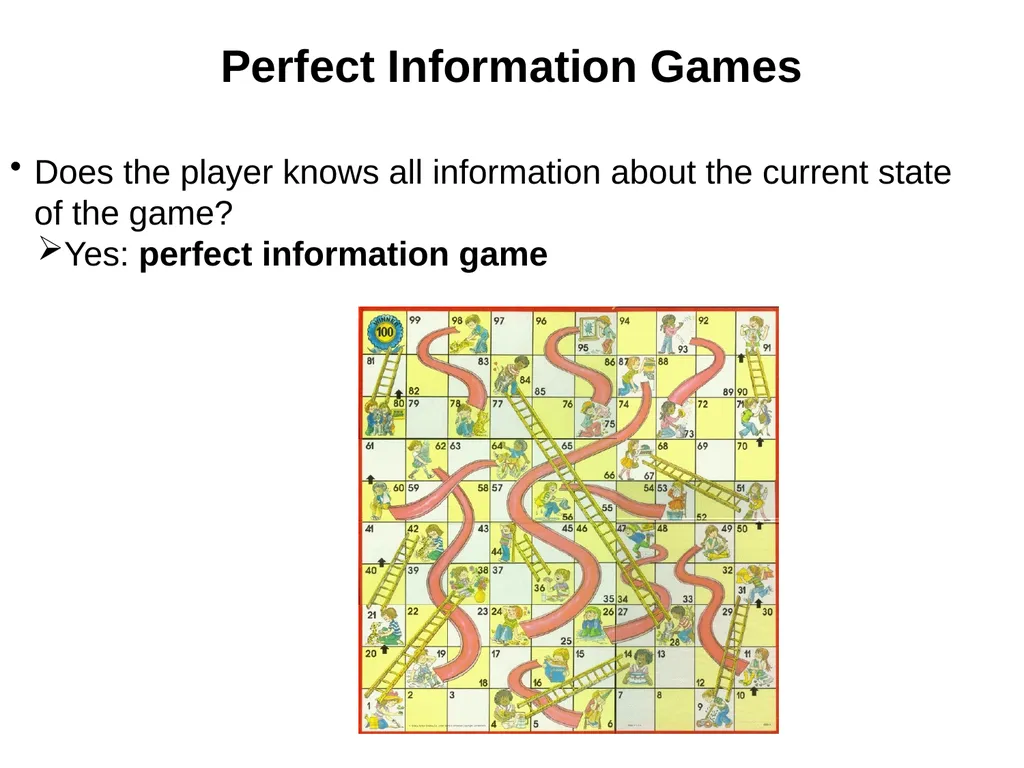
Perfect Information Games Does the player knows all information about the current state of the game?
Yes: perfect information game<br>
15
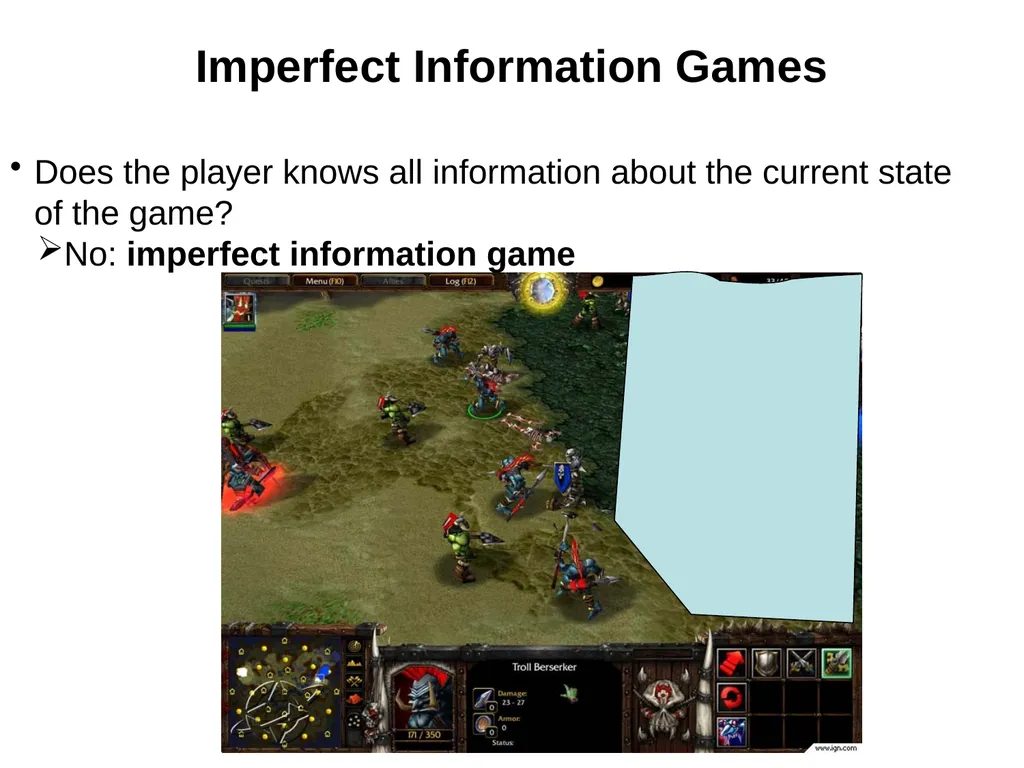
Imperfect Information Games Does the player knows all information about the current state of the game?
No: imperfect information game<br>
16
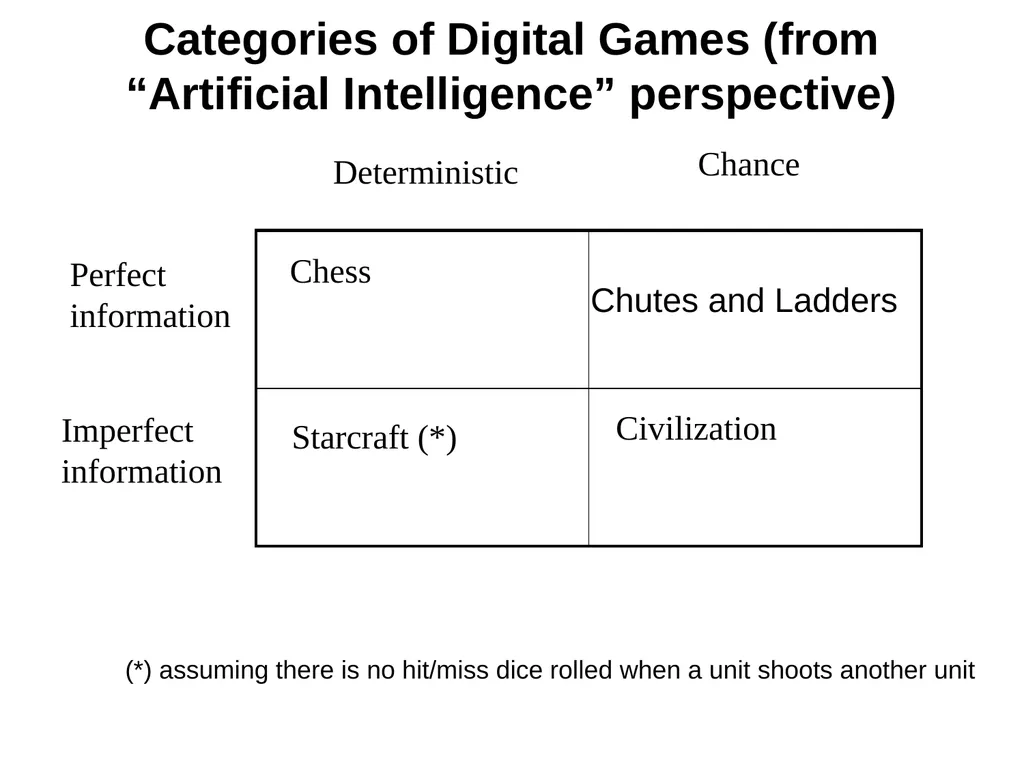
Categories of Digital Games (from “Artificial Intelligence” perspective) Perfect
information Imperfect information Deterministic Chance Chess Starcraft (*) Civilization Chutes and Ladders (*) assuming there is no hit/miss dice rolled when a unit shoots another unit<br>