
Advanced Administrative Topics: Pre-Award NIH
YM
Published · 39 slides · 0 views
1 / 1




Description
Advanced Administrative Topics: Pre-Award NIH Virtual Seminar on Program Funding and Grants Administration November 1, 2021 2 Presenters Crystal Wolfrey Chief Grants Management Officer National Cancer Institute
Related Topics
Share
Embed code
Download this presentation From Below
"Advanced Administrative Topics: Pre-Award NIH" is the property of its rightful owner. Permission is granted to download and print the materials on this website for personal, non-commercial use only, and to display it on your personal computer provided you do not modify the materials and that you retain all copyright notices contained in the materials. By downloading content from our website, you accept the terms of this agreement.
Presentation Transcript
01
Advanced Administrative Topics: Pre-Award NIH Virtual Seminar on Program
Funding and Grants Administration
November 1, 2021<br>
Funding and Grants Administration
November 1, 2021<br>
02
2 Presenters Crystal Wolfrey
Chief Grants Management Officer
National Cancer Institute
****************************
Sean Hine
Branch Chief
National Cancer Institute
****************************<br>
Chief Grants Management Officer
National Cancer Institute
****************************
Sean Hine
Branch Chief
National Cancer Institute
****************************<br>
03
Quick logistics… You are all muted with no video
You are welcome to put questions in the Q&A however…
This session relies heavily on case studies – real-life examples of issues that have occurred
We will be trying to cover a number of topics – directly and indirectly - throughout
We will most likely not have ample time to cover Q&A but we have some plans in the presentation...
You are welcome to enter questions in the chat – NIH Grants Officials will do their best to respond throughout!
Head to the NIH and/or individual IC booths to discussion your questions further!<br>
You are welcome to put questions in the Q&A however…
This session relies heavily on case studies – real-life examples of issues that have occurred
We will be trying to cover a number of topics – directly and indirectly - throughout
We will most likely not have ample time to cover Q&A but we have some plans in the presentation...
You are welcome to enter questions in the chat – NIH Grants Officials will do their best to respond throughout!
Head to the NIH and/or individual IC booths to discussion your questions further!<br>
04
NIH Perspective... a
Few Things to Remember Must support federal policy, to enforce applicable laws, cost principles and administrative requirements
Stewards of federal funds
Some IC’s have a relatively broad mission; others are (by comparison) relatively narrow
Larger IC’s have more funds which can mean more flexibilities
Not all IC’s fund the same grant mechanisms 4<br>
Stewards of federal funds
Some IC’s have a relatively broad mission; others are (by comparison) relatively narrow
Larger IC’s have more funds which can mean more flexibilities
Not all IC’s fund the same grant mechanisms 4<br>
05
NIH Perspective: Additional Considerations Additional considerations we consider in making decisions in 'tough' situations:
Will an action create a precedent which will limit flexibility in the future?
Is an action consistent with NIH, HHS or other Federal policy?
How would this play if presented on the evening news or the front page of ......? 5<br>
Will an action create a precedent which will limit flexibility in the future?
Is an action consistent with NIH, HHS or other Federal policy?
How would this play if presented on the evening news or the front page of ......? 5<br>
06
Questions We Ask When Considering Challenging Complex Situations What is in the best interest of the science?
What is in the best interest of the recipient?
What is in the best interests of the PI(s)?
Is there an opportunity for a 'win/win’?
Can we get to a “yes?” 6<br>
What is in the best interest of the recipient?
What is in the best interests of the PI(s)?
Is there an opportunity for a 'win/win’?
Can we get to a “yes?” 6<br>
07
Situations we will explore involving… Human Subjects – Single IRB
Changes prior to award
Understanding the FOA before Submission
Submitting a competitive renewal
Brand new applicants to NIH...what to expect! 7<br>
Changes prior to award
Understanding the FOA before Submission
Submitting a competitive renewal
Brand new applicants to NIH...what to expect! 7<br>
08
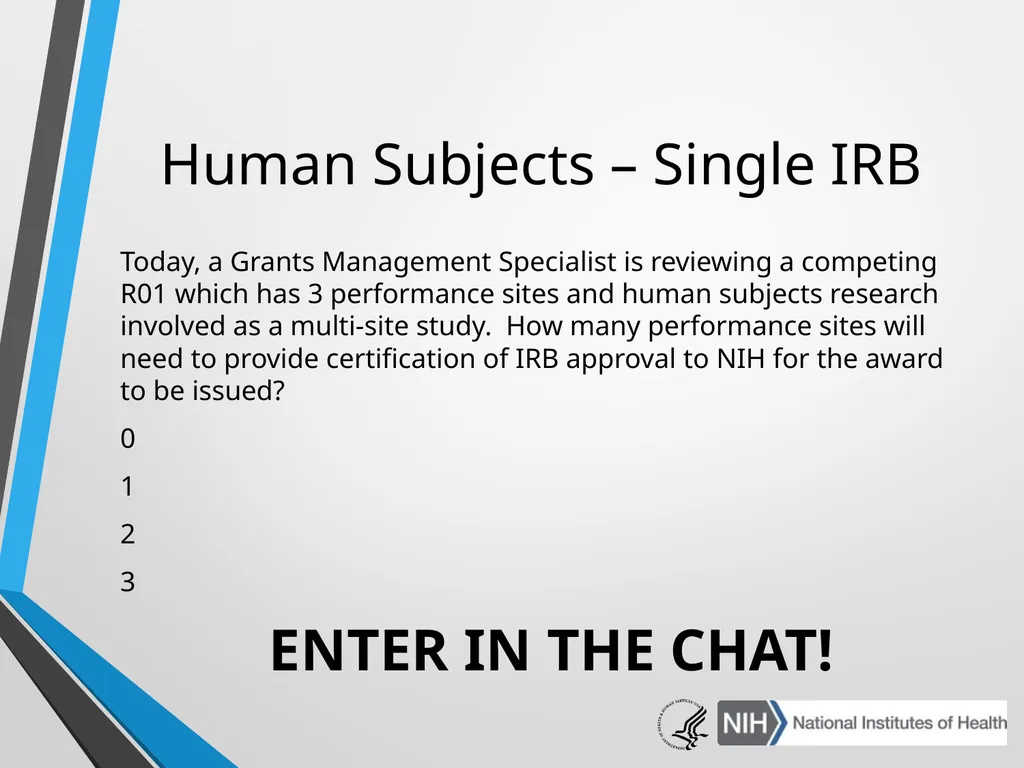
Human Subjects – Single IRB Today, a Grants Management Specialist is reviewing a competing R01 which has 3 performance sites and human subjects research involved as a multi-site study. How many performance sites will need to provide certification of IRB approval to NIH for the award to be issued?
0
1
2
3 ENTER IN THE CHAT!<br>
0
1
2
3 ENTER IN THE CHAT!<br>
09
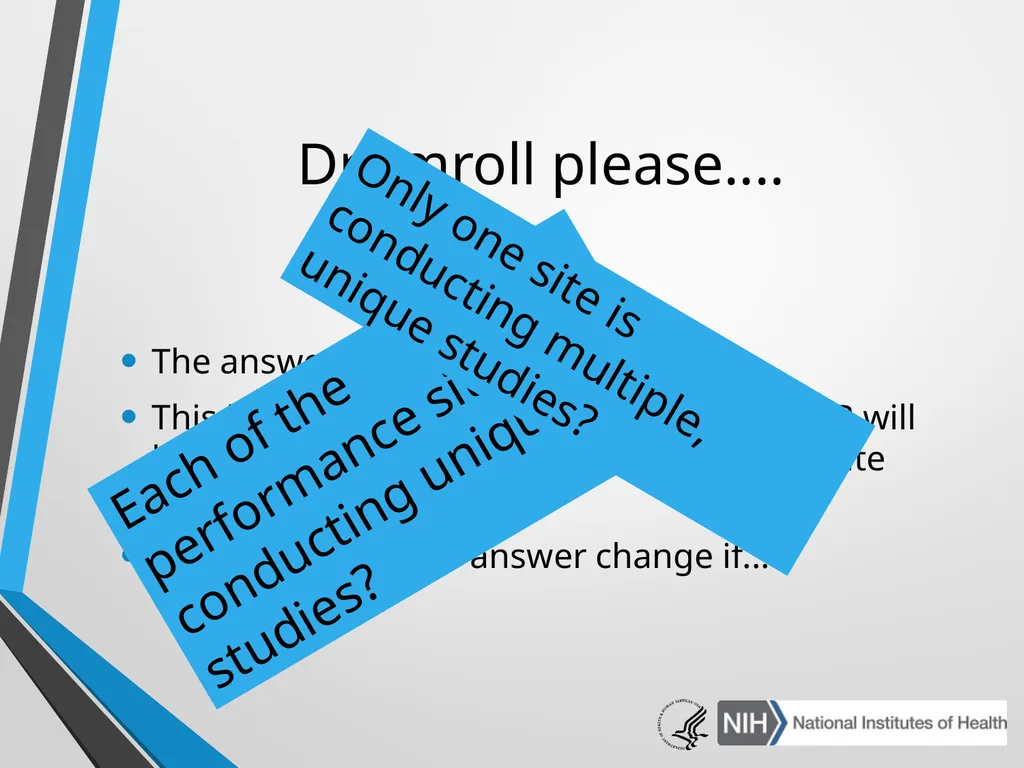
Drumroll please.... The answer is 1!
This is due to the single IRB policy – one IRB will be serving as the IRB of record for a multi-site study
But...how could the answer change if... Each of the performance sites are conducting unique studies? Only one site is conducting multiple, unique studies?<br>
This is due to the single IRB policy – one IRB will be serving as the IRB of record for a multi-site study
But...how could the answer change if... Each of the performance sites are conducting unique studies? Only one site is conducting multiple, unique studies?<br>
10
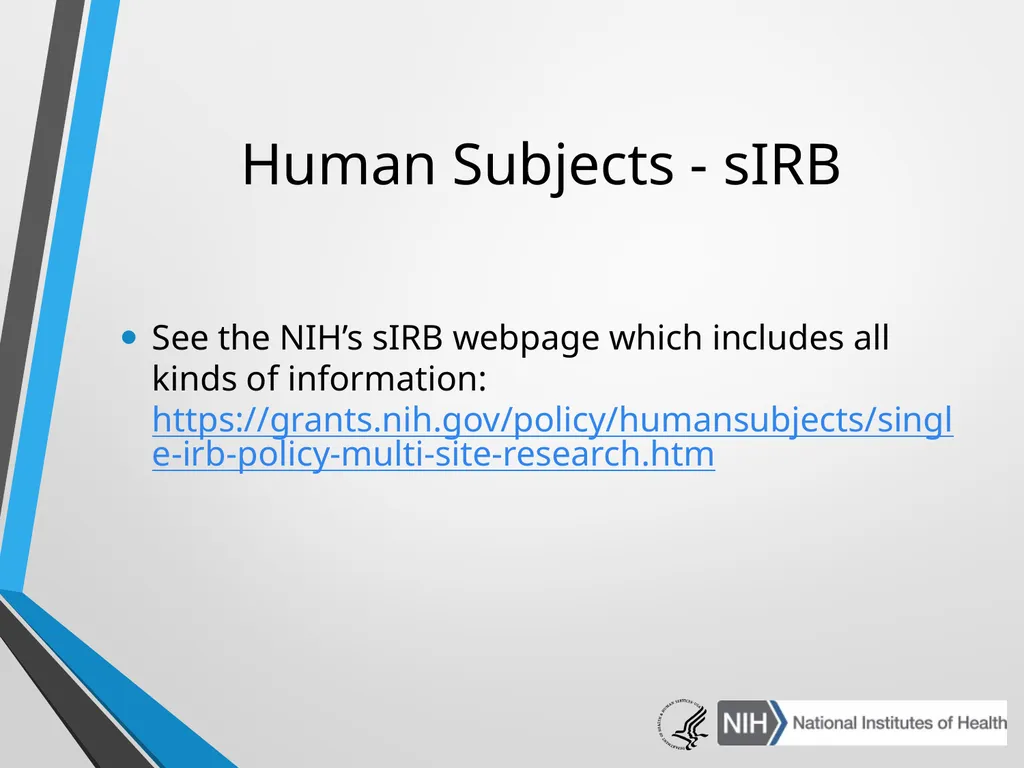
Human Subjects - sIRB See the NIH’s sIRB webpage which includes all kinds of information: https://grants.nih.gov/policy/humansubjects/single-irb-policy-multi-site-research.htm<br>
11
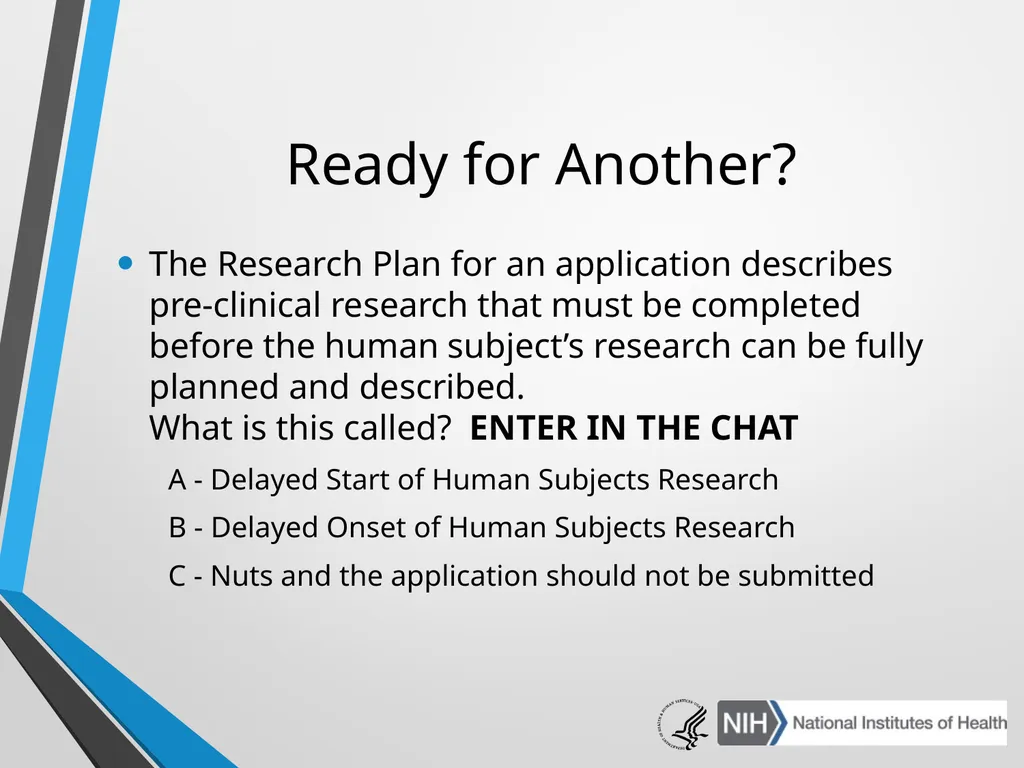
Ready for Another? The Research Plan for an application describes pre-clinical research that must be completed before the human subject’s research can be fully planned and described.
What is this called? ENTER IN THE CHAT
A - Delayed Start of Human Subjects Research
B - Delayed Onset of Human Subjects Research
C - Nuts and the application should not be submitted<br>
A - Delayed Start of Human Subjects Research
B - Delayed Onset of Human Subjects Research
C - Nuts and the application should not be submitted<br>
12
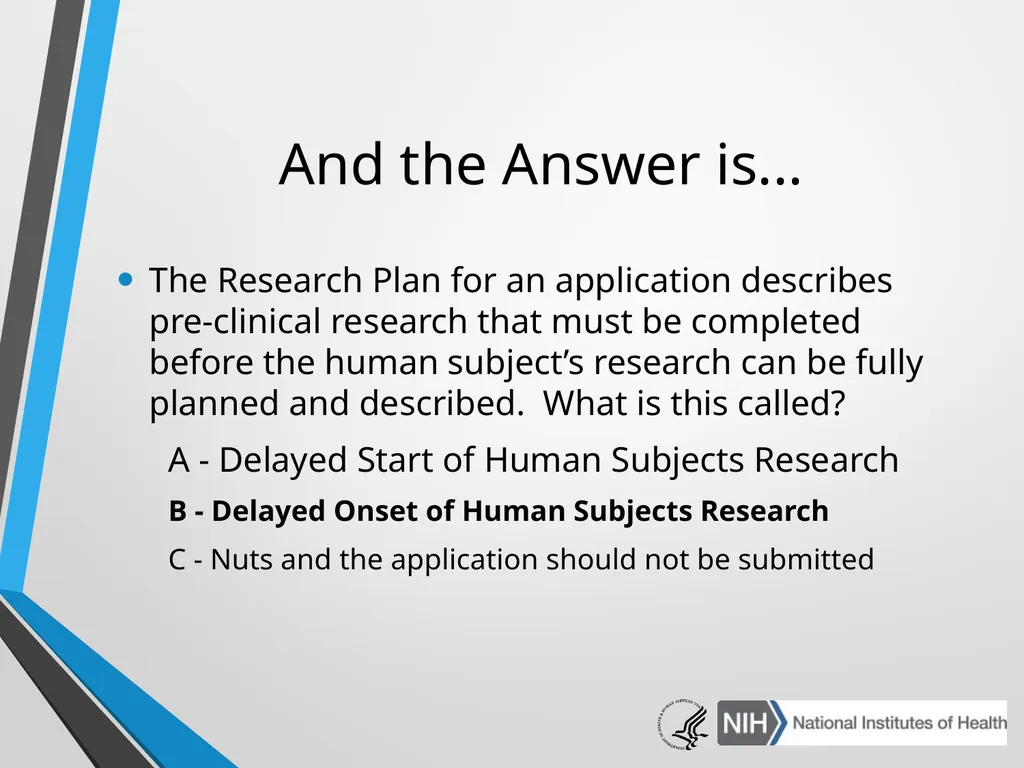
And the Answer is... The Research Plan for an application describes pre-clinical research that must be completed before the human subject’s research can be fully planned and described. What is this called?
A - Delayed Start of Human Subjects Research
B - Delayed Onset of Human Subjects Research
C - Nuts and the application should not be submitted<br>
A - Delayed Start of Human Subjects Research
B - Delayed Onset of Human Subjects Research
C - Nuts and the application should not be submitted<br>
13
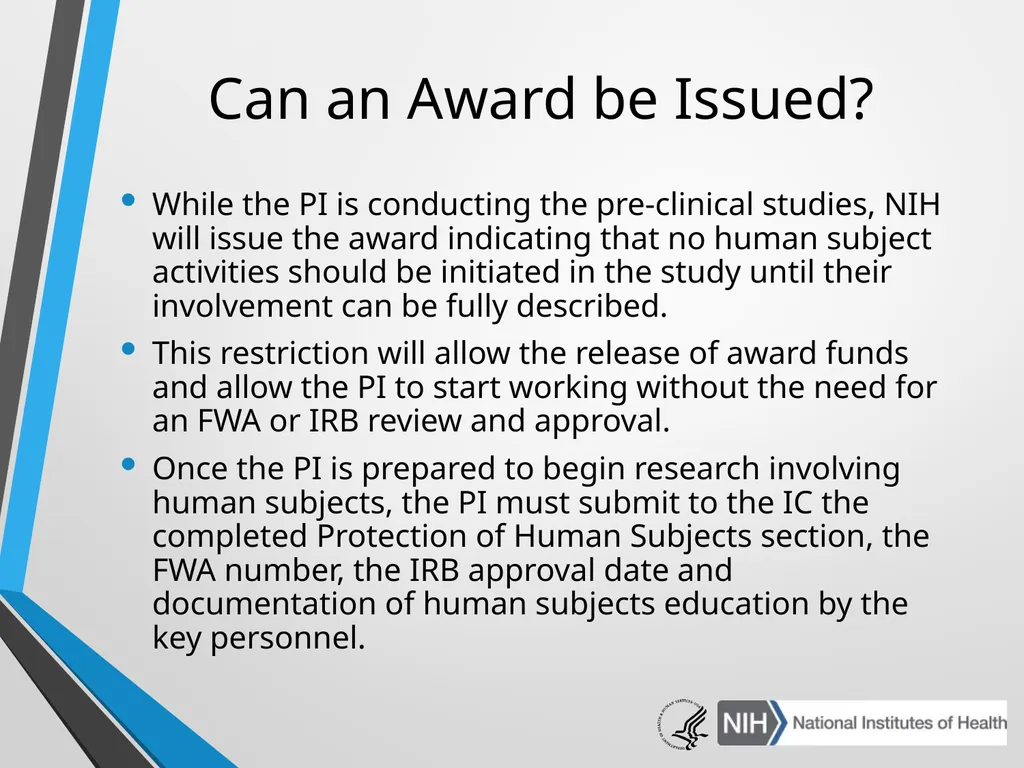
Can an Award be Issued? While the PI is conducting the pre-clinical studies, NIH will issue the award indicating that no human subject activities should be initiated in the study until their involvement can be fully described.
This restriction will allow the release of award funds and allow the PI to start working without the need for an FWA or IRB review and approval.
Once the PI is prepared to begin research involving human subjects, the PI must submit to the IC the completed Protection of Human Subjects section, the FWA number, the IRB approval date and documentation of human subjects education by the key personnel.<br>
This restriction will allow the release of award funds and allow the PI to start working without the need for an FWA or IRB review and approval.
Once the PI is prepared to begin research involving human subjects, the PI must submit to the IC the completed Protection of Human Subjects section, the FWA number, the IRB approval date and documentation of human subjects education by the key personnel.<br>
14
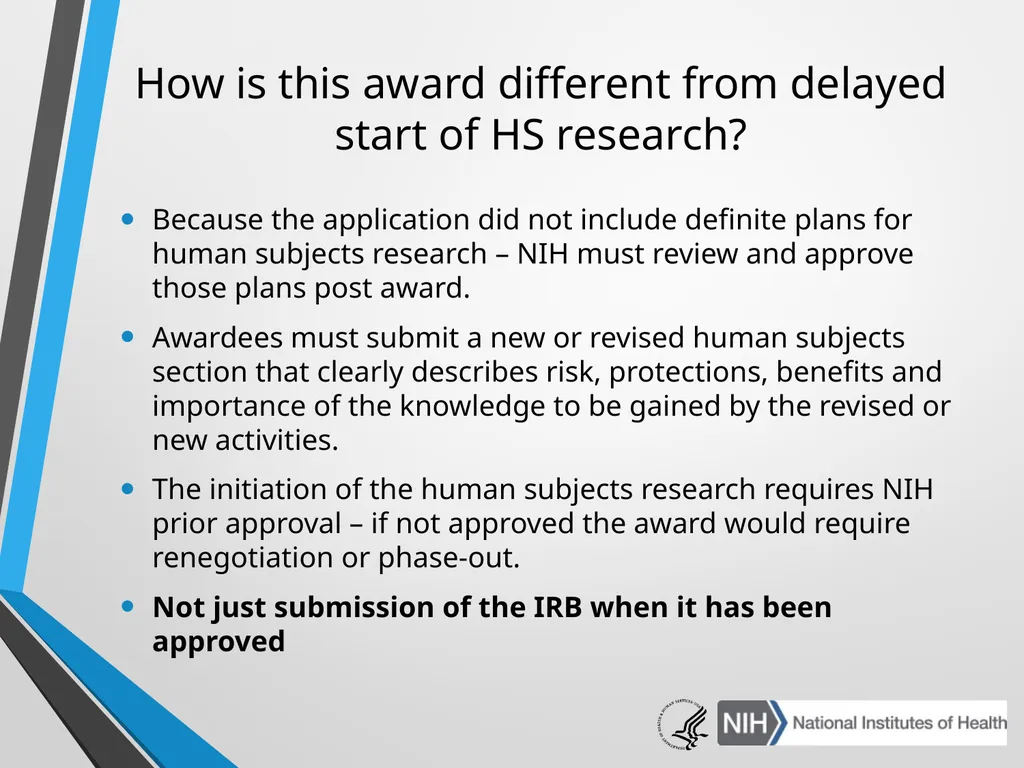
How is this award different from delayed start of HS research? Because the application did not include definite plans for human subjects research – NIH must review and approve those plans post award.
Awardees must submit a new or revised human subjects section that clearly describes risk, protections, benefits and importance of the knowledge to be gained by the revised or new activities.
The initiation of the human subjects research requires NIH prior approval – if not approved the award would require renegotiation or phase-out.
Not just submission of the IRB when it has been approved<br>
Awardees must submit a new or revised human subjects section that clearly describes risk, protections, benefits and importance of the knowledge to be gained by the revised or new activities.
The initiation of the human subjects research requires NIH prior approval – if not approved the award would require renegotiation or phase-out.
Not just submission of the IRB when it has been approved<br>
15
SWITCHING GEARS<br>
16
Changes Prior to Award There are approximately nine months between the submission of an application and the NIH making an award.
In those nine months – things can change – PI’s move, get new jobs, plans change. 16<br>
In those nine months – things can change – PI’s move, get new jobs, plans change. 16<br>
17
Close your eyes...and imagine the following... Don’t fall asleep on us...yet!<br>
18
Here is the situation... PI submits a competing application to an R01 Request for Application from Exemplary University in New Jersey...
Six months later, the PI lands a dandy job on the West Coast...
The PI tells all in his lab about the move and the grant is going with them!
The PI contacts NIH’s Program Official...let’s listen in on that call...<br>
Six months later, the PI lands a dandy job on the West Coast...
The PI tells all in his lab about the move and the grant is going with them!
The PI contacts NIH’s Program Official...let’s listen in on that call...<br>
19
Can a PI move prior to making a competing award... Typically, it is possible to change a grant recipient prior to award
Important to understand what is allowed per the funding opportunity announcement (FOA)
Also, important to consider what the grant will be doing!
It is important to contact NIH Program and Grants Management Officials early in the process
The applicant MUST relinquish their interest
A transfer application MUST be submitted Sure-ish...<br>
Important to understand what is allowed per the funding opportunity announcement (FOA)
Also, important to consider what the grant will be doing!
It is important to contact NIH Program and Grants Management Officials early in the process
The applicant MUST relinquish their interest
A transfer application MUST be submitted Sure-ish...<br>
20
What if the move is
outside the U.S.? Possible… .but it is complicated
Needs to be permitted by the Funding Opportunity Announcement
Grant still needs to be relinquished by the original applicant
Prior approval requirement – change of recipient organization AND adding a foreign component
Need to consider the scope of the originally submitted application
Must go to the IC’s Council for review and approval
It can take a while so sooner it is known, the better to start discussing<br>
Needs to be permitted by the Funding Opportunity Announcement
Grant still needs to be relinquished by the original applicant
Prior approval requirement – change of recipient organization AND adding a foreign component
Need to consider the scope of the originally submitted application
Must go to the IC’s Council for review and approval
It can take a while so sooner it is known, the better to start discussing<br>
21
For the next 5 minutes, we will address as many questions as we can…
If they are too involved, we may need to skip it. However, please feel free to contact us via e-mail (or attend one of the many Meet the Expert sessions!) Lightning Round Q&A<br>
If they are too involved, we may need to skip it. However, please feel free to contact us via e-mail (or attend one of the many Meet the Expert sessions!) Lightning Round Q&A<br>
22
Let’s get into some details... Application is submitted in response to an NIH Funding Opportunity Announcement (FOA) with very specific requirements
Example – NCI’s Outstanding Investigator Award
Application is reviewed and scores well – meets the IC’s funding policies for the program
The application is being reviewed by the Grants Management Specialist...who reaches out to the AOR to discuss.<br>
Example – NCI’s Outstanding Investigator Award
Application is reviewed and scores well – meets the IC’s funding policies for the program
The application is being reviewed by the Grants Management Specialist...who reaches out to the AOR to discuss.<br>
23
Negotiation<br>
24
What did we learn from this?? Many FOAs have very specific requirements for the award – things like a requirement to relinquish other funding or requirements for time and effort of the investigator, limitations on foreign components, requirements for attendance at meetings, etc.
Cooperative Agreements also have special terms and conditions
The IC will not be able to ignore or waive those requirements at the time of award READ THE FOA CAREFULLY!!!<br>
Cooperative Agreements also have special terms and conditions
The IC will not be able to ignore or waive those requirements at the time of award READ THE FOA CAREFULLY!!!<br>
25
A recipient has received an award to support their last year of the competitive segment in FY2021 – start date was December 1st. However, they are anxious to not have a gap in funding...So, can they submit a competing renewal early knowing that if it reviews well it would be in the wrong fiscal year?
Enter Yes or No in the Chat… Riddle me this?<br>
Enter Yes or No in the Chat… Riddle me this?<br>
26
And the Answer is... YES...But...there are somethings to consider...
Funding a Type 2 in the same year the Type 5 was funded would be funding more than 12 months from one appropriation – not generally allowed.
Typically, the IC should allow the support for the type 5 to continue and consider the type 2 in the following Fiscal Year.
But as we said at the outset – not all ICs work the same – so…
The applicant should contact the IC to discuss the potential impact of submitting a competing renewal early.<br>
Funding a Type 2 in the same year the Type 5 was funded would be funding more than 12 months from one appropriation – not generally allowed.
Typically, the IC should allow the support for the type 5 to continue and consider the type 2 in the following Fiscal Year.
But as we said at the outset – not all ICs work the same – so…
The applicant should contact the IC to discuss the potential impact of submitting a competing renewal early.<br>
27
What if you are a new NIH applicant? There is a LOT to know and consider...
Need to know a lot of different things...DUNS, SAM, eRA, FWAs, Animal Assurances, IRB, IACUC, and on, and on, and on...
All of the policies that may potentially apply to you
Reporting requirements IF you get an award<br>
Need to know a lot of different things...DUNS, SAM, eRA, FWAs, Animal Assurances, IRB, IACUC, and on, and on, and on...
All of the policies that may potentially apply to you
Reporting requirements IF you get an award<br>
28
Purely Hypothetical Situation...;) Applicant is a small-business concern
Will be applying to the NIH Small Business Program
Brand new company – got up and running in 2020 – but feeling good about what they are doing and the research they are proposing.<br>
Will be applying to the NIH Small Business Program
Brand new company – got up and running in 2020 – but feeling good about what they are doing and the research they are proposing.<br>
29
Moving along... Application is reviewed and receives a good score!
Meets the IC’s funding policy for SBIRs
No issues with the IC’s council review<br>
Meets the IC’s funding policy for SBIRs
No issues with the IC’s council review<br>
30
The application now arrives to the Grants Management Specialist... A Grants Management Specialist is responsible for evaluating the applicant’s ability to manage the Federal award.
New NIH applicants and awardees do not have any track record with NIH therefore, they inherently have higher risk to the Federal Government as award recipients.
Let’s listen in on the call that takes place between the Specialist and the Authorized Organizational Official...<br>
New NIH applicants and awardees do not have any track record with NIH therefore, they inherently have higher risk to the Federal Government as award recipients.
Let’s listen in on the call that takes place between the Specialist and the Authorized Organizational Official...<br>
31
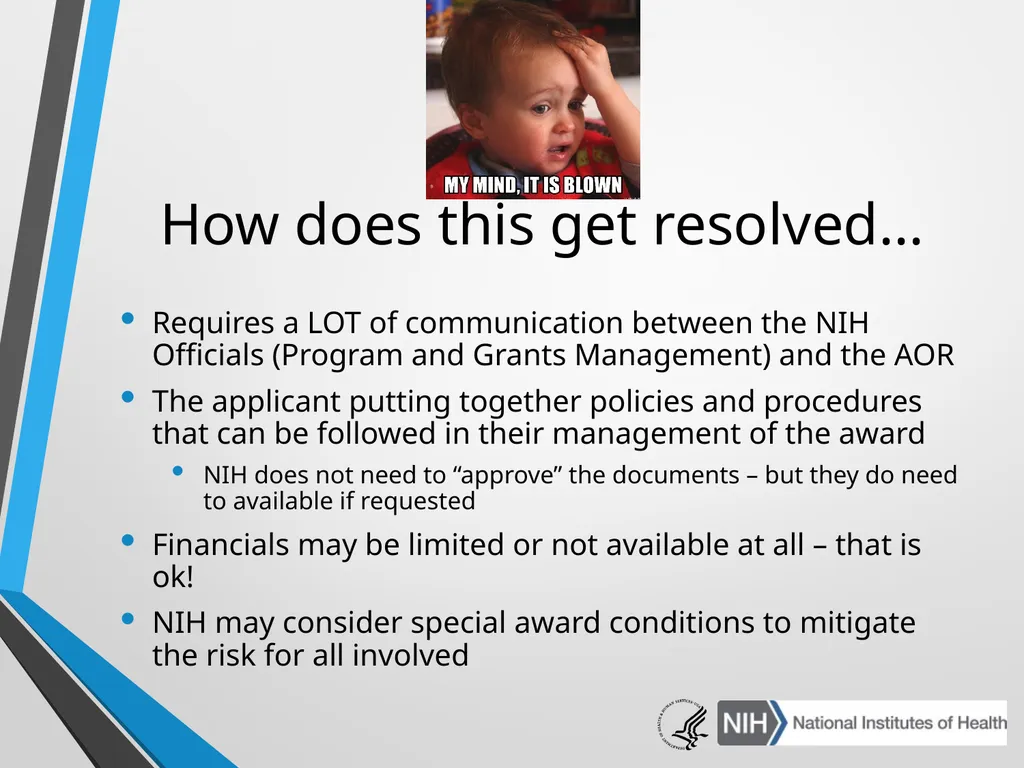
How does this get resolved... Requires a LOT of communication between the NIH Officials (Program and Grants Management) and the AOR
The applicant putting together policies and procedures that can be followed in their management of the award
NIH does not need to “approve” the documents – but they do need to available if requested
Financials may be limited or not available at all – that is ok!
NIH may consider special award conditions to mitigate the risk for all involved<br>
The applicant putting together policies and procedures that can be followed in their management of the award
NIH does not need to “approve” the documents – but they do need to available if requested
Financials may be limited or not available at all – that is ok!
NIH may consider special award conditions to mitigate the risk for all involved<br>
32
New Applicant – Additional Considerations NIH is required to assess not only the merit of the application but also to consider the ability of the applicant to manage the grant funds
Main items that would be considered:
Financial management standards – policies, audits
Will request financial records to assess capital ratio
Documentation on the organizational structure
Other policies and procedures that may be dictated based on the nature of the grant application
All other requirements for NIH applications would still apply<br>
Main items that would be considered:
Financial management standards – policies, audits
Will request financial records to assess capital ratio
Documentation on the organizational structure
Other policies and procedures that may be dictated based on the nature of the grant application
All other requirements for NIH applications would still apply<br>
33
Take comfort though... NIH IC Officials are here to help!
There are a lot of resources available
Technical assistance site visits (in-person or virtual) can be conducted
Templates are out there!
We want to get to a win-win for all involved!<br>
There are a lot of resources available
Technical assistance site visits (in-person or virtual) can be conducted
Templates are out there!
We want to get to a win-win for all involved!<br>
34
Resources… I. Your Organization
Sponsored Programs Office
Accounting Office
Internal Auditor
IRBs
IACUCs
II. NIH
Grants Management Specialist
Program Administrator
Office of Laboratory Animal Welfare (OLAW) http://grants.nih.gov/grants/olaw/olaw.htm
Office of Financial Management http://ofm.od.nih.gov
Grants Policy & Guidance
http://grants.nih.gov/grants/policy/policy.htm
III. DHHS
Office for Human Research Protections (OHRP) 34<br>
Sponsored Programs Office
Accounting Office
Internal Auditor
IRBs
IACUCs
II. NIH
Grants Management Specialist
Program Administrator
Office of Laboratory Animal Welfare (OLAW) http://grants.nih.gov/grants/olaw/olaw.htm
Office of Financial Management http://ofm.od.nih.gov
Grants Policy & Guidance
http://grants.nih.gov/grants/policy/policy.htm
III. DHHS
Office for Human Research Protections (OHRP) 34<br>
35
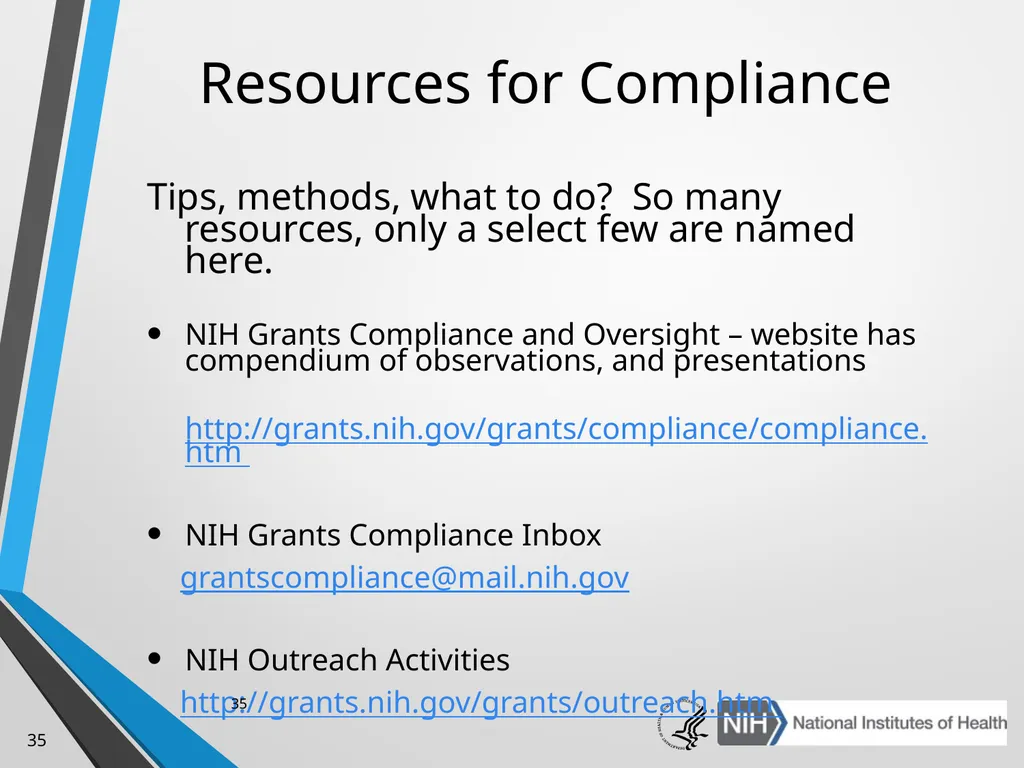
Resources for Compliance Tips, methods, what to do? So many resources, only a select few are named here.
NIH Grants Compliance and Oversight – website has compendium of observations, and presentations
http://grants.nih.gov/grants/compliance/compliance.htm
NIH Grants Compliance Inbox
grantscompliance@mail.nih.gov
NIH Outreach Activities
http://grants.nih.gov/grants/outreach.htm 35 35<br>
NIH Grants Compliance and Oversight – website has compendium of observations, and presentations
http://grants.nih.gov/grants/compliance/compliance.htm
NIH Grants Compliance Inbox
grantscompliance@mail.nih.gov
NIH Outreach Activities
http://grants.nih.gov/grants/outreach.htm 35 35<br>
36
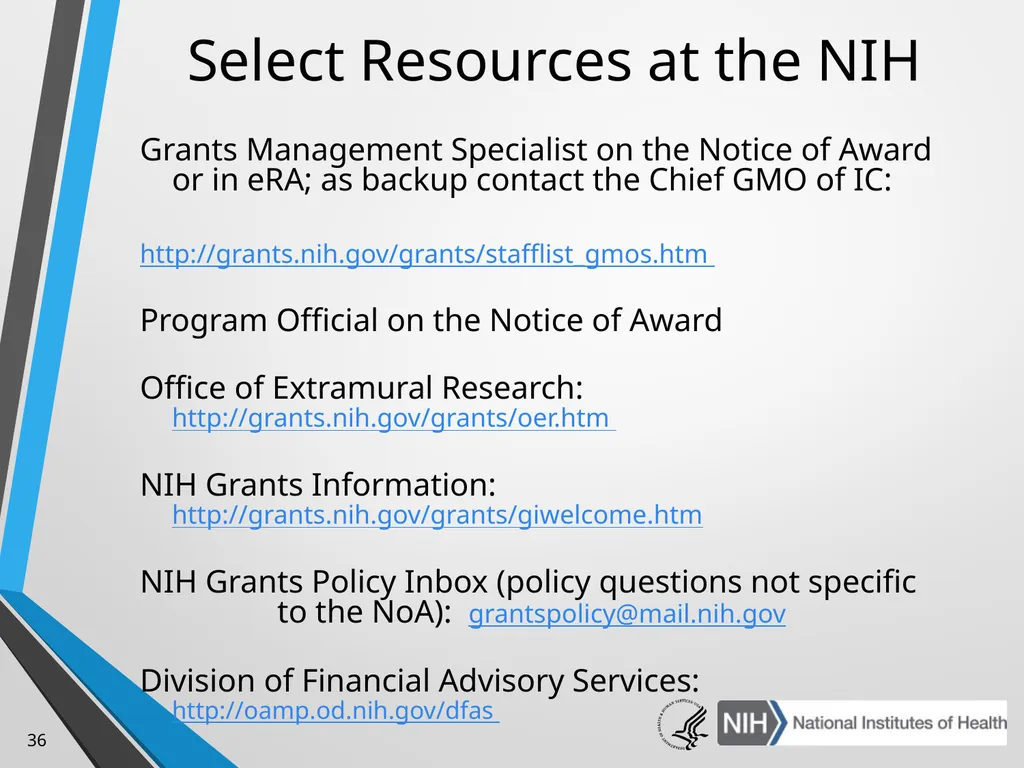
Select Resources at the NIH Grants Management Specialist on the Notice of Award or in eRA; as backup contact the Chief GMO of IC:
http://grants.nih.gov/grants/stafflist_gmos.htm
Program Official on the Notice of Award
Office of Extramural Research: http://grants.nih.gov/grants/oer.htm
NIH Grants Information: http://grants.nih.gov/grants/giwelcome.htm
NIH Grants Policy Inbox (policy questions not specific to the NoA): grantspolicy@mail.nih.gov
Division of Financial Advisory Services: http://oamp.od.nih.gov/dfas 36<br>
http://grants.nih.gov/grants/stafflist_gmos.htm
Program Official on the Notice of Award
Office of Extramural Research: http://grants.nih.gov/grants/oer.htm
NIH Grants Information: http://grants.nih.gov/grants/giwelcome.htm
NIH Grants Policy Inbox (policy questions not specific to the NoA): grantspolicy@mail.nih.gov
Division of Financial Advisory Services: http://oamp.od.nih.gov/dfas 36<br>
37
Questions?? Feel free to
contact us via e-mail:
Crystal Wolfrey - crystal.wolfrey@nih.gov
Sean Hine –
sean.hine@nih.gov 37<br>
38
Haven’t had enough of us?? Join us tomorrow (11/2) at 4:00 as we conduct an Advance Administrative Topics: Post-Award
Yep...that was just a shameless plug <br>
Yep...that was just a shameless plug <br>
39
We have a few minutes… Bring on the questions!!
Enter your questions in the Q&A and we will address what we can!<br>
Enter your questions in the Q&A and we will address what we can!<br>