
Advanced Agro-Hydro- Meteorology A MSc course for
EM
Published · 20 slides · 0 views

1 / 1
Description
Advanced Agro-Hydro- Meteorology A MSc course for students of Atmospheric Sciences Dr. Thaer Obaid Roomi Lecture 5: Agrometeorology and the solar radiation 5.1 Agrometeorology Agrometeorology Definition: It is a branch of applied
Related Topics
Share
Embed code
Download this presentation From Below
"Advanced Agro-Hydro- Meteorology A MSc course for" is the property of its rightful owner. Permission is granted to download and print the materials on this website for personal, non-commercial use only, and to display it on your personal computer provided you do not modify the materials and that you retain all copyright notices contained in the materials. By downloading content from our website, you accept the terms of this agreement.
Presentation Transcript
01
Advanced Agro-Hydro- Meteorology
A MSc course for students of Atmospheric Sciences
Dr. Thaer Obaid Roomi
Lecture 5: Agrometeorology and the solar radiation<br>
02
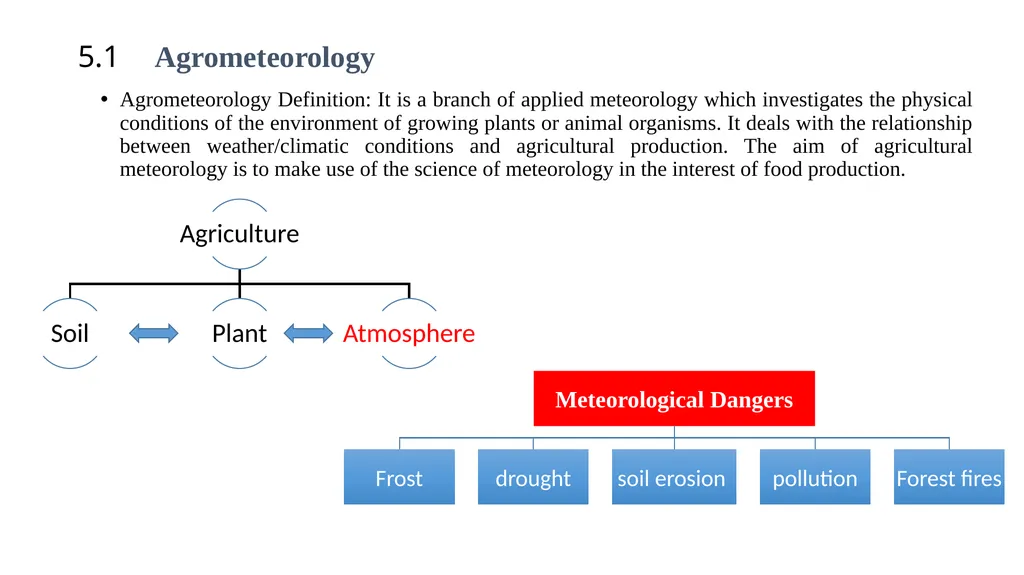
5.1 Agrometeorology Agrometeorology Definition: It is a branch of applied meteorology which investigates the physical conditions of the environment of growing plants or animal organisms. It deals with the relationship between weather/climatic conditions and agricultural production. The aim of agricultural meteorology is to make use of the science of meteorology in the interest of food production.<br>
03
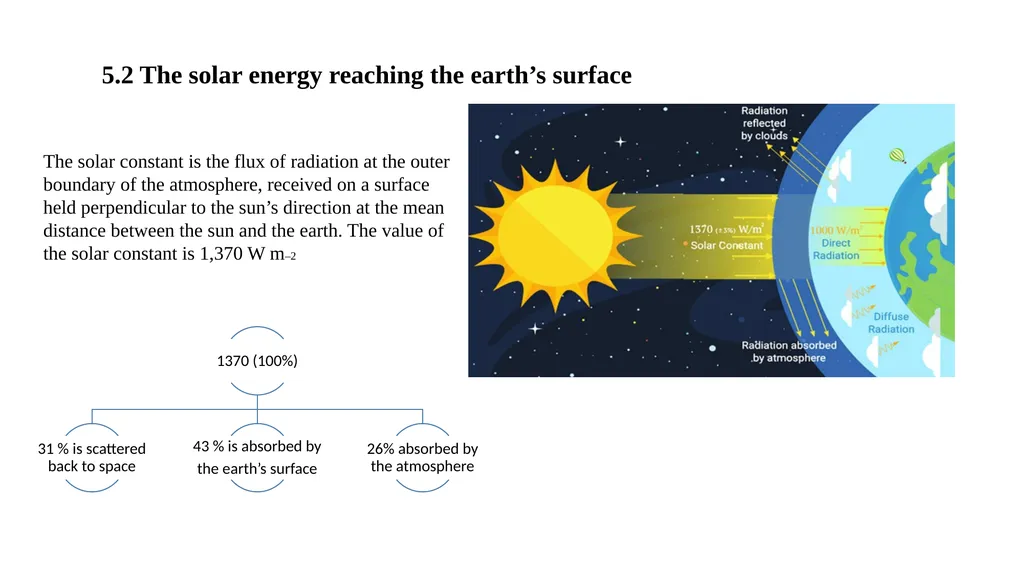
5.2 The solar energy reaching the earth’s surface The solar constant is the flux of radiation at the outer boundary of the atmosphere, received on a surface held perpendicular to the sun’s direction at the mean distance between the sun and the earth. The value of the solar constant is 1,370 W m–2<br>
04
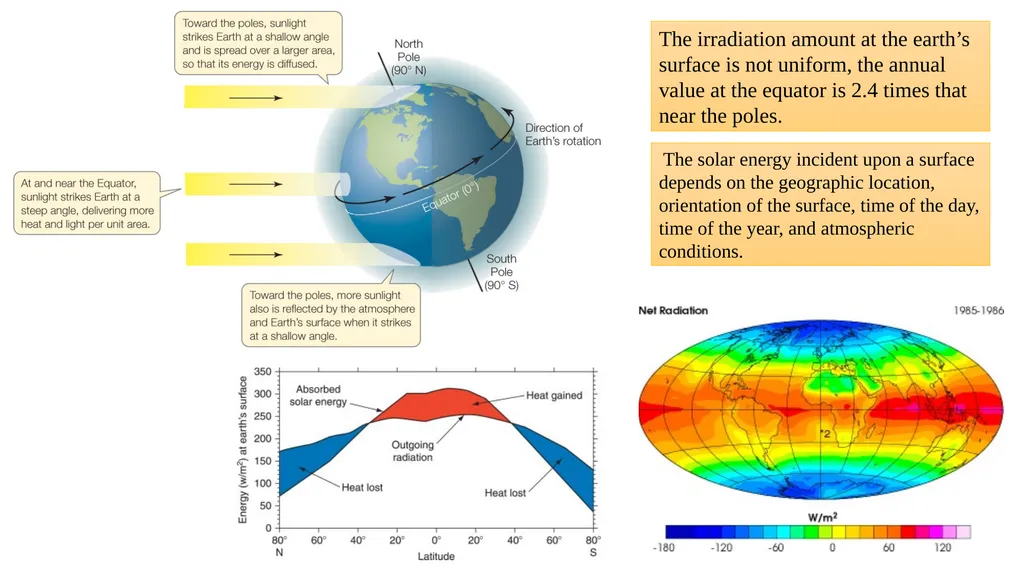
The irradiation amount at the earth’s surface is not uniform, the annual value at the equator is 2.4 times that near the poles. The solar energy incident upon a surface depends on the geographic location, orientation of the surface, time of the day, time of the year, and atmospheric conditions.<br>
05
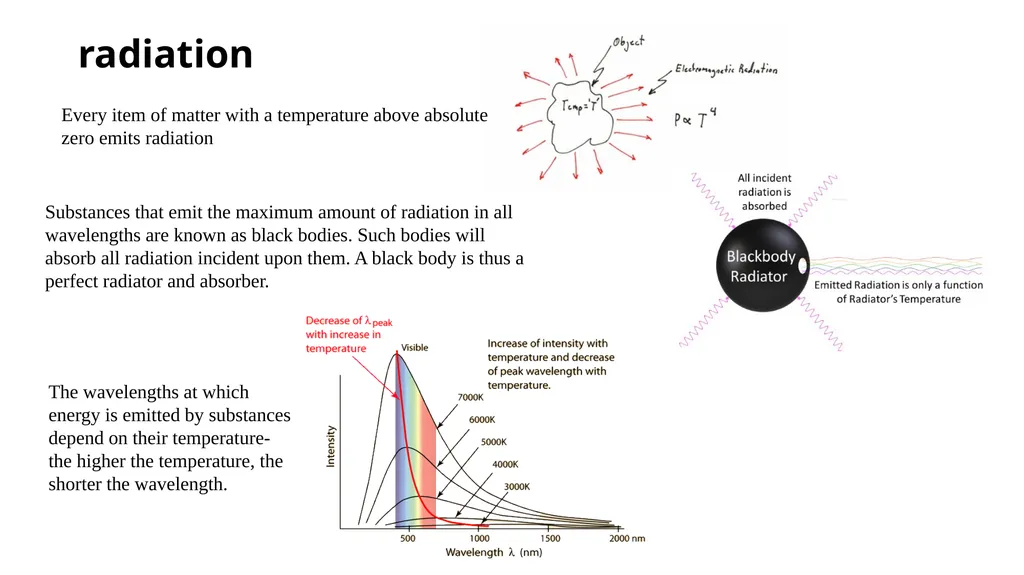
Every item of matter with a temperature above absolute zero emits radiation Substances that emit the maximum amount of radiation in all wavelengths are known as black bodies. Such bodies will absorb all radiation incident upon them. A black body is thus a perfect radiator and absorber. The wavelengths at which energy is emitted by substances depend on their temperature- the higher the temperature, the shorter the wavelength. radiation<br>
06
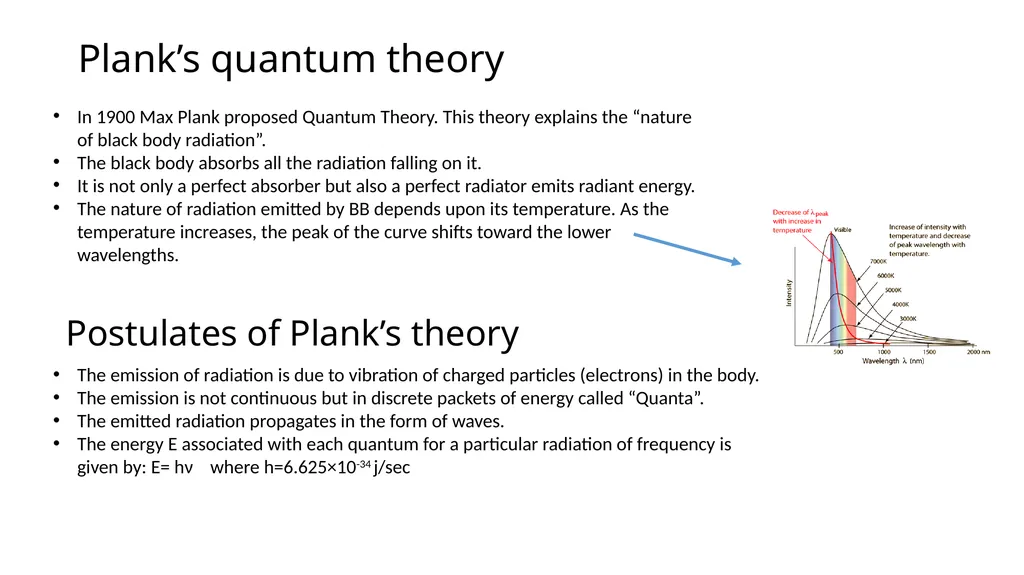
Plank’s quantum theory In 1900 Max Plank proposed Quantum Theory. This theory explains the “nature of black body radiation”.
The black body absorbs all the radiation falling on it.
It is not only a perfect absorber but also a perfect radiator emits radiant energy.
The nature of radiation emitted by BB depends upon its temperature. As the temperature increases, the peak of the curve shifts toward the lower wavelengths. Postulates of Plank’s theory The emission of radiation is due to vibration of charged particles (electrons) in the body.
The emission is not continuous but in discrete packets of energy called “Quanta”.
The emitted radiation propagates in the form of waves.
The energy E associated with each quantum for a particular radiation of frequency is given by: E= hν where h=6.625×10⁻³⁴ j/sec<br>
The black body absorbs all the radiation falling on it.
It is not only a perfect absorber but also a perfect radiator emits radiant energy.
The nature of radiation emitted by BB depends upon its temperature. As the temperature increases, the peak of the curve shifts toward the lower wavelengths. Postulates of Plank’s theory The emission of radiation is due to vibration of charged particles (electrons) in the body.
The emission is not continuous but in discrete packets of energy called “Quanta”.
The emitted radiation propagates in the form of waves.
The energy E associated with each quantum for a particular radiation of frequency is given by: E= hν where h=6.625×10⁻³⁴ j/sec<br>
07
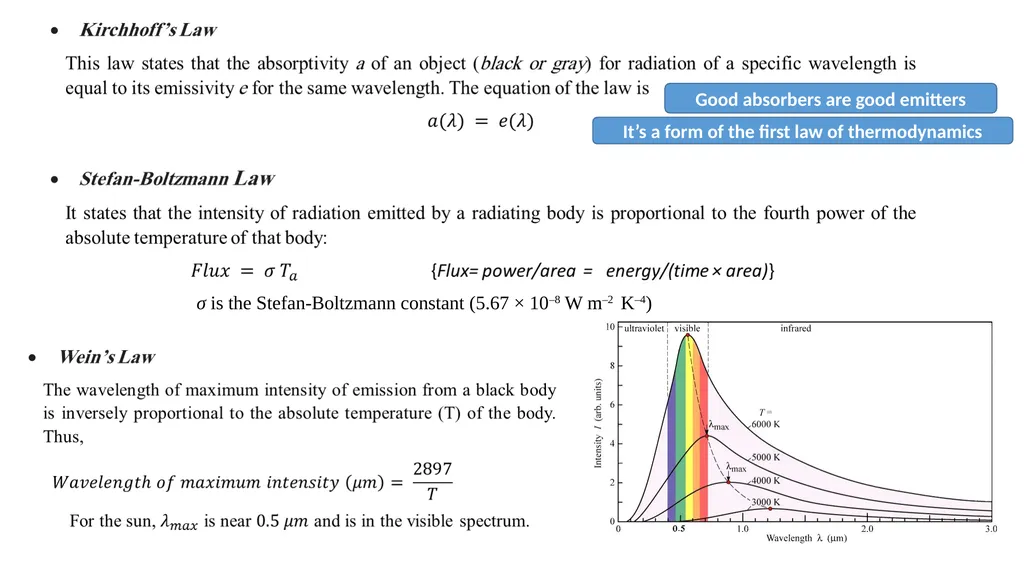
Good absorbers are good emitters It’s a form of the first law of thermodynamics σ is the Stefan-Boltzmann constant (5.67 × 10⁻⁸ W m–2 K–4)<br>
08
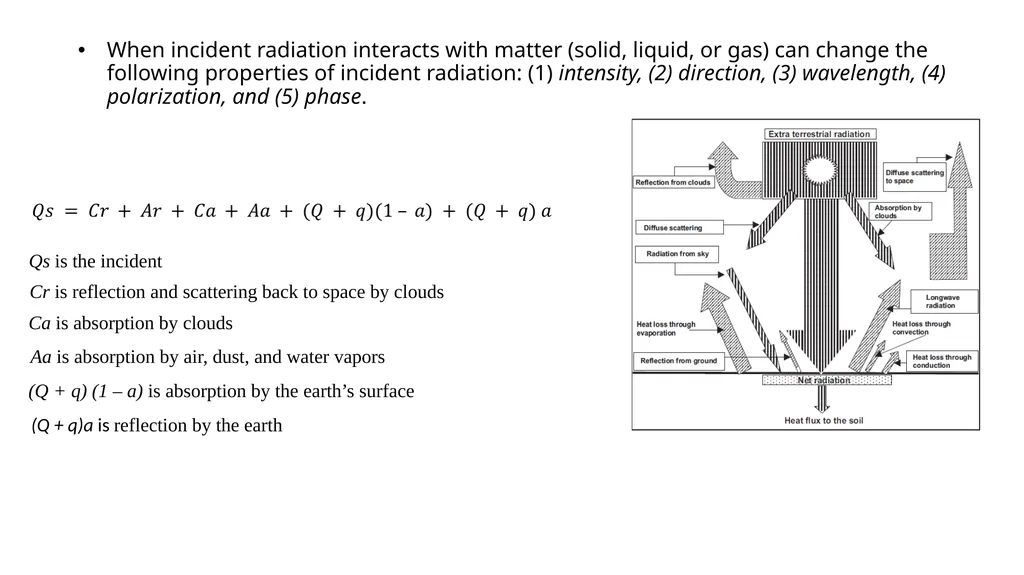
When incident radiation interacts with matter (solid, liquid, or gas) can change the following properties of incident radiation: (1) intensity, (2) direction, (3) wavelength, (4) polarization, and (5) phase. Qs is the incident Cr is reflection and scattering back to space by clouds Ca is absorption by clouds Aa is absorption by air, dust, and water vapors (Q + q) (1 – a) is absorption by the earth’s surface (Q + q)a is reflection by the earth<br>
09
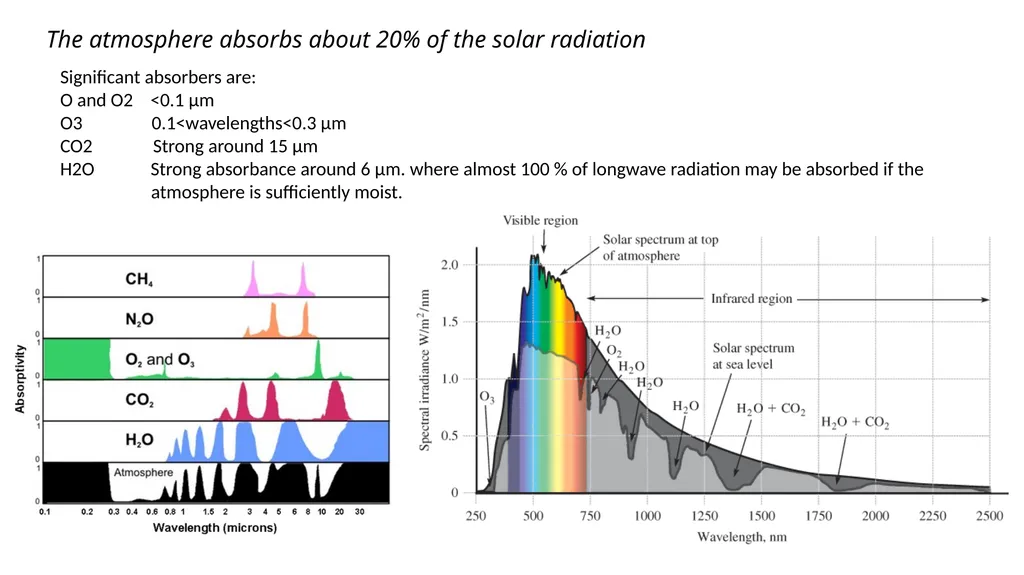
The atmosphere absorbs about 20% of the solar radiation Significant absorbers are:
O and O2 <0.1 μm
O3 0.1<wavelengths<0.3 μm
CO2 Strong around 15 μm
H2O Strong absorbance around 6 μm. where almost 100 % of longwave radiation may be absorbed if the atmosphere is sufficiently moist.<br>
O and O2 <0.1 μm
O3 0.1<wavelengths<0.3 μm
CO2 Strong around 15 μm
H2O Strong absorbance around 6 μm. where almost 100 % of longwave radiation may be absorbed if the atmosphere is sufficiently moist.<br>
10
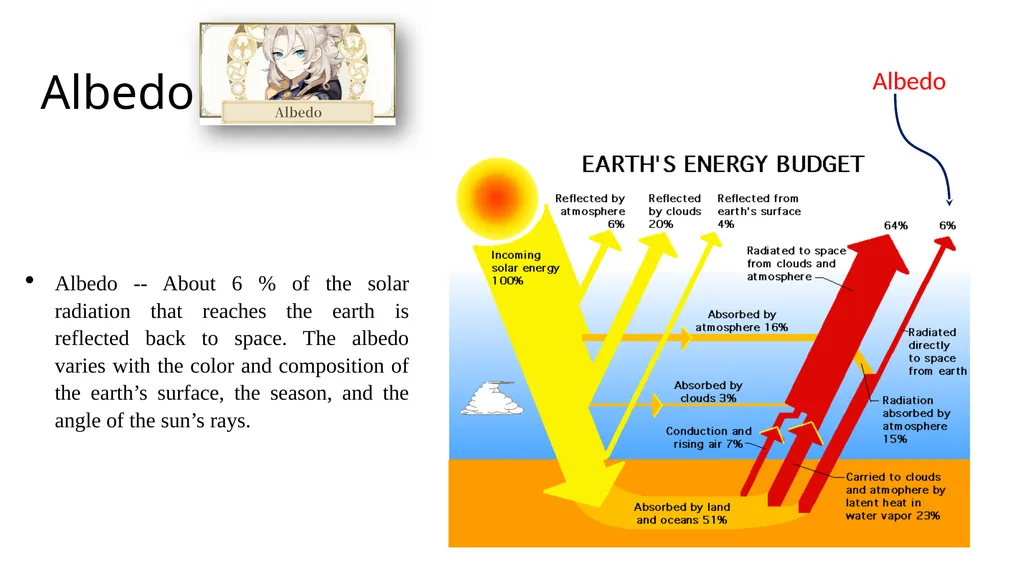
Albedo Albedo -- About 6 % of the solar radiation that reaches the earth is reflected back to space. The albedo varies with the color and composition of the earth’s surface, the season, and the angle of the sun’s rays. Albedo<br>
11
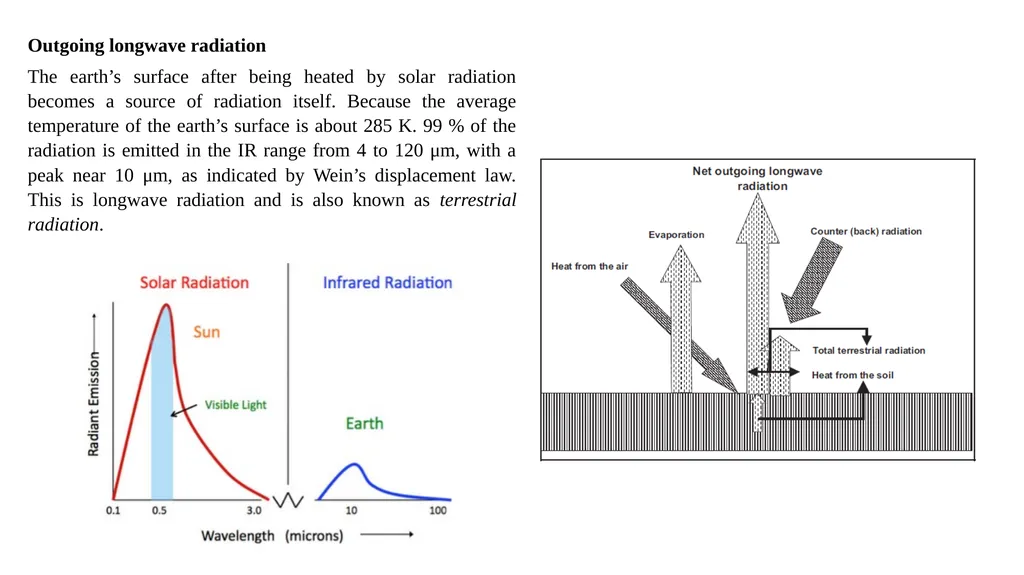
Outgoing longwave radiation
The earth’s surface after being heated by solar radiation becomes a source of radiation itself. Because the average temperature of the earth’s surface is about 285 K. 99 % of the radiation is emitted in the IR range from 4 to 120 μm, with a peak near 10 μm, as indicated by Wein’s displacement law. This is longwave radiation and is also known as terrestrial radiation.<br>
The earth’s surface after being heated by solar radiation becomes a source of radiation itself. Because the average temperature of the earth’s surface is about 285 K. 99 % of the radiation is emitted in the IR range from 4 to 120 μm, with a peak near 10 μm, as indicated by Wein’s displacement law. This is longwave radiation and is also known as terrestrial radiation.<br>
12
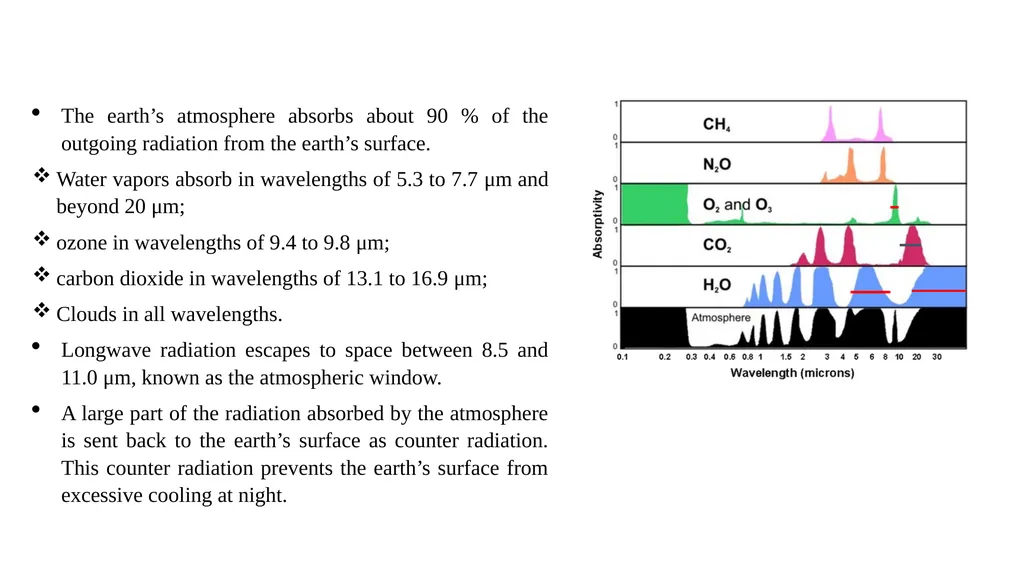
The earth’s atmosphere absorbs about 90 % of the outgoing radiation from the earth’s surface.
Water vapors absorb in wavelengths of 5.3 to 7.7 μm and beyond 20 μm;
ozone in wavelengths of 9.4 to 9.8 μm;
carbon dioxide in wavelengths of 13.1 to 16.9 μm;
Clouds in all wavelengths.
Longwave radiation escapes to space between 8.5 and 11.0 μm, known as the atmospheric window.
A large part of the radiation absorbed by the atmosphere is sent back to the earth’s surface as counter radiation. This counter radiation prevents the earth’s surface from excessive cooling at night.<br>
Water vapors absorb in wavelengths of 5.3 to 7.7 μm and beyond 20 μm;
ozone in wavelengths of 9.4 to 9.8 μm;
carbon dioxide in wavelengths of 13.1 to 16.9 μm;
Clouds in all wavelengths.
Longwave radiation escapes to space between 8.5 and 11.0 μm, known as the atmospheric window.
A large part of the radiation absorbed by the atmosphere is sent back to the earth’s surface as counter radiation. This counter radiation prevents the earth’s surface from excessive cooling at night.<br>
13
Solar radiation and crop plants
Crop production is in fact an exploitation of solar radiation. The three broad spectra of solar energy are significant to plant life.
UV is chemically very active and be detrimental if it is excessive. The atmosphere prevents most of this type of solar radiation from reaching earth. The reaching UV is very low and is normally tolerated by plants. IR segment has thermal effects on plants. In the presence of water vapors, this radiation does not harm plants; rather, it supplies the necessary thermal energy to the plant environment.
VIS part (light) plays an important part in plant growth and development through the processes of chlorophyll synthesis and photosynthesis and through photosensitive regulatory mechanisms such as phototropism and photoperiodic activity.
Light of the correct intensity, quality, and duration is essential for normal plant development. It affects the production of tillers; the stability, strength, and length of the culms; the yield and total weight of plant structures; and the size of leaves and root development.
The length of day or the duration of the light period determines flowering and has a profound effect on the content of soluble carbohydrates present.<br>
Crop production is in fact an exploitation of solar radiation. The three broad spectra of solar energy are significant to plant life.
UV is chemically very active and be detrimental if it is excessive. The atmosphere prevents most of this type of solar radiation from reaching earth. The reaching UV is very low and is normally tolerated by plants. IR segment has thermal effects on plants. In the presence of water vapors, this radiation does not harm plants; rather, it supplies the necessary thermal energy to the plant environment.
VIS part (light) plays an important part in plant growth and development through the processes of chlorophyll synthesis and photosynthesis and through photosensitive regulatory mechanisms such as phototropism and photoperiodic activity.
Light of the correct intensity, quality, and duration is essential for normal plant development. It affects the production of tillers; the stability, strength, and length of the culms; the yield and total weight of plant structures; and the size of leaves and root development.
The length of day or the duration of the light period determines flowering and has a profound effect on the content of soluble carbohydrates present.<br>
14
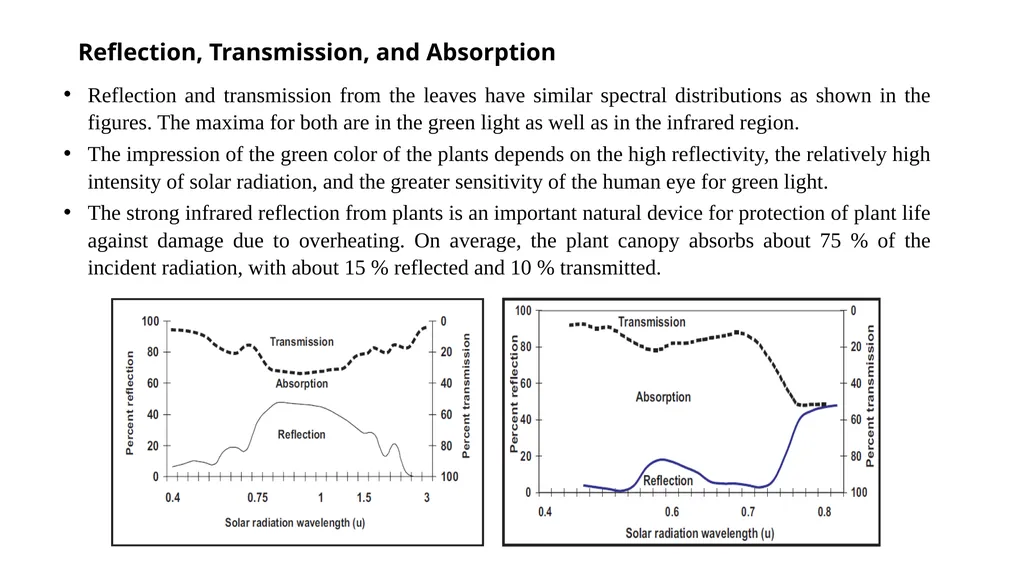
Reflection, Transmission, and Absorption Reflection and transmission from the leaves have similar spectral distributions as shown in the figures. The maxima for both are in the green light as well as in the infrared region.
The impression of the green color of the plants depends on the high reflectivity, the relatively high intensity of solar radiation, and the greater sensitivity of the human eye for green light.
The strong infrared reflection from plants is an important natural device for protection of plant life against damage due to overheating. On average, the plant canopy absorbs about 75 % of the incident radiation, with about 15 % reflected and 10 % transmitted.<br>
The impression of the green color of the plants depends on the high reflectivity, the relatively high intensity of solar radiation, and the greater sensitivity of the human eye for green light.
The strong infrared reflection from plants is an important natural device for protection of plant life against damage due to overheating. On average, the plant canopy absorbs about 75 % of the incident radiation, with about 15 % reflected and 10 % transmitted.<br>
15
Due to their chemical components or physical structures, plants absorb selectively in discrete wavelengths.
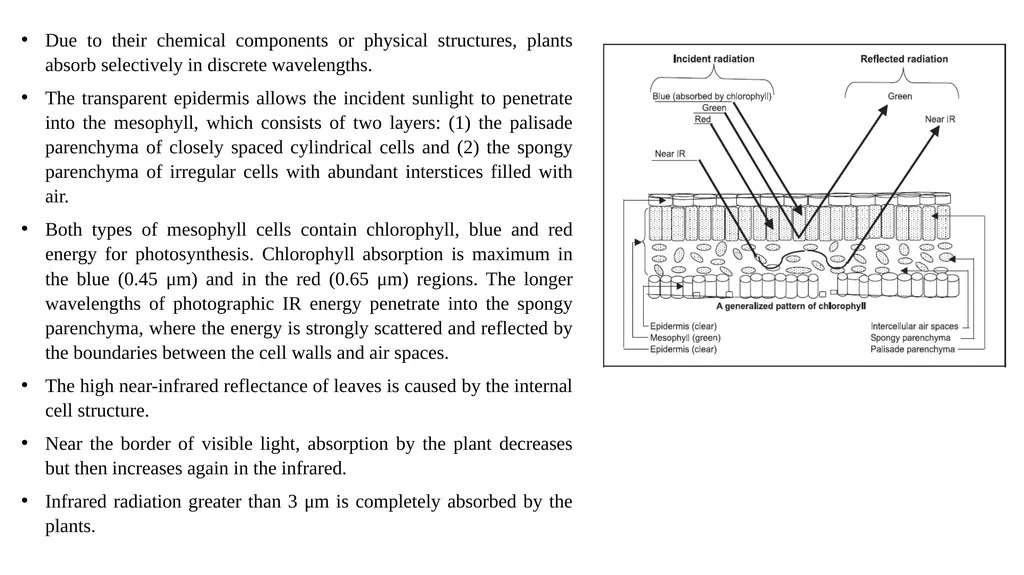
The transparent epidermis allows the incident sunlight to penetrate into the mesophyll, which consists of two layers: (1) the palisade parenchyma of closely spaced cylindrical cells and (2) the spongy parenchyma of irregular cells with abundant interstices filled with air.
Both types of mesophyll cells contain chlorophyll, blue and red energy for photosynthesis. Chlorophyll absorption is maximum in the blue (0.45 μm) and in the red (0.65 μm) regions. The longer wavelengths of photographic IR energy penetrate into the spongy parenchyma, where the energy is strongly scattered and reflected by the boundaries between the cell walls and air spaces.
The high near-infrared reflectance of leaves is caused by the internal cell structure.
Near the border of visible light, absorption by the plant decreases but then increases again in the infrared.
Infrared radiation greater than 3 μm is completely absorbed by the plants.<br>
The transparent epidermis allows the incident sunlight to penetrate into the mesophyll, which consists of two layers: (1) the palisade parenchyma of closely spaced cylindrical cells and (2) the spongy parenchyma of irregular cells with abundant interstices filled with air.
Both types of mesophyll cells contain chlorophyll, blue and red energy for photosynthesis. Chlorophyll absorption is maximum in the blue (0.45 μm) and in the red (0.65 μm) regions. The longer wavelengths of photographic IR energy penetrate into the spongy parenchyma, where the energy is strongly scattered and reflected by the boundaries between the cell walls and air spaces.
The high near-infrared reflectance of leaves is caused by the internal cell structure.
Near the border of visible light, absorption by the plant decreases but then increases again in the infrared.
Infrared radiation greater than 3 μm is completely absorbed by the plants.<br>
16
It can be summed up that the plant leaf strongly absorbs blue and red wavelengths, less strongly absorbs the green, very weakly absorbs the near infrared, and strongly absorbs in the far-infrared wavelengths. Because the absorption of the near-infrared wavelengths by the leaf is limited, by discarding this energy it prevents the internal temperature from becoming lethal. At the infrared wavelengths, the plant leaf is an efficient absorber, but in these wavelengths the energy at the surface is small, with the result that the plant is a good absorber in the far-infrared. It is an equally a good radiator at these wavelengths. The quality of radiation affects flowering, germination, and elongation.
The visible part of the spectrum also influences the orientation of shoots, phenomenon known as phototropism. When shoots turn toward the light, the phenomenon is known as positive phototropism. With increasing intensity of light, positive phototropism turns into negative phototropism. The strongest influence on phototropism is by the blue part of the spectrum (0.5 μm) and the weakest influence is by red rays.
Very little of ultraviolet part of the spectrum reaches the earth’s surface but it has biological effects. This type of rays may kill microorganisms, disinfect the soil, and eradicate diseases. Ultraviolet rays also influence the germination and quality of seeds. Ultraviolet radiation leads to a strong inhibition of photosynthesis and metabolism.<br>
The visible part of the spectrum also influences the orientation of shoots, phenomenon known as phototropism. When shoots turn toward the light, the phenomenon is known as positive phototropism. With increasing intensity of light, positive phototropism turns into negative phototropism. The strongest influence on phototropism is by the blue part of the spectrum (0.5 μm) and the weakest influence is by red rays.
Very little of ultraviolet part of the spectrum reaches the earth’s surface but it has biological effects. This type of rays may kill microorganisms, disinfect the soil, and eradicate diseases. Ultraviolet rays also influence the germination and quality of seeds. Ultraviolet radiation leads to a strong inhibition of photosynthesis and metabolism.<br>