Advanced Classifiers Week 1, Video 6 Classification There is something you want to predict (the label) The thing you want to predict is categorical The answer is one of a set of categories, not a number Neural Networks Composes extremely
"Advanced Classifiers Week 1, Video 6" is the property of its rightful owner. Permission is granted to
download and print the materials on this website for personal, non-commercial use only, and to display it
on your personal computer provided you do not modify the materials and that you retain all copyright
notices contained in the materials. By downloading content from our website, you accept the terms of this
agreement.
Presentation Transcript
01
Advanced Classifiers Week 1, Video 6<br>
02
Classification There is something you want to predict (“the label”)
The thing you want to predict is categorical
The answer is one of a set of categories, not a number<br>
03
Neural Networks Composes extremely complex relationships through combining “perceptrons”
Finds very complicated models<br>
04
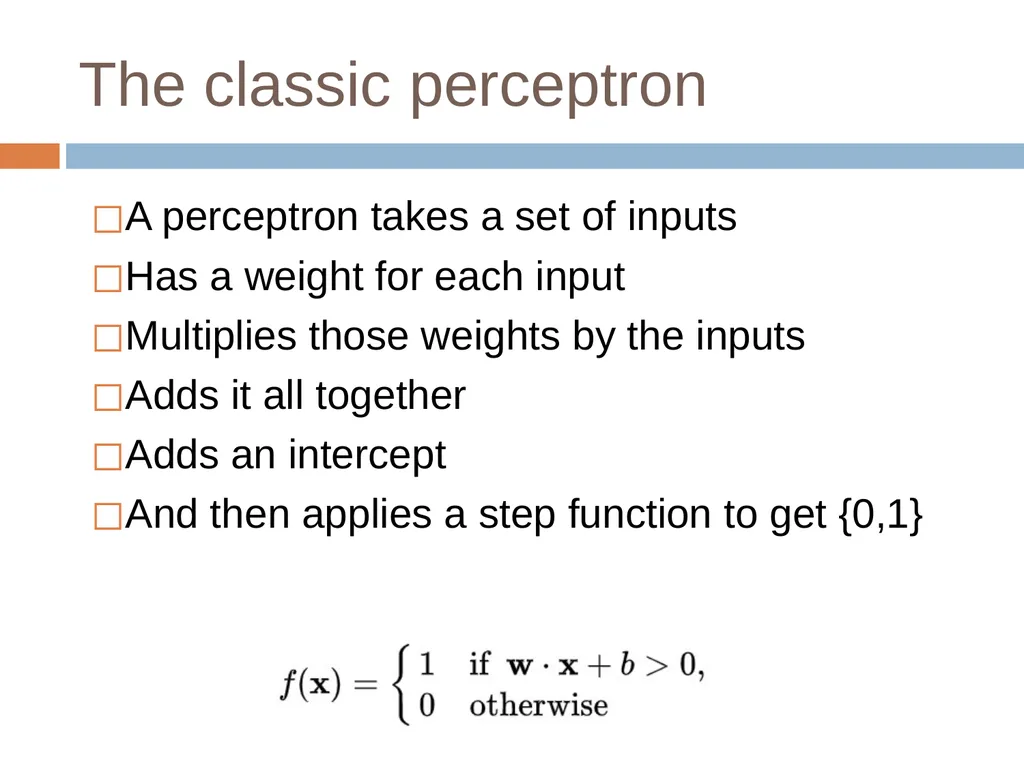
The classic perceptron A perceptron takes a set of inputs
Has a weight for each input
Multiplies those weights by the inputs
Adds it all together
Adds an intercept
And then applies a step function to get {0,1}<br>
05
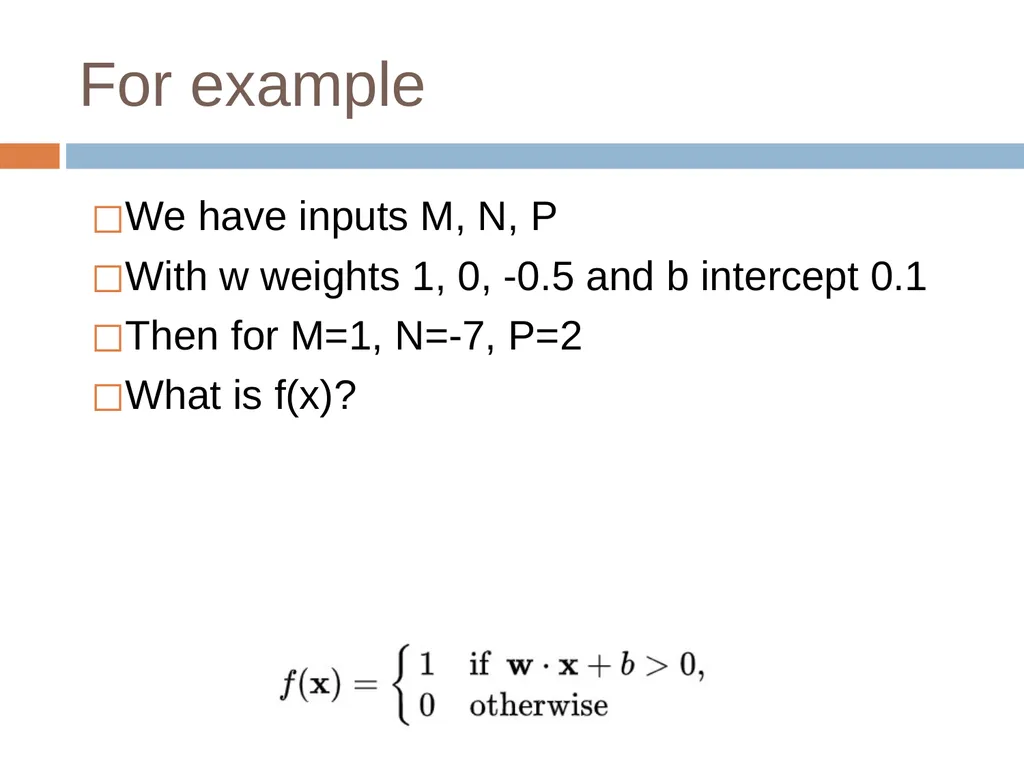
For example We have inputs M, N, P
With w weights 1, 0, -0.5 and b intercept 0.1
Then for M=1, N=-7, P=2
What is f(x)?<br>
06
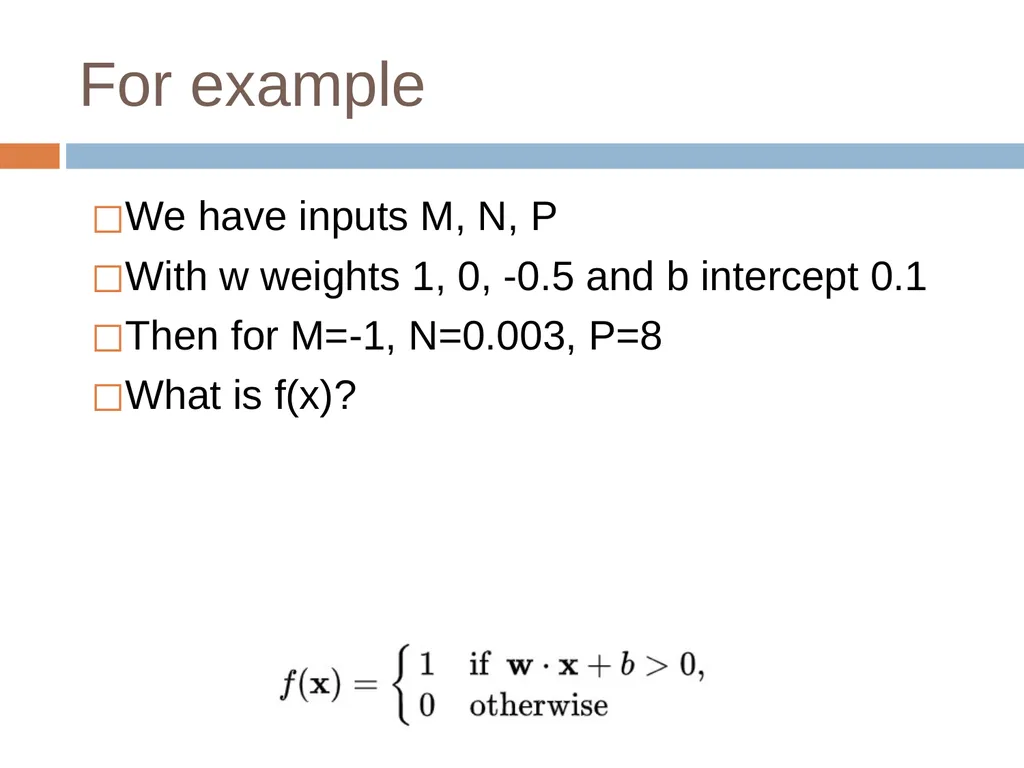
For example We have inputs M, N, P
With w weights 1, 0, -0.5 and b intercept 0.1
Then for M=-1, N=0.003, P=8
What is f(x)?<br>
07
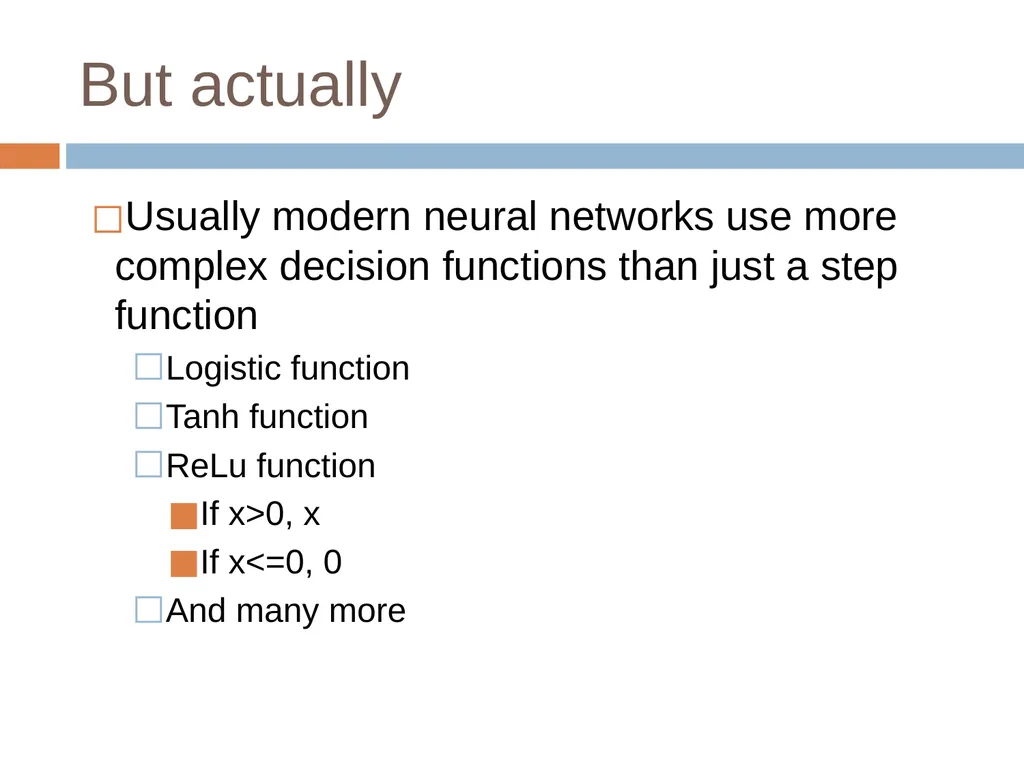
But actually Usually modern neural networks use more complex decision functions than just a step function
Logistic function
Tanh function
ReLu function
If x>0, x
If x<=0, 0
And many more<br>
08
That’s one perceptron And one perceptron can have multiple inputs<br>
09
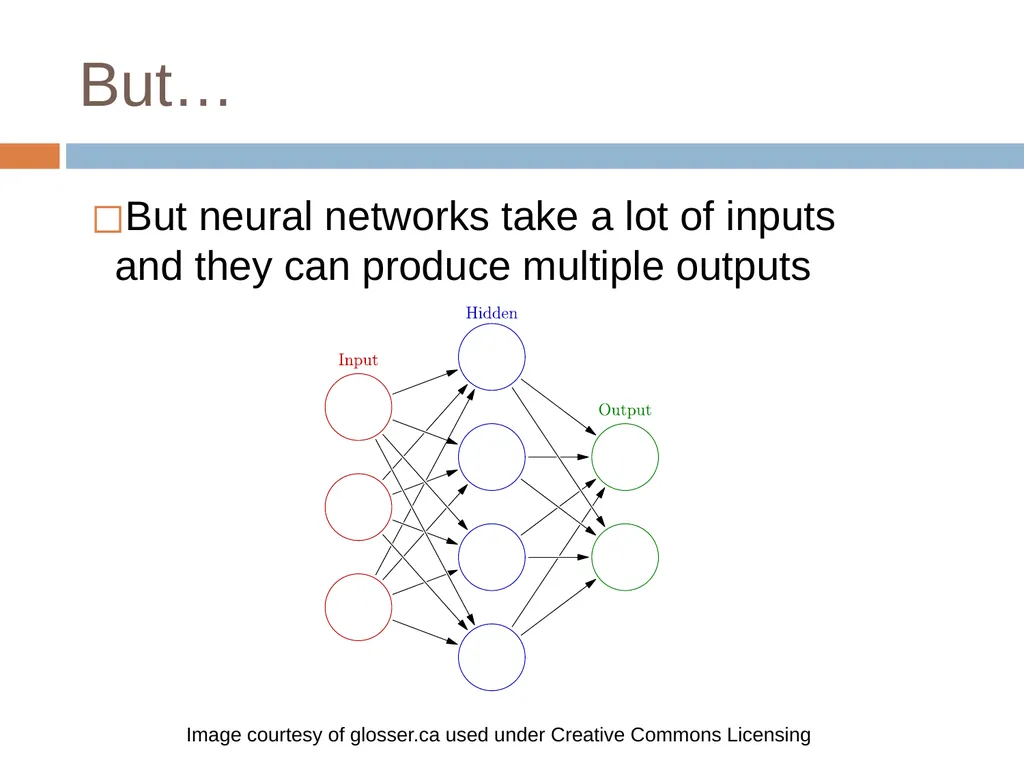
But… But neural networks take a lot of inputs and they can produce multiple outputs Image courtesy of glosser.ca used under Creative Commons Licensing<br>
10
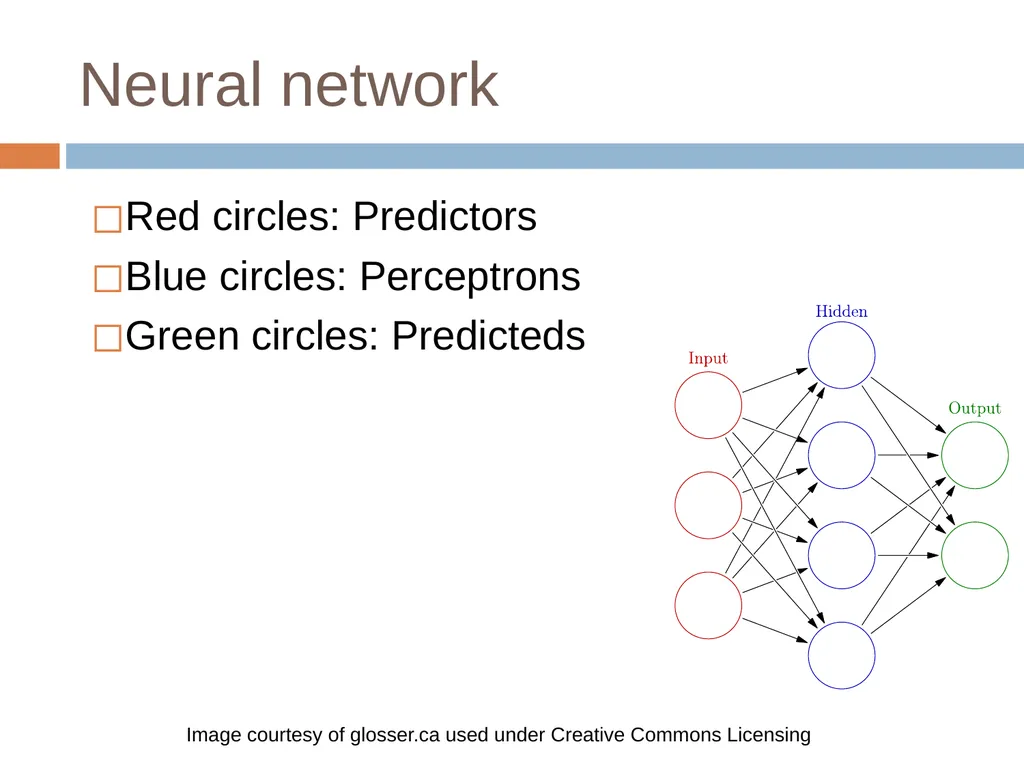
Neural network Red circles: Predictors
Blue circles: Perceptrons
Green circles: Predicteds Image courtesy of glosser.ca used under Creative Commons Licensing<br>
11
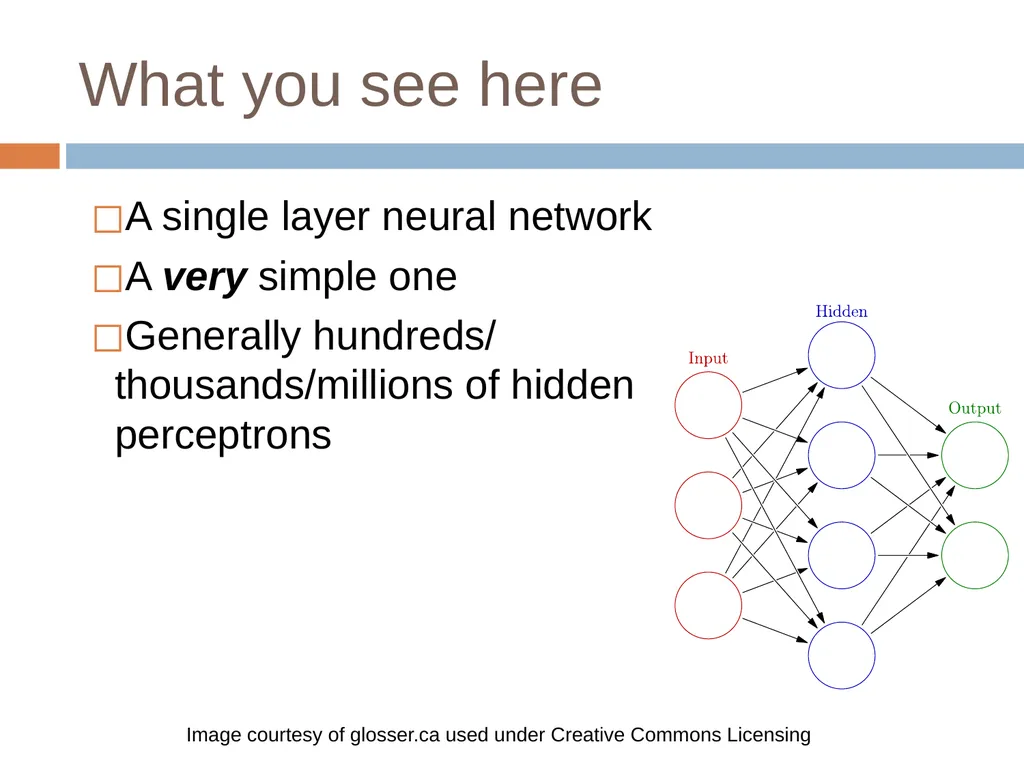
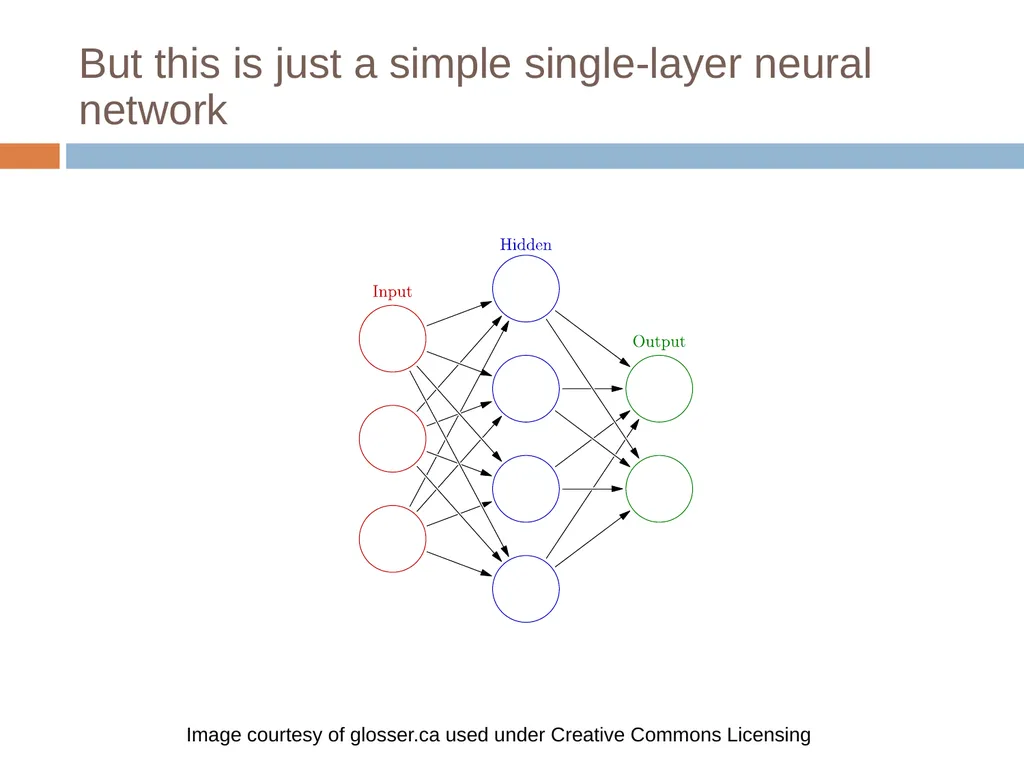
What you see here A single layer neural network
A very simple one
Generally hundreds/ thousands/millions of hidden perceptrons Image courtesy of glosser.ca used under Creative Commons Licensing<br>
12
But this is just a simple single-layer neural network Image courtesy of glosser.ca used under Creative Commons Licensing<br>
13
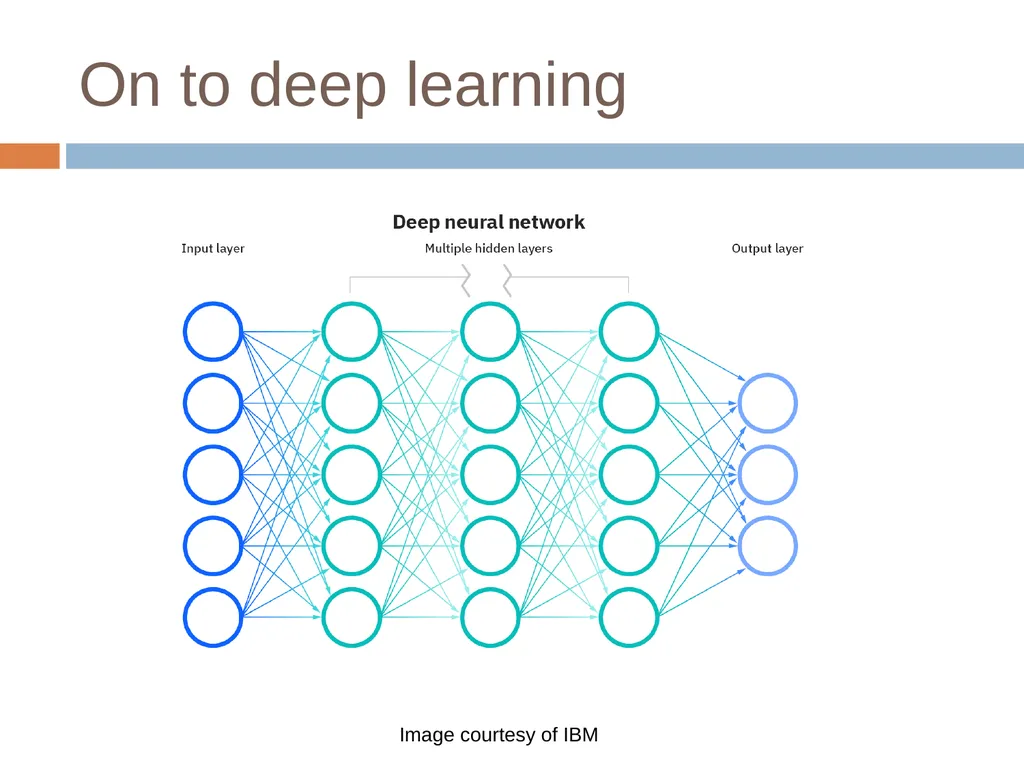
On to deep learning Image courtesy of IBM<br>
14
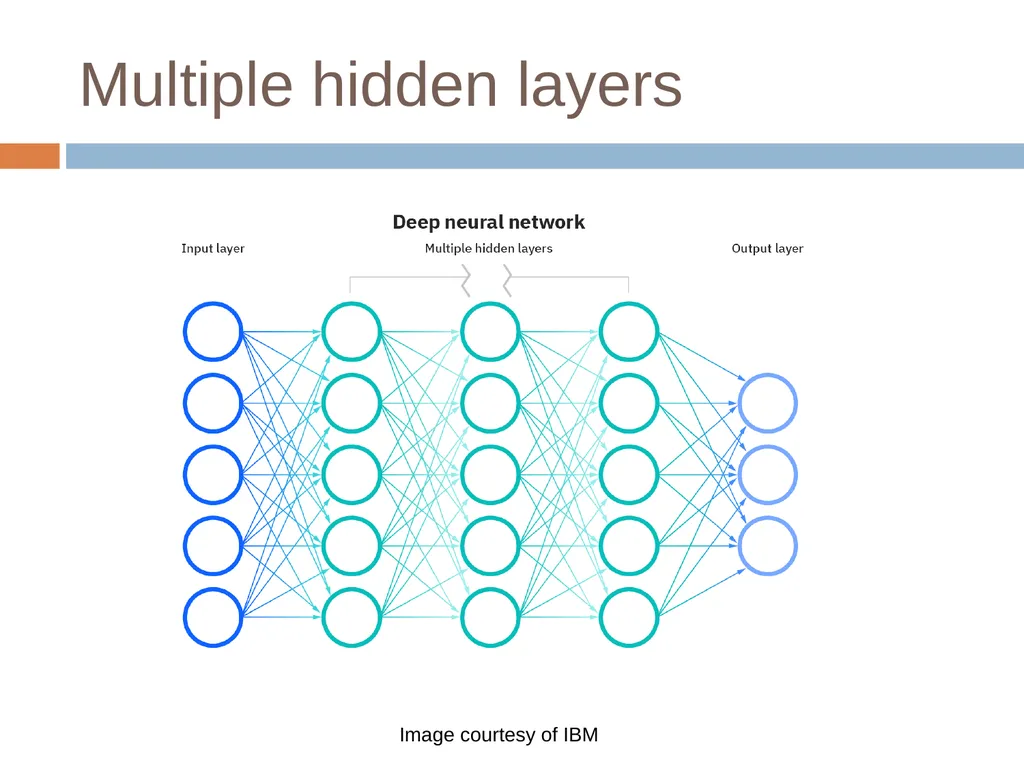
Multiple hidden layers Image courtesy of IBM<br>
15
Why does deep learning (sometimes) work better? Can capture multiple layers of abstraction
Without having to do so in a way that human beings can understand<br>
16
Any questions?<br>
17
And… Lots of ways to make things more complex still<br>
18
Often the term deep learning Reserved for recurrent neural networks (or more complex algorithms still)
Recurrent neural networks fits on sequence of events
Keeping some degree of “memory” about previous events
A different category of prediction model than classifiers that treat events as separate<br>
19
Recurrent neural networks (RNN) Feed back information from later layers back to earlier layers
A node can (over time) influence itself
Allows for sequence of outputs<br>
20
Long short term memory networks RNN variant
Replaces perceptrons with LSTM units
Information propagation reduces over time for given piece of information (long-term memory)
Activation patterns in network change once per time step (short-term memory)
Will not go into full details; linear algebra required<br>
21
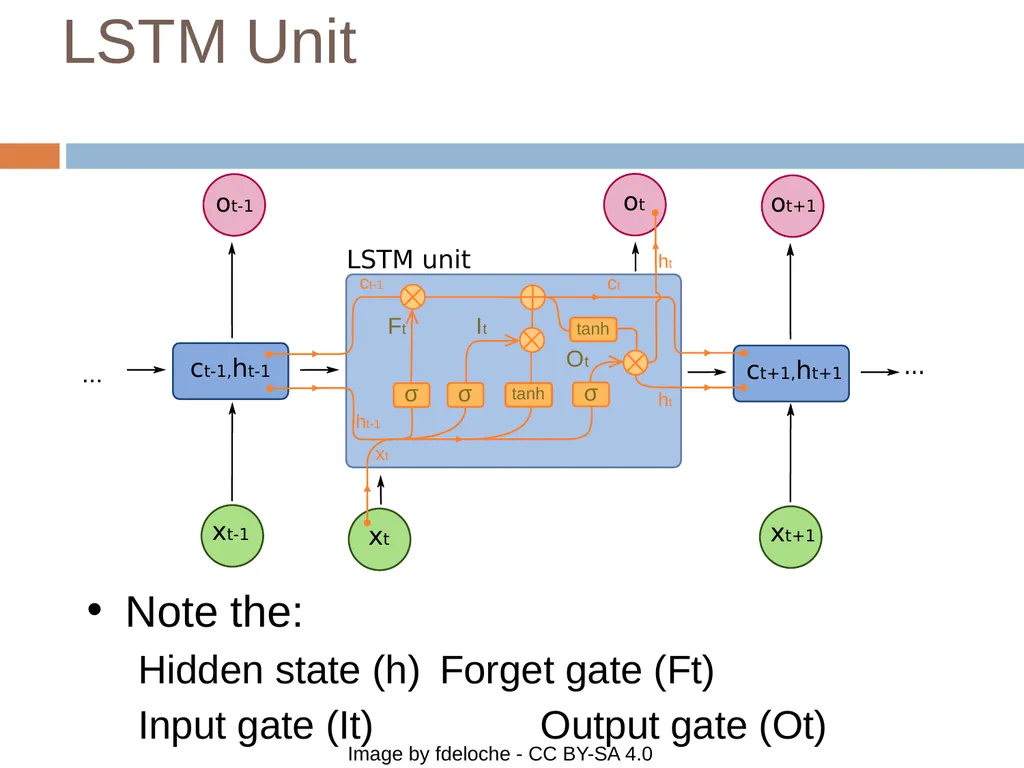
LSTM Unit Image by fdeloche - CC BY-SA 4.0 Note the:
Hidden state (h) Forget gate (Ft)
Input gate (It) Output gate (Ot)<br>
22
Transformer/Foundation Models BERT, MathBERT, GPT-2, GPT-3/3.5, DALL-E 2, StableDiffusion
As of when I’m writing this slide<br>
23
Transformer/Foundation Models Can predict
Words
Sentences
Pixels
Computer program text
Mathematical equations
Anything?<br>
24
Transformer/Foundation Models Can predict
Words
Sentences
Pixels
Computer program text
Mathematical equations
Anything?
And, in a sudden light-switch transformation, prediction becomes generation<br>
25
Transformer/Foundation Models Neural networks trained on enormous data sets
Enable impressive performance for new problems with minimal or even no training data
AKA Zero-shot learning
We will discuss them in detail in week 7
They only work for a subset of problems, but where they work it’s amazing<br>