
Advanced Methods of Interpretation Lecture III








Description: Advanced Methods of Interpretation Lecture III Hermeneutics and Structuralism Dr. Werner Binder Masaryk University, Brno Faculty of Social Studies Department of Sociology Advanced Methods of Interpretation in Cultural Sociology (soc 575)
Related Topics
Download Presentation
"Advanced Methods of Interpretation Lecture III" is the property of its rightful owner. Permission is granted to download and print the materials on this website for personal, non-commercial use only, and to display it on your personal computer provided you do not modify the materials and that you retain all copyright notices contained in the materials. By downloading content from our website, you accept the terms of this agreement.
Presentation Transcript
slide1. Advanced Methods of Interpretation
Lecture III
Hermeneutics and Structuralism
Dr. Werner Binder Masaryk University, Brno
Faculty of Social Studies
Department of Sociology Advanced Methods of Interpretation
in Cultural Sociology (soc 575)
Spring 2017<br>
slide2. werner.binder@mail.muni.cz Masaryk University
Faculty of Social Studies Summary of Lecture II
Interpretation as method of data analysis in interpretative and cultural sociology
An interpretation can never be proven to be “true”, however, good interpretations are adequate, consistent, plausible, elegant and interesting
Interpretation follows abductive reasoning: Devise a theoretical framework or hypothesis that explains observable surprising facts<br>
slide3. werner.binder@mail.muni.cz Masaryk University
Faculty of Social Studies What is Hermeneutics?
The art of interpretation of texts
A general theory of understanding
A specific paradigm in interpretative sociology
Classical Hermeneutics:
Interpretation of „legal“ or „sacred“ texts (e.g. Medieval biblical exegesis
Renaissance: Understanding classical texts
Protestantism: Shift from dogma to interpretation<br>
slide4. Friedrich Schleiermacher
(1786-1834)<br>
slide5. werner.binder@mail.muni.cz Masaryk University
Faculty of Social Studies Schleiermacher: Romantic Hermeneutics
Romanticism: individuality and genius esthetics
Shift from the objective meaning of “sacred” and “legal” texts to the subjectivity of authors (psychological)
The goal of hermeneutics: „Understanding the author better than he did understand himself“ (deep analysis)
Grammatical vs. psychological interpretation
Divinatory character of interpretation (guessing)
Non-understanding as the beginning of hermeneutics<br>
slide6. “Hermeneutics rests on the fact of the non-understanding of discourse: taken in its most general sense, including misunderstanding in the mother tongue and everyday life.”
Friedrich Schleiermacher, General Hermeneutics (1809/1810) Non-Understanding as the Starting Point for Hermeneutics<br>
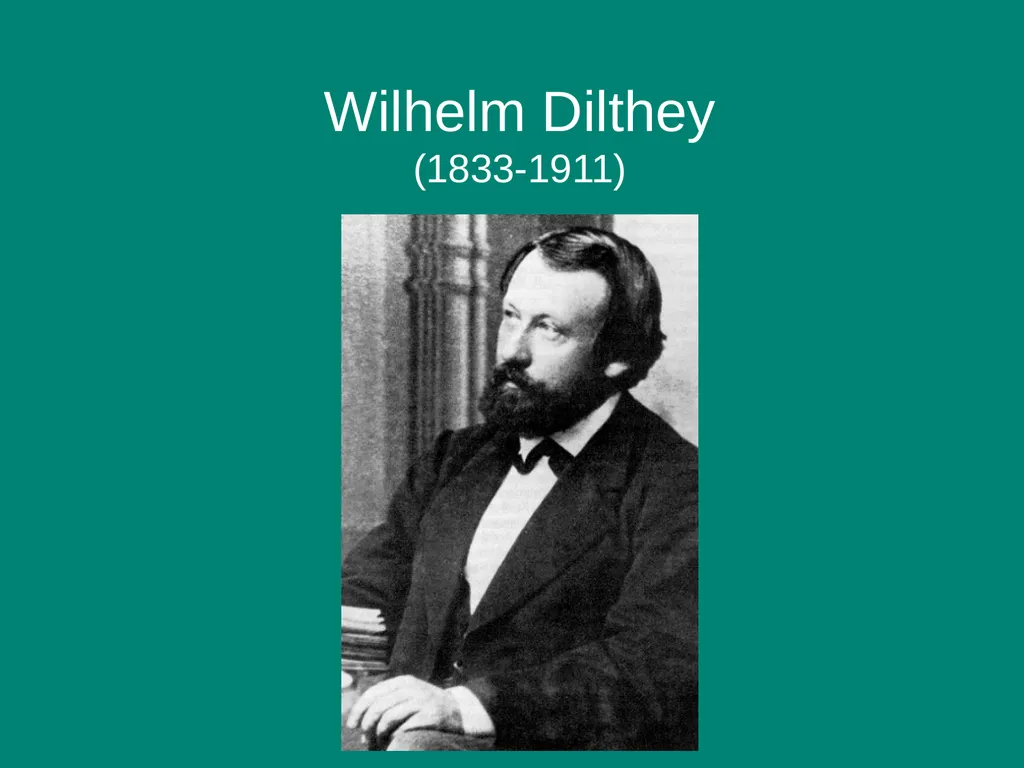
slide7. Wilhelm Dilthey
(1833-1911)<br>
slide8. werner.binder@mail.muni.cz Masaryk University
Faculty of Social Studies Dilthey’s Hermeneutics I
Historicism of the 19th century, “Lebensphilosophie”
“Erklären” vs. “Verstehen” → epistemological and methodological foundations of the cultural sciences
Hermeneutics: Shift from psychological understanding to a social and cultural conception of hermeneutics
Life can be experienced subjectively, but expresses and objectifies itself in artifacts, institutions and culture
The goal of hermeneutic interpretation is the understanding of “culture” as objectification of life<br>
slide9. werner.binder@mail.muni.cz Masaryk University
Faculty of Social Studies Dilthey’s Hermeneutics II
Through “sympathetic participation” and interpretation of cultural objectifications, understanding is possible
Meanings of individuals and cultures are organized as systems → Weltanschauung (world-view)
In order to understand, we have to fall back on our experiences (and world-view)
Culture as historically determined horizon of meaning (Weltanschauung, Zeitgeist)
Sociological thinking: Subjective experiences are shaped by social influences<br>
slide10. werner.binder@mail.muni.cz Masaryk University
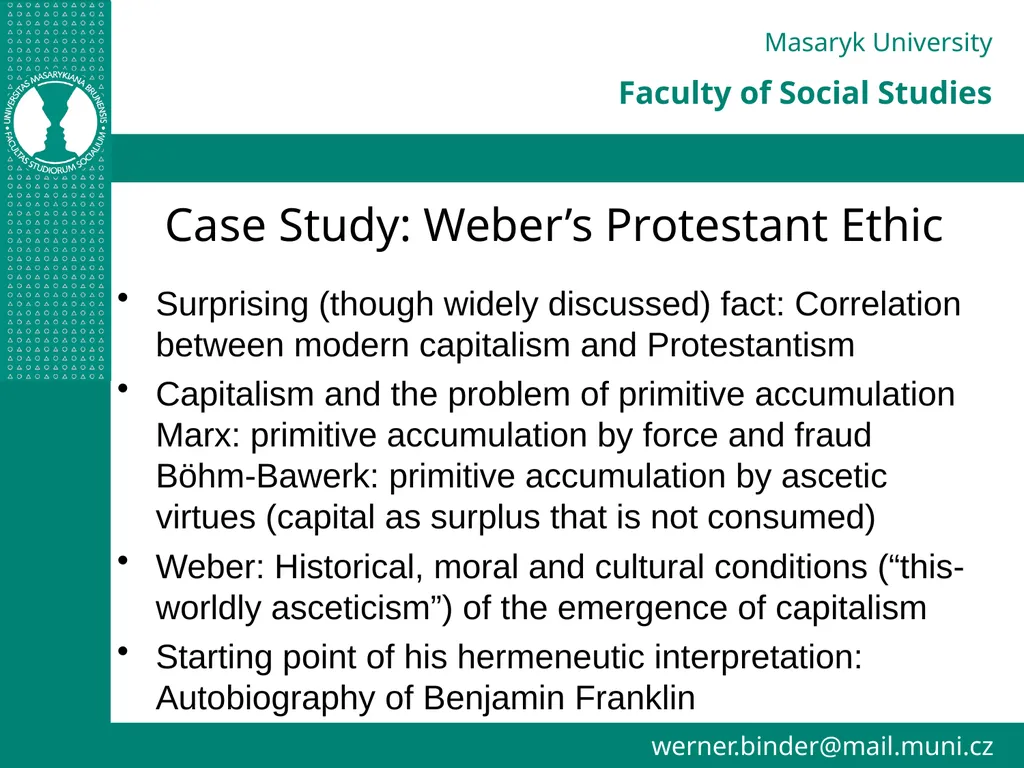
Faculty of Social Studies Case Study: Weber’s Protestant Ethic
Surprising (though widely discussed) fact: Correlation between modern capitalism and Protestantism
Capitalism and the problem of primitive accumulation Marx: primitive accumulation by force and fraud Böhm-Bawerk: primitive accumulation by ascetic virtues (capital as surplus that is not consumed)
Weber: Historical, moral and cultural conditions (“this-worldly asceticism”) of the emergence of capitalism
Starting point of his hermeneutic interpretation: Autobiography of Benjamin Franklin<br>
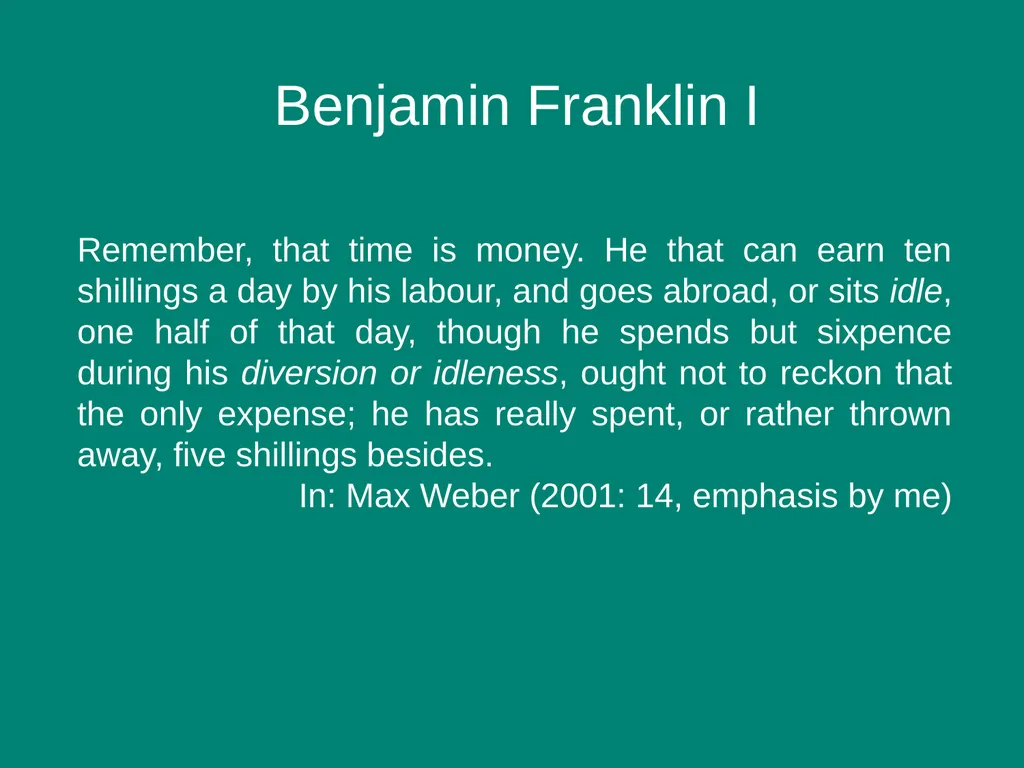
slide11. Remember, that time is money. He that can earn ten shillings a day by his labour, and goes abroad, or sits idle, one half of that day, though he spends but sixpence during his diversion or idleness, ought not to reckon that the only expense; he has really spent, or rather thrown away, five shillings besides.
In: Max Weber (2001: 14, emphasis by me) Benjamin Franklin I<br>
slide12. Remember, that money is of the prolific, generating nature. Money can beget money, and its offspring can beget more, and so on. Five shillings turned is six, turned again it is seven and three pence, and so on, till it becomes a hundred pounds. The more there is of it, the more it produces every turning, so that the profits rise quicker and quicker. He that kills a breeding sow, destroys all her offspring to the thousandth generation. He that murders a crown, destroys all that it might have produced, even scores of pounds.
In: Max Weber (2001: 15, emphasis by me) Benjamin Franklin II<br>
slide13. werner.binder@mail.muni.cz Masaryk University
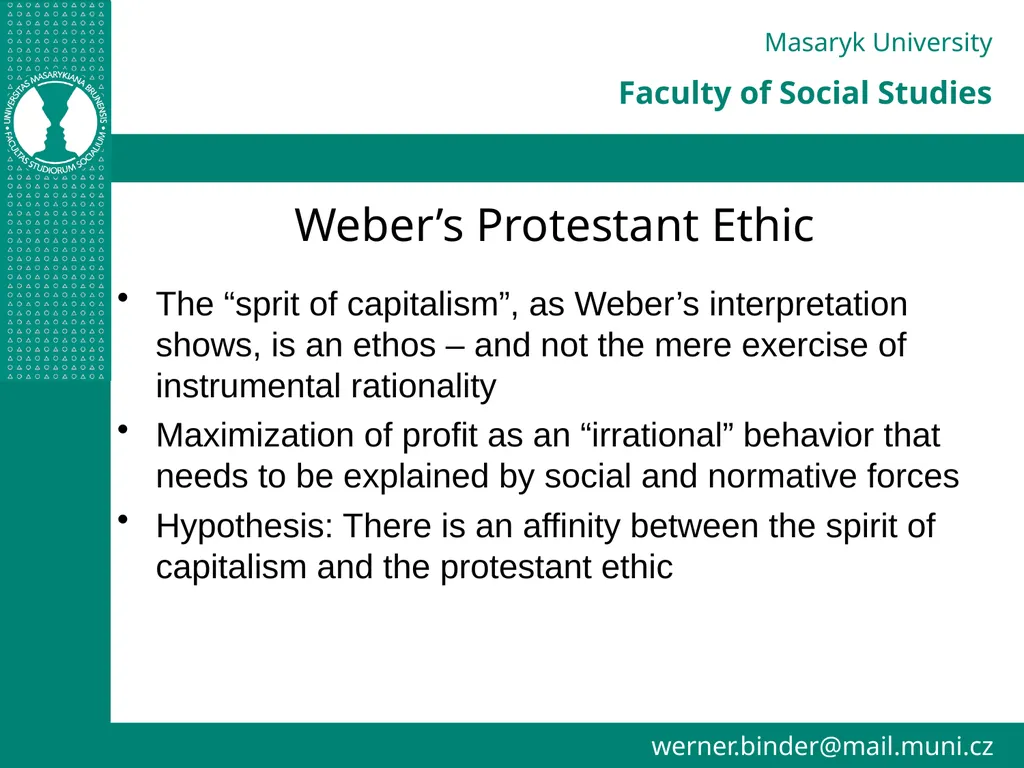
Faculty of Social Studies Weber’s Protestant Ethic
The “sprit of capitalism”, as Weber’s interpretation shows, is an ethos ‒ and not the mere exercise of instrumental rationality
Maximization of profit as an “irrational” behavior that needs to be explained by social and normative forces
Hypothesis: There is an affinity between the spirit of capitalism and the protestant ethic<br>
slide14. werner.binder@mail.muni.cz Masaryk University
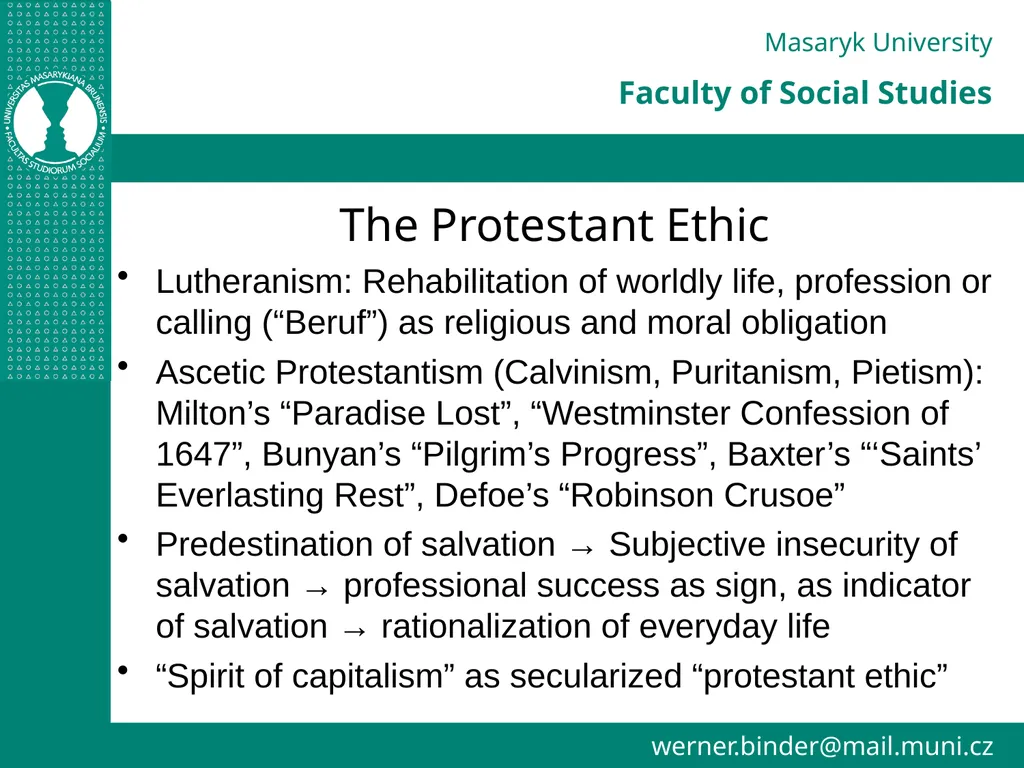
Faculty of Social Studies The Protestant Ethic
Lutheranism: Rehabilitation of worldly life, profession or calling (“Beruf”) as religious and moral obligation
Ascetic Protestantism (Calvinism, Puritanism, Pietism): Milton’s “Paradise Lost”, “Westminster Confession of 1647”, Bunyan’s “Pilgrim’s Progress”, Baxter’s “‘Saints’ Everlasting Rest”, Defoe’s “Robinson Crusoe”
Predestination of salvation → Subjective insecurity of salvation → professional success as sign, as indicator of salvation → rationalization of everyday life
“Spirit of capitalism” as secularized “protestant ethic”<br>
slide15. The Puritan wanted to work in a calling; we are forced to do so. For when asceticism was carried out of monastic cells into everyday life, and began to dominate worldly morality, it did its part in building the tremendous cosmos of the modern economic order. This order is now bound to the technical and economic conditions of machine production which to-day determine the lives of all the individuals who are born into this mechanism, not only those directly concerned with economic acquisition, with irresistible force. Perhaps it will so determine them until the last ton of fossilized coal is burnt. In Baxter’s view the care for external goods should only lie on the shoulders of the “saint like a light cloak, which can be thrown aside at any moment”. But fate decreed that the cloak should become an iron cage. Max Weber (2001: 123) From Protestant Ethic to Capitalism<br>
slide16. werner.binder@mail.muni.cz Masaryk University
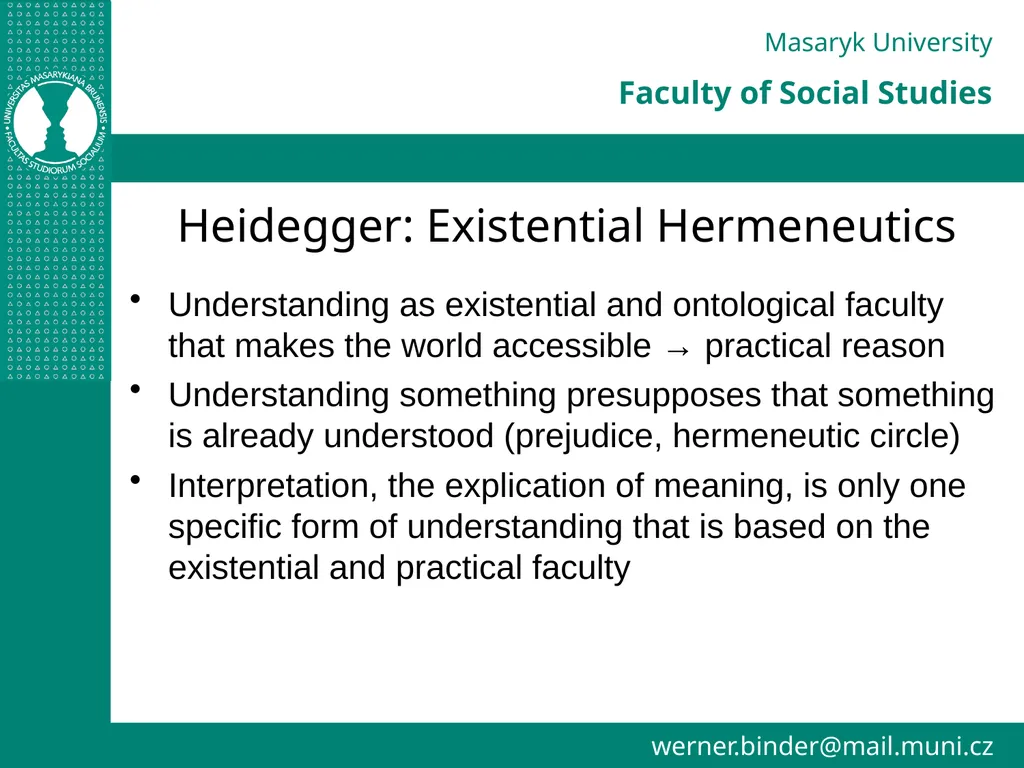
Faculty of Social Studies Heidegger: Existential Hermeneutics
Understanding as existential and ontological faculty that makes the world accessible → practical reason
Understanding something presupposes that something is already understood (prejudice, hermeneutic circle)
Interpretation, the explication of meaning, is only one specific form of understanding that is based on the existential and practical faculty<br>
slide17. werner.binder@mail.muni.cz Masaryk University
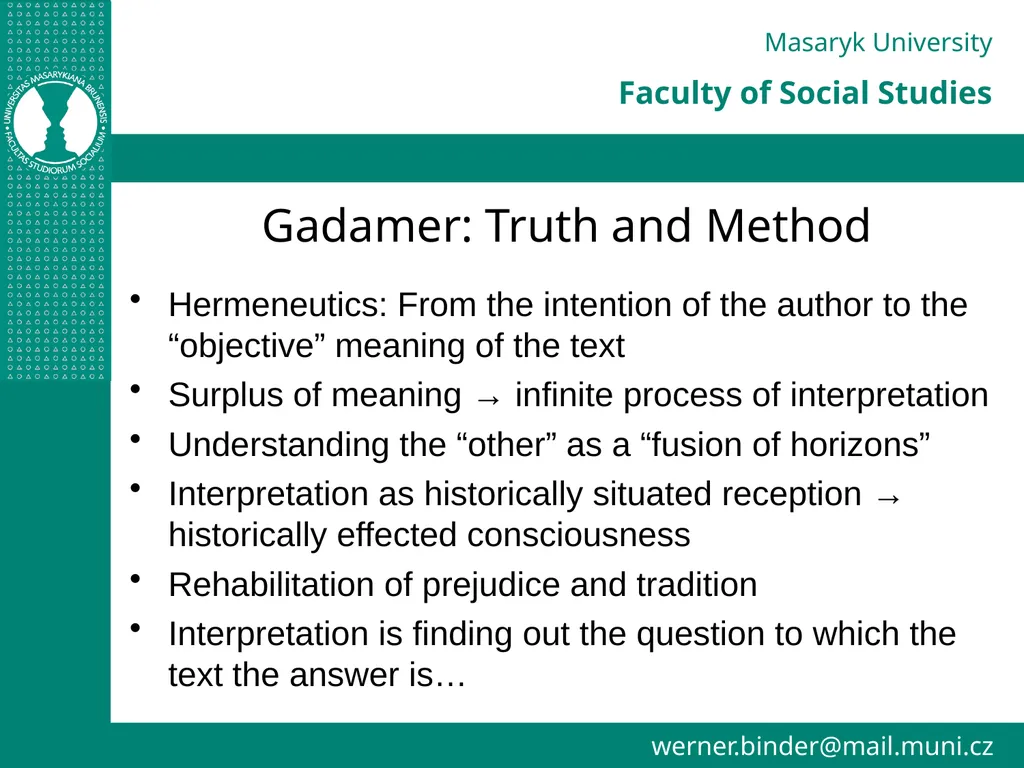
Faculty of Social Studies Gadamer: Truth and Method
Hermeneutics: From the intention of the author to the “objective” meaning of the text
Surplus of meaning → infinite process of interpretation
Understanding the “other” as a “fusion of horizons”
Interpretation as historically situated reception → historically effected consciousness
Rehabilitation of prejudice and tradition
Interpretation is finding out the question to which the text the answer is…<br>
slide18. Thus a person who wants to understand must question what lies behind what is said. He must understand it as an answer to a question. If we go back behind what is said, then we inevitably ask questions beyond what is said. We understand the sense of the text only by acquiring the horizon of the question—a horizon that, as such, necessarily includes other possible answers. Thus the meaning of a sentence is relative to the question to which it is a reply, but that implies that its meaning necessarily exceeds what is said in it. As these considerations show, then, the logic of the human sciences is a logic of the question.
Gadamer (2003: 363) The Cultural Logic of the Question<br>
slide19. werner.binder@mail.muni.cz Masaryk University
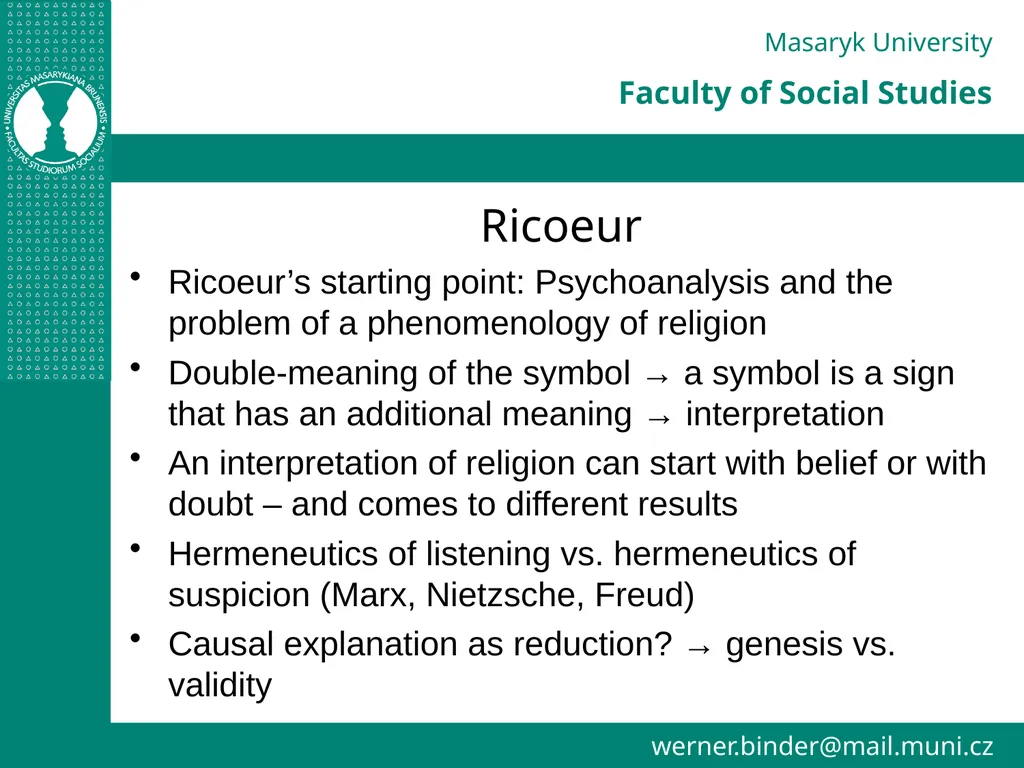
Faculty of Social Studies Ricoeur
Ricoeur’s starting point: Psychoanalysis and the problem of a phenomenology of religion
Double-meaning of the symbol → a symbol is a sign that has an additional meaning → interpretation
An interpretation of religion can start with belief or with doubt ‒ and comes to different results
Hermeneutics of listening vs. hermeneutics of suspicion (Marx, Nietzsche, Freud)
Causal explanation as reduction? → genesis vs. validity<br>
slide20. werner.binder@mail.muni.cz Masaryk University
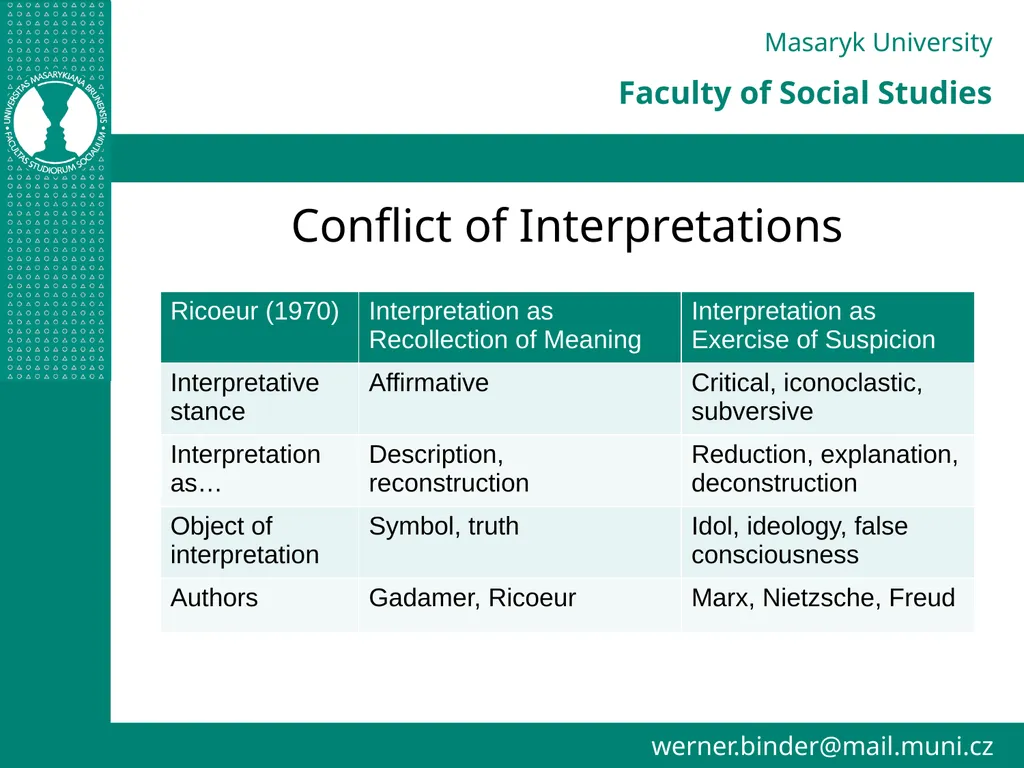
Faculty of Social Studies Conflict of Interpretations<br>
slide21. The secret to the compulsive power of social structures is that they have an inside. They are not only external to actors but internal to them. They are meaningful. These meanings are structured and socially produced, even if they are invisible. We must learn how to make them visible. For Freud, the goal of psychoanalysis was to replace the unconscious with the conscious: “Where Id was, Ego shall be.” Cultural sociology is a kind of social psychoanalysis. Its goal is to bring the social unconscious up for view. To reveal to men and women the myths that think them so that they can make new myths in turn.
Jeffrey Alexander (2003: 4) Cultural Sociology as
Social Psychoanalysis<br>
slide22. werner.binder@mail.muni.cz Masaryk University
Faculty of Social Studies What is Structuralism?
Structuralism is one of the most influential intellectual movements of the 20th century (centered in Europe)
In contrast to hermeneutics, structuralism aimed to make humanistic disciplines more “scientific”
Though structuralism was widely criticized, it had a strong influence on critics such as Michel Foucault and Pierre Bourdieu
Structuralism developed out of a strong reading of certain passages in Saussure’s lectures on linguistic<br>
slide23. Ferdinand de Saussure (1857—1913)<br>
slide24. werner.binder@mail.muni.cz Masaryk University
Faculty of Social Studies Saussure: Language as a System
“Langue”, language as a system, is a part of “langage”, the human speech
“Langue” vs. “parole” (speaking, speech act, discourse)
Language is a system and “social fact” par excellence
Speaking is individual and accidental: individuals use the language code to express their own thoughts
Synchronic vs. diachronic analysis of language (structuralism put a strong emphasis on the former)<br>
slide25. werner.binder@mail.muni.cz Masaryk University
Faculty of Social Studies Saussure: The Linguistic Sign I
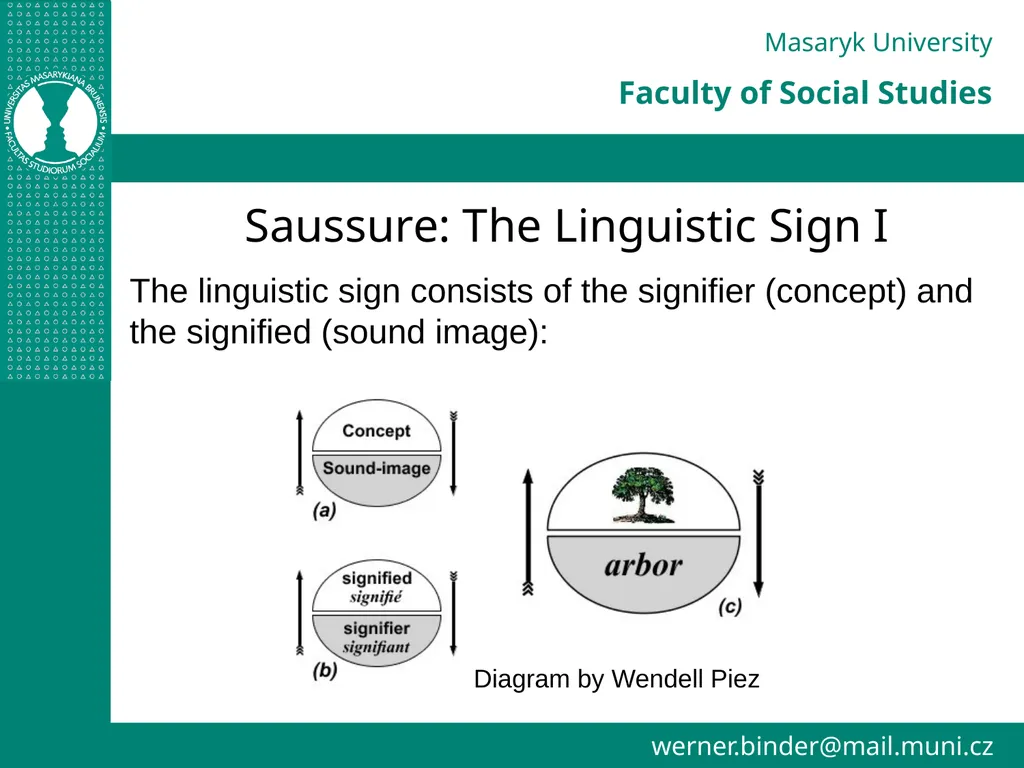
The linguistic sign consists of the signifier (concept) and the signified (sound image): Diagram by Wendell Piez<br>
slide26. werner.binder@mail.muni.cz Masaryk University
Faculty of Social Studies Saussure: The Linguistic Sign II
Arbitrariness of the linguistic sign: unmotivated, based on convention, fixed by rule
Linearity of the linguistic signifier: language is sequentially structured, in contrast to images etc.
Immutability of the sign as a result of its arbitrariness: the social force and inherent conservatism of language
Mutability of the sign as a result of its arbitrariness: individuals can’t change language intentionally, only collectives can do so, although mostly unintentionally<br>
slide27. werner.binder@mail.muni.cz Masaryk University
Faculty of Social Studies Language: Substance and Form
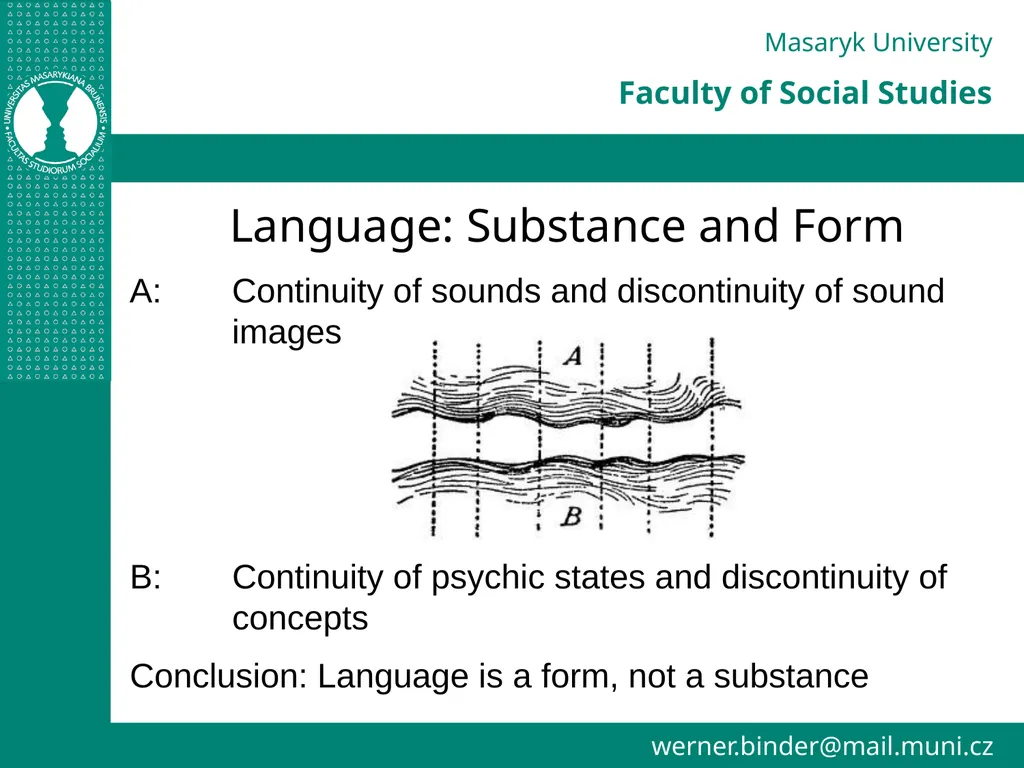
A: Continuity of sounds and discontinuity of sound images B: Continuity of psychic states and discontinuity of concepts
Conclusion: Language is a form, not a substance<br>
slide28. werner.binder@mail.muni.cz Masaryk University
Faculty of Social Studies Language as Sign System
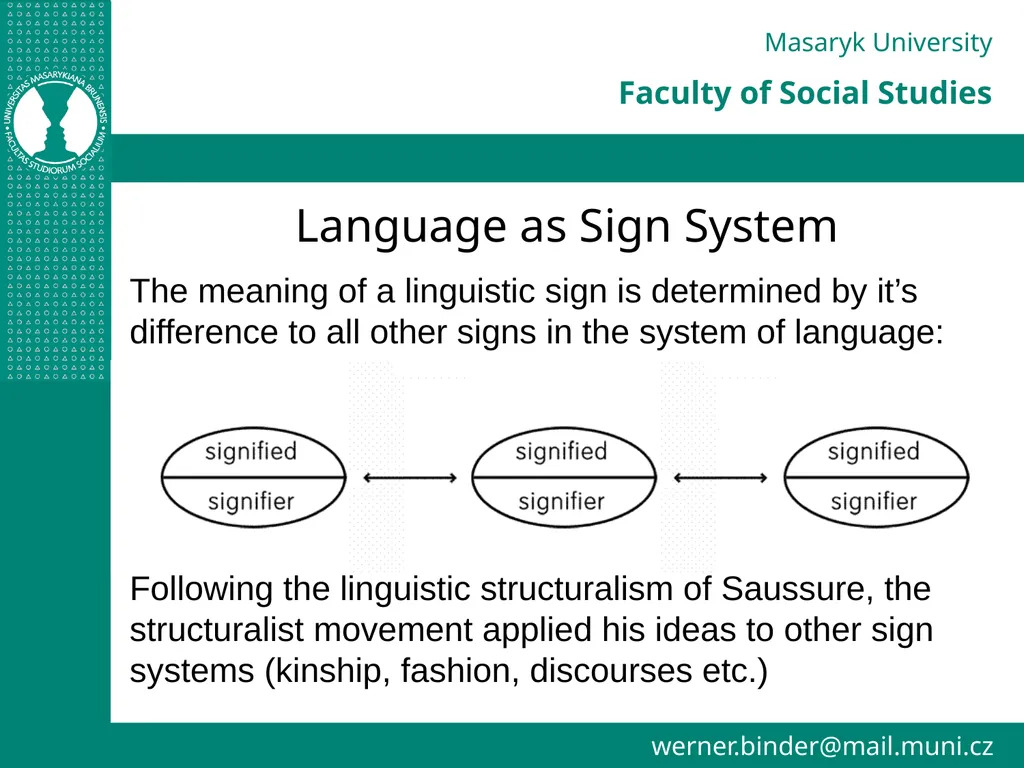
The meaning of a linguistic sign is determined by it’s difference to all other signs in the system of language: Following the linguistic structuralism of Saussure, the structuralist movement applied his ideas to other sign systems (kinship, fashion, discourses etc.)<br>
slide29. Claude Lévi-Strauss (1908—2009)<br>
slide30. werner.binder@mail.muni.cz Masaryk University
Faculty of Social Studies Lévi-Strauss: Structural Anthropology
Lévi-Strauss extended the structuralist approach from language to other systems of meaning:
Kinship as a meaning system: exchange of women
Economy as a meaning system: exchange of goods
Language as a meaning system: exchange of words
Myth, food etc…
Self-proclaimed goal of his structural analysis was to dissolve the concept of man into different systems of meaning (anti-existentialist)<br>
slide31. werner.binder@mail.muni.cz Masaryk University
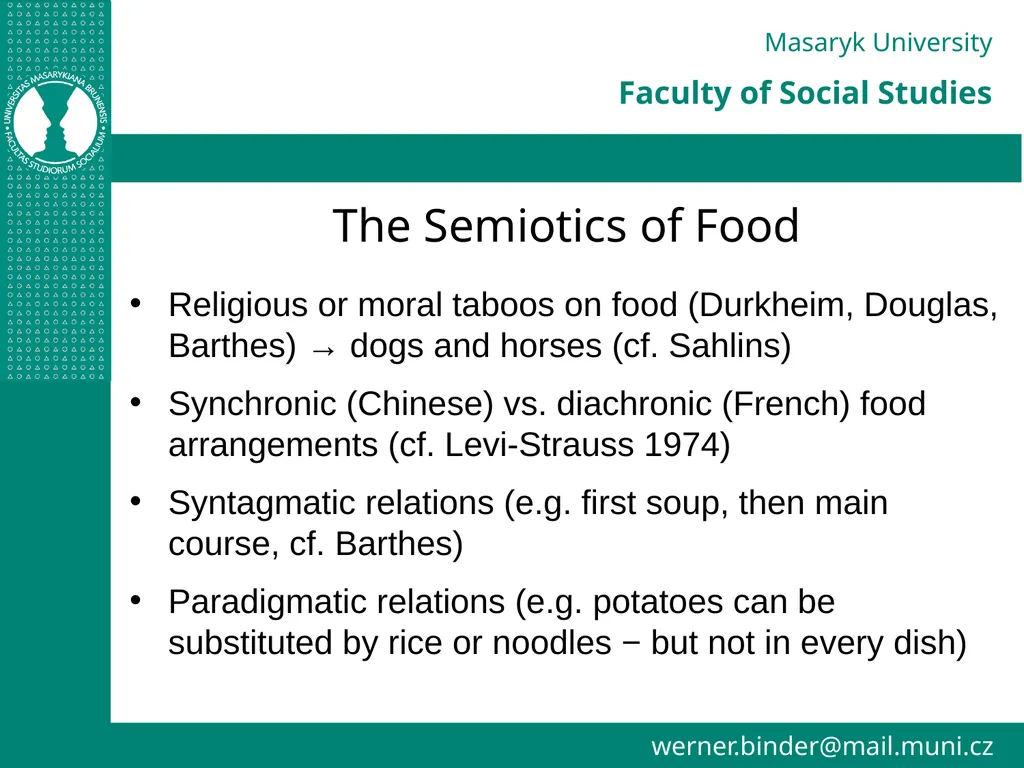
Faculty of Social Studies The Semiotics of Food
Religious or moral taboos on food (Durkheim, Douglas, Barthes) → dogs and horses (cf. Sahlins)
Synchronic (Chinese) vs. diachronic (French) food arrangements (cf. Levi-Strauss 1974)
Syntagmatic relations (e.g. first soup, then main course, cf. Barthes)
Paradigmatic relations (e.g. potatoes can be substituted by rice or noodles − but not in every dish)<br>
slide32. werner.binder@mail.muni.cz Masaryk University
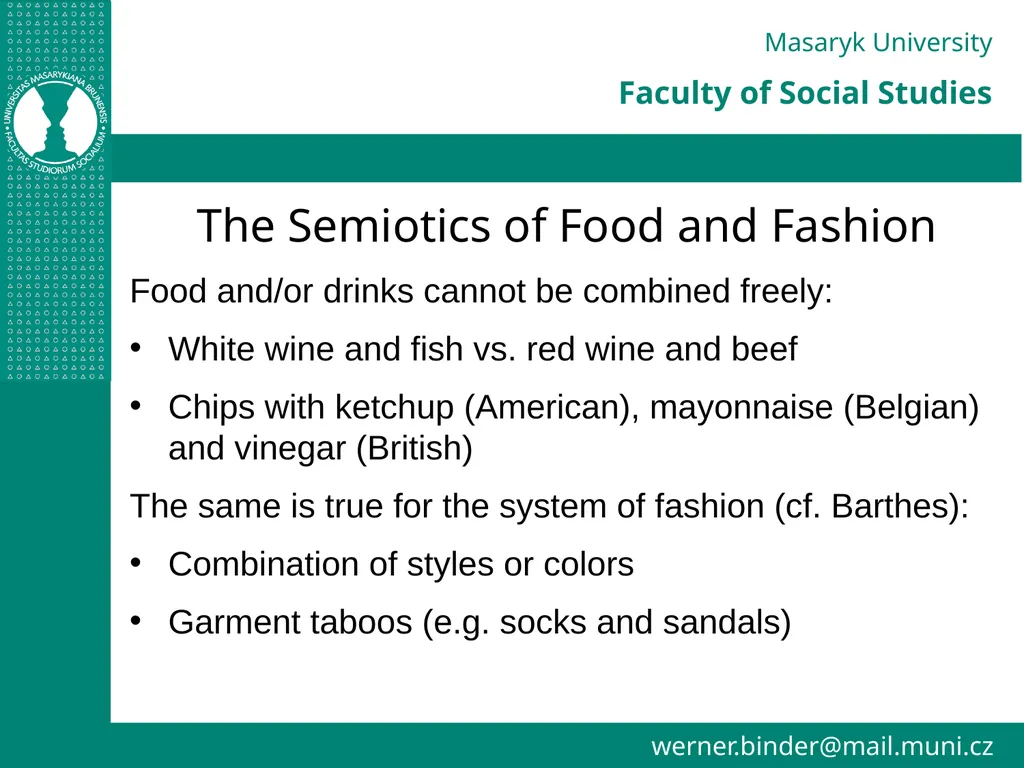
Faculty of Social Studies The Semiotics of Food and Fashion
Food and/or drinks cannot be combined freely:
White wine and fish vs. red wine and beef
Chips with ketchup (American), mayonnaise (Belgian) and vinegar (British)
The same is true for the system of fashion (cf. Barthes):
Combination of styles or colors
Garment taboos (e.g. socks and sandals)<br>
slide33. werner.binder@mail.muni.cz Masaryk University
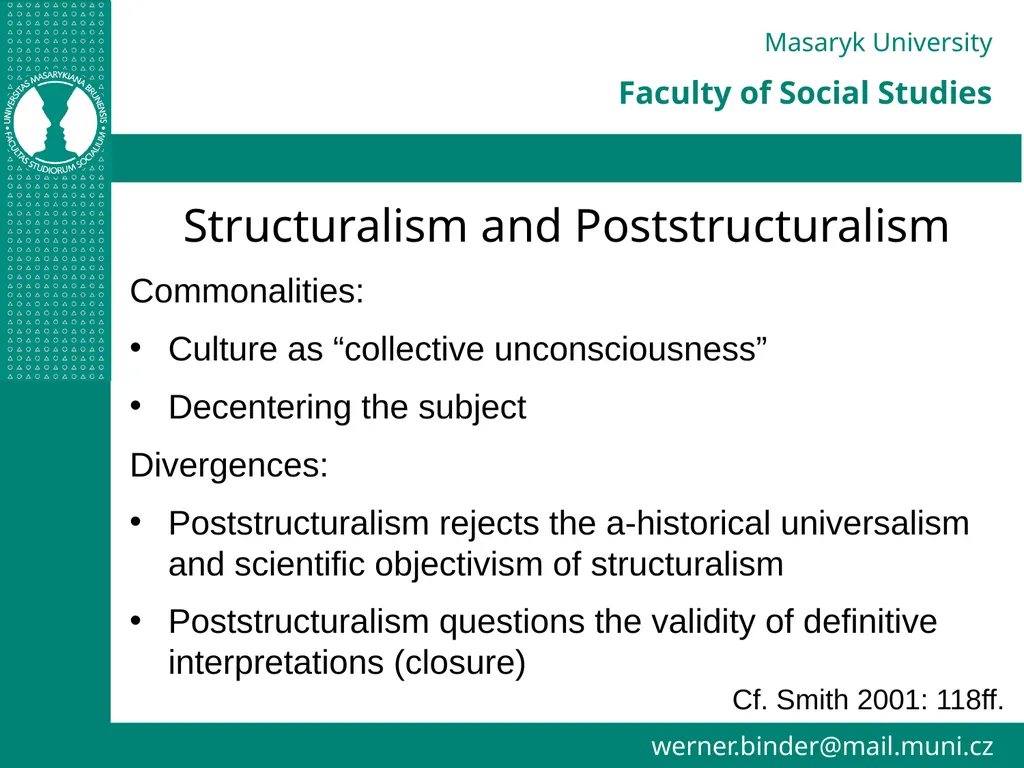
Faculty of Social Studies Structuralism and Poststructuralism
Commonalities:
Culture as “collective unconsciousness”
Decentering the subject
Divergences:
Poststructuralism rejects the a-historical universalism and scientific objectivism of structuralism
Poststructuralism questions the validity of definitive interpretations (closure)
Cf. Smith 2001: 118ff.<br>
slide34. werner.binder@mail.muni.cz Masaryk University
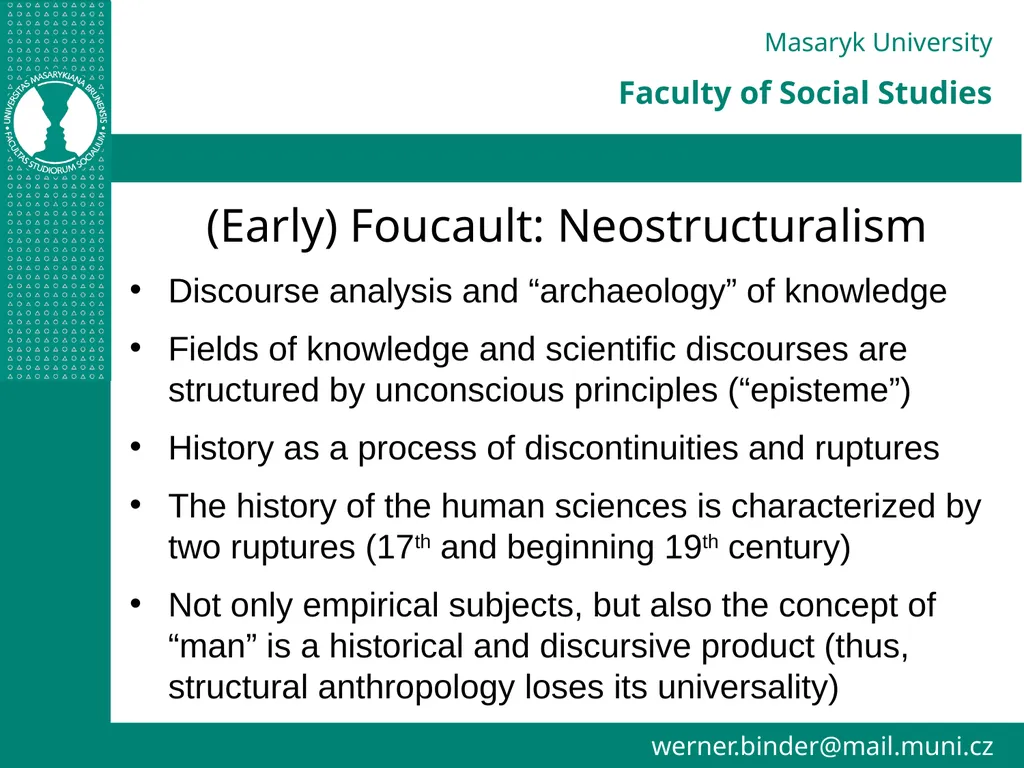
Faculty of Social Studies (Early) Foucault: Neostructuralism
Discourse analysis and “archaeology” of knowledge
Fields of knowledge and scientific discourses are structured by unconscious principles (“episteme”)
History as a process of discontinuities and ruptures
The history of the human sciences is characterized by two ruptures (17th and beginning 19th century)
Not only empirical subjects, but also the concept of “man” is a historical and discursive product (thus, structural anthropology loses its universality)<br>
slide35. werner.binder@mail.muni.cz Masaryk University
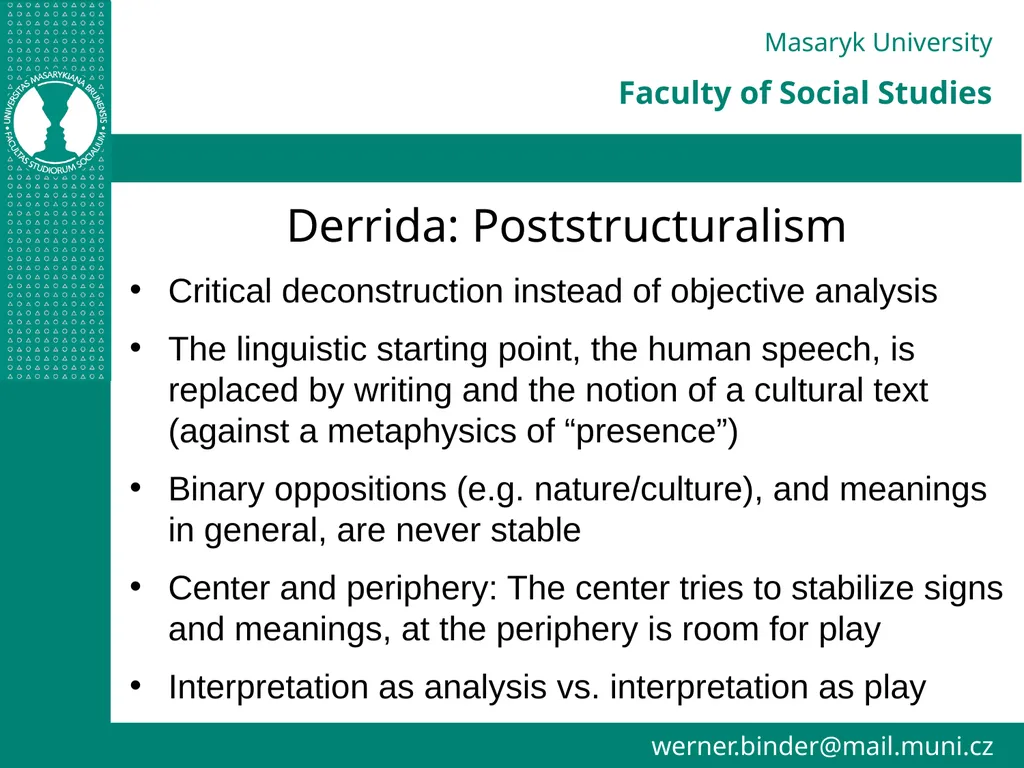
Faculty of Social Studies Derrida: Poststructuralism
Critical deconstruction instead of objective analysis
The linguistic starting point, the human speech, is replaced by writing and the notion of a cultural text (against a metaphysics of “presence”)
Binary oppositions (e.g. nature/culture), and meanings in general, are never stable
Center and periphery: The center tries to stabilize signs and meanings, at the periphery is room for play
Interpretation as analysis vs. interpretation as play<br>
slide36. werner.binder@mail.muni.cz Masaryk University
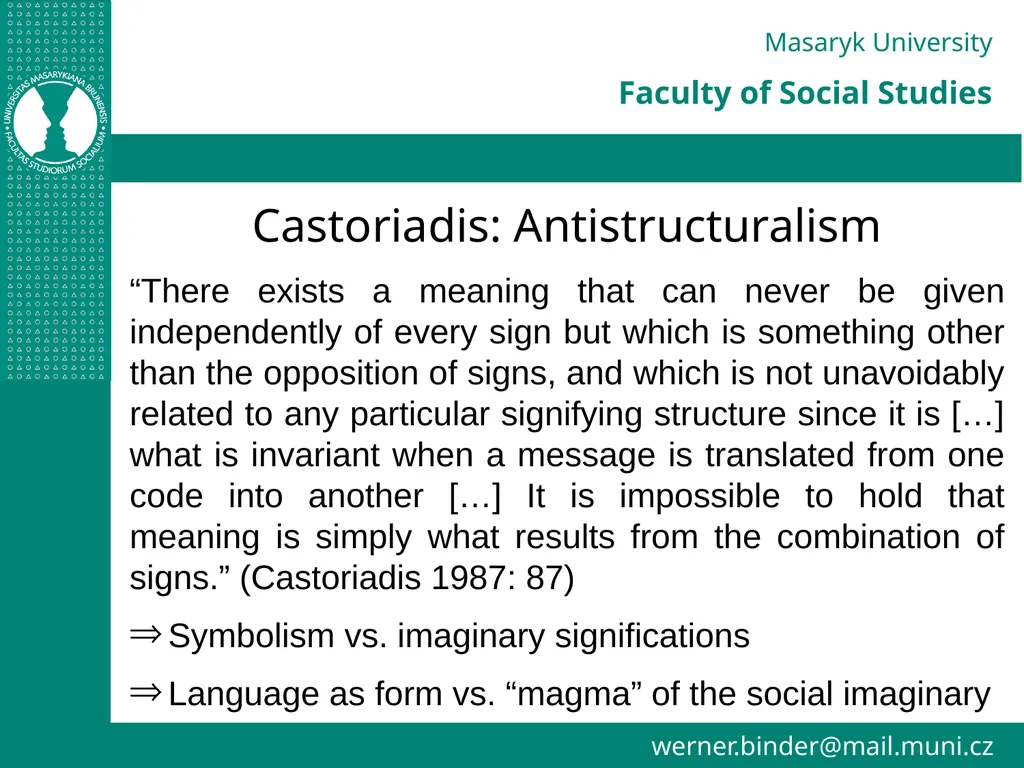
Faculty of Social Studies Castoriadis: Antistructuralism
“There exists a meaning that can never be given independently of every sign but which is something other than the opposition of signs, and which is not unavoidably related to any particular signifying structure since it is […] what is invariant when a message is translated from one code into another […] It is impossible to hold that meaning is simply what results from the combination of signs.” (Castoriadis 1987: 87)
Symbolism vs. imaginary significations
Language as form vs. “magma” of the social imaginary<br>
slide37. Thank you for your attention, criticism and further suggestions! werner.binder@mail.muni.cz<br>
Lecture III
Hermeneutics and Structuralism
Dr. Werner Binder Masaryk University, Brno
Faculty of Social Studies
Department of Sociology Advanced Methods of Interpretation
in Cultural Sociology (soc 575)
Spring 2017<br>
slide2. werner.binder@mail.muni.cz Masaryk University
Faculty of Social Studies Summary of Lecture II
Interpretation as method of data analysis in interpretative and cultural sociology
An interpretation can never be proven to be “true”, however, good interpretations are adequate, consistent, plausible, elegant and interesting
Interpretation follows abductive reasoning: Devise a theoretical framework or hypothesis that explains observable surprising facts<br>
slide3. werner.binder@mail.muni.cz Masaryk University
Faculty of Social Studies What is Hermeneutics?
The art of interpretation of texts
A general theory of understanding
A specific paradigm in interpretative sociology
Classical Hermeneutics:
Interpretation of „legal“ or „sacred“ texts (e.g. Medieval biblical exegesis
Renaissance: Understanding classical texts
Protestantism: Shift from dogma to interpretation<br>
slide4. Friedrich Schleiermacher
(1786-1834)<br>
slide5. werner.binder@mail.muni.cz Masaryk University
Faculty of Social Studies Schleiermacher: Romantic Hermeneutics
Romanticism: individuality and genius esthetics
Shift from the objective meaning of “sacred” and “legal” texts to the subjectivity of authors (psychological)
The goal of hermeneutics: „Understanding the author better than he did understand himself“ (deep analysis)
Grammatical vs. psychological interpretation
Divinatory character of interpretation (guessing)
Non-understanding as the beginning of hermeneutics<br>
slide6. “Hermeneutics rests on the fact of the non-understanding of discourse: taken in its most general sense, including misunderstanding in the mother tongue and everyday life.”
Friedrich Schleiermacher, General Hermeneutics (1809/1810) Non-Understanding as the Starting Point for Hermeneutics<br>
slide7. Wilhelm Dilthey
(1833-1911)<br>
slide8. werner.binder@mail.muni.cz Masaryk University
Faculty of Social Studies Dilthey’s Hermeneutics I
Historicism of the 19th century, “Lebensphilosophie”
“Erklären” vs. “Verstehen” → epistemological and methodological foundations of the cultural sciences
Hermeneutics: Shift from psychological understanding to a social and cultural conception of hermeneutics
Life can be experienced subjectively, but expresses and objectifies itself in artifacts, institutions and culture
The goal of hermeneutic interpretation is the understanding of “culture” as objectification of life<br>
slide9. werner.binder@mail.muni.cz Masaryk University
Faculty of Social Studies Dilthey’s Hermeneutics II
Through “sympathetic participation” and interpretation of cultural objectifications, understanding is possible
Meanings of individuals and cultures are organized as systems → Weltanschauung (world-view)
In order to understand, we have to fall back on our experiences (and world-view)
Culture as historically determined horizon of meaning (Weltanschauung, Zeitgeist)
Sociological thinking: Subjective experiences are shaped by social influences<br>
slide10. werner.binder@mail.muni.cz Masaryk University
Faculty of Social Studies Case Study: Weber’s Protestant Ethic
Surprising (though widely discussed) fact: Correlation between modern capitalism and Protestantism
Capitalism and the problem of primitive accumulation Marx: primitive accumulation by force and fraud Böhm-Bawerk: primitive accumulation by ascetic virtues (capital as surplus that is not consumed)
Weber: Historical, moral and cultural conditions (“this-worldly asceticism”) of the emergence of capitalism
Starting point of his hermeneutic interpretation: Autobiography of Benjamin Franklin<br>
slide11. Remember, that time is money. He that can earn ten shillings a day by his labour, and goes abroad, or sits idle, one half of that day, though he spends but sixpence during his diversion or idleness, ought not to reckon that the only expense; he has really spent, or rather thrown away, five shillings besides.
In: Max Weber (2001: 14, emphasis by me) Benjamin Franklin I<br>
slide12. Remember, that money is of the prolific, generating nature. Money can beget money, and its offspring can beget more, and so on. Five shillings turned is six, turned again it is seven and three pence, and so on, till it becomes a hundred pounds. The more there is of it, the more it produces every turning, so that the profits rise quicker and quicker. He that kills a breeding sow, destroys all her offspring to the thousandth generation. He that murders a crown, destroys all that it might have produced, even scores of pounds.
In: Max Weber (2001: 15, emphasis by me) Benjamin Franklin II<br>
slide13. werner.binder@mail.muni.cz Masaryk University
Faculty of Social Studies Weber’s Protestant Ethic
The “sprit of capitalism”, as Weber’s interpretation shows, is an ethos ‒ and not the mere exercise of instrumental rationality
Maximization of profit as an “irrational” behavior that needs to be explained by social and normative forces
Hypothesis: There is an affinity between the spirit of capitalism and the protestant ethic<br>
slide14. werner.binder@mail.muni.cz Masaryk University
Faculty of Social Studies The Protestant Ethic
Lutheranism: Rehabilitation of worldly life, profession or calling (“Beruf”) as religious and moral obligation
Ascetic Protestantism (Calvinism, Puritanism, Pietism): Milton’s “Paradise Lost”, “Westminster Confession of 1647”, Bunyan’s “Pilgrim’s Progress”, Baxter’s “‘Saints’ Everlasting Rest”, Defoe’s “Robinson Crusoe”
Predestination of salvation → Subjective insecurity of salvation → professional success as sign, as indicator of salvation → rationalization of everyday life
“Spirit of capitalism” as secularized “protestant ethic”<br>
slide15. The Puritan wanted to work in a calling; we are forced to do so. For when asceticism was carried out of monastic cells into everyday life, and began to dominate worldly morality, it did its part in building the tremendous cosmos of the modern economic order. This order is now bound to the technical and economic conditions of machine production which to-day determine the lives of all the individuals who are born into this mechanism, not only those directly concerned with economic acquisition, with irresistible force. Perhaps it will so determine them until the last ton of fossilized coal is burnt. In Baxter’s view the care for external goods should only lie on the shoulders of the “saint like a light cloak, which can be thrown aside at any moment”. But fate decreed that the cloak should become an iron cage. Max Weber (2001: 123) From Protestant Ethic to Capitalism<br>
slide16. werner.binder@mail.muni.cz Masaryk University
Faculty of Social Studies Heidegger: Existential Hermeneutics
Understanding as existential and ontological faculty that makes the world accessible → practical reason
Understanding something presupposes that something is already understood (prejudice, hermeneutic circle)
Interpretation, the explication of meaning, is only one specific form of understanding that is based on the existential and practical faculty<br>
slide17. werner.binder@mail.muni.cz Masaryk University
Faculty of Social Studies Gadamer: Truth and Method
Hermeneutics: From the intention of the author to the “objective” meaning of the text
Surplus of meaning → infinite process of interpretation
Understanding the “other” as a “fusion of horizons”
Interpretation as historically situated reception → historically effected consciousness
Rehabilitation of prejudice and tradition
Interpretation is finding out the question to which the text the answer is…<br>
slide18. Thus a person who wants to understand must question what lies behind what is said. He must understand it as an answer to a question. If we go back behind what is said, then we inevitably ask questions beyond what is said. We understand the sense of the text only by acquiring the horizon of the question—a horizon that, as such, necessarily includes other possible answers. Thus the meaning of a sentence is relative to the question to which it is a reply, but that implies that its meaning necessarily exceeds what is said in it. As these considerations show, then, the logic of the human sciences is a logic of the question.
Gadamer (2003: 363) The Cultural Logic of the Question<br>
slide19. werner.binder@mail.muni.cz Masaryk University
Faculty of Social Studies Ricoeur
Ricoeur’s starting point: Psychoanalysis and the problem of a phenomenology of religion
Double-meaning of the symbol → a symbol is a sign that has an additional meaning → interpretation
An interpretation of religion can start with belief or with doubt ‒ and comes to different results
Hermeneutics of listening vs. hermeneutics of suspicion (Marx, Nietzsche, Freud)
Causal explanation as reduction? → genesis vs. validity<br>
slide20. werner.binder@mail.muni.cz Masaryk University
Faculty of Social Studies Conflict of Interpretations<br>
slide21. The secret to the compulsive power of social structures is that they have an inside. They are not only external to actors but internal to them. They are meaningful. These meanings are structured and socially produced, even if they are invisible. We must learn how to make them visible. For Freud, the goal of psychoanalysis was to replace the unconscious with the conscious: “Where Id was, Ego shall be.” Cultural sociology is a kind of social psychoanalysis. Its goal is to bring the social unconscious up for view. To reveal to men and women the myths that think them so that they can make new myths in turn.
Jeffrey Alexander (2003: 4) Cultural Sociology as
Social Psychoanalysis<br>
slide22. werner.binder@mail.muni.cz Masaryk University
Faculty of Social Studies What is Structuralism?
Structuralism is one of the most influential intellectual movements of the 20th century (centered in Europe)
In contrast to hermeneutics, structuralism aimed to make humanistic disciplines more “scientific”
Though structuralism was widely criticized, it had a strong influence on critics such as Michel Foucault and Pierre Bourdieu
Structuralism developed out of a strong reading of certain passages in Saussure’s lectures on linguistic<br>
slide23. Ferdinand de Saussure (1857—1913)<br>
slide24. werner.binder@mail.muni.cz Masaryk University
Faculty of Social Studies Saussure: Language as a System
“Langue”, language as a system, is a part of “langage”, the human speech
“Langue” vs. “parole” (speaking, speech act, discourse)
Language is a system and “social fact” par excellence
Speaking is individual and accidental: individuals use the language code to express their own thoughts
Synchronic vs. diachronic analysis of language (structuralism put a strong emphasis on the former)<br>
slide25. werner.binder@mail.muni.cz Masaryk University
Faculty of Social Studies Saussure: The Linguistic Sign I
The linguistic sign consists of the signifier (concept) and the signified (sound image): Diagram by Wendell Piez<br>
slide26. werner.binder@mail.muni.cz Masaryk University
Faculty of Social Studies Saussure: The Linguistic Sign II
Arbitrariness of the linguistic sign: unmotivated, based on convention, fixed by rule
Linearity of the linguistic signifier: language is sequentially structured, in contrast to images etc.
Immutability of the sign as a result of its arbitrariness: the social force and inherent conservatism of language
Mutability of the sign as a result of its arbitrariness: individuals can’t change language intentionally, only collectives can do so, although mostly unintentionally<br>
slide27. werner.binder@mail.muni.cz Masaryk University
Faculty of Social Studies Language: Substance and Form
A: Continuity of sounds and discontinuity of sound images B: Continuity of psychic states and discontinuity of concepts
Conclusion: Language is a form, not a substance<br>
slide28. werner.binder@mail.muni.cz Masaryk University
Faculty of Social Studies Language as Sign System
The meaning of a linguistic sign is determined by it’s difference to all other signs in the system of language: Following the linguistic structuralism of Saussure, the structuralist movement applied his ideas to other sign systems (kinship, fashion, discourses etc.)<br>
slide29. Claude Lévi-Strauss (1908—2009)<br>
slide30. werner.binder@mail.muni.cz Masaryk University
Faculty of Social Studies Lévi-Strauss: Structural Anthropology
Lévi-Strauss extended the structuralist approach from language to other systems of meaning:
Kinship as a meaning system: exchange of women
Economy as a meaning system: exchange of goods
Language as a meaning system: exchange of words
Myth, food etc…
Self-proclaimed goal of his structural analysis was to dissolve the concept of man into different systems of meaning (anti-existentialist)<br>
slide31. werner.binder@mail.muni.cz Masaryk University
Faculty of Social Studies The Semiotics of Food
Religious or moral taboos on food (Durkheim, Douglas, Barthes) → dogs and horses (cf. Sahlins)
Synchronic (Chinese) vs. diachronic (French) food arrangements (cf. Levi-Strauss 1974)
Syntagmatic relations (e.g. first soup, then main course, cf. Barthes)
Paradigmatic relations (e.g. potatoes can be substituted by rice or noodles − but not in every dish)<br>
slide32. werner.binder@mail.muni.cz Masaryk University
Faculty of Social Studies The Semiotics of Food and Fashion
Food and/or drinks cannot be combined freely:
White wine and fish vs. red wine and beef
Chips with ketchup (American), mayonnaise (Belgian) and vinegar (British)
The same is true for the system of fashion (cf. Barthes):
Combination of styles or colors
Garment taboos (e.g. socks and sandals)<br>
slide33. werner.binder@mail.muni.cz Masaryk University
Faculty of Social Studies Structuralism and Poststructuralism
Commonalities:
Culture as “collective unconsciousness”
Decentering the subject
Divergences:
Poststructuralism rejects the a-historical universalism and scientific objectivism of structuralism
Poststructuralism questions the validity of definitive interpretations (closure)
Cf. Smith 2001: 118ff.<br>
slide34. werner.binder@mail.muni.cz Masaryk University
Faculty of Social Studies (Early) Foucault: Neostructuralism
Discourse analysis and “archaeology” of knowledge
Fields of knowledge and scientific discourses are structured by unconscious principles (“episteme”)
History as a process of discontinuities and ruptures
The history of the human sciences is characterized by two ruptures (17th and beginning 19th century)
Not only empirical subjects, but also the concept of “man” is a historical and discursive product (thus, structural anthropology loses its universality)<br>
slide35. werner.binder@mail.muni.cz Masaryk University
Faculty of Social Studies Derrida: Poststructuralism
Critical deconstruction instead of objective analysis
The linguistic starting point, the human speech, is replaced by writing and the notion of a cultural text (against a metaphysics of “presence”)
Binary oppositions (e.g. nature/culture), and meanings in general, are never stable
Center and periphery: The center tries to stabilize signs and meanings, at the periphery is room for play
Interpretation as analysis vs. interpretation as play<br>
slide36. werner.binder@mail.muni.cz Masaryk University
Faculty of Social Studies Castoriadis: Antistructuralism
“There exists a meaning that can never be given independently of every sign but which is something other than the opposition of signs, and which is not unavoidably related to any particular signifying structure since it is […] what is invariant when a message is translated from one code into another […] It is impossible to hold that meaning is simply what results from the combination of signs.” (Castoriadis 1987: 87)
Symbolism vs. imaginary significations
Language as form vs. “magma” of the social imaginary<br>
slide37. Thank you for your attention, criticism and further suggestions! werner.binder@mail.muni.cz<br>