
ADVANCING FORWARD: Intro to the New Tri-Agency
FD
Published · 34 slides · 0 views

1 / 1




Description
ADVANCING FORWARD: Intro to the New Tri-Agency Guide on Financial Administration Jacqueline Dockray Research Project Officer, Natural Sciences and Engineering Aneta Douglass Accounting Analyst - Research OBJECTIVES By the end of this
Related Topics
Share
Embed code
Download this presentation From Below
"ADVANCING FORWARD: Intro to the New Tri-Agency" is the property of its rightful owner. Permission is granted to download and print the materials on this website for personal, non-commercial use only, and to display it on your personal computer provided you do not modify the materials and that you retain all copyright notices contained in the materials. By downloading content from our website, you accept the terms of this agreement.
Presentation Transcript
01
ADVANCING FORWARD:
Intro to the New
Tri-Agency Guide on Financial Administration Jacqueline Dockray
Research Project Officer, Natural Sciences and Engineering
Aneta Douglass
Accounting Analyst - Research<br>
Research Project Officer, Natural Sciences and Engineering
Aneta Douglass
Accounting Analyst - Research<br>
02
OBJECTIVES By the end of this session, you should be able to use the new Guide by:
Understanding the key differences between the new and the old Tri-Agency Guide on Financial Administration (TAGFA), including the four principles and other important changes
Understand the impact of the new TAGFA on the administration of the Tri-Agency research funds at UNBC
Navigate available resources for more information about the new TAGFA implementation<br>
Understanding the key differences between the new and the old Tri-Agency Guide on Financial Administration (TAGFA), including the four principles and other important changes
Understand the impact of the new TAGFA on the administration of the Tri-Agency research funds at UNBC
Navigate available resources for more information about the new TAGFA implementation<br>
03
CONTENT Part 1: About the Guide
Part 2: Use of Grant Funds
Part 3: TAGFA Principles and Directives
Part 4: Administering Institution’s Policies and Directives
Part 5: Tri-Agency Resources<br>
Part 2: Use of Grant Funds
Part 3: TAGFA Principles and Directives
Part 4: Administering Institution’s Policies and Directives
Part 5: Tri-Agency Resources<br>
04
Part 1: About the Guide<br>
05
Objectives of the Principles-Based Guide Streamline and simplify the administration and use of grant funds
Promote and support sound judgment and due diligence
Foster a balance between control and flexibility
Lessen administrative burden
Allow for more efficient processes
Harmonization of Tri-Agency policies and guidelines
No discretion to depart from these principles and directives<br>
Promote and support sound judgment and due diligence
Foster a balance between control and flexibility
Lessen administrative burden
Allow for more efficient processes
Harmonization of Tri-Agency policies and guidelines
No discretion to depart from these principles and directives<br>
06
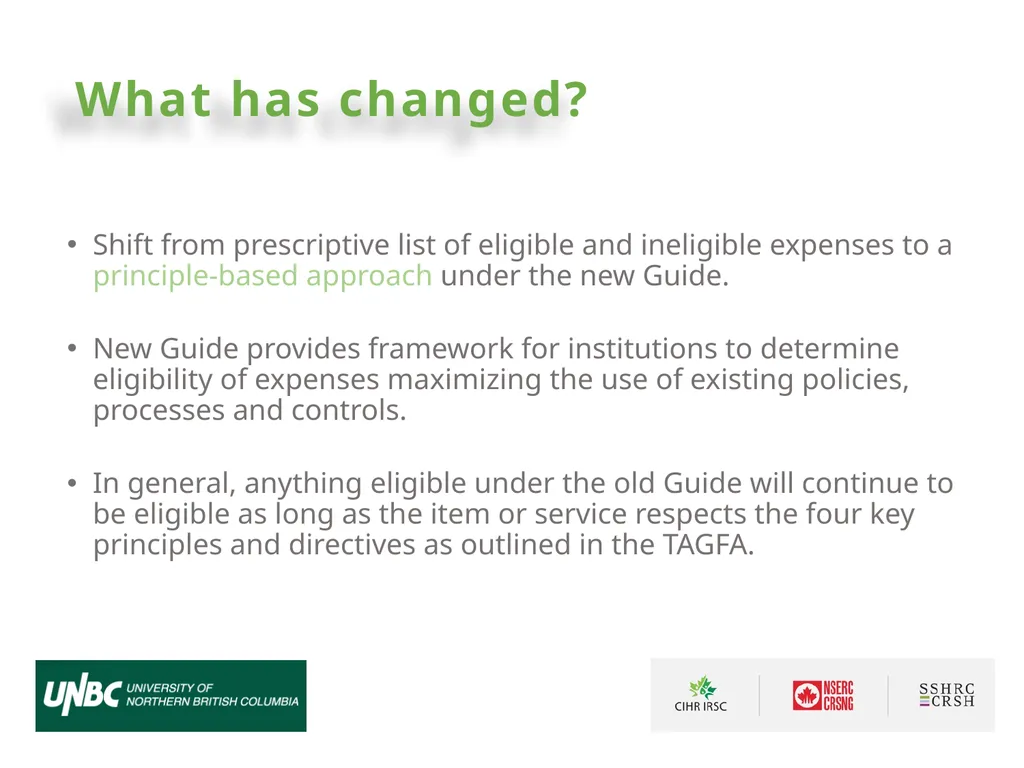
What has changed? Shift from prescriptive list of eligible and ineligible expenses to a principle-based approach under the new Guide.
New Guide provides framework for institutions to determine eligibility of expenses maximizing the use of existing policies, processes and controls.
In general, anything eligible under the old Guide will continue to be eligible as long as the item or service respects the four key principles and directives as outlined in the TAGFA.<br>
New Guide provides framework for institutions to determine eligibility of expenses maximizing the use of existing policies, processes and controls.
In general, anything eligible under the old Guide will continue to be eligible as long as the item or service respects the four key principles and directives as outlined in the TAGFA.<br>
07
Part 2: Use of Grant Funds<br>
08
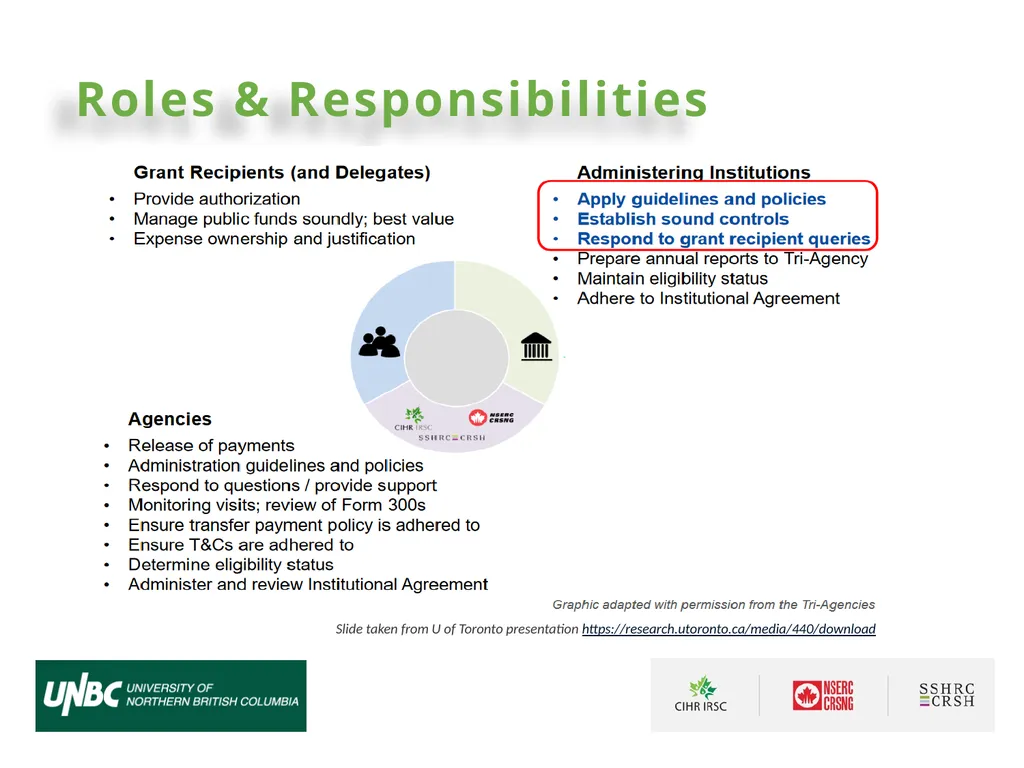
Roles & Responsibilities Slide taken from U of Toronto presentation https://research.utoronto.ca/media/440/download<br>
09
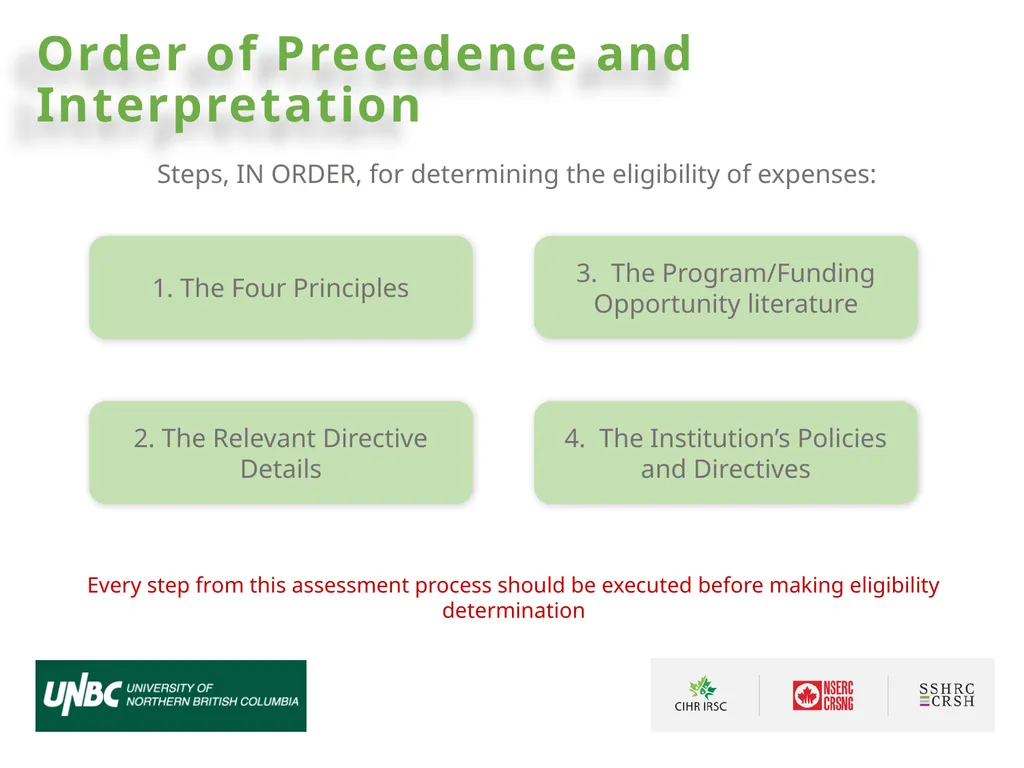
Order of Precedence and Interpretation Steps, IN ORDER, for determining the eligibility of expenses: 1. The Four Principles 3. The Program/Funding Opportunity literature 4. The Institution’s Policies and Directives 2. The Relevant Directive Details Every step from this assessment process should be executed before making eligibility determination<br>
10
Part 3: TAGFA Principles
&
Directives<br>
&
Directives<br>
11
PRINCIPLES Grant expenditures MUST:
1. Contribute towards the direct costs of the research/activities
2. Not be provided by the administering institution
3. Be effective and economical
4. Not result in personal gain<br>
1. Contribute towards the direct costs of the research/activities
2. Not be provided by the administering institution
3. Be effective and economical
4. Not result in personal gain<br>
12
PRINCIPLES on the Use of Grant Funds Grant expenditures MUST:
1. Contribute to the direct costs of the research/activities for which the funds were awarded, with benefits directly attributable to the grant What are DIRECT COSTS?
Essential expenditures that would not have been incurred had the grant not been undertaken
Accordingly, they can be directly assigned to the grant activities with a high degree of accuracy<br>
1. Contribute to the direct costs of the research/activities for which the funds were awarded, with benefits directly attributable to the grant What are DIRECT COSTS?
Essential expenditures that would not have been incurred had the grant not been undertaken
Accordingly, they can be directly assigned to the grant activities with a high degree of accuracy<br>
13
PRINCIPLES on the Use of Grant Funds Grant expenditures MUST:
2. Not be provided by the administering institution to their research personnel “Provided by the administering institution”?
If an administering unit normally provides a good or service, it cannot be charged to the grant
Tri-Agencies are mindful that what is provided by an institution can vary both across and within institutions<br>
2. Not be provided by the administering institution to their research personnel “Provided by the administering institution”?
If an administering unit normally provides a good or service, it cannot be charged to the grant
Tri-Agencies are mindful that what is provided by an institution can vary both across and within institutions<br>
14
PRINCIPLES on the Use of Grant Funds Grant expenditures MUST:
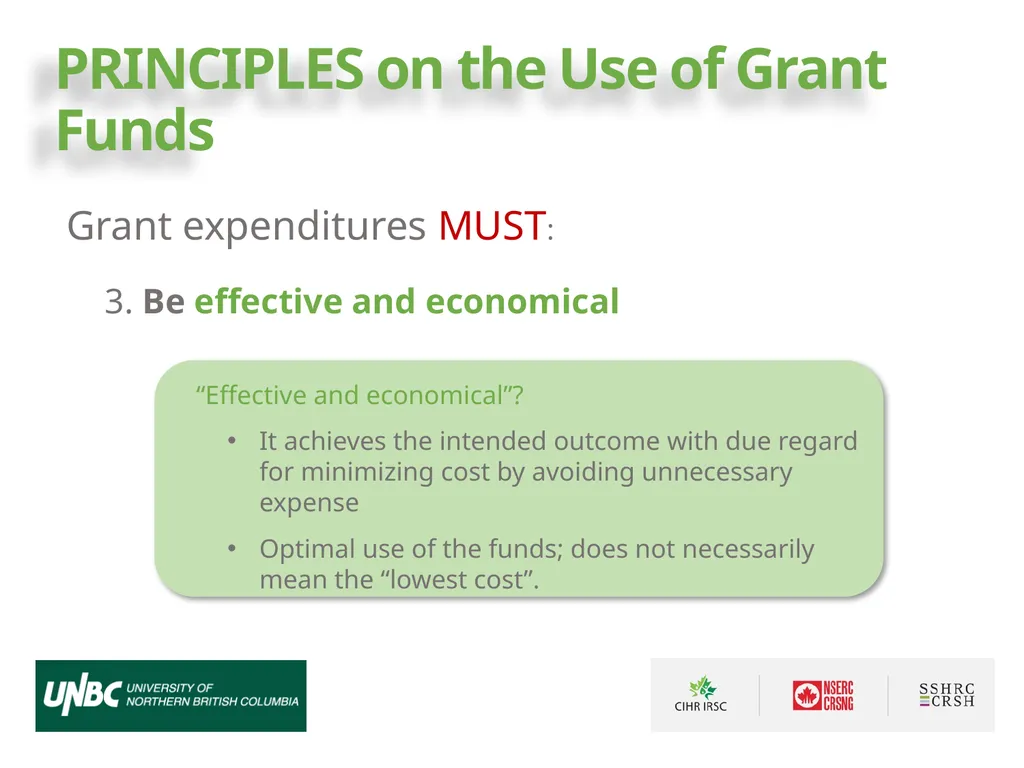
3. Be effective and economical “Effective and economical”?
It achieves the intended outcome with due regard for minimizing cost by avoiding unnecessary expense
Optimal use of the funds; does not necessarily mean the “lowest cost”.<br>
3. Be effective and economical “Effective and economical”?
It achieves the intended outcome with due regard for minimizing cost by avoiding unnecessary expense
Optimal use of the funds; does not necessarily mean the “lowest cost”.<br>
15
PRINCIPLES on the Use of Grant Funds Grant expenditures MUST:
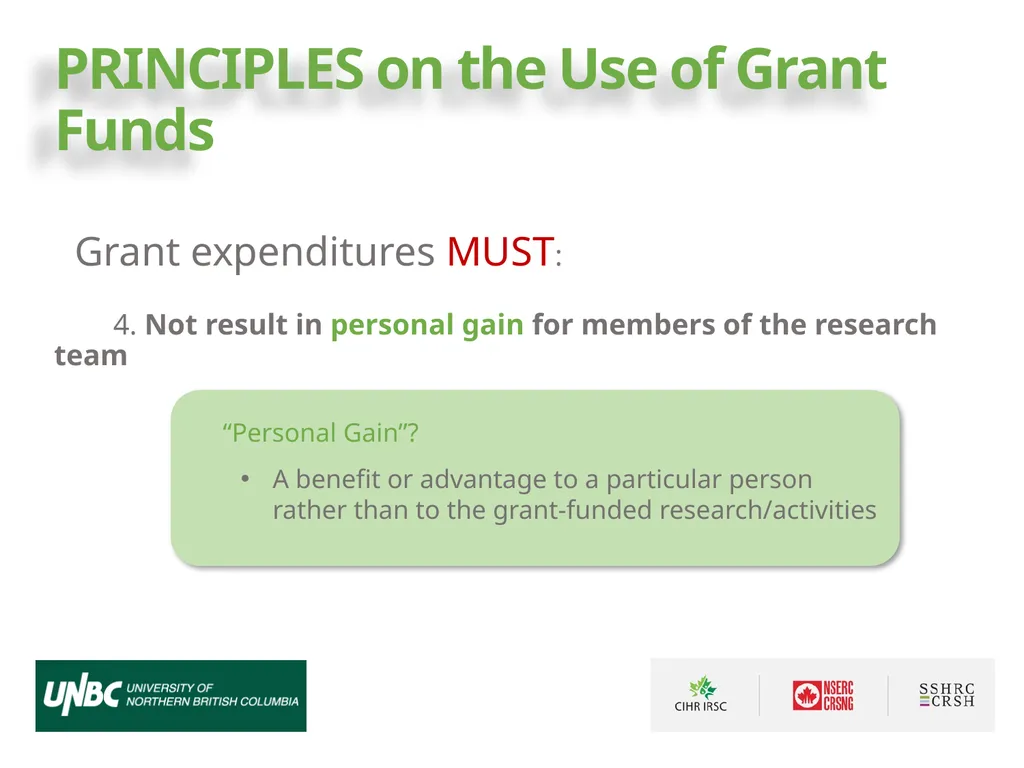
4. Not result in personal gain for members of the research team “Personal Gain”?
A benefit or advantage to a particular person rather than to the grant-funded research/activities<br>
4. Not result in personal gain for members of the research team “Personal Gain”?
A benefit or advantage to a particular person rather than to the grant-funded research/activities<br>
16
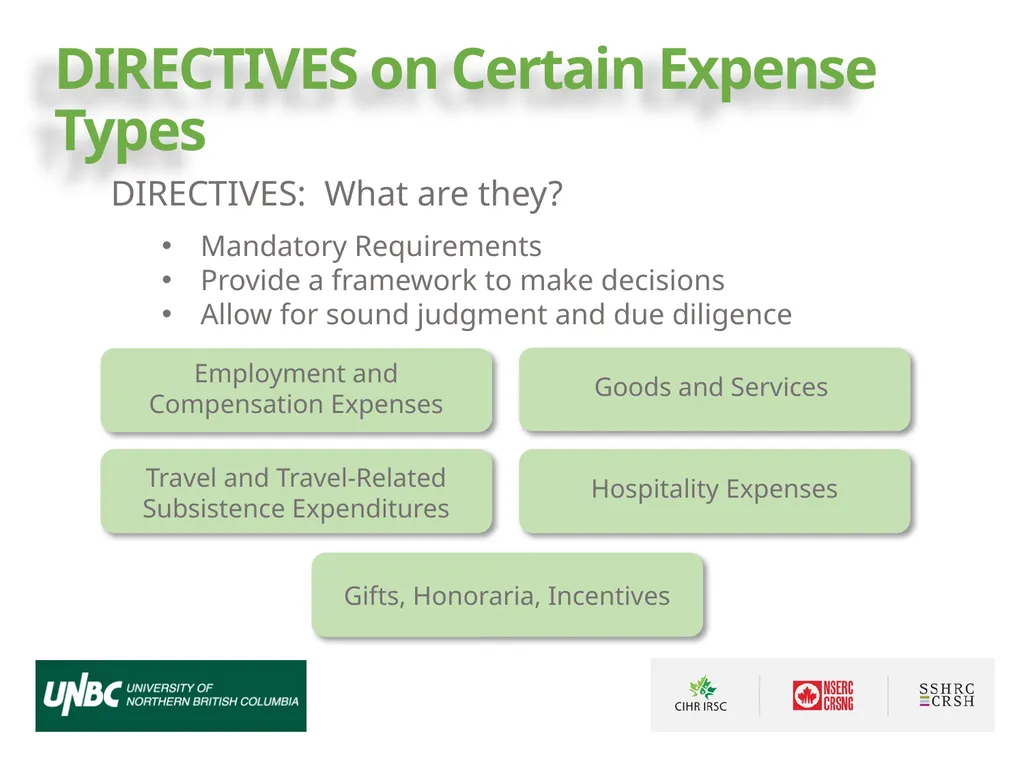
DIRECTIVES on Certain Expense Types Employment and Compensation Expenses Goods and Services Travel and Travel-Related Subsistence Expenditures Hospitality Expenses Gifts, Honoraria, Incentives DIRECTIVES: What are they?
Mandatory Requirements
Provide a framework to make decisions
Allow for sound judgment and due diligence<br>
Mandatory Requirements
Provide a framework to make decisions
Allow for sound judgment and due diligence<br>
17
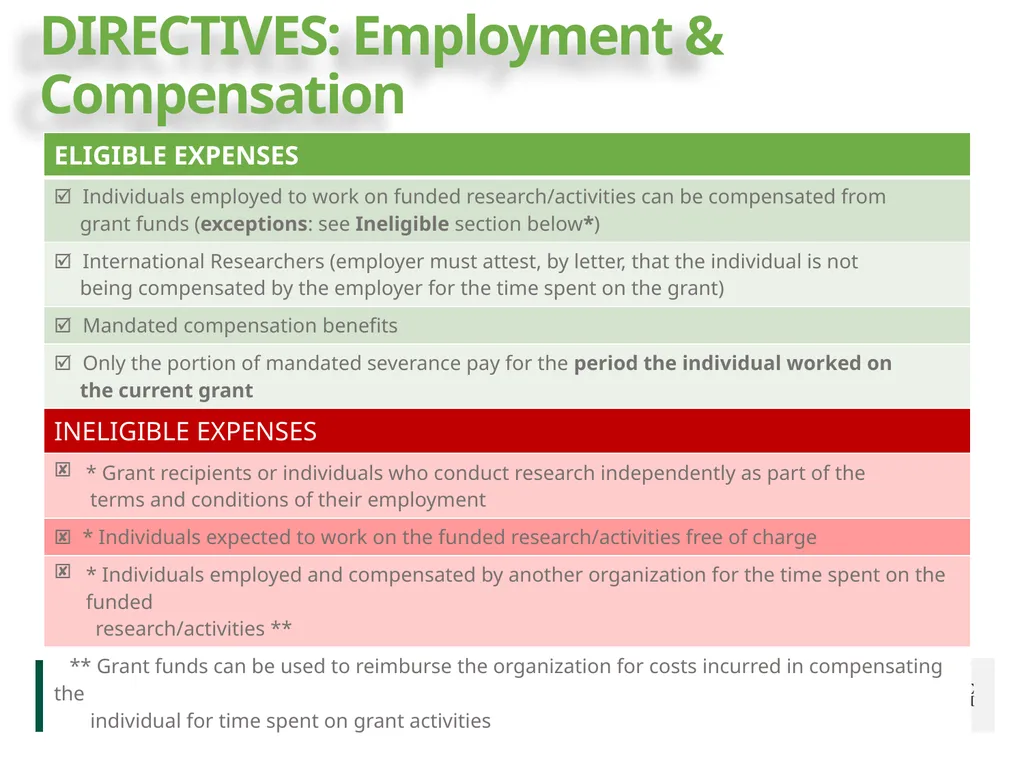
DIRECTIVES: Employment & Compensation<br>
18
DIRECTIVES: Employment & Compensation Test for Understanding
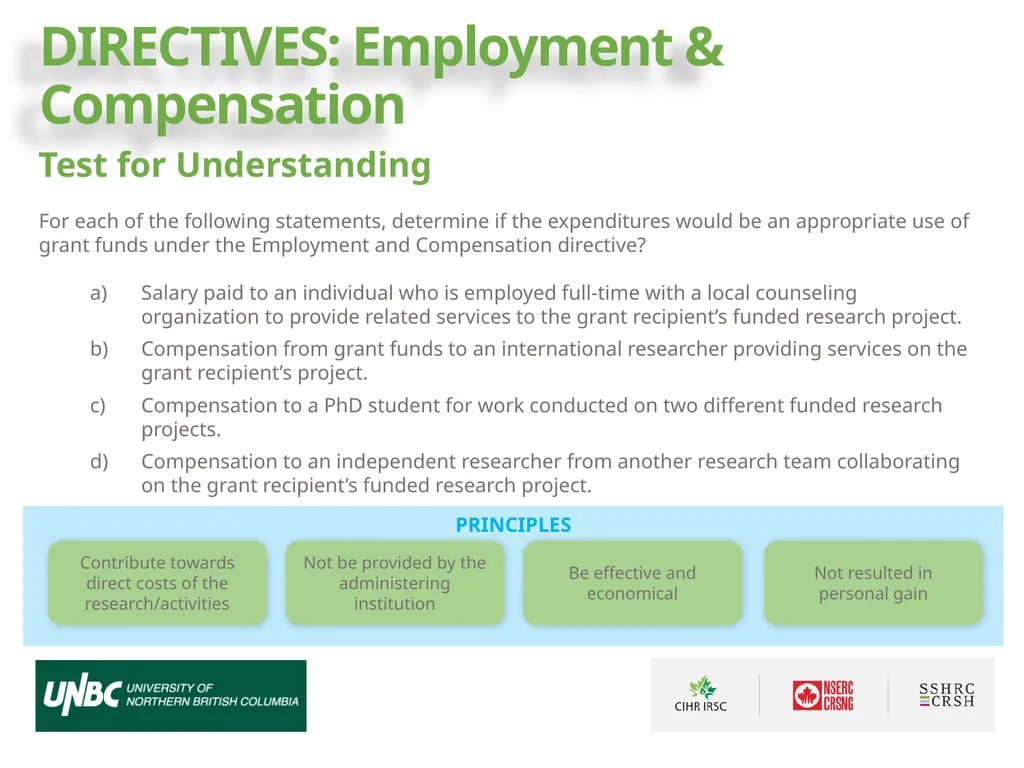
For each of the following statements, determine if the expenditures would be an appropriate use of grant funds under the Employment and Compensation directive?
Salary paid to an individual who is employed full-time with a local counseling organization to provide related services to the grant recipient’s funded research project.
Compensation from grant funds to an international researcher providing services on the grant recipient’s project.
Compensation to a PhD student for work conducted on two different funded research projects.
Compensation to an independent researcher from another research team collaborating on the grant recipient’s funded research project. Contribute towards direct costs of the research/activities Not be provided by the administering institution Be effective and economical Not resulted in personal gain<br>
For each of the following statements, determine if the expenditures would be an appropriate use of grant funds under the Employment and Compensation directive?
Salary paid to an individual who is employed full-time with a local counseling organization to provide related services to the grant recipient’s funded research project.
Compensation from grant funds to an international researcher providing services on the grant recipient’s project.
Compensation to a PhD student for work conducted on two different funded research projects.
Compensation to an independent researcher from another research team collaborating on the grant recipient’s funded research project. Contribute towards direct costs of the research/activities Not be provided by the administering institution Be effective and economical Not resulted in personal gain<br>
19
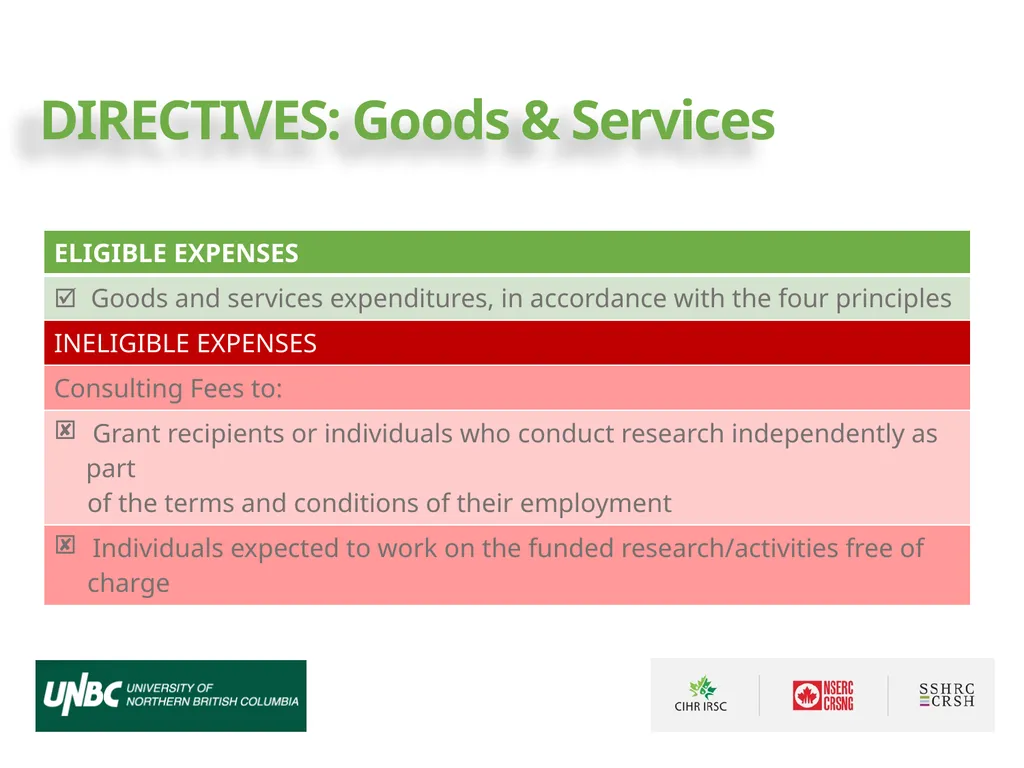
DIRECTIVES: Goods & Services<br>
20
DIRECTIVES: Goods & Services Test for Understanding
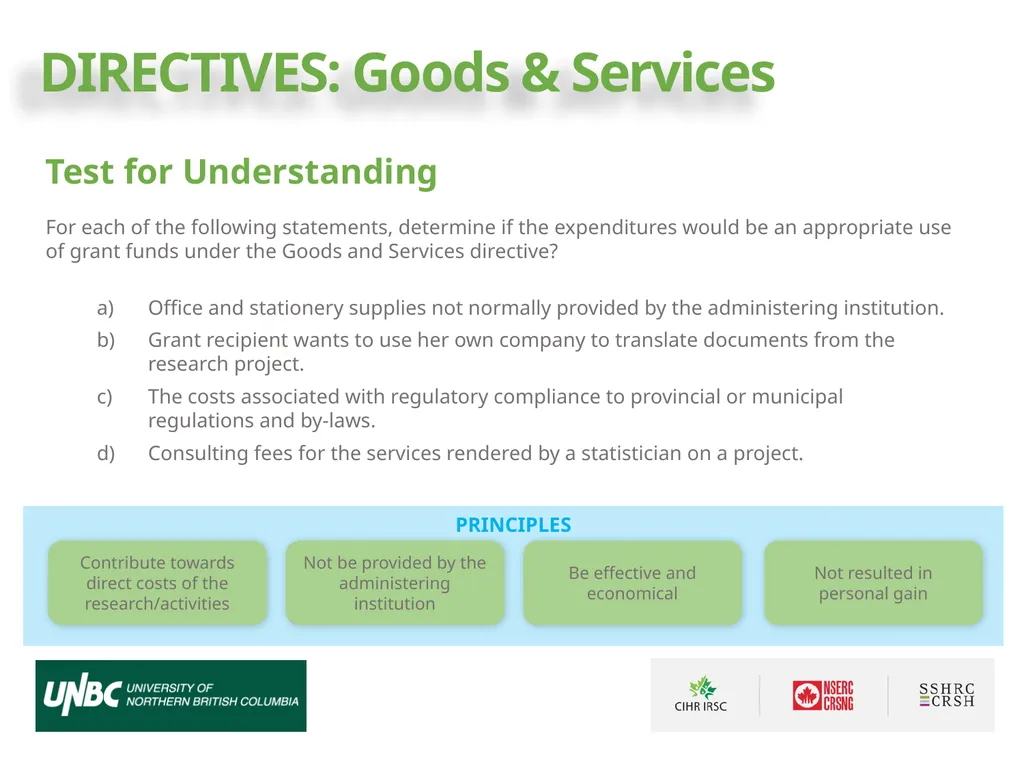
For each of the following statements, determine if the expenditures would be an appropriate use of grant funds under the Goods and Services directive?
Office and stationery supplies not normally provided by the administering institution.
Grant recipient wants to use her own company to translate documents from the research project.
The costs associated with regulatory compliance to provincial or municipal regulations and by-laws.
Consulting fees for the services rendered by a statistician on a project. Contribute towards direct costs of the research/activities Not be provided by the administering institution Be effective and economical Not resulted in personal gain<br>
For each of the following statements, determine if the expenditures would be an appropriate use of grant funds under the Goods and Services directive?
Office and stationery supplies not normally provided by the administering institution.
Grant recipient wants to use her own company to translate documents from the research project.
The costs associated with regulatory compliance to provincial or municipal regulations and by-laws.
Consulting fees for the services rendered by a statistician on a project. Contribute towards direct costs of the research/activities Not be provided by the administering institution Be effective and economical Not resulted in personal gain<br>
21
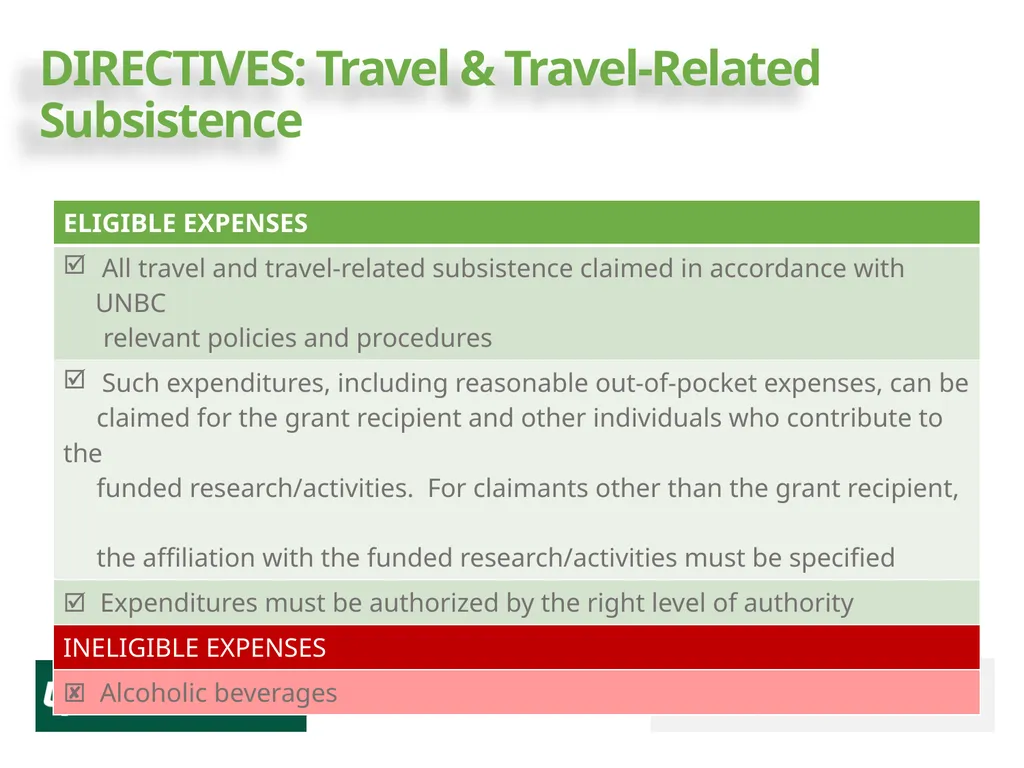
DIRECTIVES: Travel & Travel-Related Subsistence<br>
22
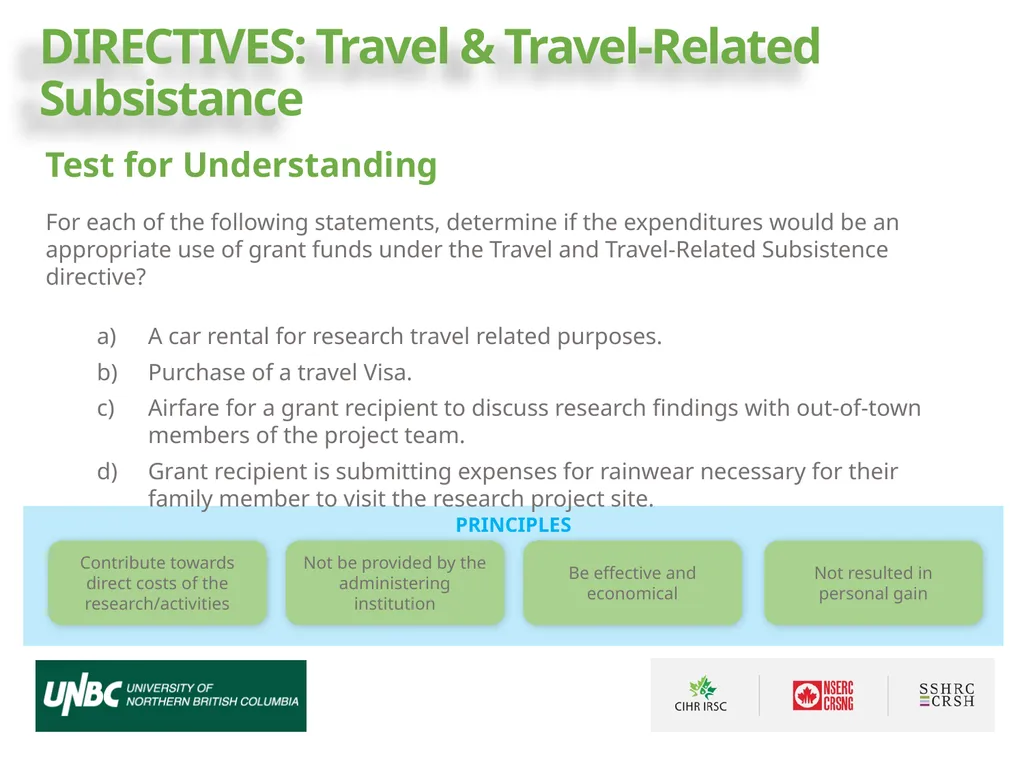
DIRECTIVES: Travel & Travel-Related Subsistance Test for Understanding
For each of the following statements, determine if the expenditures would be an appropriate use of grant funds under the Travel and Travel-Related Subsistence directive?
A car rental for research travel related purposes.
Purchase of a travel Visa.
Airfare for a grant recipient to discuss research findings with out-of-town members of the project team.
Grant recipient is submitting expenses for rainwear necessary for their family member to visit the research project site. Contribute towards direct costs of the research/activities Not be provided by the administering institution Be effective and economical Not resulted in personal gain<br>
For each of the following statements, determine if the expenditures would be an appropriate use of grant funds under the Travel and Travel-Related Subsistence directive?
A car rental for research travel related purposes.
Purchase of a travel Visa.
Airfare for a grant recipient to discuss research findings with out-of-town members of the project team.
Grant recipient is submitting expenses for rainwear necessary for their family member to visit the research project site. Contribute towards direct costs of the research/activities Not be provided by the administering institution Be effective and economical Not resulted in personal gain<br>
23
DIRECTIVES: Hospitality<br>
24
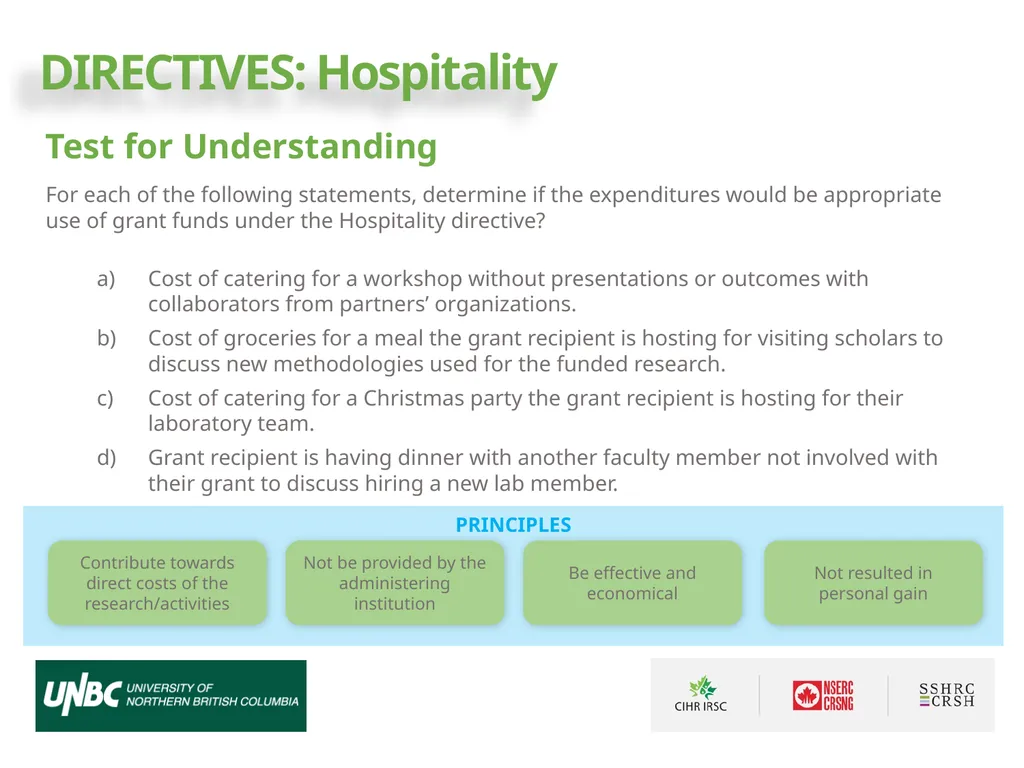
DIRECTIVES: Hospitality Test for Understanding
For each of the following statements, determine if the expenditures would be appropriate use of grant funds under the Hospitality directive?
Cost of catering for a workshop without presentations or outcomes with collaborators from partners’ organizations.
Cost of groceries for a meal the grant recipient is hosting for visiting scholars to discuss new methodologies used for the funded research.
Cost of catering for a Christmas party the grant recipient is hosting for their laboratory team.
Grant recipient is having dinner with another faculty member not involved with their grant to discuss hiring a new lab member. Contribute towards direct costs of the research/activities Not be provided by the administering institution Be effective and economical Not resulted in personal gain<br>
For each of the following statements, determine if the expenditures would be appropriate use of grant funds under the Hospitality directive?
Cost of catering for a workshop without presentations or outcomes with collaborators from partners’ organizations.
Cost of groceries for a meal the grant recipient is hosting for visiting scholars to discuss new methodologies used for the funded research.
Cost of catering for a Christmas party the grant recipient is hosting for their laboratory team.
Grant recipient is having dinner with another faculty member not involved with their grant to discuss hiring a new lab member. Contribute towards direct costs of the research/activities Not be provided by the administering institution Be effective and economical Not resulted in personal gain<br>
25
DIRECTIVES: Gifts, Honoraria & Incentives<br>
26
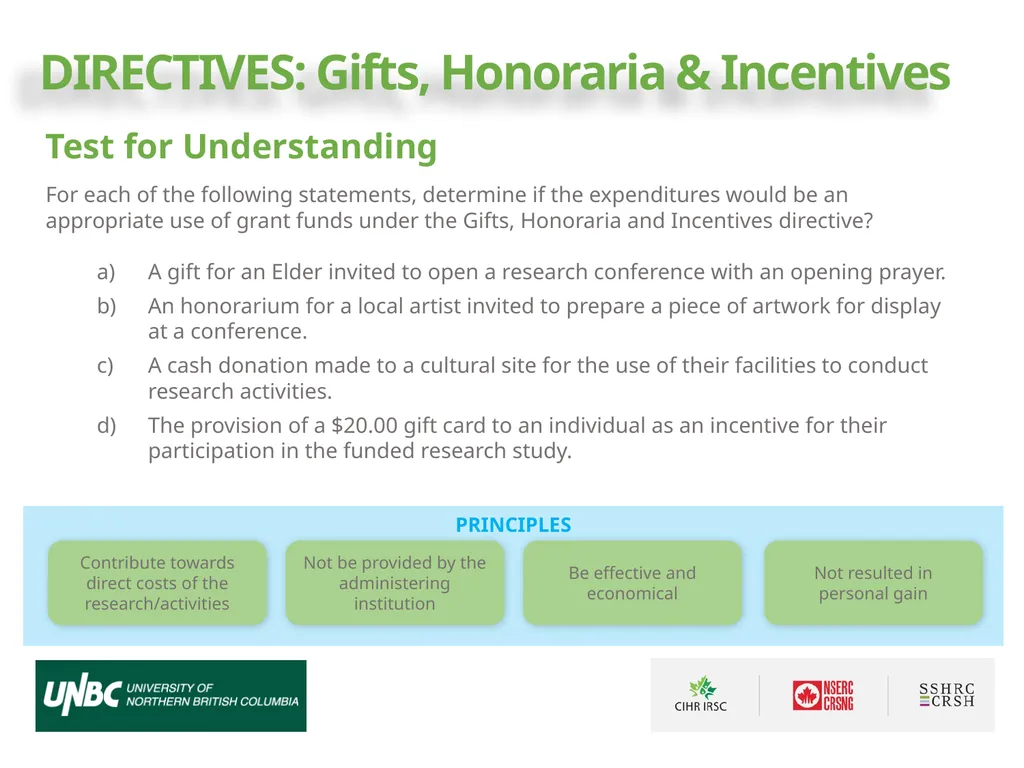
DIRECTIVES: Gifts, Honoraria & Incentives Test for Understanding
For each of the following statements, determine if the expenditures would be an appropriate use of grant funds under the Gifts, Honoraria and Incentives directive?
A gift for an Elder invited to open a research conference with an opening prayer.
An honorarium for a local artist invited to prepare a piece of artwork for display at a conference.
A cash donation made to a cultural site for the use of their facilities to conduct research activities.
The provision of a $20.00 gift card to an individual as an incentive for their participation in the funded research study. Contribute towards direct costs of the research/activities Not be provided by the administering institution Be effective and economical Not resulted in personal gain<br>
For each of the following statements, determine if the expenditures would be an appropriate use of grant funds under the Gifts, Honoraria and Incentives directive?
A gift for an Elder invited to open a research conference with an opening prayer.
An honorarium for a local artist invited to prepare a piece of artwork for display at a conference.
A cash donation made to a cultural site for the use of their facilities to conduct research activities.
The provision of a $20.00 gift card to an individual as an incentive for their participation in the funded research study. Contribute towards direct costs of the research/activities Not be provided by the administering institution Be effective and economical Not resulted in personal gain<br>
27
Part 4: Administering Institution’s Policies and Directives<br>
28
EDI – Equity, Diversity and Inclusion UNBC is responsible for recognizing the importance of equity, diversity and inclusion in its policies and practices as stated in the Agreement on the Administration of Agency Grants and Awards by Research Institutions.
All administering institutions that accept agency funding must make concerted efforts to develop and implement policies and procedures that advance the goals of EDI in the use of grant funds, to achieve equitable participation in the research system.
Grant recipients are responsible for ensuring that they carry out their grant activities in accordance with the EDI policies and practices of their administering institutions.<br>
All administering institutions that accept agency funding must make concerted efforts to develop and implement policies and procedures that advance the goals of EDI in the use of grant funds, to achieve equitable participation in the research system.
Grant recipients are responsible for ensuring that they carry out their grant activities in accordance with the EDI policies and practices of their administering institutions.<br>
29
Institutional Policies Work in Progress:
GAP Analysis to identify gaps and changes between the old Guide, the new Guide and current UNBC policies, processes and guidelines
For situations where the new guide is silent, institutional policies will apply.
When in doubt, the MOST stringent policy always applies.<br>
GAP Analysis to identify gaps and changes between the old Guide, the new Guide and current UNBC policies, processes and guidelines
For situations where the new guide is silent, institutional policies will apply.
When in doubt, the MOST stringent policy always applies.<br>
30
Part 5: Tri-Agency Resources<br>
31
Supporting Resources and Tools Frequently Asked Questions
Roles and Responsibilities
Virtual Guidance Tool
CAUBO Best Practices<br>
Roles and Responsibilities
Virtual Guidance Tool
CAUBO Best Practices<br>
32
Contact Information Aneta Douglass – Finance @ 26534
email: Aneta.Douglass@unbc.ca
Phone: 250-960-6534
Jacqueline Dockray – Office of Research @ 26357
email: Jacqueline.Dockray@unbc.ca
Phone: 250-960-6357<br>
email: Aneta.Douglass@unbc.ca
Phone: 250-960-6534
Jacqueline Dockray – Office of Research @ 26357
email: Jacqueline.Dockray@unbc.ca
Phone: 250-960-6357<br>
33
Questions/Comments<br>
34
Thank YOU!<br>