
AETCOM Module 2.6 Bioethics: case studies on
KL
Published · 31 slides · 0 views
1 / 1






Description
AETCOM Module 2.6 Bioethics: case studies on autonomy and decision making A defining responsibility of a practicing physician is to make decisions on patient care in different settings These decisions involve more than selecting appropriate
Related Topics
Share
Embed code
Download this presentation From Below
"AETCOM Module 2.6 Bioethics: case studies on" is the property of its rightful owner. Permission is granted to download and print the materials on this website for personal, non-commercial use only, and to display it on your personal computer provided you do not modify the materials and that you retain all copyright notices contained in the materials. By downloading content from our website, you accept the terms of this agreement.
Presentation Transcript
01
AETCOM Module 2.6
Bioethics: case studies on autonomy and decision making<br>
Bioethics: case studies on autonomy and decision making<br>
02
A defining responsibility of a practicing physician is to make decisions on patient care in different settings
These decisions involve more than selecting appropriate treatment or intervention<br>
These decisions involve more than selecting appropriate treatment or intervention<br>
03
Ethics is an inherent and inseparable part of clinical medicine as the physician has an ethical obligation
to benefit the patient
to avoid or minimize harm
respect the values and preferences of the patient
Ethical skills be improved by a goal-oriented educational program
It will lead to learner awareness, attitude, knowledge, moral reasoning and confidence<br>
to benefit the patient
to avoid or minimize harm
respect the values and preferences of the patient
Ethical skills be improved by a goal-oriented educational program
It will lead to learner awareness, attitude, knowledge, moral reasoning and confidence<br>
04
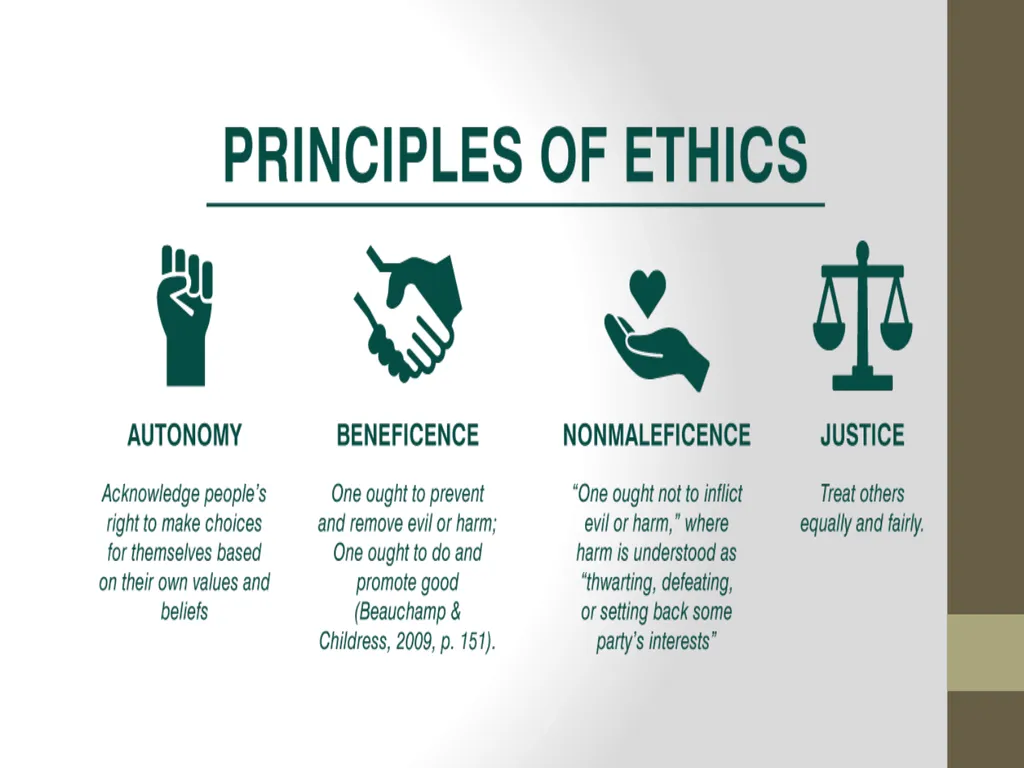
The 4 main ethical principles:
beneficence
nonmaleficence
autonomy
justice
Informed consent, truth-telling and confidentiality are part of the principle of autonomy
In patient care situations, not infrequently, there are conflicts between ethical principles (especially between beneficence and autonomy)<br>
beneficence
nonmaleficence
autonomy
justice
Informed consent, truth-telling and confidentiality are part of the principle of autonomy
In patient care situations, not infrequently, there are conflicts between ethical principles (especially between beneficence and autonomy)<br>
05
Beneficence The principle of beneficence is the obligation of physician to act:
for the benefit of the patient
prevent harm
remove conditions that will cause harm
help persons with disabilities
and rescue persons in danger
The principle calls for not just avoiding harm, but also to benefit patients and to promote their welfare<br>
for the benefit of the patient
prevent harm
remove conditions that will cause harm
help persons with disabilities
and rescue persons in danger
The principle calls for not just avoiding harm, but also to benefit patients and to promote their welfare<br>
06
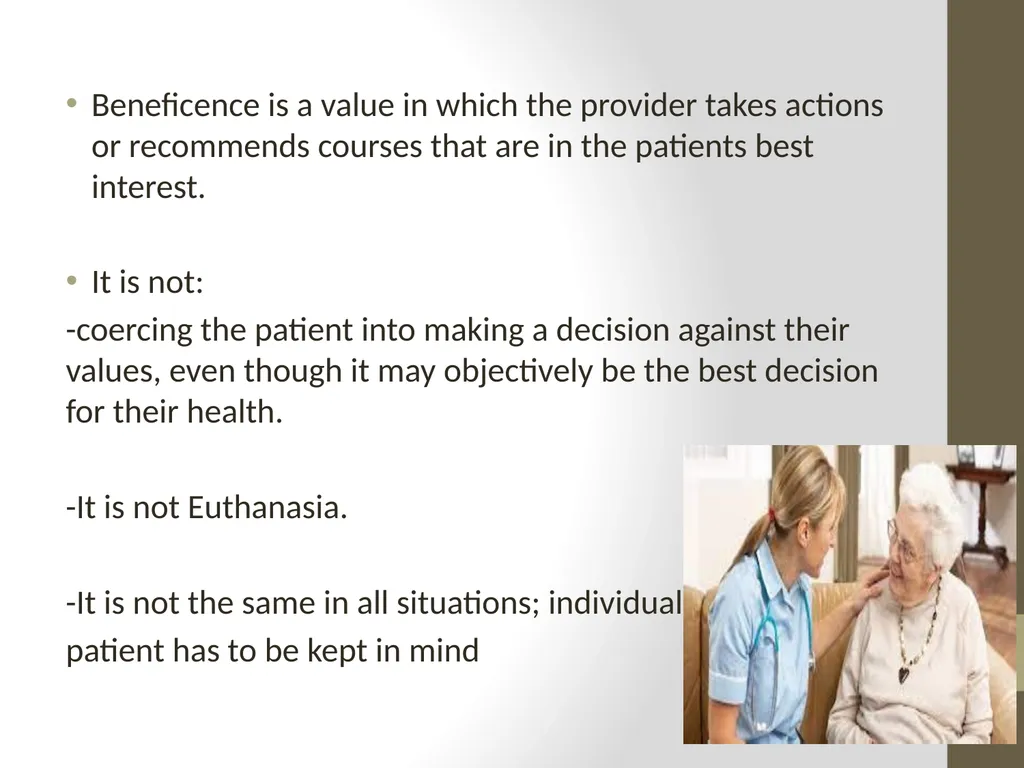
Beneficence is a value in which the provider takes actions or recommends courses that are in the patients best interest.
It is not:
-coercing the patient into making a decision against their values, even though it may objectively be the best decision for their health.
-It is not Euthanasia.
-It is not the same in all situations; individual
patient has to be kept in mind<br>
It is not:
-coercing the patient into making a decision against their values, even though it may objectively be the best decision for their health.
-It is not Euthanasia.
-It is not the same in all situations; individual
patient has to be kept in mind<br>
07
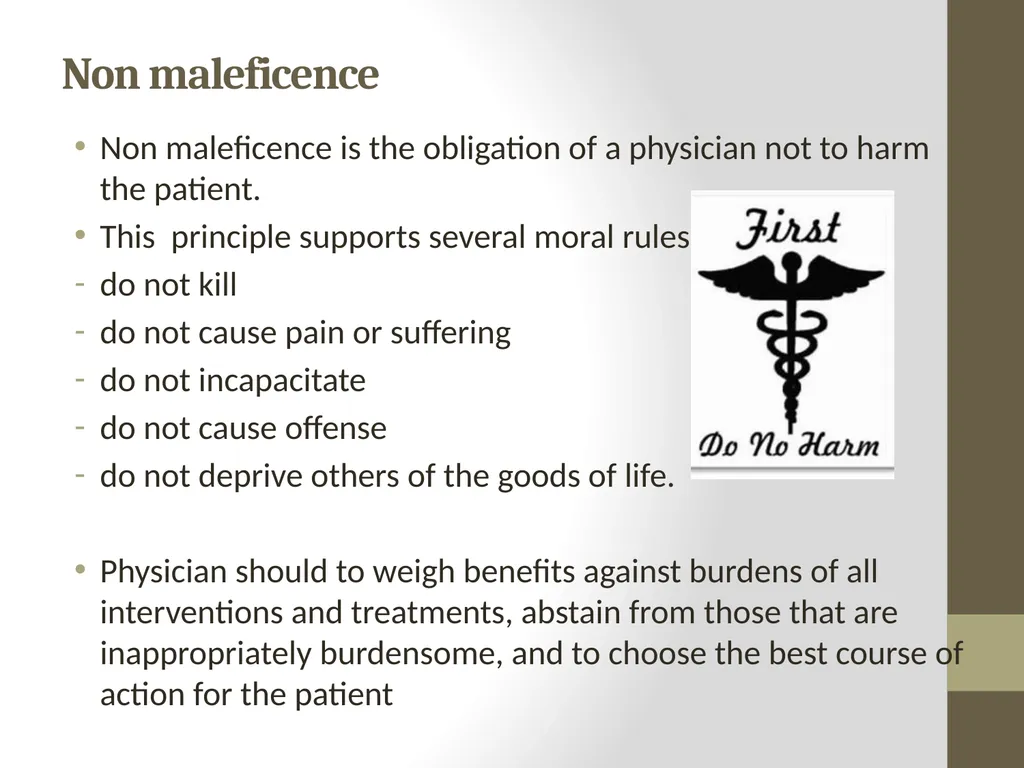
Non maleficence Non maleficence is the obligation of a physician not to harm the patient.
This principle supports several moral rules
do not kill
do not cause pain or suffering
do not incapacitate
do not cause offense
do not deprive others of the goods of life.
Physician should to weigh benefits against burdens of all interventions and treatments, abstain from those that are inappropriately burdensome, and to choose the best course of action for the patient<br>
This principle supports several moral rules
do not kill
do not cause pain or suffering
do not incapacitate
do not cause offense
do not deprive others of the goods of life.
Physician should to weigh benefits against burdens of all interventions and treatments, abstain from those that are inappropriately burdensome, and to choose the best course of action for the patient<br>
08
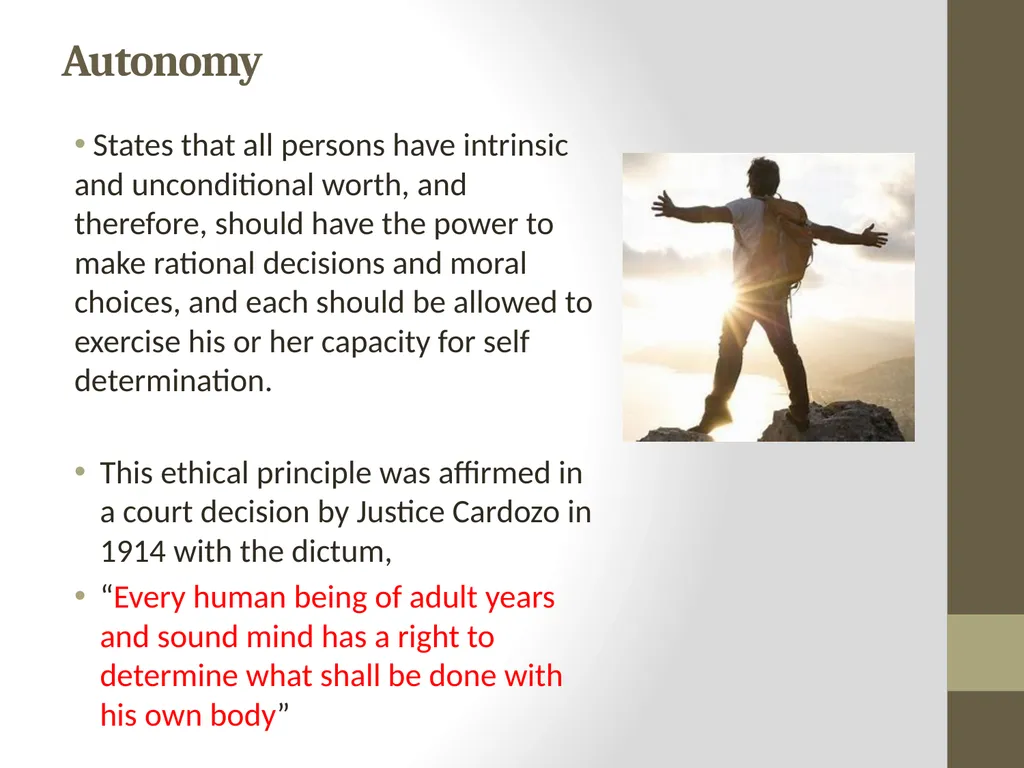
Autonomy States that all persons have intrinsic and unconditional worth, and therefore, should have the power to make rational decisions and moral choices, and each should be allowed to exercise his or her capacity for self determination.
This ethical principle was affirmed in a court decision by Justice Cardozo in 1914 with the dictum,
“Every human being of adult years and sound mind has a right to determine what shall be done with his own body”<br>
This ethical principle was affirmed in a court decision by Justice Cardozo in 1914 with the dictum,
“Every human being of adult years and sound mind has a right to determine what shall be done with his own body”<br>
09
The principle of autonomy does NOT
extend to persons who lack the capacity (competence) to act autonomously; examples include infants and children and incompetence due to developmental, mental or physical disorder.
INCOMPETENCY: court will assign a guardian
CAPACITY: determined by physician. refers to an assessment of the individuals ability to understand and make rational decision. Referred to as de facto incompetent<br>
extend to persons who lack the capacity (competence) to act autonomously; examples include infants and children and incompetence due to developmental, mental or physical disorder.
INCOMPETENCY: court will assign a guardian
CAPACITY: determined by physician. refers to an assessment of the individuals ability to understand and make rational decision. Referred to as de facto incompetent<br>
10
Respecting the principle of autonomy obliges the physician to disclose medical information and treatment options that are necessary for the patient to exercise self determination<br>
11
Informed consent The requirements of an informed consent for a medical or surgical procedure, or for research, are that the patient or subject
must be competent to understand and decide,
receives a full disclosure,
comprehends the disclosure,
acts voluntarily
consents to the proposed action<br>
must be competent to understand and decide,
receives a full disclosure,
comprehends the disclosure,
acts voluntarily
consents to the proposed action<br>
12
As competence is the first of the requirements for informed consent, one should know how to detect incompetence
In a previously autonomous, but presently incompetent patient, his/her previously expressed preferences (i.e., prior autonomous judgments) are to be respected
Presently incompetent patients would need a surrogate decision-maker<br>
In a previously autonomous, but presently incompetent patient, his/her previously expressed preferences (i.e., prior autonomous judgments) are to be respected
Presently incompetent patients would need a surrogate decision-maker<br>
13
In a non-autonomous patient, the surrogate can use either a-
a) substituted judgment standard (i.e., what the patient would wish in this circumstance and not what the surrogate would wish)
b) or a best interests standard (i.e., what would bring the highest net benefit to the patient by weighing risks and benefits)<br>
a) substituted judgment standard (i.e., what the patient would wish in this circumstance and not what the surrogate would wish)
b) or a best interests standard (i.e., what would bring the highest net benefit to the patient by weighing risks and benefits)<br>
14
Truth telling Truth-telling is a vital component in a physician-patient relationship; without this component, the physician loses the trust of the patient
An autonomous patient has not only the right to know (disclosure) of his/her diagnosis and prognosis, but also has the option to forgo (to decide not to know) this disclosure
Providing full information, with tact and sensitivity, to patients who want to know should be the standard<br>
An autonomous patient has not only the right to know (disclosure) of his/her diagnosis and prognosis, but also has the option to forgo (to decide not to know) this disclosure
Providing full information, with tact and sensitivity, to patients who want to know should be the standard<br>
15
Consequences of not telling the truth regarding a cancer include depriving the patient of an opportunity for completion of important life-tasks:
giving advice to,
and taking leave of loved ones,
putting financial affairs in order, including
division of assets,
reconciling with estranged family members and friends,
attaining spiritual order by reflection, prayer, rituals, and religious sacraments<br>
giving advice to,
and taking leave of loved ones,
putting financial affairs in order, including
division of assets,
reconciling with estranged family members and friends,
attaining spiritual order by reflection, prayer, rituals, and religious sacraments<br>
16
Confidentiality Physicians are obligated not to disclose confidential information given by a patient to another party without the patient’s authorization
An obvious exception (with implied patient authorization) is the sharing necessary of medical information for the care of the patient from the primary physician to consultants and other health-care teams
In the present-day modern hospitals with multiple points of tests and consultants, and the use of electronic medical records, there has been an erosion of confidentiality<br>
An obvious exception (with implied patient authorization) is the sharing necessary of medical information for the care of the patient from the primary physician to consultants and other health-care teams
In the present-day modern hospitals with multiple points of tests and consultants, and the use of electronic medical records, there has been an erosion of confidentiality<br>
17
However, individual physicians must exercise discipline in not discussing patient specifics with their family members or in social gatherings and social media
There are some exceptions to patient confidentiality
These include, among others, legally required reporting of gunshot wounds and sexually transmitted diseases and exceptional situations that may cause major harm to another (e.g., epidemics of infectious diseases, partner notification in HIV disease, relative notification of certain genetic risks, etc.)<br>
There are some exceptions to patient confidentiality
These include, among others, legally required reporting of gunshot wounds and sexually transmitted diseases and exceptional situations that may cause major harm to another (e.g., epidemics of infectious diseases, partner notification in HIV disease, relative notification of certain genetic risks, etc.)<br>
18
Justice Justice is generally interpreted as fair, equitable (not equal), and appropriate treatment of persons
These include
allotment of scarce resources (equipment, tests, medications, organ transplants),
care of uninsured patients,
allotment of time for outpatient visits (equal time for every patient?
Based on need or complexity not on social/ economic status<br>
These include
allotment of scarce resources (equipment, tests, medications, organ transplants),
care of uninsured patients,
allotment of time for outpatient visits (equal time for every patient?
Based on need or complexity not on social/ economic status<br>
19
An example of violation of this principle would be when a particular option of treatment is chosen over others or an
expensive drug is chosen over an equally effective but less
expensive one because it benefits the physician, financially or otherwise
A patient with urgent life threatening diseases can be treated first before patients who come with simple complaints<br>
expensive drug is chosen over an equally effective but less
expensive one because it benefits the physician, financially or otherwise
A patient with urgent life threatening diseases can be treated first before patients who come with simple complaints<br>
20
Conflicts between principles While considering a competent patient’s refusal of a potentially life-saving intervention (e.g., instituting mechanical ventilation) or request for a potentially life-ending action (e.g., withdrawing mechanical ventilation)
Ethical decision-making conflict is pronounced when the principles of beneficence and autonomy collide<br>
Ethical decision-making conflict is pronounced when the principles of beneficence and autonomy collide<br>
21
Beneficence has a historical role in the traditional practice of medicine
However, giving it primacy over patient autonomy is paternalism that makes a physician- patient relationship analogous to that of a father/mother to a child<br>
However, giving it primacy over patient autonomy is paternalism that makes a physician- patient relationship analogous to that of a father/mother to a child<br>
22
On the other end of the scale is consumerism, that says that physician’s role is limited to providing all the medical information and the available choices for interventions and treatments while the fully informed patient selects from the available choices
In this model, the physician’s role is constrained, and does not permit the full use of his/her knowledge and skills<br>
In this model, the physician’s role is constrained, and does not permit the full use of his/her knowledge and skills<br>
23
Paternalism and consumerism:
need to reconcile these to find a common ground<br>
need to reconcile these to find a common ground<br>
24
Case 1
A 20-year old college student living in hostel is brought by a friend to the Emergency Departmen (ED) because of unrelenting headache and fever. He appeared drowsy but was responsive and had fever (40°C) & neck rigidity on examination.
Lumbar puncture was done, and spinal fluid appeared cloudy and showed increased white cells; Gram stain showed Gram-positive diplococci. Based on the diagnosis of bacterial meningitis, appropriate antibiotics were started and hospitalization was instituted.<br>
A 20-year old college student living in hostel is brought by a friend to the Emergency Departmen (ED) because of unrelenting headache and fever. He appeared drowsy but was responsive and had fever (40°C) & neck rigidity on examination.
Lumbar puncture was done, and spinal fluid appeared cloudy and showed increased white cells; Gram stain showed Gram-positive diplococci. Based on the diagnosis of bacterial meningitis, appropriate antibiotics were started and hospitalization was instituted.<br>
25
Although initial consent for diagnosis was implicit, and consent for lumbar puncture was explicit, at this point, the patient refuses treatment without giving any reason and insists to return to his hostel. Even after explanation by the physician as to the seriousness of his diagnosis, and the absolute need for prompt treatment (i.e., danger to life without treatment), the patient is adamant in his refusal.<br>
26
Case 2
A 56-year old male lawyer and current cigarette smoker with a pack-a-day habit for more than 30 years, is found to have a solitary right upper lobe pulmonary mass 5 cm in size on a chest radiograph done as part of an insurance application. The mass has no calcification, and there are no other pulmonary abnormalities. He has no symptoms, and his examination is normal. Tuberculosis skin test is negative and he has no history of travel to an endemic area of fungal infection.<br>
A 56-year old male lawyer and current cigarette smoker with a pack-a-day habit for more than 30 years, is found to have a solitary right upper lobe pulmonary mass 5 cm in size on a chest radiograph done as part of an insurance application. The mass has no calcification, and there are no other pulmonary abnormalities. He has no symptoms, and his examination is normal. Tuberculosis skin test is negative and he has no history of travel to an endemic area of fungal infection.<br>
27
As lung cancer is the most probable and significant diagnosis to consider and early surgical resection provides the best prospects for cure, the physician, in consultation with the thoracic surgeon, recommends bronchoscopic biopsy and subsequent resection.
The patient understands the treatment plan and the significance of not delaying the treatment. However, he refuses & states that he does not think he has cancer; and is fearful that the surgery would kill him. Even after further explanations on the low mortality of surgery and the importance of removing the mass before it spreads, he continues to refuse treatment.<br>
The patient understands the treatment plan and the significance of not delaying the treatment. However, he refuses & states that he does not think he has cancer; and is fearful that the surgery would kill him. Even after further explanations on the low mortality of surgery and the importance of removing the mass before it spreads, he continues to refuse treatment.<br>
28
Case 3
A 67-year old widow, an immigrant from southern India, is living with her son and his family in Wisconsin, USA. She was experiencing nausea, lack of appetite and weight loss for a few months. During the past week, she also had dark yellow urine, and yellow coloration of her skin. She has basic knowledge of English.<br>
A 67-year old widow, an immigrant from southern India, is living with her son and his family in Wisconsin, USA. She was experiencing nausea, lack of appetite and weight loss for a few months. During the past week, she also had dark yellow urine, and yellow coloration of her skin. She has basic knowledge of English.<br>
29
She was brought to a multi-specialty teaching hospital by her son, who informed the doctor that his mother has “jaundice,” and instructed that, if any serious life-threatening disease was found, not to inform her. He asked that all information should come to him, and if there is any cancer not to treat it, since she is older and frail. Investigations in the hospital reveals that she has pancreatic cancer, and chemotherapy, while not likely to cure, would prolong her life.<br>
30
Discuss… After a road traffic accident a patient was rushed to Emergency OT where splenectomy was performed without the patient’s consent.
The surgeon followed:
Autonomy
Beneficience
Justice
Non maleficience<br>
The surgeon followed:
Autonomy
Beneficience
Justice
Non maleficience<br>