Affections of Teeth continued Gulshan Kumar MVSc, PhD Dept. of Veterinary Surgery and Radiology, CoVSc AH, DUVASU, Mathura-281001 Dental fistula Abuts on the root of the tooth Ætiology: Alveolar periostitis or dental abscessation
"Affections of Teeth ………continued Gulshan Kumar" is the property of its rightful owner. Permission is granted to
download and print the materials on this website for personal, non-commercial use only, and to display it
on your personal computer provided you do not modify the materials and that you retain all copyright
notices contained in the materials. By downloading content from our website, you accept the terms of this
agreement.
Presentation Transcript
01
Affections of Teeth ………continued Gulshan Kumar
MVSc, PhD Dept. of Veterinary Surgery and Radiology, CoVSc & AH, DUVASU, Mathura-281001<br>
02
Dental fistula
Abuts on the root of the tooth
Ætiology:
Alveolar periostitis or dental abscessation
Trauma Dept. of Veterinary Surgery and Radiology, CoVSc & AH, DUVASU, Mathura-281001<br>
03
Tumours of gums and alveoli
Odontoma
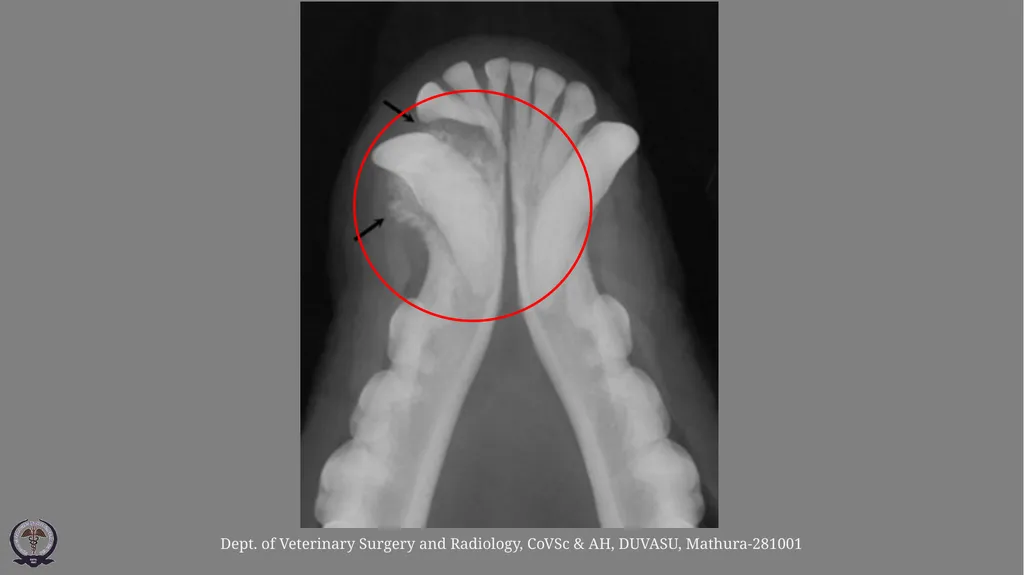
Benign odontogenic tumour in which both the epithelial and mesenchymal cells are well differentiated resulting in the formation of all dental tissue types.
A hamartoma rather than a neoplasm.
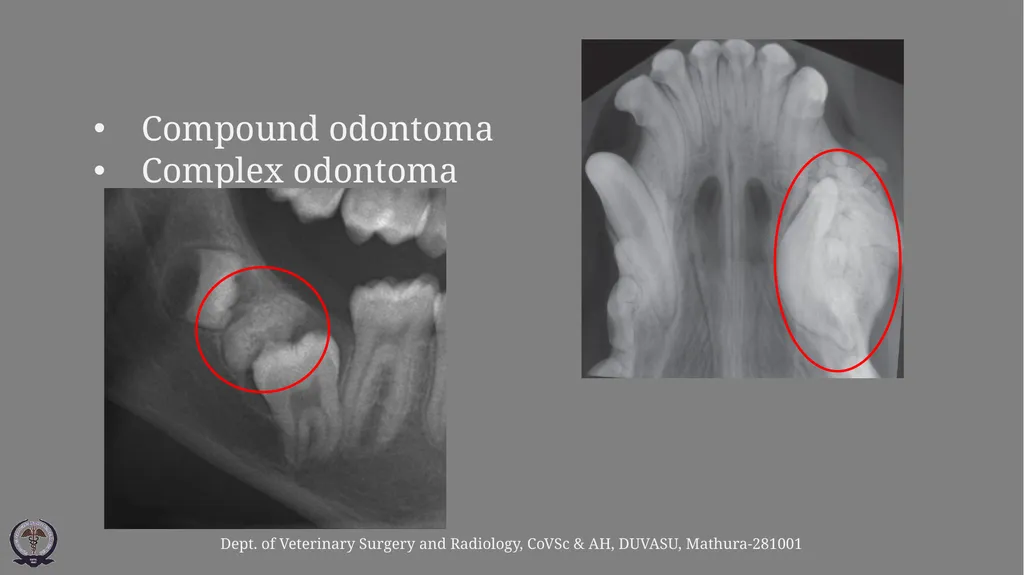
Compound odontoma: tooth-like structures are present indicating advanced cellular differentiation (radiographically, variable number of tooth-like structures-denticles.)
Complex odontoma: the conglomerate of dental tissues bears no resemblance to a tooth ( radiographically, a sharply defined mass of calcified material surrounded by a narrow radiolucent band.)
May be associated with un-erupted teeth, a dentigerous cyst, or may be attached to an otherwise normal tooth. The term ameloblastic odontoma is occasionally encountered in the veterinary literature. An ameloblastic odontoma is an ameloblastoma with focal differentiation into an odontoma Dept. of Veterinary Surgery and Radiology, CoVSc & AH, DUVASU, Mathura-281001<br>
04
Compound odontoma
Complex odontoma Dept. of Veterinary Surgery and Radiology, CoVSc & AH, DUVASU, Mathura-281001<br>
05
Tumours of gums and alveoli
Ameloblastoma: most common odontogenic tumors, occasionally incorrectly referred to as adamantinoma.
Occur in young animals.
Usually a locally invasive neoplasm with osteolysis around the tooth roots and cystic changes.
Has a follicular arrangement of ameloblasts and stellate reticulum cells, resembling the basic structure of the enamel organ.
In the dog, often characterized by focal keratinization. Metastasis has not been described. Dept. of Veterinary Surgery and Radiology, CoVSc & AH, DUVASU, Mathura-281001<br>
06
Dept. of Veterinary Surgery and Radiology, CoVSc & AH, DUVASU, Mathura-281001<br>
07
Tumours of gums and alveoli
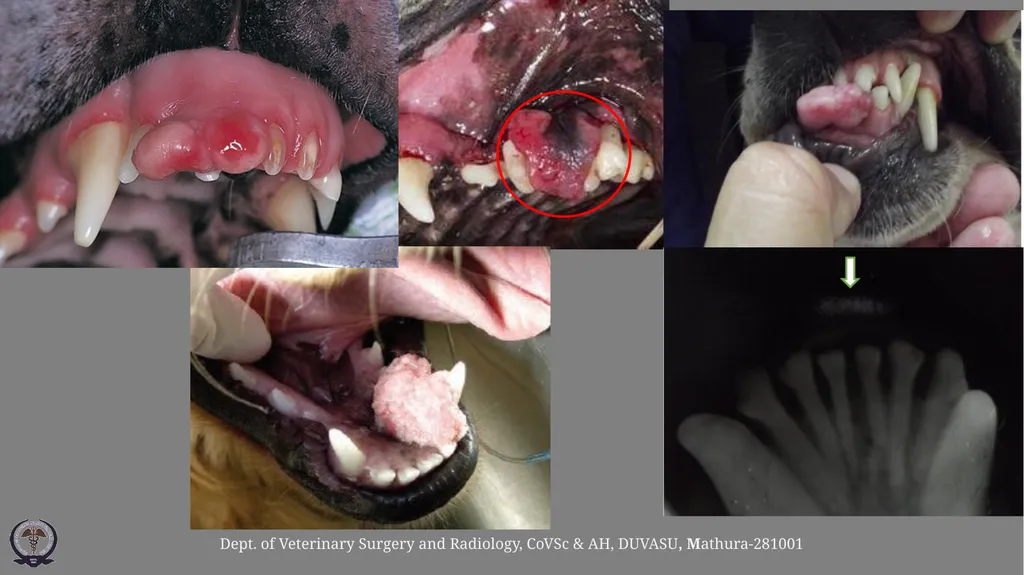
Epulis: Hyper-reactive fibrous granuloma (Gum boil) of the gum arising from periodontal ligament.
Mainly 3 types:
Fibromatous -less aggressive.
Ossifying epulides -less aggressive.
Acanthomatous is most aggressive. Dept. of Veterinary Surgery and Radiology, CoVSc & AH, DUVASU, Mathura-281001<br>
08
Dept. of Veterinary Surgery and Radiology, CoVSc & AH, DUVASU, Mathura-281001<br>
09
Dept. of Veterinary Surgery and Radiology, CoVSc & AH, DUVASU, Mathura-281001 Bishoping: Normally the infundibular mark disappears from the central incisors by 6 yrs. And from corner incisors by 8 yrs. Bishoping is attempting to make an old mouth look younger, as follows:
The teeth are filed short and level, a false “infundibular mark” is gouged out of the centre of the table and blackened with caustic to lessen the years.
The trick may be detected by :
closing the mouth, when the teeth will not meet naturally;
by observing the absence of the enamel rim to the false mark and errors of its shape due to slips of the gouge;
occasionally the traces of the rasp or file used to shorten the teeth are in evidence..<br>