
AGB 610 Laboratory Animal Breeding UNIT – I



Description: AGB 610 Laboratory Animal Breeding UNIT I Laboratory Animals and their uses Lecture - 1 Dr K G Mandal Department of Animal Genetics Breeding Bihar Veterinary College, Patna Bihar Animal Sciences University, Patna Laboratory Animals ?:
Related Topics
Download Presentation
"AGB 610 Laboratory Animal Breeding UNIT – I" is the property of its rightful owner. Permission is granted to download and print the materials on this website for personal, non-commercial use only, and to display it on your personal computer provided you do not modify the materials and that you retain all copyright notices contained in the materials. By downloading content from our website, you accept the terms of this agreement.
Presentation Transcript
slide1. AGB 610
Laboratory Animal Breeding UNIT – I
Laboratory Animals and their uses
Lecture - 1
Dr K G Mandal Department of Animal Genetics & Breeding Bihar Veterinary College, Patna Bihar Animal Sciences University, Patna<br>
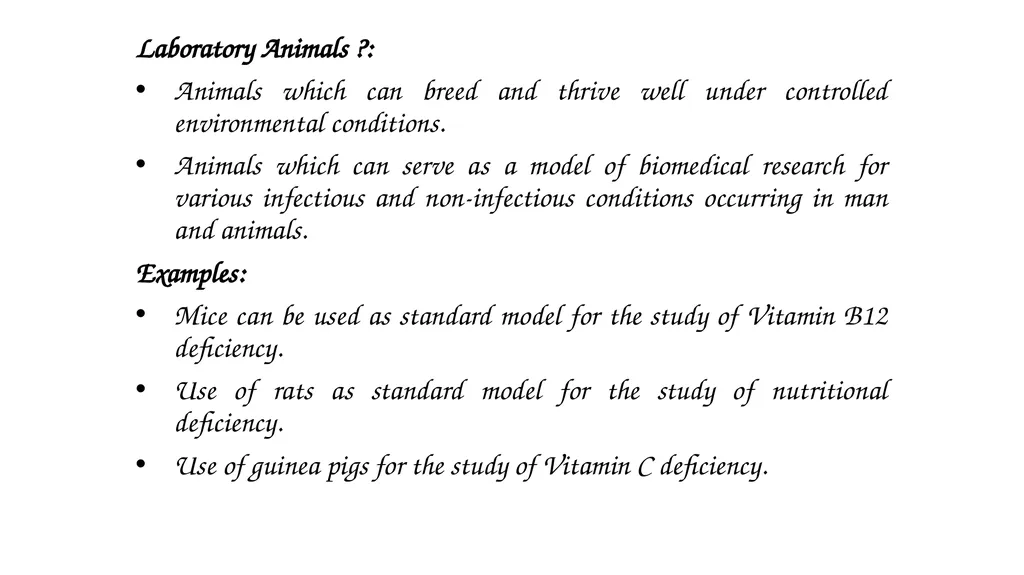
slide2. Laboratory Animals ?:
Animals which can breed and thrive well under controlled environmental conditions.
Animals which can serve as a model of biomedical research for various infectious and non-infectious conditions occurring in man and animals.
Examples:
Mice can be used as standard model for the study of Vitamin B12 deficiency.
Use of rats as standard model for the study of nutritional deficiency.
Use of guinea pigs for the study of Vitamin C deficiency.<br>
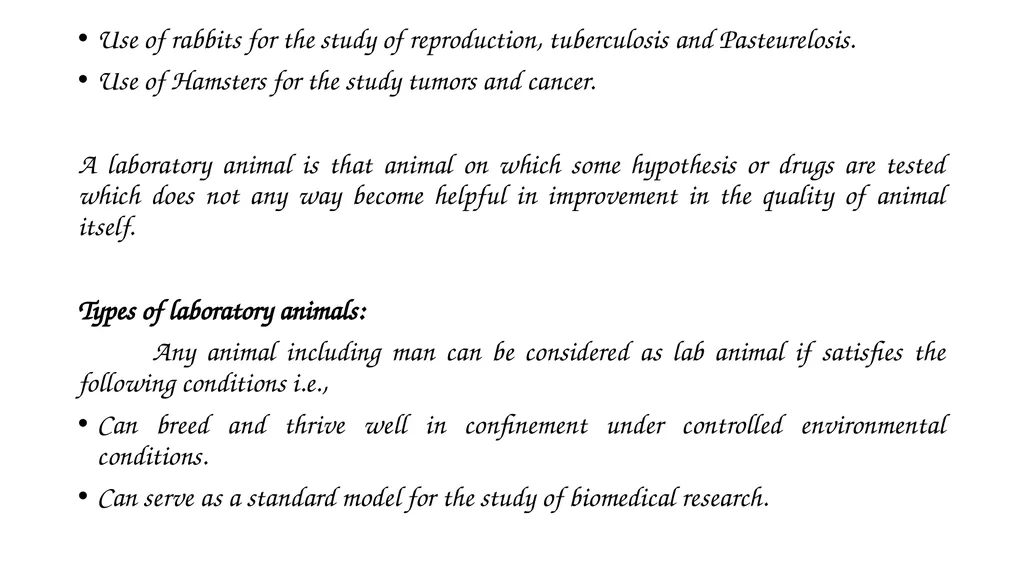
slide3. Use of rabbits for the study of reproduction, tuberculosis and Pasteurelosis.
Use of Hamsters for the study tumors and cancer.
A laboratory animal is that animal on which some hypothesis or drugs are tested which does not any way become helpful in improvement in the quality of animal itself.
Types of laboratory animals:
Any animal including man can be considered as lab animal if satisfies the following conditions i.e.,
Can breed and thrive well in confinement under controlled environmental conditions.
Can serve as a standard model for the study of biomedical research.<br>
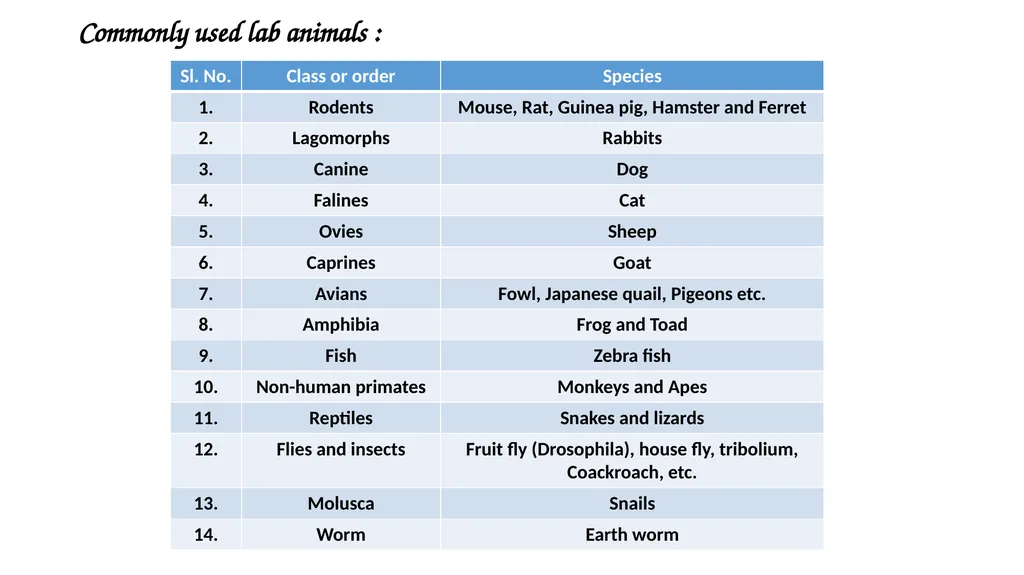
slide4. Commonly used lab animals :<br>
slide5. Selection or choice of species :
The most important factor in selection of species is the target population on which inference of any experiment is to be drawn.
When result of any experiment is to be projected on human being, serious consideration is to be given on selection of animals.
The experiment should be continued if results are satisfactory.
Initially mice, rats, guinea pigs, rabbits and hamsters should be used for screening.
If results are satisfactory, then the experiment can be extended on dogs or non-human primates like monkey & apes.<br>
slide6. Classification of laboratory animals :
On the basis of bacterial load they carry, the laboratory animals can be classified into following three categories:
Conventional lab animals (CV)
Germ Free Animals (GF)
Specific Pathogen Free animals (SPF)
Use of laboratory animals – in the field of biomedical research:
Reproductive biology
To study the nutritional deficiency
To study the deficiency of vitamins<br>
slide7. 4. Diagnosis of bacterial and viral infection
5. Tissue transplantation and cancer research
6. Testing of drugs
7. Production of clone and transgenic animals
8. Toxicity study
9. To study the principles of genetics and breeding
10. To test the pregnancy in woman
11. Production of anti-sera
12. To study the efficacy of vaccine, sera, toxins and antigens
13. Assay of insulin and other hormones<br>
slide8. Conclusion :
Reliability and reproducibility of the results of biomedical experiment depends on the use of standard, genetically uniform and well defined lab animals in the clean and healthy environment and standard management practices.
The use of substandard animals of unknown origin, unknown nutritional and microbial status may lead in the production of unreliable and un-reproducible results.<br>
slide9. THANK YOU<br>
Laboratory Animal Breeding UNIT – I
Laboratory Animals and their uses
Lecture - 1
Dr K G Mandal Department of Animal Genetics & Breeding Bihar Veterinary College, Patna Bihar Animal Sciences University, Patna<br>
slide2. Laboratory Animals ?:
Animals which can breed and thrive well under controlled environmental conditions.
Animals which can serve as a model of biomedical research for various infectious and non-infectious conditions occurring in man and animals.
Examples:
Mice can be used as standard model for the study of Vitamin B12 deficiency.
Use of rats as standard model for the study of nutritional deficiency.
Use of guinea pigs for the study of Vitamin C deficiency.<br>
slide3. Use of rabbits for the study of reproduction, tuberculosis and Pasteurelosis.
Use of Hamsters for the study tumors and cancer.
A laboratory animal is that animal on which some hypothesis or drugs are tested which does not any way become helpful in improvement in the quality of animal itself.
Types of laboratory animals:
Any animal including man can be considered as lab animal if satisfies the following conditions i.e.,
Can breed and thrive well in confinement under controlled environmental conditions.
Can serve as a standard model for the study of biomedical research.<br>
slide4. Commonly used lab animals :<br>
slide5. Selection or choice of species :
The most important factor in selection of species is the target population on which inference of any experiment is to be drawn.
When result of any experiment is to be projected on human being, serious consideration is to be given on selection of animals.
The experiment should be continued if results are satisfactory.
Initially mice, rats, guinea pigs, rabbits and hamsters should be used for screening.
If results are satisfactory, then the experiment can be extended on dogs or non-human primates like monkey & apes.<br>
slide6. Classification of laboratory animals :
On the basis of bacterial load they carry, the laboratory animals can be classified into following three categories:
Conventional lab animals (CV)
Germ Free Animals (GF)
Specific Pathogen Free animals (SPF)
Use of laboratory animals – in the field of biomedical research:
Reproductive biology
To study the nutritional deficiency
To study the deficiency of vitamins<br>
slide7. 4. Diagnosis of bacterial and viral infection
5. Tissue transplantation and cancer research
6. Testing of drugs
7. Production of clone and transgenic animals
8. Toxicity study
9. To study the principles of genetics and breeding
10. To test the pregnancy in woman
11. Production of anti-sera
12. To study the efficacy of vaccine, sera, toxins and antigens
13. Assay of insulin and other hormones<br>
slide8. Conclusion :
Reliability and reproducibility of the results of biomedical experiment depends on the use of standard, genetically uniform and well defined lab animals in the clean and healthy environment and standard management practices.
The use of substandard animals of unknown origin, unknown nutritional and microbial status may lead in the production of unreliable and un-reproducible results.<br>
slide9. THANK YOU<br>