04
Case Information Complaint. The Plaintiff may pursue different theories of negligence.
Defense. The Defense may elect to contest the charge and/or pursue an affirmative defense. Pursuing an affirmative defense does not alleviate the Plaintiff of its burden.
All Constitutional objections overruled. All potential constitutional issues that might normally be addressed through pretrial motion have been raised and overruled.<br>
05
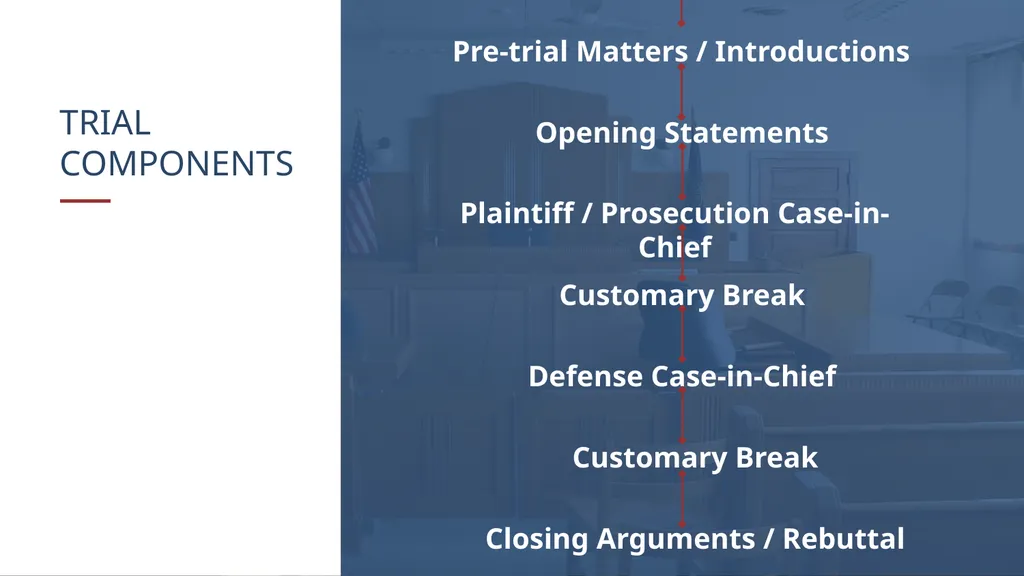
TRIAL COMPONENTS Pre-trial Matters / Introductions Plaintiff / Prosecution Case-in-Chief Opening Statements Defense Case-in-Chief Customary Break Closing Arguments / Rebuttal Customary Break<br>
06
PRESIDING, SCORING, & COMMENTING How to evaluate the round<br>
07
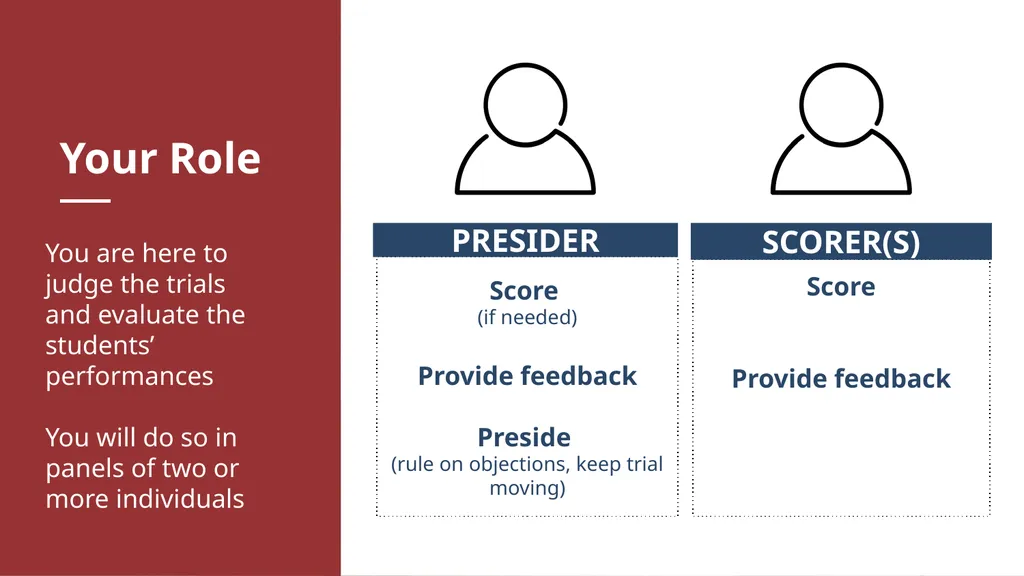
Your Role You are here to judge the trials and evaluate the students’ performances
You will do so in panels of two or more individuals Score
(if needed)
Provide feedback
Preside
(rule on objections, keep trial moving) Score
Provide feedback PRESIDER SCORER(S)<br>
08
PRESIDER: RULING ON OBJECTIONS In general, please allow students to be heard on objections. We want them to display what they do (and don’t) know.
Try not to let objection arguments drag on too long. Allowing each advocate to speak one or two times should be sufficient for ruling on most objections.
Please do not raise your own objections and do not question the witnesses yourself.
You have discretion and final say in your rulings.<br>
09
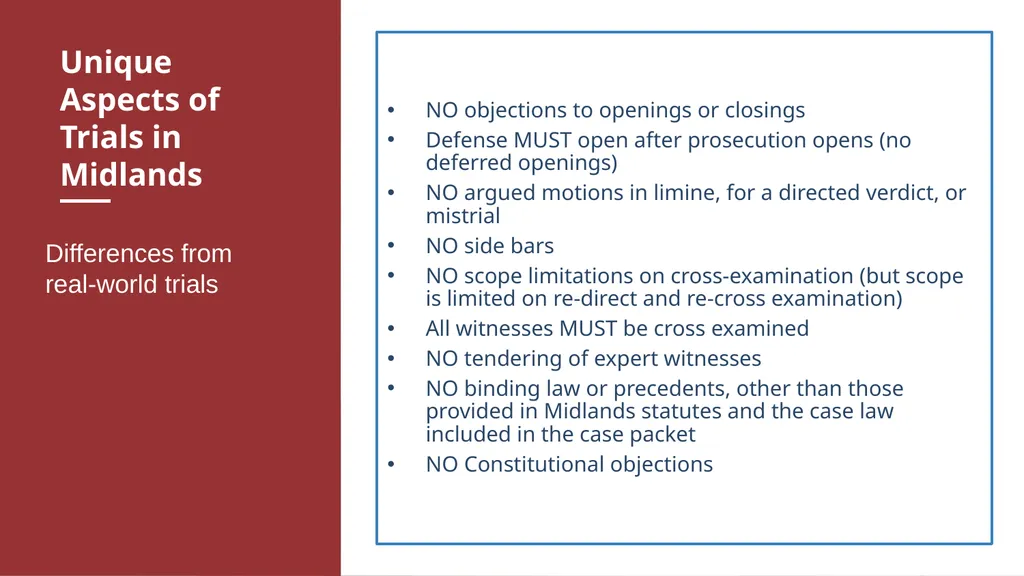
Unique Aspects of Trials in Midlands Differences from real-world trials NO objections to openings or closings
Defense MUST open after prosecution opens (no deferred openings)
NO argued motions in limine, for a directed verdict, or mistrial
NO side bars
NO scope limitations on cross-examination (but scope is limited on re-direct and re-cross examination)
All witnesses MUST be cross examined
NO tendering of expert witnesses
NO binding law or precedents, other than those provided in Midlands statutes and the case law included in the case packet
NO Constitutional objections<br>
10
Movement Throughout Trial and Exhibits While other jurisdictions may differ, please allow students to move throughout the well and use demonstrative aids (subject to objections).
Students may elect to provide exhibits to the Court and witnesses via exhibit binders they have provided, which may be located at the bench and witness stand.<br>
11
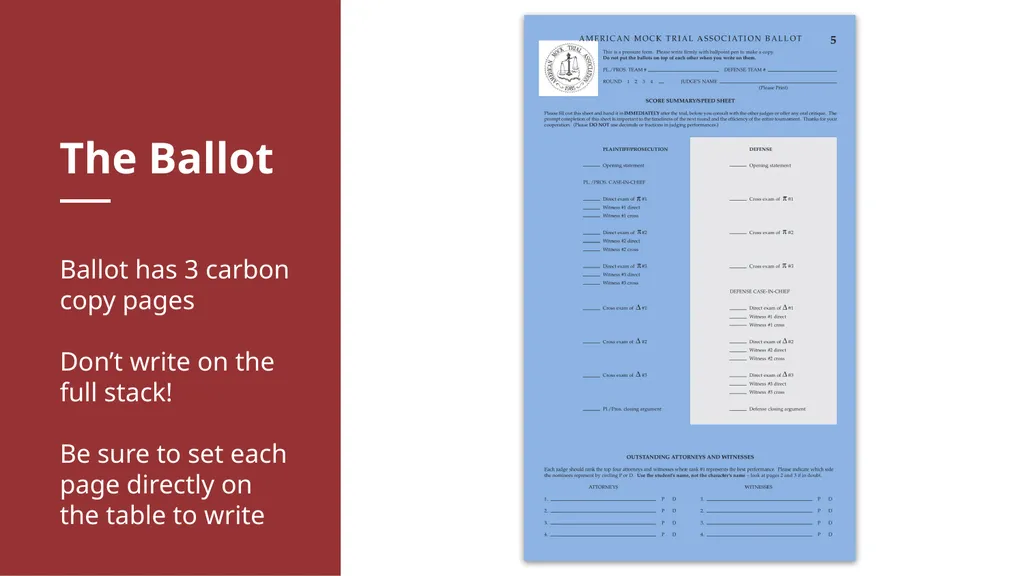
The Ballot Ballot has 3 carbon copy pages
Don’t write on the full stack!
Be sure to set each page directly on the table to write<br>
12
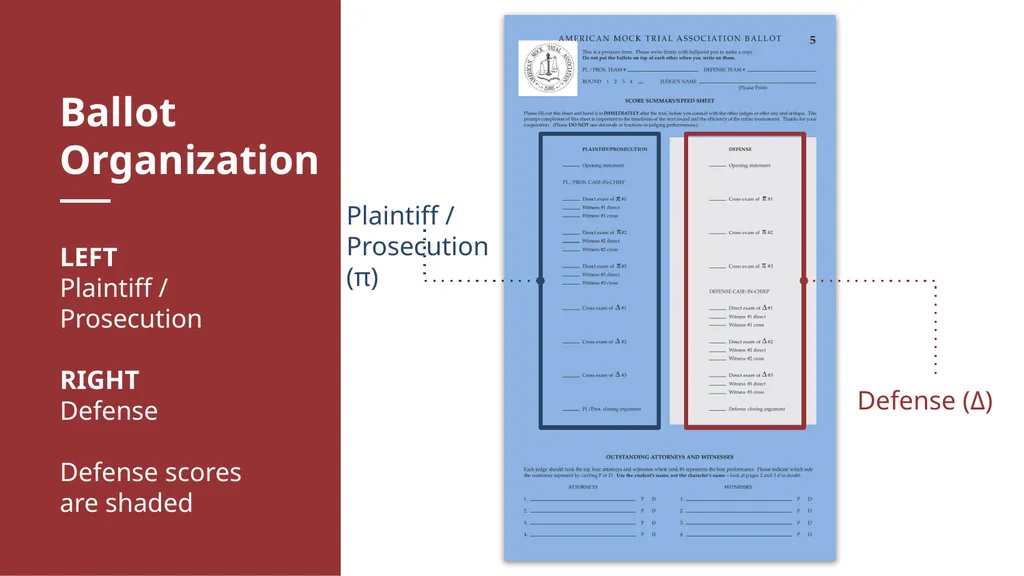
Ballot Organization LEFT
Plaintiff / Prosecution
RIGHT
Defense
Defense scores are shaded Plaintiff / Prosecution (π) Defense (Δ)<br>
13
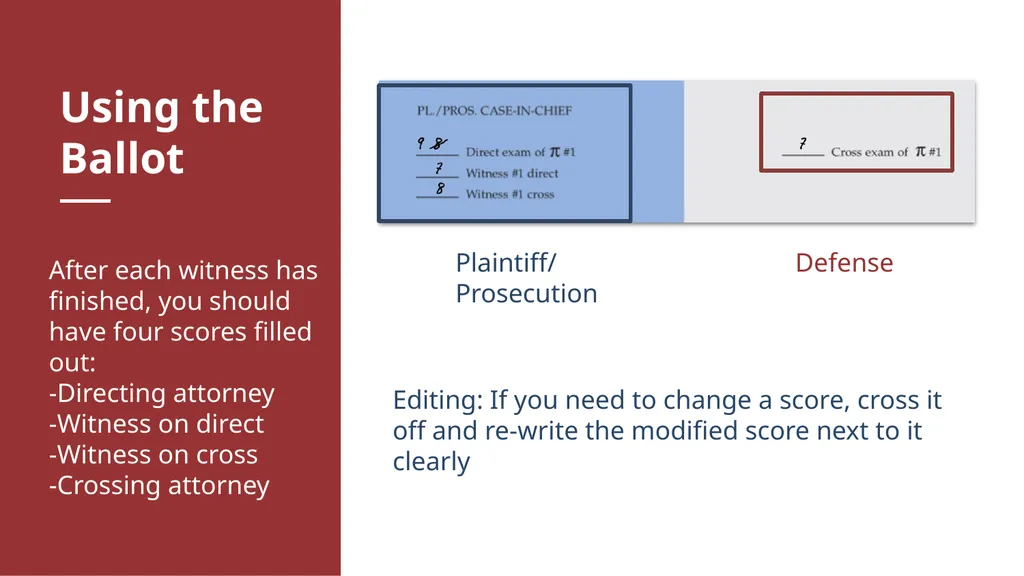
Using the Ballot After each witness has finished, you should have four scores filled out:
-Directing attorney
-Witness on direct
-Witness on cross
-Crossing attorney Defense Plaintiff/
Prosecution Editing: If you need to change a score, cross it off and re-write the modified score next to it clearly<br>
14
Remember: Witnesses are scored twice – on Direct AND Cross!<br>
15
No Separate Scores For: Pre-trial matters
Re-direct examinations
Re-cross examinations
Rebuttal
Objections
Instead, you can consider these in the corresponding scored portion (for example, the rebuttal may influence your score for closing).<br>
16
Score as you go & write scores on
the ballot!<br>
17
You’re not reaching a verdict.
Score on your own (don’t confer with co-judge on scores).<br>
18
Scoring Framework RANGE
Score from 1-10, with 10 being the best score
No decimals, only whole numbers
No zeros*
* Unless the role didn’t occur DIFFERENTIATE
Use scores to differentiate performances
Scale doesn’t matter, just be internally consistent<br>
19
Scoring Framework What TO Consider
Presentation / poise
Knowledge of the facts / rules of evidence
Ability to present a case on direct / control witnesses on cross
Witness credibility and character What NOT to Consider
What you saw in prior trials
Which side would win in a real trial (merits)
Student health precautions (like masks)
Attire of attorneys or witnesses* *Witnesses are allowed to wear costumes, but are not required to do so<br>
20
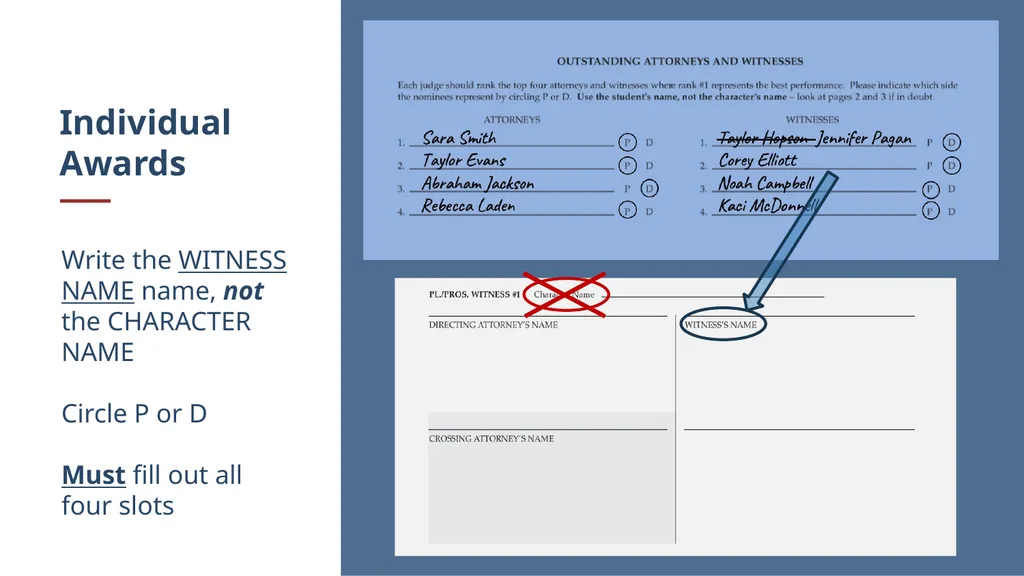
Individual Awards Write the WITNESS NAME name, not the CHARACTER NAME
Circle P or D
Must fill out all four slots<br>
21
Scoring Consistency and Student Experience Please apply criteria for excellence consistently across all competitors, focusing on performance quality and competency.
Please do not consider students’ race, gender, age, sexual orientation, or other similar factors when scoring.
Please help us make this activity a warm, welcoming and educational experience for all students. Feedback should, where appropriate, be encouraging, and should focus on areas that students can improve in future rounds.<br>
22
Invention of Fact Limited to sworn affidavits and reports (and materials relied upon) and reasonable inferences on direct examination.
On cross examination, must not contradict their affidavit….
…but if an attorney asks a question outside of the affidavit, then the attorney is stuck with the answer. All Witnesses<br>
23
Invention of Fact This competition has NO “invention of fact” objection when teams believe that a witness has improperly invented facts.
Instead, the rules allow students to attempt to impeach the witness during cross examination (via contradiction or omission).
Each scoring judge determines whether testimony offered by a witness is a reasonable inference or an invention of fact. If you believe the impeachment was effective in showing there was an invention of fact, then score accordingly on your blue ballot. In Trial Remedies<br>
24
PROVIDING COMMENTS<br>
25
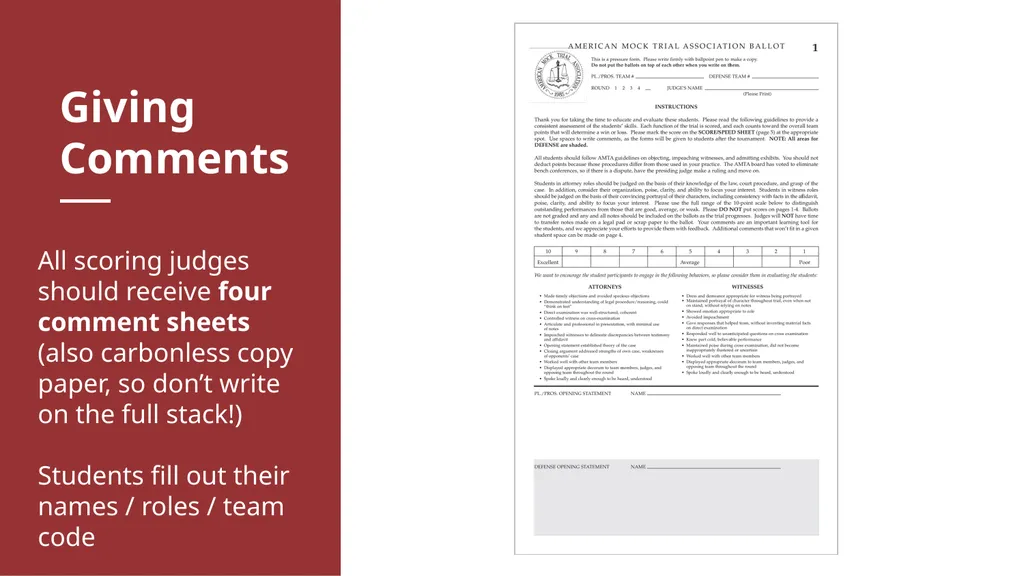
Giving Comments All scoring judges should receive four comment sheets (also carbonless copy paper, so don’t write on the full stack!)
Students fill out their names / roles / team code<br>
26
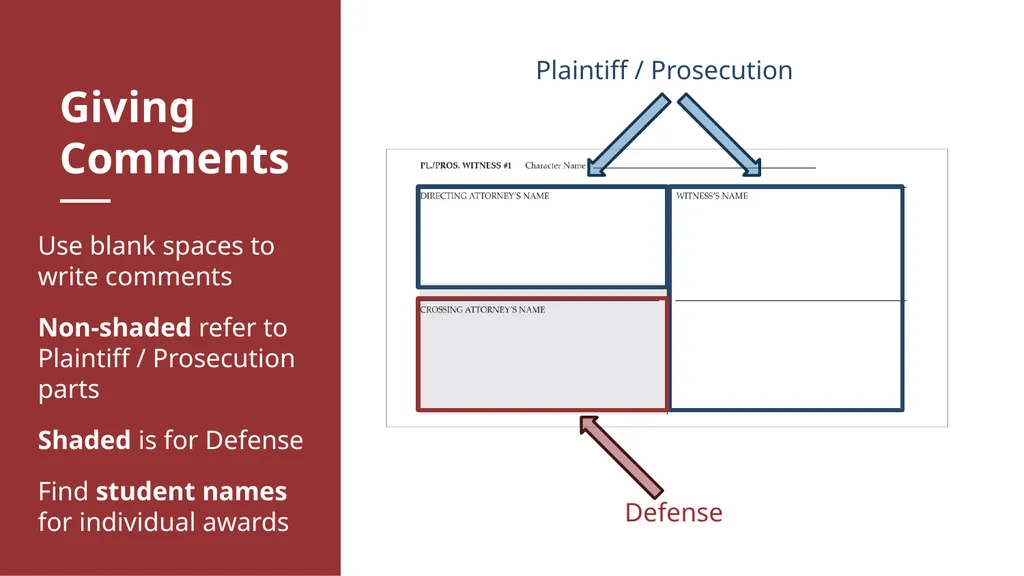
Giving Comments Use blank spaces to write comments
Non-shaded refer to Plaintiff / Prosecution parts
Shaded is for Defense
Find student names for individual awards Plaintiff / Prosecution Defense<br>
27
Giving Comments Students will receive copies of the written comments after the competition. Please write legibly.
After the trial is complete, please provide a few minutes of general verbal feedback<br>
28
TIMEKEEPING & OTHER RULES<br>
29
Timekeepers Students act as timekeepers
The trial has a 3-hour time limit, and each part of the trial has specific time limits
Please enforce time limits when informed of them to avoid exceeding the “all-loss time”<br>
30
Anonymity & Spectators Students’ school identity should remain anonymous until after the round
All trials are public; don’t assume the identity of the teams based on who enters the courtroom<br>
31
Conflicts If you have already judged a team at this particular tournament, please DON’T start the trial; inform tournament staff
If you are affiliated with the team (e.g., your child is on the team), please DON’T start the trial; inform the event representative<br>
32
What happens next? Questions & Judging Assignments!<br>