Aging, Dementia, and the Care Gap How population trends are shaping the demand for care and delivery systems Jacqueline L. Angel, PhD The University of Texas at Austin Presented 2026 Texas Demographic Conference May 21, 2026 Who Should Take
"Aging, Dementia, and the Care Gap How population" is the property of its rightful owner. Permission is granted to
download and print the materials on this website for personal, non-commercial use only, and to display it
on your personal computer provided you do not modify the materials and that you retain all copyright
notices contained in the materials. By downloading content from our website, you accept the terms of this
agreement.
Presentation Transcript
01
Aging, Dementia, and the Care Gap How population trends are shaping the demand for care and delivery systems Jacqueline L. Angel, PhD
The University of Texas at Austin
Presented
2026 Texas Demographic Conference
May 21, 2026<br>
02
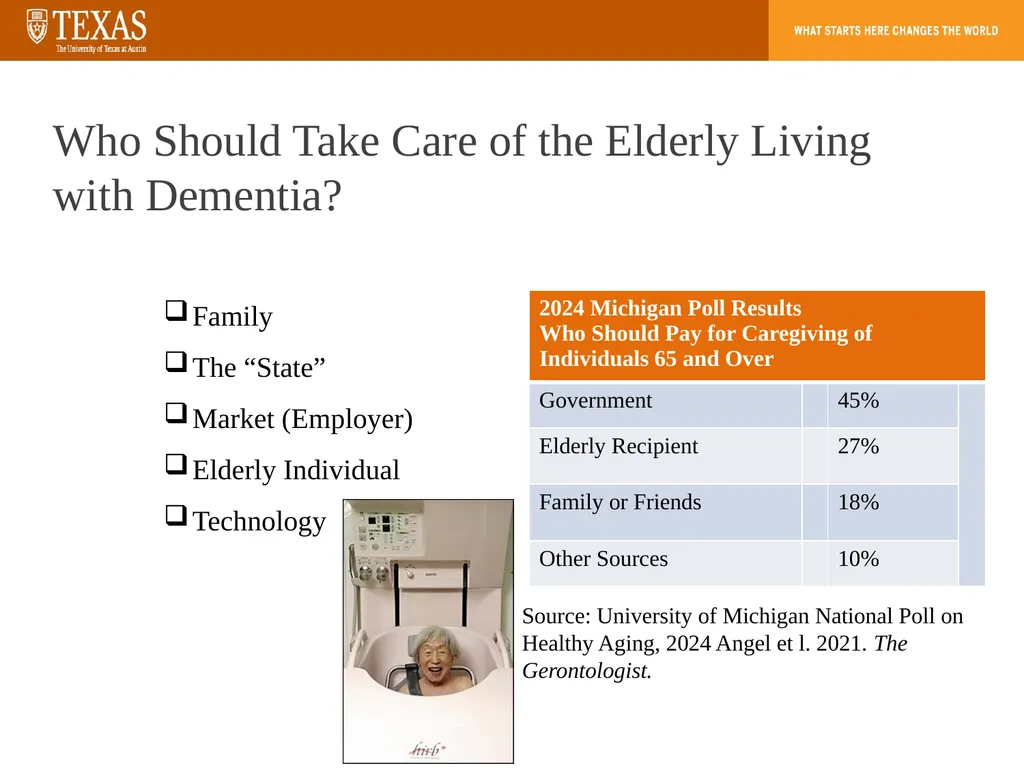
Who Should Take Care of the Elderly Living with Dementia? Family
The “State”
Market (Employer)
Elderly Individual
Technology Source: University of Michigan National Poll on Healthy Aging, 2024 Angel et l. 2021. The Gerontologist.<br>
03
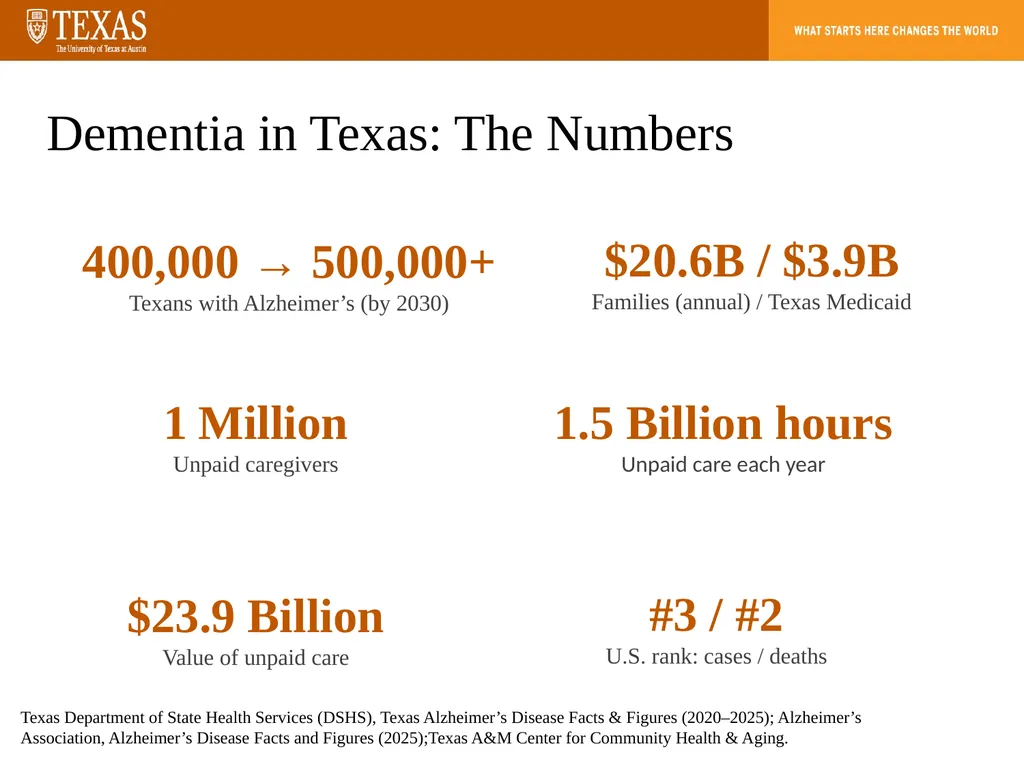
Dementia in Texas: The Numbers 400,000 → 500,000+
Texans with Alzheimer’s (by 2030) $20.6B / $3.9B
Families (annual) / Texas Medicaid 1 Million
Unpaid caregivers 1.5 Billion hours
Unpaid care each year $23.9 Billion
Value of unpaid care #3 / #2
U.S. rank: cases / deaths Texas Department of State Health Services (DSHS), Texas Alzheimer’s Disease Facts & Figures (2020–2025); Alzheimer’s Association, Alzheimer’s Disease Facts and Figures (2025);Texas A&M Center for Community Health & Aging.<br>
04
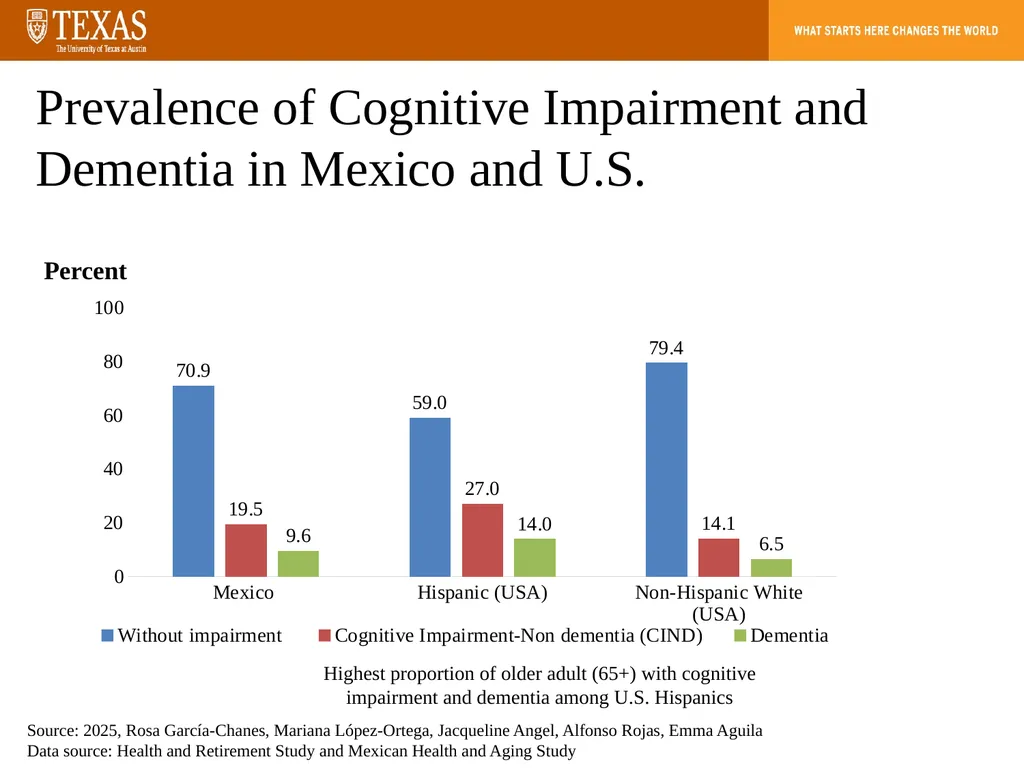
Prevalence of Cognitive Impairment and Dementia in Mexico and U.S. Highest proportion of older adult (65+) with cognitive impairment and dementia among U.S. Hispanics Source: 2025, Rosa García-Chanes, Mariana López-Ortega, Jacqueline Angel, Alfonso Rojas, Emma Aguila
Data source: Health and Retirement Study and Mexican Health and Aging Study Percent<br>
05
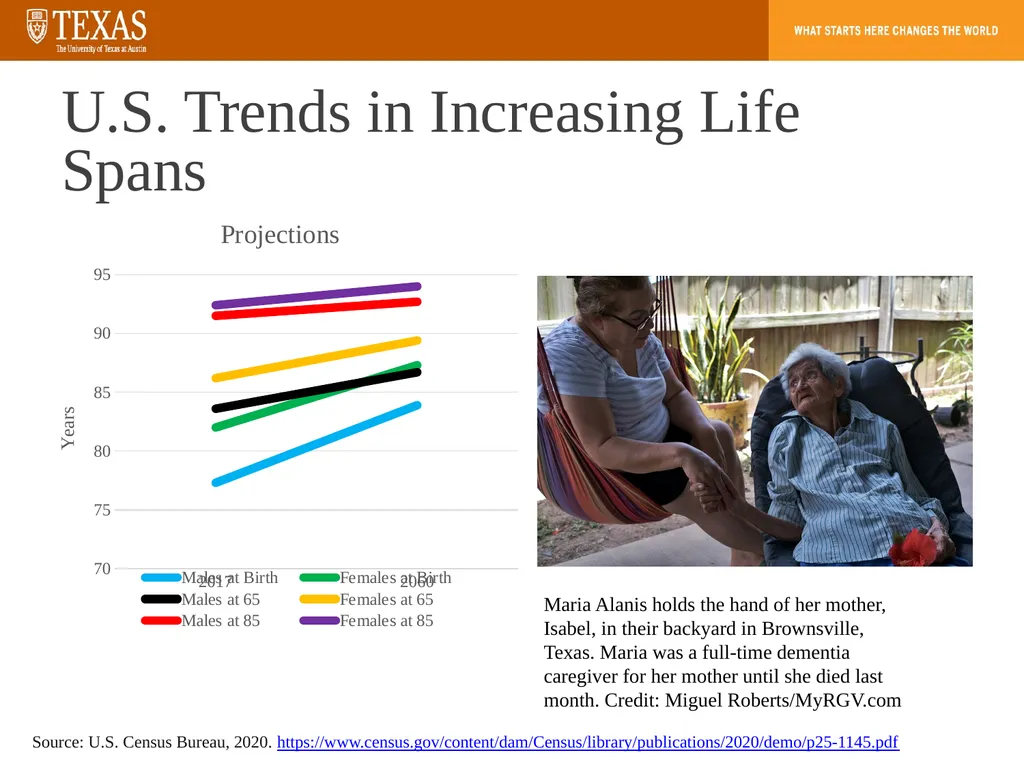
U.S. Trends in Increasing Life Spans Maria Alanis holds the hand of her mother, Isabel, in their backyard in Brownsville, Texas. Maria was a full-time dementia caregiver for her mother until she died last month. Credit: Miguel Roberts/MyRGV.com Source: U.S. Census Bureau, 2020. https://www.census.gov/content/dam/Census/library/publications/2020/demo/p25-1145.pdf<br>
06
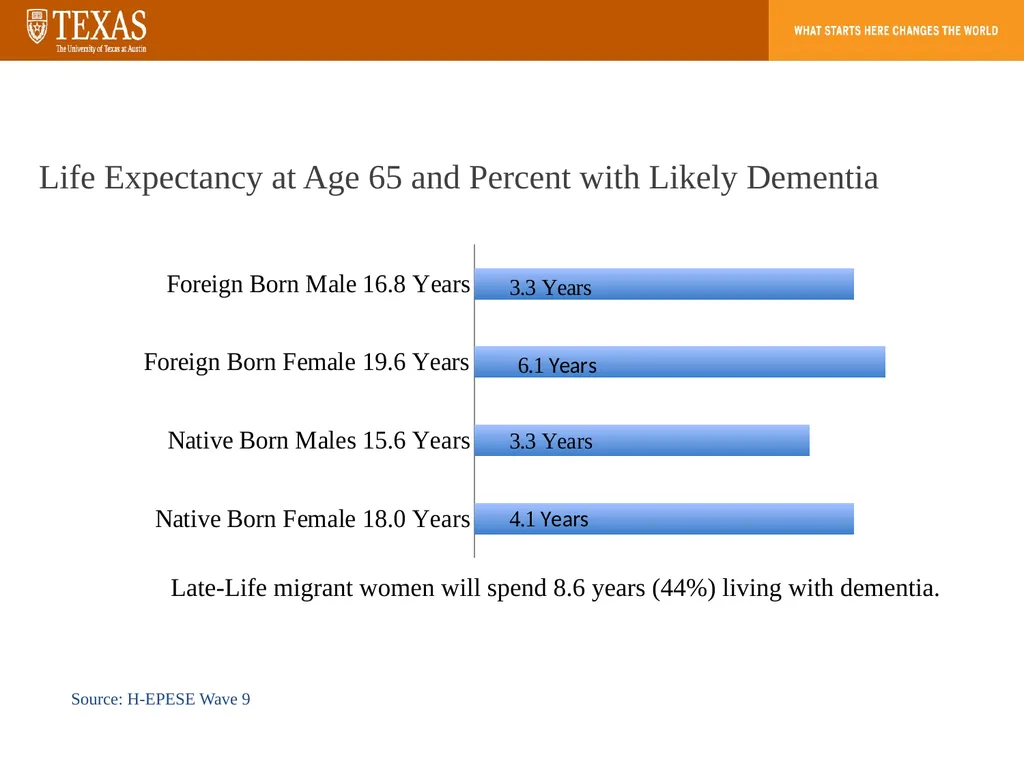
Life Expectancy at Age 65 and Percent with Likely Dementia Source: H-EPESE Wave 9 Late-Life migrant women will spend 8.6 years (44%) living with dementia.<br>
07
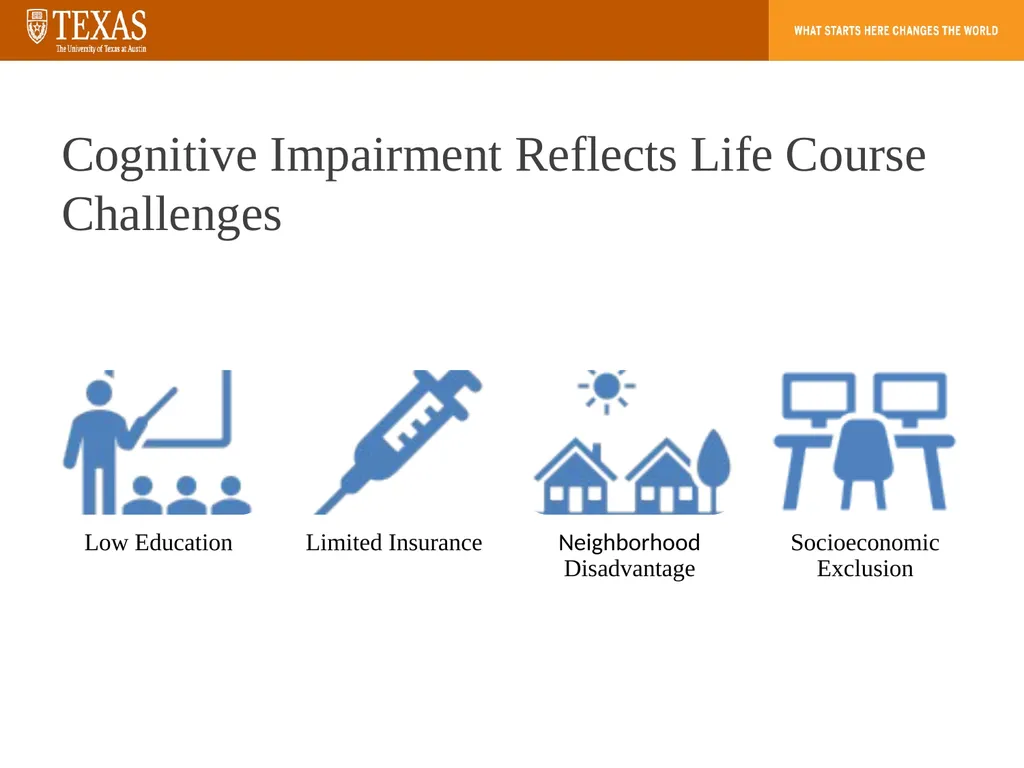
Cognitive Impairment Reflects Life Course Challenges<br>
08
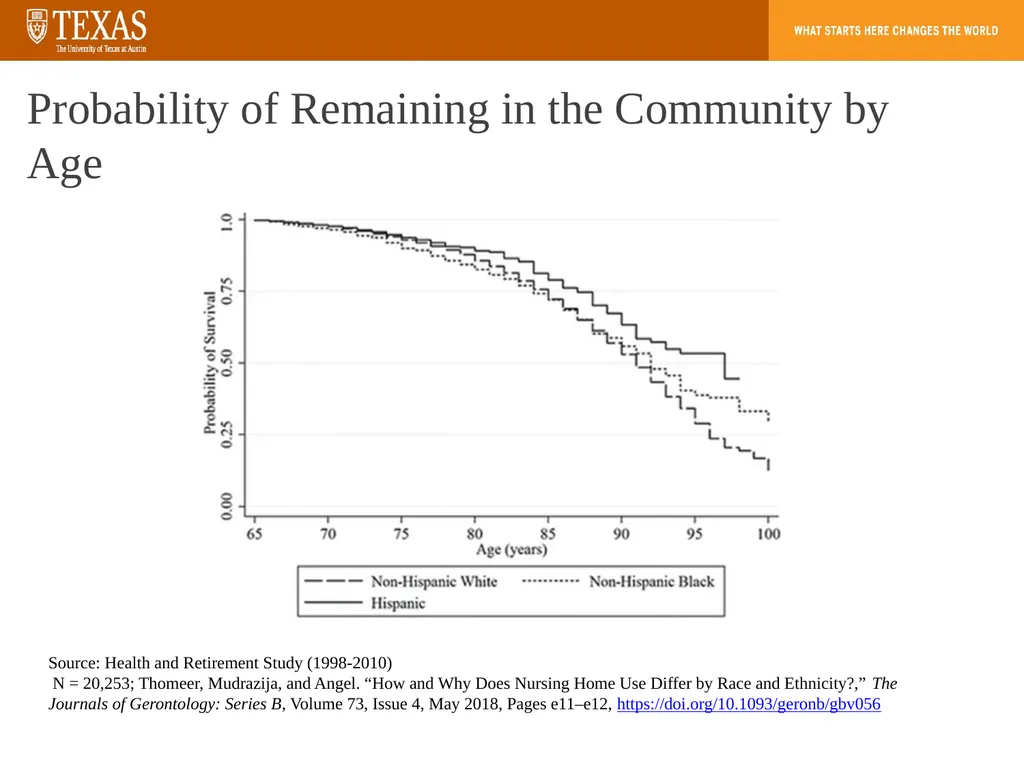
Probability of Remaining in the Community by Age Ka18,952) (plan-Meier Survival Estimates for Entering Nursing Homes after Age 65 by Race/Ethnicity (N = Adjusted for birth year and gender) Source: Health and Retirement Study (1998-2010)
N = 20,253; Thomeer, Mudrazija, and Angel. “How and Why Does Nursing Home Use Differ by Race and Ethnicity?,” The Journals of Gerontology: Series B, Volume 73, Issue 4, May 2018, Pages e11–e12, https://doi.org/10.1093/geronb/gbv056<br>
09
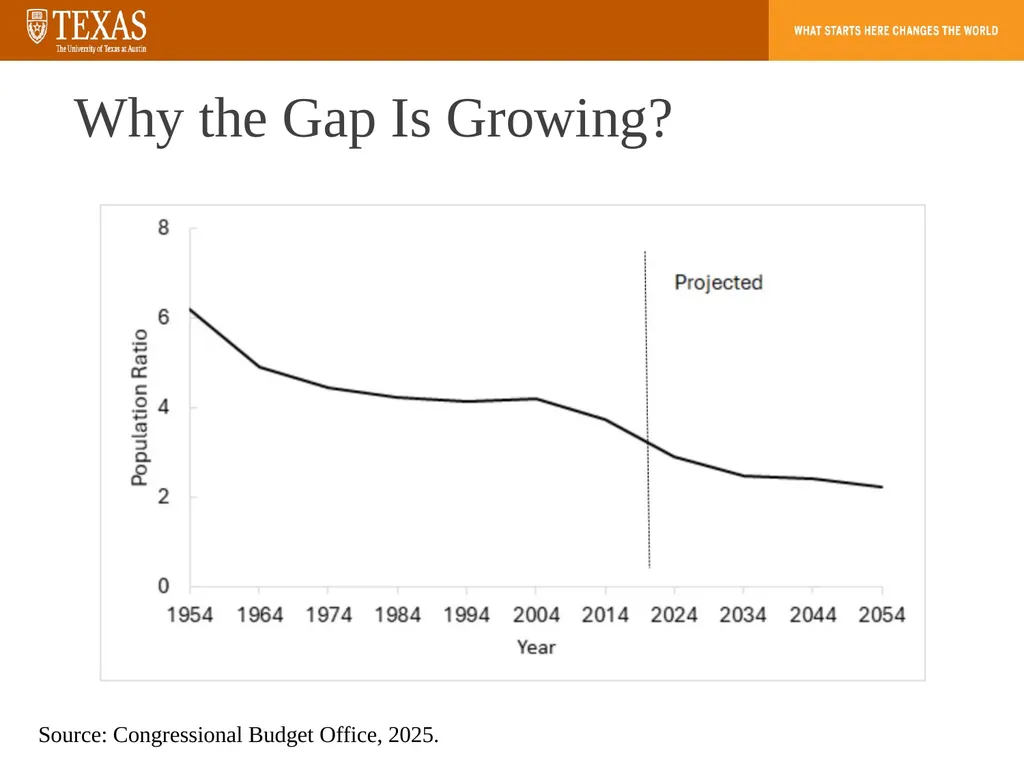
Why the Gap Is Growing? Source: Congressional Budget Office, 2025.<br>
10
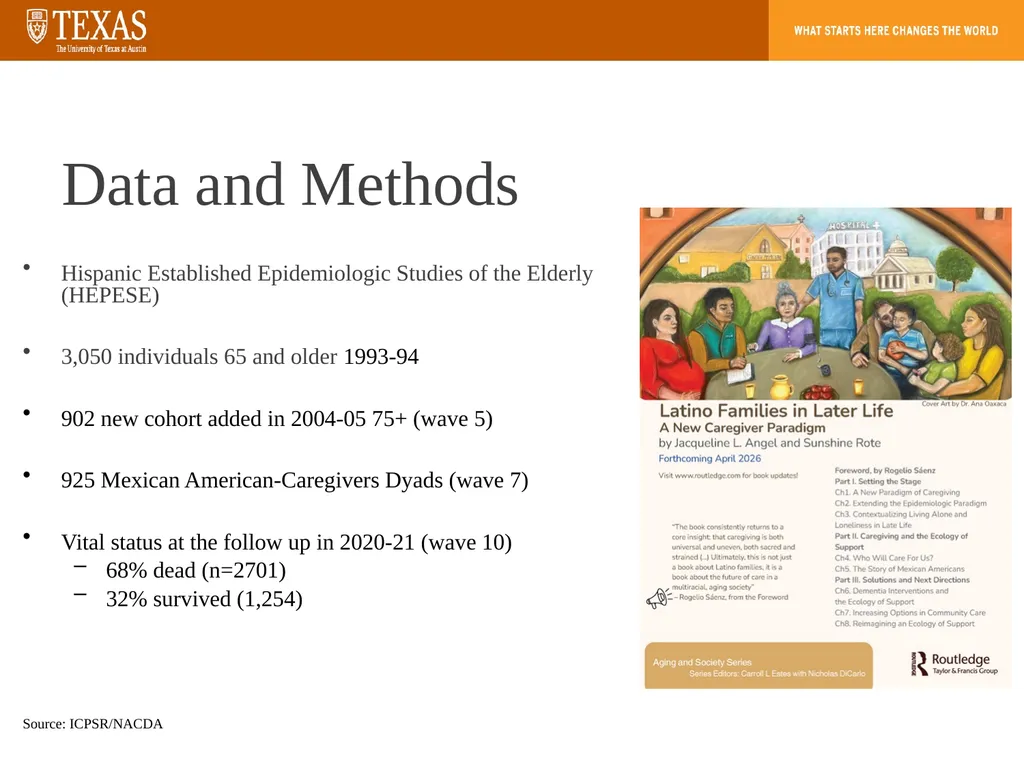
Data and Methods Hispanic Established Epidemiologic Studies of the Elderly (HEPESE)
3,050 individuals 65 and older 1993-94
902 new cohort added in 2004-05 75+ (wave 5)
925 Mexican American-Caregivers Dyads (wave 7)
Vital status at the follow up in 2020-21 (wave 10)
68% dead (n=2701)
32% survived (1,254)
Source: ICPSR/NACDA<br>
11
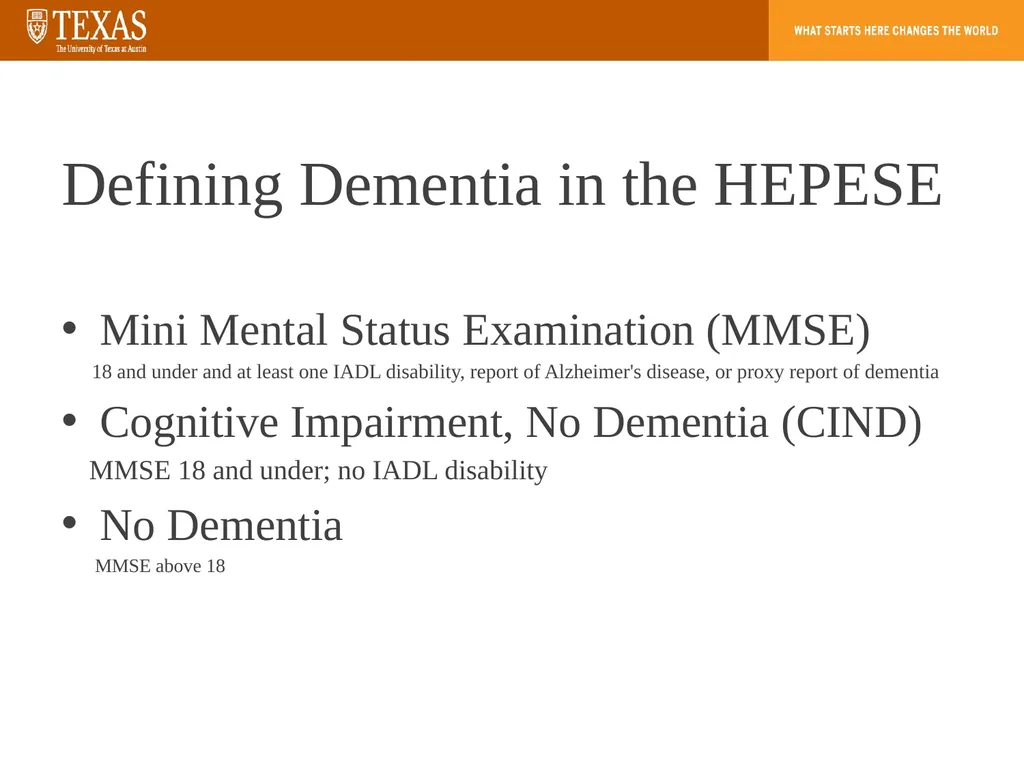
Defining Dementia in the HEPESE Mini Mental Status Examination (MMSE)
18 and under and at least one IADL disability, report of Alzheimer's disease, or proxy report of dementia
Cognitive Impairment, No Dementia (CIND)
MMSE 18 and under; no IADL disability
No Dementia
MMSE above 18<br>
12
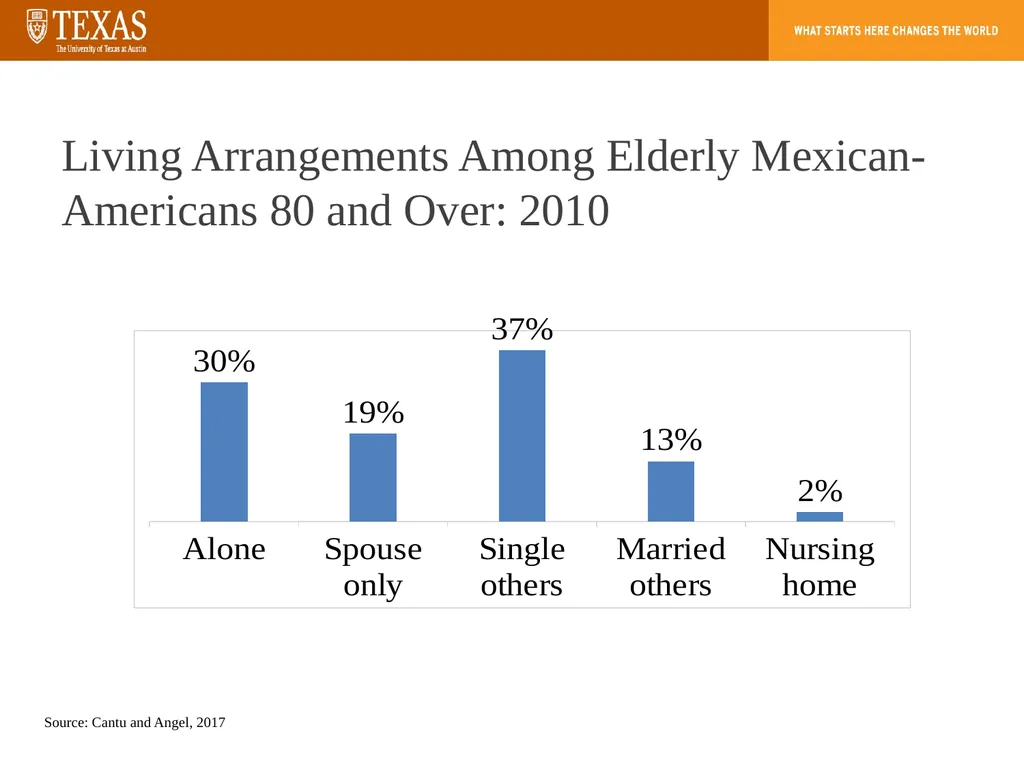
Living Arrangements Among Elderly Mexican-Americans 80 and Over: 2010 12 Source: Cantu and Angel, 2017<br>
13
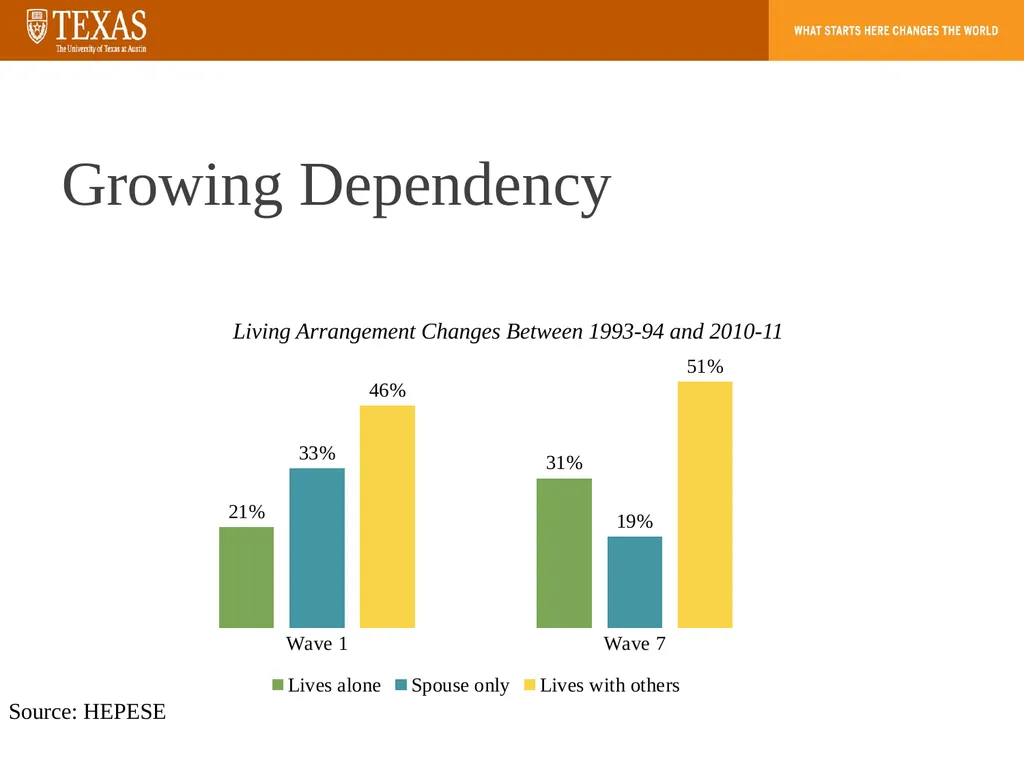
Growing Dependency Living Arrangement Changes Between 1993-94 and 2010-11 Source: HEPESE<br>
14
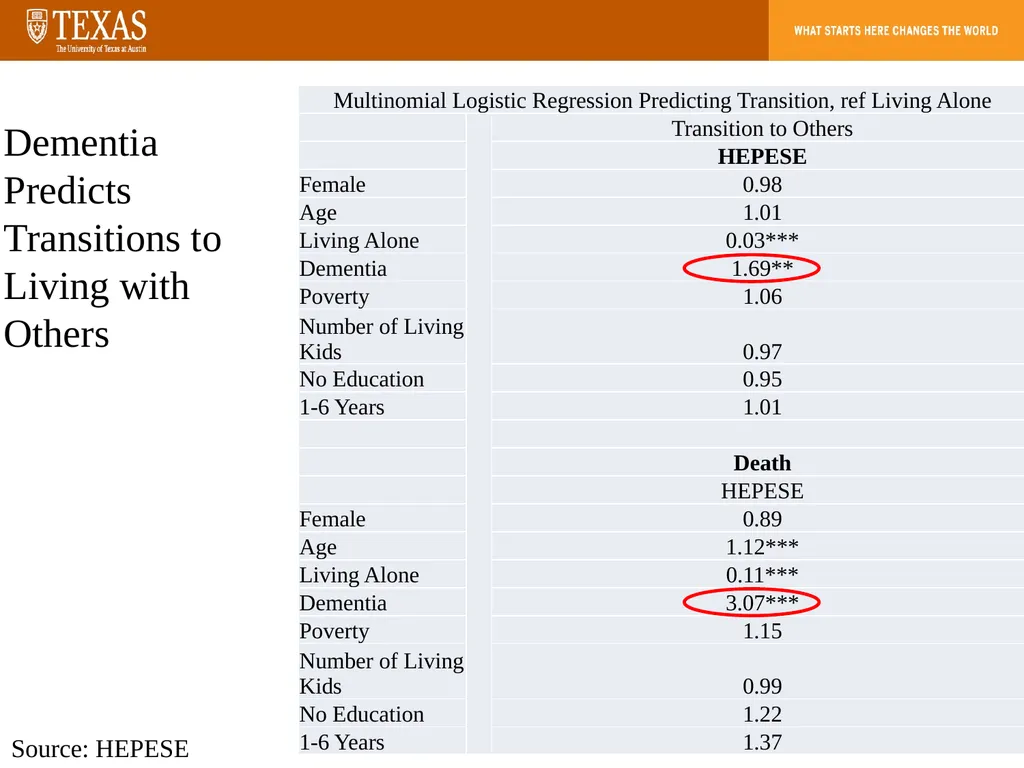
Dementia Predicts Transitions to Living with Others Source: HEPESE<br>
15
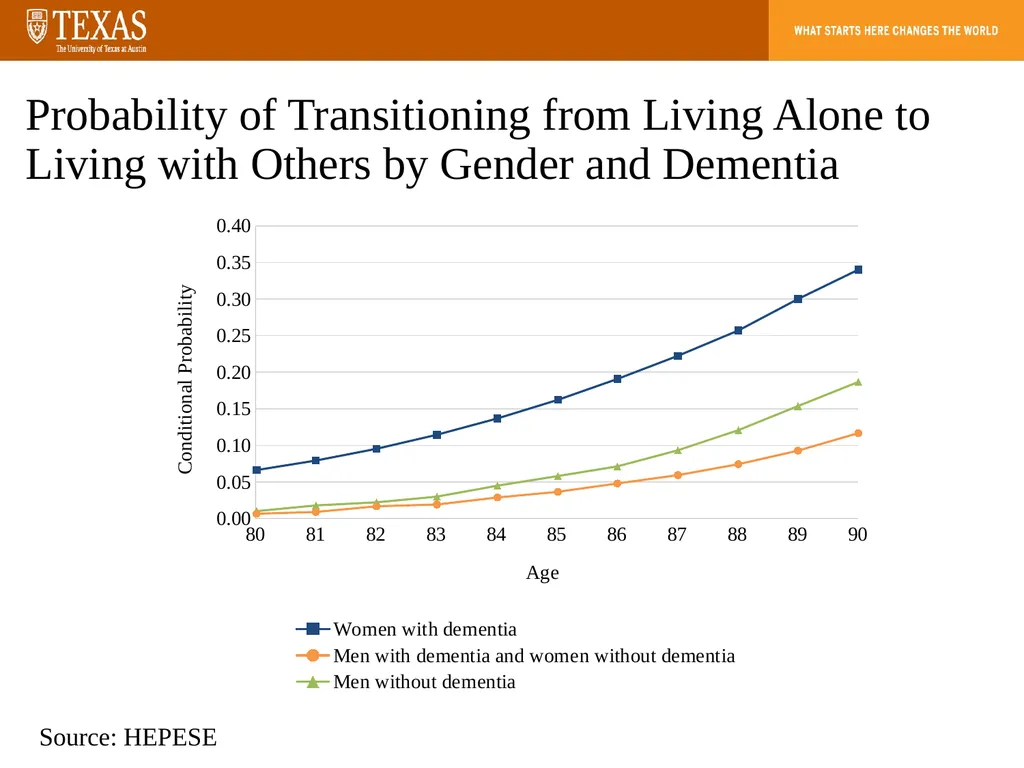
Probability of Transitioning from Living Alone to Living with Others by Gender and Dementia Source: HEPESE<br>
16
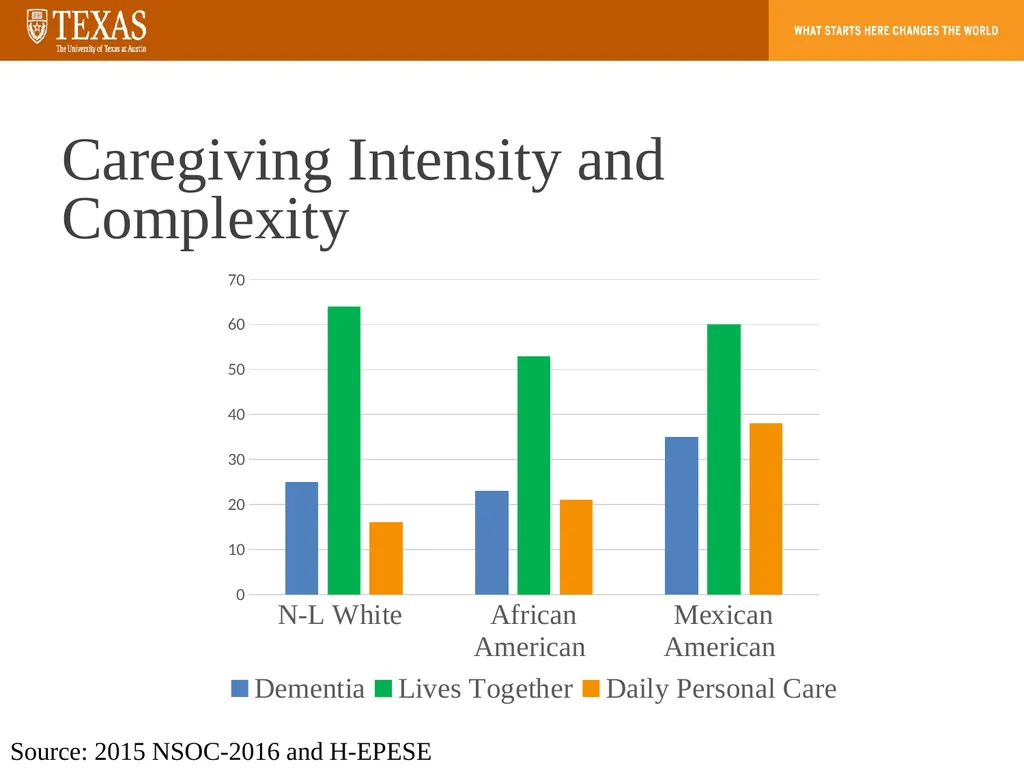
Caregiving Intensity and Complexity Source: 2015 NSOC-2016 and H-EPESE<br>
17
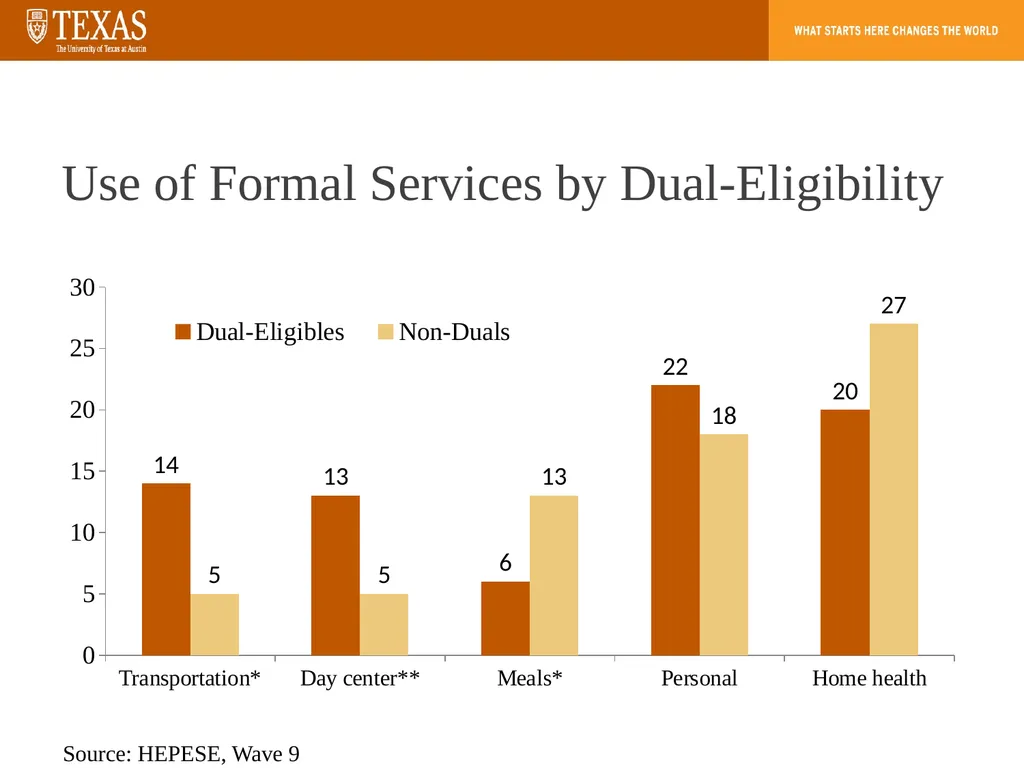
Use of Formal Services by Dual-Eligibility Source: HEPESE, Wave 9<br>
18
Adult Day Center Use Compared to California, Texas has a state Medicaid plan that entitles participants to adult day health care services. Despite restrictive participation rules, (2019 $771 a monthly individual income and $2000 asset limit), higher proportion of extreme poor reside in Texas.<br>
19
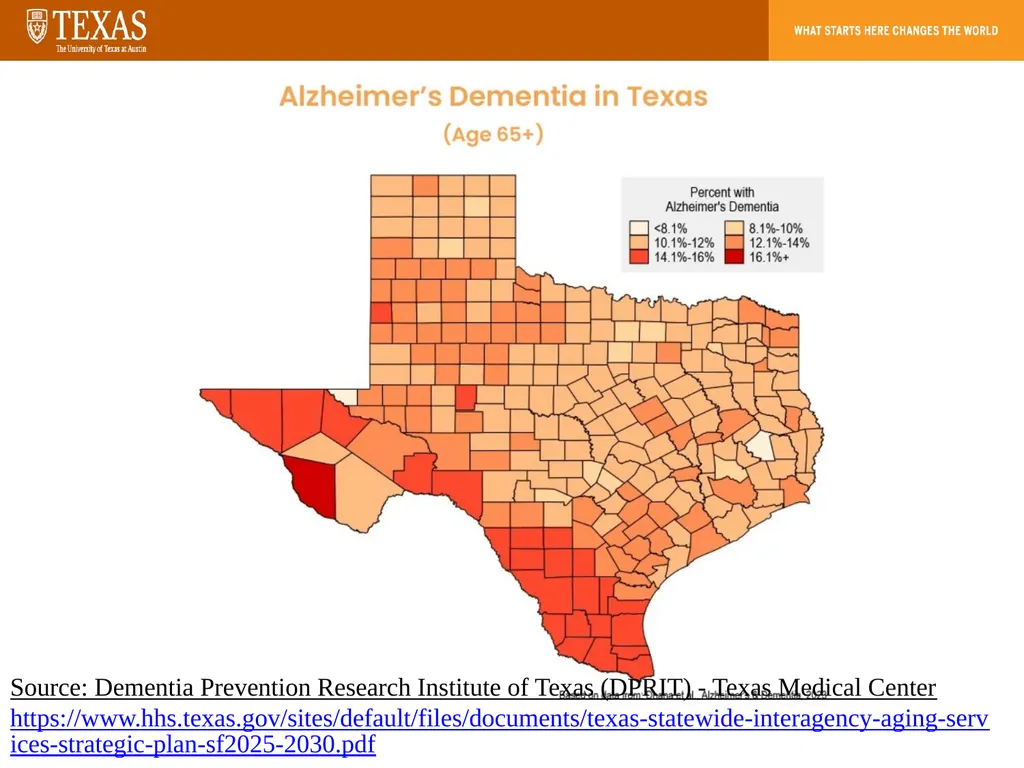
Source: Dementia Prevention Research Institute of Texas (DPRIT) - Texas Medical Center https://www.hhs.texas.gov/sites/default/files/documents/texas-statewide-interagency-aging-services-strategic-plan-sf2025-2030.pdf<br>
20
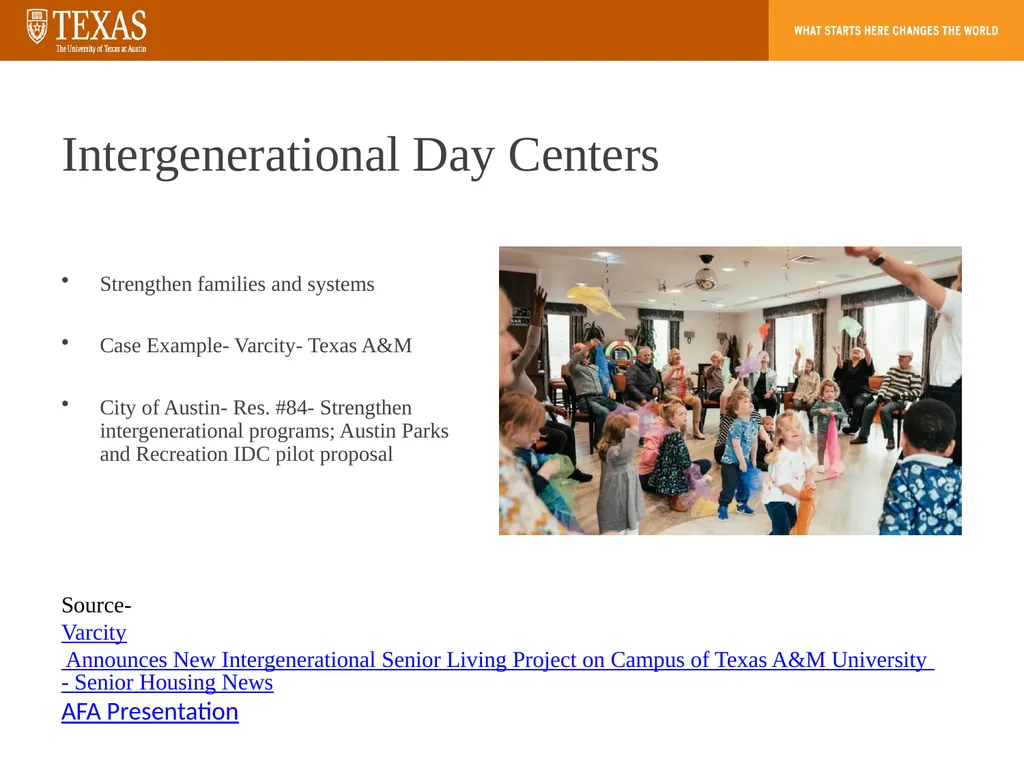
Intergenerational Day Centers Strengthen families and systems
Case Example- Varcity- Texas A&M
City of Austin- Res. #84- Strengthen intergenerational programs; Austin Parks and Recreation IDC pilot proposal Source-
Varcity Announces New Intergenerational Senior Living Project on Campus of Texas A&M University - Senior Housing News
AFA Presentation<br>
21
Acknowledgments National Institute on Aging: R03 AG063183-01
Texas RCMAR: P30AG059301
H-EPESE: R01 AG010939-25
MHAS: R01-AG018016
NIA T-32 Postdoctoral Training Grant 5T32AG000270-21
1R03AG063183-01
PRC/CAPS P30AG066614
Collaborators: Sunshine Rote and ICAA Team https://sites.utexas.edu/caa/<br>