Agricultural resources Food crops (Pulses) Agricultural Resources: Food Crops (Pulses) India has achieved 19.25 million tonnes of pulse production from an area of about 25.2 million hectares during the year 2013-14 (DAC, MOA FW, GoI).
"Agricultural resources Food crops (Pulses)" is the property of its rightful owner. Permission is granted to
download and print the materials on this website for personal, non-commercial use only, and to display it
on your personal computer provided you do not modify the materials and that you retain all copyright
notices contained in the materials. By downloading content from our website, you accept the terms of this
agreement.
Presentation Transcript
01
Agricultural resources Food crops (Pulses)<br>
02
Agricultural Resources: Food Crops (Pulses) India has achieved 19.25 million tonnes of pulse production from an area of about 25.2 million hectares during the year 2013-14 (DAC, MOA & FW, GoI).
However, the per capita availability of protein is 28g/day which is much lower than the FAO recommended level of 80g/day.
Per capita consumption of pulses over the years has come down to 30g/day in 2008 from 61g/day in 1951 (Reddy, 2009).
The same trend is followed in the North Eastern part of our country. Considering the importance of pulses to achieve nutritional security, the 68th UN General Assembly declared 2016 the International Year of Pulses (IYP).
Pulses are mainly grown in the uplands in the North Eastern Hill Region of India. The agricultural production system in North- Eastern Region (NER) is characterized by a large CDR (Complex diverse risk prone) type, low cropping intensity, subsistence farming, undulating topography and faulty land use pattern with an annual loss of soil of 46 t/ha.<br>
03
The major pulses grown in NE India are green gram (Vigna radiata), black gram (V. mungo), pigeon pea (Cajanus cajan), cowpea (V. unguiculata), french bean (Phaseolus vulgaris), chickpea (Cicer arietinum), lentil (L. culinaris) & field pea (Pisum sativum).
In hills, other beans such as faba bean (V. faba), adzuki bean (Vigna angularis), moth bean (V. aconitifoloia) and broad bean (Dolichos lablab) are also used as pulses. The primitive system of shifting cultivation is practiced widely in all the states of North East, except Sikkim. The cropping system can more precisely be described as relay mixed cropping as crops are sown in the same field before the harvest of the previously sown mixed crops in the same field. Depending on the size of the farm land and their resources, pulses are grown by the farmers.<br>
04
In 2013-14, NE India produced 209.3 thousand tonnes of pulses from an area of 252.8 thousand hectare with an average productivity of 828 Kg/ ha.
The NE region of India is almost 82% deficit in pulse production against its requirements as per ICMR recommendation.
Closing the gap between demand and the supply of pulses would require production to grow at least by 4 per cent per annum (Kumar, 1998; IIPR, 2011).
Pulse production has been given more emphasis under the National Food Security Mission (NFSM) but still more efforts are required to feed our own population.<br>
05
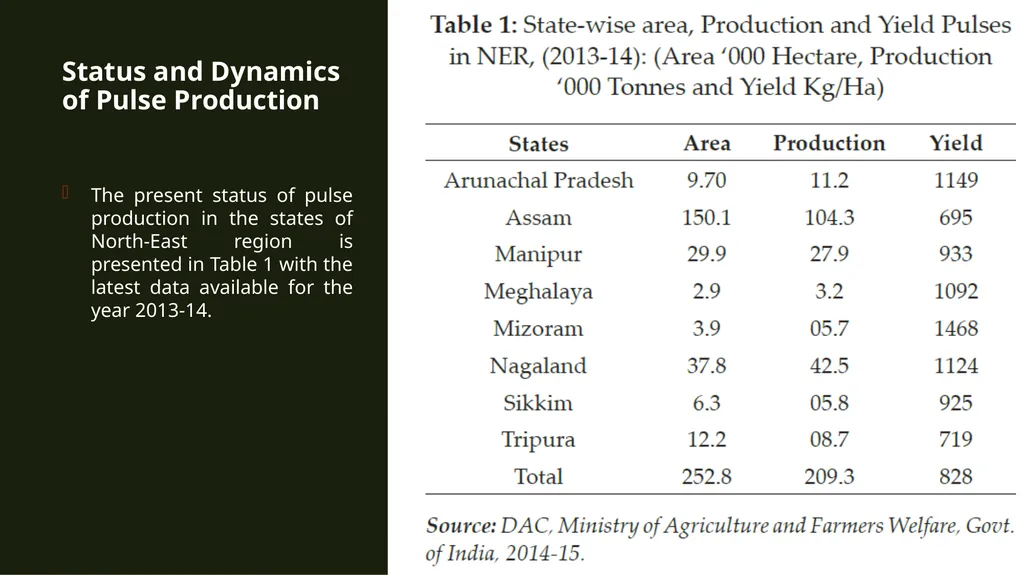
Status and Dynamics of Pulse Production The present status of pulse production in the states of North-East region is presented in Table 1 with the latest data available for the year 2013-14.<br>
06
The total area under pulses in the North-East region was almost 252 thousand hectares of which 58 per cent was in Assam, followed by Nagaland (15%) and Manipur (12%).
The total production from the region amounted to 209.3 thousand tonnes with the highest contribution made by Assam (48%) followed by Nagaland (20%) and Manipur (13%).
Interestingly, Mizoram having less area under pulses (3.9 thousand ha) showed the highest yield (1468 Kg/ha) among the North-Eastern States.
On the other hand, the yield was the lowest in Assam (695 kg/ha) even though the maximum area was found under pulses.
Higher than the regional average yield (828 kg/ha) were found in Arunachal Pradesh, Manipur, Meghalaya, Mizoram, Nagaland and Sikkim whereas in Tripura and Assam, the yield of pulses were lower, leaving the future scope for increasing pulse production of the region through productivity increase.<br>
07
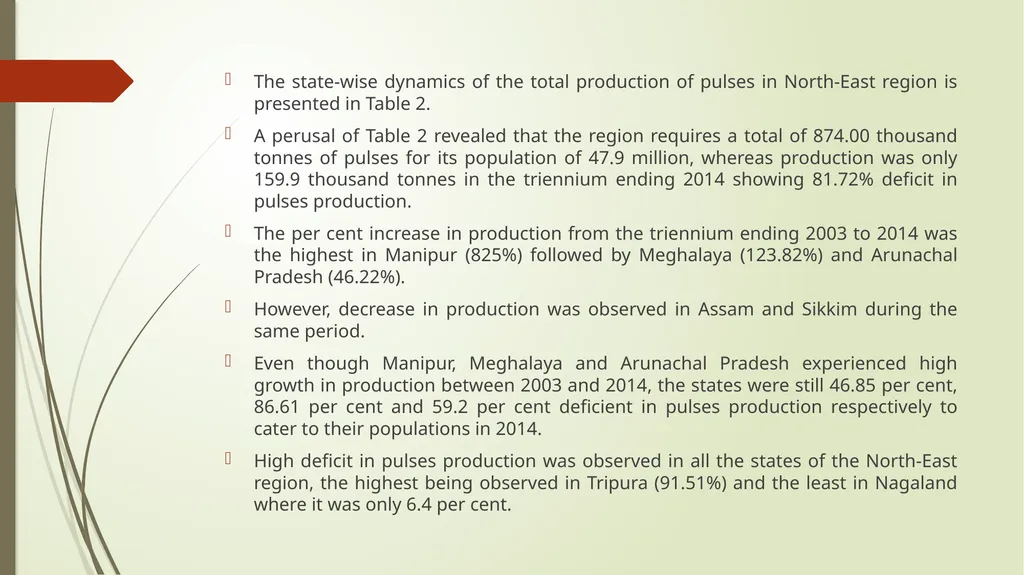
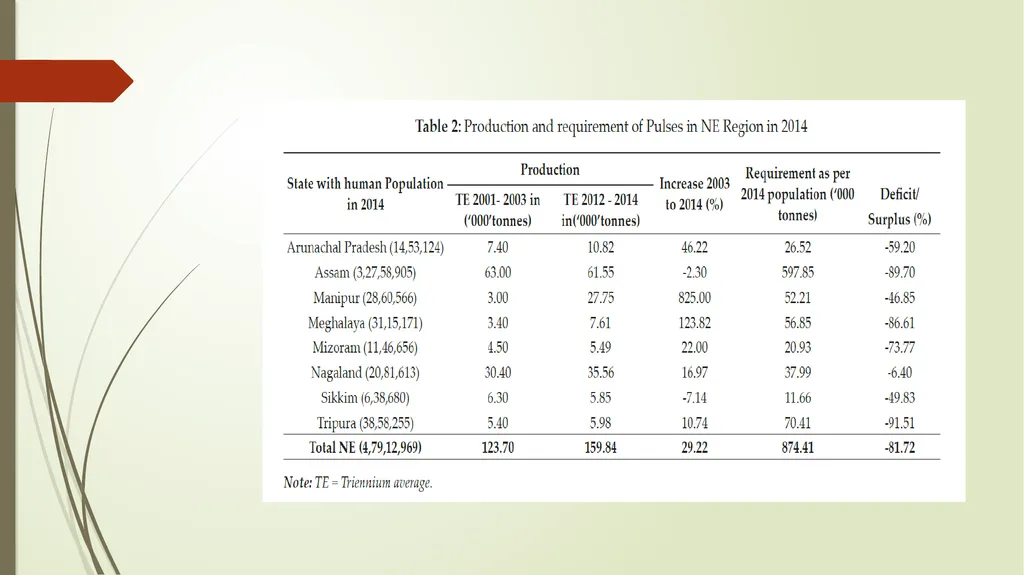
The state-wise dynamics of the total production of pulses in North-East region is presented in Table 2.
A perusal of Table 2 revealed that the region requires a total of 874.00 thousand tonnes of pulses for its population of 47.9 million, whereas production was only 159.9 thousand tonnes in the triennium ending 2014 showing 81.72% deficit in pulses production.
The per cent increase in production from the triennium ending 2003 to 2014 was the highest in Manipur (825%) followed by Meghalaya (123.82%) and Arunachal Pradesh (46.22%).
However, decrease in production was observed in Assam and Sikkim during the same period.
Even though Manipur, Meghalaya and Arunachal Pradesh experienced high growth in production between 2003 and 2014, the states were still 46.85 per cent, 86.61 per cent and 59.2 per cent deficient in pulses production respectively to cater to their populations in 2014.
High deficit in pulses production was observed in all the states of the North-East region, the highest being observed in Tripura (91.51%) and the least in Nagaland where it was only 6.4 per cent.<br>