
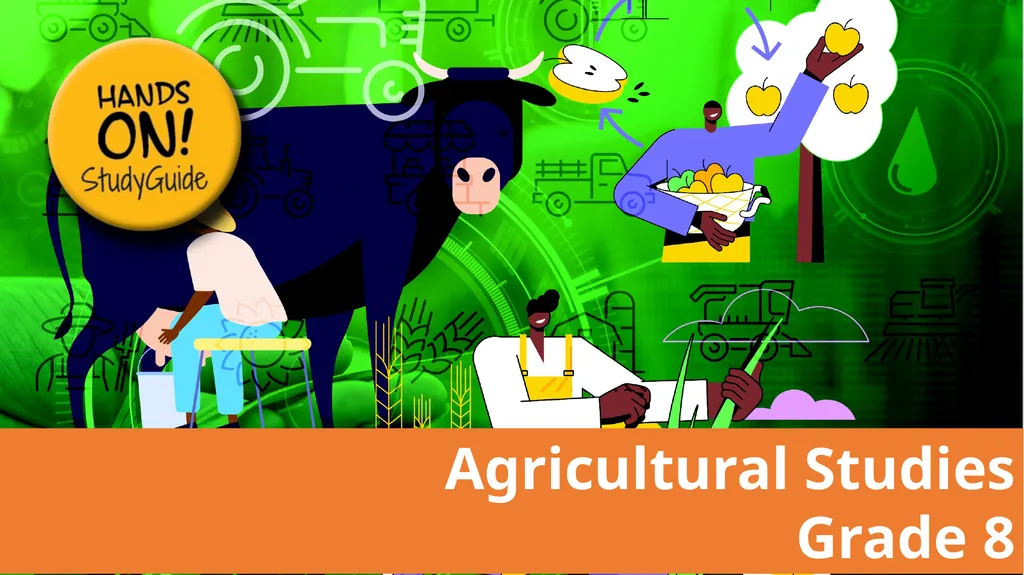
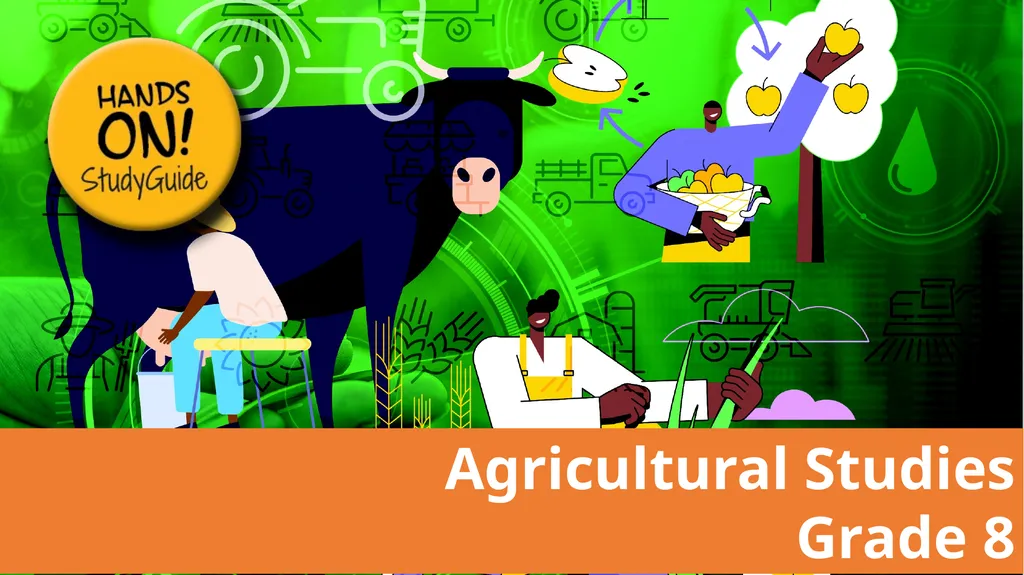
Agricultural Studies Grade 8
Description: Agricultural Studies Grade 8 www.futuremanagers.com INTRODUCTION No farming practices can survive without having access to the important factors of production as the basic resources that farmers need. Farmers not only use the natural
Related Topics
Download Presentation
"Agricultural Studies Grade 8" is the property of its rightful owner. Permission is granted to download and print the materials on this website for personal, non-commercial use only, and to display it on your personal computer provided you do not modify the materials and that you retain all copyright notices contained in the materials. By downloading content from our website, you accept the terms of this agreement.
Presentation Transcript
slide1. Agricultural Studies
Grade 8<br>
slide2. www.futuremanagers.com INTRODUCTION
No farming practices can survive without having access to the important factors of production as the basic resources that farmers need. Farmers not only use the natural resources available to them to the maximum, they also have the obligation (duty) to protect and conserve those resources so that future generations will also have access to them. Module 1: General farming, production factors, and agricultural resources<br>
slide3. www.futuremanagers.com Module 1: General farming, production factors, and agricultural resources (continued) DEVELOPMENT OF AGRICULTURE IN SOUTH AFRICA
The first farmers in Southern Africa were Black people from the northern parts of Africa, speaking different languages. These farmers usually moved in larger groups. When there were too many farmers in one place some of them began to move around in the country to find better places to keep their animals and to grow their own food. The first real farmers lived differently to hunters and gatherers. They had to stay in one place long enough to plant and harvest their crops. They also built permanent homes near their fields.<br>
slide4. www.futuremanagers.com Module 1: General farming, production factors, and agricultural resources (continued) BASIC RESOURCES FOR FARMING
Any farmer (or business) needs to have access to the following four basic resources, also known as factors of production:
Natural resources;
Financial resources;
Human resources; and
Entrepreneurship.<br>
slide5. www.futuremanagers.com Module 1: General farming, production factors, and agricultural resources (continued) THE IMPORTANCE OF CONSERVATION OF NATURAL RESOURCES
Not all natural resources are available in the same quantities across the country. Different parts of the country have different resources available and provide access for the local communities to those resources. The farmer’s goal is to conserve (protect) the resources as much as possible so that they could last longer. The advantage thereof is that the resources will be available much longer for future generations.<br>
slide6. www.futuremanagers.com Module 1: General farming, production factors, and agricultural resources (continued) FARMING SYSTEMS
A farming system comprises of all the activities required to produce something which can be used or consumed by people. It includes all crops, animals, the use of machines and equipment, people working on a farm as well as all other resources needed to be able to produce something through a process and at the end have a final product that can be sold or used.<br>
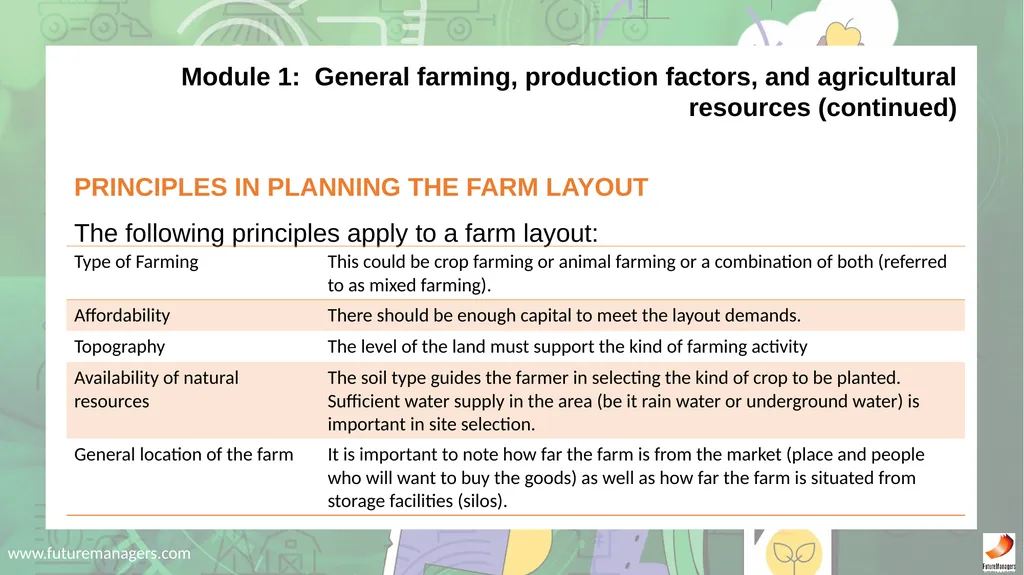
slide7. www.futuremanagers.com Module 1: General farming, production factors, and agricultural resources (continued) PRINCIPLES IN PLANNING THE FARM LAYOUT
The following principles apply to a farm layout:<br>
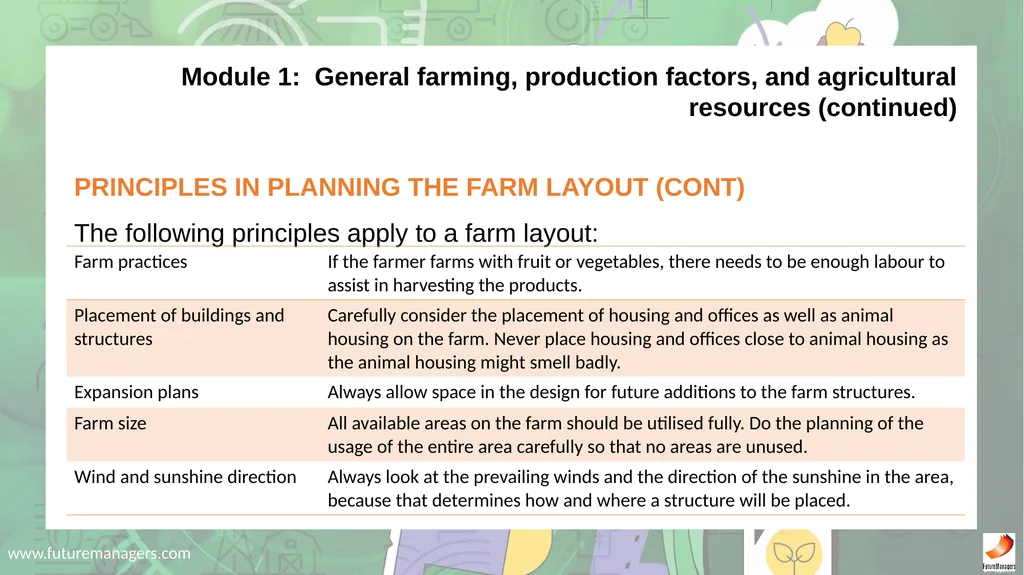
slide8. www.futuremanagers.com Module 1: General farming, production factors, and agricultural resources (continued) PRINCIPLES IN PLANNING THE FARM LAYOUT (CONT)
The following principles apply to a farm layout:<br>
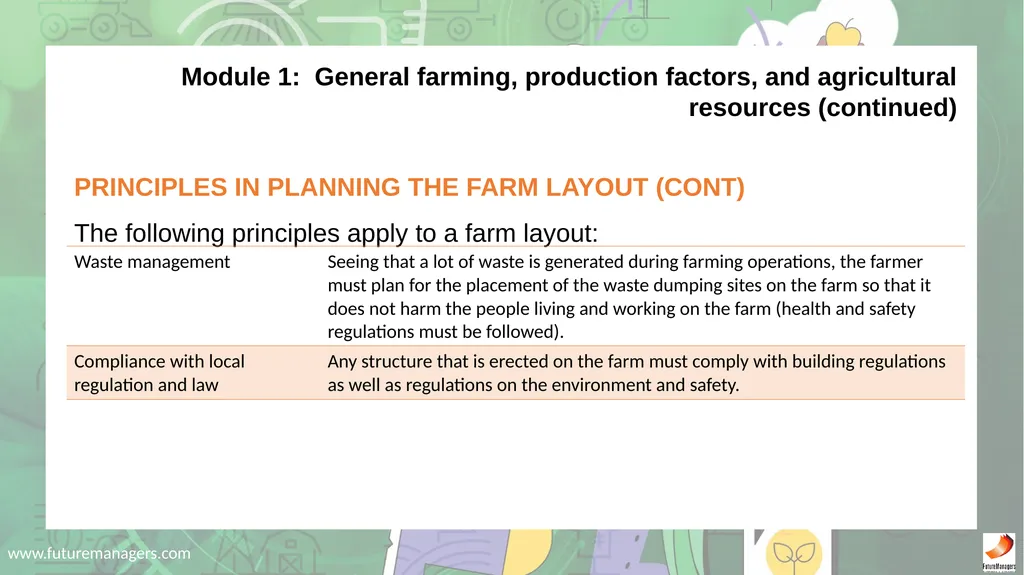
slide9. www.futuremanagers.com Module 1: General farming, production factors, and agricultural resources (continued) PRINCIPLES IN PLANNING THE FARM LAYOUT (CONT)
The following principles apply to a farm layout:<br>
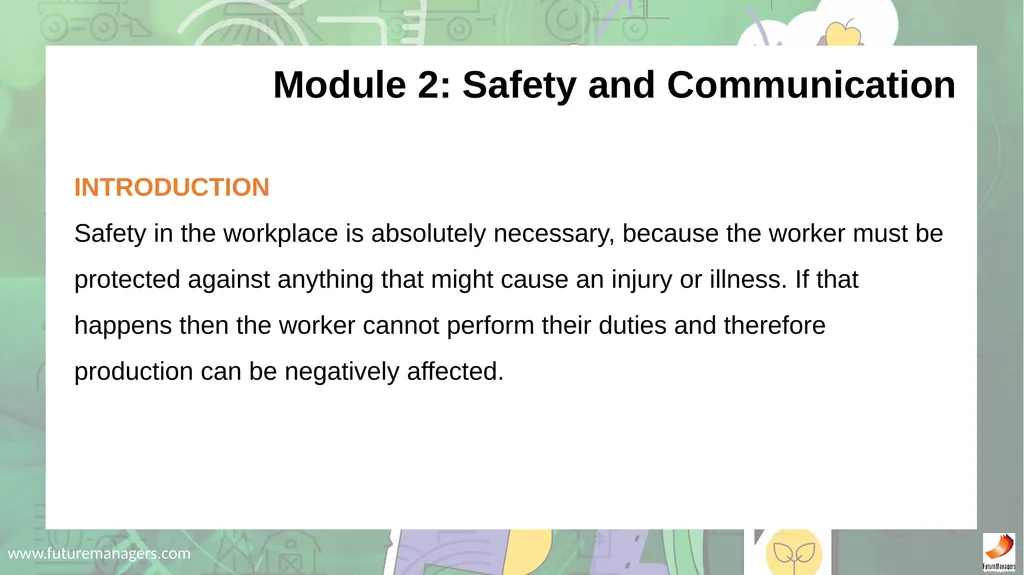
slide10. www.futuremanagers.com INTRODUCTION
Safety in the workplace is absolutely necessary, because the worker must be protected against anything that might cause an injury or illness. If that happens then the worker cannot perform their duties and therefore production can be negatively affected. Module 2: Safety and Communication<br>
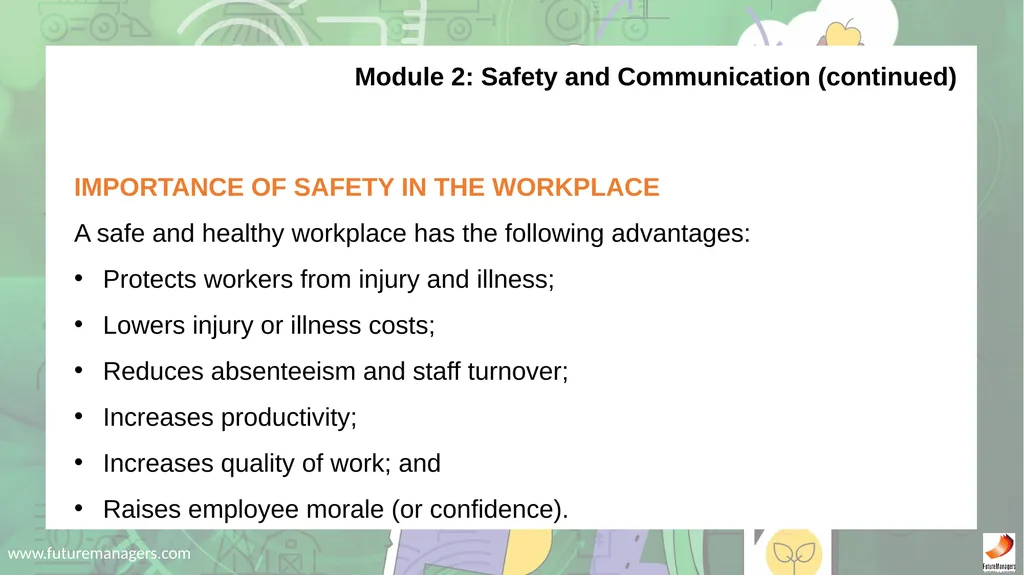
slide11. www.futuremanagers.com Module 2: Safety and Communication (continued) IMPORTANCE OF SAFETY IN THE WORKPLACE
A safe and healthy workplace has the following advantages:
Protects workers from injury and illness;
Lowers injury or illness costs;
Reduces absenteeism and staff turnover;
Increases productivity;
Increases quality of work; and
Raises employee morale (or confidence).<br>
slide12. www.futuremanagers.com Module 2: Safety and Communication (continued) SAFE USE OF TOOLS AND EQUIPMENT
The workers must always keep the following in mind when they work with dangerous tools, equipment, and chemical substances on the farm:
Read and comply with the manual of the instrument/item.
Wear the correct clothing and protection.
Ensure you are well rested before working with dangerous substances, tools, and equipment.
Avoid taking any form of alcohol.<br>
slide13. www.futuremanagers.com Module 2: Safety and Communication (continued) SAFE USE OF TOOLS AND EQUIPMENT (CONT)
The workers must always keep the following in mind when they work with dangerous tools, equipment, and chemical substances on the farm:
Maintain awareness and keep focus on the job at hand.
Apply all safety measures always when performing a dangerous job.
Wear safety clothes as prescribed; keep all covers and protective parts on a machine or tools when using them, and
Keep children and animals away from working areas.<br>
slide14. www.futuremanagers.com Module 2: Safety and Communication (continued) DANGERS IN USING TOOLS AND EQUIPMENT
The following kinds of unsafe and dangerous situations may happen on a farm:
Electrical accident;
Exposure to dangerous chemicals;
Machinery and tools hazard; and
Fire accidents.<br>
slide15. www.futuremanagers.com INTRODUCTION
A farm worker cannot perform any work on the farm, unless they receive specific instruments to do that. There is a large variety of equipment, tools, and machinery (implements) that can be used for specific kinds of jobs. Therefore, the farmer needs to train the farm workers about the purpose of the different tools and equipment and how each one of these can be used. Module 3: Tools, equipment, machinery, and alternative energy<br>
slide16. www.futuremanagers.com Module 3: Tools, equipment, machinery, and alternative energy (continued) PRIMARY CULTIVATION
Primary cultivation refers to the processes that need to be completed before any planting or harvesting of crops can take place. Its main purpose is to prepare the land in different ways before the planting/sowing starts.<br>
slide17. www.futuremanagers.com Module 3: Tools, equipment, machinery, and alternative energy (continued) SECONDARY CULTIVATION
Secondary cultivation follows the primary cultivation process. Once the soil is prepared, the actual sowing of seeds and planting of plants take place.<br>
slide18. www.futuremanagers.com Module 3: Tools, equipment, machinery, and alternative energy (continued) ALTERNATIVE SOURCES OF ENERGY
Alternative or renewable energy means that the source never gets depleted or used up. Examples of alternative energy are:
Wind power;
Solar power;
Hydro energy;
Biogas and;
Biofuel.<br>
slide19. www.futuremanagers.com INTRODUCTION
Plant production deals with the basic rules of plant growth, the impact of soil, water, nutrients and others on the growth of plants as well as the impact that diseases and pests have on the quality of the crops. Horticulture is a part of agriculture that deals with the business of plant growth that includes the cultivation of fruits, vegetables, nuts, seeds, herbs, flowers, and non-food crops such as grass and ornamental trees and plants. Module 4: Plant production and horticulture<br>
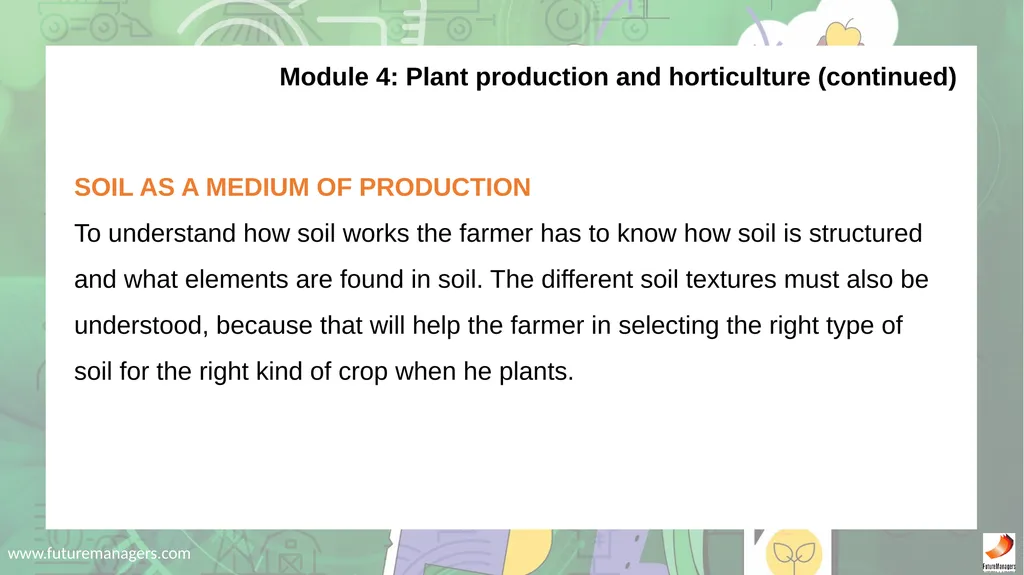
slide20. www.futuremanagers.com Module 4: Plant production and horticulture (continued) SOIL AS A MEDIUM OF PRODUCTION
To understand how soil works the farmer has to know how soil is structured and what elements are found in soil. The different soil textures must also be understood, because that will help the farmer in selecting the right type of soil for the right kind of crop when he plants.<br>
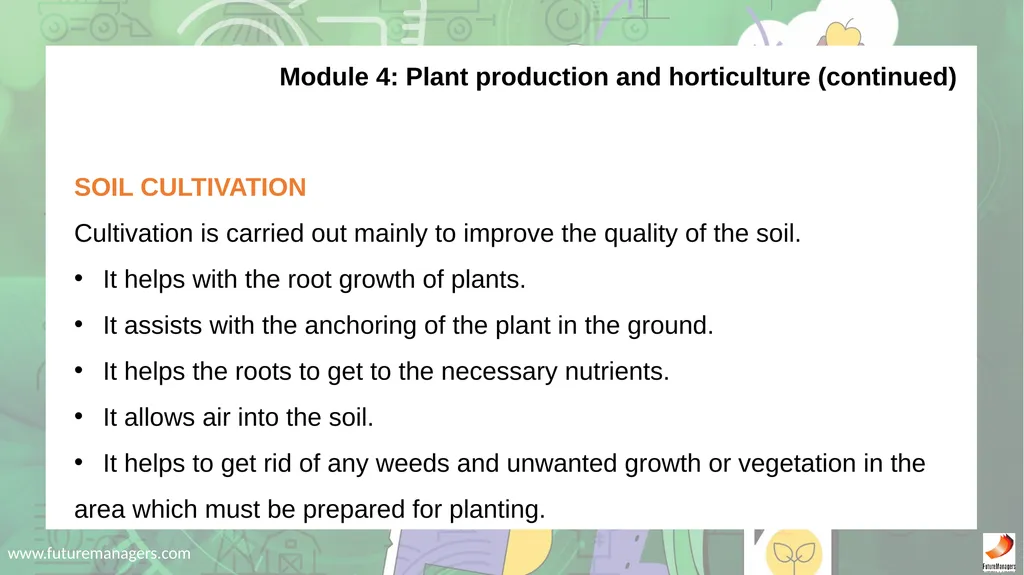
slide21. www.futuremanagers.com Module 4: Plant production and horticulture (continued) SOIL CULTIVATION
Cultivation is carried out mainly to improve the quality of the soil.
It helps with the root growth of plants.
It assists with the anchoring of the plant in the ground.
It helps the roots to get to the necessary nutrients.
It allows air into the soil.
It helps to get rid of any weeds and unwanted growth or vegetation in the
area which must be prepared for planting.<br>
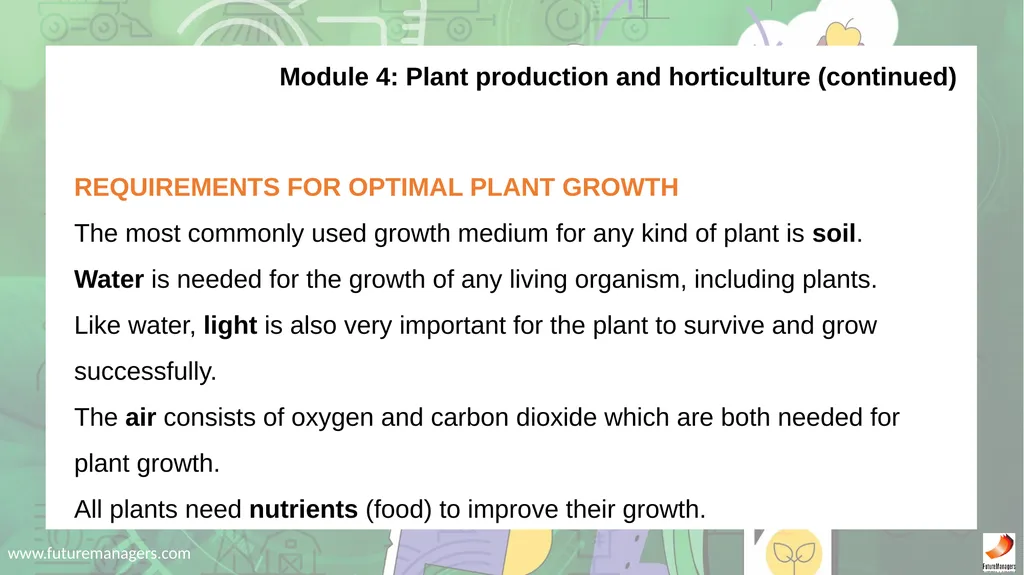
slide22. www.futuremanagers.com Module 4: Plant production and horticulture (continued) REQUIREMENTS FOR OPTIMAL PLANT GROWTH
The most commonly used growth medium for any kind of plant is soil.
Water is needed for the growth of any living organism, including plants.
Like water, light is also very important for the plant to survive and grow successfully.
The air consists of oxygen and carbon dioxide which are both needed for plant growth.
All plants need nutrients (food) to improve their growth.<br>
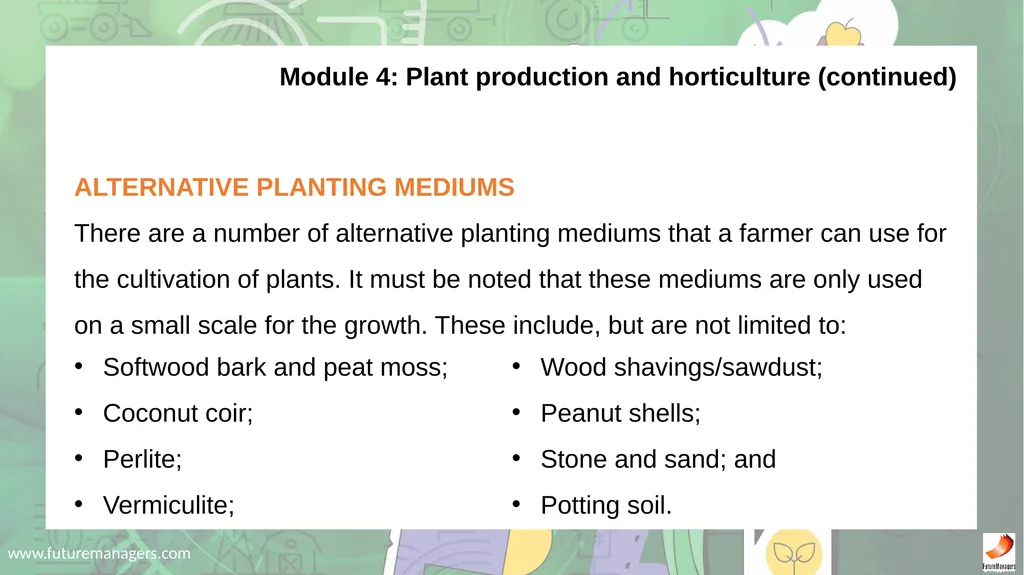
slide23. www.futuremanagers.com Module 4: Plant production and horticulture (continued) ALTERNATIVE PLANTING MEDIUMS
There are a number of alternative planting mediums that a farmer can use for the cultivation of plants. It must be noted that these mediums are only used on a small scale for the growth. These include, but are not limited to: Softwood bark and peat moss;
Coconut coir;
Perlite;
Vermiculite;
Wood shavings/sawdust;
Peanut shells;
Stone and sand; and
Potting soil.<br>
slide24. www.futuremanagers.com Module 4: Plant production and horticulture (continued) CROPS PRODUCED IN SOUTH AFRICA
Production of agricultural produce in South Africa is divided into:
Field crops (maize, wheat, sunflower, soybeans);
Fruits (stone, deciduous, citrus, tropical, nuts);
Vegetables (roots, leaves, pods);
Trees (forestry);
Ornamental crops (trees, flowers); and
Pastoral crops (grasses, legumes).<br>
slide25. www.futuremanagers.com Module 4: Plant production and horticulture (continued) INTEGRATED PEST AND DISEASE MANAGEMENT (IPM)
IPM is defined as a system that focuses on the prevention of pests and diseases by using a combination of different techniques. These techniques include:
Biological control; and
Habitat manipulation.<br>
slide26. www.futuremanagers.com INTRODUCTION
Animal production plays a vital role in the whole of the agricultural sector. South Africa produces large quantities of animal products annually. Animal farmers will only be in a position to produce large quantities of animal products if they have good and healthy animal herds and are able to produce (or breed) more of the same quality animals. Module 5: Animal production<br>
slide27. www.futuremanagers.com Module 5: Animal production (continued) ANIMAL BREEDS AND THEIR PRODUCTS: CATTLE
Cattle breeds are divided into two categories according to their products, namely beef (meat) and dairy products.<br>
slide28. www.futuremanagers.com Module 5: Animal production (continued) ANIMAL BREEDS AND THEIR PRODUCTS: SHEEP
There are approximately 20 different kinds of sheep breeds in South Africa. Sheep breeding takes place all over South Africa, however, it is mainly found in the drier parts of the country like the Karoo. Sheep are bred for their meat (called mutton) and wool. The following types of sheep produce the best mutton for local consumption, namely Merino, Dorper, Dohne Merino, Dormer, and Black-headed Persian. Although some of these breeds also produce wool, the length and quality of their wool is not the best.<br>
slide29. www.futuremanagers.com Module 5: Animal production (continued) ANIMAL BREEDS AND THEIR PRODUCTS: PIGS
Three main types of pigs are found in South Africa, namely South African Landrace, Large White, and Duroc. The meat that is produced by pigs is called pork.<br>
slide30. www.futuremanagers.com Module 5: Animal production (continued) ANIMAL BREEDS AND THEIR PRODUCTS: GOATS
Goat farming is one of the oldest forms of livestock farming in the country. These animals are bred and kept for their meat, milk, and hair (fibre). Goat farming is found across South Africa, but mainly in the Eastern Cape, KwaZulu-Natal, and Limpopo provinces. Two well-known breeds exist in South Africa, namely Boer goats and Angora (older animals).<br>
slide31. www.futuremanagers.com Module 5: Animal production (continued) ANIMAL BREEDS AND THEIR PRODUCTS: POULTRY
There are different types of poultry farming in South Africa, namely layers, broilers, and incubation. Poultry farms and companies are spread all over South Africa.<br>
slide32. www.futuremanagers.com Module 5: Animal production (continued) ANIMAL BREEDS AND THEIR PRODUCTS: HORSES
There are four main South African horse breeds of which the SA Boerperd, Nooitgedacht, Basuto pony, and Cape Boerperd are the most well-known. Many other breeds exist all over the world and are bred for specific purposes such as for horse riding and to assist with daily tasks on the farm.<br>
slide33. www.futuremanagers.com Module 5: Animal production (continued) ANIMAL BREEDS AND THEIR PRODUCTS: RABBITS
Rabbit farming is practiced in South Africa for the purpose of their meat, their wool (fur) and as pets. Currently the market for rabbit meat is small in South Africa, however, a large amount of it is exported. The wool (fibre) or as it is better known – fur – of rabbits is highly sought after.<br>
slide34. www.futuremanagers.com Module 5: Animal production (continued) ANIMAL BREEDS AND THEIR PRODUCTS: BEEKEEPING
Beekeeping could be a profitable option due to the high demand for the honey product – the sweet substance produced by the bees.<br>
slide35. www.futuremanagers.com Module 5: Animal production (continued) ANIMAL BREEDS AND THEIR PRODUCTS: OSTRICHES
Ostriches are mostly bred in the Klein Karoo (Oudtshoorn) and surrounding areas. These birds are bred for their eggs, meat, skin (leather), as well as for their feathers. The ostrich industry is a large contributor to the economy of that region.<br>
slide36. www.futuremanagers.com Module 5: Animal production (continued) ANIMAL BREEDS AND THEIR PRODUCTS: GAME
A game farm is a place where game animals are kept and raised for the purpose of hunting, photography, and tourism.<br>
slide37. www.futuremanagers.com Module 5: Animal production (continued) BASIC REQUIREMENTS FOR OPTIMAL ANIMAL PRODUCTION
A livestock farmer aims to have the best possible increase in the livestock on the farm. To be able to reach that goal, the farmer has to meet the minimum basic requirements of the animals, these are:
Environmental factors such as the climate; and
Animal management such as housing, care and health, nitration, and selection and breeding.<br>
slide38. www.futuremanagers.com INTRODUCTION
Although the practical application and farming with crops and animals are the foundation of the farm, the farmer needs to practice good business skills in order to grow and expand the farm. Module 6: Business planning and practices<br>
slide39. www.futuremanagers.com Module 6: Business planning and practices (continued) GOOD RECORD KEEPING
The farmer needs to keep book of everything before, during, and after production. This includes recording aspects such as:
Fuel consumption;
Fertilisers;
Seed; and
Labour.<br>
slide40. www.futuremanagers.com Module 6: Business planning and practices (continued) BUDGETING
Budgeting is a planning tool. It means that the money to be spent and earned on the product that the farmer is going to plant and sell is planned.<br>
slide41. www.futuremanagers.com INTRODUCTION
As part of the whole process of bringing the goods (e.g. vegetables), from the farm to the consumers (persons who buy the vegetables) the farmer needs to spend time evaluating the different options and ways of doing this best. This is known as the marketing process. Module 7: Marketing and price setting<br>
slide42. www.futuremanagers.com Module 7: Marketing and price setting (continued) BASIC MARKETING
Marketing is defined as the process through which the products or goods produced by the farmer are transferred or sold to another person who has the need for that particular product.<br>
slide43. www.futuremanagers.com Module 7: Marketing and price setting (continued) BASIC AGRICULTURAL NEEDS AND WANTS: CONSUMER A need is something that is necessary for all and without it cannot live, e.g. food, water, sleep, shelter, and clothing.
A want is something that improves the quality of your life and that you feel a
desire for, but can live without.<br>
slide44. www.futuremanagers.com Module 7: Marketing and price setting (continued) BASIC AGRICULTURAL NEEDS AND WANTS: FARMER A need is something that is necessary to do farming activities, e.g. land, water, sunshine, air, and nutrients to grow crops and livestock.
A want is something that improves or betters the quality of the farming activities, e.g. smart implements, large crop fields, large animal herds, and a fast pick-up bakkie!<br>
slide45. www.futuremanagers.com Module 7: Marketing and price setting (continued) DETERMINING THE SELLING POINT
The selling price is derived at after considering all the costs involved in producing the product as well as the percentage profit that the farmer wants to add.<br>
slide46. www.futuremanagers.com INTRODUCTION
At the end of the farming season or cycle, the farmer still has one big activity to conclude the production. Usually, crop farmers know when the crops in their areas are ready to be harvested. One must never forget about the fruit and vegetable farmers. They use other means to harvest their produce. Module 8: Harvesting and storage<br>
slide47. www.futuremanagers.com Module 8: Harvesting and storage (continued) HARVESTING EQUIPMENT
There are two common harvesting methods applied throughout farming:
Manual harvesting which is applied where the product needs to be picked by hand only; and
Mechanical harvesting which is used specifically where large areas of crop have to be harvested.<br>
slide48. www.futuremanagers.com Module 8: Harvesting and storage (continued) STORAGE
Once the crops are harvested it needs to be kept somewhere before it is delivered to either the mass storage facilities (like silos for grain harvests or co-operatives) or to shops and markets where the produce is sold directly to consumers. The aim of storage is to prevent the products from going bad (decaying) or improving the maturity or the ripeness of the product.<br>
slide49. www.futuremanagers.com INTRODUCTION
The final part of the farmer’s journey through the production of crops and animals has finally arrived. Some more work needs to be done now before the farmer can sit back and evaluate the year’s or season’s success on the farm. Module 9: Processing and value adding<br>
slide50. www.futuremanagers.com Module 9: Processing and value adding (continued) PROCESSING OF PRODUCTS AFTER THE HARVEST
The biggest and hardest work on the farm is done when the harvest is collected from the fields and stored safely. Before the products are delivered to the market the farmer still has some more work to do. These activities are also called post-harvesting activities.<br>
slide51. www.futuremanagers.com Module 9: Processing and value adding (continued) PROCESSING
Processing means that the inedible parts of the crop are removed through different actions, e.g. pealing, washing, drying, sorting, grading, etc. so that it is in a form ready to be used by the consumer.<br>
slide52. www.futuremanagers.com Module 9: Processing and value adding (continued) VALUE ADDING
Value adding means that the raw product is transformed or changed into another form or shape which gives it a better value or use in the market and in many cases, also lengthens the shelf life of the product. The overall purpose of value adding is to make the product more attractive for the consumer so that they want to buy the product.<br>
slide53. www.futuremanagers.com Module 9: Processing and value adding (continued) PACKAGING
Agricultural packaging refers to the actions of designing and use of something that can protect the final product during the transport (distribution), storage, sale, and use thereof. Packaging of the farmer’s product can either take place on the farm (e.g. packing of grapes in boxes) or in the market (e.g. food placed in tins, fresh produce packed in bags).<br>
Grade 8<br>
slide2. www.futuremanagers.com INTRODUCTION
No farming practices can survive without having access to the important factors of production as the basic resources that farmers need. Farmers not only use the natural resources available to them to the maximum, they also have the obligation (duty) to protect and conserve those resources so that future generations will also have access to them. Module 1: General farming, production factors, and agricultural resources<br>
slide3. www.futuremanagers.com Module 1: General farming, production factors, and agricultural resources (continued) DEVELOPMENT OF AGRICULTURE IN SOUTH AFRICA
The first farmers in Southern Africa were Black people from the northern parts of Africa, speaking different languages. These farmers usually moved in larger groups. When there were too many farmers in one place some of them began to move around in the country to find better places to keep their animals and to grow their own food. The first real farmers lived differently to hunters and gatherers. They had to stay in one place long enough to plant and harvest their crops. They also built permanent homes near their fields.<br>
slide4. www.futuremanagers.com Module 1: General farming, production factors, and agricultural resources (continued) BASIC RESOURCES FOR FARMING
Any farmer (or business) needs to have access to the following four basic resources, also known as factors of production:
Natural resources;
Financial resources;
Human resources; and
Entrepreneurship.<br>
slide5. www.futuremanagers.com Module 1: General farming, production factors, and agricultural resources (continued) THE IMPORTANCE OF CONSERVATION OF NATURAL RESOURCES
Not all natural resources are available in the same quantities across the country. Different parts of the country have different resources available and provide access for the local communities to those resources. The farmer’s goal is to conserve (protect) the resources as much as possible so that they could last longer. The advantage thereof is that the resources will be available much longer for future generations.<br>
slide6. www.futuremanagers.com Module 1: General farming, production factors, and agricultural resources (continued) FARMING SYSTEMS
A farming system comprises of all the activities required to produce something which can be used or consumed by people. It includes all crops, animals, the use of machines and equipment, people working on a farm as well as all other resources needed to be able to produce something through a process and at the end have a final product that can be sold or used.<br>
slide7. www.futuremanagers.com Module 1: General farming, production factors, and agricultural resources (continued) PRINCIPLES IN PLANNING THE FARM LAYOUT
The following principles apply to a farm layout:<br>
slide8. www.futuremanagers.com Module 1: General farming, production factors, and agricultural resources (continued) PRINCIPLES IN PLANNING THE FARM LAYOUT (CONT)
The following principles apply to a farm layout:<br>
slide9. www.futuremanagers.com Module 1: General farming, production factors, and agricultural resources (continued) PRINCIPLES IN PLANNING THE FARM LAYOUT (CONT)
The following principles apply to a farm layout:<br>
slide10. www.futuremanagers.com INTRODUCTION
Safety in the workplace is absolutely necessary, because the worker must be protected against anything that might cause an injury or illness. If that happens then the worker cannot perform their duties and therefore production can be negatively affected. Module 2: Safety and Communication<br>
slide11. www.futuremanagers.com Module 2: Safety and Communication (continued) IMPORTANCE OF SAFETY IN THE WORKPLACE
A safe and healthy workplace has the following advantages:
Protects workers from injury and illness;
Lowers injury or illness costs;
Reduces absenteeism and staff turnover;
Increases productivity;
Increases quality of work; and
Raises employee morale (or confidence).<br>
slide12. www.futuremanagers.com Module 2: Safety and Communication (continued) SAFE USE OF TOOLS AND EQUIPMENT
The workers must always keep the following in mind when they work with dangerous tools, equipment, and chemical substances on the farm:
Read and comply with the manual of the instrument/item.
Wear the correct clothing and protection.
Ensure you are well rested before working with dangerous substances, tools, and equipment.
Avoid taking any form of alcohol.<br>
slide13. www.futuremanagers.com Module 2: Safety and Communication (continued) SAFE USE OF TOOLS AND EQUIPMENT (CONT)
The workers must always keep the following in mind when they work with dangerous tools, equipment, and chemical substances on the farm:
Maintain awareness and keep focus on the job at hand.
Apply all safety measures always when performing a dangerous job.
Wear safety clothes as prescribed; keep all covers and protective parts on a machine or tools when using them, and
Keep children and animals away from working areas.<br>
slide14. www.futuremanagers.com Module 2: Safety and Communication (continued) DANGERS IN USING TOOLS AND EQUIPMENT
The following kinds of unsafe and dangerous situations may happen on a farm:
Electrical accident;
Exposure to dangerous chemicals;
Machinery and tools hazard; and
Fire accidents.<br>
slide15. www.futuremanagers.com INTRODUCTION
A farm worker cannot perform any work on the farm, unless they receive specific instruments to do that. There is a large variety of equipment, tools, and machinery (implements) that can be used for specific kinds of jobs. Therefore, the farmer needs to train the farm workers about the purpose of the different tools and equipment and how each one of these can be used. Module 3: Tools, equipment, machinery, and alternative energy<br>
slide16. www.futuremanagers.com Module 3: Tools, equipment, machinery, and alternative energy (continued) PRIMARY CULTIVATION
Primary cultivation refers to the processes that need to be completed before any planting or harvesting of crops can take place. Its main purpose is to prepare the land in different ways before the planting/sowing starts.<br>
slide17. www.futuremanagers.com Module 3: Tools, equipment, machinery, and alternative energy (continued) SECONDARY CULTIVATION
Secondary cultivation follows the primary cultivation process. Once the soil is prepared, the actual sowing of seeds and planting of plants take place.<br>
slide18. www.futuremanagers.com Module 3: Tools, equipment, machinery, and alternative energy (continued) ALTERNATIVE SOURCES OF ENERGY
Alternative or renewable energy means that the source never gets depleted or used up. Examples of alternative energy are:
Wind power;
Solar power;
Hydro energy;
Biogas and;
Biofuel.<br>
slide19. www.futuremanagers.com INTRODUCTION
Plant production deals with the basic rules of plant growth, the impact of soil, water, nutrients and others on the growth of plants as well as the impact that diseases and pests have on the quality of the crops. Horticulture is a part of agriculture that deals with the business of plant growth that includes the cultivation of fruits, vegetables, nuts, seeds, herbs, flowers, and non-food crops such as grass and ornamental trees and plants. Module 4: Plant production and horticulture<br>
slide20. www.futuremanagers.com Module 4: Plant production and horticulture (continued) SOIL AS A MEDIUM OF PRODUCTION
To understand how soil works the farmer has to know how soil is structured and what elements are found in soil. The different soil textures must also be understood, because that will help the farmer in selecting the right type of soil for the right kind of crop when he plants.<br>
slide21. www.futuremanagers.com Module 4: Plant production and horticulture (continued) SOIL CULTIVATION
Cultivation is carried out mainly to improve the quality of the soil.
It helps with the root growth of plants.
It assists with the anchoring of the plant in the ground.
It helps the roots to get to the necessary nutrients.
It allows air into the soil.
It helps to get rid of any weeds and unwanted growth or vegetation in the
area which must be prepared for planting.<br>
slide22. www.futuremanagers.com Module 4: Plant production and horticulture (continued) REQUIREMENTS FOR OPTIMAL PLANT GROWTH
The most commonly used growth medium for any kind of plant is soil.
Water is needed for the growth of any living organism, including plants.
Like water, light is also very important for the plant to survive and grow successfully.
The air consists of oxygen and carbon dioxide which are both needed for plant growth.
All plants need nutrients (food) to improve their growth.<br>
slide23. www.futuremanagers.com Module 4: Plant production and horticulture (continued) ALTERNATIVE PLANTING MEDIUMS
There are a number of alternative planting mediums that a farmer can use for the cultivation of plants. It must be noted that these mediums are only used on a small scale for the growth. These include, but are not limited to: Softwood bark and peat moss;
Coconut coir;
Perlite;
Vermiculite;
Wood shavings/sawdust;
Peanut shells;
Stone and sand; and
Potting soil.<br>
slide24. www.futuremanagers.com Module 4: Plant production and horticulture (continued) CROPS PRODUCED IN SOUTH AFRICA
Production of agricultural produce in South Africa is divided into:
Field crops (maize, wheat, sunflower, soybeans);
Fruits (stone, deciduous, citrus, tropical, nuts);
Vegetables (roots, leaves, pods);
Trees (forestry);
Ornamental crops (trees, flowers); and
Pastoral crops (grasses, legumes).<br>
slide25. www.futuremanagers.com Module 4: Plant production and horticulture (continued) INTEGRATED PEST AND DISEASE MANAGEMENT (IPM)
IPM is defined as a system that focuses on the prevention of pests and diseases by using a combination of different techniques. These techniques include:
Biological control; and
Habitat manipulation.<br>
slide26. www.futuremanagers.com INTRODUCTION
Animal production plays a vital role in the whole of the agricultural sector. South Africa produces large quantities of animal products annually. Animal farmers will only be in a position to produce large quantities of animal products if they have good and healthy animal herds and are able to produce (or breed) more of the same quality animals. Module 5: Animal production<br>
slide27. www.futuremanagers.com Module 5: Animal production (continued) ANIMAL BREEDS AND THEIR PRODUCTS: CATTLE
Cattle breeds are divided into two categories according to their products, namely beef (meat) and dairy products.<br>
slide28. www.futuremanagers.com Module 5: Animal production (continued) ANIMAL BREEDS AND THEIR PRODUCTS: SHEEP
There are approximately 20 different kinds of sheep breeds in South Africa. Sheep breeding takes place all over South Africa, however, it is mainly found in the drier parts of the country like the Karoo. Sheep are bred for their meat (called mutton) and wool. The following types of sheep produce the best mutton for local consumption, namely Merino, Dorper, Dohne Merino, Dormer, and Black-headed Persian. Although some of these breeds also produce wool, the length and quality of their wool is not the best.<br>
slide29. www.futuremanagers.com Module 5: Animal production (continued) ANIMAL BREEDS AND THEIR PRODUCTS: PIGS
Three main types of pigs are found in South Africa, namely South African Landrace, Large White, and Duroc. The meat that is produced by pigs is called pork.<br>
slide30. www.futuremanagers.com Module 5: Animal production (continued) ANIMAL BREEDS AND THEIR PRODUCTS: GOATS
Goat farming is one of the oldest forms of livestock farming in the country. These animals are bred and kept for their meat, milk, and hair (fibre). Goat farming is found across South Africa, but mainly in the Eastern Cape, KwaZulu-Natal, and Limpopo provinces. Two well-known breeds exist in South Africa, namely Boer goats and Angora (older animals).<br>
slide31. www.futuremanagers.com Module 5: Animal production (continued) ANIMAL BREEDS AND THEIR PRODUCTS: POULTRY
There are different types of poultry farming in South Africa, namely layers, broilers, and incubation. Poultry farms and companies are spread all over South Africa.<br>
slide32. www.futuremanagers.com Module 5: Animal production (continued) ANIMAL BREEDS AND THEIR PRODUCTS: HORSES
There are four main South African horse breeds of which the SA Boerperd, Nooitgedacht, Basuto pony, and Cape Boerperd are the most well-known. Many other breeds exist all over the world and are bred for specific purposes such as for horse riding and to assist with daily tasks on the farm.<br>
slide33. www.futuremanagers.com Module 5: Animal production (continued) ANIMAL BREEDS AND THEIR PRODUCTS: RABBITS
Rabbit farming is practiced in South Africa for the purpose of their meat, their wool (fur) and as pets. Currently the market for rabbit meat is small in South Africa, however, a large amount of it is exported. The wool (fibre) or as it is better known – fur – of rabbits is highly sought after.<br>
slide34. www.futuremanagers.com Module 5: Animal production (continued) ANIMAL BREEDS AND THEIR PRODUCTS: BEEKEEPING
Beekeeping could be a profitable option due to the high demand for the honey product – the sweet substance produced by the bees.<br>
slide35. www.futuremanagers.com Module 5: Animal production (continued) ANIMAL BREEDS AND THEIR PRODUCTS: OSTRICHES
Ostriches are mostly bred in the Klein Karoo (Oudtshoorn) and surrounding areas. These birds are bred for their eggs, meat, skin (leather), as well as for their feathers. The ostrich industry is a large contributor to the economy of that region.<br>
slide36. www.futuremanagers.com Module 5: Animal production (continued) ANIMAL BREEDS AND THEIR PRODUCTS: GAME
A game farm is a place where game animals are kept and raised for the purpose of hunting, photography, and tourism.<br>
slide37. www.futuremanagers.com Module 5: Animal production (continued) BASIC REQUIREMENTS FOR OPTIMAL ANIMAL PRODUCTION
A livestock farmer aims to have the best possible increase in the livestock on the farm. To be able to reach that goal, the farmer has to meet the minimum basic requirements of the animals, these are:
Environmental factors such as the climate; and
Animal management such as housing, care and health, nitration, and selection and breeding.<br>
slide38. www.futuremanagers.com INTRODUCTION
Although the practical application and farming with crops and animals are the foundation of the farm, the farmer needs to practice good business skills in order to grow and expand the farm. Module 6: Business planning and practices<br>
slide39. www.futuremanagers.com Module 6: Business planning and practices (continued) GOOD RECORD KEEPING
The farmer needs to keep book of everything before, during, and after production. This includes recording aspects such as:
Fuel consumption;
Fertilisers;
Seed; and
Labour.<br>
slide40. www.futuremanagers.com Module 6: Business planning and practices (continued) BUDGETING
Budgeting is a planning tool. It means that the money to be spent and earned on the product that the farmer is going to plant and sell is planned.<br>
slide41. www.futuremanagers.com INTRODUCTION
As part of the whole process of bringing the goods (e.g. vegetables), from the farm to the consumers (persons who buy the vegetables) the farmer needs to spend time evaluating the different options and ways of doing this best. This is known as the marketing process. Module 7: Marketing and price setting<br>
slide42. www.futuremanagers.com Module 7: Marketing and price setting (continued) BASIC MARKETING
Marketing is defined as the process through which the products or goods produced by the farmer are transferred or sold to another person who has the need for that particular product.<br>
slide43. www.futuremanagers.com Module 7: Marketing and price setting (continued) BASIC AGRICULTURAL NEEDS AND WANTS: CONSUMER A need is something that is necessary for all and without it cannot live, e.g. food, water, sleep, shelter, and clothing.
A want is something that improves the quality of your life and that you feel a
desire for, but can live without.<br>
slide44. www.futuremanagers.com Module 7: Marketing and price setting (continued) BASIC AGRICULTURAL NEEDS AND WANTS: FARMER A need is something that is necessary to do farming activities, e.g. land, water, sunshine, air, and nutrients to grow crops and livestock.
A want is something that improves or betters the quality of the farming activities, e.g. smart implements, large crop fields, large animal herds, and a fast pick-up bakkie!<br>
slide45. www.futuremanagers.com Module 7: Marketing and price setting (continued) DETERMINING THE SELLING POINT
The selling price is derived at after considering all the costs involved in producing the product as well as the percentage profit that the farmer wants to add.<br>
slide46. www.futuremanagers.com INTRODUCTION
At the end of the farming season or cycle, the farmer still has one big activity to conclude the production. Usually, crop farmers know when the crops in their areas are ready to be harvested. One must never forget about the fruit and vegetable farmers. They use other means to harvest their produce. Module 8: Harvesting and storage<br>
slide47. www.futuremanagers.com Module 8: Harvesting and storage (continued) HARVESTING EQUIPMENT
There are two common harvesting methods applied throughout farming:
Manual harvesting which is applied where the product needs to be picked by hand only; and
Mechanical harvesting which is used specifically where large areas of crop have to be harvested.<br>
slide48. www.futuremanagers.com Module 8: Harvesting and storage (continued) STORAGE
Once the crops are harvested it needs to be kept somewhere before it is delivered to either the mass storage facilities (like silos for grain harvests or co-operatives) or to shops and markets where the produce is sold directly to consumers. The aim of storage is to prevent the products from going bad (decaying) or improving the maturity or the ripeness of the product.<br>
slide49. www.futuremanagers.com INTRODUCTION
The final part of the farmer’s journey through the production of crops and animals has finally arrived. Some more work needs to be done now before the farmer can sit back and evaluate the year’s or season’s success on the farm. Module 9: Processing and value adding<br>
slide50. www.futuremanagers.com Module 9: Processing and value adding (continued) PROCESSING OF PRODUCTS AFTER THE HARVEST
The biggest and hardest work on the farm is done when the harvest is collected from the fields and stored safely. Before the products are delivered to the market the farmer still has some more work to do. These activities are also called post-harvesting activities.<br>
slide51. www.futuremanagers.com Module 9: Processing and value adding (continued) PROCESSING
Processing means that the inedible parts of the crop are removed through different actions, e.g. pealing, washing, drying, sorting, grading, etc. so that it is in a form ready to be used by the consumer.<br>
slide52. www.futuremanagers.com Module 9: Processing and value adding (continued) VALUE ADDING
Value adding means that the raw product is transformed or changed into another form or shape which gives it a better value or use in the market and in many cases, also lengthens the shelf life of the product. The overall purpose of value adding is to make the product more attractive for the consumer so that they want to buy the product.<br>
slide53. www.futuremanagers.com Module 9: Processing and value adding (continued) PACKAGING
Agricultural packaging refers to the actions of designing and use of something that can protect the final product during the transport (distribution), storage, sale, and use thereof. Packaging of the farmer’s product can either take place on the farm (e.g. packing of grapes in boxes) or in the market (e.g. food placed in tins, fresh produce packed in bags).<br>