
AI based Attacks Amit Sankholia Dy. Director











Description: AI based Attacks Amit Sankholia Dy. Director Indian Cyber Crime Coordination Centre Introduction to Artificial Intelligence Understanding AI in Cyber-security Evolution of Cyber Threats Types of AI based attacks Adversarial ML Deep fake
Related Topics
Download Presentation
"AI based Attacks Amit Sankholia Dy. Director" is the property of its rightful owner. Permission is granted to download and print the materials on this website for personal, non-commercial use only, and to display it on your personal computer provided you do not modify the materials and that you retain all copyright notices contained in the materials. By downloading content from our website, you accept the terms of this agreement.
Presentation Transcript
slide1. AI based Attacks Amit Sankholia
Dy. Director
Indian Cyber Crime Coordination Centre<br>
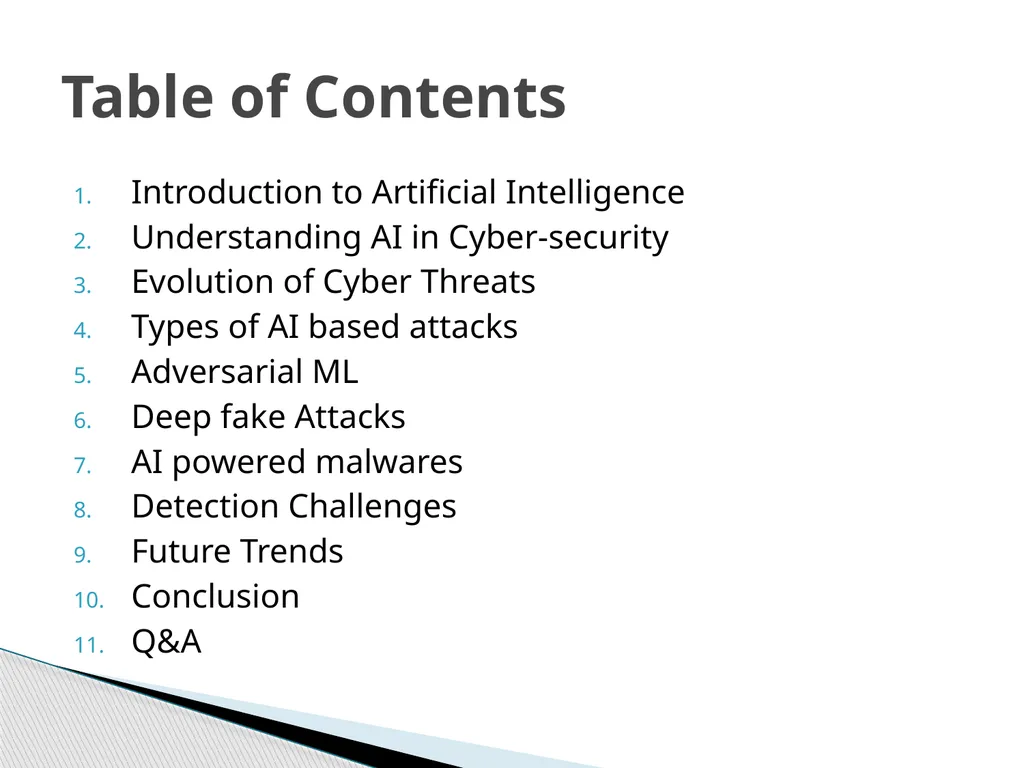
slide2. Introduction to Artificial Intelligence
Understanding AI in Cyber-security
Evolution of Cyber Threats
Types of AI based attacks
Adversarial ML
Deep fake Attacks
AI powered malwares
Detection Challenges
Future Trends
Conclusion
Q&A Table of Contents<br>
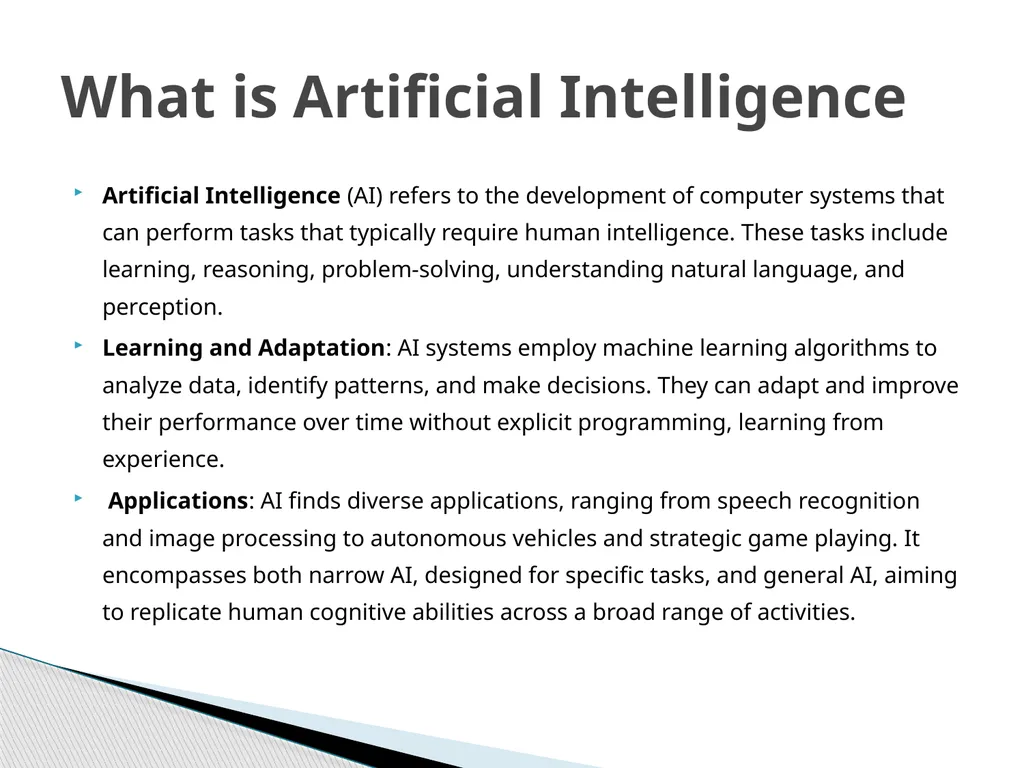
slide4. Artificial Intelligence (AI) refers to the development of computer systems that can perform tasks that typically require human intelligence. These tasks include learning, reasoning, problem-solving, understanding natural language, and perception.
Learning and Adaptation: AI systems employ machine learning algorithms to analyze data, identify patterns, and make decisions. They can adapt and improve their performance over time without explicit programming, learning from experience.
Applications: AI finds diverse applications, ranging from speech recognition and image processing to autonomous vehicles and strategic game playing. It encompasses both narrow AI, designed for specific tasks, and general AI, aiming to replicate human cognitive abilities across a broad range of activities. What is Artificial Intelligence<br>
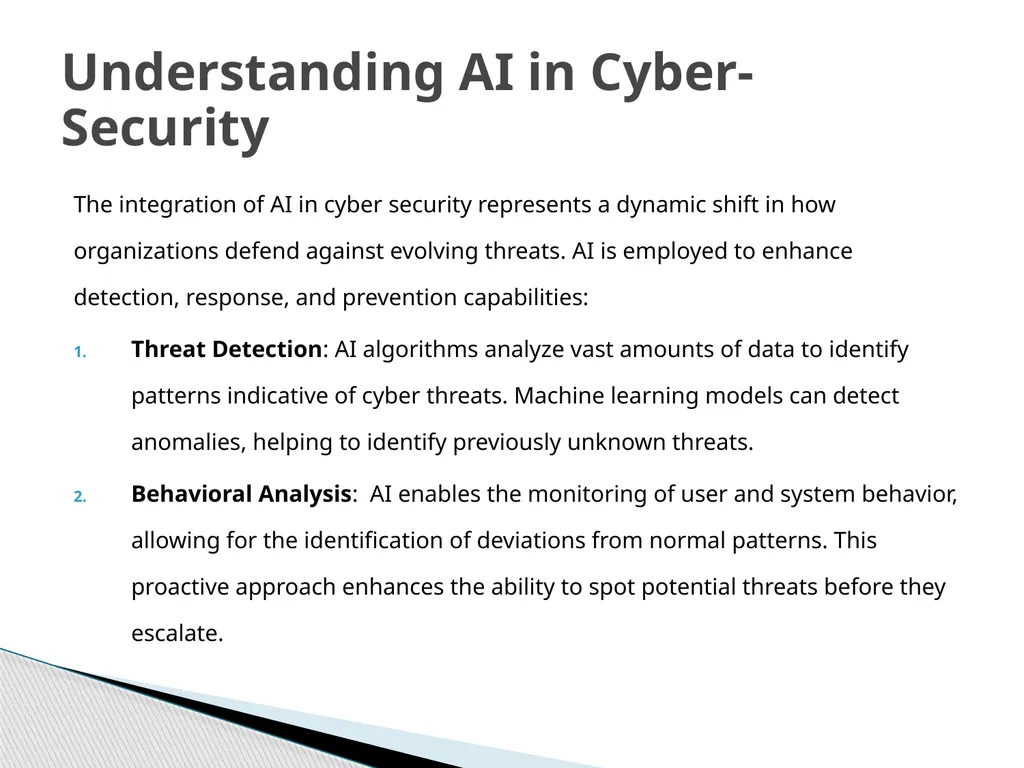
slide6. The integration of AI in cyber security represents a dynamic shift in how organizations defend against evolving threats. AI is employed to enhance detection, response, and prevention capabilities:
Threat Detection: AI algorithms analyze vast amounts of data to identify patterns indicative of cyber threats. Machine learning models can detect anomalies, helping to identify previously unknown threats.
Behavioral Analysis: AI enables the monitoring of user and system behavior, allowing for the identification of deviations from normal patterns. This proactive approach enhances the ability to spot potential threats before they escalate. Understanding AI in Cyber-Security<br>
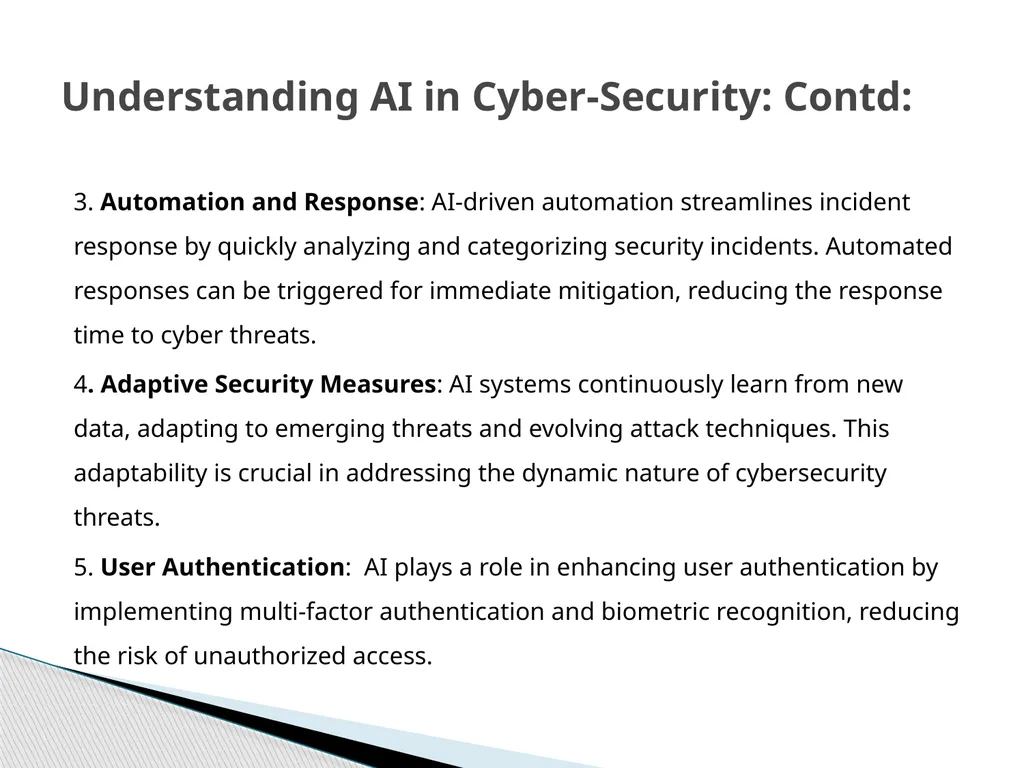
slide7. 3. Automation and Response: AI-driven automation streamlines incident response by quickly analyzing and categorizing security incidents. Automated responses can be triggered for immediate mitigation, reducing the response time to cyber threats.
4. Adaptive Security Measures: AI systems continuously learn from new data, adapting to emerging threats and evolving attack techniques. This adaptability is crucial in addressing the dynamic nature of cybersecurity threats.
5. User Authentication: AI plays a role in enhancing user authentication by implementing multi-factor authentication and biometric recognition, reducing the risk of unauthorized access. Understanding AI in Cyber-Security: Contd:<br>
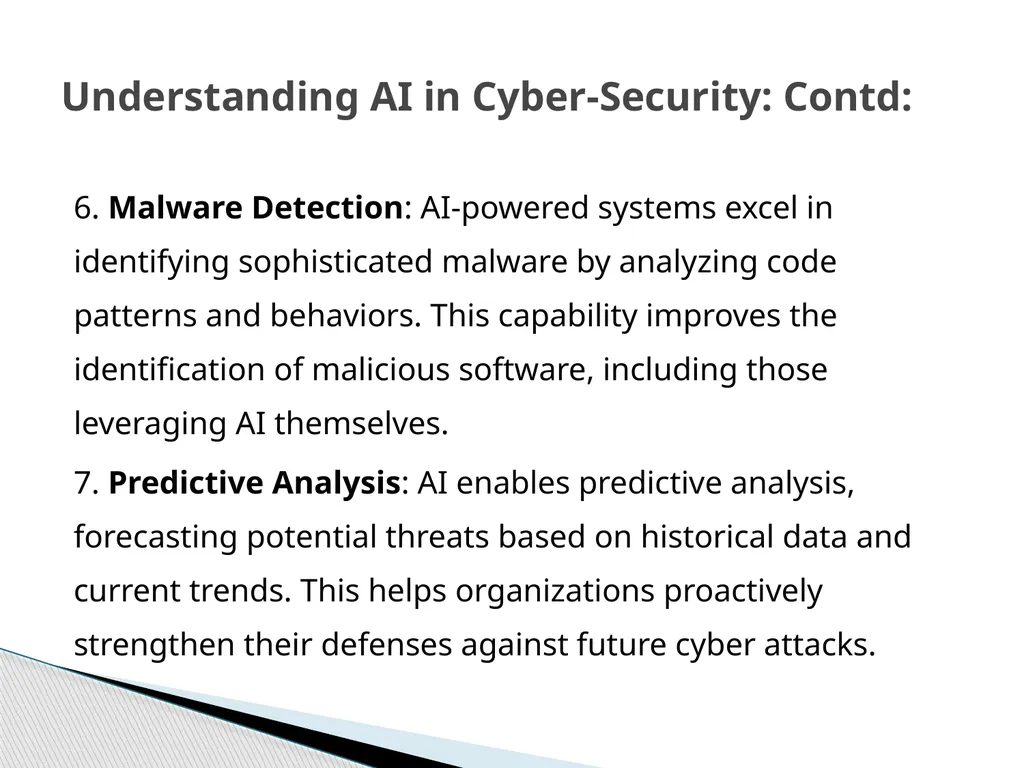
slide8. 6. Malware Detection: AI-powered systems excel in identifying sophisticated malware by analyzing code patterns and behaviors. This capability improves the identification of malicious software, including those leveraging AI themselves.
7. Predictive Analysis: AI enables predictive analysis, forecasting potential threats based on historical data and current trends. This helps organizations proactively strengthen their defenses against future cyber attacks. Understanding AI in Cyber-Security: Contd:<br>
slide10. Increasing Sophistication: Cyber threats have evolved from simple, easily detectable attacks to highly sophisticated and nuanced strategies. Attackers now employ advanced techniques making it challenging for traditional security measures to keep up.
Diversification of Targets: The range of targets for cyber threats has expanded beyond individual users to encompass large enterprises, critical infrastructure, and even entire nations. This diversification poses significant risks as cybercriminals seek financial gain, political motives, or simply to create widespread disruption.
Global Interconnectedness: The evolution of cyber threats is closely tied to the growing interconnectedness of the global digital landscape. The internet's expansion and the increasing reliance on interconnected devices have created a broader attack surface, allowing cyber threats to propagate rapidly and impact diverse sectors across the globe. Evolution of Cyber Threats<br>
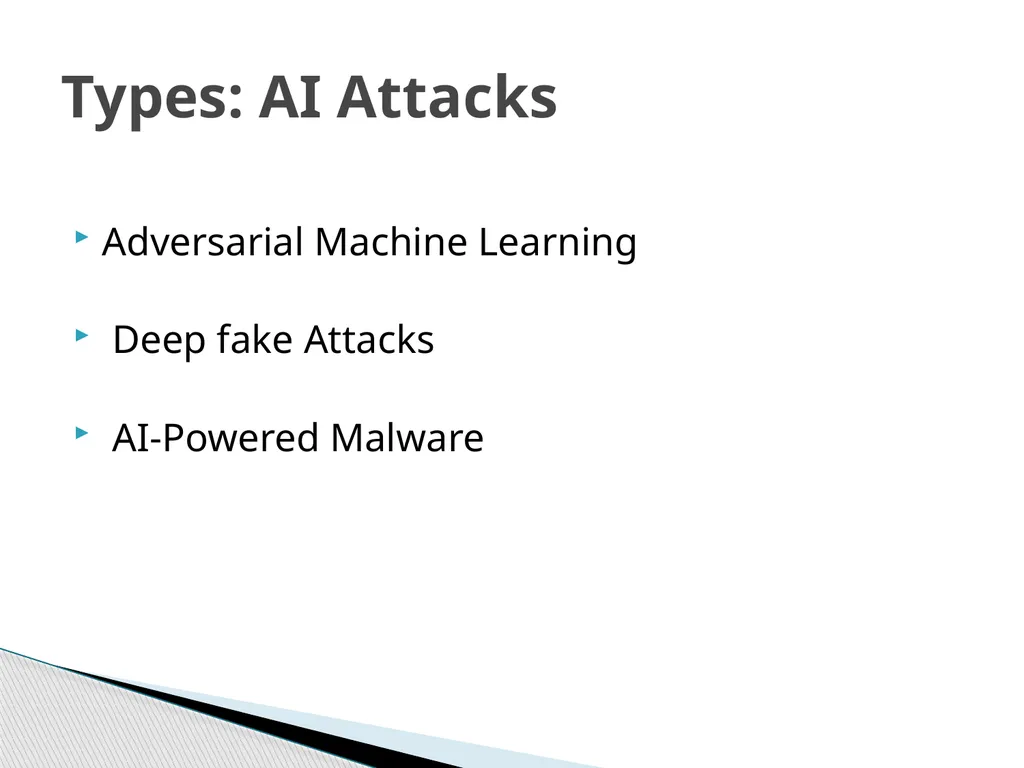
slide11. Adversarial Machine Learning
Deep fake Attacks
AI-Powered Malware Types: AI Attacks<br>
slide13. Purposeful Manipulation: Adversarial machine learning involves attackers purposefully manipulating input data to deceive machine learning models. By making subtle alterations to input features, adversaries aim to exploit vulnerabilities and cause the model to misclassify or make incorrect predictions.
Evasion and Misclassification: Adversarial attacks often focus on evading detection or causing misclassification. Attackers use techniques like adding imperceptible noise to images or tweaking input values to trick machine learning algorithms into producing inaccurate results, compromising the reliability of the model.
Continuous Cat-and-Mouse Game: As machine learning models improve in detecting adversarial attacks, adversaries adapt their methods, leading to a continuous cat-and-mouse game between attackers and defenders. This dynamic challenges the development of robust machine learning models that can withstand evolving adversarial strategies. Adversarial Machine Learning<br>
slide15. Deepfake attacks pose a substantial threat to individuals and organizations by leveraging advanced AI to create convincingly realistic manipulated content.
These maliciously crafted videos or audio recordings can damage reputations, spread misinformation, and incite mistrust. Individuals may face personal harm as their identities are exploited, while organizations risk brand damage, financial losses, and the erosion of public trust.
The potential for deepfakes to deceive and manipulate poses significant challenges for cybersecurity and underscores the critical need for advanced detection and mitigation measures to protect against the multifaceted impacts of these deceptive AI-driven attacks. Deep fake Attacks<br>
slide17. AI-driven malware represents a paradigm shift in cyber threats. Infused with artificial intelligence capabilities, this malware adapts, learns, and evolves, making it highly sophisticated and difficult to detect.
Its autonomous nature allows for dynamic, targeted attacks, posing a significant challenge to traditional cybersecurity measures, necessitating advanced defense strategies. AI-Powered Malware<br>
slide19. Detecting AI-based attacks presents challenges due to their adaptive nature. These attacks dynamically evolve, leveraging machine learning to mimic normal behavior and evade traditional detection methods.
The use of adversarial techniques, where attackers manipulate input data to confuse models, adds complexity.
As AI becomes integral to cybersecurity, distinguishing between legitimate AI activities and malicious intent becomes intricate.
The rapid evolution of attack strategies demands continuous updates in detection mechanisms. Addressing these difficulties requires a multifaceted approach, combining advanced algorithms, continuous monitoring, and a thorough understanding of AI's dual role in defending against and facilitating cyber threats. Detection Challenges<br>
slide20. Anticipating the evolution of AI-based attacks demands foresight into emerging technologies and potential adversarial strategies.
As AI capabilities advance, attackers are likely to exploit novel techniques, including more sophisticated adversarial machine learning and the synthesis of hyper-realistic deepfakes.
The integration of AI in cybersecurity tools necessitates a proactive stance, predicting how attackers might leverage these advancements. Constant research and collaboration between cybersecurity experts are essential to stay ahead, developing robust defenses and adaptive strategies.
Vigilance in monitoring emerging trends and understanding the evolving threat landscape are crucial elements in anticipating and mitigating the future evolution of AI-based cyber attacks Future Trends<br>
slide21. Invest in Advanced Threat Detection: Organizations should prioritize the deployment of advanced threat detection systems that leverage AI for anomaly detection and behavior analysis. These systems can identify subtle patterns indicative of AI-based attacks, enhancing the ability to detect and respond to evolving cyber threats.
Continuous Employee Training: As AI-based attacks often exploit human vulnerabilities through tactics like phishing, continuous employee training is crucial. Educating staff on recognizing and reporting suspicious activities, particularly those involving AI-driven manipulation, helps fortify the human element of cybersecurity.
Implement Adaptive Security Measures: Employ adaptive security measures that evolve in response to emerging threats. Regularly update and upgrade cybersecurity protocols, leveraging AI-driven solutions that learn from new data and adjust defenses accordingly. This dynamic approach is essential for staying resilient against the ever-evolving tactics of AI-powered adversaries. Conclusion<br>
slide23. Which of the following is an example of an AI-based cyberattack?
a) Phishing
b) Ransomware
c) Adversarial Machine Learning
d) DDoS attacks Q&A<br>
slide24. 2. What is the primary purpose of deepfake technology in the context of cybersecurity?
a) Data encryption
b) User authentication
c) Identity deception
d) Network intrusion Q&A<br>
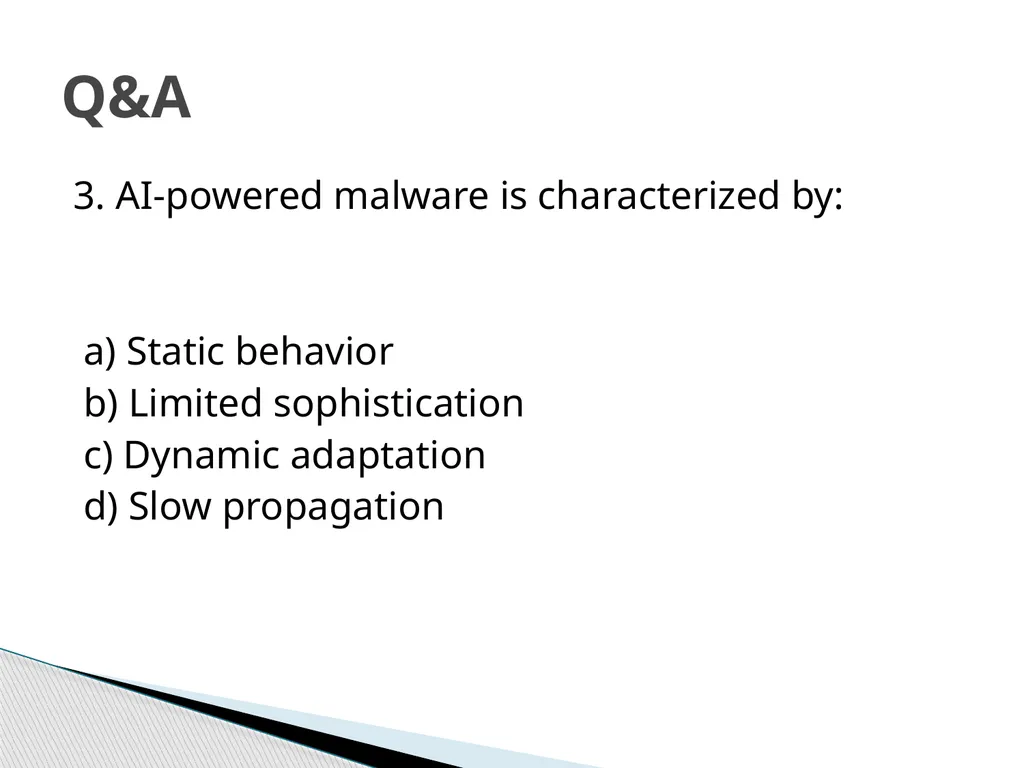
slide25. 3. AI-powered malware is characterized by:
a) Static behavior
b) Limited sophistication
c) Dynamic adaptation
d) Slow propagation Q&A<br>
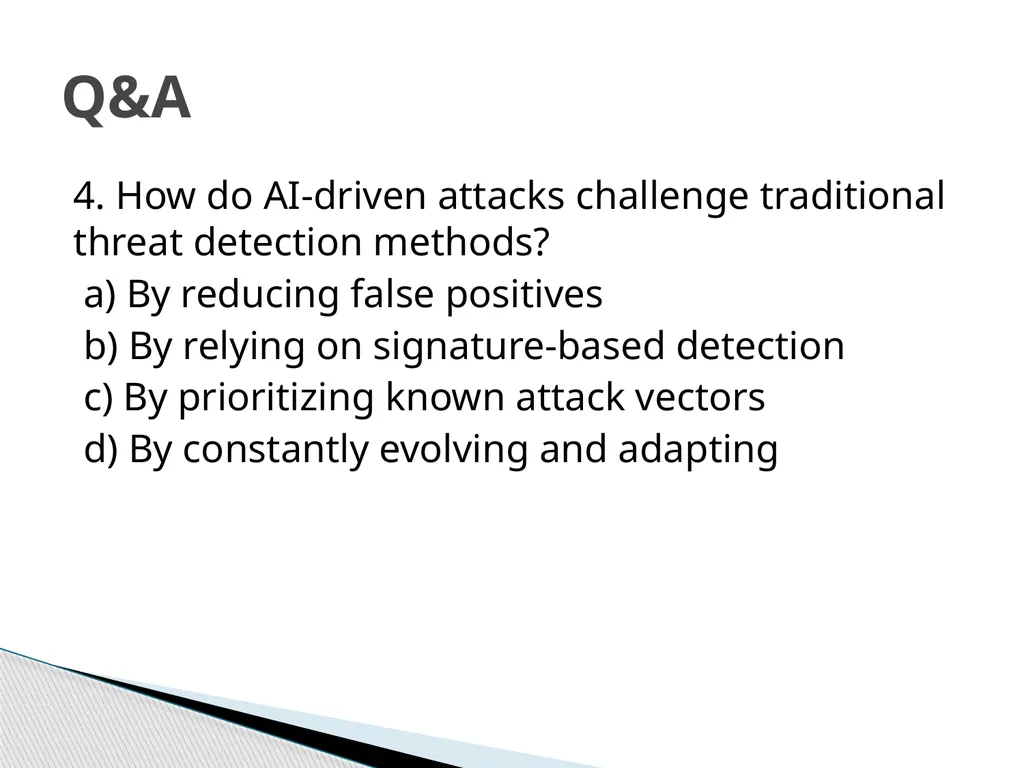
slide26. 4. How do AI-driven attacks challenge traditional threat detection methods?
a) By reducing false positives
b) By relying on signature-based detection
c) By prioritizing known attack vectors
d) By constantly evolving and adapting Q&A<br>
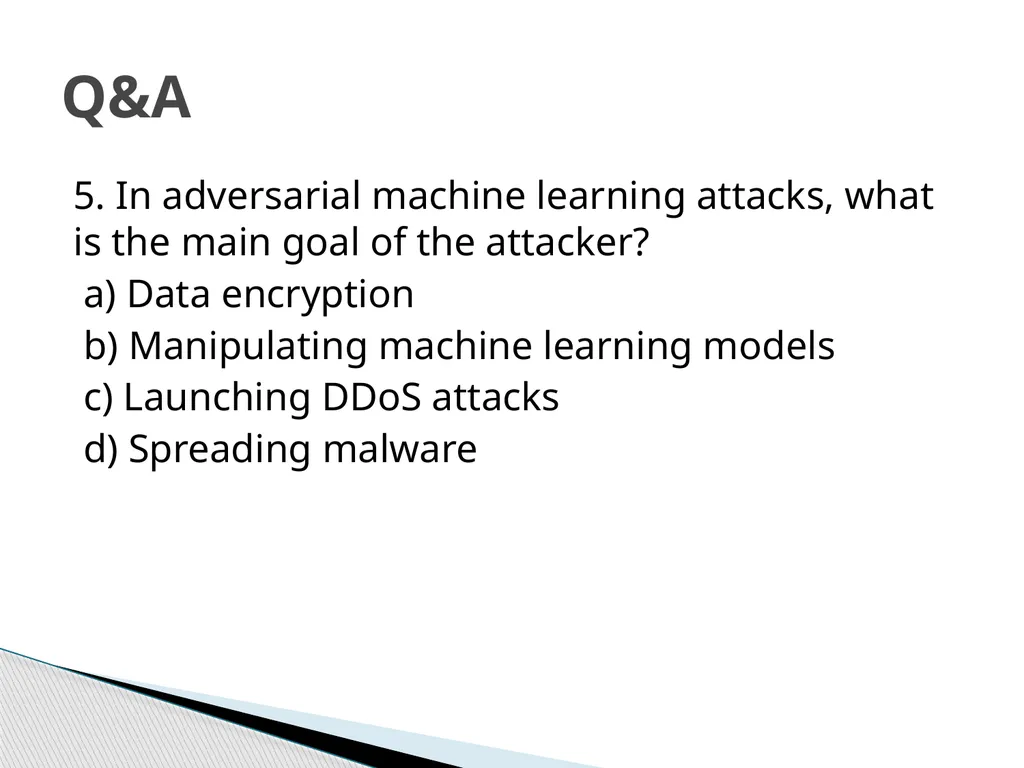
slide27. 5. In adversarial machine learning attacks, what is the main goal of the attacker?
a) Data encryption
b) Manipulating machine learning models
c) Launching DDoS attacks
d) Spreading malware Q&A<br>
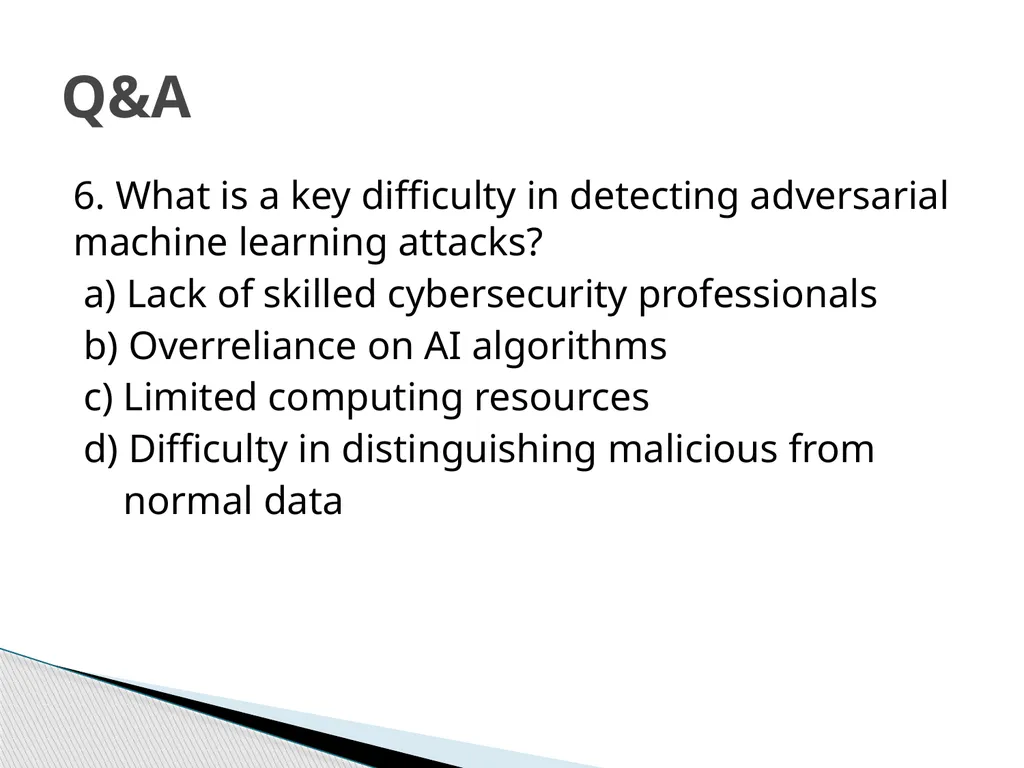
slide28. 6. What is a key difficulty in detecting adversarial machine learning attacks?
a) Lack of skilled cybersecurity professionals
b) Overreliance on AI algorithms
c) Limited computing resources
d) Difficulty in distinguishing malicious from
normal data Q&A<br>
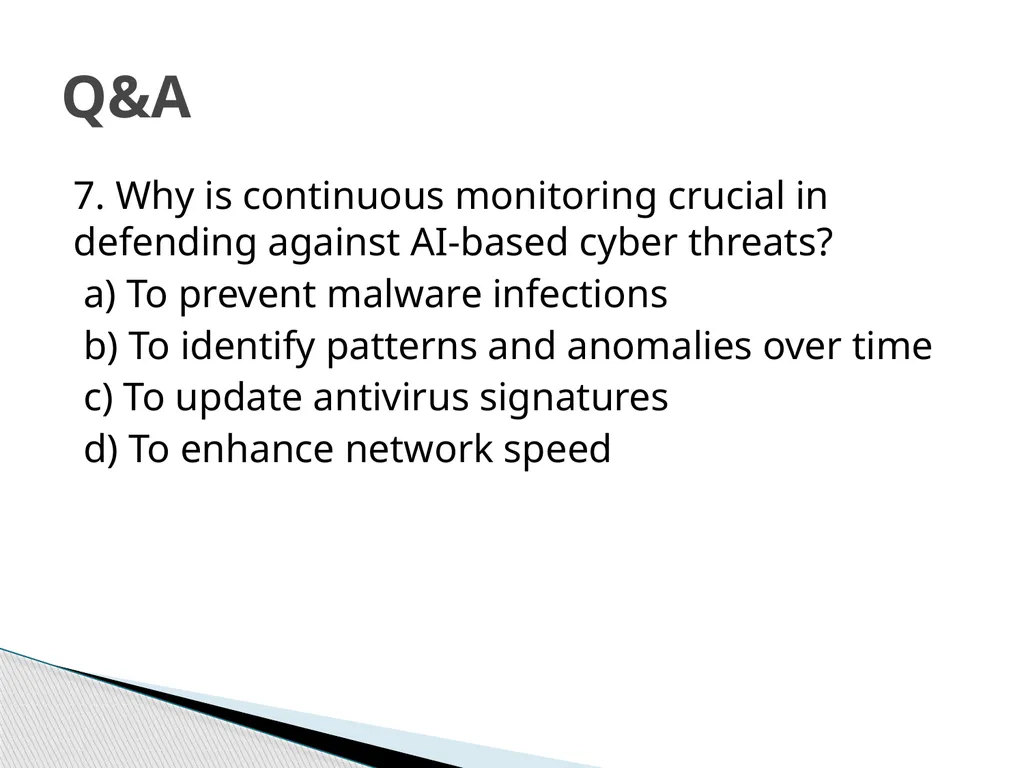
slide29. 7. Why is continuous monitoring crucial in defending against AI-based cyber threats?
a) To prevent malware infections
b) To identify patterns and anomalies over time
c) To update antivirus signatures
d) To enhance network speed Q&A<br>
slide30. 8. Which of the following is a real-world example of AI impacting a cyber attack?
a) Heartbleed vulnerability
b) Stuxnet worm
c) WannaCry ransomware
d) None of above Q&A<br>
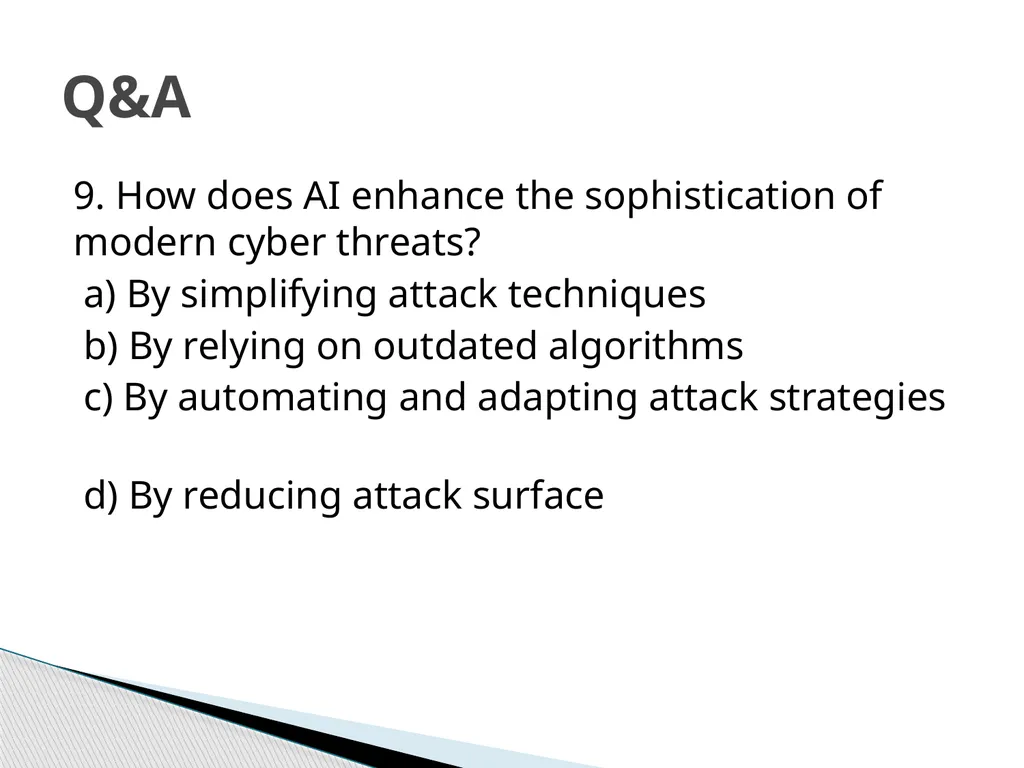
slide31. 9. How does AI enhance the sophistication of modern cyber threats?
a) By simplifying attack techniques
b) By relying on outdated algorithms
c) By automating and adapting attack strategies
d) By reducing attack surface Q&A<br>
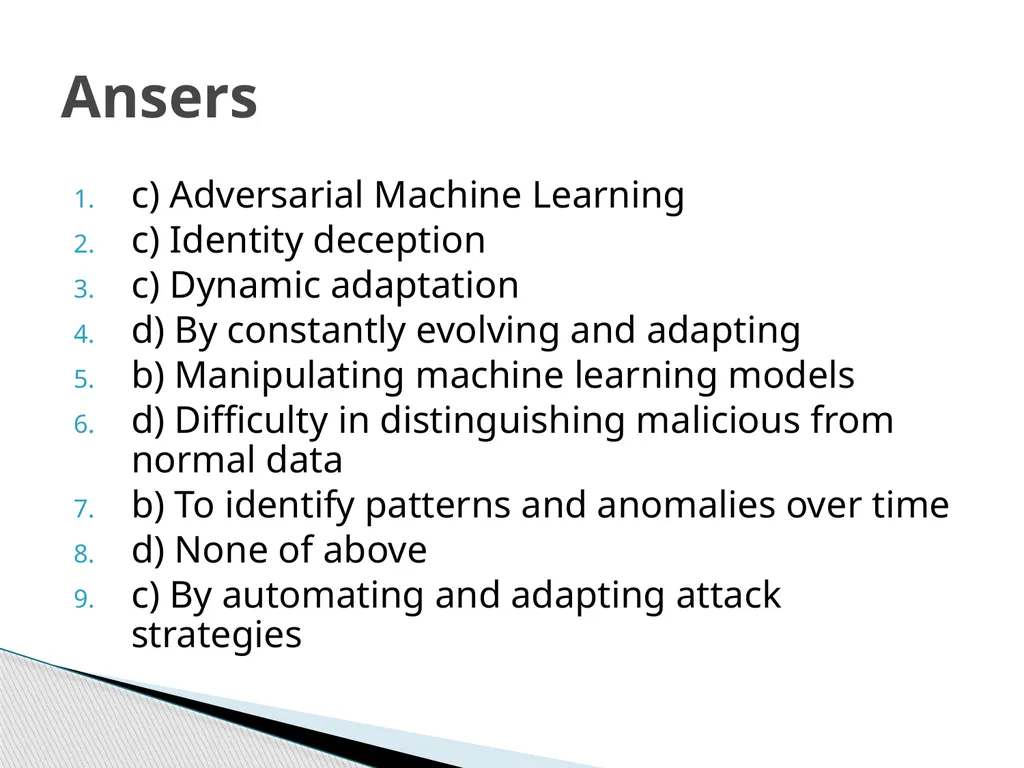
slide32. c) Adversarial Machine Learning
c) Identity deception
c) Dynamic adaptation
d) By constantly evolving and adapting
b) Manipulating machine learning models
d) Difficulty in distinguishing malicious from normal data
b) To identify patterns and anomalies over time
d) None of above
c) By automating and adapting attack strategies Ansers<br>
slide33. THANKS<br>
Dy. Director
Indian Cyber Crime Coordination Centre<br>
slide2. Introduction to Artificial Intelligence
Understanding AI in Cyber-security
Evolution of Cyber Threats
Types of AI based attacks
Adversarial ML
Deep fake Attacks
AI powered malwares
Detection Challenges
Future Trends
Conclusion
Q&A Table of Contents<br>
slide4. Artificial Intelligence (AI) refers to the development of computer systems that can perform tasks that typically require human intelligence. These tasks include learning, reasoning, problem-solving, understanding natural language, and perception.
Learning and Adaptation: AI systems employ machine learning algorithms to analyze data, identify patterns, and make decisions. They can adapt and improve their performance over time without explicit programming, learning from experience.
Applications: AI finds diverse applications, ranging from speech recognition and image processing to autonomous vehicles and strategic game playing. It encompasses both narrow AI, designed for specific tasks, and general AI, aiming to replicate human cognitive abilities across a broad range of activities. What is Artificial Intelligence<br>
slide6. The integration of AI in cyber security represents a dynamic shift in how organizations defend against evolving threats. AI is employed to enhance detection, response, and prevention capabilities:
Threat Detection: AI algorithms analyze vast amounts of data to identify patterns indicative of cyber threats. Machine learning models can detect anomalies, helping to identify previously unknown threats.
Behavioral Analysis: AI enables the monitoring of user and system behavior, allowing for the identification of deviations from normal patterns. This proactive approach enhances the ability to spot potential threats before they escalate. Understanding AI in Cyber-Security<br>
slide7. 3. Automation and Response: AI-driven automation streamlines incident response by quickly analyzing and categorizing security incidents. Automated responses can be triggered for immediate mitigation, reducing the response time to cyber threats.
4. Adaptive Security Measures: AI systems continuously learn from new data, adapting to emerging threats and evolving attack techniques. This adaptability is crucial in addressing the dynamic nature of cybersecurity threats.
5. User Authentication: AI plays a role in enhancing user authentication by implementing multi-factor authentication and biometric recognition, reducing the risk of unauthorized access. Understanding AI in Cyber-Security: Contd:<br>
slide8. 6. Malware Detection: AI-powered systems excel in identifying sophisticated malware by analyzing code patterns and behaviors. This capability improves the identification of malicious software, including those leveraging AI themselves.
7. Predictive Analysis: AI enables predictive analysis, forecasting potential threats based on historical data and current trends. This helps organizations proactively strengthen their defenses against future cyber attacks. Understanding AI in Cyber-Security: Contd:<br>
slide10. Increasing Sophistication: Cyber threats have evolved from simple, easily detectable attacks to highly sophisticated and nuanced strategies. Attackers now employ advanced techniques making it challenging for traditional security measures to keep up.
Diversification of Targets: The range of targets for cyber threats has expanded beyond individual users to encompass large enterprises, critical infrastructure, and even entire nations. This diversification poses significant risks as cybercriminals seek financial gain, political motives, or simply to create widespread disruption.
Global Interconnectedness: The evolution of cyber threats is closely tied to the growing interconnectedness of the global digital landscape. The internet's expansion and the increasing reliance on interconnected devices have created a broader attack surface, allowing cyber threats to propagate rapidly and impact diverse sectors across the globe. Evolution of Cyber Threats<br>
slide11. Adversarial Machine Learning
Deep fake Attacks
AI-Powered Malware Types: AI Attacks<br>
slide13. Purposeful Manipulation: Adversarial machine learning involves attackers purposefully manipulating input data to deceive machine learning models. By making subtle alterations to input features, adversaries aim to exploit vulnerabilities and cause the model to misclassify or make incorrect predictions.
Evasion and Misclassification: Adversarial attacks often focus on evading detection or causing misclassification. Attackers use techniques like adding imperceptible noise to images or tweaking input values to trick machine learning algorithms into producing inaccurate results, compromising the reliability of the model.
Continuous Cat-and-Mouse Game: As machine learning models improve in detecting adversarial attacks, adversaries adapt their methods, leading to a continuous cat-and-mouse game between attackers and defenders. This dynamic challenges the development of robust machine learning models that can withstand evolving adversarial strategies. Adversarial Machine Learning<br>
slide15. Deepfake attacks pose a substantial threat to individuals and organizations by leveraging advanced AI to create convincingly realistic manipulated content.
These maliciously crafted videos or audio recordings can damage reputations, spread misinformation, and incite mistrust. Individuals may face personal harm as their identities are exploited, while organizations risk brand damage, financial losses, and the erosion of public trust.
The potential for deepfakes to deceive and manipulate poses significant challenges for cybersecurity and underscores the critical need for advanced detection and mitigation measures to protect against the multifaceted impacts of these deceptive AI-driven attacks. Deep fake Attacks<br>
slide17. AI-driven malware represents a paradigm shift in cyber threats. Infused with artificial intelligence capabilities, this malware adapts, learns, and evolves, making it highly sophisticated and difficult to detect.
Its autonomous nature allows for dynamic, targeted attacks, posing a significant challenge to traditional cybersecurity measures, necessitating advanced defense strategies. AI-Powered Malware<br>
slide19. Detecting AI-based attacks presents challenges due to their adaptive nature. These attacks dynamically evolve, leveraging machine learning to mimic normal behavior and evade traditional detection methods.
The use of adversarial techniques, where attackers manipulate input data to confuse models, adds complexity.
As AI becomes integral to cybersecurity, distinguishing between legitimate AI activities and malicious intent becomes intricate.
The rapid evolution of attack strategies demands continuous updates in detection mechanisms. Addressing these difficulties requires a multifaceted approach, combining advanced algorithms, continuous monitoring, and a thorough understanding of AI's dual role in defending against and facilitating cyber threats. Detection Challenges<br>
slide20. Anticipating the evolution of AI-based attacks demands foresight into emerging technologies and potential adversarial strategies.
As AI capabilities advance, attackers are likely to exploit novel techniques, including more sophisticated adversarial machine learning and the synthesis of hyper-realistic deepfakes.
The integration of AI in cybersecurity tools necessitates a proactive stance, predicting how attackers might leverage these advancements. Constant research and collaboration between cybersecurity experts are essential to stay ahead, developing robust defenses and adaptive strategies.
Vigilance in monitoring emerging trends and understanding the evolving threat landscape are crucial elements in anticipating and mitigating the future evolution of AI-based cyber attacks Future Trends<br>
slide21. Invest in Advanced Threat Detection: Organizations should prioritize the deployment of advanced threat detection systems that leverage AI for anomaly detection and behavior analysis. These systems can identify subtle patterns indicative of AI-based attacks, enhancing the ability to detect and respond to evolving cyber threats.
Continuous Employee Training: As AI-based attacks often exploit human vulnerabilities through tactics like phishing, continuous employee training is crucial. Educating staff on recognizing and reporting suspicious activities, particularly those involving AI-driven manipulation, helps fortify the human element of cybersecurity.
Implement Adaptive Security Measures: Employ adaptive security measures that evolve in response to emerging threats. Regularly update and upgrade cybersecurity protocols, leveraging AI-driven solutions that learn from new data and adjust defenses accordingly. This dynamic approach is essential for staying resilient against the ever-evolving tactics of AI-powered adversaries. Conclusion<br>
slide23. Which of the following is an example of an AI-based cyberattack?
a) Phishing
b) Ransomware
c) Adversarial Machine Learning
d) DDoS attacks Q&A<br>
slide24. 2. What is the primary purpose of deepfake technology in the context of cybersecurity?
a) Data encryption
b) User authentication
c) Identity deception
d) Network intrusion Q&A<br>
slide25. 3. AI-powered malware is characterized by:
a) Static behavior
b) Limited sophistication
c) Dynamic adaptation
d) Slow propagation Q&A<br>
slide26. 4. How do AI-driven attacks challenge traditional threat detection methods?
a) By reducing false positives
b) By relying on signature-based detection
c) By prioritizing known attack vectors
d) By constantly evolving and adapting Q&A<br>
slide27. 5. In adversarial machine learning attacks, what is the main goal of the attacker?
a) Data encryption
b) Manipulating machine learning models
c) Launching DDoS attacks
d) Spreading malware Q&A<br>
slide28. 6. What is a key difficulty in detecting adversarial machine learning attacks?
a) Lack of skilled cybersecurity professionals
b) Overreliance on AI algorithms
c) Limited computing resources
d) Difficulty in distinguishing malicious from
normal data Q&A<br>
slide29. 7. Why is continuous monitoring crucial in defending against AI-based cyber threats?
a) To prevent malware infections
b) To identify patterns and anomalies over time
c) To update antivirus signatures
d) To enhance network speed Q&A<br>
slide30. 8. Which of the following is a real-world example of AI impacting a cyber attack?
a) Heartbleed vulnerability
b) Stuxnet worm
c) WannaCry ransomware
d) None of above Q&A<br>
slide31. 9. How does AI enhance the sophistication of modern cyber threats?
a) By simplifying attack techniques
b) By relying on outdated algorithms
c) By automating and adapting attack strategies
d) By reducing attack surface Q&A<br>
slide32. c) Adversarial Machine Learning
c) Identity deception
c) Dynamic adaptation
d) By constantly evolving and adapting
b) Manipulating machine learning models
d) Difficulty in distinguishing malicious from normal data
b) To identify patterns and anomalies over time
d) None of above
c) By automating and adapting attack strategies Ansers<br>
slide33. THANKS<br>