
Aim: how to determine missing information from a
Description: Aim: how to determine missing information from a chemical Equation Do Now: How do you identify the following types of reactions: synthesis, decomposition, single replacement, and double replacement? Determining Missing Mass in Equations
Related Topics
Download Presentation
"Aim: how to determine missing information from a" is the property of its rightful owner. Permission is granted to download and print the materials on this website for personal, non-commercial use only, and to display it on your personal computer provided you do not modify the materials and that you retain all copyright notices contained in the materials. By downloading content from our website, you accept the terms of this agreement.
Presentation Transcript
slide1. Aim: how to determine missing information from a chemical Equation Do Now:
How do you identify the following types of reactions: synthesis, decomposition, single replacement, and double replacement?<br>
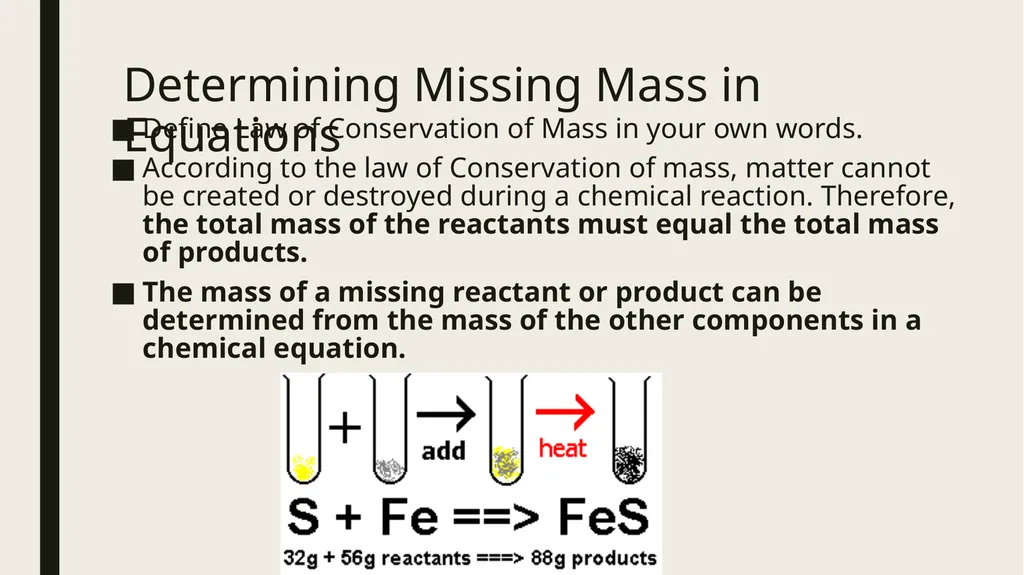
slide2. Determining Missing Mass in Equations Define Law of Conservation of Mass in your own words.
According to the law of Conservation of mass, matter cannot be created or destroyed during a chemical reaction. Therefore, the total mass of the reactants must equal the total mass of products.
The mass of a missing reactant or product can be determined from the mass of the other components in a chemical equation.<br>
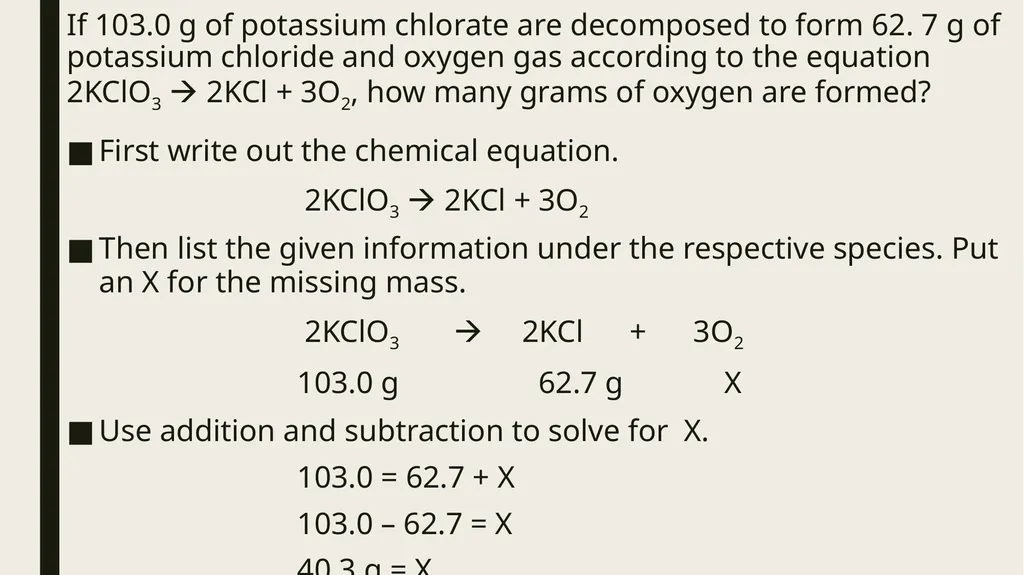
slide3. If 103.0 g of potassium chlorate are decomposed to form 62. 7 g of potassium chloride and oxygen gas according to the equation 2KClO3 2KCl + 3O2, how many grams of oxygen are formed? First write out the chemical equation.
2KClO3 2KCl + 3O2
Then list the given information under the respective species. Put an X for the missing mass.
2KClO3 2KCl + 3O2
103.0 g 62.7 g X
Use addition and subtraction to solve for X.
103.0 = 62.7 + X
103.0 – 62.7 = X
40.3 g = X<br>
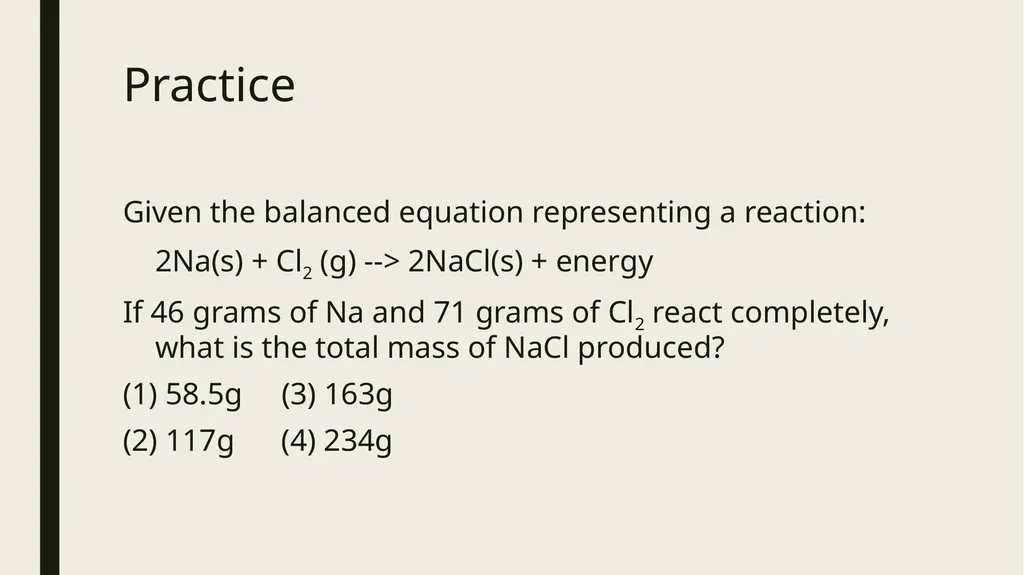
slide4. Practice Given the balanced equation representing a reaction:
2Na(s) + Cl2 (g) --> 2NaCl(s) + energy
If 46 grams of Na and 71 grams of Cl2 react completely, what is the total mass of NaCl produced?
(1) 58.5g (3) 163g
(2) 117g (4) 234g<br>
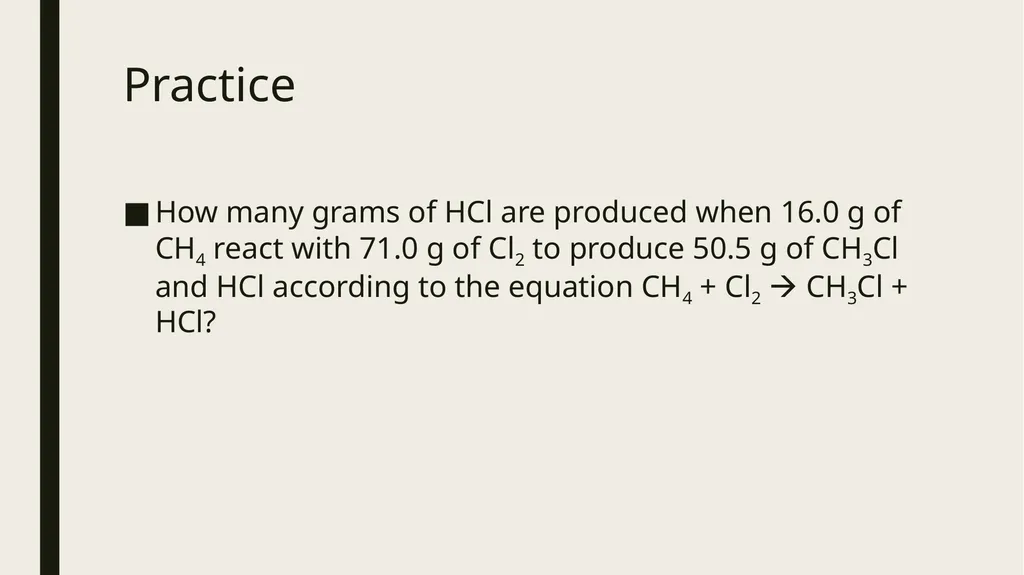
slide5. Practice How many grams of HCl are produced when 16.0 g of CH4 react with 71.0 g of Cl2 to produce 50.5 g of CH3Cl and HCl according to the equation CH4 + Cl2 CH3Cl + HCl?<br>
slide6. Determining Unknown Reactants and Products When given a balanced equation in which either a reactant or product is missing, you should be able to determine the formulas of the missing substance.<br>
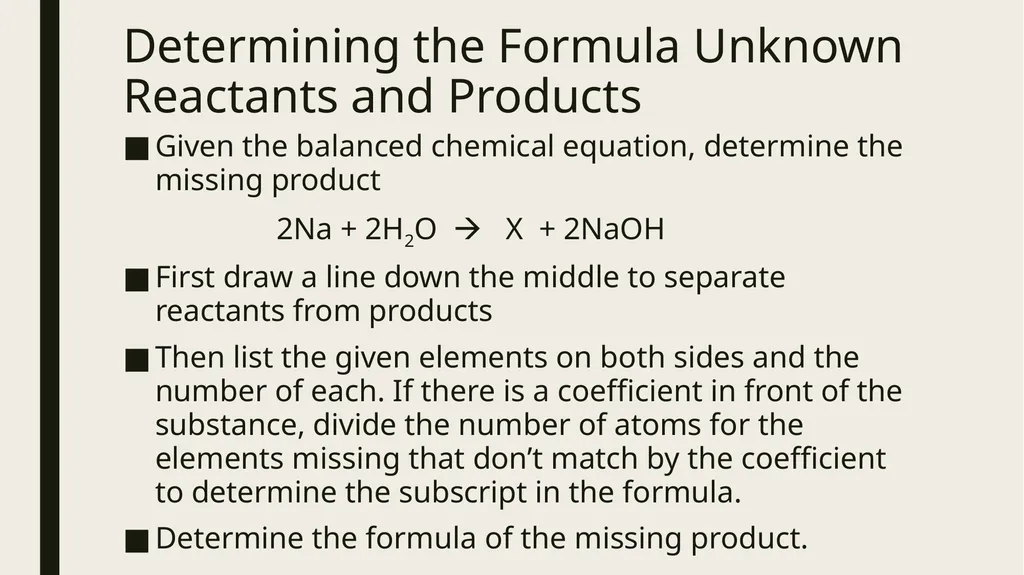
slide7. Determining the Formula Unknown Reactants and Products Given the balanced chemical equation, determine the missing product
2Na + 2H2O X + 2NaOH
First draw a line down the middle to separate reactants from products
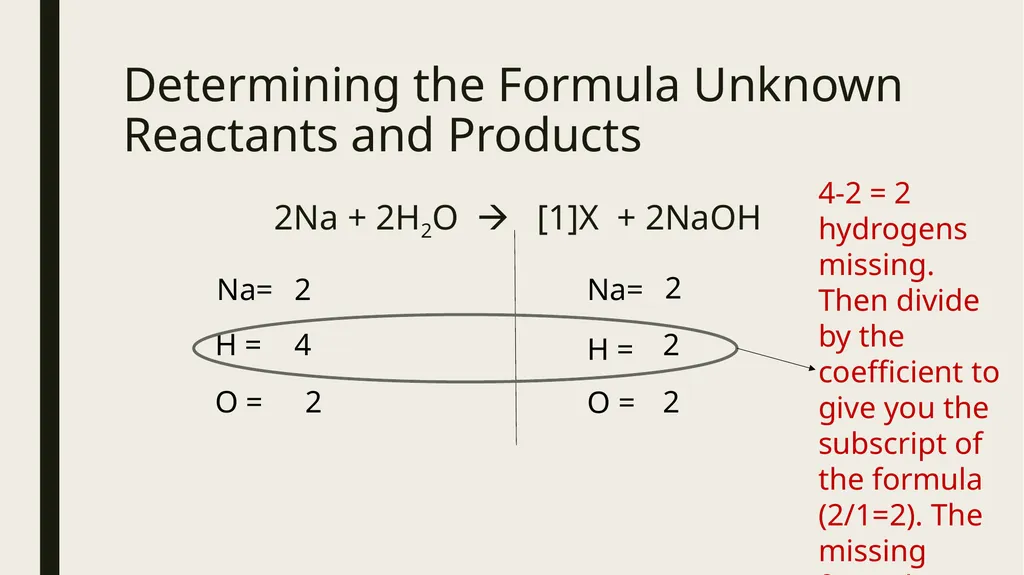
Then list the given elements on both sides and the number of each. If there is a coefficient in front of the substance, divide the number of atoms for the elements missing that don’t match by the coefficient to determine the subscript in the formula.
Determine the formula of the missing product.<br>
slide8. Determining the Formula Unknown Reactants and Products 2Na + 2H2O [1]X + 2NaOH Na= Na= H = H = O = O = 2 2 2 2 2 4 4-2 = 2 hydrogens missing.
Then divide by the coefficient to give you the subscript of the formula (2/1=2). The missing formula is H2<br>
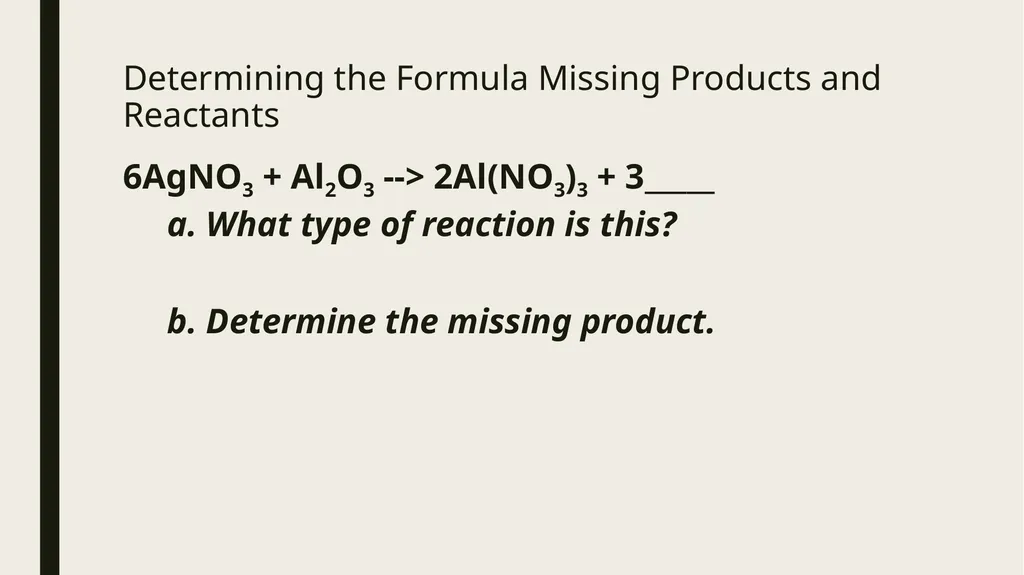
slide9. Determining the Formula Missing Products and Reactants 6AgNO3 + Al2O3 --> 2Al(NO3)3 + 3_____
a. What type of reaction is this?
b. Determine the missing product.<br>
How do you identify the following types of reactions: synthesis, decomposition, single replacement, and double replacement?<br>
slide2. Determining Missing Mass in Equations Define Law of Conservation of Mass in your own words.
According to the law of Conservation of mass, matter cannot be created or destroyed during a chemical reaction. Therefore, the total mass of the reactants must equal the total mass of products.
The mass of a missing reactant or product can be determined from the mass of the other components in a chemical equation.<br>
slide3. If 103.0 g of potassium chlorate are decomposed to form 62. 7 g of potassium chloride and oxygen gas according to the equation 2KClO3 2KCl + 3O2, how many grams of oxygen are formed? First write out the chemical equation.
2KClO3 2KCl + 3O2
Then list the given information under the respective species. Put an X for the missing mass.
2KClO3 2KCl + 3O2
103.0 g 62.7 g X
Use addition and subtraction to solve for X.
103.0 = 62.7 + X
103.0 – 62.7 = X
40.3 g = X<br>
slide4. Practice Given the balanced equation representing a reaction:
2Na(s) + Cl2 (g) --> 2NaCl(s) + energy
If 46 grams of Na and 71 grams of Cl2 react completely, what is the total mass of NaCl produced?
(1) 58.5g (3) 163g
(2) 117g (4) 234g<br>
slide5. Practice How many grams of HCl are produced when 16.0 g of CH4 react with 71.0 g of Cl2 to produce 50.5 g of CH3Cl and HCl according to the equation CH4 + Cl2 CH3Cl + HCl?<br>
slide6. Determining Unknown Reactants and Products When given a balanced equation in which either a reactant or product is missing, you should be able to determine the formulas of the missing substance.<br>
slide7. Determining the Formula Unknown Reactants and Products Given the balanced chemical equation, determine the missing product
2Na + 2H2O X + 2NaOH
First draw a line down the middle to separate reactants from products
Then list the given elements on both sides and the number of each. If there is a coefficient in front of the substance, divide the number of atoms for the elements missing that don’t match by the coefficient to determine the subscript in the formula.
Determine the formula of the missing product.<br>
slide8. Determining the Formula Unknown Reactants and Products 2Na + 2H2O [1]X + 2NaOH Na= Na= H = H = O = O = 2 2 2 2 2 4 4-2 = 2 hydrogens missing.
Then divide by the coefficient to give you the subscript of the formula (2/1=2). The missing formula is H2<br>
slide9. Determining the Formula Missing Products and Reactants 6AgNO3 + Al2O3 --> 2Al(NO3)3 + 3_____
a. What type of reaction is this?
b. Determine the missing product.<br>