
Aim Objectives First Aid Half Day Workbook V6.5
AS
Published · 9 slides · 0 views
1 / 1
Description
Aim Objectives First Aid Half Day Workbook V6.5 Curve Learning and Development 2024 To give learners the knowledge, skills and confidence to enable them to administer first aid in an emergency safely, promptly and effectively. By the end of
Related Topics
Share
Embed code
Download this presentation From Below
"Aim Objectives First Aid Half Day Workbook V6.5" is the property of its rightful owner. Permission is granted to download and print the materials on this website for personal, non-commercial use only, and to display it on your personal computer provided you do not modify the materials and that you retain all copyright notices contained in the materials. By downloading content from our website, you accept the terms of this agreement.
Presentation Transcript
01
Aim Objectives First Aid Half Day Workbook V6.5
Curve Learning and Development 2024 To give learners the knowledge, skills and confidence to enable them to administer first aid in an emergency safely, promptly and effectively. By the end of the course, you will be able to:
List the aims of first aid.
Explain how to prioritise treatment.
Define life threatening conditions.
Demonstrate how to administer first aid in different situations including CPR.
Have a basic overview of what an AED is and how to use it. 1.<br>
Curve Learning and Development 2024 To give learners the knowledge, skills and confidence to enable them to administer first aid in an emergency safely, promptly and effectively. By the end of the course, you will be able to:
List the aims of first aid.
Explain how to prioritise treatment.
Define life threatening conditions.
Demonstrate how to administer first aid in different situations including CPR.
Have a basic overview of what an AED is and how to use it. 1.<br>
02
Primary Assessment First Aid Half Day Workbook V6.5
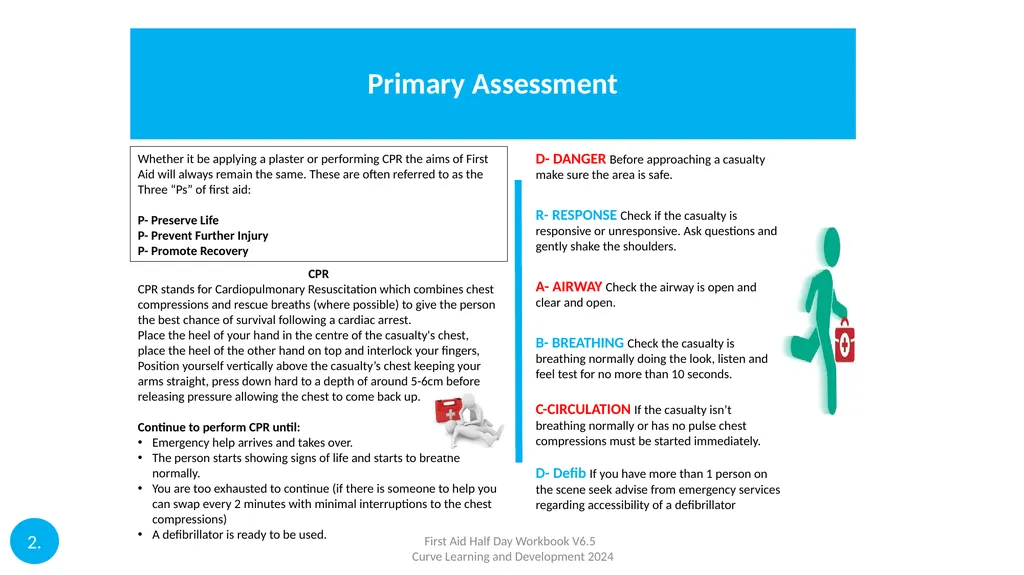
Curve Learning and Development 2024 2. Whether it be applying a plaster or performing CPR the aims of First Aid will always remain the same. These are often referred to as the Three “Ps” of first aid:
P- Preserve Life
P- Prevent Further Injury
P- Promote Recovery D- DANGER Before approaching a casualty make sure the area is safe.
R- RESPONSE Check if the casualty is responsive or unresponsive. Ask questions and gently shake the shoulders.
A- AIRWAY Check the airway is open and clear and open.
B- BREATHING Check the casualty is breathing normally doing the look, listen and feel test for no more than 10 seconds.
C-CIRCULATION If the casualty isn’t breathing normally or has no pulse chest compressions must be started immediately.
D- Defib If you have more than 1 person on the scene seek advise from emergency services regarding accessibility of a defibrillator CPR
CPR stands for Cardiopulmonary Resuscitation which combines chest compressions and rescue breaths (where possible) to give the person the best chance of survival following a cardiac arrest.
Place the heel of your hand in the centre of the casualty's chest, place the heel of the other hand on top and interlock your fingers, Position yourself vertically above the casualty’s chest keeping your arms straight, press down hard to a depth of around 5-6cm before releasing pressure allowing the chest to come back up.
Continue to perform CPR until:
Emergency help arrives and takes over.
The person starts showing signs of life and starts to breathe normally.
You are too exhausted to continue (if there is someone to help you can swap every 2 minutes with minimal interruptions to the chest compressions)
A defibrillator is ready to be used.<br>
Curve Learning and Development 2024 2. Whether it be applying a plaster or performing CPR the aims of First Aid will always remain the same. These are often referred to as the Three “Ps” of first aid:
P- Preserve Life
P- Prevent Further Injury
P- Promote Recovery D- DANGER Before approaching a casualty make sure the area is safe.
R- RESPONSE Check if the casualty is responsive or unresponsive. Ask questions and gently shake the shoulders.
A- AIRWAY Check the airway is open and clear and open.
B- BREATHING Check the casualty is breathing normally doing the look, listen and feel test for no more than 10 seconds.
C-CIRCULATION If the casualty isn’t breathing normally or has no pulse chest compressions must be started immediately.
D- Defib If you have more than 1 person on the scene seek advise from emergency services regarding accessibility of a defibrillator CPR
CPR stands for Cardiopulmonary Resuscitation which combines chest compressions and rescue breaths (where possible) to give the person the best chance of survival following a cardiac arrest.
Place the heel of your hand in the centre of the casualty's chest, place the heel of the other hand on top and interlock your fingers, Position yourself vertically above the casualty’s chest keeping your arms straight, press down hard to a depth of around 5-6cm before releasing pressure allowing the chest to come back up.
Continue to perform CPR until:
Emergency help arrives and takes over.
The person starts showing signs of life and starts to breathe normally.
You are too exhausted to continue (if there is someone to help you can swap every 2 minutes with minimal interruptions to the chest compressions)
A defibrillator is ready to be used.<br>
03
Automated External Defibrillator First Aid Half Day Workbook V6.5
Curve Learning and Development 2024 3. An Automated external defibrillator (AED) is a portable lifesaving device which can give the casualties heart an electric shock when it has stopped beating normally due to sudden cardiac arrest.
The defibrillator works by checking the casualty's hear rhythm once the defibrillator pads are placed on their chest and giving them a shock if needed.
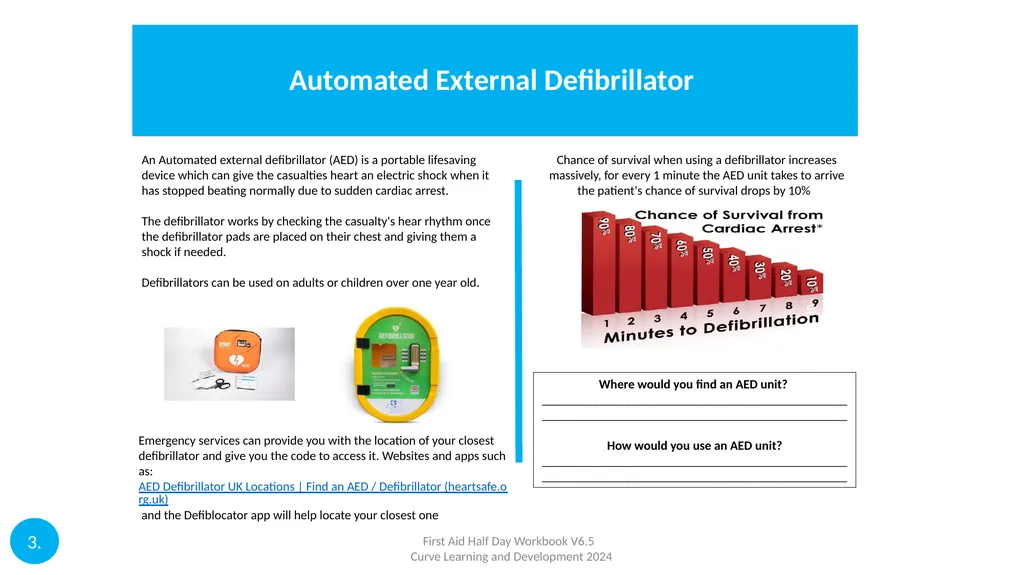
Defibrillators can be used on adults or children over one year old. Chance of survival when using a defibrillator increases massively, for every 1 minute the AED unit takes to arrive the patient's chance of survival drops by 10% Emergency services can provide you with the location of your closest defibrillator and give you the code to access it. Websites and apps such as: AED Defibrillator UK Locations | Find an AED / Defibrillator (heartsafe.org.uk) and the Defiblocator app will help locate your closest one Where would you find an AED unit?
________________________________________________________________________________________________
How would you use an AED unit?
________________________________________________________________________________________________<br>
Curve Learning and Development 2024 3. An Automated external defibrillator (AED) is a portable lifesaving device which can give the casualties heart an electric shock when it has stopped beating normally due to sudden cardiac arrest.
The defibrillator works by checking the casualty's hear rhythm once the defibrillator pads are placed on their chest and giving them a shock if needed.
Defibrillators can be used on adults or children over one year old. Chance of survival when using a defibrillator increases massively, for every 1 minute the AED unit takes to arrive the patient's chance of survival drops by 10% Emergency services can provide you with the location of your closest defibrillator and give you the code to access it. Websites and apps such as: AED Defibrillator UK Locations | Find an AED / Defibrillator (heartsafe.org.uk) and the Defiblocator app will help locate your closest one Where would you find an AED unit?
________________________________________________________________________________________________
How would you use an AED unit?
________________________________________________________________________________________________<br>
04
Top to Toe Assessment First Aid Half Day Workbook V6.5
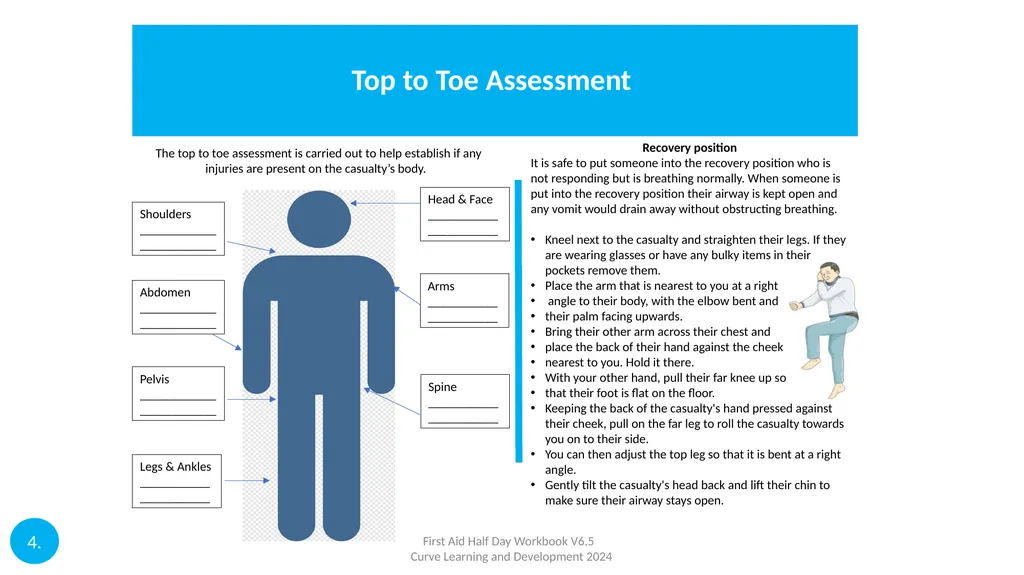
Curve Learning and Development 2024 4. Recovery position
It is safe to put someone into the recovery position who is not responding but is breathing normally. When someone is put into the recovery position their airway is kept open and any vomit would drain away without obstructing breathing.
Kneel next to the casualty and straighten their legs. If they are wearing glasses or have any bulky items in their pockets remove them.
Place the arm that is nearest to you at a right
angle to their body, with the elbow bent and
their palm facing upwards.
Bring their other arm across their chest and
place the back of their hand against the cheek
nearest to you. Hold it there.
With your other hand, pull their far knee up so
that their foot is flat on the floor.
Keeping the back of the casualty's hand pressed against their cheek, pull on the far leg to roll the casualty towards you on to their side.
You can then adjust the top leg so that it is bent at a right angle.
Gently tilt the casualty's head back and lift their chin to make sure their airway stays open.<br>
Curve Learning and Development 2024 4. Recovery position
It is safe to put someone into the recovery position who is not responding but is breathing normally. When someone is put into the recovery position their airway is kept open and any vomit would drain away without obstructing breathing.
Kneel next to the casualty and straighten their legs. If they are wearing glasses or have any bulky items in their pockets remove them.
Place the arm that is nearest to you at a right
angle to their body, with the elbow bent and
their palm facing upwards.
Bring their other arm across their chest and
place the back of their hand against the cheek
nearest to you. Hold it there.
With your other hand, pull their far knee up so
that their foot is flat on the floor.
Keeping the back of the casualty's hand pressed against their cheek, pull on the far leg to roll the casualty towards you on to their side.
You can then adjust the top leg so that it is bent at a right angle.
Gently tilt the casualty's head back and lift their chin to make sure their airway stays open.<br>
05
Secondary Assessment First Aid Half Day Workbook V6.5
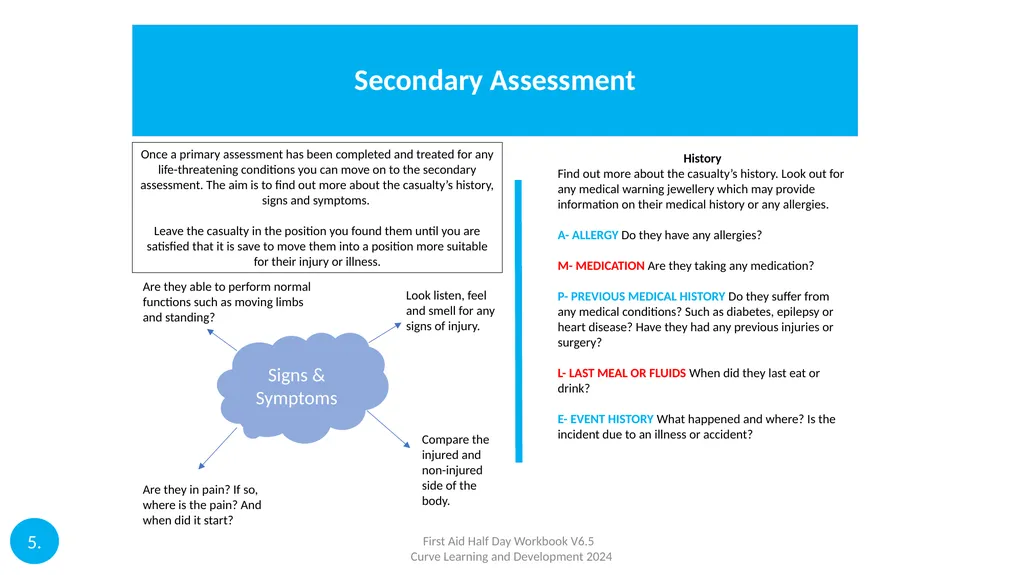
Curve Learning and Development 2024 5. History
Find out more about the casualty’s history. Look out for any medical warning jewellery which may provide information on their medical history or any allergies.
A- ALLERGY Do they have any allergies?
M- MEDICATION Are they taking any medication?
P- PREVIOUS MEDICAL HISTORY Do they suffer from any medical conditions? Such as diabetes, epilepsy or heart disease? Have they had any previous injuries or surgery?
L- LAST MEAL OR FLUIDS When did they last eat or drink?
E- EVENT HISTORY What happened and where? Is the incident due to an illness or accident?<br>
Curve Learning and Development 2024 5. History
Find out more about the casualty’s history. Look out for any medical warning jewellery which may provide information on their medical history or any allergies.
A- ALLERGY Do they have any allergies?
M- MEDICATION Are they taking any medication?
P- PREVIOUS MEDICAL HISTORY Do they suffer from any medical conditions? Such as diabetes, epilepsy or heart disease? Have they had any previous injuries or surgery?
L- LAST MEAL OR FLUIDS When did they last eat or drink?
E- EVENT HISTORY What happened and where? Is the incident due to an illness or accident?<br>
06
Choking & Heart Attack First Aid Half Day Workbook V6.5
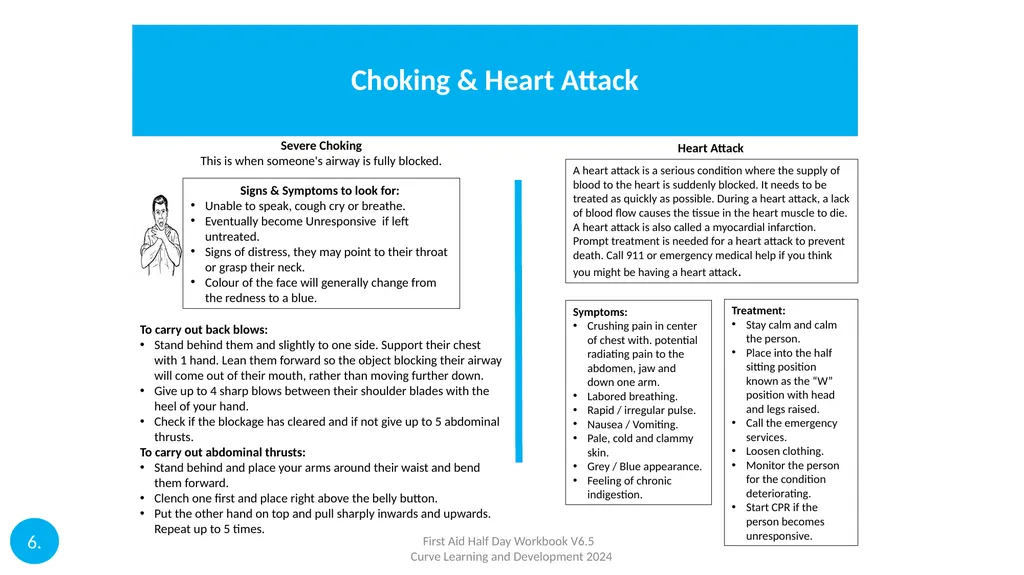
Curve Learning and Development 2024 6. Severe Choking
This is when someone's airway is fully blocked.
To carry out back blows:
Stand behind them and slightly to one side. Support their chest with 1 hand. Lean them forward so the object blocking their airway will come out of their mouth, rather than moving further down.
Give up to 4 sharp blows between their shoulder blades with the heel of your hand.
Check if the blockage has cleared and if not give up to 5 abdominal thrusts.
To carry out abdominal thrusts:
Stand behind and place your arms around their waist and bend them forward.
Clench one first and place right above the belly button.
Put the other hand on top and pull sharply inwards and upwards. Repeat up to 5 times. Signs & Symptoms to look for:
Unable to speak, cough cry or breathe.
Eventually become Unresponsive if left untreated.
Signs of distress, they may point to their throat or grasp their neck.
Colour of the face will generally change from the redness to a blue. Symptoms:
Crushing pain in center of chest with. potential radiating pain to the abdomen, jaw and down one arm.
Labored breathing.
Rapid / irregular pulse.
Nausea / Vomiting.
Pale, cold and clammy skin.
Grey / Blue appearance.
Feeling of chronic indigestion. Treatment:
Stay calm and calm the person.
Place into the half sitting position known as the “W” position with head and legs raised.
Call the emergency services.
Loosen clothing.
Monitor the person for the condition deteriorating.
Start CPR if the person becomes unresponsive.<br>
Curve Learning and Development 2024 6. Severe Choking
This is when someone's airway is fully blocked.
To carry out back blows:
Stand behind them and slightly to one side. Support their chest with 1 hand. Lean them forward so the object blocking their airway will come out of their mouth, rather than moving further down.
Give up to 4 sharp blows between their shoulder blades with the heel of your hand.
Check if the blockage has cleared and if not give up to 5 abdominal thrusts.
To carry out abdominal thrusts:
Stand behind and place your arms around their waist and bend them forward.
Clench one first and place right above the belly button.
Put the other hand on top and pull sharply inwards and upwards. Repeat up to 5 times. Signs & Symptoms to look for:
Unable to speak, cough cry or breathe.
Eventually become Unresponsive if left untreated.
Signs of distress, they may point to their throat or grasp their neck.
Colour of the face will generally change from the redness to a blue. Symptoms:
Crushing pain in center of chest with. potential radiating pain to the abdomen, jaw and down one arm.
Labored breathing.
Rapid / irregular pulse.
Nausea / Vomiting.
Pale, cold and clammy skin.
Grey / Blue appearance.
Feeling of chronic indigestion. Treatment:
Stay calm and calm the person.
Place into the half sitting position known as the “W” position with head and legs raised.
Call the emergency services.
Loosen clothing.
Monitor the person for the condition deteriorating.
Start CPR if the person becomes unresponsive.<br>
07
Stroke & Shock First Aid Half Day Workbook V6.5
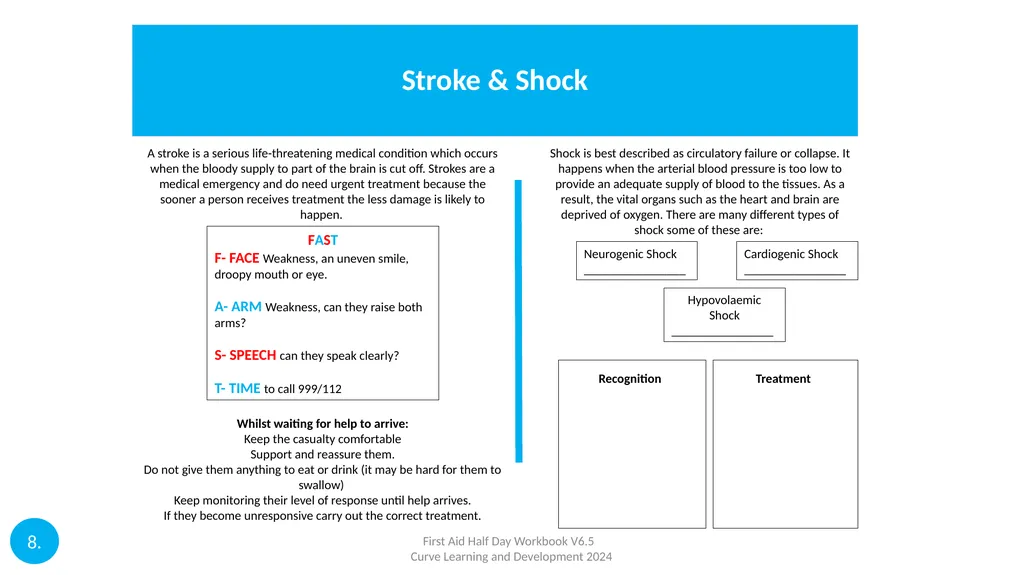
Curve Learning and Development 2024 8. FAST
F- FACE Weakness, an uneven smile, droopy mouth or eye.
A- ARM Weakness, can they raise both arms?
S- SPEECH can they speak clearly?
T- TIME to call 999/112 A stroke is a serious life-threatening medical condition which occurs when the bloody supply to part of the brain is cut off. Strokes are a medical emergency and do need urgent treatment because the sooner a person receives treatment the less damage is likely to happen. Whilst waiting for help to arrive:
Keep the casualty comfortable
Support and reassure them.
Do not give them anything to eat or drink (it may be hard for them to swallow)
Keep monitoring their level of response until help arrives.
If they become unresponsive carry out the correct treatment. Shock is best described as circulatory failure or collapse. It happens when the arterial blood pressure is too low to provide an adequate supply of blood to the tissues. As a result, the vital organs such as the heart and brain are deprived of oxygen. There are many different types of shock some of these are: Neurogenic Shock
________________ Cardiogenic Shock
________________ Hypovolaemic Shock
________________ Recognition Treatment<br>
Curve Learning and Development 2024 8. FAST
F- FACE Weakness, an uneven smile, droopy mouth or eye.
A- ARM Weakness, can they raise both arms?
S- SPEECH can they speak clearly?
T- TIME to call 999/112 A stroke is a serious life-threatening medical condition which occurs when the bloody supply to part of the brain is cut off. Strokes are a medical emergency and do need urgent treatment because the sooner a person receives treatment the less damage is likely to happen. Whilst waiting for help to arrive:
Keep the casualty comfortable
Support and reassure them.
Do not give them anything to eat or drink (it may be hard for them to swallow)
Keep monitoring their level of response until help arrives.
If they become unresponsive carry out the correct treatment. Shock is best described as circulatory failure or collapse. It happens when the arterial blood pressure is too low to provide an adequate supply of blood to the tissues. As a result, the vital organs such as the heart and brain are deprived of oxygen. There are many different types of shock some of these are: Neurogenic Shock
________________ Cardiogenic Shock
________________ Hypovolaemic Shock
________________ Recognition Treatment<br>
08
Burns & Asthma First Aid Half Day Workbook V6.5
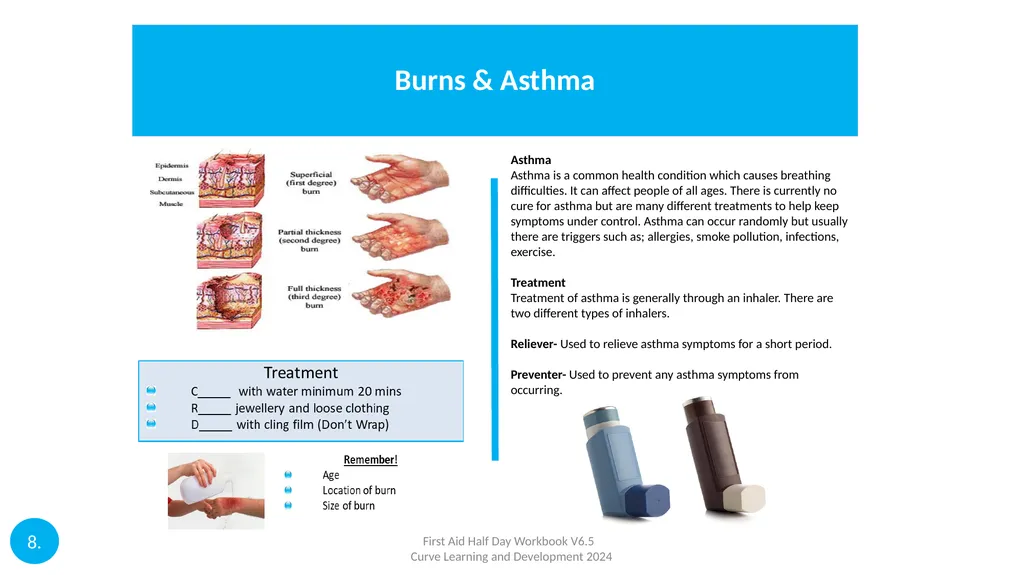
Curve Learning and Development 2024 8.<br>
Curve Learning and Development 2024 8.<br>
09
Bleeding & Sepsis First Aid Half Day Workbook V6.5
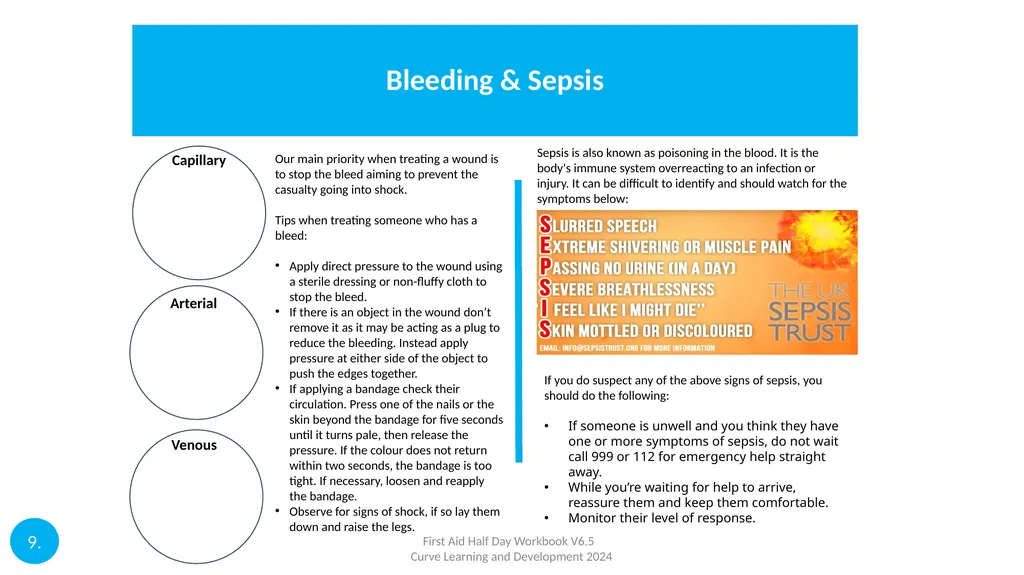
Curve Learning and Development 2024 9. Venous Capillary Our main priority when treating a wound is to stop the bleed aiming to prevent the casualty going into shock.
Tips when treating someone who has a bleed:
Apply direct pressure to the wound using a sterile dressing or non-fluffy cloth to stop the bleed.
If there is an object in the wound don’t remove it as it may be acting as a plug to reduce the bleeding. Instead apply pressure at either side of the object to push the edges together.
If applying a bandage check their circulation. Press one of the nails or the skin beyond the bandage for five seconds until it turns pale, then release the pressure. If the colour does not return within two seconds, the bandage is too tight. If necessary, loosen and reapply the bandage.
Observe for signs of shock, if so lay them down and raise the legs. Arterial<br>
Curve Learning and Development 2024 9. Venous Capillary Our main priority when treating a wound is to stop the bleed aiming to prevent the casualty going into shock.
Tips when treating someone who has a bleed:
Apply direct pressure to the wound using a sterile dressing or non-fluffy cloth to stop the bleed.
If there is an object in the wound don’t remove it as it may be acting as a plug to reduce the bleeding. Instead apply pressure at either side of the object to push the edges together.
If applying a bandage check their circulation. Press one of the nails or the skin beyond the bandage for five seconds until it turns pale, then release the pressure. If the colour does not return within two seconds, the bandage is too tight. If necessary, loosen and reapply the bandage.
Observe for signs of shock, if so lay them down and raise the legs. Arterial<br>